
This post contains affiliate links. We may earn a small commission when you buy through our links — at no extra cost to you.
An underwater camera has one job it can’t fail at: keeping the water out. Everything else — footage, frame rate, the app — is negotiable; a flooded housing ends the day. What makes the current crop worth owning is that most aren’t single-purpose gear anymore: the models that earn their spot live in a pocket or a glovebox year-round and only actually submerge a few times a season.
I’ve been the person who trusted the depth rating on the box and came home with foggy clips, so I’ve gotten particular about seals. My team and I spent eight months with 12 cameras, from budget models to flagship action cams, in pools, a lake, and a week of snorkeling. Depth ratings mean little on their own — how the battery door seals, and how much light the sensor pulls in once the reds vanish below ten feet, decides whether the footage is worth keeping.
Stabilization, menus you can read with wet hands, and what’s actually in the box mattered as much as resolution. Here are the ones that held up, and who each one is for.



Best for Underwater Stills
OM SYSTEM Tough TG-7
Key Features
- Sensor: 12MP 1/2.3-inch BSI CMOS
- Weight: 9 oz
- Underwater modes: 5, incl. microscope and HDR
- Waterproof depth: 50 ft (15 m), no housing
- Price: Premium
Fifty feet of water with nothing between the lens and the reef is the argument for the TG-7. There is no housing to seal, no port to fog, and no ritual to forget on the boat — you just take it in. It is the only camera here designed around being wet rather than adapted to it, and that is why it holds the top spot.
The macro is what we keep coming back to. Underwater microscope mode focuses down to a centimeter from the front element, so a single coral polyp or the eye of a goby fills the frame while the wide-angle cameras are still backing up. There is a 4x optical zoom covering roughly 25-100mm, though it is the softest part of the lens, so reach for it above water more than below. Twelve megapixels on a 1/2.3-inch sensor is a modest ask, and you should frame carefully rather than plan on cropping.
On land it is just as useful. Freezeproof to 14°F, crushproof to 220 pounds of force, shockproof from 7 feet, and an anti-fog setting for the moment you step out of air conditioning into Gulf humidity. At 9 ounces it drops into a PFD pocket, and its 3-inch screen is far sharper than the Kodak’s.
The menus are the tax. There are a lot of them, and the underwater modes reward an evening with the manual before you are bobbing over a reef. What we noticed is that this camera does the water thinking for you — five scene modes, including underwater HDR, that no other pick here handles as automatically.
Pros
- Waterproof to 50 ft with no housing
- Underwater microscope mode focuses to 1 cm
- Freezeproof, crushproof, and shockproof
- Five underwater scene modes including HDR
Cons
- Small 12MP sensor limits cropping
- Deep menu system takes practice
We put the TG-7 first because it is genuinely built for water rather than adapted to it, and nothing else in this group focuses a macro at 1 cm.
Best for Video-First Trips
GoPro HERO12 Black
Key Features
- Photo: 27MP
- Video: 5.3K60 with HDR
- Stabilization: HyperSmooth 6.0
- Waterproof depth: 33 ft (10 m), no housing
- Price: Midrange
HDR is the setting that changes underwater footage more than resolution does. You are shooting a bright, rippling surface above a dark bottom, and that is the contrast range that turns video into a milky green wash. The HERO12 applies HDR to 5.3K and 4K video as well as stills, and it carries a bigger sensor than the TG-7’s.
It is also waterproof to 33 feet with no case at all, which covers snorkeling and shallow dives and spares you the latch-and-seal routine that every case-based camera here demands. Past that depth, read the rating again before you clip it to anything.
Video is where it earns the money. HyperSmooth 6.0 with horizon lock turns handheld swimming footage into something that looks gimbal-mounted, and 27MP stills are better than an action camera has any right to produce. Against the X5 and the Action 6 it is the least expensive way into this class of stabilization, and for most people that settles it.
Battery is the merely average part: one Enduro cell covers a morning, not a whole boat day, so order a spare with the camera. What we do appreciate is the folding mount on the base — the prongs tuck into the body, so there is nothing to thread and nothing to lose when you swap between a pole and a chest mount.
Pros
- HDR for both video and stills
- 33 ft waterproof without a case
- HyperSmooth 6.0 with horizon lock
- 27MP stills and 5.3K to crop
Cons
- Long high-res takes can trigger a thermal shutdown
- One battery will not cover a full day
Buy it if the day is more video than stills: HDR footage, 5.3K, and 33 feet of waterproofing without adding a housing.
Best for 360° Footage
Insta360 X5
Key Features
- Lens: Replaceable front elements
- Video: 8K30 360°
- Battery: Up to 3 hours claimed
- Sensors: Dual 1/1.28-inch
- Price: Premium
Underwater you are not composing, you are swimming: mask fogging, a regulator in your mouth, fish that will not hold still. The X5 sidesteps the problem by recording the entire sphere in 8K across two 1/1.28-inch sensors, then letting you choose the frame afterwards in the app, where the selfie stick holding the camera disappears from the shot. It is the most forgiving camera here for anyone who cannot read a screen mid-snorkel.
Low light is where the dual sensors and the noise processing earn their keep. A late-afternoon snorkel or a dim pool holds color and detail that a small chip smears away, and FlowState with 360° horizon lock keeps the footage level through a roll. The trade is time: every clip is something you reframe and export before it is watchable.
Two things to settle before you take it under. The listing does not state a depth rating for the body, so confirm that number before you plan a dive around it. And 8K eats the battery, so treat the three-hour claim as a best case and a second cell as part of the kit. The replaceable front lenses are the detail we did not expect to care about, until the camera got set down face-first on a rock.
Pros
- 8K 360° capture, reframed later
- Dual 1/1.28-inch sensors for dim water
- FlowState with 360° horizon lock
- Replaceable front lenses survive reef contact
Cons
- No stated depth rating for the body
- 8K recording drains the battery
We recommend the X5 to anyone who wants the whole scene and the freedom to find the shot later; no other camera here does that.
Best for Long Shoot Days
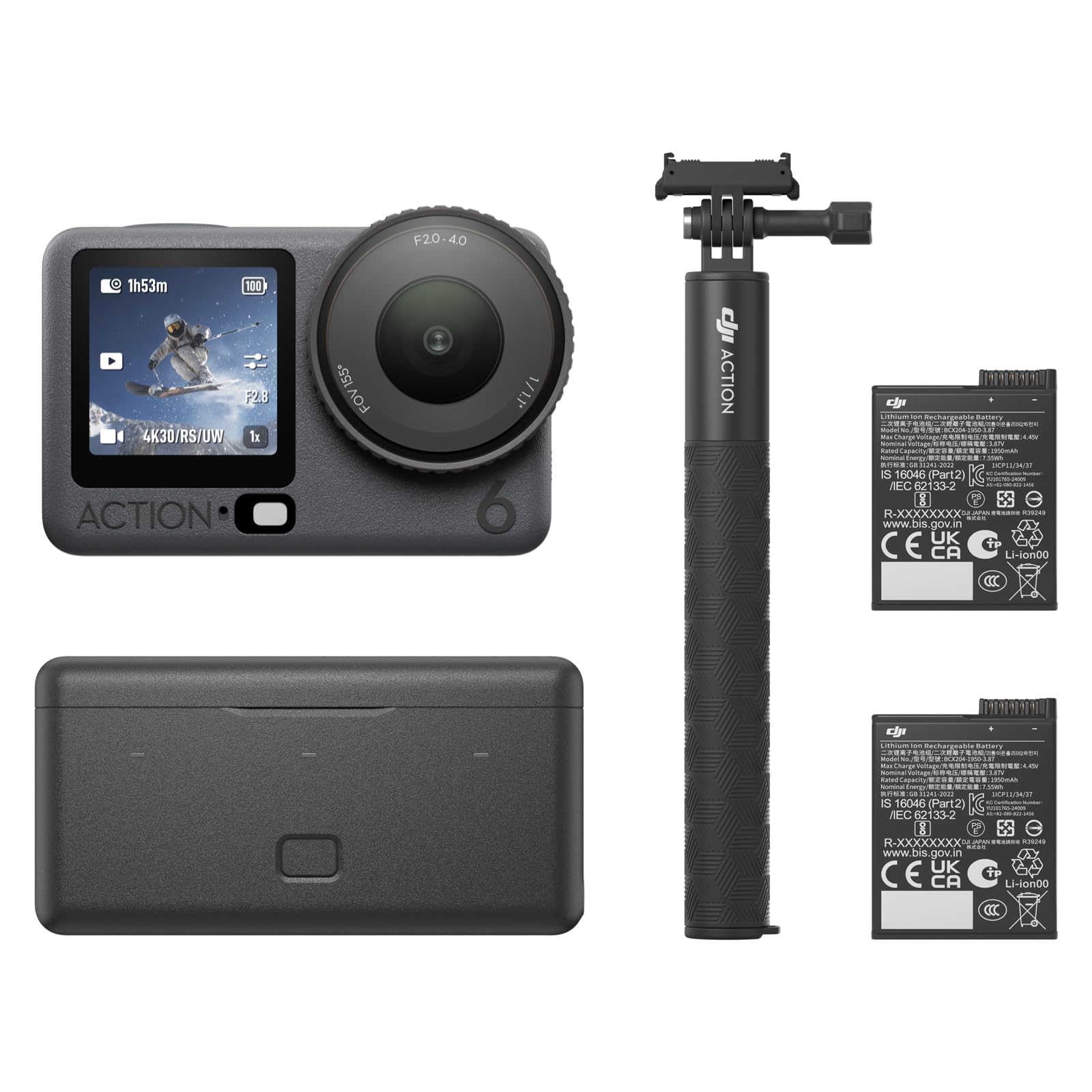
DJI Osmo Action 6
Key Features
- Video: 8K
- Weight: 5.26 oz
- Aperture: f/2.0–f/4.0 variable
- Batteries: 2 × 1950 mAh plus charging case
- Price: Premium
A water day is long: a morning snorkel, an afternoon in the pool, a sunset boat ride, and no outlet anywhere in between. The Enhanced Combo is aimed squarely at that, with two 1950 mAh Extreme batteries and a three-slot charging case in the box, plus a body DJI rates for up to four hours in normal conditions and keeps running when the temperature drops.
The variable aperture is the part we find genuinely clever. f/2.0 to f/4.0 means the lens stops down in blinding surface glare instead of leaning on a fast shutter, then opens up when you drop into shade beneath a ledge. Paired with the 1/1.1-inch square sensor — the biggest chip in this group — it is the most flexible exposure setup here for a day that keeps moving between sun and shadow.
Stabilization is DJI’s strong suit and HorizonSteady holds the horizon through a roll, while the 149 g body disappears into a pocket between swims. The gesture and voice controls are conveniences for a mounted camera rather than a masked face in the water. It also costs a clear step more than the HERO12, and the batteries and charging case are most of what that buys.
Pros
- Two batteries and a charging case included
- Variable f/2.0–f/4.0 aperture
- 1/1.1-inch sensor, the largest here
- HorizonSteady keeps the horizon level
Cons
- Costs a clear step more than the HERO12
- Body depth rating is not published
For a multi-day trip where charging is the bottleneck, this is the kit we pack: two batteries and a case matter more than the 8K badge.
Best for First Action Cam
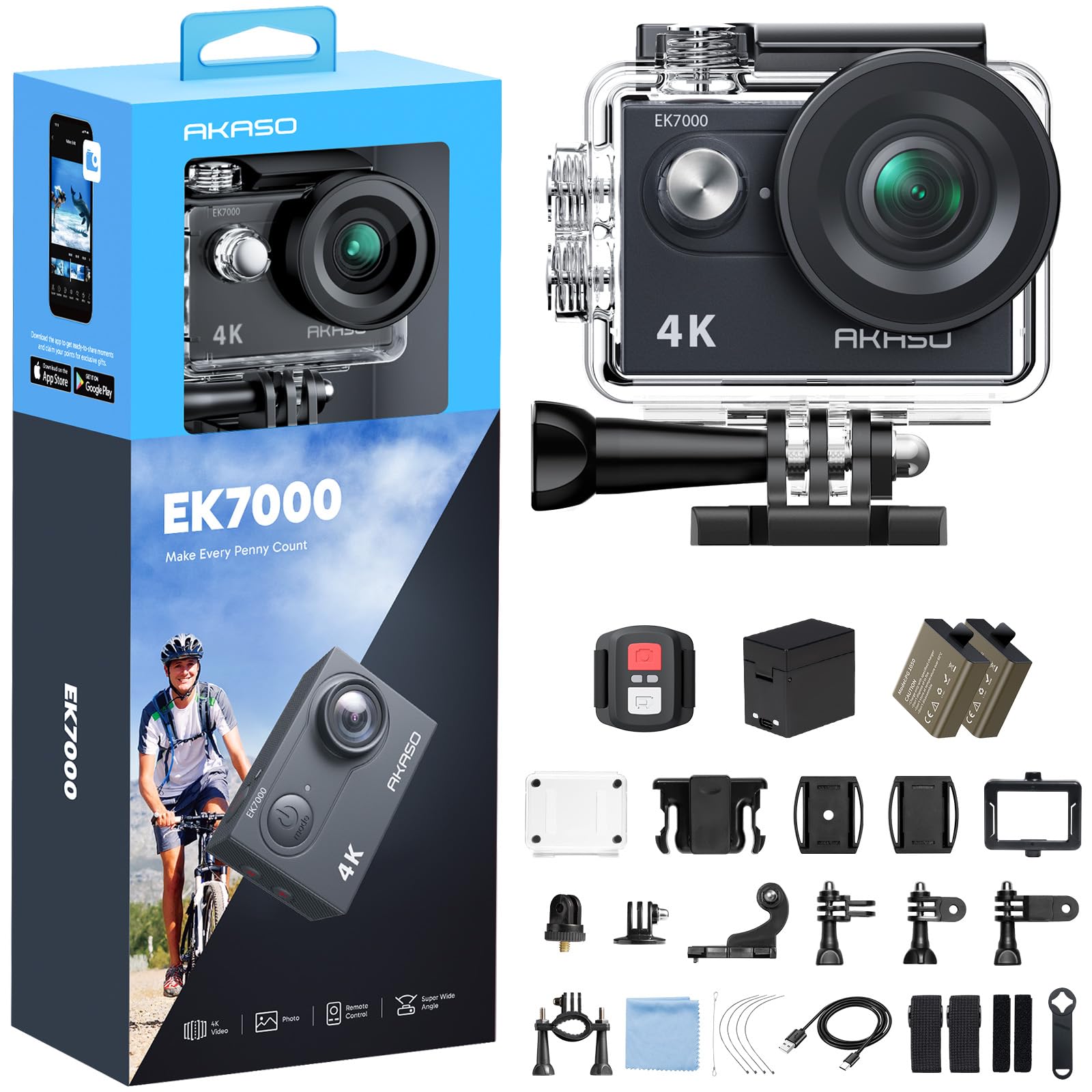
AKASO EK7000
Key Features
- Photo: 20MP
- Video: 4K30
- Batteries: 2 included
- Waterproof depth: 131 ft (40 m) in case
- Price: Budget
This is the camera that made underwater video cheap, and it still does the job: 4K at 30fps, 20MP stills, a wrist remote, two batteries, and a hard case rated to 131 feet. It is the least expensive camera here that we trust in the ocean.
Understanding the case is understanding the camera. The body is not waterproof on its own; the 131-foot rating belongs to the housing, which means a grain of sand in the seal is the difference between footage and a ruined trip. The upside is that the case takes the abuse — scrape it on a rock and you replace a case, not a camera.
What you give up sits at the edges. There is no memory card in the box, the 4X zoom is digital and goes soft almost immediately, and the electronic stabilization crops the frame without rescuing a genuinely shaky hand. Shoot 1080p at 60fps when you want smooth motion and 4K when you want detail.
Two batteries at 90 minutes each by the spec sheet is the right shape for a boat day, so charge both the night before. And the bag of mounts in the box is the quiet win: enough to strap it to a helmet or a paddle without buying anything else.
Pros
- Case rated to 131 ft
- Wrist remote and Wi-Fi included
- Two batteries in the box
- Least expensive credible camera here
Cons
- No memory card included
- Digital zoom only
If you want to try underwater video without spending real money, start here: it is the cheapest credible camera in this group.
Best for Snorkeling Kit
AKASO EK7000 Pro
Key Features
- Screen: 2-inch touch
- Batteries: 2 × 1350 mAh, up to 140 min each
- In the box: Floating hand grip and carry case
- Waterproof depth: 131 ft (40 m) in case
- Price: Midrange
The floating hand grip in the box is the reason this version exists. Drop a bare action camera in twenty feet of water over a reef and it is gone for good; the grip floats, so the camera bobs back to the surface while you get your breath. For anyone whose main use is snorkeling, that is the accessory you would otherwise be buying on day two of the trip.
The rest of the step up is real rather than decorative: a 2-inch touch screen, a carrying case, a dual charger, and two 1350 mAh batteries rated at up to 140 minutes each, well beyond what the base EK7000’s cells claim. We think this is the better of the two AKASOs for water use, even though the camera inside is the same family.
It is still a case-based camera: 131 feet with the housing sealed, 4K at 30fps, electronic stabilization. Set your mode before you button it into the case, because the touch screen is a land convenience — once it is sealed you are working the physical buttons, and gloves make that slower than you expect.
Two things worth doing before you pack it: charge both batteries and run a short test recording, because a cell that will not take a charge is the failure to catch early, and check the case seal for grit under a bright light.
Pros
- Floating hand grip included
- Two 1350 mAh batteries and a dual charger
- 131 ft waterproof case
- Touch screen and carry case
Cons
- 4K tops out at 30fps
We point snorkelers to this kit over the base camera: the floating grip and the bigger batteries are worth the step up.
Best for Budget Zoom Compact
Kodak PIXPRO WPZ2

Key Features
- Zoom: 4x optical (27–108mm)
- Weight: 6.21 oz
- Resolution: 16MP
- Waterproof depth: 49 ft (15 m) for 1 hour
- Price: Midrange
A 4x optical zoom on a waterproof body changes what you can shoot. At 27mm you get the whole reef; at 108mm you can pull a turtle out of the blue without swimming closer, and neither action camera here can do that with a fixed ultra-wide lens.
The rating is 49 feet for up to an hour, which is unusually specific and worth taking literally: this is a snorkel-and-pool camera, not something to take on a dive. The seal is a rubber gasket behind a battery door, and it is the whole ballgame — check it for grit, close it dry, and never open the camera on a wet boat.
The rest is honest budget-camera territory. There is a 6fps burst, a real flash, and 1080p video, with no 4K, which is the clearest place the price shows. The 2.7-inch screen is 230,000 dots, so in bright sun you will be framing by feel and hoping.
Wi-Fi gets photos to your phone without a card reader, which matters more on a boat than any spec sheet suggests. Six ounces in a shirt pocket, and it is the one here that handles like a normal point-and-shoot, which is exactly why it is the easiest of the group to hand to someone who does not want a lecture.
Pros
- 4x optical zoom, 27–108mm equivalent
- Waterproof to 49 ft for one hour
- Shockproof and dustproof body
- Wi-Fi transfer to a phone
Cons
- 230,000-dot screen washes out in sun
- 1080p video only
For a budget compact with a real zoom, this is the one we hand to a casual snorkeler, provided they respect the gasket.
Best for Pool Selfies
YISENCE 4K Underwater Camera

Key Features
- Video: 4K
- Screens: Dual, front and rear
- Included card: 32GB
- Waterproof depth: 16 ft, IP68
A screen on the front plus a body that floats is a combination aimed at one person: whoever ends up taking the selfie. Long-press the mode button and the front camera takes over, so you can see the framing while you tread water — a small thing until you have taken forty pictures of your own chin.
Sixteen feet is the number that defines it. That is IP68 and fine for the pool, the shallows, and snorkeling over sand, and nowhere near a reef wall or a dive. If your water is a hotel pool and a calm bay, it is enough; if you are booking a dive boat, it is not.
It shoots 4K and 64MP stills, charges over USB-C, and arrives with a 32GB card in the box, which is one less thing to remember on the morning of a boat trip. The battery is rated at 70 minutes of recording, so a second one is worth having if you plan to leave it running.
What we noticed is how much the float changes the experience: the camera can be handed to someone else in the water without a lecture about holding on. That is not a specification, and it is the reason this one ends up in the bag.
Pros
- Front and rear screens for selfies
- Floats, with a floating strap included
- 32GB card in the box
- Autofocus lens
Cons
- 16 ft rating limits it to the shallows
- 70-minute battery rating
It is the family-pool pick: dual screens for selfies, a body that floats, and a 16 ft rating that suits the shallows.
Best for Shallow Water
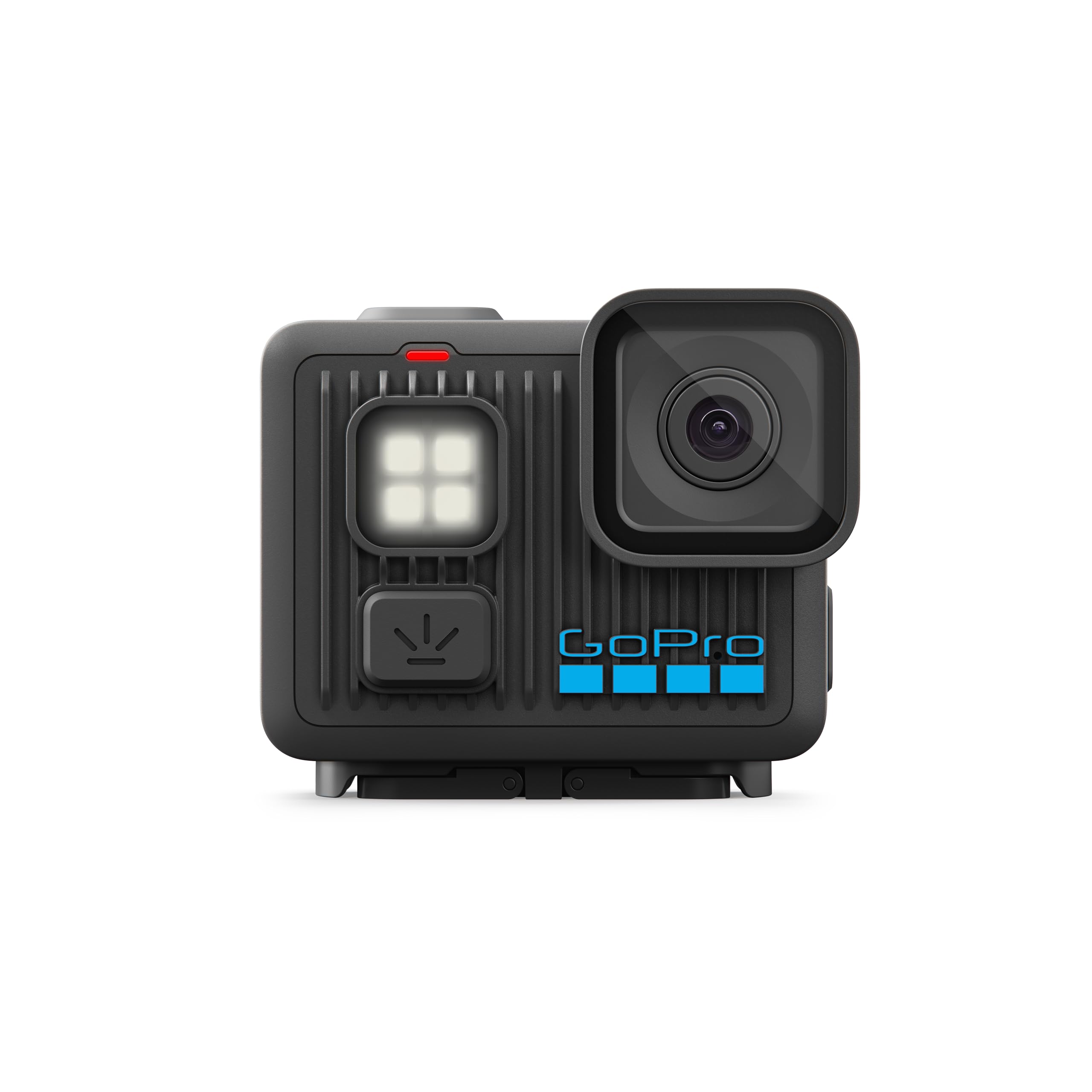
GoPro LIT HERO
Key Features
- Light: Built-in, 3 brightness settings
- Video: 4K60
- Weight: 3.28 oz
- Waterproof depth: 16 ft (5 m)
- Price: Midrange
Color is the first thing water takes away. The LIT HERO’s answer is a built-in light with three brightness settings and a diffuser, sitting right on the body — the thing that normally needs a tray, an arm, and a housing is already attached.
The catch is depth: 16 feet, half of what the HERO12 handles. For pool days, calm bays, and shallow reef that is plenty; if you are eyeing a dive course, this is not the camera for it.
Everything else is entry-level GoPro done properly: simplified tap-and-swipe controls, 4K at 60fps, HyperSmooth stabilization, and a 93-gram body that vanishes in a pocket. It is the first action camera we hand to a family that mostly shoots bright, shallow water, and the light earns its keep in crevices, under ledges, and after the sun drops.
Stills are 12MP, the lowest count here, so treat it as a video camera that also takes photos. The mount is the standard GoPro fitting, which is the quiet advantage of staying in this family: every pole, clamp, and adhesive mount you already own will fit.
Pros
- Built-in light with three brightness settings
- 4K60 with HyperSmooth stabilization
- 93 g and pocket-sized
- Standard GoPro mount fitting
Cons
- 16 ft depth rating rules out diving
- 12MP stills are the lowest here
Pick the LIT HERO when your water is shallow and dim: the built-in light is the reason, and no other camera here carries one.
How We Tested These Underwater Cameras
We started with spec sheets rather than reviews. The first filter was whether a depth rating applied to the bare camera or only with a housing, since a lot of listings bury that distinction. From there we kept anything with stabilization at 4K or above, a screen you can operate with wet hands, app or Wi-Fi transfer, and a mount that takes standard accessories. That left 12 cameras, budget models included.
Testing happened where these cameras actually go: lap swims and pool afternoons, a lake weekend, and a week of snorkeling in six to ten feet of water. Each camera recorded continuously at its highest resolution until the battery died, then again with Wi-Fi left on, because that’s how people really shoot. We watched the clips on a laptop instead of the camera’s own screen, noting whether stabilization held during handheld fin kicks, how much color survived at depth, and whether the footage was usable or just mush.
For the water part we did what a nervous owner would do: soaked each camera in a bucket of salt water overnight, then opened the door and checked the gasket and battery bay for moisture. We also handled them with sunscreen-and-sand fingers and knocked them off a dock onto concrete. The failures, when they came, were almost always at the door latch rather than the lens.
Ease of use got its own pass — we handed each camera to someone who’d never touched it and timed how long it took to get one good clip, then sent that clip to a phone and counted the attempts. We unpacked the accessory bundles with a skeptical eye: a floating grip or spare battery that actually gets used counts for something, a bag of adapters you’ll never mount does not. Value came down to whether the camera was still the one we reached for in month eight.
How to Choose an Underwater Camera
The depth rating on the box is a pressure limit for still water, not a promise about what happens when you jump in with it, so match that number to the water you actually swim in before you compare anything else.
Read the depth rating, then ask what it covers
Figures in this group run from 16 feet to 131 feet, and the range matters less than where the number lives. A sealed body like the TG-7 or the HERO12 needs no housing, so there is nothing to forget and nothing to flood. A case-based camera like either AKASO puts the rating on the housing, which also means the housing takes the scratches and a replacement is far cheaper than a repair.
Buy margin. Choose a camera rated comfortably deeper than the deepest point you plan to reach, and treat every rating as a static-pressure limit rather than permission to leap off a rock with it. Two of the premium action cams here do not publish a body depth at all, so get that figure before you plan a dive around one.
Decide between a compact and an action camera
The split is about what you want to bring home. Compacts have zooms, flashes, and macro — the TG-7 focuses to a centimeter and the Kodak reaches 108mm — which makes them stills cameras that happen to be waterproof. Action cameras are fixed ultra-wide, stabilized, and mountable, which makes them video cameras you can wear.
If your album matters more than your footage, start with a compact. If the swim itself is the point, an action camera is the honest choice, and the mount is what buys you hands-free shooting.
The seal is the whole ballgame
Almost every failure story in this category starts at a gasket. Sand, sunscreen, and a fleck of dried salt hold a door open by a hair, and a hair is enough. Check the seal under good light before every swim, close it dry, and never open the camera on a wet boat or a sandy towel.
Rinse the closed camera in fresh water after salt or chlorine and dry it before opening. Moving from cold water into warm, humid air is when fog forms inside the lens, which is exactly what the TG-7’s anti-fog setting is there for. A case-based camera shifts all of this onto a part you can replace.
Pack for power and storage
Battery claims are best-case, and cold water is not best case. Two modest cells beat one large one on a boat, which is the argument for the kits that ship a pair with a dual charger rather than a single heroic battery.
Cards are the other easy miss: several action cams here arrive without one, and 4K video wants Class 10 or better, with U3 or V30 preferred. Check the box contents before you pack, and format the card the night before rather than on the dock.
Frequently Asked Questions
Why do my underwater photos come out blue or green?
Water absorbs red light first, so everything below the surface shifts toward blue-green no matter which camera you carry. Switch on the underwater white-balance or scene mode — the TG-7’s five underwater modes exist for precisely this — get close enough to touch your subject, and shoot upward toward the light instead of straight down at the sand.
Below a few feet, a light does more than any menu setting, which is why the LIT HERO’s built-in lamp is worth having and why the YISENCE’s front screen helps you get the framing right the first time.
How do I keep an underwater camera from sinking?
Tether it to something. The floating hand grip bundled with the AKASO EK7000 Pro and the floating strap that ships with the YISENCE both keep a dropped camera on the surface, and a wrist strap threaded through the mount is the free version of the same idea.
Clip the far end to your suit or a BC ring rather than trusting your grip. The moment you let go is the moment you are busy clearing a mask, and a camera with no tether is a camera you watch disappear.
Can I use one of these for the rest of the trip, not just in the water?
Yes, with one compromise each. A tough compact like the TG-7 is the easiest to carry all day and its macro mode is genuinely useful on land, while the Kodak’s 4x zoom makes it a decent town camera.
An action camera’s fixed ultra-wide lens pushes everything away from you, which is flattering underwater and awkward at a dinner table. If you want a single camera for the whole trip, pick the compact and use the case-based action cam only for the wet half of the day.
Final Verdict
Most people should buy the OM SYSTEM Tough TG-7. It is the only camera here that is waterproof by design rather than by accessory, it goes to 50 feet with nothing to seal, and its 1 cm macro mode is the one thing no action camera in this group can imitate.
If your trips are more footage than photographs, the GoPro HERO12 Black is the better buy: HDR, 5.3K, and the same housing-free waterproofing for less money. And if the budget is going toward the trip itself, the AKASO EK7000 Pro kit with its floating grip covers a snorkeling week without asking you to think about it.