
This post contains affiliate links. We may earn a small commission when you buy through our links — at no extra cost to you.
A waterproof camera lives or dies on a rubber gasket. Every model on the shelf advertises a depth rating, but what separates a good one from a ruined vacation is whether that seal, and the door it lives in, still closes cleanly after a summer of sand, sunscreen, and salt water. What you’re really buying is permission to stop worrying: hand it to a kid at the pool, dunk it off a snorkel boat, keep shooting in the rain.
The category splits roughly in two, between rugged point-and-shoots with a lens that never needs a housing and action cams built around a mount. I’ve carried both kinds through beach trips and the bottom of a kayak for years, and over the past seven months our team put 11 of them through salt water, chlorinated pools, and one parking-lot drop.
First-time buyers overrate resolution and underrate everything around it: how fast the battery drains once the water runs cold, whether the camera overheats and shuts itself off mid-clip, and how the menu behaves with wet fingers. Below are the ones I’d hand to a friend without a caveat.



Best for All-Round Water Use
DJI Osmo Action 4
Key Features
- Video: 4K/120fps
- Sensor: 1/1.3-inch CMOS
- Weight: 5.11 oz
- Battery life: 160 minutes
- Price: Midrange
Underwater footage turns grainy quickly, which is why we start with the sensor. The Osmo Action 4’s 1/1.3-inch chip is the largest of the conventional action cameras here, a clear step up from the 1/1.9-inch sensor in the GoPro HERO12, and the 2.4-micron pixels hold their color as the light falls off at the deep end of a pool. Shoot at 4K/120fps and you can slow a jump down without it falling apart, while 10-bit color and the D-Log M profile keep the highlight detail that surface glare would otherwise burn to white.
It is also the easiest of these to live with. The battery is quoted at 160 minutes, close to double what the budget action cameras manage, and the magnetic quick-release mount lets you move from a chest harness to a selfie stick one-handed, using the hand you are not holding a mask with. Two full-color touchscreens mean you can frame from the front when the camera is pointed at you, and the body still fits a jacket pocket.
Water is where it earns the top spot. There is no housing to seal, rinse, or flood, because the camera body is the waterproof part, so you can go from a swim to a still shot without opening anything. One caveat we think matters: the listed specs call it waterproof without quoting a depth, while the TG-7 and the Kodak publish 15 meters and the AKASO’s case is rated to 131 feet. For snorkeling, pools, kayaks, and rain that is plenty. If the trip includes a dive tank, buy a number you can check.
The reservation is software. Registration and pairing run through a phone app, and it is the fussiest part of ownership; shoot, pull the card, and edit on a laptop, and you barely touch it. Long 4K takes in direct sun can also push the body into a heat shutdown, so break recordings into shorter clips when the camera is sitting in the open.
Pros
- Biggest sensor of the standard action cams here
- 160-minute battery, roughly double the budget cams
- No housing to seal or flood
- Magnetic mount swaps one-handed
Cons
- App pairing and registration are a chore
Our pick for most people: the best underwater video and stills here for snorkeling, pools, and wet weather, with the sensor, battery, and mount to back it up.
Best for High-Res Action Video
GoPro HERO12 Black
Key Features
- Video: 5.3K/60fps
- Stabilization: HyperSmooth 6.0
- Photo resolution: 27 MP
- Waterproof depth: 33 ft (10 m)
- Price: Midrange
Two numbers separate the HERO12 from our top pick: 5.3K and 33 feet. The first is resolution, and it is higher than any other conventional action camera here. The second is the depth the camera handles on its own, with no case to add, which covers snorkeling, duck-diving, and a shallow reef.
If you shoot to edit rather than to post straight from the card, that resolution earns its keep. HDR is available for video and photos, so a frame shot against bright surface glare keeps detail in the shadows underneath it, and the 27MP stills leave room to crop. HyperSmooth 6.0 is the stabilization we trust most on a bike, a ski pole, or a mask strap, and the horizon lock holds the waterline level while you bob.
GoPro’s mount pattern is the quiet argument for it. The folding fingers are built into the body, so the camera sits flat on a table and clips into a helmet mount without a frame around it, and there is a bracket for a rail, a paddleboard, or a handlebar. The Enduro battery is in the box, but budget for a second one: quoted runtime drops sharply as you climb the resolution ladder, and 5.3K is thirsty.
Where it loses to the DJI is in the dark and in simplicity. The smaller sensor and a tight heat budget mean dim water is not its strength, and long 5.3K takes in sun or still air can shut it down, so plan shorter clips and shade between them. If your trips are bright water and fast movement, none of that will bother you much. If you want to point and shoot in a dim pool, the Osmo Action 4 is the better buy.
Pros
- 5.3K60, the highest resolution of the standard cams
- Waterproof to 33 ft without a housing
- HDR for both video and photos
- HyperSmooth 6.0 with horizon lock
Cons
- Runs hot on long 5.3K takes
- Runtime drops fast at high resolution
Buy it when the footage matters most: 5.3K and a 33-foot bare-body rating make it the video specialist of this group.
Best for Underwater Stills
OM SYSTEM Tough TG-7
Key Features
- Lens: f/2.0-4.9, 4x optical zoom
- Video: 4K
- Waterproof depth: 15 m (50 ft)
- Shockproof rating: 2.1 m (7 ft)
- Price: Premium
Macro is the reason this camera belongs in a roundup full of action cams. The TG-7 focuses down to a centimeter from the front of the lens, with four macro modes and a dedicated underwater microscope setting, and that is the difference between a photo of a reef and a photo of the nudibranch on it. Nothing else here gets close, and nothing else here lets you choose a composition at all.
The rest of the lens is just as unusual: an f/2.0-4.9 zoom covering 25-100mm equivalent, the only way in this group to frame a subject without swimming toward it, plus RAW capture if you plan to correct the color cast water puts on everything. The compromise is the sensor. Twelve megapixels on a 1/2.3-inch chip has a ceiling, and you meet it in low light and at the long end of the zoom, where files go soft.
The toughness figures are the most complete here: 15 meters of water, a 2.1-meter drop, 100 kilogram-force of crush, operation down to 14 °F, and anti-fog treatment that earns its keep when you step off a cold boat into humid air. This is the camera we reach for when the day includes a rocky descent as well as a swim.
What you pay is patience. The menu is deep, the underwater modes live inside it, and arriving at the water still hunting for the underwater white balance is the usual mistake, so give the manual an evening before the trip. It is also the priciest camera here that is not a 360 rig, which is hard to justify on specifications alone. You are buying the lens and the sealing, and if you will use the macro and the zoom, both are worth it.
Pros
- Focuses to 1 cm for macro
- 4x optical zoom at f/2.0
- 15 m waterproof, 2.1 m shockproof, freezeproof
- RAW files for correcting water color
Cons
- Deep menus take an evening to learn
- 12 MP small sensor limits low light
For photographs rather than wide video, this is the one: a 1 cm macro mode and a 4x zoom no action camera here can match.
Best for 360 Reframing
Insta360 X5
Key Features
- Video: 8K/30fps 360°
- Sensors: Dual 1/1.28-inch
- Battery life: 208 minutes
- Stabilization: FlowState + horizon lock
- Price: Premium
A 360 camera does not ask you to aim. Hold the X5 up, press record, and everything around it is captured; you choose the frame afterwards in the app. That is either the most freeing idea in this roundup or one more editing job, and which one it is depends entirely on how you travel.
The trick we like most is the invisible selfie stick: mount the camera on a stick and the software erases it, leaving a third-person shot of you swimming over a reef with no drone and no second person holding a camera. You supply the stick, though, because this standard bundle does not include one, which is worth knowing before you order. InstaFrame mode gives you a flat, ready-to-post video straight away if reframing on a phone is not how you want to spend an evening.
The hardware is serious. Two 1/1.28-inch sensors shoot 8K30, the triple-chip processing handles a lit pool at night better than small 360 sensors usually manage, and FlowState stabilization with full horizon lock keeps the picture level through a hand-off or a stumble. The quoted battery of 208 minutes is the longest here, though heavy 8K shooting eats into it quickly.
Two things to know before you commit. The body is half a kilogram, which is a lot to hold at the end of a stick through a long snorkel, and every clip needs reframing before it is watchable, so budget the editing time. If you want a camera to clip to a mask and forget about, a conventional action cam is simpler.
Pros
- Shoots 8K30 in every direction
- Invisible selfie stick effect
- 208-minute quoted battery
- Choose any angle after the fact
Cons
- Half a kilogram on the end of a stick
- Every clip needs reframing time
Choose the X5 when you want one camera to catch everything and the freedom to frame it later.
Best for Budget Diving
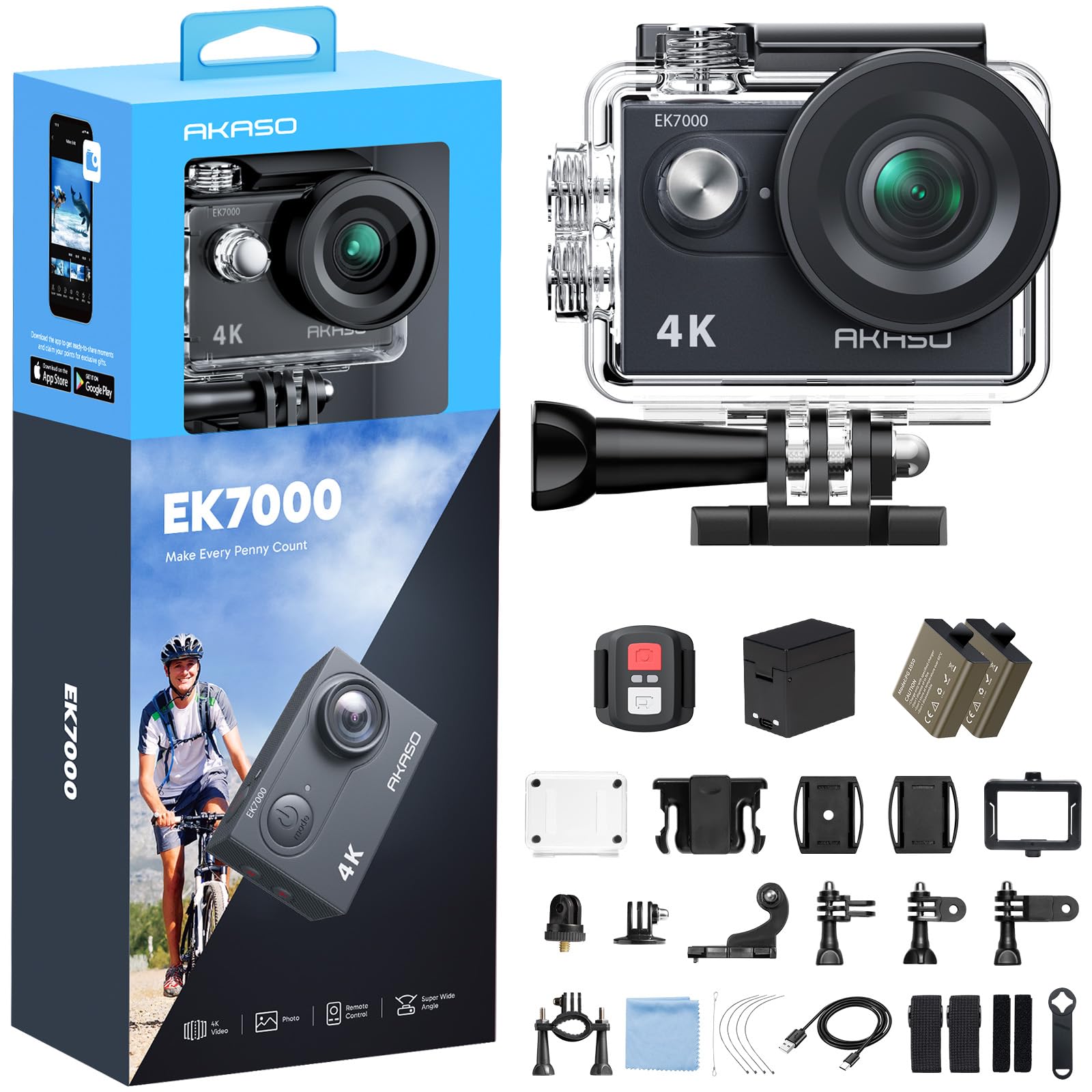
AKASO EK7000
Key Features
- Video: 4K/30fps
- Battery life: 90 minutes
- Photo resolution: 20 MP
- Waterproof depth: 131 ft with case
- Price: Budget
The EK7000 is the cheapest way into genuine underwater footage here, and it goes deeper than anything else on this list. With the included case sealed it is rated to 131 feet, well past the 15 meters the rugged compacts publish and past the 33 feet the GoPro handles bare. If the trip includes an actual dive rather than a snorkel, this is the camera in this roundup that is rated for it.
What the money buys is 4K30 video, 20MP stills, electronic stabilization, a 2.4G wrist remote, two batteries with a dual charger, and a bag of mounts that would cost more than the camera bought separately. The remote gets more use than we expected: strap the camera to a bike or a helmet, start recording from your wrist, and the camera actually comes along instead of staying in the bag. Add a microSD card, since there is none in the box.
The case is the waterproofing, so it does what cases do. It dulls the audio to a muffle and puts a layer of plastic between your fingers and the buttons, and the app is slower and clunkier than the DJI or GoPro equivalents. Neither matters much when the alternative is not getting the shot at 60 feet.
Footage is at its best in good light. The stabilization smooths a bike ride but cannot rescue a dim pool, and there is no HDR to lean on. That is the trade, and it is a fair one at this end of the market: you get depth, mounts, and a spare battery, and you give up the low-light quality and the polish of the cameras above.
Pros
- 131 ft rating with the included case
- Two batteries, charger, and mounts included
- Wrist remote for helmet and bike mounting
Cons
- Waterproof only with the case sealed
- About 90 minutes per battery
The only camera here rated for a real dive: the case goes to 131 feet and the kit covers everything else.
Best for Daylight Snapshots
Kodak PIXPRO WPZ2
Key Features
- Zoom: 4x optical
- Video: 1080p
- Sensor: 16 MP BSI CMOS
- Waterproof depth: 15 m (49 ft)
- Price: Midrange
Every swim with the WPZ2 starts the same way: open the door, look at the rubber gasket for grit or a hair, close it, and push the catch until it locks. Skip that and the rest of this review stops applying, because on a camera like this the seal is the waterproofing.
What you get for the trouble is the cheapest route to an optical zoom underwater. The 27-108mm equivalent lens is one of only two zooms here, and it lets you photograph a child at the far end of the pool without swimming over. The 16MP BSI CMOS sensor and 1080p video are modest but competent in daylight, Wi-Fi gets files to a phone without a card reader, and the body is shockproof to 2 meters as well as sealed to 15. Charge it for four hours before the first use, as the instructions insist, and expect condensation if you carry it from air conditioning into tropical air.
Two things stand out in real use. The 2.7-inch screen washes out in bright sun, so you frame roughly and check the shots later, and there is no 4K, only 1080p, when you want to crop a clip. Neither is unusual at this end of the market, and neither will bother someone who mainly wants holiday stills.
The bigger question is longevity. Water getting past the seal has happened on some of these, and the camera is not built to the standard of the rugged models above, so treat it as a cheap, cheerful holiday camera rather than the last one you buy. For a first underwater camera, a snorkel trip, or a careful kid, that is a reasonable trade to make.
Pros
- 4x optical zoom in a cheap body
- 16 MP sensor and 1080p video
- Shockproof to 2 m as well as waterproof
- Wi-Fi transfer to a phone
Cons
- 1080p only, no 4K
- Screen is hard to read in sunlight
A good first underwater camera with a real zoom lens: buy it for daylight stills, and check the gasket before every swim.
Best for Premium 360
Insta360 X6
Key Features
- Video: 8K/50fps 360°
- Stills: 120 MP
- Sensors: Dual 1/1.1-inch
- Battery life: 140 minutes (8K)
- Price: Premium
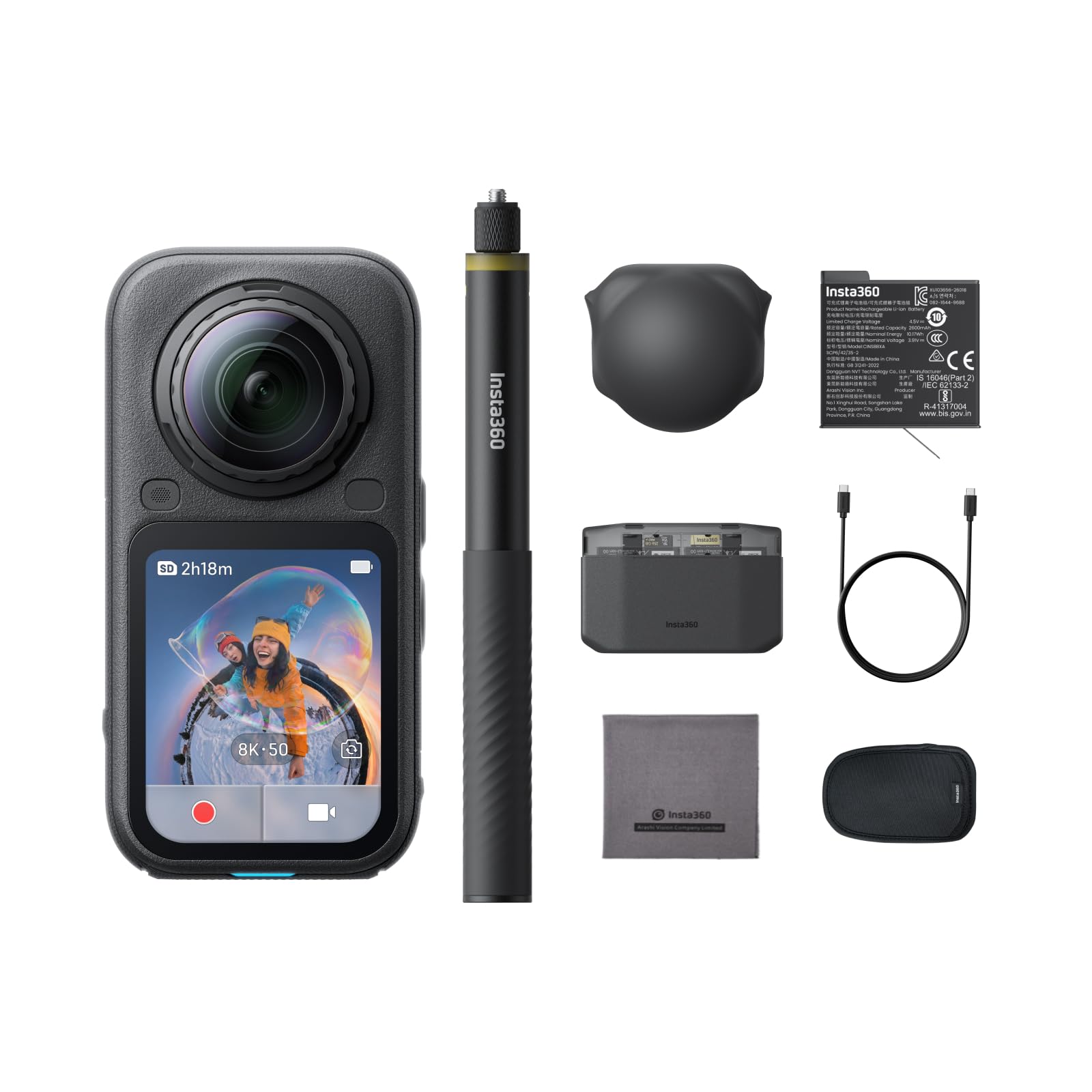
The Essentials bundle is the reason to look here instead of at the X5. A 114 cm invisible selfie stick, a second battery, and a fast-charge case come in the box, which is exactly the kit you otherwise assemble one purchase at a time, and the stick is the piece that makes the whole 360 effect work.
The camera itself moves the numbers on. Dual 1/1.1-inch sensors, 8K at 50fps, 10-bit color, and a tracking mode that follows a person or a pet with one tap, all in a body that is smaller and lighter than the X5 at 278 grams. That weight matters at the end of a long stick, and the AI editing pass does a decent job of turning a long take into something postable while the camera charges.
Whether it is worth the extra over the X5 is a real question. The X5 quotes 208 minutes of battery; this one quotes 140 minutes for 8K, and the files are bigger, so you will be carrying cards and the charger as well. For most people the X5 is already more camera than they will use.
It earns its place for the shooter who knows they will use the stick, wants the best low light Insta360 puts in a pocketable body, and would rather find the second battery in the box than order it later. That is a narrower buyer than the X5’s, and it is the one this bundle is priced for.
Pros
- Selfie stick and spare battery included
- Dual 1/1.1-inch sensors at 8K50
- Lighter than the X5 at 278 g
Cons
- Costs noticeably more than the X5
- Shorter quoted 8K runtime than the X5
The premium 360 pick: better sensors, a lighter body, and the selfie stick in the box, for shooters who already know they will use 360.
Best for Kids and Pools
YISENCE 4K Underwater Camera

Key Features
- Video: 4K
- Battery life: 70 minutes
- Photo resolution: 64 MP
- Waterproof depth: 16 ft (IP68)
- Price: Budget
It floats. That is the feature that matters here: drop it in the pool and it comes back up instead of heading for the drain, which is more than most cameras on this list can claim. For a child’s first underwater camera, or for an adult who would rather not lose a camera on day one of a holiday, it is worth a great deal.
The rest is a bundle that makes sense for the money: a 32GB card in the box, a front screen as well as a rear one so you can see yourself for selfies, a 1250mAh battery quoted at 70 minutes, and USB-C charging rather than a proprietary cable. It is small enough to live in a swim bag and light enough for a child to hold steady.
Take the headline numbers with some salt. The 64 megapixels come off a 1/3.2-inch sensor, so the files will not carry the detail of a 12 MP TG-7 shot, and 4K here is budget 4K. The 16-foot rating is a pool and surface rating, not a diving one, and there is no Wi-Fi at all, so you transfer by pulling the card and using a reader.
None of that ruins it as what it is: a cheap, floating, easy camera for pool afternoons, a first snorkel, and handing to a kid without flinching. If you want photographs you will print, spend more, and if you want to dive, look at the AKASO instead.
Pros
- Floats if you drop it
- 32GB card and dual screens included
- Small enough for a child to hold
Cons
- 16 ft limit rules out diving
- Small sensor limits fine detail
A floating pool camera for kids and casual snorkeling: buy it for family days, not for files you plan to print.
How We Tested These Waterproof Cameras
We started with every camera we could find that carries an actual depth rating rather than a splash-resistant claim, then narrowed by sensor size, video resolution, mounting standard, and what ships in the box. That left 11 cameras, from pocketable rugged point-and-shoots to action cams that live on a mount. Testing ran seven months, and most of it happened where these cameras actually get used: pool decks, a kayak, a rain-soaked trail, and a hotel sink at night.
Water resistance got the most attention. Each camera went into a chlorinated pool and a bucket of salt water for half an hour, then we rinsed, dried, and reopened the battery door with wet, sandy hands to see whether the gasket still seated flat. Several took a waist-high fall onto concrete, a few spent the night in a freezer, and we kept a log of anything that fogged, stuck, or needed a second try to close.
For battery and heat, we recorded at each camera’s top resolution until it died and wrote down the minutes, then ran 20-minute continuous clips and pressed a palm to the body to feel how warm it got. Footage was judged on a television rather than the rear screen, with stabilization checked on gravel and stills compared at full crop in low light. We also counted the mounts and cases in each box, timed how long it took to reach a recording state from a cold start, and worked the menus one-handed with wet fingers. Value came last: what you actually get for the money once the accessories are factored in.
How to Choose a Waterproof Camera
The depth rating on the box matters less than where you will actually take the camera, and the lens matters more than the megapixels.
Match the Depth Rating to Your Deepest Day
Ratings in this group run from 16 feet to 131 feet, and every one of them is a pressure rating measured in still water. Jumping off a boat adds a spike the number does not describe, so buy for the deepest water on your calendar and leave margin. Sixteen feet covers pools and surface swimming, 33 feet covers duck-diving and a shallow reef, and 50 feet covers a casual dive.
Past that you are in case territory. One thing to check while you shop: whether the number belongs to the camera or to a housing you have to remember to close. The action cameras here are the ones you can hand to a kid at the pool; the case-based AKASO is the one for a dive boat.
Housing-Free or a Case
Two designs, two ownership experiences. A housing-free camera is its own waterproof body: nothing to assemble before you get in, nothing to flood, and the lens and buttons stay uncovered. A case lets an inexpensive camera reach serious depth, but you shoot through plastic, the microphone is muffled, and the seal becomes a second thing that can fail.
Either way the routine is the same. Inspect the gasket dry, look for sand and hair, close and lock the door before you leave the room, and rinse in fresh water after salt. Never open a camera that is wet or has just come out of the water; skipping that rule is how waterproof cameras drown.
Fixed Wide Lens or a Zoom
An action camera has a wide, fixed lens: excellent for grabbing a whole scene and for video you will stabilize later, poor at reaching anything. A zoom compact frames a subject across the pool and gets close enough for a 1 cm macro of a reef creature, which is exactly why the TG-7 and the Kodak earn places here.
The trade is speed and video. Compacts shoot lower frame rates, buffer less, and top out at 1080p or 4K rather than 5.3K. The trap is buying megapixels instead of glass: 64 megapixels on a 1/3.2-inch sensor will not out-detail 12 on a larger one, so judge the lens and the sensor, not the number on the front.
Battery Life and Handling With Wet Hands
Quoted runtime in this group runs from 70 minutes to 208, and every figure shrinks when you shoot 4K or 8K, or work in the cold. A spare battery is not optional on a boat: swap it dry, away from spray, and carry it somewhere warm rather than in a wet bag.
The other thing to picture is your hands. Wet fingers on a touchscreen are a bad combination, which is why the action cameras lean on physical buttons and wrist remotes, and why a case adds a layer between you and the controls. If you will shoot in gloves, press the buttons on a display model before you buy.
Frequently Asked Questions
Is a waterproof camera better than a phone in a waterproof pouch?
Below the surface, yes. A pouch keeps splashes off a phone, but you are still poking at a touchscreen through plastic, and phones are rated for accidental immersion rather than swimming at depth or pressure. A dedicated camera also keeps your phone dry and charged for the part of the trip where it is the better camera.
If you only shoot at the surface, from a boat or the pool edge, a pouch is cheap and fine. As soon as you want a photo with your head underwater, buy something with a depth rating.
What memory card does a waterproof camera need?
A microSD rated Class 10 or U3, and for 4K or 8K a V30 card or faster so recordings do not stall partway through a dive. The Kodak accepts cards up to 1.5TB, but a 64GB or 128GB card is more practical than a huge one you will lose.
Check the box before you travel. The AKASO EK7000 ships without a card, the YISENCE includes a 32GB one that fills quickly at 4K, and a spare card costs less than the footage you would lose.
Does the warranty cover a flooded camera?
Rarely, and water ingress is the first thing a manufacturer will look for. Buy from a dealer you can return to, and check whether the warranty is tied to authorized sellers: the TG-7’s warranty is only honored on units bought from a U.S. authorized dealer, which is worth confirming before you order.
Do a five-minute soak in a sink of fresh water before your trip. A leak that shows up at home is an exchange; the same leak on day two of a holiday is just a dead camera.
Does cold weather affect a waterproof camera?
Yes, even on cameras rated to work below freezing, like the TG-7 at 14 °F and the DJI Osmo Action 4 at minus 4 °F. Battery capacity drops with temperature, so keep the spare in an inside pocket and swap it only when the camera is dry.
Watch the transition too. A cold camera going into warm, humid air fogs its lens, and the TG-7’s anti-fog treatment is the only one here that addresses it directly. Give any camera a few minutes to equalize inside its bag.
Final Verdict
The DJI Osmo Action 4 is the camera we point most people toward. It handles water without a case, its sensor and stabilization are the best combination here for both stills and video, and the battery lasts long enough to leave the charger at home.
Buy the TG-7 instead if you want photographs: the 1 cm macro and the 4x zoom are worth the premium. And if the trip includes a dive below 50 feet, the AKASO’s 131-foot case is the only one here rated for it.