
This post contains affiliate links. We may earn a small commission when you buy through our links — at no extra cost to you.
Higher magnification numbers on binoculars often seem better, but for most outdoor use – birding, hiking, sports – a steady 8x or 10x actually delivers clearer, brighter images. The real difference lies in lens quality, eye relief, and how the binoculars handle in low light.
That’s why the sweet spot for general-purpose binoculars sits between $150 and $250, where you get fully multi-coated optics, reliable waterproofing, and a solid warranty. Paying less often means compromises in durability or image sharpness; paying more doesn’t guarantee a better experience for your specific activity.
This guide focuses on matching the right specs to your needs – whether you wear glasses, hunt at dawn, or want a compact pair for travel. We’ve sorted through dozens of options to highlight the models that balance performance and value without the marketing fluff.


Best for Birding & Hunting
Vortex Diamondback HD 8×42
Key Features
- Mag & Objective: 8×42
- Optics: HD, Roof prism
- Eye Relief: 17mm
- Waterproof: Yes
- Price: Premium
The Diamondback HD’s optical system delivers sharp, color-accurate images across the entire field of view – a notable step above typical binoculars in this price range. The HD glass and dielectric prism coatings produce contrast-rich views that reveal fine feather details and subtle color differences in foliage.
Build quality matches the optics: the magnesium-alloy chassis feels dense and balanced, and the rubber armor provides a non-slip grip even in wet conditions. At 1.45 pounds, it’s light enough for all-day hikes yet sturdy enough to withstand the occasional bump against a tree or rock.
Low-light performance is a standout: the 42mm objective gathers ample light during dawn and dusk, making it possible to identify birds in deep forest shade or track game in low twilight. The 17mm eye relief accommodates eyeglass wearers without losing the full field of view.
This binocular targets serious birdwatchers, hunters, and outdoor enthusiasts who intend to use it regularly for years. The $239 price is a meaningful investment – it’s not aimed at casual users or those who need an ultralight travel companion. The included GlassPak harness works well for many body types but may require a strap swap for broader shoulders or taller frames.
Pros
- Exceptional optical clarity with edge-to-edge sharpness
- Solid build quality with comfortable non-slip grip
- Bright image in low-light conditions at dawn and dusk
- Lightweight for a 42mm class, easy to carry on hikes
- Lifetime warranty adds long-term value with no questions asked
Cons
- At a premium price, this is a serious investment best suited for dedicated enthusiasts
- Included GlassPak harness may not fit all body types comfortably
The Diamondback HD 8×42 is the binocular to buy when optical fidelity and durability matter more than saving a few dollars – it earns its premium through performance.
Best for Budget Birding/hunting
Vortex Crossfire HD 10×42
Key Features
- Mag & Objective: 10×42
- Optics: HD, Roof prism
- Eye Relief: 15mm
- Waterproof: Yes
- Weight: 1.4 lbs
- Price: Mid-Range
The Crossfire HD delivers a crisp, color-accurate image with its HD optical system at a price that undercuts many competitors. The included GlassPak harness and lifetime warranty add further value, making this a budget-conscious alternative to the Diamondback HD without sacrificing the core optical performance needed for birding and hunting.
This 10×42 is best suited for hunters and birders who want reliable glass without stretching their budget. The 15mm eye relief may feel tight for eyeglass wearers, so dedicated glasses users should try before buying or consider the Nikon PROSTAFF P3. At 1.4 lbs, the weight is balanced in hand but can be felt during all-day carries — the included harness helps distribute the load.
Pros
- Crystal clear HD optics for the price — sharp, bright, and color accurate
- Great value with included GlassPak harness and lifetime warranty
- Solid build with a comfortable, rugged grip
Cons
- At 1.4 lbs, the weight becomes noticeable during long hikes without a harness — less of an issue if you use the included GlassPak
If you need 10x magnification and HD clarity on a budget, the Crossfire HD is the logical choice — just be mindful of the weight and eye relief if those are priorities for you.
Best for Glasses Wearers
Nikon PROSTAFF P3 8×42
Key Features
- Mag & Objective: 8×42
- Optics: Roof, multi-coated
- Eye Relief: 20.2mm
- Waterproof: Yes
- Price: Mid-Range
With 20.2mm of eye relief, the Nikon PROSTAFF P3 provides a full field of view even for glasses users—something few binoculars at this price achieve. The image is sharp and color-accurate, typical of Nikon’s optical heritage, and at 1.1 pounds it’s light enough for all-day hikes.
This binocular is built for birders and outdoor enthusiasts who wear glasses and need a reliable, waterproof optic. The tradeoff is the neck strap attachment: the slot design can allow the strap to slip off, so a third-party harness is a practical addition. The plastic housing keeps weight down but lacks the tactile refinement of metal-bodied competitors like the Vortex Diamondback HD.
Compared to the Diamondback HD, the PROSTAFF P3 trades a magnesium chassis and ED glass for longer eye relief and a slightly lower weight. For glasses wearers, that tradeoff favors the Nikon—especially when birding or hiking for hours.
Pros
- 20.2mm eye relief – longest in class – keeps the full view visible with glasses.
- Crisp, vibrant image with accurate color reproduction.
- Lightweight at 1.1 pounds, easy to pack on hikes.
- Smooth, accurate focus wheel for quick adjustments.
Cons
- Neck strap attachment slot can allow the strap to detach during use.
- Plastic construction lacks the premium feel of metal-bodied binoculars.
If you wear glasses, the PROSTAFF P3 is the clear choice in this price range—just swap the neck strap for a harness.
Best for Serious Birders
Athlon Midas UHD 8×42
Key Features
- Mag & Objective: 8×42
- Optics: ED glass, UHD
- Eye Relief: 17.2mm
- Waterproof: Yes
- Weight: 1.56 lbs
- Price: Premium
Extra-low dispersion glass virtually eliminates color fringing, and the focus wheel is silky smooth. The Athlon Midas UHD 8×42 uses ED glass and a magnesium chassis to deliver reference-grade image clarity under $300. In daylight or dusk, the view stays crisp and bright without the chromatic aberration that plagues many binoculars in its price class. The focus mechanism responds with precision, making fine adjustments effortless during birding sessions.
This binocular is built for dedicated birders and nature photographers who demand the sharpest image possible without jumping to $500+ models. The weight (1.56 lbs) is on the higher side for an 8×42, and the cost is a stretch for casual users. If you’re willing to carry a few extra ounces for noticeably better glass, this fits perfectly. It’s less suited for ultralight hiking or budget-first purchases.
In use, the wide 8.1° field of view helps track moving birds, and the 17.2mm eye relief accommodates most eyeglass wearers without blackouts. The waterproof build and rubber armor offer confidence in damp conditions.
Pros
- ED glass eliminates color fringing for crisp, true-color views
- Bright, vivid images even in low-light conditions
- Premium magnesium chassis feels sturdy and durable
- Smooth, precise focus wheel allows quick adjustments
Cons
- Heavier than many 8x42s at 1.56 lbs — noticeable on long hikes
- Premium pricing limits appeal for budget-conscious buyers
For birders who refuse to compromise on optical quality, the Athlon Midas UHD is a standout runner-up — just be prepared to accept its heft and higher price tag.
Best for Budget Beginners
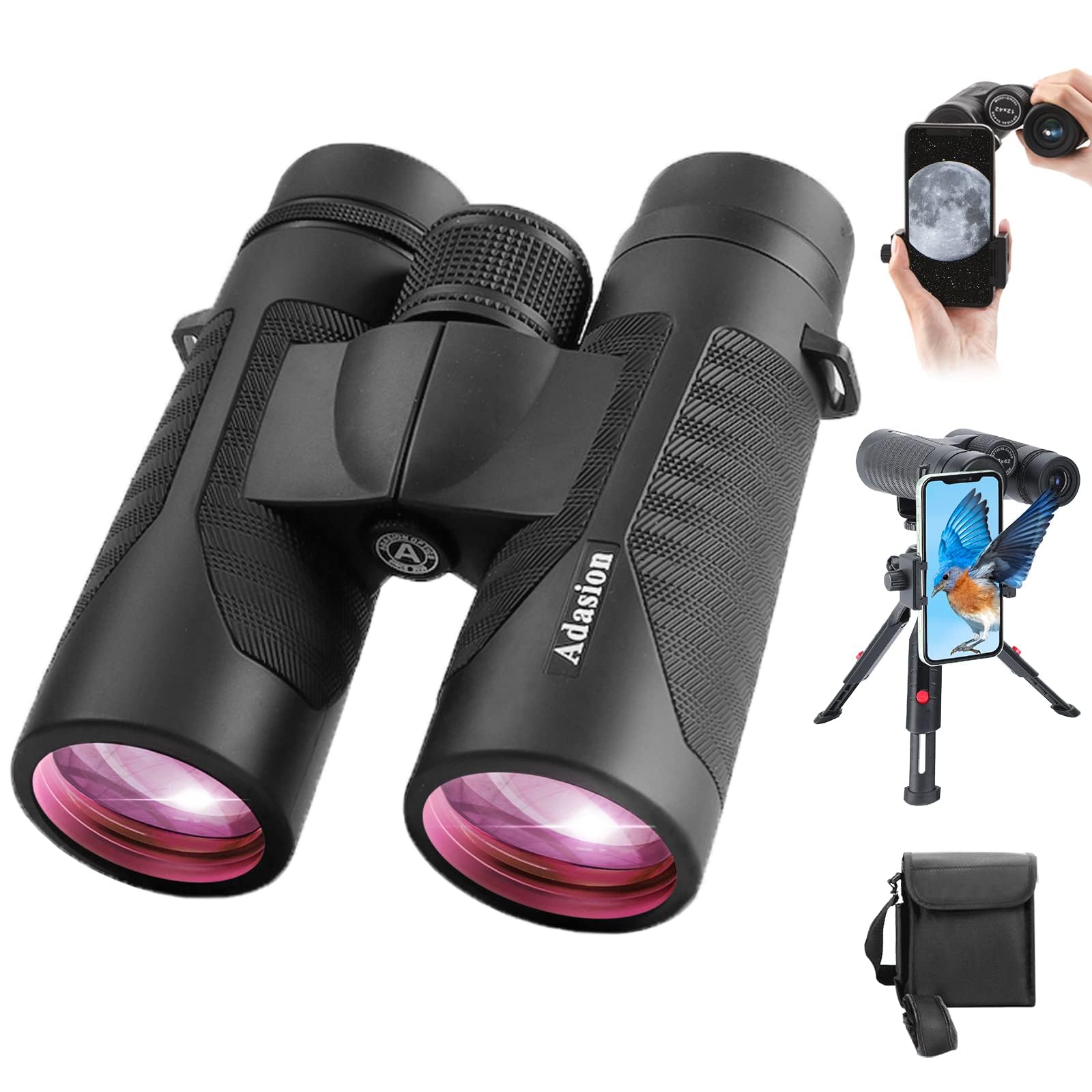
Adasion 12×42 HD
Key Features
- Mag & Objective: 12×42
- Optics: BAK4 Roof, HD
- Eye Relief: 13.6mm
- Waterproof: IPX7
- Weight: 1.25 lbs
- Price: Budget
The Adasion 12×42 HD distinguishes itself from pricier options like the Vortex Diamondback HD by including everything a beginner needs out of the box: a phone adapter, a tripod, and a carrying case. At a budget-friendly price, the optics — fully multi-coated with BAK4 prisms — deliver clarity that punches above their cost.
This kit is best suited for first-time binocular buyers and travelers who want to capture smartphone digiscoping photos without investing heavily. However, the 13.6mm eye relief means eyeglass wearers will find the view uncomfortable, and the phone adapter may not clamp securely onto larger phones.
The 12x magnification gives you extra reach for wildlife and sports, but the 367-foot field of view is narrower than typical 8x or 10x binoculars — a tradeoff to consider for tracking fast-moving subjects. The IPX7 waterproof rating and lightweight 1.25-pound build make it a practical companion for damp trails or travel.
Pros
- Complete kit with phone adapter and tripod included — no extras to buy.
- Sharp, bright images that exceed expectations at this price point.
- Lightweight design (1.25 lbs) makes it easy to carry on long hikes.
- Effective for birdwatching and wildlife observation, especially at moderate distances.
Cons
- Short eye relief (13.6mm) can be uncomfortable for eyeglass wearers.
- Phone adapter may not stay securely on larger phone sizes.
Ideal for budget-conscious first-time buyers who don’t wear glasses and want smartphone photo capability — not recommended if you need long eye relief or a secure adapter.
Best for Hunters, Wildlife
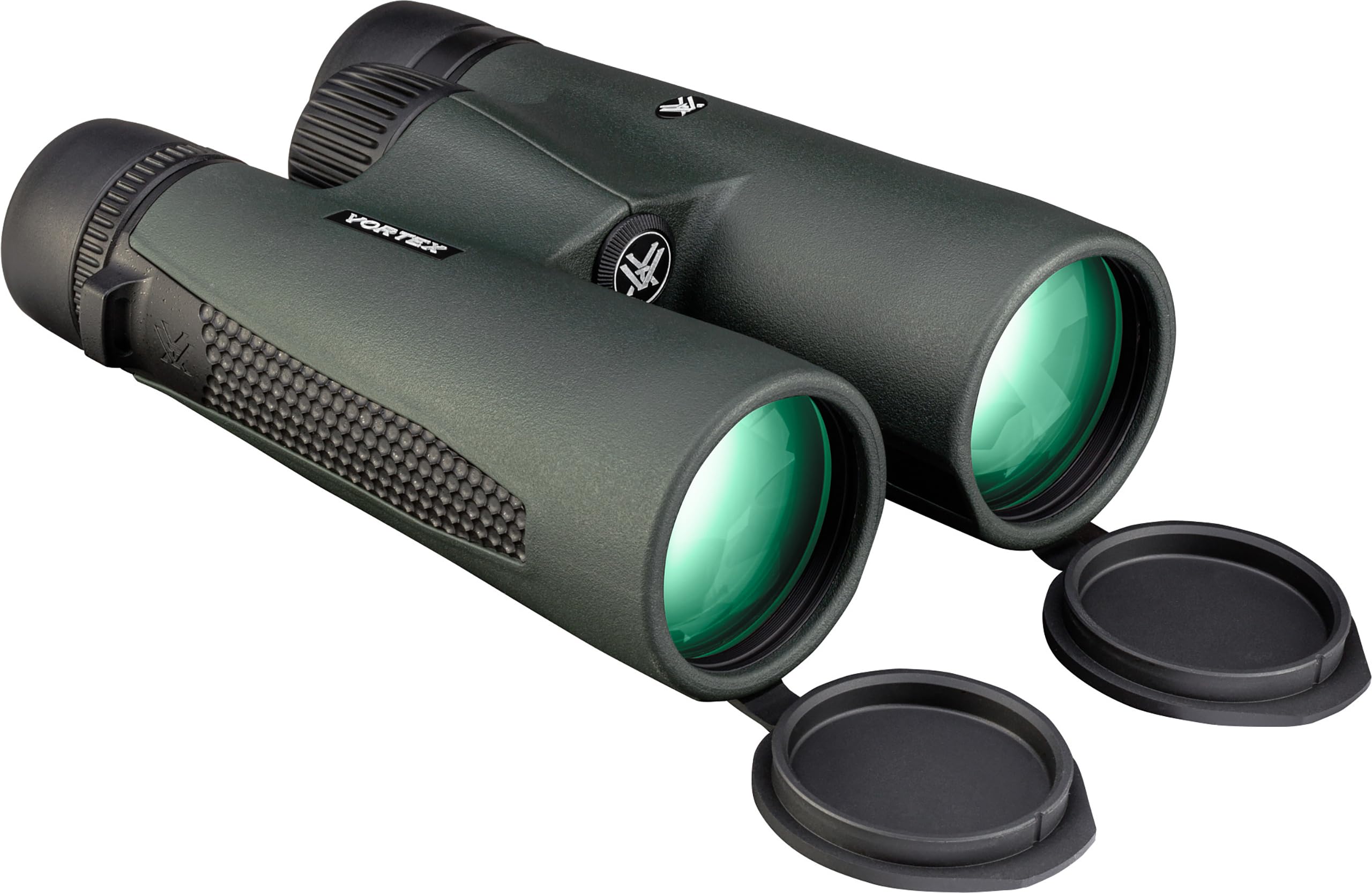
Vortex Triumph HD 12×50
Key Features
- Mag & Objective: 12×50
- Optics: HD, Roof prism
- Eye Relief: 16mm
- Waterproof: Yes
- Weight: 1.64 lbs
- Price: Mid-Range
With a 12×50 configuration, HD glass, and a lifetime warranty at a mid-range price, the Triumph HD is built for those who need extra reach and light gathering for open-country hunting or wildlife observation. The image is crisp with good color, and the 1.64-pound weight is reasonable for a 50mm class. However, in high-contrast scenes, some color fringing appears at the edges — a tradeoff birders prioritizing absolute edge-to-edge sharpness will notice. The weight also makes it less suited for ultra-light backpacking. For its intended use — stationary or tripod-supported long-distance viewing — this is a capable tool.
Pros
- HD glass and lifetime warranty at a mid-range price point.
- Crisp image with accurate color reproduction.
- Light for a 50mm class at 1.64 lbs.
Cons
- Slight color fringing at edges in high-contrast scenes.
For hunters and wildlife observers who want 12x magnification over absolute edge sharpness, the Triumph HD offers strong value backed by Vortex’s warranty.
Best for Travel, Casual Use
Adorrgon 12×42 HD

Key Features
- Mag & Objective: 12×42
- Optics: BAK4 Roof, HD
- Eye Relief: 10mm
- Waterproof: Yes
- Weight: 1.1 lbs
- Price: Budget
The Adorrgon 12×42 HD bundles a phone adapter and tripod at a price that undercuts most competitors, and the optical performance is clear and crisp in good light. For daytime birdwatching, hiking, or social sharing via the phone adapter, it’s a solid value. However, the 10mm exit pupil restricts low-light capability, so dusk or dawn observation will be dim. The short 10mm eye relief also means anyone who wears glasses will need to remove them to see the full field — this is a kit best suited for non-glasses users seeking a lightweight, easy-to-use binocular for casual daytime outings.
Pros
- Complete kit includes phone adapter and tripod, saving additional purchases.
- Clear, sharp image quality for the price – described as crisp and surprising.
- Lightweight at 1.1 lbs, comfortable for extended viewing sessions.
Cons
- Low-light performance is limited – not ideal for dawn, dusk, or heavy shade.
Best for daytime casual users who want a complete digiscoping setup without spending extra – skip if you need low-light performance or wear glasses.
Best for Kids, Concerts
Occer 12×25 Compact

Key Features
- Mag & Objective: 12×25
- Optics: BAK4
- Eye Relief: 20mm
- Waterproof: Yes
- Weight: 0.39 kg
- Price: Budget
The Occer 12×25 Compact is built around portability — at just 0.39 kg and small enough to slip into a pocket, it goes anywhere without adding bulk. The 12x magnification provides decent reach for daytime events, concerts, and casual wildlife spotting, and the BAK4 prisms deliver acceptable clarity for the price. However, the 25mm objective lens lets in limited light, making it unusable in dawn or dusk conditions, and some units arrive with alignment issues that cause double vision. This makes the Occer best suited as a backup pair or for kids and beginners who prioritize compactness over optical performance.
Pros
- Fits in a cargo pocket for easy carry anywhere
- Lightweight at 0.39 kg, comfortable for extended use
- Cost-effective entry-level option under $40
Cons
- Some units have alignment issues that can cause double vision
- Small 25mm objective limits use to bright daylight only
A good choice for casual daytime use where pocketability matters most, but not a substitute for full-size binoculars in low light or for critical viewing.
Best for Hunters
Bushnell Trophy XLT 10×42

Key Features
- Mag & Objective: 10×42
- Optics: Roof, multi-coated
- Eye Relief: 15.2mm
- Waterproof: Yes
- Weight: 1.6 lbs
- Price: Budget
The Bushnell Trophy XLT 10×42 delivers a crisp, bright image and solid low-light performance for its price range, and the included harness adds immediate value. At 1.6 pounds, though, the binoculars feel heavy during extended carry, and the harness pads can trap heat or cause discomfort. This combination works well for short hunting sessions or stationary use from a blind, but it doesn’t suit long hikes or all-day glassing.
Pros
- Clear, bright image for the price
- Great value with included harness
- Good low-light performance for a budget 10×42
Cons
- Harness pads can be uncomfortable or trap heat during extended wear
- Weight (1.6 lbs) may be too heavy for all-day carry on foot
Best for occasional hunting or fixed-position use where weight isn’t a concern and you can live with a basic harness.
Best for Casual Birding
Celestron Outland X 8×42

Key Features
- Mag & Objective: 8×42
- Optics: BaK-4 Roof, multi-coated
- Eye Relief: 17.8mm
- Waterproof: Yes
- Price: Mid-Range
The Celestron Outland X 8×42 delivers a bright, clear image with good color fidelity that stands out in the under-$120 range. Its lightweight build makes it easy to carry on a hike or hand to a younger birder without fatigue.
The tradeoff is the eyecup mechanism: the twist-up cups may loosen over time and retract unexpectedly, which frustrates anyone who needs consistent eye relief. This makes the Outland X best suited for casual, non-critical use — a great loaner or starter binocular, but not a primary tool for glasses wearers or rough outings. For a few dollars more, the optics are matched by more reliable designs.
Pros
- Crisp, bright image with good color fidelity for the price
- Lightweight enough for extended carry without strain
Cons
- Eyecup mechanism may loosen and retract unexpectedly during use
A reasonable pick for casual birding on a tight budget or as a spare pair to lend, provided you’re willing to check and adjust the eyecups before each session.
How to Choose
The right binoculars for you depend on where and when you’ll use them – a pair that excels at dawn birding may be too heavy for a day hike.
Magnification and Objective Size
Magnification (8x, 10x, 12x) determines how close objects appear, but higher power magnifies hand shake. For handheld use, 8x or 10x gives a stable, bright image; 12x and above often require a tripod to avoid blur. The objective lens (the second number, e.g., 42mm) controls light gathering: larger numbers (50mm) are brighter in low light but heavier. A 42mm objective is the most versatile balance for general outdoor use.
Optical Quality
HD or ED (Extra-low Dispersion) glass reduces color fringing and boosts contrast, especially in high-contrast scenes like a bird against a bright sky. BAK-4 prisms and fully multi-coated lens surfaces improve light transmission. These features matter most in low light – at dawn or dusk, lower-quality optics lose detail and sharpness. For serious birding or hunting, HD glass is worth the premium.
Eye Relief
Eye relief is the distance from the eyepiece where you can see the full image. If you wear glasses, you need at least 15mm of eye relief; 17mm or more is ideal for comfortable, quick viewing without removing your glasses. Short eye relief (under 15mm) forces glasses wearers to press their lenses against the eyecups or remove them altogether, which breaks the viewing rhythm.
Waterproof and Fogproof
Waterproofing (usually O-ring sealed and nitrogen-purged) keeps internal lenses dry and prevents fogging in cold or humid conditions. For any outdoor use – especially hiking, boating, or rainy birding – waterproof is a must. Fogproof is equally important: even waterproof binoculars can fog internally if not purged with dry gas. Look for models labeled ‘fogproof’ alongside waterproof.
Weight and Ergonomics
A heavy binocular (over 1.5 lbs) can become uncomfortable after an hour of neck carry, especially on long hikes. Lightweight models (under 1.3 lbs) reduce fatigue but may sacrifice stability or low-light performance. Non-slip rubber armor and a comfortable grip help with all-day use. Try to balance weight with the objective size – an 8×42 can be built light; a 12×50 inherently weighs more.
FAQ
Is an 8×42 binocular better than a 10×42 for birdwatching?
For birdwatching in forests or close-range, 8×42 gives a wider field of view and steadier image, making it easier to track moving birds. 10×42 is better for open fields or long-distance viewing, but the image will be shakier. If you’re new to birding, start with 8×42 – it’s more forgiving and brighter in low light.
Why do my binoculars show double vision even after focusing?
Double vision that persists after adjusting the focus wheel usually indicates a misaligned prism – common in cheap binoculars. This is a manufacturing defect, not user error. If you’re within the return window, exchange the unit. For higher-end models with a warranty (like Vortex or Athlon), contact the manufacturer for repair or replacement.
Can I use a 20×50 binocular without a tripod?
At 20x magnification, even small hand movements cause significant image shake, making it nearly impossible to get a steady view without a tripod. For handheld use, stick to 8x or 10x. If you need high power for stargazing or long-distance observation, budget for a sturdy tripod – otherwise the image will be frustratingly blurry.
How long does the phone adapter take to set up on these binoculars?
Most included phone adapters (like those with Adasion or Adorrgon) take about 30 seconds to attach and align. They typically clamp onto the eyepiece and require minor adjustments to center the phone camera on the image. Once set, digiscoping is straightforward, but the adapter may not fit large or thick-cased phones securely.