
This post contains affiliate links. We may earn a small commission when you buy through our links — at no extra cost to you.
Shopping for a mini digital camera feels like a game of spec roulette. Many models boast 48MP sensors and 4K video, but that tiny sensor often delivers images that can’t beat a smartphone. Worse, reliability issues plague many popular options – cameras that stop working after a few months aren’t uncommon.
The good news? A handful of cameras actually deliver on their promises. Some combine optical zoom with decent sensors for clear travel shots. Others prioritize ruggedness or a flip screen for vlogging. The key is knowing which spec matters for your use-case and which brands have proven track records.
This guide focuses on the cameras that earn their place in your bag – ones with reliable performance, sensible battery life, and image quality that justifies carrying an extra device. The best mini camera is the one you can count on, not the one with the biggest number on the box.


Best for Vloggers and Travelers
TEFTYMON 4K WiFi
The TEFTYMON 4K Digital Camera delivers clear, color-accurate photos and smooth 4K video at a budget-friendly price. The 180° flip screen makes selfie framing and vlogging intuitive, while built-in WiFi enables quick transfer of shots to a phone for sharing. The kit’s two rechargeable batteries and included 32GB memory card mean you can start shooting immediately without extra purchases.
Where this camera makes a concession is in its zoom capability. The 16x digital zoom works by cropping the sensor, so sharpness drops noticeably past about 2x magnification – getting physically closer to your subject yields much better results. The autofocus can also hesitate in low-contrast or dim lighting, producing the occasional softer frame; this is a typical tradeoff for compact cameras in this price tier rather than a defect.
This camera is best suited for beginner vloggers, casual travelers, and content creators who want a lightweight pocketable camera with a flip screen and easy WiFi transfer. The included two batteries and 32GB card mean you’re ready to shoot right away – no additional purchases needed. However, if you regularly need to capture distant subjects (like wildlife or stage performances), the lack of optical zoom will be a limiting factor. For everyday selfies, group shots, and indoor vlogging, the TEFTYMON handles those scenarios well.
The body is lightweight plastic but feels sturdy enough for regular travel. The 3-inch flip screen is bright and responsive, making framing easy from any angle. Battery life is generous – two batteries cover a full day of casual shooting. The WiFi connection allows quick photo transfer to a phone for sharing, though the app interface is basic.
Pros
- Delivers clear, colorful photos and smooth 4K video straight out of the box.
- Complete kit includes two batteries, 32GB memory card, and WiFi for easy phone transfer.
- Lightweight body with intuitive controls makes it simple for beginners to start shooting.
- 180° flip screen is ideal for vlogging and selfie framing.
Cons
- Digital zoom only – zoomed-in shots lose detail quickly; optical zoom would retain more clarity.
- Autofocus can occasionally produce softer images in challenging lighting conditions.
For budget-minded vloggers and travelers who want a complete, pocketable camera with flip screen and 4K, the TEFTYMON offers the most balanced feature set and consistent performance in its price class.
Best for Keychain Novelty
Kodak Charmera Keychain
At roughly the size of a pack of gum, the Kodak Charmera is less a camera and more a wearable fashion statement. It clips onto a keyring or bag zipper, making it the most portable option in this roundup – smaller than any pocket-sized travel camera with optical zoom. The blind-box design adds a collectible thrill, with multiple color variants that appeal to anyone chasing retro aesthetics.
That extreme portability comes with a clear tradeoff: the 1.6MP sensor captures images that are intentionally low-resolution and grainy. Think early-2000s webcam quality rather than anything printable. This camera is for spontaneous, imperfect snapshots that fit a Y2K scrapbook or social media feed – not for recording holiday memories or events where clarity matters. It works best as a novelty gift for teens or adults who appreciate the blurry-charm trend, or as an accessory that happens to take pictures.
Pros
- Ultra-compact keychain design – fits on a keyring for effortless portability
- Fun and easy to use, perfect for spontaneous shots and retro vibes
- Cute, collectible design with multiple color options in blind boxes
Cons
- At 1.6MP, photos are pixelated and grainy – intentional retro look, not for clear memories
- Fixed lens with no optical zoom – subjects must be close for anything recognizable
If your goal is a quirky accessory that happens to take delightfully fuzzy photos, the Charmera delivers. For anything resembling clear memories, stick with a smartphone or a budget travel camera.
Best for Teens & Beginners
Duluvulu 4K Flip
Key Features
- Sensor: 48 MP CMOS (interpolated)
- Video: 4K (upscaled)
- Price: Budget
The Duluvulu 4K Flip puts everything a beginner needs in one box: a 3-inch 180° flip screen, 4K video recording, two rechargeable batteries, and a microSD card. At this price, you’re getting a lightweight camera that’s easy to carry and ready to shoot for hours. Unlike the top pick with WiFi, this camera focuses on the essentials—ideal for learning the basics of vlogging or travel photography without overspending.
This camera suits teens, first-time vloggers, and budget travelers who shoot mostly in good light. The digital zoom and interpolated 48MP sensor mean image quality degrades in dim scenes and when zooming in—fine for noon outings or well-lit interiors, less so for dusk or indoor parties. If your priority is a low-cost camera with a flip screen and long run time, this fits the bill.
Battery life holds up across a full day of casual shooting, and the included spare pack adds confidence for trips. The build is light but feels good in hand. A small portion of units may have minor quality issues out of the box—testing the camera soon after arrival is a small step that can save frustration later.
Pros
- Complete starter bundle with two batteries, SD card, and accessories
- Sharp 4K video and clear photos in good light
- Lightweight and portable, ideal for travel
- Solid battery life with two packs
Cons
- Digital zoom reduces detail when zoomed in — better to frame shots than rely on zoom
- Low-light photos become soft and grainy due to the small sensor and interpolation
- A small number of units can arrive with defects or inconsistent operation
For a beginner who wants a flip screen and two batteries without spending more than $60, this is the most complete package in its price class.
Best for Travel Zoom Lovers
Canon SX740 HS
The Canon PowerShot SX740 HS stands out with a 40x optical zoom (24–960mm equivalent) that brings distant wildlife, sports action, or landscape details into clear view, all while sliding into a jacket pocket. The 20.3 MP CMOS sensor and 4K video capability produce solid image quality for a camera this size. The tilting 3-inch LCD screen is useful for low-angle shots but does not flip forward for self-recording, which limits its vlogging appeal.
This camera is best suited for travelers, hikers, and sports fans who need a powerful zoom but cannot carry a DSLR. The compact build makes it easy to bring anywhere, and the zoom range covers everything from wide group shots to faraway subjects. However, the autofocus can be sluggish and hesitant at the telephoto end, particularly in lower light. Some units may show operational quirks after several months of use, so long-term performance varies. Vloggers should look elsewhere due to the non-articulating screen.
When shooting at full zoom, the autofocus may hunt for focus on moving targets, making it better suited for stationary or slow-moving subjects. In well-lit conditions and at shorter focal lengths, the autofocus behaves more predictably. The 4K video is a welcome addition, though the camera crops into the sensor slightly during recording. Image stabilization helps keep handheld shots steady at moderate zoom levels but is less effective at the extreme telephoto end.
Pros
- 40x optical zoom brings distant subjects into clear view – unmatched in a pocket-sized camera
- Compact and lightweight despite its zoom range, ideal for travel
- Good overall image quality and capable 4K video recording
Cons
- Autofocus can be slow and inconsistent when using the full zoom range
- Some units may develop operational issues after extended use
If your priority is getting close to distant subjects without a huge camera, the SX740 HS delivers extraordinary zoom reach in a very portable form – just be ready for occasional autofocus hesitation and unit-to-unit variation in long-term performance.
Best for Budget Travel Zoom
Kodak Pixpro FZ55

The FZ55 packs a 5x optical zoom into a compact body that slips easily into a pocket – a rare combination at this price point. In good light, photos come out crisp and clear, making it a capable companion for daytime travel snaps or casual outings. The controls are simple enough for beginners to pick up immediately. However, the camera’s long-term reliability is a known vulnerability: some units can stop powering on or lose battery charge after a few months of use. If you happen to get a trouble-free unit, it’s a fantastic value for the optical reach; but the gamble means it’s best suited as a secondary or short-term travel camera rather than a primary investment.
Pros
- Strong value for travelers needing optical zoom without spending much
- Crisp daylight photos with good detail and color
- Compact and lightweight design fits in pocket or purse
Cons
- Battery life can be inconsistent, with some units draining faster than expected
- Some units may stop powering on or lose charge retention after several months of use
If you need optical zoom on a tight budget and are comfortable with potential early replacement, the FZ55 is a capable travel companion for daylight use.
Best for Young Kids Toy
CAMKORY 1080p Kids

This entry-level camera appeals to young children with its simple controls and compact size. The price is low enough to treat as a toy, but the photos can appear soft and grainy, and some units may stop working after weeks of use. For adults or anyone needing clear pictures, this is not a suitable camera. It fits best as a very low-cost disposable for toddlers or one-time events where durability is not required.
Pros
- Simple controls and lightweight body make it easy for young children to use
- Cute design appeals to kids
- Compact size fits easily in small bags or pockets
Cons
- Photos can lack sharpness and appear grainy in many lighting conditions
- Some units may stop working after a few weeks of use
For very young children who need a cheap camera that can be handled roughly, the CAMKORY fits as a disposable toy – but expect soft photos and the possibility of early malfunction.
Best for Vloggers & Travelers
XNSIAKXA 4K WiFi
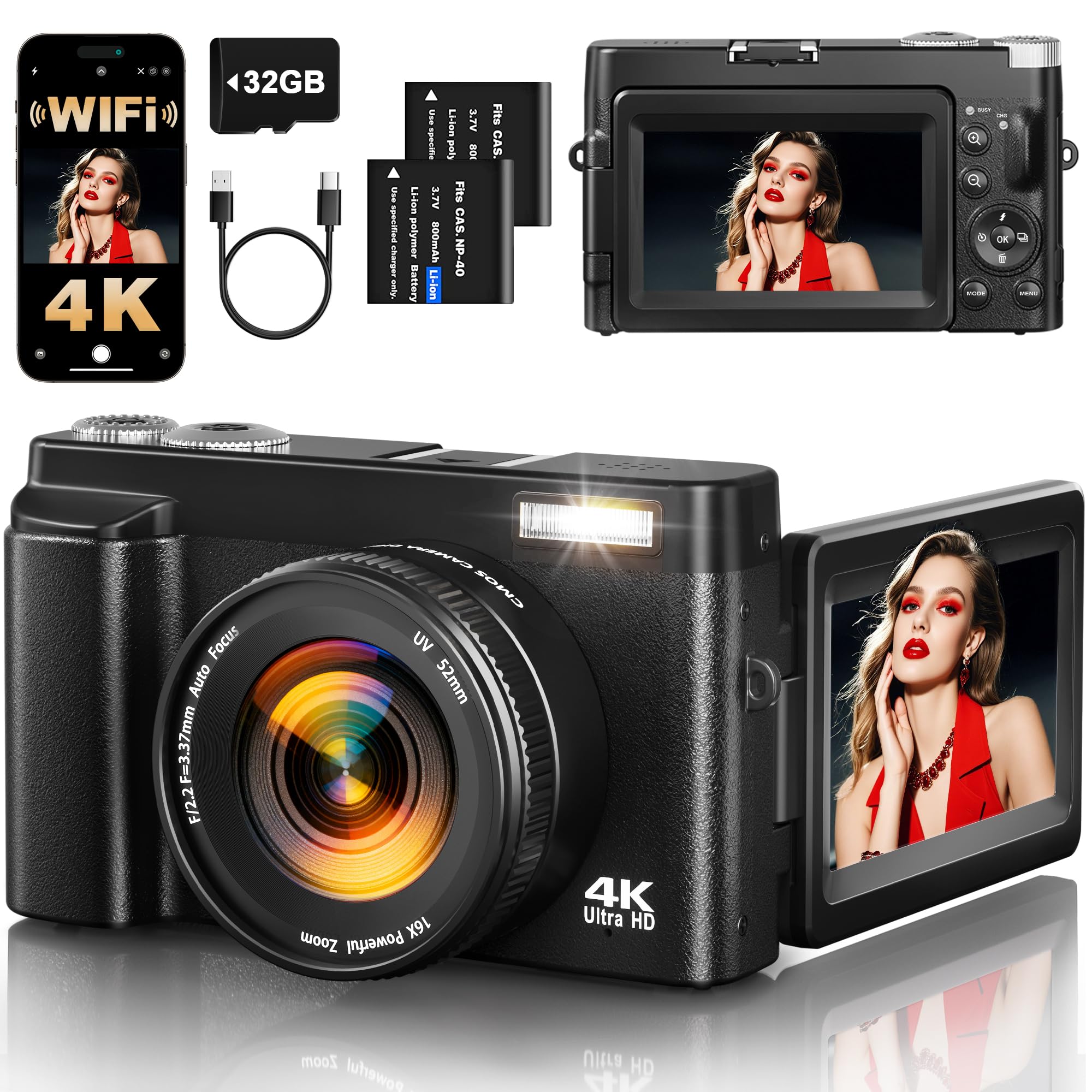
The XNSIAKXA delivers a commendable set of features for its price: 4K video, a 180° flip screen, WiFi transfer, and a kit that includes a UV filter, bag, two batteries, and an SD card. Sharp photos and smooth footage in good light make it a capable starter camera for vloggers and travelers. However, image quality can soften in low light or when using the 16x digital zoom, and the camera has a shorter track record than the TEFTYMON – meaning long-term durability is less confirmed. For beginners who want a low-cost all-in-one and can work within its lighting and zoom limits, this is a strong alternative.
Pros
- Sharp, clear photos and smooth 4K video in good lighting.
- Flip screen and WiFi make vlogging and sharing straightforward.
- Complete kit includes UV filter, bag, two batteries, and SD card for under $60.
Cons
- Digital zoom only – image quality degrades noticeably when zoomed in.
- Low light performance can be inconsistent, with occasional softness.
Best for first-time vloggers or travelers who want a complete kit under $60 and can accept digital zoom and moderate low-light limits.
Best for Kids & Teens
QUIOF 4K Auto

The QUIOF 4K Autofocus camera delivers quick focus and easy handling for young beginners. Its lightweight body fits small hands, and the image quality in good light is vivid enough for sharing. However, the lack of a flip screen and interpolated sensor mean it’s not suited for vlogging or photography beyond casual snapshots. Early signs are positive, but long-term durability under regular use has yet to be confirmed.
Pros
- Beginner-friendly controls with quick autofocus
- Sharp and vibrant photos in daylight
- Lightweight and easy for small hands to hold
Cons
- No flip screen – cannot frame yourself while recording video
- Interpolated 48MP sensor limits fine detail, so images look soft when printed or cropped
This camera fits the bill for a child’s first camera that’s easy to use and takes decent photos in daylight, but don’t expect it to handle vlogging or low-light scenarios.
Best for Y2k Aesthetic Lovers
HOTU Mini Keychain
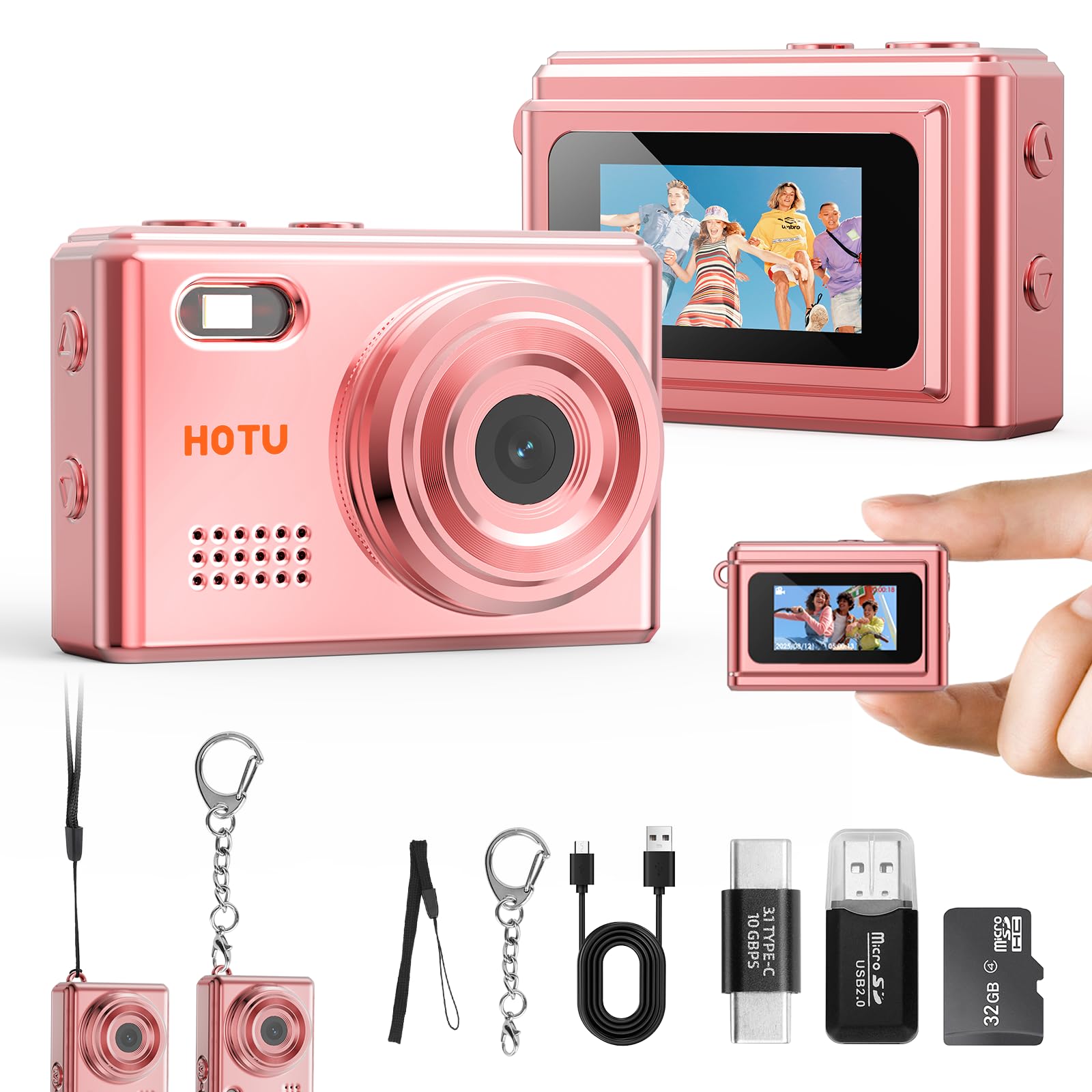
The HOTU Mini Keychain Camera is adorably small — lighter than a pair of earphones — and captures photos that are surprisingly clear for a 2MP sensor, especially in good light. Resolution is the tradeoff: images lack fine detail and may appear grainy in dim conditions, making them best for social media sharing rather than prints. This is why it sits as a secondary option behind the Kodak Charmera; the novelty is charming, but the 2MP limit and lower review volume keep it in the niche of pure keychain fun.
Pros
- Tiny keychain size makes it easy to clip onto bags or lanyards for always-ready snapshots.
- Image quality exceeds expectations for a 2MP sensor, with decent color in well-lit scenes.
- Simple one-button operation great for parties or spontaneous vlogs.
Cons
- 2MP resolution means photos lack detail and are best saved for social media, not prints.
A cute novelty for Y2K lovers or concert-goers who want a tiny camera for casual social media posts, but not for anyone needing usable prints or a primary camera.
How to Choose
The most important factor when buying a mini digital camera is knowing that megapixel counts are often marketing hype – the real image quality depends on sensor size and the presence of optical zoom.
Sensor Resolution and Size
Higher megapixel numbers on a tiny sensor don’t translate to sharper photos. A 48MP sensor the size of a pea can’t capture as much light as a larger 16MP sensor, leading to noisy images, especially in low light.
For travel photography, a 16-20MP sensor with decent pixel size (like the one in the Canon SX740) will often produce cleaner, more detailed shots than a 64MP sensor crammed into a cheaper body. Look for cameras that mention sensor size (1/2.3-inch is common) rather than just megapixels.
Optical Zoom vs. Digital Zoom
Optical zoom uses glass elements to magnify the image without losing quality, while digital zoom simply crops and enlarges the center of the frame – effectively reducing resolution. For travel, even 4x optical zoom (like the Kodak Pixpro FZ55) is far more useful than 16x digital zoom.
If you need to capture distant subjects – wildlife, landmarks, stage performances – a camera with optical zoom is essential. A model with 40x zoom (like the Canon SX740) can reach subjects that would be a blurry mess with digital zoom.
Flip Screen for Vlogging
A 180° flip screen lets you frame yourself while recording vlogs or taking selfies, which is critical for content creators. Many budget cameras now include this feature, making them a strong alternative to using a phone with a selfie camera.
The flip screen adds some bulk, but the convenience of seeing yourself live outweighs the slight size increase for anyone planning to vlog on trips. Models like the TEFTYMON and Duluvulu offer this at a low price.
Video Resolution
4K video sounds superior, but on budget mini cameras it’s often upscaled from lower resolutions – meaning the actual detail may not be much better than 1080p. The benefit of 4K is that you can crop into the frame while keeping HD quality for social media.
For casual travel clips, 1080p at 30fps is perfectly adequate and often more reliable than choppy 4K from an underpowered sensor. If you plan to edit and crop heavily, prioritize 4K, but don’t let it be the sole deciding factor.
Water and Ruggedness
Waterproof cameras are rare in the mini category, and the ones that exist (like the Kodak WPZ2) have reliability concerns. If you need a camera for snorkeling or beach trips, you may have to accept a higher risk of failure.
For most travelers, a splash-proof pouch or simple plastic bag offers enough protection without the added cost and compromise in image quality. Rugged cameras also tend to be bulkier, so trade-offs are inevitable.
FAQ
Why do mini digital cameras have such short battery life compared to smartphones?
Mini cameras often use older battery chemistry (AA alkaline or small lithium-ion packs) and lack the power management chips found in phones. A smartphone’s battery is engineered for a full day of mixed use, while a mini camera may only last a few hours of continuous shooting. The solution: carry spare rechargeable batteries and disable power-hungry features like Wi-Fi and flash.
Can a $50 mini camera take better photos than my iPhone for travel vlogs?
In good light, a $50 camera with optical zoom can out-reach your iPhone’s fixed lens, but the iPhone’s superior computational photography, low-light performance, and video stabilization will produce more consistently sharp images. For casual vlogs, stick with your phone unless you need zoom or want a dedicated device that won’t drain your phone battery.
Is digital zoom ever useful on a compact travel camera, or is optical zoom mandatory?
Digital zoom is effectively useless for capturing detail—it just crops and enlarges the center of the image, reducing resolution. For travel, optical zoom (even 2x) is far more valuable. Avoid cameras that only list digital zoom if you plan to shoot anything beyond arm’s length.
Are keychain cameras like the Kodak Charmera worth it for picture quality, or just a novelty?
Keychain cameras are pure novelty. They produce low-resolution, grainy images that are fine for social media filters but useless for printing or sharp memories. If you want a fun accessory that also captures the vibe of a scene, they’re worth the low price. If you care about quality, skip them.