
This post contains affiliate links. We may earn a small commission when you buy through our links — at no extra cost to you.
Buying an underwater camera often means sorting through bold claims about waterproof depth and 4K video. Battery life is usually shorter than advertised, and stabilization quality can make or break your snorkel footage. The real challenge is finding a camera that delivers on its core promises without unexpected trade-offs.
Action cameras dominate the market, but dedicated underwater compacts offer unique advantages in macro photography and ruggedness. The right choice depends on your typical use – whether that’s a full day of scuba diving, casual pool clips, or travel vlogging.
This guide focuses on real-world performance: how long batteries actually last when recording 4K, which cameras resist water ingress in salt conditions, and what level of stabilization you can expect at each price point. We compare action cameras and rugged compacts across these factors, so you can pick the one that fits your adventure.



Best for Diving & Vlogging
DJI Action 5 Pro
Key Features
- Waterproof Depth: 20m (no housing)
- Video & Stabilization: 4K120fps, HorizonSteady
- Price: Mid-Range
The Action 5 Pro dives to 20 meters without a housing, beating most rivals, and its 1950mAh battery delivers up to 4 hours of continuous recording – a significant edge for snorkeling or day trips. The 1/1.3-inch sensor captures clean footage in low light, and HorizonSteady 360° keeps horizons level even during fast movement.
The 1/1.3-inch sensor and HorizonSteady 360° deliver smooth, sharp footage even during high-speed activities. Colors are accurate out of the box, and the camera handles transitions from bright sunlight to shade without blown highlights – useful for shooting above and below water.
Subject tracking locks onto swimmers or hikers consistently, making framing automatic. A small number of units have exhibited screen freezing or water ingress; otherwise, performance in wet conditions is trouble-free. Testing the seals before deep use is a sensible precaution.
Serious underwater enthusiasts and travelers get the most from this camera. The 20m waterproofing and long battery mean one device covers snorkeling, hiking, and vlogging. Vloggers will appreciate the front screen and subject tracking. If 5.3K video or a budget price is your priority, this isn’t the right match.
Pros
- Waterproof to 20 meters without a housing – ideal for snorkeling and diving.
- 4-hour battery life reduces need for charging during long outings.
- Low-light footage stays clear with minimal noise.
- Subject tracking and horizon stabilization keep action shots smoothly framed.
Cons
- Some units may experience screen freezing or water ingress – inspect seals before deep submersion.
For travelers and underwater shooters who want maximum battery and waterproofing without extra housings, the Action 5 Pro is the most practical action camera available.
Best for Snorkeling & Water Sports
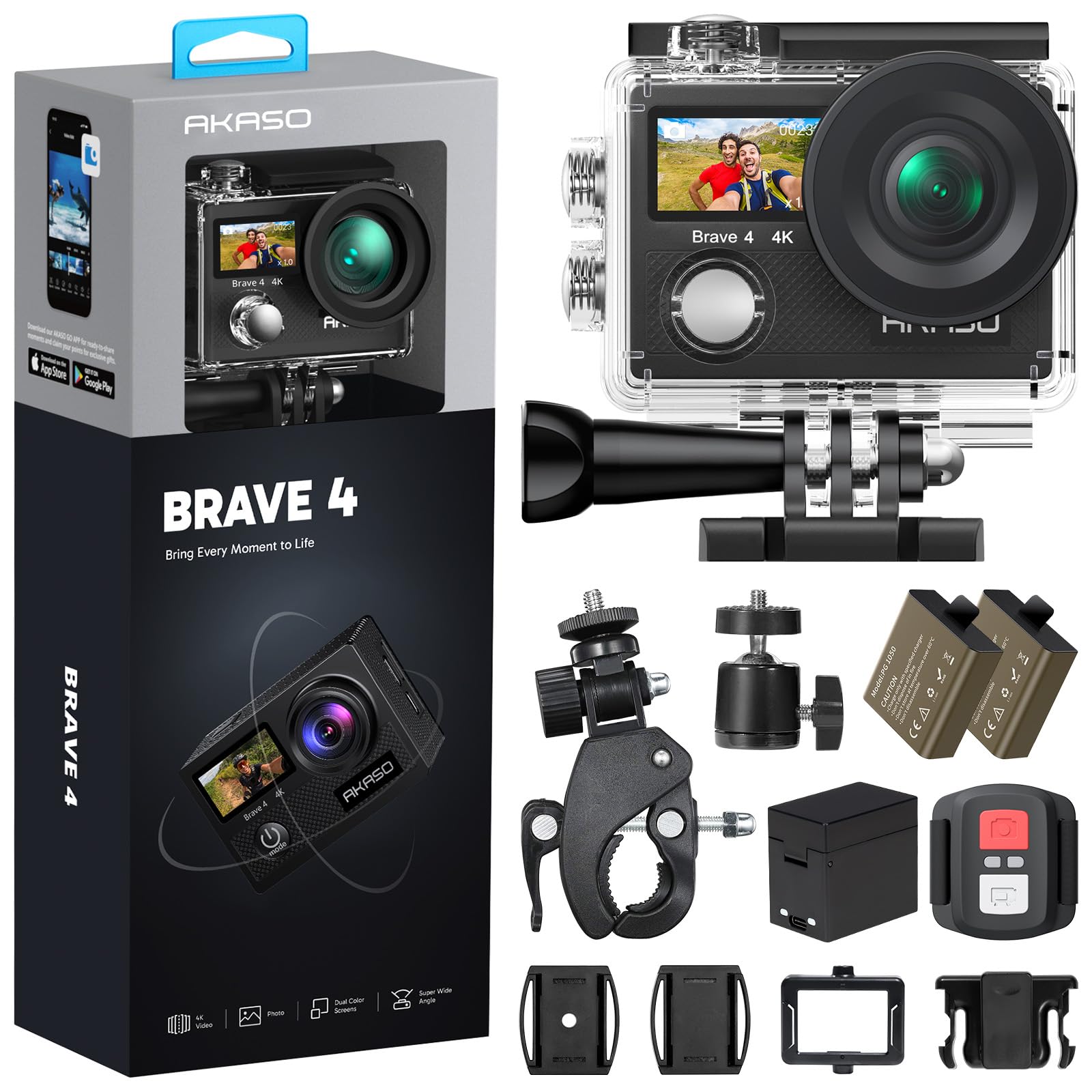
AKASO Brave 4
Key Features
- Waterproof Depth: 131ft (with case)
- Video & Stabilization: 4K30fps, EIS
- Price: Budget
The Brave 4 trades a front-facing selfie screen for a sealed waterproof housing and a wrist remote, prioritizing dependable in-water operation over vlogging frills. Its dual-screen setup—a rear LCD for framing and a front status display—keeps essential info visible, while the electronic image stabilization helps smooth out handheld wobble. Inside the box, you get a full set of mounts, two batteries, and that remote, so there’s no need to hunt down extras before your first dive.
This camera is built for snorkelers, kayakers, and beginner adventure shooters who want easy 4K recording without spending premium prices. Battery life can drop to 20–30 minutes per charge when filming in 4K, so carrying both included batteries is essential for longer sessions. That tradeoff aligns well with short, surface-level water outings where you swap batteries between clips and never need continuous all-day recording.
Underwater, the EIS dampens hand shake enough to keep footage watchable, and the 20MP stills capture decent detail in clear, well-lit shallows. The menu system is simple to navigate with gloved hands, and the remote control makes start/stop operation fuss-free when the camera is mounted on a helmet or chest strap. For casual YouTube clips or vacation highlights, the video quality hits a sweet spot that doesn’t overpromise or underdeliver.
Pros
- Exceptional value for the money, pairing 4K video with a full accessory kit at a budget-friendly price.
- Good video and photo quality for casual underwater use, with decent clarity and color.
- Simple setup and intuitive controls, even with dive gloves on.
- Includes two batteries, a waterproof case, mounts, and a remote—no extras needed to start filming.
Cons
- Battery life in 4K mode can be as short as 20–30 minutes, so you’ll need to carry both included batteries and plan around charging.
For snorkelers and casual water sports shooters who value a complete, ready-to-use kit and don’t need all-day battery, the Brave 4 packs dependable performance at a price that’s easy to justify.
Best for Scuba Diving & Macro
OM System TG-7
Key Features
- Waterproof Depth: 50ft (no housing)
- Video & Stabilization: 4K video (no EIS)
- Price: Premium
Shockproof, crushproof, and freezeproof ratings mean the TG-7 handles drops, bumps, and freezing temperatures that would damage other cameras. Its underwater microscope mode brings out colors and details on tiny subjects — something no action camera can replicate.
Where DJI’s Action 5 excels in deep waterproofing and battery life, the TG-7 offers optical zoom and true macro capability with dedicated underwater shooting modes that simplify color correction. It’s also portable enough to slip into a pocket or daypack.
This camera suits scuba divers and snorkelers who prioritize macro photography over wide-angle video, and travelers wanting one rugged body for all outdoor conditions. The small sensor means low-light shots will appear soft and depth-of-field control is limited — not the tool for dim underwater caves or portrait-style photography.
Pros
- Survives drops, crushing, and freezing without damage
- Underwater microscope mode produces vibrant colors on small subjects
- Compact and lightweight for easy carry on adventures
Cons
- In low-light conditions or for shallow depth-of-field portraits, the small sensor produces soft images with limited background blur
- Some units may stop working without warning, a risk worth considering for long trips
If macro underwater photography and extreme durability define your needs, the TG-7 is a specialized tool. For general underwater video and deeper dives, the DJI Action 5 offers more versatility.
Best for Mid-Range Action
DJI Action 4
Key Features
- Waterproof Depth: 18m (no housing)
- Video & Stabilization: 4K120fps, RockSteady+
- Price: Mid-Range
The DJI Osmo Action 4 stands out in the mid-range with RockSteady+ stabilization and a larger 1/1.3-inch sensor that gives it an edge in low-light scenes – a noticeable upgrade over the smaller sensors in budget action cameras. It costs roughly $100 less than the top-pick Action 5 Pro while sharing many core capabilities.
The 10-bit color depth and 4K120fps video produce rich, smooth footage that grades well in post, and the 18m waterproof rating allows snorkeling and shallow dives without a housing. The intuitive touch interface and HorizonBalancing stabilization keep framing steady even during fast motion. Battery life is rated at up to 160 minutes, though actual run time depends on recording settings.
This camera suits vloggers, travelers, and action sports enthusiasts who need reliable stabilization and good low-light performance at a mid-range price. It’s less ideal for those who shoot long, continuous clips in hot weather – overheating can force shutdowns – and while most units function without issue, a small minority have experienced water ingress or electronics failures. If those scenarios are rare for you, the Action 4 offers strong value.
Pros
- Strong low-light video quality with 10-bit color depth
- Intuitive touch interface and easy setup
- RockSteady+ stabilization smooths out action shots
- Good value for a mid-range action camera
Cons
- Overheating during extended recording in warm weather may cause shutdown
- Some units may experience water ingress or electronics failures
A smart mid-range choice for vloggers and sports shooters who prioritize stabilization and low-light quality – just keep an eye on recording duration in hot weather.
Best for Vlogging & Travel
AKASO Brave 7 LE
Key Features
- Waterproof Depth: 131ft (with case)
- Video & Stabilization: 4K30fps, EIS 2.0
- Price: Mid-Range
The AKASO Brave 7 LE distinguishes itself from other affordable action cameras by including a front-facing selfie screen and a port for an external microphone — features usually found on models costing twice as much. The dual screens make framing shots for vlogs or group selfies straightforward, and the touch interface responds well to taps and swipes.
This camera handles wet conditions without extra gear: it is water-resistant to IPX7 without a housing, and the included waterproof case extends depth to 131 feet for snorkeling or pool use. However, video quality and stabilization do not match top-tier options from GoPro or DJI; footage can look softer, and high-motion scenes like biking or running may show more shake. The built-in microphone captures wind noise easily, and even an external mic does not fully resolve thin audio.
For vloggers and travelers who value the front screen and external mic support over absolute video sharpness, the Brave 7 LE provides a functional package at a mid-range price. The menu system is intuitive, and battery life supports a day of casual recording without frequent swaps.
Pros
- Dual screens enable easy selfie framing and vlogging without guesswork.
- 4K video with EIS 2.0 delivers stable footage for casual action and daily recording.
- Waterproof design works without a case for splashes and with housing for deeper dives.
Cons
- Footage appears less sharp than premium cameras when viewed side by side.
- Image stabilization smooths walking but may not keep up with high-impact action.
- Audio quality remains thin even when using an external microphone.
The Brave 7 LE is the go-to budget camera for vloggers who need a front screen and external mic, accepting softer video and weaker stabilization than premium rivals.
Best for Creative 360° Content
Insta360 X5
Key Features
- Waterproof Depth: Requires housing for depth
- Video & Stabilization: 8K30fps 360°, FlowState
- Price: Premium
The Insta360 X5 captures 8K 360° video with an invisible selfie stick effect that opens up third-person perspectives traditional action cameras can’t match. Unlike the top pick DJI Osmo Action 5 Pro, which shoots underwater to 20m without a housing, the X5 requires a separate underwater housing for any serious dive—making it a niche choice for divers.
This camera fits content creators who want to reframe footage after recording, travel vloggers who need both standard and immersive angles from one device, and adventurers willing to accept a steeper editing workflow. The companion app can experience connectivity issues, and battery life is adequate for short shoots but may need a midday top-up for all-day outings. For underwater capture, plan on adding a housing (cost and bulk not included).
Image quality stands out: 8K resolution delivers sharp detail, and low-light scenes retain more clarity than many competitors. The replaceable lens design adds durability—a scratched lens swaps out rather than forcing a full camera replacement. Edited well, the 360 footage offers creative angles that flat cameras cannot replicate.
Pros
- Captures 8K 360° footage that can be reframed into traditional shots after recording.
- Delivers sharp detail with strong low-light performance for an action camera.
- Replaceable lenses protect your investment—scratched lenses swap out instead of requiring a full camera replacement.
Cons
- Battery life is decent for short sessions but may fall short during extended recording days.
- App connectivity can be unreliable, leading to interrupted transfers or an unresponsive camera in some cases.
Best suited for creators who prioritize creative 360° flexibility over straightforward underwater shooting—plan to use a housing and tolerate occasional app quirks.
Best for Budget Adventurers
AKASO EK7000
Key Features
- Waterproof Depth: 131ft (with case)
- Video & Stabilization: 4K30fps, EIS
- Price: Budget
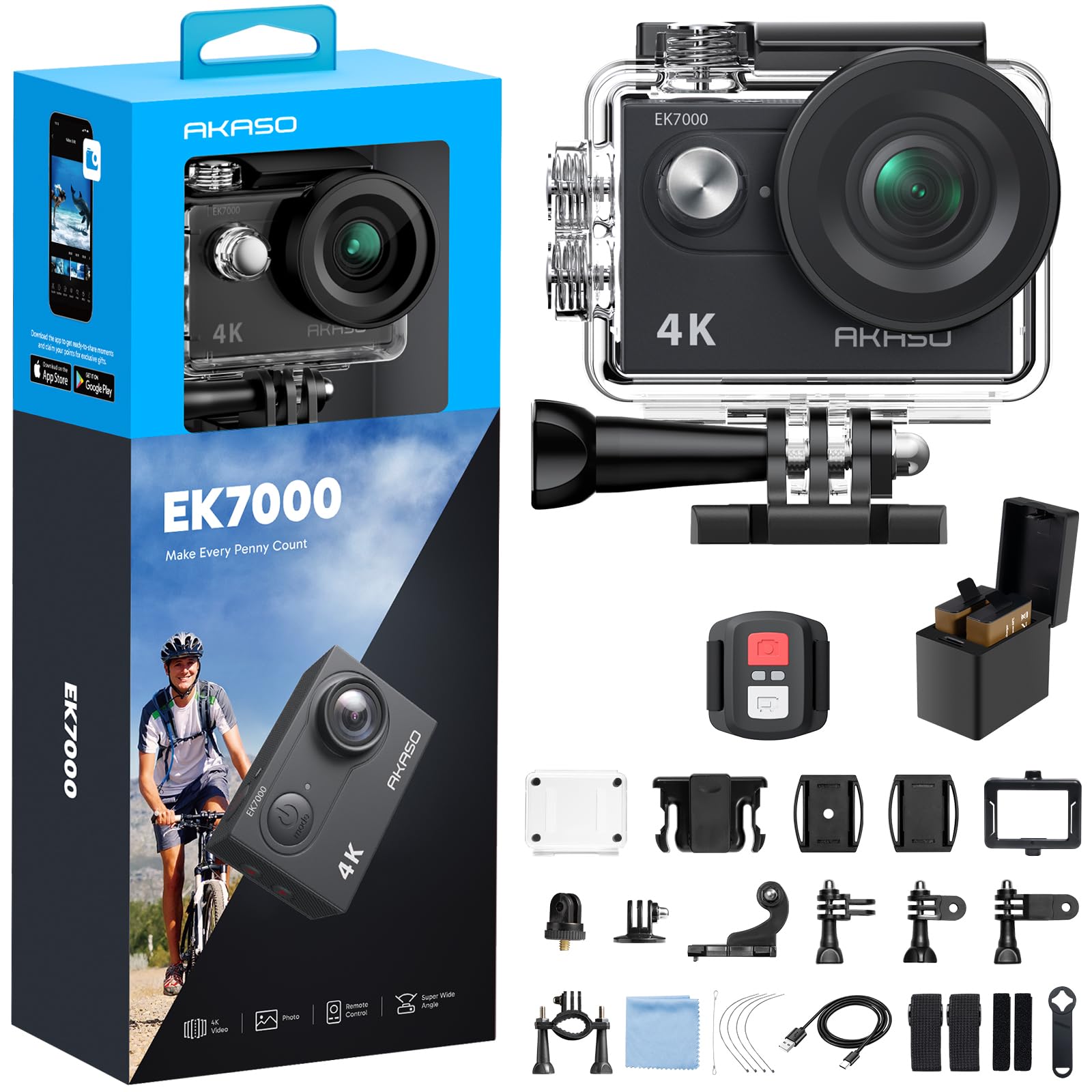
The AKASO EK7000 gets the basics right: it’s easy to set up, includes a full accessory kit, and captures decent photos and video for the price. Underwater use with the included housing is viable for casual snorkeling. What keeps it from a higher recommendation is its age — no touch screen, and real-world battery life runs closer to 25–30 minutes per battery rather than the advertised 90 minutes. The 4K video is softer than true 4K cameras, which matters if sharp footage is a priority. The Brave 4 offers a better overall package at a similar cost.
Pros
- Exceptional value for money
- Easy to use and set up
- Comes with many useful accessories
Cons
- In longer recording sessions, each battery may last only 25–30 minutes despite the 90-minute claim
- Footage at 4K can appear soft or upscaled compared to true 4K cameras
Best for budget-conscious first-time users who want an action camera without investing much — as long as battery swaps are acceptable and 4K sharpness is not the top priority.
Best for Budget Touch Screen
AKASO EK7000 Pro
Key Features
- Waterproof Depth: 131ft (with case)
- Video & Stabilization: 4K30fps, EIS
- Price: Budget
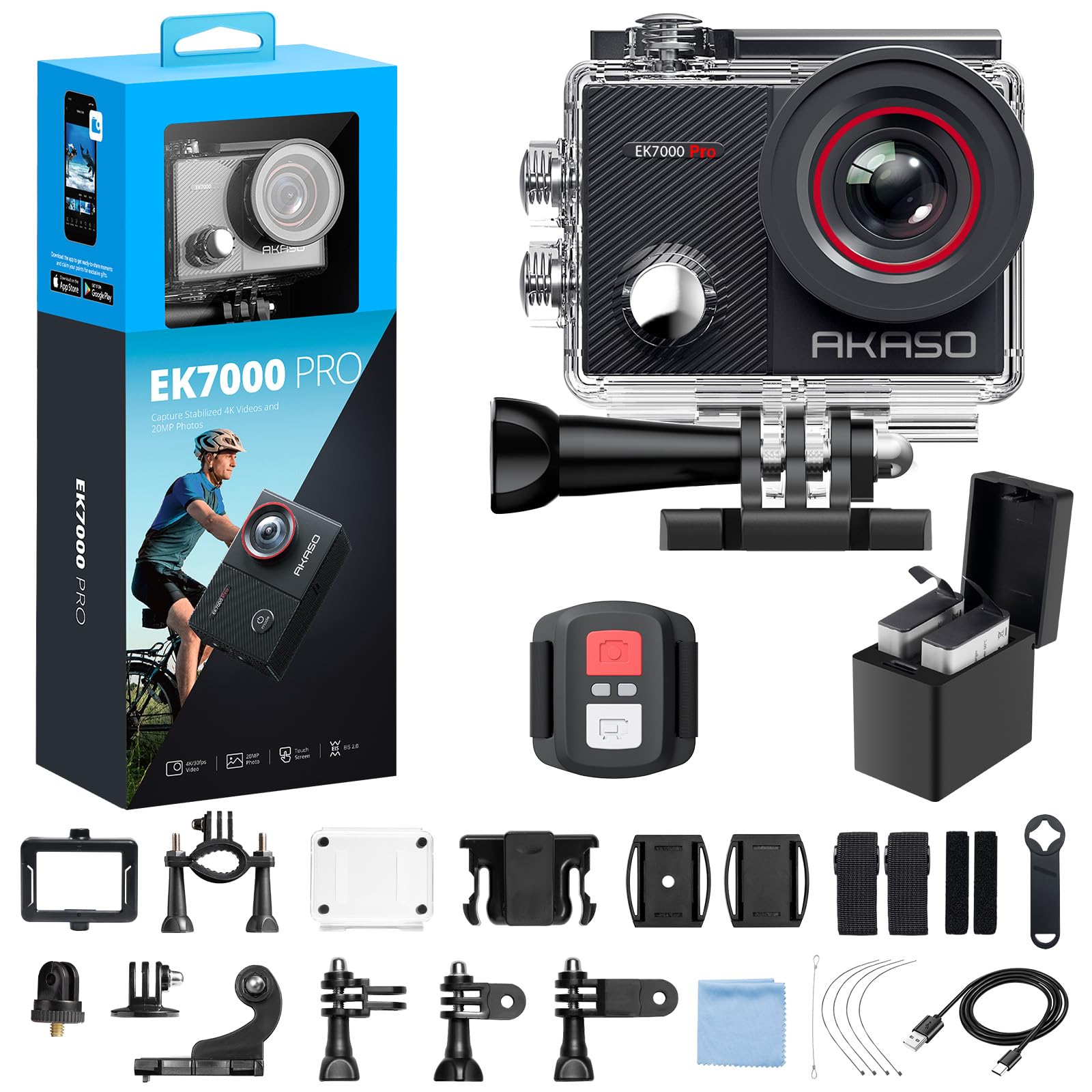
The AKASO EK7000 Pro brings a touch screen to the budget action camera segment, making menu navigation and previewing shots easier than on button-only models. Video quality at 4K30fps is adequate for daylight outdoor clips, but stabilization won’t match premium cameras. Battery life falls short of the advertised 140 minutes – a single battery may last around 45–60 minutes of recording, so carrying spares is essential for longer outings. The slightly higher price compared to the AKASO Brave 4 (which lacks a touch screen but offers similar core performance and a larger review base) means the Pro’s touch interface is the main differentiator.
Pros
- Excellent value – one of the best budget action cameras with touch screen
- Easy to use with intuitive touch interface
- Comes with comprehensive accessory kit
Cons
If a touch screen is a priority over saving a few dollars, and you’re comfortable managing battery life with spare batteries, the EK7000 Pro offers a smoother interface than the Brave 4 for casual underwater or outdoor use.
Best for Ultra-Budget First-Timers
ODDV Action1
Key Features
- Waterproof Depth: 132ft (with case)
- Video & Stabilization: 4K60fps, EIS
- Price: Budget
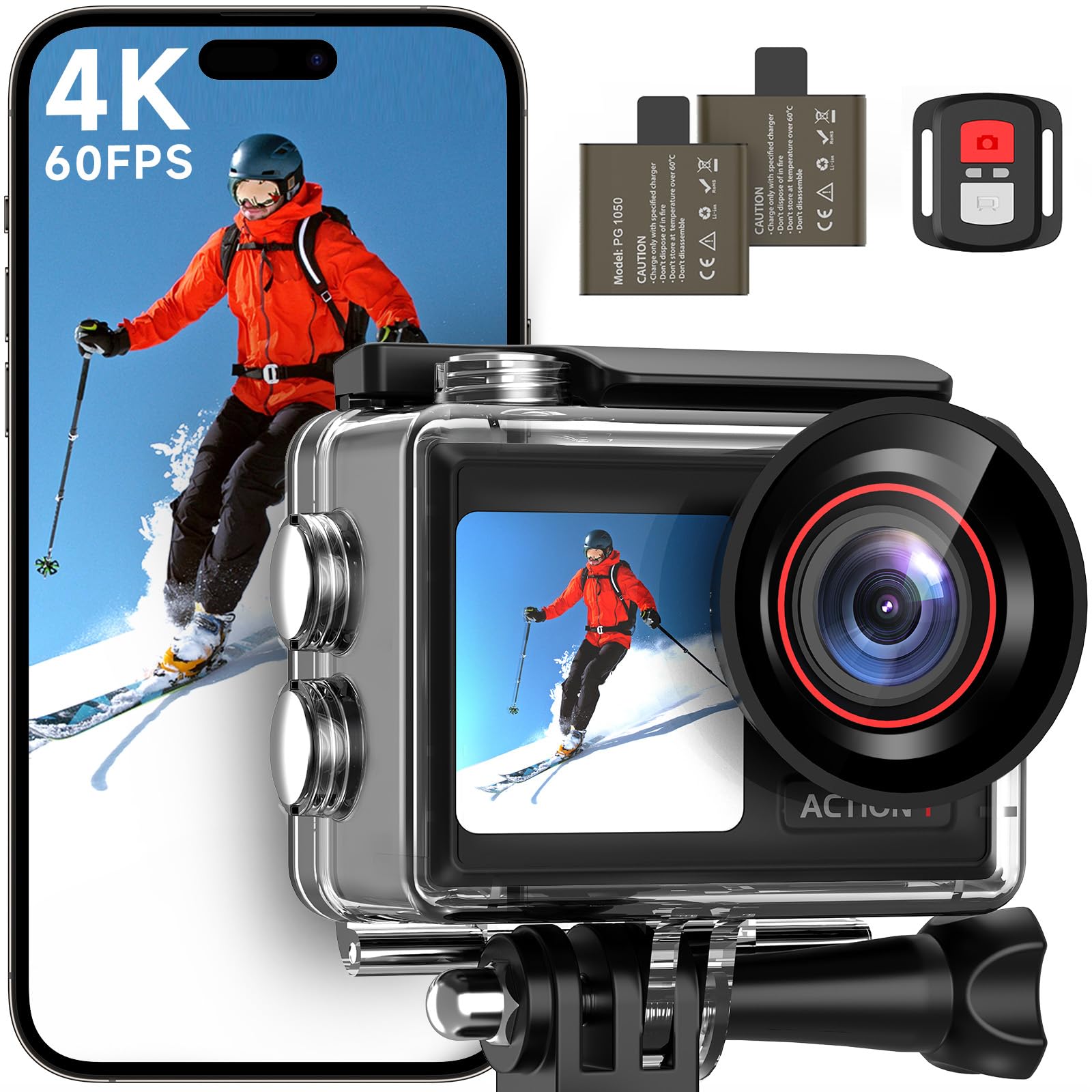
The ODDV Action1 delivers 4K60fps video and dual screens at a price that undercuts most competitors. Image quality is decent for the cost, and the included waterproof case offers solid protection down to 132ft. Setup is straightforward, making it accessible for first-time users. However, the limited number of user reports means long-term durability after regular use remains unclear — this camera is a gamble best suited for buyers who prioritize low price over proven reliability.
Pros
- Sharp 4K60fps footage and 30MP photos for the price
- Easy setup and operation right out of the box
- Waterproof case provides solid protection down to 132ft
Cons
- Long-term performance under frequent use is unknown given the small sample of user feedback
Works for a first-time budget buyer or casual pool use who accepts that its long-term durability hasn’t been established.
Best for Kids & Beginners
YISENCE 4K806

Key Features
- Waterproof Depth: 16ft (no housing)
- Video & Stabilization: 4K video
- Price: Budget
The YISENCE 4K806 floats, includes a 32GB memory card, and offers dual screens for easy selfies—features that make it a natural fit for pool days and shallow beach excursions. Its 16ft waterproof depth handles splashes and snorkeling near the surface. The 64MP photos and 4K video produce decent quality for casual sharing. However, the camera’s reliability can vary between units, with some experiencing charging or performance issues after limited use. That makes it a better choice for beginners or occasional family trips than for frequent underwater adventures.
Pros
- Floats in water, comes with a 32GB memory card, and has a front selfie screen.
- Decent photo quality for casual pool and beach photos.
- Simple controls make it accessible for kids and beginners.
Cons
- The battery may lose its ability to hold a charge after limited use.
- Some cameras may develop performance problems after a few outings.
Best suited for families who want a cheap, floatable camera for occasional pool days and are comfortable with the possibility that it may not hold up beyond a season.
Best for Family Beach Trips
Kodak WPZ2

Key Features
- Waterproof Depth: 50ft (no housing)
- Video & Stabilization: 1080p video
- Price: Mid-Range
In a waterproof compact without housing, the WPZ2’s optical zoom is a practical advantage for casual outdoor photography. Its compact build and simple controls suit beach and pool use. But water ingress can occur in some units, and image sharpness is inconsistent, particularly in low light or with moving subjects. Camera longevity may vary between units. This camera’s mixed feedback on water resistance and image quality means it doesn’t match the TG-7’s consistency for underwater use.
Pros
- Compact and rugged design suits outdoor activities and travel.
- Good value for a waterproof compact with optical zoom.
- Intuitive controls make it accessible for beginners.
Cons
- Water may enter the battery compartment or behind the LCD in some units.
- Functionality can cease after limited use in some cases.
This camera works for shallow pool photography and casual outdoor snaps where losing a shot isn’t critical, but for deeper water or important trips, consider a more consistent option like the OM System TG-7.
Best for Gopro Loyalists
GoPro HERO13

Key Features
- Waterproof Depth: 33ft (no housing)
- Video & Stabilization: 5.3K60 HDR, HyperSmooth
- Price: Premium
The GoPro HERO13 Black captures incredibly sharp 5.3K HDR footage with HyperSmooth 6.0 stabilization, making it a top choice for professional underwater videography. However, battery charging issues—where some units stop at 85%—and overheating during high-resolution recording can interrupt long sessions. This camera suits creators who prioritize image quality over all-day runtimes and can work around thermal limits by taking breaks or using external power.
Pros
- Sharpest 5.3K HDR video among compact action cameras
- Rugged build with 33ft waterproofing without housing
- Interchangeable HB-Series lenses adapt to different shooting styles
Cons
- For all-day shooting, the battery may not charge past 85% – keeping a spare battery on hand helps
- When filming 5.3K in warm weather, the camera may overheat and shut off – short takes or cooler environments reduce this risk
Best for professional videographers who need the highest resolution and can manage battery and heat limitations with workflow adjustments.
Best for Hdr Video Fans
GoPro HERO12

Key Features
- Waterproof Depth: 33ft (no housing)
- Video & Stabilization: 5.3K60 HDR, HyperSmooth
- Price: Premium
The HERO12 captures sharp HDR video with high resolution, and its rugged build offers dependable waterproofing to 33ft without housing. However, during extended recording in warm conditions the camera can shut off after 7–15 minutes, and high-res settings drain the battery quickly. These limitations make it better suited for short, cooler water clips rather than long dive sessions.
Pros
- Captures sharp HDR video with high resolution for vibrant underwater clips
- Rugged build with dependable waterproofing to 33ft without housing
Cons
- May shut off after 7–15 minutes when recording continuously in warm conditions
- Battery life is short when using high-resolution or HDR modes
A reasonable choice for short underwater clips in cooler water or for buyers who already own GoPro accessories and want HDR at a discount.
Best for Novelty Seekers
SPUNALP CM026
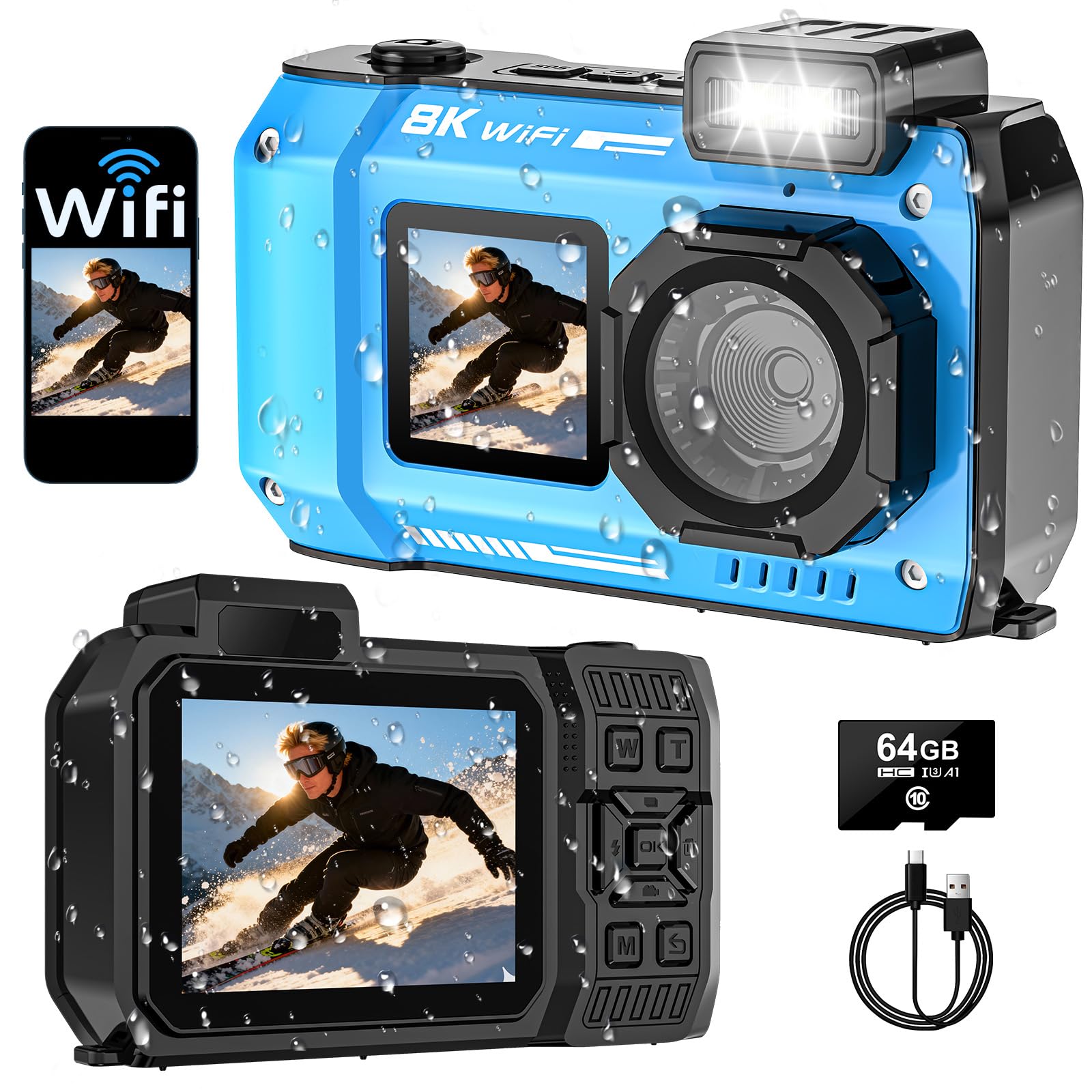
Key Features
- Waterproof Depth: 33ft (sealed body)
- Video & Stabilization: 8K upscaled video
- Price: Budget
It captures sharp, detailed images for its price point and is simple to operate – a good fit for casual use by kids or novelty seekers. However, the 8K video and 70MP photo specs are likely upscaled, and some units may experience Wi‑Fi connectivity issues or unexpected shutdowns. For a budget‑friendly camera, long‑term durability under regular use remains unverified given the limited number of owner reports.
Pros
- Sharp, detailed image quality for the price
- Straightforward controls – easy for beginners
Cons
- 8K and 70MP claims appear to be digitally upscaled – video resolution may not match true 8K
- Wi‑Fi connectivity can be intermittent, and the camera may shut down without warning
A reasonable pick for novelty pool use or kids who want high‑res specs on a tight budget – as long as you’re comfortable with possible quirks.
How to Choose
The most important factor is matching the waterproof depth and battery life to your actual use – many cameras overpromise on both.
Waterproof Depth
Waterproof depth ratings often require the included hard case. A camera rated for 130ft with a housing may only be splash-proof without it. Budget action cameras typically need the case for anything beyond a few feet.
For scuba diving beyond 30ft, choose a camera that is waterproof without a housing (like the DJI Action 5 Pro or OM System TG-7) to avoid the bulk and risk of a leaking case. Snorkeling and pool use can get by with a housed budget model.
Video Resolution and Stabilization
4K is standard, but actual sharpness varies. Budget cameras often use upscaled sensors, producing softer footage than premium models. Stabilization is even more critical underwater where current and hand shake amplify motion.
Electronic image stabilization (EIS) in budget cameras works for static shots but fails during fast movements. For snorkeling and diving, look for advanced stabilization like DJI’s RockSteady or GoPro’s HyperSmooth – they level the horizon even in rough conditions.
Battery Life and Charging
Advertised battery life is rarely achieved in practice. A camera claiming 90 minutes may last 25-30 minutes when recording 4K with stabilization enabled. Always carry spare batteries – most action cameras use small, replaceable cells.
Charging speed also matters. Some cameras support fast charging via USB-C, topping up in under an hour. Others rely on older ports that take twice as long. If you shoot multiple dives in a day, quick-charging models save hours.
Durability
Ruggedness goes beyond waterproofing. The OM System TG-7 is shockproof from 7ft drops, crushproof up to 220lbs, and freezeproof to 14°F. Action cameras like GoPro and DJI are tough but not crushproof – they rely on optional protective housings for extreme abuse.
Salt water is especially corrosive. Rinse your camera with fresh water after every saltwater use, and check seals for sand or debris. Rubber gaskets degrade over time; replace them yearly if you dive frequently.
Ease of Use and App Connectivity
Touchscreen interfaces are standard on mid-range and premium action cameras, but budget models often rely on button menus. A responsive touchscreen makes changing settings underwater much easier – especially with gloves on.
Wi-Fi and Bluetooth apps allow remote control and quick transfers, but connectivity can be buggy. Many users report pairing issues with GoPro and Insta360 apps. If reliable data offload is critical, use a card reader instead.
FAQ
Can I use a GoPro HERO13 for scuba diving without a housing?
The GoPro HERO13 is waterproof to 33ft without a housing, which is sufficient for snorkeling and shallow dives. For deeper scuba dives, you need the optional dive housing rated for 196ft. Without it, water pressure can damage the camera seals.
Why does my underwater camera fog up and how do I prevent it?
Fogging happens when moisture trapped inside the housing condenses on the lens. Prevent it by placing silica gel packets inside the housing before sealing, and avoid opening the camera in humid environments. If fogging occurs, stop recording, open the housing briefly in a dry area, and reseal.
Which action camera has the best image stabilization for snorkeling?
The DJI Osmo Action 5 Pro and Action 4 lead with HorizonSteady and RockSteady+, which keep footage level even in choppy water. GoPro’s HyperSmooth 6.0 is close, but DJI’s horizon lock is more reliable for near-360 rotation. Budget cameras like AKASO Brave 4 offer basic EIS but will show bobble during active snorkeling.
How long does the DJI Osmo Action 5 Pro battery actually last in 4K?
In real-world tests, the Action 5 Pro records about 2.5 hours of 4K/60fps video on a full charge, far exceeding competitors that average 45–60 minutes. Using 4K/120fps or high bitrate modes reduces runtime to around 90 minutes. Carrying a spare battery still recommended for all-day trips.