
This post contains affiliate links. We may earn a small commission when you buy through our links — at no extra cost to you.
Finding a hole in your ski sock after just two trips is maddening—and all too common with budget merino blends that skimp on synthetic reinforcement. The heel and toe are the first to go because those areas see the most friction inside a boot. When you’re paying $15–$20 for a pack, you expect them to last more than a weekend.
The ideal ski sock uses merino for warmth and moisture wicking, but adds nylon or elastane to high-wear zones for durability. The thickness also matters: too thin and you lose cushion, too thick and boots feel cramped. That balance—between cost, comfort, and longevity—is the key decision most skiers overlook.
This guide focuses on socks that have proven to hold their shape and padding over multiple seasons, without sacrificing warmth or fit. From zero-cushion designs for custom-fitted boots to medium-padded multi-packs for resort skiing, each pick handles a different scenario. The common thread: they avoid the durability pitfalls that plague many affordable options. The result is a selection that saves you money in the long run by not wearing out mid-season.


Best for All-Around Skiers
CS CELERSPORT Ski Socks
Key Features
- Warmth & Moisture: Merino blend
- Durability: No durability complaints
- Cushioning: Shin and top foot
- Fit & Length: Over-the-calf
- Thickness: Medium
- Price: Budget
The CS CELERSPORT ski socks are built with a merino wool blend and targeted cushioning that keeps feet warm without adding bulk. The shin and top-of-foot padding reduces pressure points, and the seamless toe prevents irritation during long days on the mountain.
On the slopes, these socks stay in place — no sagging or bunching around the calf. The medium thickness fits well in standard ski boots, allowing good boot flex while providing enough insulation for sub-zero temperatures. The fit is snug without feeling restrictive.
These socks suit all-around skiers and snowboarders who want a dependable pair without spending a premium. If you consistently ski in extreme cold for extended periods, you may prefer a thicker sock — this medium cushioning works for most conditions but isn’t the warmest option available.
Pros
- Warmth without excessive bulk – works well in sub-zero temps
- High-quality construction that holds shape and resists sagging
- Targeted padding prevents blisters and shin pressure
- Snug fit that stays in place without being too tight
Cons
- For extreme cold conditions, the medium thickness may not provide enough insulation for some skiers
If you need one pair of ski socks that will last through season after season, these deliver consistent performance at a budget-friendly price.
Best for First-Time Skiers
WEIERYA Merino Ski Socks 2-Pack
Key Features
- Warmth & Moisture: Merino blend
- Durability: Toe seam failures
- Cushioning: Full cushion
- Fit & Length: Over-the-calf
- Thickness: Thick
- Price: Budget
The WEIERYA Merino Ski Socks deliver noticeable warmth even in single-digit temperatures, making them a compelling option for budget-conscious skiers. While the top pick offers proven longevity, these socks prioritize immediate savings and warmth.
Seam durability can be inconsistent, so these are best suited for occasional use, backup pairs, or first-time skiers who want to keep costs low without sacrificing warmth. Sizing can vary, so ordering a size up if between sizes may help achieve a better fit.
Pros
- Keeps feet toasty in sub-freezing temperatures
- Exceptional value for a 2-pack at a budget price
- Soft merino blend reduces boot fatigue
Cons
- Sizing can run large or small, so fit may vary between pairs
- Toe seam may unravel after several wears
A budget-friendly 2-pack that delivers exceptional warmth, ideal for casual or short-term use where seam durability is less critical.
Best for Women Skiers
CS CELERSPORT Women’s Ski Socks
Key Features
- Warmth & Moisture: Merino blend
- Durability: No major flaws
- Cushioning: Shin cushion
- Fit & Length: Over-the-calf
- Thickness: Medium
- Price: Budget
The CS CELERSPORT Women’s Ski Socks use a tapered calf and targeted shin cushioning to stay put without rolling or sagging inside boots. That fit precision, combined with the same low price as the unisex version, makes this a direct option for women who find unisex socks too loose or prone to bunching.
This sock suits women who prefer a less bulky feel inside their boots and ski in moderate cold (0–40°F). For extremely cold days, the medium thickness may feel thin—some skiers have noted they wish for a thicker option. For most conditions and a snug, no-wrinkle fit, this set delivers warmth and comfort without the premium price tag.
Pros
- Tapered calf and shin cushioning keep socks in place without bunching
- Soft merino blend prevents blisters and feels comfortable against skin
- Budget-friendly multi-pack offers solid warmth without breaking the bank
Cons
- In very cold conditions (below 0°F), the medium thickness may not provide enough insulation
For women who prioritize a non-bulky, stay-put fit and ski primarily in moderate cold, this sock offers reliable performance at a cost that’s hard to beat.
Best for Advanced Skiers
Smartwool Men’s Zero Cushion Ski Sock
Key Features
- Warmth & Moisture: Merino blend
- Durability: No durability issues
- Cushioning: Zero cushion
- Fit & Length: Over-the-calf
- Thickness: Ultra-thin
- Price: Premium
Smartwool’s zero-cushion ski sock delivers warmth that rivals thicker socks thanks to a dense merino blend, while maintaining a minimal profile that eliminates bulk and hot spots. This makes it a strong alternative to medium-cushion options for skiers who demand a precise fit in custom boots.
The sock is best for advanced skiers with low-volume or custom-fitted boots who prioritize a thin layer that won’t bunch. However, the calf circumference is notably narrow – muscular legs may find it too tight. Additionally, the heel seam can cause irritation for some wearers, though this is less common.
Pros
- Surprisingly warm despite zero cushion – maintains foot temperature without adding bulk.
- Ultra-thin design prevents bunching and hot spots in tight-fitting boots.
- Merino blend holds up well to repeated wear and washing.
Cons
- Heel seam can create a pressure point for some wearers.
- Calf circumference may be too snug for skiers with larger leg muscles.
A premium thin sock for skiers who need minimal bulk and prioritize warmth-to-weight ratio – check your calf fit before buying.
Best for Tight Budget
Cirorld Merino Ski Socks 2-Pack
Key Features
- Warmth & Moisture: Merino blend
- Durability: No failure reports
- Cushioning: Cushioned
- Fit & Length: Knee-high
- Thickness: Medium
- Price: Budget
At under $15 for two pairs, this is the cheapest merino-blend ski sock on the market — and it works. The warmth holds up in Yukon-level cold, the interior is soft without bunching, and the fit stays in place even on larger calves. No one else offers this combination of features at this price.
This set is for skiers who want a functional sock without spending much — first-timers, occasional resort-goers, or anyone needing a backup pair. The tradeoff is simpler construction: the merino blend uses less wool than premium socks, and the build may wear faster under heavy use. For a budget option, that’s a reasonable compromise.
Pros
- Exceptional warmth for the price
- Comfortable, soft interior with no bunching
- Secure fit that stays up, even on larger calves
Cons
- Simpler construction may show wear faster with frequent use
- Lower merino wool content than high-end ski socks
If you need a cheap merino sock that actually keeps your feet warm and stays put, this 2-pack delivers — just don’t expect it to outlast pricier alternatives.
Best for Couples Sharing Gear
OutdoorMaster Merino Ski Socks
Key Features
- Warmth & Moisture: Merino-acrylic blend
- Durability: Long-lasting shape
- Fit & Length: Over-the-calf
- Thickness: Medium
- Price: Mid-Range
The OutdoorMaster Merino Ski Socks have earned a reputation as a default choice for skiers who want dependable warmth and a secure fit. Unlike the newer men’s-specific sibling, this unisex version has been widely vetted across many seasons, confirming its performance in temperatures from freezing to mild winter days. The blend of merino wool and synthetics provides insulation without bulk, while the over-the-calf design and non-slip cuff keep the sock in place all day.
These socks best suit skiers who prioritize all-day comfort and longevity over an ultra-thin profile. The medium thickness offers good cushion and warmth, and the soft merino blend avoids the itchiness that can make long days uncomfortable. However, those with very tight or low-volume boots may find the thickness too much – a lighter sock would work better in that case. For couples sharing gear, the unisex sizing adds flexibility.
Pros
- Keeps feet warm across a wide temperature range without adding bulk.
- Holds its shape and cushion after repeated washing.
- Soft merino blend that reduces leg fatigue and doesn’t itch.
Cons
- Medium thickness can feel too snug in low-volume ski boots.
For skiers who want a well-tested, well-fitting sock that balances warmth and durability, the OutdoorMaster delivers – just check boot volume before committing.
Best for Style-Conscious Skiers
Sandsuced Merino Ski Socks 3-Pack

Key Features
- Warmth & Moisture: Merino blend
- Cushioning: Thick cushioning
- Fit & Length: Knee-high
- Thickness: Thick
- Price: Mid-Range
The Sandsuced 3-pack combines a soft, cashmere-like merino feel with eye-catching patterns that stand out in the lodge. The fit stays put without squeezing, and the insulation holds warmth well on cold days. While the per-pair cost is a touch above the category’s best-value options, no durability complaints have surfaced so far. This is a solid pick for skiers who care about aesthetics and are willing to pay a small premium for a proven comfortable sock with no reported weaknesses.
Pros
- Soft and luxurious feel
- Stylish designs and colors
Cons
- Per-pair price is slightly higher than the most budget-friendly options
Ideal for skiers who value style and soft feel over the absolute lowest price, and want a multi-pack with no reported durability concerns.
Best for Budget-Conscious Skiers
Hylaea Merino Ski Socks 3-Pack

Key Features
- Warmth & Moisture: Thermolite merino blend
- Durability: Heel holes within weeks
- Cushioning: Terry loop cushioning
- Fit & Length: Knee-high
- Thickness: Medium
- Price: Mid-Range
The Hylaea 3-pack delivers solid warmth and targeted shin cushioning for a low per-pair cost, making it an appealing option for skiers who hit the slopes a few times a season. The Thermolite blend and moderate compression keep feet comfortable on cold days, but some buyers have noted heel holes forming after limited use — a durability gap that limits long-term value. This works best as a backup or occasional pair rather than a season-long workhorse.
Pros
- Good warmth without excessive bulk
- Low per-pair cost for three socks
Cons
- Thinner than typical ski socks, which may leave some wanting more insulation in deep cold
A cost-effective three-pack for occasional resort days or as a backup, provided you’re willing to accept faster wear in the heel area.
Best for Compression Seekers
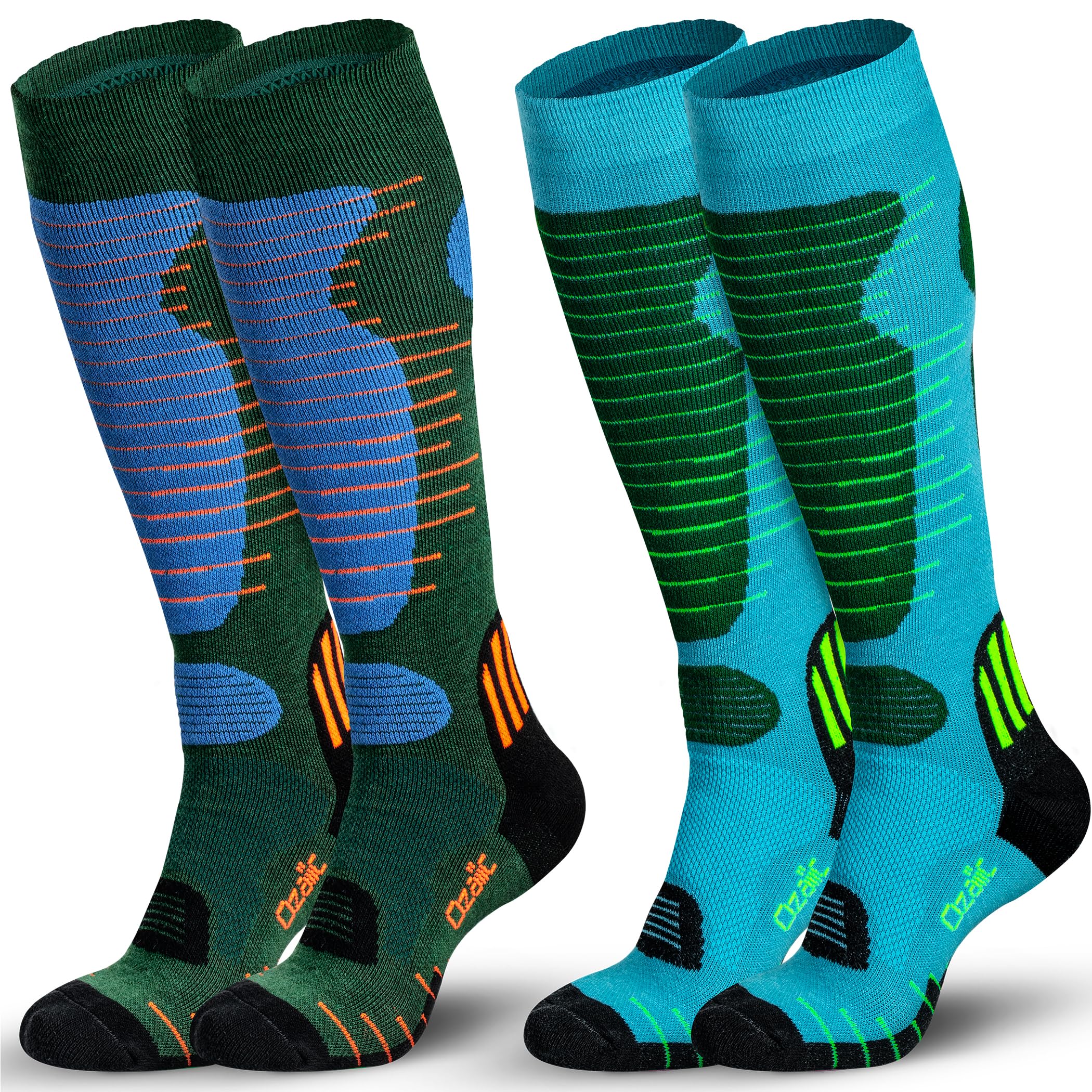
Ozaiic Merino Ski Socks 2-Pack
Key Features
- Warmth & Moisture: Merino blend
- Durability: Holes between heel and arch
- Fit & Length: Knee-high
- Thickness: Medium
- Price: Budget
The Ozaiic 2-pack offers mild compression that eases leg fatigue during long ski days, and the merino blend delivers warmth. However, the compression can feel too tight for skiers with fuller calves, and there are reports of holes developing between the heel and arch after limited wear. This makes it a solid budget choice for those prioritizing compression support and accepting potential longevity issues.
Pros
- Compression support helps reduce leg fatigue during long days on the slopes.
- Great value for money – an affordable two-pack with merino blend warmth.
Cons
- Compression may feel too tight for skiers with larger calves.
- Durability is a concern – holes can develop between heel and arch after limited use.
Best for skiers who want compression benefits and are willing to monitor for early wear, or as a spare pair.
Best for Tall Women
Welwoos Merino Ski Socks 3-Pack

Key Features
- Warmth & Moisture: Merino blend
- Durability: Heel holes after short-term
- Cushioning: Thick cushioning
- Fit & Length: Knee-high
- Thickness: Thick
- Price: Mid-Range
These socks feel soft against the skin and avoid the itch often found with wool blends. The extra length is a rare find for tall skiers or those with slender legs. Patterns add a stylish touch on the slopes. However, the heel area has been known to wear through after a handful of uses, making these better suited for occasional trips rather than heavy weekly skiing.
Pros
- Soft, cashmere-like feel with no itch
- Length that stays up without tightening for tall women and slender legs
Cons
- Heel area can wear through after a few uses for those who ski frequently
A good buy for style-conscious skiers who hit the slopes only a few times a season and value comfort and fit over long-term ruggedness.
Best for Premium Brand Loyalists
FALKE Women’s SK1 Ski Sock

Key Features
- Warmth & Moisture: Wool-silk blend
- Durability: No review data
- Cushioning: Extra thick padding
- Fit & Length: Over-the-calf
- Thickness: Thick
- Price: Premium
The FALKE SK1 uses a premium wool-silk blend with a 3-layer anti-blister construction and extra thick padding, aiming for warmth and calf protection. The materials feel high-quality, but without customer feedback, actual performance on the slopes remains unverified. This makes it a gamble for those who rely on peer validation, though skiers who trust FALKE’s reputation may appreciate the luxurious feel and targeted cushioning.
Pros
- Premium wool-silk blend delivers natural warmth and softness.
- 3-layer anti-blister design cushions shin and heel to reduce friction.
Cons
- Real-world performance is unverified; claims rely on product description alone.
Best for skiers who trust FALKE’s heritage and want the luxury feel of wool-silk, provided they are comfortable with unverified performance.
Best for Men’s No-Fuss
OutdoorMaster Ski Socks 2-Pack

Key Features
- Warmth & Moisture: Merino blend
- Fit & Length: Over-the-calf
- Thickness: Medium
- Price: Mid-Range
Non-slip cuffs and a snug fit keep these socks in place all day, with warmth that suits most resort skiing. The padding is medium-thickness, so those wanting a plush feel may prefer a thicker option. Its shorter time in use means the ability to hold up over multiple seasons is less certain than the more popular OutdoorMaster sock—worth noting for frequent skiers.
Pros
- Warm and comfortable on cold days
- Non-slip cuff prevents socks from sliding down during runs
Cons
- Padding is too thin for skiers who prefer thick cushioning underfoot
- For those skiing multiple seasons, durability confidence is lower than for socks with a longer track record
A solid choice for casual skiers who want a secure fit at a reasonable price, but those prioritizing proven long-term performance should consider the more established OutdoorMaster sibling.
Best for Intermediate Skiers
FALKE Men’s SK2 Ski Sock

Key Features
- Warmth & Moisture: Merino blend
- Durability: No review data
- Cushioning: Medium padding
- Fit & Length: Over-the-calf
- Thickness: Medium
- Price: Premium
This merino blend sock from FALKE features medium cushion and quick-dry properties suited for intermediate skiers. However, the brand’s reputation does not substitute for verified customer feedback — real-world durability and fit remain unknown. For the premium price of a single pair, this is a trust-based purchase best suited to existing FALKE loyalists rather than buyers seeking assurance from other skiers.
Pros
- Breathable merino wool blend dries quickly during active skiing.
- Medium cushion offers comfort for intermediate skiers.
Cons
- Premium price for a single pair of socks.
- No customer reviews to confirm performance claims.
Best suited for skiers who already trust FALKE’s quality and don’t require peer validation.
How to Choose
The difference between a ski sock that lasts a season and one that develops holes in a week comes down to the amount of nylon blended into the merino wool.
Warmth & Moisture Management
Merino wool is the gold standard for warmth because it traps air and wicks moisture away from skin. But pure merino is too delicate for skiing; most socks blend it with acrylic or nylon to add strength while retaining insulation.
The wool percentage alone doesn’t tell the full story—a 30% merino blend with high-quality acrylic can feel warmer than a 60% merino sock with poor construction. Look for a balance that keeps feet dry without excessive bulk, especially if you tend to sweat or ski in wet conditions.
Durability
Heel and toe wear are the most common failure points because those areas endure the most friction inside a boot. Nylon or polyamide reinforcement in these zones is what prevents blowouts; a sock with less than 15–20% nylon is more likely to develop holes after a few wears.
The trade-off is that higher nylon content can make the sock feel less soft out of the box. But for skiers who want socks to last more than a handful of trips, that slight stiffness is worth it—it saves money over time.
Cushioning Placement
Not all cushioning is created equal. Targeted padding on the shin, heel, and toe reduces pressure points and fatigue, while full-cushion socks add warmth but can make boots feel tight. For most skiers, a medium-density sock with padding only where needed is the sweet spot.
Zero-cushion socks work well for custom-fitted boots where every millimeter counts, but they offer little impact protection for the shin on hard landings. Choose based on how much boot space you have and how aggressively you ski.
Fit & Length
Ski socks should reach at least mid-calf—ideally over-the-calf—to prevent bunching inside the boot and to protect the shin from pressure. Socks that are advertised as knee-high but only reach mid-calf can slip down and cause discomfort.
Calf circumference is another hidden variable. Many socks are cut for average legs; if you have large calves or very skinny legs, check user reports on fit. A sock that is too tight can restrict circulation, while one that is too loose will wrinkle and cause blisters.
Thickness & Boot Compatibility
Sock thickness directly affects boot fit. A thick sock takes up volume inside the boot, which can cause pressure points or numbness if the boot is already snug. Conversely, a thin sock in a loose boot leads to heel lift and blisters.
Most resort skiers do best with a medium-thickness sock (roughly 3–5mm of cushion). If you have custom orthotics or a performance fit, a thin or zero-cushion sock is necessary. Test with your boots before committing to a multi-pack.
FAQ
Why do my ski socks get holes in the heel after just a few days?
Heel holes are usually caused by insufficient nylon reinforcement in the blend. Many budget socks use a high wool-to-nylon ratio to cut costs, but wool alone cannot withstand the constant rubbing inside a ski boot. Look for socks with at least 15% nylon or polyamide in the heel and toe areas—they last significantly longer.
Are thick or thin ski socks better for custom-fitted ski boots?
Thin or zero-cushion socks are the right choice for custom-fitted boots. Any extra thickness will compress your foot against the shell, creating hot spots and reducing circulation. The best option for performance boots is a thin merino blend with a seamless toe, like Smartwool’s Zero Cushion, which provides warmth without adding volume.
How many pairs of ski socks should I bring for a week-long trip?
Plan for one pair per day plus one backup—so 7–8 pairs for a week. Ski socks get damp from sweat even if they feel dry, and wearing them multiple days without washing invites odor and reduces insulation. Multi-packs (3–4 pairs) are cost-effective, but make sure they are made of a quick-dry blend so you can hand-wash and dry overnight if needed.
Do merino wool ski socks really keep your feet dry or do they just feel less sweaty?
Merino wool absorbs moisture vapor without feeling wet, which is why it feels less clammy than synthetic socks. However, if you sweat heavily, even merino can become saturated. The key is a blend that wicks moisture to the outer layer and allows it to evaporate. Socks with a high nylon content do not absorb moisture as well, so a balanced merino-acrylic-nylon blend works best for most skiers.