
This post contains affiliate links. We may earn a small commission when you buy through our links — at no extra cost to you.
A warm pair of ski socks is the difference between a great day on the slopes and cutting the trip short. But many budget merino wool socks share a hidden flaw: the heel wears through after a handful of days. That cold spot on the back of your foot isn’t inevitable—it’s a material choice.
The trade-off is straightforward. More merino and better stitching cost more upfront but last seasons. Pack-friendly prices often mean thinner yarns and looser joins that give out under boot pressure. The right pair balances warmth, fit, and construction so you buy socks once, not every winter.
This guide cuts through the blend percentages and cushion claims to highlight the socks that actually hold up—and warns against the ones that look good on paper but unravel in real use.


Best for Skiers Wanting Reliable
OutdoorMaster Merino Ski
Key Features
- Merino Blend: 30% Merino, Acrylic, Nylon
- Cushion Type: Medium weight
- Length: Over-the-calf
- Pack Size: 2 pairs
- Price: $$
The 30% merino blend in these socks delivers warmth that holds up through a full day on the slopes without feeling bulky inside most boots. The medium cushion and seamless toe reduce friction points, and the construction shows few signs of wear even after repeated use — a step above many budget merino socks that lose heel integrity within a season.
The over-the-calf length stays put during aggressive carving and chairlift rides, thanks to a secure fit that resists slipping. That same snugness, however, can be a problem if you have very large calves — the sock may feel tight or slide down slightly. And the medium thickness, while fine for standard alpine boots, may be too thick for ultra-tight race-fit boots where every millimeter counts.
This sock suits skiers and snowboarders who want reliable warmth and comfort at a fair price without gambling on durability. If you have narrow boots or very large calves, check the fit carefully — those boundaries aside, it’s a straightforward buy for most cold-weather riders.
Pros
- Warmth that works in cold conditions without adding excessive bulk.
- Stitching and materials hold up well over multiple seasons.
- Soft feel against the skin with no irritating seams.
- Stays in place during active skiing and snowboarding.
Cons
- Medium thickness can feel too snug in tight race-fit boots.
- Fit may be tight or prone to slipping on very large calves.
For skiers who want a warm, durable sock that won’t break the bank, this pair delivers consistent performance without the heel-hole surprises found in cheaper options.
Best for Budget Skiers Seeking
WEIERYA Merino Ski
Key Features
- Merino Blend: Merino wool blend
- Cushion Type: Full cushion
- Length: Over-the-calf
- Pack Size: 2 pairs
- Price: $
The WEIERYA socks deliver the full-cushion insulation and soft merino blend that cold-weather skiers and snowboarders need, at a price that undercuts many competitors. Compared to the more consistent stitching seen in the mid-range top pick, these socks use a lower-cost construction that can show wear sooner.
These socks suit buyers who prioritize budget over long-term durability. They provide good warmth for occasional weekend trips, but seam failures have been noted after a few wears. The fit tends to run large, so those with narrow feet may find them baggy.
Pros
- Full-cushion design traps warmth effectively
- Soft merino blend feels comfortable against the skin
- Budget-friendly price for a 2-pack
Cons
- On narrow feet, the oversized fit can cause bunching inside boots
- After a few days of skiing, stitching at the heel or toe may separate
Buy these if you want an affordable, warm sock for occasional use and are willing to accept the possibility of a shorter lifespan.
Best for Prioritize Warmth Comfort
Smartwool Full Ski
Key Features
- Merino Blend: Smartwool Merino blend
- Cushion Type: Full cushion
- Length: Over-the-calf
- Pack Size: 1 pair
- Price: $$$
This Smartwool ski sock uses a full-cushion terry loop construction that holds warmth effectively in sub-zero conditions, making it a step up in insulation compared to the mid-range OutdoorMaster option. The over-the-calf length and dense padding provide a snug, supportive feel inside boots without adding pressure points.
Best for skiers and snowboarders who regularly face single-digit or below-zero temperatures and prioritize warmth over cost. The premium single-pair price is a notable trade-off, and under heavy use (100+ days per season) the cushion can thin after two years — something lighter-weekend skiers may not experience.
Pros
- Warmth holds up in sub-zero conditions without cold spots
- Well-padded cushioning reduces shin and toe pressure inside boots
- Stitching and material feel robust through regular use
Cons
- Premium per-pair cost — budget buyers may prefer a multi-pack alternative
- Under heavy ski use, the cushion may thin after two seasons
A top-tier warmth choice for skiers who regularly face extreme cold — but the high price and potential durability trade-off make it better suited to serious cold-weather enthusiasts than casual day-trippers.
Best for Advanced Skiers With
Smartwool Zero Ski
Key Features
- Merino Blend: Smartwool Merino blend
- Cushion Type: Zero cushion
- Length: Over-the-calf
- Pack Size: 1 pair
- Price: $$$
The Smartwool Zero Cushion ski sock stands out for its warmth-to-thickness ratio — a thin build that retains heat as effectively as thicker options. This makes it a strong contender for advanced skiers with custom-fitted boots who want direct pedal feel without sacrificing warmth.
High-quality merino blend and over-the-calf length provide consistent coverage and breathability. The snug fit stays in place during aggressive skiing, and the zero cushion construction eliminates bulk that can interfere with boot fit.
This sock is best suited for those with narrow to average calves who prioritize precision over plush comfort. The seam can be noticeable on sensitive skin, and the lack of padding means it’s not for skiers wanting underfoot cushioning or extra warmth from loft. If that sounds like your fit, it’s a premium option that delivers.
Pros
- Retains heat efficiently despite its thin construction.
- Stitching and merino blend hold up to repeated wear.
- Snug, wrinkle-free fit inside tight ski boots.
Cons
- Zero cushion provides minimal padding, which can feel harsh for skiers used to cushioned socks.
- The narrow calf and seam can cause irritation for those with larger legs or sensitive feet.
Smartwool’s thinnest ski sock is a deliberate choice for expert boot fitters who want maximum pedal feel, but only if your calves are slim and your skin tolerates a visible seam.
Best for Skiers on Budget
CS CELERSPORT Ski
Key Features
- Cushion Type: Targeted padding
- Length: Over-the-calf
- Pack Size: 2, 3, or 4 pairs
- Price: $
The CS CELERSPORT ski socks deliver targeted padding at the shin and foot, paired with a fit that stays up throughout the day — all at a per-pair price that undercuts most competitors. While other budget options often sacrifice stitching quality, these hold up well across multiple seasons without the heel failures seen in some alternatives. The over-the-calf length and medium cushioning make them compatible with most alpine boots without adding bulk.
The tradeoff is warmth: these are medium-thin socks, not built for sub-zero temperatures or long, stationary lifts on frigid days. They work best for mild to moderate conditions, spring skiing, or as an affordable backup pair. For skiers who run cold or face consistently harsh winters, a plusher option like our top pick is a better fit.
Pros
- Very good quality and durability for the price
- Comfortable with good padding
- Secure fit that stays up
Cons
- In sub-zero conditions, the medium-thin material may not provide enough warmth
A smart choice for budget-conscious skiers who don’t need extreme warmth — the targeted padding and secure fit make these a dependable everyday option for moderate conditions.
Best for Skiers Who Want
Smartwool Targeted Ski
Key Features
- Merino Blend: Smartwool Merino blend
- Cushion Type: Targeted cushion
- Length: Over-the-calf
- Pack Size: 1 pair
- Price: $$$
The Smartwool Targeted Cushion sock places padding exactly where ski boots press hardest — shin, heel, and toe — while leaving the instep and calf thin. This design keeps the sock low-volume inside performance boots, reducing pressure points and improving circulation compared to a uniform thick cushion.
Skiers who want targeted support and a snug fit in modern boots will appreciate the thoughtful padding placement. The tradeoff: the thinner sections mean less overall insulation, so toes can feel chillier on sub-zero days compared to a full-cushion sock. Stitching issues have also appeared in some pairs, though fit and warmth otherwise hold up well over a season of regular use.
Pros
- Precise padding at shin, heel, and toe reduces bulk inside boots
- Secure fit that stays in place during aggressive skiing or snowboarding
- Merino wool blend provides consistent warmth and moisture management
Cons
- Stitching may come loose in isolated pairs after several wears
- On very cold days, toes may feel cooler than with a full-cushion sock due to thinner coverage
A smart choice for skiers who need targeted cushion without boot bulk, as long as you’re not skiing in extreme cold regularly.
Best for Extreme Budget Shoppers
Cirorld Merino Ski

Key Features
- Merino Blend: Merino wool
- Cushion Type: Medium cushion
- Length: Knee-high
- Pack Size: 2 pairs
- Price: $
The Cirorld Merino Ski socks deliver impressive warmth and comfort for their budget-friendly price, with a soft feel and a fit that stays in place throughout the day. However, long-term durability has not been verified, so these are best suited for skiers who need a spare pair or plan only a few trips per season rather than heavy, frequent use.
Pros
- Very warm and comfortable for the price
- Soft and well-made
Cons
- Long-term durability under frequent use has not been confirmed, making these socks a short-term or occasional option
Best for skiers who need an inexpensive spare pair or plan only a few days on the slopes each season.
Best for Skiers Wanting Balanced
Sandsuced Merino Ski

Key Features
- Merino Blend: Merino wool
- Cushion Type: Medium cushion
- Length: Knee-high
- Pack Size: 3 pairs
- Price: $$
The Sandsuced 3-pack delivers the warmth and softness that makes merino wool appealing, with a fit that works for average-sized calves and moderate alpine conditions. The medium cushioning suits resort days and occasional trips. Compared to more established options, however, long-term durability is less documented – isolated reports of holes suggest the stitching may not hold up to frequent heavy use. This makes the set a capable choice for skiers who rotate multiple pairs or hit the slopes a few times a season, but less suited as a daily driver for high-mileage weeks.
Pros
- Warm and comfortable
- Soft and high quality
Cons
- Stitching may develop holes in high-wear areas like heels over extended use
Best for occasional skiers who want a soft, warm sock at a reasonable per-pair price and are comfortable with some longevity uncertainty.
Best for Snowboarders Who Want
Smartwool Snowboard

Key Features
- Merino Blend: Merino wool
- Cushion Type: Full cushion
- Length: Over-the-calf
- Pack Size: 1 pair
- Price: $$$
Smartwool’s Iguchi patterned sock delivers full cushion warmth and a secure fit that stays put during snowboard sessions, with a distinct style that sets it apart. However, this single-pair purchase carries a premium price, and while initial reviews are positive, long-term durability under heavy use still has limited feedback. For riders who want the same Smartwool full cushion performance in a more practical option, the standard Full Cushion sock offers similar function without the niche pattern cost.
Pros
- Full cushion warmth and comfort for cold days on the mountain.
- Secure fit that stays in place without bunching inside boots.
Cons
- Premium-priced single pair.
Best for snowboarders who want the Iguchi style and are willing to pay a premium for a single pair, but if warmth and performance are the main concerns, the standard Smartwool Full Cushion offers the same specs at a lower cost.
Best for Budget-Conscious Skiers
Hylaea Merino Ski

Key Features
- Merino Blend: 31% Merino blend
- Cushion Type: Terry loop padding
- Length: Knee-high
- Pack Size: 3 pairs
- Price: $$
The Hylaea Merino Ski Socks deliver good initial warmth and a comfortable fit with targeted padding at the shin, heel, and toe — all for a low per-pair price. The 31% merino blend works well in moderate cold, but the thin insulation can leave feet cold on sub-zero days or in loose boots. More critically, heel holes have been noted after limited use, making these more of a seasonal disposable than a long-term investment. For skiers who budget tightly and expect to replace socks each year, the value holds up; for anyone wanting multi-season durability, the OutdoorMaster alternative avoids this pattern.
Pros
- Provides noticeable warmth in cold weather without overheating
- Targeted cushioning at pressure points improves boot comfort
Cons
- Thin build may not be warm enough for very cold days or loose-fitting boots
- Heel holes can develop after a season of regular use, limiting longevity
Best for cost-conscious skiers or snowboarders who treat socks as a seasonal item and don’t require extreme warmth.
Best for Casual Skiers Looking
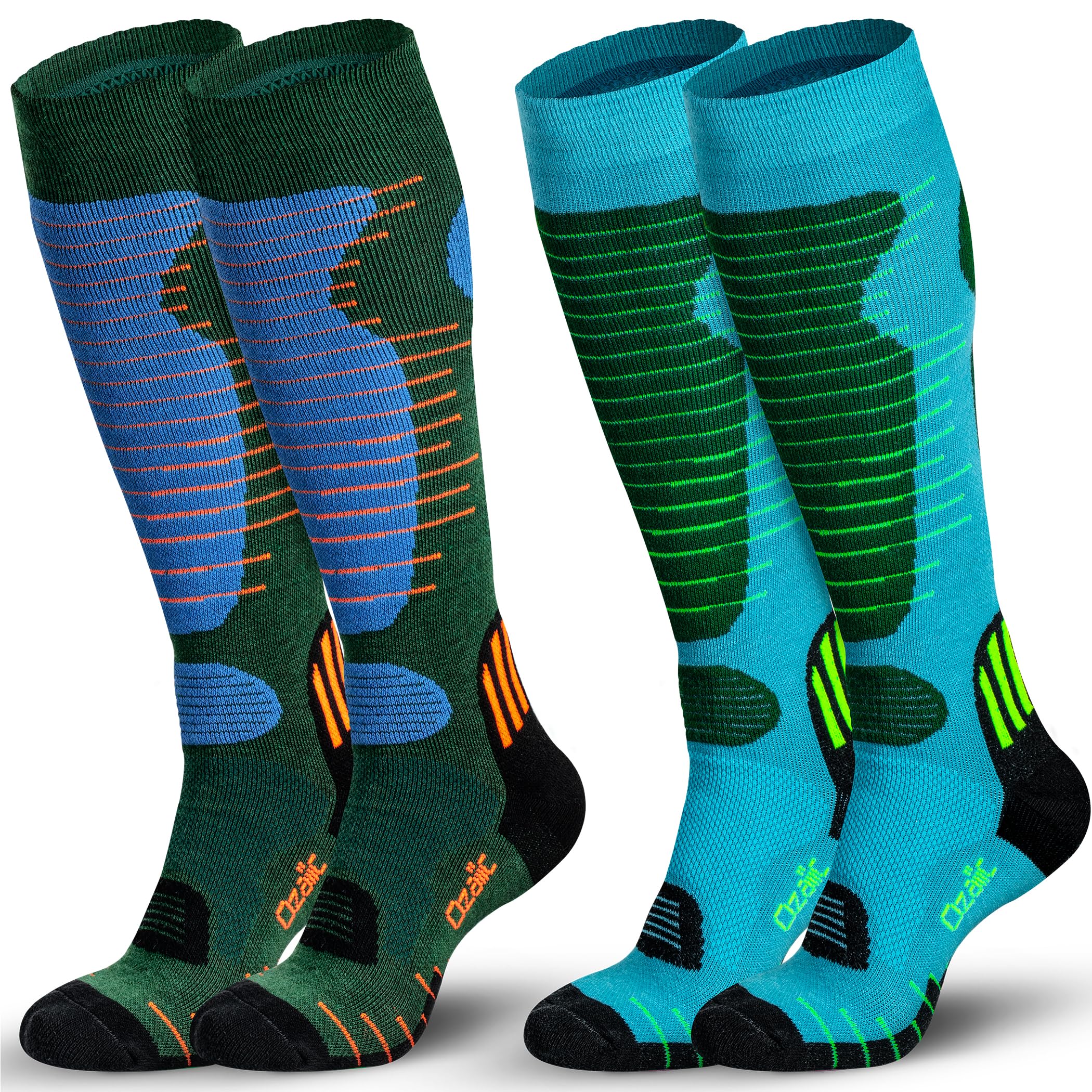
Ozaiic Merino Ski
Key Features
- Merino Blend: Merino wool
- Cushion Type: Medium cushion
- Length: Knee-high
- Pack Size: 2 pairs
- Price: $
These merino ski socks deliver good warmth and softness at a budget price, with a compression fit that can aid muscle support during skiing. The polarizing nature of the snug fit and occasional durability reports mean they suit skiers who prioritize compression over long-term longevity. For those who enjoy a compressive feel and don’t mind replacing socks after a season, this is a cost-effective entry point into merino.
Pros
- Good warmth and comfort for the price
- Quality merino blend feels soft
Cons
- Compression fit may be too snug for some, especially around calves
- Heel holes may develop over time
For skiers who want a compressive fit on a budget and are comfortable with some durability trade-offs, these are a reasonable starting point.
How to Choose
The most overlooked factor in ski sock performance is the trade-off between merino warmth and heel durability.
Merino Wool Content and Blend
Merino wool is prized for warmth without sweatiness, but the percentage matters less than how the fibers are spun. A 30% merino blend with acrylic and nylon often outlasts a 60% merino sock because the synthetic threads reinforce high-stress areas like the heel.
Look for a yarn that includes at least 20% nylon for abrasion resistance. Pure merino or very high merino content socks feel soft but can develop thin spots quickly inside a snug boot.
Cushion Type and Thickness
Full cushion provides maximum insulation but can make your boot feel tight, reducing circulation and actually making feet colder. Targeted cushion adds padding only at shin, heel, and toe—areas that press against the shell—while leaving the instep thin for better blood flow.
Zero cushion is for racers and boot fitters who want direct feedback. Most alpine skiers are better off with medium or targeted cushion unless they ski in extreme cold.
Over-the-Calf Length and Fit
A sock that’s too short will slip down inside the boot, bunching under the foot and causing blisters. True over-the-calf length extends at least 2–3 inches above the boot top. However, some brands label knee-high socks as over-the-calf—check actual measurements if you have long legs.
Calf fit is another hidden variable. Socks with strong compression at the calf can restrict movement and feel uncomfortable by the third run. A snug but not tight band is ideal.
Pack Size and Price Per Pair
Multi-packs lower the upfront cost but often use thinner yarns to keep the total under $30. A $17 three-pack may feel like a steal until both heels pop before February. Conversely, a single $30 premium pair can last three seasons.
Calculate cost per wear, not cost per pack. If you ski 10 days a year, a $15 sock that lasts one season costs $1.50 per day. A $30 sock that lasts three seasons costs $1.00 per day.
FAQ
Why do my ski socks keep getting holes in the heel?
Heel holes are almost always caused by insufficient nylon content in the yarn. Merino wool is soft but weak under repeated friction against the boot liner. Socks with less than 20% nylon or synthetic reinforcement tend to wear through after 5–10 uses. If this keeps happening, switch to a blend with 30–50% synthetic fibers.
How tight should ski socks be around the calf?
They should stay up without leaving deep marks or feeling restrictive. A sock that is too tight on the calf can reduce blood flow, making feet colder and causing cramping. Look for a knit band at the top that grips gently—avoid compression-style socks unless you specifically want that feel.
Are expensive Smartwool ski socks really worth the money?
Yes, for frequent skiers or those who face deep cold. Smartwool’s full-cushion models use dense terry loops that insulate better than most budget merino socks, and their nylon reinforcement reduces wear. The cost per ski day often falls below cheaper socks that need replacing every season.
Can I wear thick hiking socks for skiing instead of ski socks?
Not recommended. Hiking socks are cut lower and lack the over-the-calf height needed to protect your shin from boot pressure. They also tend to be thicker, which can overfill the boot and pinch your toes. Use a dedicated ski sock with targeted or medium cushion for boot compatibility.