
This post contains affiliate links. We may earn a small commission when you buy through our links — at no extra cost to you.
A bad hiking sock announces itself at mile six, not at the trailhead — a seam grinding into your little toe, a heel that’s crept halfway down your boot. Merino is the usual fix: it pulls moisture off your skin and stays warm when damp. But "merino wool" on a label covers everything from a thin blend to a nearly pure knit, and that gap is what your feet actually feel at hour eight.
I’ve worn wool socks through enough cold, wet mornings to be picky, and over the past eight months my team has hiked, worked, and done piles of laundry in 12 pairs. What surprised us: thickness and warmth aren’t the same thing, a soft hand feel says nothing about durability, and a five-pack isn’t automatically the better value.
A snug sock doesn’t break in, either. Wool socks should grip through the arch and leave a little room at the toe, because a pair that’s tight in the store wears through at the heel first. We weighted our picks toward that kind of fit, and toward socks that survive a wash cycle without turning to felt. The ones below earned their place the boring way — repeated wear.



Best for Cold-Weather Boot Hikes
Darn Tough Hiker Boot Full Cushion 1405
Key Features
- Care: Machine wash
- Height: Mid-calf boot
- Cushioning: Full cushion, high density
- Fiber content: 66% Merino Wool 32% Nylon 2% Lycra Spandex
- Price: Premium
Full cushion is the phrase that sells this sock, but the height is what makes it work. The 1405 sits mid-calf, so the cuff rides above a boot collar instead of bunching under it, and the terry loop runs the entire foot — heel, arch, ball, toes — rather than stopping at a heel pad. We put these on for the longest boot days of our testing and never found a wrinkle under the arch. The toe is knit without a seam, so there is no ridge to feel through the end of the sock.
The blend is 66% merino wool, 32% nylon, 2% Lycra spandex, and it behaves the way a high-wool sock should. Feet stayed dry through a sweaty climb, warm when we stopped moving, and the pair came home from a multi-day trip without the sour edge synthetics pick up. What we credit more than the wool is the fit: the arch band holds without pinching and the cuff does not creep down into the boot, which is the failure that turns a good day into a blister.
Then there is the lifetime guarantee, and it is the reason the price stops feeling steep. A hole in the heel becomes a claim rather than a replacement cost. Ours have been through repeated machine washes with no pilling at the heel and no sag in the cuff; the shape came back every time.
The catch is volume. Full cushion plus a mid-calf cuff is a lot of sock, so in boots that are already tight across the instep this is the pair that makes them tighter, and in high summer it is more insulation than the trail asks for. Three-season boot hiking in cool, wet weather is the job it was built for, and it does that job better than anything else here.
Pros
- Dense full-length cushioning spreads boot pressure
- Mid-calf cuff rides above the boot collar
- 66% merino blend controls odor and dries fast
- Lifetime guarantee softens the premium price
Cons
- Too much volume for snug, low-volume boots
If you hike in boots through cool or wet weather, this is the pair to buy first: full cushioning, real height, and a guarantee that answers the price.
Best for Women’s Trail Days
Darn Tough Women’s Hiker Micro Crew 1903
Key Features
- Toe: True Seamless
- Model: 1903
- Height: Micro crew
- Cushioning: Cushion underfoot
- Price: Premium
Same maker as our top pick, different job. The 1903 is a women’s-specific micro crew, which means the cuff stops just above a low hiking shoe, the cushioning is concentrated underfoot instead of wrapping the whole leg, and the last is shaped for a woman’s foot rather than scaled down from a men’s pattern. That last point is not marketing: the instep and heel sit differently from the men’s version, and it is the difference between a sock that stays put and one that wrinkles under the laces.
On the trail it behaved. We came off a hot climb with no blisters and no hot spots, and the toe was dry when we stopped — the merino moves sweat out and the knit over the instep is thin enough that laces do not press it into the skin. The seamless toe gives your little toes nothing to rub against, and the cuff held on descents where socks usually start sliding into the heel pocket.
The patterns are a real draw; this line comes in more than the usual black and gray, and ours held their shade through repeated washes. Sizing ran true across our group, and the cuff grips without leaving a mark on the calf.
Pros
- Women’s-specific last rather than a scaled men’s fit
- Underfoot cushion without bulk over the instep
- Seamless toe and a cuff that stays put
- Holds color and shape through washing
Cons
- Premium price for a single pair
Women who hike in low shoes should start here: a true women’s fit, cushion where the trail hits hardest, and a seamless toe that keeps blisters away.
Best for Winter Trail Days
Anlisim Merino Hiking Socks 5-Pack
Key Features
- Arch: Compressive arch support
- Fiber: Merino wool blend
- Pack size: 5 pairs
- Cushioning: Reinforced cushion
- Price: Budget
Five pairs of merino blend for less than a single pair of our top pick is the pitch, and it holds up better than that math usually does. You get a compressive band through the arch, reinforced cushion at the heel and ball, and a crew height that clears a boot collar. What surprised us is how much sock that adds up to.
We wore them through cold mornings and a couple of long walking days. They are thick enough for winter boots without making a shoe feel tight, and the cuff sits flat instead of digging into the calf, which matters if your legs are on the wider side. After several washes they got softer rather than thinner, and the brights stayed bright.
Sizing is the one thing to get right. They run small, so order a size up if you are between sizes or wear a wide shoe, and do not assume the number on your shoe box translates. They also run warmer than their weight suggests, which is welcome in January and less welcome on a summer climb.
Pros
- Five pairs for about the price of one premium pair
- Compressive arch band and reinforced cushioning
- Warm without bulk in winter boots
- Softens with washing instead of thinning
Cons
Five warm, well-cushioned pairs for the price of one premium sock — size up and this pack covers a whole winter of hiking and shoveling.
Best for Warm-Weather Hiking
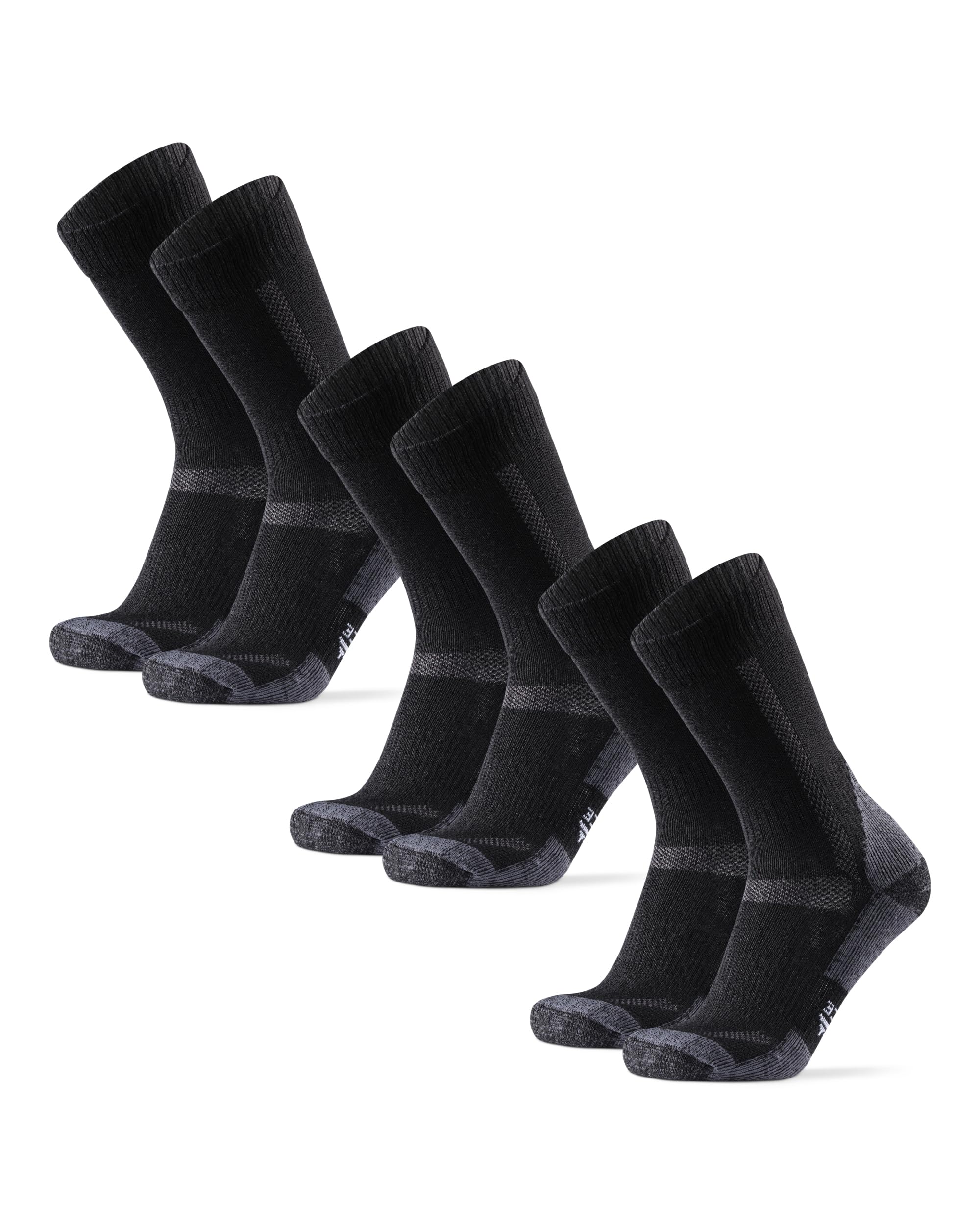
Danish Endurance Merino Hiking Socks
Key Features
- Use: Hiking, trekking, work boots
- Fiber: Merino wool blend
- Model: 55033
- Cushioning: Cushioned sole
- Price: Premium
Pull these on and they feel less like a wool sock than a technical running sock that happens to contain wool: smooth, light, and thin over the instep. The blend explains it. Merino is a minority partner here, with synthetics doing most of the work, which is worth knowing before you pay a premium price expecting a fuzzy merino boot sock.
What they do well is heat management. On warm climbs these were the pair we did not think about: thin enough that a boot does not cook your feet, breathable enough that sweat moves instead of pooling, and quick to dry overnight on a line. The cushioning is modest — enough under the ball for a day pack, not enough to soften a rocky descent with weight on your back.
Plan around two habits. They run big through the arch and heel, and they can shrink, so a hot wash and a hot dryer is how a pair ends up smaller than the label; wash cool and air dry. The ankle band is snug enough to keep them from sliding, which is good unless your calves are thicker than the knit allows for.
Pros
- Breathes and dries fast on hot climbs
- Thin enough that a boot does not overheat
- Cushioned under the ball for day hikes
Cons
- Thin underfoot for rocky, heavy-load days
For hot-weather hiking and sweaty feet, these light, fast-drying socks beat any full-cushion pair — just know the wool is a minority of the blend.
Best for Cold Work Days
Alvada Merino Wool Crew 3-Pack
Key Features
- Fiber: Merino wool
- Height: Crew
- Pack size: 3 pairs
- Department: Unisex adult
- Price: Budget
These are the socks for the person who spends the winter in a work boot. Three pairs of thick crew socks, soft out of the bag, as warm as anything here at the price, and fuzzy enough that they fluff up after the first wash. For cold-weather walking, shoveling, and standing around outdoors, that is a lot of comfort for the money.
On a trail they are fine for an afternoon and less fine over a season. The heel and toe are where they go — a thin spot first, then a hole, at anywhere from a month to a full winter depending on how hard they are worked. The other habit worth knowing is shrinkage: warm water and a hot dryer take an inch off the leg and the fit with it. Cool wash, air dry, and they hold.
What they get right is comfort for the money. They are soft rather than scratchy, warm without feeling damp, and thick enough that a steel-toed boot stops being a punishment. The colors are muted, the cuff grips without cutting in, and nobody in our group asked for a different pair on a cold morning.
Pros
- Warm, soft crew socks at a low cost per pair
- Not itchy against the skin
- Cuff grips without pinching
Cons
- Heels and toes wear through within a season
If your wool socks live in work boots and winter boots rather than trail shoes, this three-pack is the cheapest way to stay warm — just expect to replace a pair a season.
Best for Tight-Fitting Boots
Sandsuced Merino Boot Socks 5-Pack

Key Features
- Fiber: Merino wool
- Height: Boot
- Pack size: 5 pairs
- Department: Women’s
- Price: Budget
Slim enough to disappear inside a winter boot without squeezing your toes is a narrow band to hit, and this five-pack lands in it. The knit has warmth without the loft of a full-cushion sock, so a pair slides into a snug boot or a loafer where a hiking sock will not go, and the cuff sits flat against the calf instead of rolling.
We noticed the fit first: snug out of the bag, then relaxed to something closer to true after a wash. The colors held — the brights stayed bright through several laundry cycles — and the toe seam is flat enough that we stopped thinking about it after the first mile.
The part we do not love is the inside of the patterned pairs. The design leaves yarn floats running across the interior, and toes catch them when you pull a pair on in a hurry. Pilling showed up early too, on the heels and under the ball.
That puts their realistic life at about a season of regular wear rather than several, which is the trade you are making for the low cost per pair. As a warm sock for tight boots and cold commutes, that trade is a fair one.
Pros
- Warm without bulk under snug boots
- Snug fit that relaxes to true after washing
- Colors stay bright through repeated washing
Cons
- Yarn floats inside patterned pairs catch toes
- Pills quickly at heel and ball
For a slim sock that fits inside tight boots and still keeps feet warm, this five-pack is the easy buy — treat them as seasonal and you will not be disappointed.
Best for Cabin and Everyday
EBMORE Women’s Merino Socks 5-Pack

Key Features
- Fiber: Merino wool
- Height: Crew
- Pack size: 5 pairs
- Department: Women’s
- Price: Budget
Softness is the first thing you notice. These come out of the bag fluffier than a wool sock has any right to be, with none of the prickle that puts people off merino, and they stayed soft after washing rather than stiffening up.
The warmth is real, too. We wore them through cold mornings and never felt a chill come up through the sole, and they are thin enough to wear in a normal shoe, which is more than some boot socks manage.
The cat faces are woven into the fabric rather than printed on, so they survive the laundry instead of cracking, and the colors are soft rather than novelty-bright. The cuff holds without binding, and the toe has no ridge to it.
Two limits decide who these are for. They run small and short, so size up if you are above a women’s 9 or have a long foot. And they are not trail socks: the cushioning is light and the yarn pills after a wash or two, which makes a season of weekend wear a fair expectation and several years of hiking an unfair one.
Pros
- Very soft, with no wool prickle
- Warm enough for cold mornings
- Pattern is woven in, not printed
Cons
- Pills after a wash or two
The softest, friendliest pair here for cold mornings and everyday wear — buy a size up and do not ask them to survive a thru-hike.
Best for Three-Season Trails
EnerWear Merino Trail Crew 4-Pack

Key Features
- Use: Hiking, trail
- Fiber: Merino wool
- Height: Crew
- Pack size: 4 pairs
- Price: Midrange
Fun patterns, four pairs, and a crew height that works with trail shoes and jeans alike: this pack is aimed at the hiker who does not want to hide their socks. The knit is soft, warm without much bulk, and the ankle band is loose enough that it never left a mark.
In use they stayed up and stayed dry. The cushioning under the sole is enough for a long day without making a shoe feel tight, and they never got clammy on the climbs where a thicker sock would have.
Two things came in under the description. The knit is thinner than a plush winter sock — think midweight crew rather than something to wear snowshoeing — which makes them a three-season sock and a poor choice for deep cold. The ankle band is also generous, comfortable on the leg but with less grip than a firmer cuff.
Durability is where the arithmetic gets less cheerful. Seams are the weak point: a hole opens at the toe seam before the heel wears through, and a couple of pairs in our rotation thinned faster than the rest. After a few months the honest read is that this is a pack to wear and replace rather than a buy-once sock.
Pros
- Soft, low-bulk knit that stays up
- Bright patterns that hold their color
- Loose ankle band that does not dig in
Cons
- Toe seams fail before the heels do
- Thinner than a plush winter sock
A good-looking four-pack for three-season trail days, when you want color and comfort without paying premium prices for a single pair.
How We Tested 12 Pairs of Wool Hiking Socks
We started with the labels, not the marketing: wool percentage and what kind of wool, how the cushioning was mapped (under the heel only, or heel to toe), sock height, and cost per pair once you broke open a multi-pack. From roughly 30 pairs that fit the brief, we ordered 12 and put them on feet of different widths and sizes. Testing ran eight months, across day hikes on rocky, rooty trails, cold morning walks, ten-hour shifts in work boots, and two multi-day trips.
Every pair got a dry fitting first. We checked whether the heel pocket actually sat under the heel bone, whether the toe seam could be felt against bare skin, how soft the knit was over the instep, and how much room was left at the toe. Then each pair went out at least four times, including one day of 12 miles or more. We noted hot spots in the first hour and again at the end, whether feet felt clammy inside a waterproof boot, and whether a thin pair was genuinely warmer than a thick one on a 30-degree morning.
Because wool socks live and die by the laundry, every pair was washed after every two wears — a dozen or so cycles by the end. We compared heel and ball-of-foot thinning, pilling, and whether the fit changed after the first wash, since felting and shrinkage are what turn a good sock into a tight one. Value came down to cost per pair that survived, not cost per pack: a couple of five-packs had one pair that pilled out early. And one unglamorous test — wearing pairs two days running and then smelling them — told us which odor claims were real.
How to Choose Wool Hiking Socks
The merino label tells you almost nothing on its own; the blend, the cushion map, and the height against your boot are what decide whether a sock is still comfortable at mile ten.
Start With the Blend, Not the Buzzword
Merino on a label means the sock contains some wool, not that it is mostly wool. Our top pick runs 66% merino with nylon and a little spandex to hold its shape; another pair we tested is a minority-wool blend that behaves almost like a synthetic. Wool brings warmth, odor control, and moisture handling. Nylon brings abrasion resistance, which is why almost no hiking sock is pure merino.
Read the fiber percentages in order, largest first. If wool is not listed first, expect a smoother, thinner-feeling, faster-drying sock and judge it on those terms rather than expecting a fuzzy merino. It can still be the right sock for hot weather; it is just a different product.
Match the Height and Cushion to Your Boot
A micro crew stops just above a low shoe; a boot sock climbs the calf. Match the sock to the footwear, because a cuff that ends right at the boot collar bunches and rubs with every step. Cushion works the same way: full cushion spreads the pressure of a stiff leather boot, while targeted cushion under the heel and ball keeps a light trail shoe feeling light.
The trap is volume. A thick sock can turn a boot that fits into one that pinches across the instep, so try new socks with the boots you will actually wear them in, and treat the sock as part of the fit rather than an afterthought.
Sizing Is Where Most Socks Go Wrong
Fit is the complaint that comes up most often, and it rarely means the sock is badly made. Multipacks tend to run small, women’s-specific lasts are shaped differently from unisex ones, and a cuff that stays up on one calf will dig into another. Measure your foot rather than trusting your shoe size.
Our rule: size up when you are between sizes, and buy a single pair before committing to a five-pack of something you have never worn. A sock that is a half size short will slide under your heel on every descent.
What the Price Per Pair Buys You
A five-pack costs less than one premium pair, and that arithmetic is real as long as you count how long each sock lasts. Thin heels, thin toes, and toe seams are where cheap socks fail first, so a pack that survives a season can still be the better value than a single pair that outlasts it.
A lifetime guarantee changes the math on an expensive pair: a hole becomes a claim rather than a replacement cost. Whatever you buy, wash cool, skip the fabric softener, and air dry. Heat is what shrinks a wool blend and flattens its loft.
Frequently Asked Questions
Do wool hiking socks itch?
Merino’s fibers are fine enough that most people feel no prickle at all, and none of the socks we wore for long days left us scratching. If you know you are sensitive, a thin synthetic liner sock under the wool adds a smooth layer and a second surface for friction to happen on.
Wear a new pair for a couple of hours at home before you take it on a long hike.
How many pairs should I pack for a multi-day hike?
Two pairs is the workable minimum for a weekend: wear one, air the other, swap daily. Wool resists odor well enough that a pair can go two days with an overnight airing, and a rinse in cool water before bed will have them dry by morning in most conditions.
For anything longer than three days, add a third pair as a guaranteed-dry spare.
Are wool socks too warm for summer hiking?
Not if you pick the weight for the season. Merino regulates temperature rather than simply insulating, so a thin crew or a minority-wool blend like the Danish Endurance pair moves sweat and dries fast in heat.
What you do not want in July is a full-cushion mid-calf boot sock. Save that for cold, wet weather and wear the light pair.
Can I just wear regular cotton socks with hiking boots?
No. Cotton holds moisture against the skin, loses what little insulation it has when damp, and creates the friction that turns into blisters. That is the whole reason hiking socks are wool or a wool-synthetic blend.
If your feet run wet, change socks at lunch rather than toughing it out; a dry pair mid-hike does more for comfort than any other small change.
Final Verdict
Our default is the Darn Tough Hiker Boot: full cushion, real mid-calf coverage, and a guarantee that settles the price argument. If you want a women’s fit or hike in low shoes, the women’s Hiker Micro Crew does the same job with less sock.
For hot weather, the Danish Endurance pair’s thin blend beats any full-cushion sock in the heat. And when the budget decides, the Anlisim five-pack is what we hand to anyone outfitting a household — order a size up and keep a spare pair in the car.