
This post contains affiliate links. We may earn a small commission when you buy through our links — at no extra cost to you.
Shopping for a 9-month-old can feel like a guessing game. They’re leaving the sleepy newborn phase behind, grabbing everything in sight, and their favorite activity is often the box the gift came in rather than the toy itself. The challenge isn’t finding something colorful or loud — it’s finding something they’ll still be fascinated by next month.
The most-loved gifts tend to be deceptively simple: stacking cups that turn into bath toys, cloth books that make crinkle sounds, or a ring stack they can chew on safely. This guide cuts through the noise to focus on toys that hold attention without driving everyone else crazy, work for travel, and support the milestones that matter right now.




Best for Open-Ended Play
First Years Stack & Count Cups
Key Features
- Age Range: 6-24 months
- Sensory Features: Stacking, nesting, pouring, water holes
- Developmental Focus: Fine motor, counting, nesting
- Portability & Storage: Compact, lightweight, nestable
- Safety Materials: BPA-free plastic
- Price: Budget
Eight cups that stack, nest, and pour — this set adapts to bath time, floor play, and early counting lessons as the baby grows. Numbers printed on each cup bottom turn stacking into a simple counting game for toddlers, while the drainage holes make water play mess-free.
The cups are more compact than many traditional stacking toys. That smaller size makes them easy to pack in a diaper bag or tuck into a bath caddy, and the cup rims fit a 9-month-old’s grip comfortably. For parents expecting jumbo cups, the scale may come as a surprise, but it’s a deliberate choice for portability and little hands.
This set suits parents who want a low-tech, open-ended toy that works across multiple contexts — dry stacking, bath pouring, and later number recognition. It is not for those who prefer a storage ring or case, or who envision oversized cups for dramatic stacking towers. The compact design travels well and fits into a 9-month-old’s daily routine without adding clutter.
Pros
- Strong plastic construction that withstands drops and gnawing.
- Simple stacking and nesting play that holds attention across months.
- Appropriate for babies starting at 6 months with no small parts or sharp edges.
- Budget-friendly price for a toy that works as bath set, counting tool, and puzzle.
Cons
- Cups are smaller than traditional stacking toys — fine for travel but may not match expectations for size.
For budget-conscious gift givers seeking a multi-use toy that grows with a baby from 6 months to toddlerhood, this 8-cup set delivers consistent play without electronic bells or whistles.
Best for Teething & Sensory
Sassy Stacks of Circles
Key Features
- Age Range: 6-24 months
- Sensory Features: Textured rings, rattle, teething-safe
- Developmental Focus: Stacking, sensory, cause-effect
- Portability & Storage: Compact, no carry case
- Safety Materials: BPA-free plastic
- Price: Budget
Unlike stacking cups that invite water play or counting games, this ring stack is singularly designed for oral and tactile exploration. Nine pieces include five textured rings—some with rattles—and a straight center post that eliminates the tilting frustration of classic angled cones. Babies don’t need to align at a precise angle; they can drop a ring and immediately feel success.
This set lands best with 9-month-olds who reach for anything chewable. The BPA-free rings offer bumpy, ridged, and smooth surfaces that double as teethers, and the stack’s overall height is smaller than traditional ring towers—exactly right for little hands that can’t grip larger rings. Adults expecting a grandiose floor toy may find it modest, but for a baby mastering sit-and-play, it stays within arm’s reach without tipping.
Pros
- Textured rings double as teethers for oral explorers.
- Bright, varied colors capture attention and encourage reaching.
- Rings sized for small hands with an easy-stack post that suits babies as young as 6 months.
Cons
- The stack’s small footprint can surprise adults expecting a traditional oversized ring toy, though it suits little hands.
Right for teething babies who need a mouth-safe stacker that rewards early attempts — the compact size is the tradeoff for baby-friendly grip.
Best for Travel Shape Sorting
Fisher-Price First Blocks
Key Features
- Age Range: 6+ months
- Sensory Features: Colorful shapes, bucket
- Developmental Focus: Shape & color recognition
- Portability & Storage: Carry handle, blocks store inside
- Safety Materials: BPA-free plastic
- Price: Mid-Range
Ten colorful blocks fit inside a bucket with a carry handle, turning shape sorting into a grab-and-go activity for babies 6 months and up. The low-tech design encourages repeated dumping, stacking, and matching without batteries or sounds, which keeps the focus on fine motor skills and visual recognition.
This set suits families who want a classic learning toy that travels easily—to grandma’s house or the car. The lid does not snap shut, so it can pop off during active play or transit, spilling blocks. That tradeoff is manageable for most parents (a rubber band provides a quick fix), but buyers expecting a sealed storage container should consider the simpler stacking cups instead.
Pros
- Teaches shape and color recognition through hands-on sorting play.
- Bucket handle and block-storage design make it easy to bring along for outings.
- 10 blocks in varied shapes offer repeated trial-and-error learning without frustration.
Cons
- During travel or active play, the lid can pop off unexpectedly, spilling the blocks on the floor or in the diaper bag.
For fans of simple, battery-free shape sorting that doubles as a travel toy, this bucket delivers—just keep a rubber band handy for secure storage.
Best for Pretend Driving Fun
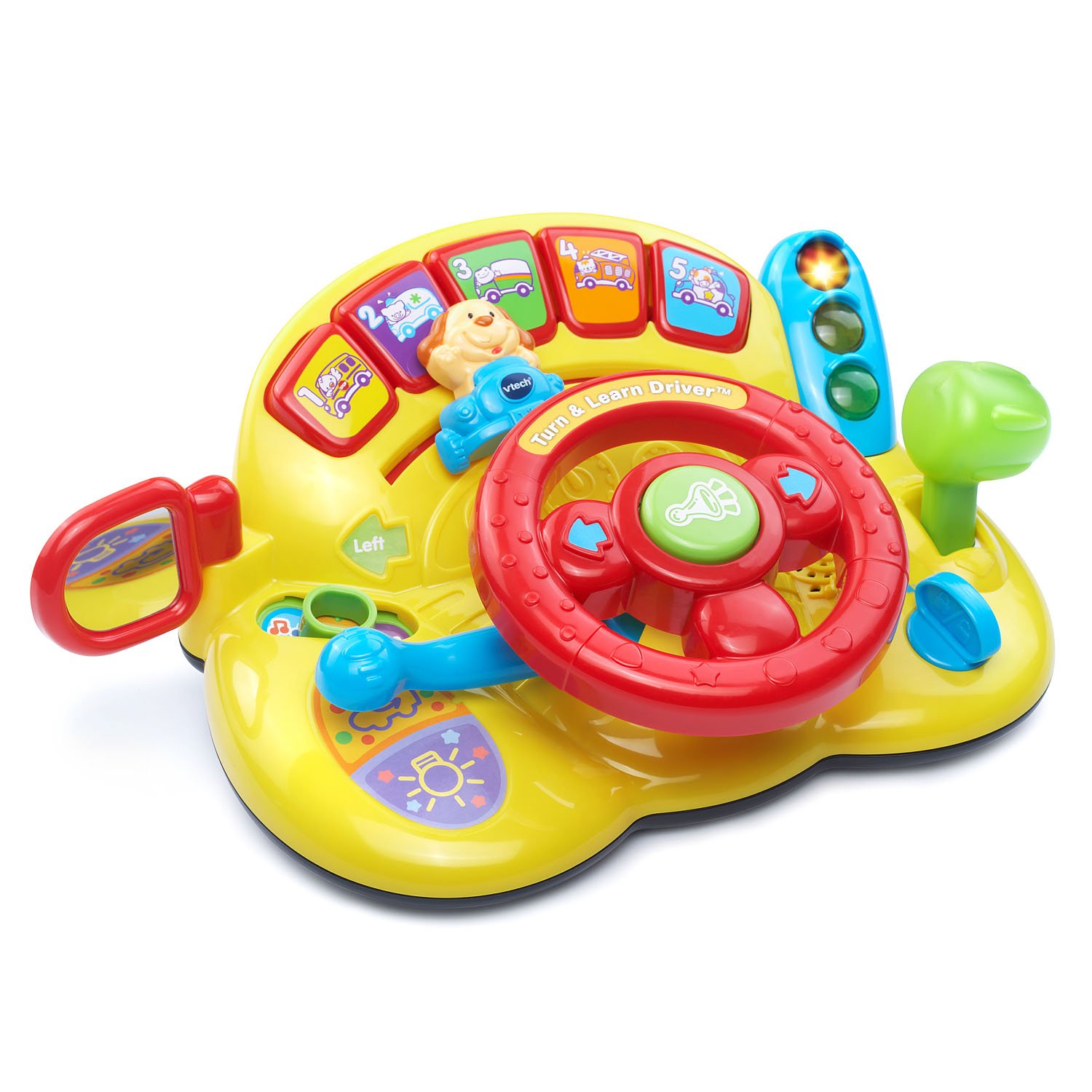
VTech Turn & Learn Driver
Key Features
- Age Range: 6-36 months
- Sensory Features: Lights, 60+ songs, buttons, wheel
- Developmental Focus: Cause-effect, pretend play
- Portability & Storage: Handheld, no storage
- Safety Materials: BPA-free plastic
- Price: Mid-Range
The steering wheel responds to turns, honks, and gear shifts with lights and songs, making it a dedicated pretend-driving toy that holds a baby’s attention in a seated position. This focused cause-and-effect experience is a clear alternative to multi-sided activity cubes that support sitting development.
This toy suits babies who enjoy reacting to lights and sounds and can sit well enough to engage with the wheel. The low volume setting may still be noticeable in quiet rooms; a piece of tape over the speaker can reduce it further. Not the best choice for noise-sensitive households or as a quiet travel companion.
Pros
- Engaging cause-and-effect with steering, horn, and gear shift
- Sturdy construction that holds up to toddler handling
- Good value for the number of songs and interactive features
Cons
- In a quiet space, the low volume setting may still be louder than expected
For a baby who already enjoys sitting and reacting to lights and sounds, this driving toy delivers focused, interactive fun — just be aware the volume may not suit a nursery.
Best for Sitting & Multi-Activity
VTech Busy Learners Cube
Key Features
- Age Range: 6-36 months
- Sensory Features: 5 sides, lights, songs, motion sensor
- Developmental Focus: Fine motor, sitting stability
- Portability & Storage: Bulky, not travel-friendly
- Safety Materials: BPA-free plastic
- Price: Premium
A gentle nudge or a wobble and the cube comes alive with lights and songs — that motion-activated responsiveness sets it apart from simpler stacking and shape-sorting toys. Five sides of sliders, spinners, and light-up keys invite a 9-month-old to reach, grasp, and explore, all while the sturdy base rewards them for staying upright.
For a baby learning to sit, the cube offers a compelling reason to hold the position: each press or spin earns a musical response. The motion sensor can trigger during curious exploration that isn’t intentional play, and the volume can feel sharp in a quiet nursery. Families who appreciate electronic toys during active floor time will find the most value; those needing silent play should look elsewhere.
Pros
- Encourages independent sitting with lights and sounds that reward upright play
- Five sides of sliders, spinners, and light-up keys keep a 9-month-old’s hands busy
- Introduces cause-and-effect and colors through songs and phrases
Cons
- Motion sensor may activate without touch, and volume can be jarring in quiet environments
This cube rewards a 9-month-old’s upright efforts with celebratory songs, making it a strong pick for active playtime. If your home prizes quiet, a non-electronic sorter or stacker will fit better.
Best for Tummy Time Play
Melissa & Doug Flip Fish
Key Features
- Age Range: 0-9 months (all ages)
- Sensory Features: Crinkle, squeaker, mirror, hidden flaps
- Developmental Focus: Tummy time engagement
- Portability & Storage: Large, not portable
- Safety Materials: Plush fabric, nonelectric
- Price: Premium
The Melissa & Doug Flip Fish is an extra-large, non-electronic plush toy that transforms tummy time into a sensory exploration zone. Where the top pick’s stacking cups excel in portability and multi-use, this fish stakes its claim on the floor with crinkle scales, a squeaker tail, and a shatterproof mirror that encourages babies to lift their heads and reach.
This size works best for families with dedicated play space — it’s not a toy you toss in a diaper bag. Babies from 0-9 months enjoy the varied textures and hidden pictures under flaps, and the fish’s height makes it a natural bottle propper during supervised feedings. For those with limited floor space, the fish may feel cumbersome rather than inviting.
Pros
- Bright, high-contrast colors hold baby’s attention during floor play.
- Multiple textures and sensory elements (crinkle, squeak, mirror) encourage tactile exploration.
- Large size doubles as a bottle propping aid during tummy time.
Cons
- The fish’s generous dimensions can overwhelm small nurseries; it’s best suited to homes with ample floor space.
Best for parents who prioritize tummy time engagement over portability and have the floor space to let this fish spread out.
Best for Fine Motor & Counting
Fisher-Price Piggy Bank
Key Features
- Age Range: 6-36 months
- Sensory Features: 10 coins, 40+ songs, lights
- Developmental Focus: Fine motor, counting, bilingual
- Portability & Storage: Semi-portable, coins store inside
- Safety Materials: BPA-free plastic
- Price: Mid-Range
Ten colorful coins, each printed with a number and animal, drop into a smiling piggy bank that responds with counting songs, color names, and Spanish words. Smart Stages technology adjusts the learning content as a baby grows, and the door swings open to release the coins for repeat play. While shape-sorting toys lean on matching, the coin-drop action builds pincer grasp and cause-effect understanding with every insertion.
The bank fits babies beginning to purposefully grasp and release, turning a classic pretend activity into a fine-motor workout. The sound can come through as muffled because of the speaker’s placement, and a coin may stick in the slot — minor pauses in an otherwise engaging loop that are easy to overlook during active play.
Pros
- Sturdy, well-made construction that holds up to repeated drops and toddler handling.
- Coin insertion and door opening strengthens pincer grasp and hand-eye coordination.
- Songs, phrases, and animal sounds keep babies engaged and giggling through play.
Cons
- Songs can sound muffled depending on speaker placement, and no volume control exists.
- A coin may occasionally stick in the slot, needing an adult to tip it free.
For a musical coin-drop toy that strengthens pincer grasp while teaching early numbers and bilingual words, this piggy bank is a charming choice — just don’t expect pristine sound quality.
Best for On-The-Go Teething
Skip Hop Bandana Buddies

Key Features
- Age Range: 0-12 months
- Sensory Features: Rattle, crinkle, teether, mirror
- Developmental Focus: Sensory exploration, teething
- Portability & Storage: Stroller/car seat clip
- Safety Materials: Polyester/cotton, BPA-free teether
- Price: Mid-Range
The plush elephant combines crinkle ears, a rattle, and a silicone teether into one stroller-friendly package that keeps a 9-month-old engaged during car rides or walks. The variety of textures and sounds provides solid sensory play, and the detachable bandana doubles as a teether. Its larger footprint and mid-range price make it a specialized on-the-go distraction rather than an everyday teether. It works best clipped to a stroller or car seat, where the size is less of a handling challenge.
Pros
- Entertains during car rides with crinkle, rattle, and teething surfaces
- Multiple textures and a detachable bandana teether engage sensory exploration
Cons
- May overwhelm smaller infants when used as a handheld toy due to its plush bulk
A sensible choice for families who need a clip-on companion for car rides and stroller walks, provided your baby is comfortable with a larger plush toy.
Best for Sensory Book
hahaland Jungle Tails Book

Key Features
- Age Range: 0-12 months
- Sensory Features: Crinkle, squeaker, 3D tails
- Developmental Focus: Early reading, sensory
- Portability & Storage: Hanging strap, clips on
- Safety Materials: Cloth, BPA-free
- Price: Budget
With crinkle pages, a squeaker, and soft 3D tails, this cloth book delivers sensory engagement that keeps a 9-month-old reaching and grabbing. The bright animal designs and varied textures hold attention without any batteries, but it lacks the musical feedback or electronic lights of pricier interactive books. It fills a niche for quiet, portable distraction — clip it to a stroller or car seat for on-the-go entertainment — rather than an all-in-one developmental toy.
Pros
- Engaging textures with 3D tails, crinkle, and squeaker hold a baby’s attention during tummy time or stroller rides.
- Bright, bold colors and cute animal designs catch a baby’s eye and encourage visual tracking.
Cons
- Short book with only a few pages may not satisfy parents hoping for a longer storybook.
For parents who want a lightweight, soft book that attaches to a stroller or car seat and provides hands-on sensory play without batteries, this is a low-cost choice. Those wanting a longer narrative or electronic sounds will prefer the interactive nursery rhyme book.
Best for Music Introduction
Baby Einstein Piano

Key Features
- Age Range: 6-36 months
- Sensory Features: Touch keys, 6 songs, volume control
- Developmental Focus: Musical exploration
- Portability & Storage: Portable, needs flat surface
- Safety Materials: Wood, non-toxic
- Price: Premium
This wooden piano pairs a classic instrument look with touch-sensitive keys that play notes and songs without buttons. The sound is clear for a toy, and volume control keeps it tolerable for adults. The main tradeoff is stability — the piano can tip forward if a baby leans on the keyboard, so it needs placement against a wall or on a non-slip surface. It’s a premium-priced choice that fits families who prioritize aesthetics and supervised musical play, but less suited for rough-and-tumble independent use than bulkier electronic alternatives.
Pros
- Beautiful wooden design fits Montessori-style nurseries
- Touch-sensitive keys encourage cause-and-effect learning without buttons
- Clear, pleasant sound with volume control for parents’ sanity
Cons
- Piano may tip forward if baby leans on it, requiring careful placement or supervision
This piano shines in a calm, adult-supervised play environment where wooden aesthetics matter more than ruggedness — a lovely first music toy for a 9-month-old’s sensory exploration.
How to Choose
The best gifts for a 9-month-old aren’t always the ones that light up and sing; they’re the ones that adapt to a baby’s changing skills without driving parents nuts.
Pick a Toy That Grows Past 9 Months
Toys labeled 6-36 months are ideal because they offer challenges at multiple stages. A toy that’s too simple will bore a 9-month-old quickly, while one that’s too advanced will frustrate and get abandoned. Look for items with multiple ways to play, like stacking cups that later teach counting, or ring stacks that become teethers now and shape-recognition puzzles later. This ensures the toy stays relevant as your baby sits, crawls, and walks.
Why Texture, Sound, and Crinkle Matter More Than Lights
Touch, sound, and varied textures build neural connections. Electronic lights and songs can overstimulate and lose novelty, while simple crinkle, squeak, and tactile surfaces sustain curiosity without requiring batteries. A cloth book with 3D tails or a teether with ridges offers hands-on learning that a screen-like toy can’t replace. For a 9-month-old who mouths everything, a toy that also crinkles or rattles turns that oral stage into discovery.
Match the Toy to the Milestone
Fine motor skills like pincer grasp and object transfer are emerging at 9 months. Toys that encourage fitting coins into a slot or stacking rings on a post build hand-eye coordination. The trade-off is that some sorting toys have lids that pop off easily, converting a shape-sorting activity into a dumping game. Choose designs where the puzzle element is sturdy enough to actually teach the skill, or accept that the dumping phase is also a valuable learning moment.
Travel-Ready Toys That Don’t Lose Pieces
Gifts that compact or clip onto a stroller become car-ride savers. The hidden hassle: toys with many loose parts and no built-in storage scatter under seats. Look for toys that nest inside themselves, like stacking cups that collapse into a single stack, or a shape sorter with a handle and a lid that at least partially contains the blocks. For car trips, toys that can be secured to the seat with a strap prevent the constant pick-up game.
Non-Toxic and Easy to Clean Are Non-Negotiable
At this mouthing stage, everything goes in the mouth, so BPA-free plastic and washable fabrics matter. The often-overlooked issue: toys with holes or squirters can trap water and grow mold inside after bath use. Choose bath toys that fully drain, or avoid them entirely if you can’t disassemble and dry them thoroughly.
FAQ
Why does my baby’s stacking toy get mold and how can I prevent it?
Mold grows when water gets trapped inside bath toys with small holes, like squirters or stacking cups that don’t drain completely. After bath time, shake out all water and leave the toy in a well-ventilated area or sun to dry fully. For cups with holes, ensure water can escape from every cup; if the smallest cup lacks a hole, drill one if safe, or avoid submerging it.
How do I stop my shape sorter lid from falling off?
Many shape sorters, including Fisher-Price’s classic bucket, have a lid that sits on top without a locking mechanism. A simple fix is to place a small piece of masking tape or a Velcro strip on one side to create a tighter seal, or accept the lid-off play as part of the fun — your baby may enjoy dumping the blocks as much as sorting them. For travel, pack the blocks inside and secure the lid with a rubber band.
Are VTech toys too loud for a 9-month-old in a car?
VTech toys like the Turn and Learn Driver often have a loud default volume, even on the low setting, which can be jarring in a small car. Many parents place a piece of clear tape over the speaker to muffle the sound, reducing it by about half. In a car, the constant noise and motion sensor triggers can overstimulate, so you may want to reserve these toys for home play and bring simpler, quieter crinkle books for drives.