
This post contains affiliate links. We may earn a small commission when you buy through our links — at no extra cost to you.
Shopping for an 8-month-old can feel like a guessing game. Flashy electronic toys promise developmental leaps but often end up ignored or broken within weeks, while simple stacking cups become instant favorites. The secret? At this age, babies want to shake, chew, and explore, not navigate complicated buttons.
We focused on toys that earn lasting engagement by matching real-world motor skills and sensory hunger. That means versatile picks — sensory balls, musical rattles, and busy cubes — that stay interesting through multiple stages, not just the first unboxing.
These are gifts built for months of drool, drops, and chewing. Because the best choice isn’t the one with the most buttons, it’s the one your baby reaches for again and again.




Best for Sitting & Motor Skills
VTech Busy Learners Cube
Key Features
- Age Range: 6–36 months
- Fine Motor Features: Push buttons, sliders, shape sorter
- Safety: BPA-free, no detachable small parts
- Durability: Withstands drops, durable plastic
- Sensory Engagement: Lights, 25 melodies, motion sounds
- Price: Mid-Range
The cube’s 14 interactive features spread across five sides give a sitting 8‑month‑old plenty to grab, press, and spin. Buttons light up and trigger short songs or animal names, while sliding knobs and turning gears work fine‑motor coordination. The durable plastic body survives being knocked over, dropped, and chewed—and still plays on. It anchors a baby in one spot for 15 to 20 minutes of self‑directed play, which makes tummy time and sitting practice less of a negotiation.
Floor‑based exploration is where this toy shines. It stays put during batted hands and helps strengthen the core muscles a baby needs to sit independently. The trade‑off is a soundtrack that even the lowest volume setting cannot tame, with 25+ melodies that can feel inescapable during a long afternoon. Families sensitive to repetitive electronic noise may want a quieter, travel‑friendly music toy instead, though they will sacrifice the cube’s broad range of hands‑on activities.
Pros
- Keeps babies engaged through lights, sounds, and manipulative features that reward every reach.
- Helps develop sitting balance and fine‑motor skills by encouraging reaching and pressing.
- Tough plastic construction survives drops, throws, and mouthing without cracking.
Cons
- Music and sound effects can be loud even on the lowest volume, and the 25+ tunes can become repetitive during extended play.
The Busy Learners Cube packs five sides of fine‑motor discovery into one floor toy, making it the most efficient way to occupy a sitting baby — as long as the repetitive melodies are tolerable.
Best for On-The-Go Grasping
Bright Starts Jingle & Shake Pal
Key Features
- Age Range: Newborn+
- Fine Motor Features: Open-hole grasp, lightweight
- Safety: BPA-free, no small parts
- Durability: Chew and drop resistant
- Sensory Engagement: Jingle rattle, no electronics
- Price: Budget
The open-hole frame gives babies an immediate grip success, building fine motor confidence from the newborn stage. Its lightweight plastic and gentle rattle reward shaking and mouthing, which aligns well with teething exploration. At roughly 4 inches across, the toy tucks easily into a diaper bag, though that compact size also means it can vanish under car seats. For an 8-month-old who already sits and reaches, this rattle provides quick bursts of batting and passing-from-hand-to-hand practice rather than extended solo play. Parents who want a no-fuss, portable teether-rattle will appreciate it; those seeking longer engagement may prefer a larger activity toy.
Pros
- Open-hole shape lets babies grab and hold without frustration, building fine motor confidence right away.
- Lightweight and BPA-free, it’s safe for gumming and shaking during teething spells.
- Shaking and passing the rattle from hand to hand strengthens coordination and visual tracking.
Cons
- At 4 inches, its small body easily slips under furniture and may not hold an 8-month-old’s attention for long stretches.
A grab-and-go rattle that shines during the early grasping months and stays useful for quick sensory play, but parents shopping for an 8-month-old who craves more complexity will want a larger interactive toy.
Best for Travel & Quiet Play
Baby Einstein Take Along Tunes
Key Features
- Age Range: 3–36 months
- Fine Motor Features: Large button, easy-grip handle
- Safety: No detachable parts, BPA-free
- Durability: Drop-resistant plastic
- Sensory Engagement: 7 classical melodies, flashing lights
- Price: Budget
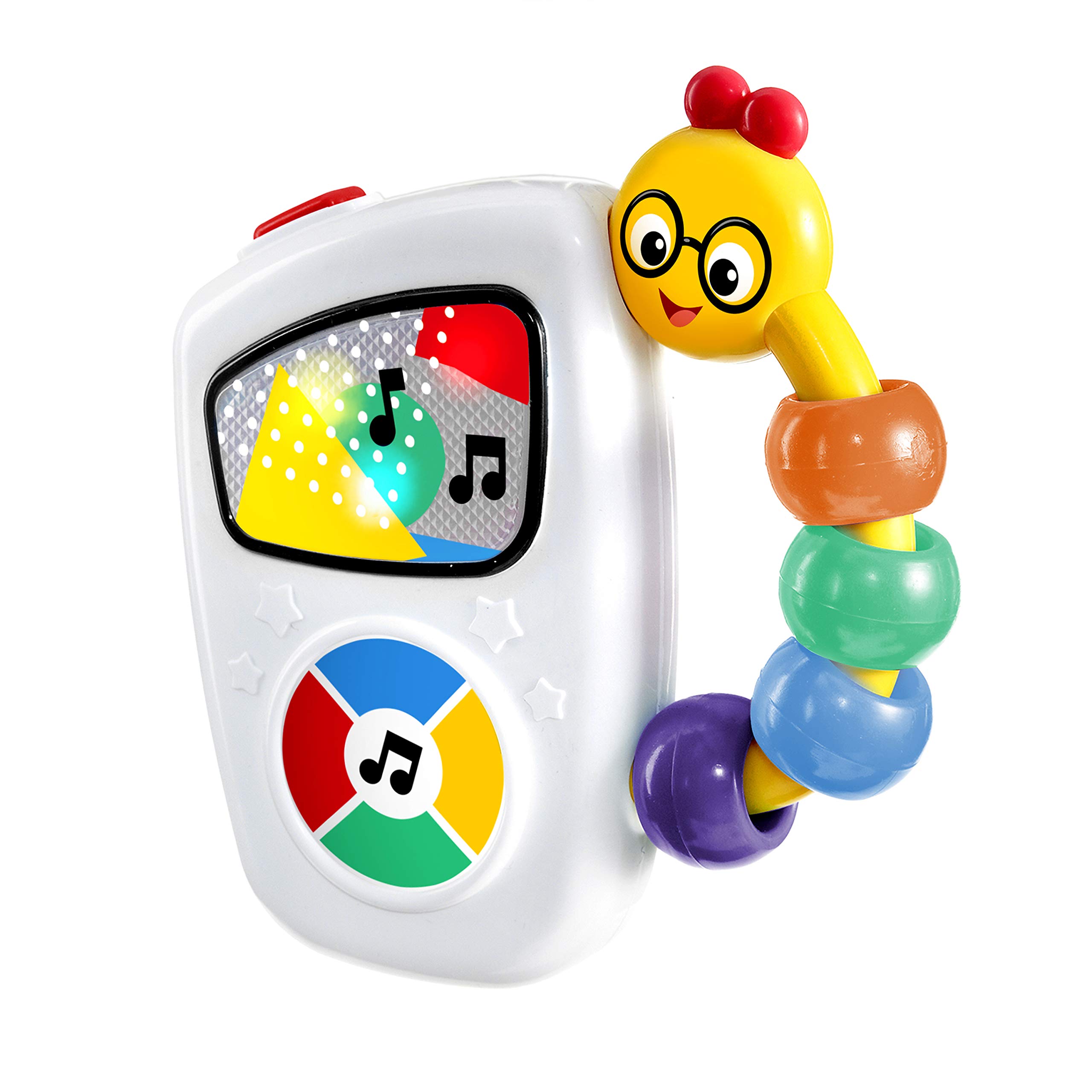
The Baby Einstein Take Along Tunes is one of the few musical toys where the melodies are genuinely pleasant for adult ears — seven classical pieces played at an adjustable volume. While the VTech Busy Learners Cube offers more interactive features for stationary floor play, this portable option clips onto strollers and diaper bags, making it the go-to for car rides and outings. With only 7 melodies, babies may tire of the selection over extended play, though the lights and easy-grasp handle maintain interest during short trips. Best suited for babies 3 months and older who respond to music and lights, caregivers should note the speaker on the bottom muffles sound when set on carpet or a blanket.
Pros
- Classical music is pleasant for parents while lights capture baby’s attention.
- Compact design with handle and stroller clip makes it easy to take anywhere.
Cons
- Song selection limited to 7 melodies, which may feel repetitive during extended play.
- Speaker on bottom muffles sound when placed on soft surfaces like carpet or blankets.
For on-the-go families who want a music toy that parents can tolerate, this is the right companion — just keep it on a hard surface or in a stroller to get the best sound.
Best for Bath & Creative Play
First Years Stack & Count Cups
Key Features
- Age Range: 6–24 months
- Fine Motor Features: Stacking, nesting, water play
- Safety: BPA-free, smooth edges
- Durability: Water-safe, drop-resistant
- Sensory Engagement: Colorful, numbered, water fun
- Price: Budget
Eight numbered cups with drainage holes turn bath time into splashy discovery, and stacking them on the living room floor teaches order and sequence just as naturally. The cups nest into a compact tower that tucks into a diaper bag — a travel-friendly toy that doesn’t need batteries or volume controls. This set is for families who want a single toy that works in water, sand, and on the go. The cups are smaller than photos suggest, so babies who need larger pieces to grasp may struggle. The included ring holder can snap and create a choking hazard; toss it before first use and the cups function without it.
Pros
- Stacking, nesting, and water play provide open-ended engagement that holds interest from bathtime to tummy time.
- Durable enough to survive drops and chewing, yet costs less than most single-purpose infant toys.
- Bold colors and numbered sides introduce colors and counting naturally during play.
Cons
- Cups are smaller than they appear online — babies who need large grips may have trouble holding them.
- The ring holder can break and pose a choking hazard; safest to remove it before giving the toy to baby.
At a budget-friendly price, these cups deliver more playtime variety than many electronic toys — just lose the ring before baby gets it.
Best for Motor & Language
Fisher-Price Piggy Bank
Key Features
- Age Range: 6–36 months
- Fine Motor Features: Coin drop, door latch
- Safety: BPA-free, chunky coins
- Durability: Durable plastic build
- Sensory Engagement: 40+ songs, light-up nose
- Price: Mid-Range
Where the plush learning companion uses touch-activated songs for snuggling, this piggy bank rewards each coin drop with a light-up nose and phrases that introduce numbers, colors, and Spanish. The coin slot promotes fine-motor precision — a challenge some 8-month-olds won’t master on their own, but one that keeps older babies absorbed. The fixed volume can be too loud in a quiet nursery or too quiet in a busy room, making it better suited for play spaces with background noise.
Pros
- Reinforces fine motor skills through coin insertion and door opening.
- Keeps toddlers engaged for surprisingly long stretches.
- Bright, friendly pig design with light-up nose that babies find charming.
Cons
- No volume adjustment; sound can be overly loud in quiet spaces or nearly inaudible amid background noise.
For babies nearing 12 months who enjoy inserting objects, this bank holds attention and builds fine-motor skills — just expect the volume to be fixed, which may be too loud for quiet nurseries.
Best for Tummy Time Sensory
Sassy Bumpy Ball
Key Features
- Age Range: 6+ months
- Fine Motor Features: Textured bumps for grasp
- Safety: BPA-free, baby-safe mirror
- Durability: Foam core, durable
- Sensory Engagement: Rattle, mirror, patterns
- Price: Budget
Unlike textured stacking rings that stay put during play, this bumpy ball rolls and rattles with each swipe, turning tummy time into a reach-and-chase game. High-contrast patterns, a small mirror, and multiple textures keep an 8-month-old visually and tactilely engaged, while the lightweight construction helps little hands practice transferring it between palms. The firm bumps are not flexible enough for teething, and the ball can roll away quickly — this suits a baby working on grasping and tracking more than one seeking a chew toy. It’s a better fit for floor play in a contained space than for car seat or stroller use.
Pros
- Easy-to-grasp bumps encourage hand-to-hand transfers, building early motor skills.
- Multiple textures and a gentle rattle provide rich sensory exploration.
- High-contrast colors and a mirror draw and hold a baby’s gaze.
Cons
- The firm bumps are not pliable enough for teething, so heavy chewers may lose interest.
- The ball rolls away easily during play, which can frustrate a baby who hasn’t yet mastered crawling.
A focused sensory tool that invites reaching and visual tracking. Works best on a play mat with a nearby adult ready to retrieve it — skip it if your baby is in a biting phase.
Best for Shape Sorting
Fisher-Price Baby’s First Blocks

Key Features
- Age Range: 6+ months
- Fine Motor Features: Shape sorting, dumping
- Safety: BPA-free plastic
- Durability: Durable blocks
- Sensory Engagement: Colorful shapes, storage
- Price: Budget
Ten blocks help an 8-month-old practice grasping, dumping, and shape identification. Chew-resistant plastic holds up, but the lid pops off easily, so the bucket stays put during play. The shape slots demand more precision than the coin-drop alternative, which may frustrate younger babies.
Pros
- Great for fine motor skills and shape/color recognition
- Durable plastic blocks resist chewing
Cons
- Lid doesn’t snap securely, so the bucket can’t be carried without spilling
A good fit for at-home shape-sorting practice under supervision; skip it if you need a travel-ready container that stays closed.
Best for On-The-Go Cuddle
VTech Rattle and Sing Puppy

Key Features
- Age Range: 3–24 months
- Fine Motor Features: Grasping, shaking
- Safety: BPA-free, no small parts
- Durability: Plush and plastic, holds up
- Sensory Engagement: Crinkly ears, 20+ songs
- Price: Budget
This puppy packs a surprising number of responses into a small, lightweight frame – the crinkly ears and light-up cheeks invite batting and mouthing, and the music volume stays parent-friendly. It’s a solid grab-and-go companion for diaper bags or car seats. The catch: at about 6 ounces, some 8-month-olds with developing grip struggle to lift it on their own, and the battery compartment takes a small screwdriver to access.
Pros
- Crinkly ears and flashing cheeks engage multiple senses at once.
- Pleasant music volume that doesn’t grate on parent ears.
Cons
- For younger 8-month-olds or babies with a weak grasp, the weight can make independent play brief.
Best suited for babies who already lift toys confidently, or for supervised tummy-time play where an adult can help.
Best for Tummy Time Discovery
Infinno Wrist Rattle Set

Key Features
- Age Range: 0–12 months
- Fine Motor Features: Kicking, reaching
- Safety: Soft fabrics, BPA-free
- Durability: Hand wash only
- Sensory Engagement: Rattles, high-contrast patterns
- Price: Budget
The soft, chewable pieces and high-contrast bug patterns hold a young baby’s attention during tummy time. But this set is best for newborns through 6 months — older babies can pull off the loose-fitting socks, shifting its value toward early infancy.
Pros
- Encourages hand and foot discovery through gentle rattle sounds.
- Soft, chew-safe material with high-contrast colors that attract infant attention.
Cons
- Care is hand wash only, which may frustrate parents used to machine-washable baby items.
A thoughtful gift for the newborn stage, but for an 8-month-old, it’s already past its window of peak engagement.
Best for Teething & Stacking
Sassy Stacks of Circles

Key Features
- Age Range: 6–24 months
- Fine Motor Features: Stacking, teething
- Safety: BPA-free
- Durability: Durable rings
- Sensory Engagement: Textured rings, rattle
- Price: Budget
Each ring offers a different texture and one includes a rattle, keeping teething babies engaged with colors and sounds. The rings are smaller than traditional stackers, and the base can trap water and develop mold if not dried thoroughly after play.
Pros
- Varied textures provide teething relief and sensory stimulation
- Bright colors and rattling sounds hold a baby’s attention
Cons
- Base can trap water and develop mold if not dried thoroughly — a consideration for bath-time use
Best for babies who mouth everything and enjoy texture variety, provided caregivers dry the base after cleaning.
Best for Cuddly Learning
Fisher-Price Smart Puppy

Key Features
- Age Range: 6–36 months
- Fine Motor Features: Touch sensors on plush
- Safety: BPA-free electronics, soft
- Durability: Plush with electronics
- Sensory Engagement: Songs, phrases, lights
- Price: Premium
This plush puppy pairs cuddly softness with touch-activated songs and three learning levels that introduce body parts, shapes, and counting. The huggable design wins over babies, but the premium price and occasional electronic hiccups mean it’s not the most bulletproof choice. For gift-givers who prioritize a plush learning buddy over rugged simplicity, it hits the mark.
Pros
- Soft plush that soothes and teaches with touch-activated phrases
- Three learning levels grow with baby; teaches body parts, shapes, counting
Cons
- Electronic components can fail after weeks; quality control variance
For gift-givers wanting a cuddly, interactive plush that teaches early concepts, this puppy delivers — provided the occasional electronic glitch is an acceptable trade-off.
How to Choose
The toys that truly captivate 8-month-olds satisfy their drive to shake, chew, and see immediate reactions — not the ones with the most buttons.
Age Appropriateness
Six months marks a critical window: babies are sitting up, reaching, and mouthing. A toy labeled “18+ months” often contains small parts or requires dexterity your baby hasn’t developed yet, leading to frustration instead of joy. Stick with items that explicitly start at 6 months so your child can interact immediately — not wait another year to figure it out.
Even within the 6–36 month range, pay attention to the required skill. A piggy bank’s coin drop demands a controlled pincer grasp that emerges around 9 months, while a textured ball can be enjoyed months earlier just by batting and mouthing.
Fine Motor Features
Toys that demand different hand movements — grasping a rattle, turning a gear, dropping a coin — build the pincer grasp and hand-eye coordination blossoming at this age. The wider the variety of actions, the longer a toy stays engaging.
Open-ended designs like stacking cups or activity cubes let the baby “level up” the toy: first chewing on a ring, then banging two together, eventually stacking them upright. Single-function gadgets that rely on one button press often lose appeal once the novelty fades.
Safety Considerations
Every piece must pass the toilet-paper-tube test: if it fits through a 1.75-inch opening, it’s a choking hazard. BPA-free plastic is a baseline, but also check how coatings hold up under constant chewing — painted surfaces can flake, and plush fibers can shed.
Water-play toys like stacking cups with drainage holes reduce mold risk, but detachable rings or small lids that snap off under pressure can become dangerous. Scan recent reviews for photos of broken parts, not just the marketing shots.
Built to Last
Assume every toy will be dropped from a high chair, thrown across the room, and soaked in drool. Solid plastic construction without glued joints survives longest; hollow rattles with seams can crack and expose sharp edges.
Electronic toys with exposed speaker grills often fail when moisture seeps in, even from a teething session. Look for tightly sealed battery compartments and consider how well sound holes are shielded from little mouths.
Sensory Variety
At eight months, high-contrast patterns, simple melodies, and physical textures do more for development than elaborate storylines. A toy with three to five distinct sounds or surfaces provides enough variety without overstimulation.
Volume control isn’t just a parent-friendly bonus — it prevents auditory fatigue and lets you use the toy during wind-down moments. Toys that blast at a single loud setting often get hidden in a drawer after a few days.
FAQ
Are stacking cups safe for an 8-month-old who puts everything in their mouth?
Yes, as long as they are BPA-free and have smooth edges. The First Years cups include drainage holes to reduce mold, but you should remove the supplied ring holder if it becomes loose. Always supervise water play and check that no small pieces have broken off before each use.
Why does my baby ignore the toy after a week? What makes a toy engaging for an 8-month-old?
Babies lose interest in toys that offer only one action. The most engaging options provide multiple ways to play — stacking, shaking, or triggering a sound — so the toy adapts as their skills grow. Cause-and-effect reactions (press a button, hear a melody) hold attention longer than passive features.
Can I use the Fisher-Price Puppy Walker for a baby who isn’t walking yet?
An 8-month-old who can sit can play with the walker’s front panel, but pushing it requires standing and coordination they may not have for months. Until they’re pulling up confidently, the VTech Busy Learners Cube offers safer, seated motor practice without the risk of tipping.
Do musical toys for 8-month-olds need volume control?
Not every toy must have it, but volume control is a major quality-of-life feature. Toys without it can become grating when played repeatedly, and high-pitched sounds may startle sensitive babies. Choose a toy with adjustable volume or a headphone jack if you plan to use it in shared spaces or during quieter moments.