
This post contains affiliate links. We may earn a small commission when you buy through our links — at no extra cost to you.
Photos make baby toys look like the perfect size — until the package arrives and the stacking rings are smaller than your palm or the plush cow is barely bigger than a fist. That mismatch between expectation and reality is the most common frustration when shopping for a 6‑month‑old.
The real trick isn’t finding the highest star rating. It’s knowing which features actually get used: a ball that tiny fingers can grab without help, a stacking toy that doesn’t tip over on a carpet, a teether that stays attached to the stroller. Simple, graspable toys often keep a 6‑month‑old engaged longer than anything with lights and music.
This guide cuts through the photo trickery and overblown claims. Every pick here is chosen for how it behaves in real hands — the weight, the texture, the noise level, and whether it survives a week of floor play.



Best for Grasp Practice
Bright Starts Oball Jingle & Shake Pal
Key Features
- Age Range: Newborn+
- Grip & Size: 5.8 in, finger holes
- Sensory Features: Jingle rattle
- Durability: BPA-free plastic
- Price: $
The Oball’s open-frame design lets tiny fingers wrap through the holes, making it one of the few rattles a 3-month-old can actually hold and control. At 0.09 kg, it’s light enough to wave without tiring, and the internal jingle provides clear auditory feedback that encourages repetition. The BPA-free plastic withstands drops and throws without cracking — a common failure point in cheaper rattles.
Because the ball measures about the size of a softball (5.8 inches), some parents find it larger than expected for very small newborns. For babies who are already reaching and grasping around 4–6 months, that size becomes an advantage: it’s big enough to engage both hands and promote coordinated movement. This rattle suits families wanting a straightforward, mess-free sensory toy that develops motor skills without batteries or cleanup.
Pros
- Exceptional grip design for tiny hands
- High-quality construction that survives drops
- Supports motor skill development through grasping and shaking
Cons
- Larger than some parents expect for very small infant hands
The go-to rattle for graspability and durability — ideal for babies 4 months and up, with a size worth confirming against your baby’s hand size.
Best for On-The-Go Music
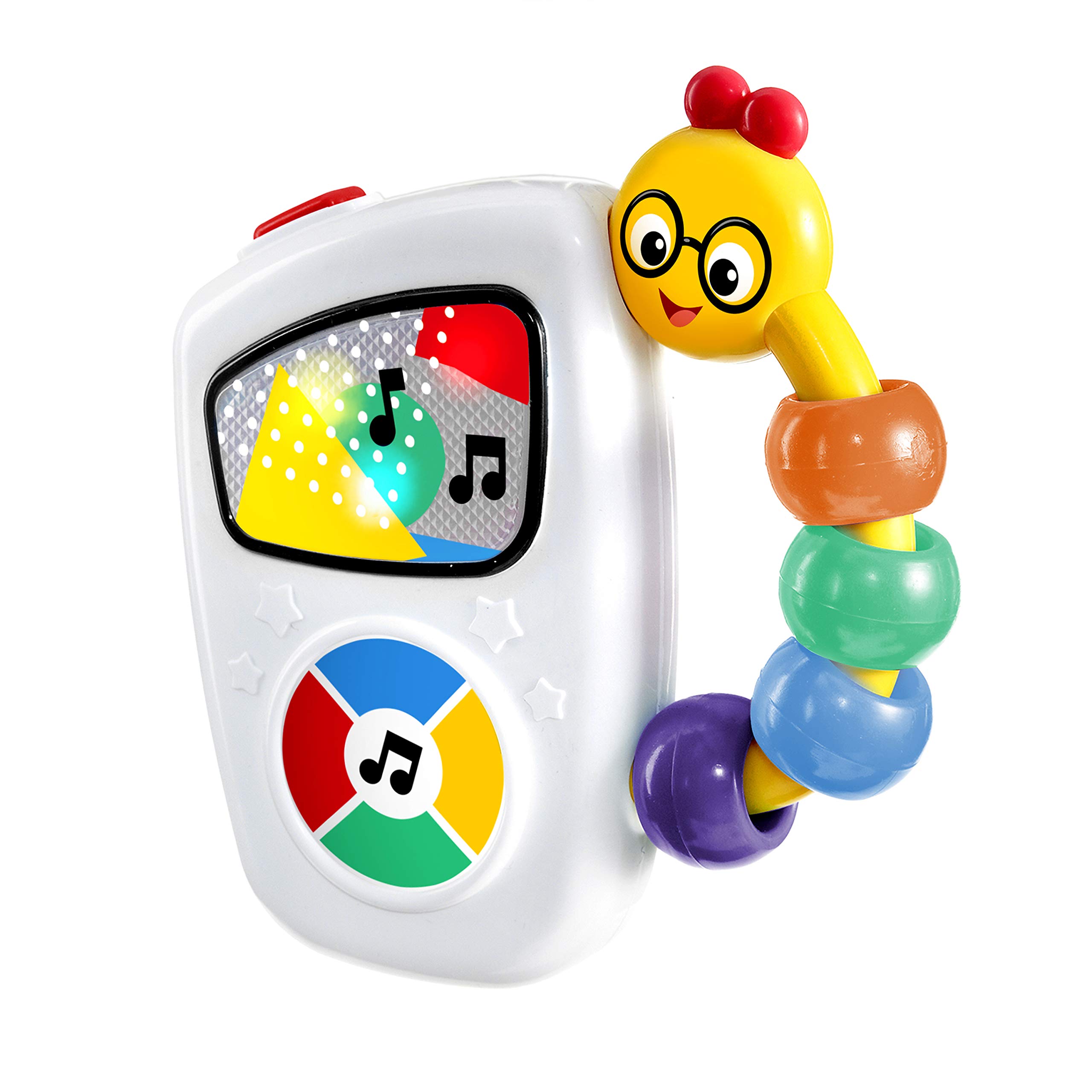
Baby Einstein Take Along Tunes
Key Features
- Age Range: 3-36 months
- Grip & Size: 4.8 in, handle
- Sensory Features: 10 melodies, lights
- Durability: Survives drops
- Price: $
The Baby Einstein Take Along Tunes fits easily into a diaper bag and plays classical music at adjustable volume, making it a travel-friendly option for keeping babies entertained. The lights and colors engage little ones, but the speaker sits on the back, so sound muffles when the toy is placed flat on the floor — less of an issue when held or clipped to a stroller. Durability is generally good, though a small number of units may show wear over time. This toy suits parents who prioritize portability and music over floor-play volume.
Pros
- Compact and lightweight — clips to a bag or stroller for easy transport.
- Plays classical music that parents find pleasant and babies respond to.
- Colorful lights and high-contrast colors capture baby’s attention.
Cons
- Sound can be muffled when laid on the floor due to rear-facing speaker.
- Durability varies; some units may show wear sooner than expected.
Best for families who need a take-anywhere musical toy and can work around the floor sound limitation.
Best for Stacking & Textures
Sassy Stacks of Circles
Key Features
- Age Range: 6-24 months
- Grip & Size: 4.25 in base
- Sensory Features: Textured rings, rattle
- Durability: Plastic, may wobble
- Price: $
Vibrant, textured rings make the Sassy Stacks of Circles a sensory-rich stacking option for 6-month-olds exploring cause and effect. The toy is compact — smaller than many expect — but that suits small hands learning to grasp and stack. The center post can wobble on some units, so stability depends on a flat surface; this works best for families who value texture and color variety over a rock-solid stacking post.
Pros
- Textured rings with varied colors engage babies in sensory exploration.
- Age-appropriate design supports stacking and fine motor skill development.
- Budget-friendly price for a classic developmental toy.
Cons
- Center post can feel flimsy; stability may vary on uneven surfaces.
- Compact size may be smaller than expected for those familiar with larger stacking rings.
Good value for a classic stacking toy with sensory bonuses, though the compact size and possible post wobble mean it’s best for buyers who prioritize texture variety over durability.
Best for Teething & Textures
Skip Hop Bandana Buddies Elephant
Key Features
- Age Range: Baby
- Grip & Size: 4×10 in, clip
- Sensory Features: Crinkle, rattle, mirror
- Durability: Spot clean fabric
- Price: $
The Skip Hop Bandana Buddies Elephant combines a detachable bandana teether with crinkle ears, a rattle, and a mirror, all connected by a clip that hooks onto strollers, diaper bags, or car seats. The polyester and cotton construction feels sturdy, and the multiple textures give teething babies something to explore. However, the toy is larger than product photos suggest — at 10 inches long, it can feel bulky for very small newborns who aren’t yet grabbing. For a 6-month-old who is actively mouthing and reaching, the size works well, and the clip prevents it from ending up on the floor. It’s a practical choice for parents who want a sensory toy that stays put during outings.
Pros
- Adorable elephant design with durable materials
- Detachable bandana teether offers a soft, separate chewing surface
- Crinkle, rattle, and mirror keep babies engaged during travel
Cons
- Larger than photos suggest — may feel cumbersome for newborns under 3 months who aren’t yet gripping
Best for 6-month-olds who are teething and need a clip-on toy for stroller or car seat use — the size tradeoff is manageable once babies start grabbing.
Best for Teething & Grip
TOHIBEE Sensory Teether
Key Features
- Age Range: 0-18 months
- Grip & Size: 4.1 in diameter
- Sensory Features: Silicone balls, rattle, click
- Durability: Silicone & ABS
- Price: $
The TOHIBEE packs 12 textured silicone balls with rattle and click sounds into a compact, budget-friendly design. Its small size fits easily into a diaper bag but may not provide enough chewing surface for babies who prefer a larger teether — the loops also trap residue, requiring thorough cleaning between uses. This is best for parents seeking a lightweight, sensory-dense option for travel rather than a primary teether for aggressive chewers.
Pros
- Multiple textures and sounds keep babies engaged during play and teething.
- Silicone balls are safe for mouthing and easy for small hands to grip.
- Lightweight and compact enough for diaper bags or stroller clips.
Cons
- Smaller size means less chewing surface for babies who want a substantial teether.
- Loops and crevices trap moisture and debris, making thorough cleaning a chore.
A cost-effective sensory toy for on-the-go use, but check the size expectations before buying if your baby prefers a larger teether.
Best for Stationary Floor Play
VTech Busy Learners Cube
Key Features
- Age Range: 6 months – 3 years
- Grip & Size: 6.2 in cube
- Sensory Features: Lights, sounds, 5 sides
- Durability: Plastic, battery powered
- Price: $$
The VTech Busy Learners Cube packs five sides of interactive play – piano keys, spinning gears, and button triggers – that keep a sitting baby exploring. It’s a sturdy, stationary cube that encourages reaching, grasping, and cause-and-effect learning. The volume is loud even on the lowest setting, and there is no off switch for the sound. This makes it less suitable for noise-sensitive homes but a fine choice for playrooms or active floor time where ambient noise is expected.
Pros
- Five sides of interactive activities keep babies engaged for extended periods.
- Supports fine motor skill development and encourages sitting practice.
- Durable construction withstands active play.
Cons
- Volume is loud even on lowest setting, with no way to turn off sound without removing batteries.
A solid value for a multi-activity cube that supports developmental milestones, provided the volume level is acceptable for your household.
Best for Sensory Storytelling
hahaland Jungle Tails Book

Key Features
- Age Range: 0-12 months
- Grip & Size: Soft cloth
- Sensory Features: Crinkle, squeaker, 3D tails
- Durability: Machine washable
- Price: $
With crinkle sounds, a squeaker, and dangling tails, this cloth book focuses on texture exploration. Its bright colors and durable stitching hold up well. Fewer reviews than top picks, but equally high quality — a good alternative for parents preferring fabric over plastic. The limited pages may not sustain long attention, but for short sensory play sessions it works well.
Pros
- Adorable and brightly colored with varied textures
- Good quality and durable stitching
Cons
- Not suited for parents seeking a text-based storybook
Ideal for brief tummy time or stroller entertainment where a simple, fabric-based sensory book is sufficient.
Best for Farm Theme Book
beiens Farm Tails Book

Key Features
- Age Range: 0-36 months
- Grip & Size: Soft cloth
- Sensory Features: Crinkle, squeaker, tails
- Durability: Hand wash
- Price: $$
The farm animal illustrations are delightful and the crinkle pages add sensory appeal. Yet at a mid-range price for a single small book, it faces competition from similar cloth books that offer more pages or lower cost. It remains a solid pick for those who appreciate the brand and the theme.
Pros
- Cute and appealing farm animal theme
- Colorful and engaging with crinkle sounds
Cons
- Price can feel high for a single small cloth book
Best for gift-givers focused on brand and farm theme; otherwise a similar cloth book with more pages offers better value.
Best for Texture Exploration
Sassy Developmental Bumpy Ball

Key Features
- Age Range: 6+ months
- Grip & Size: 5 in, bumps
- Sensory Features: Rattle, mirror, textures
- Durability: Foam & plastic
- Price: $$
The Sassy Developmental Bumpy Ball delivers exactly what the name promises: a ball covered in varied bumps, with rattles inside and a mirror on one side. It’s well-constructed and visually engaging for babies learning to transfer objects between hands. However, the bumps are deliberately sized for gripping, not for mouthing, which limits its use for teething babies who want something to chew.
Pros
- High-quality construction with multiple textures for sensory exploration.
- Bright colors and patterns attract baby’s attention during play.
Cons
- Bumps are too large for teething — better suited for grasping than mouthing.
A worthwhile pick for parents focused on grasping and visual stimulation, but skip if teething relief is a priority.
Best for Tummy Time Learning
Baby Einstein Glow & Discover

Key Features
- Age Range: 3-36 months
- Grip & Size: 12.8 in bar
- Sensory Features: 3 languages, lights, music
- Durability: Flimsy stand
- Price: $$
This light bar offers engaging multilingual modes (xylophone, animal, color) with lights and music that hold a 6-month-old’s attention during tummy time or floor play. The intended upright stand, however, tends to collapse under light pressure, so the bar is most reliable when used flat — which suits the crawling and reaching stage but limits seated, independent play.
Pros
- Three learning modes in three languages support early exposure to sounds and words.
- Lights and music keep babies engaged during tummy time or floor play.
Cons
- When used upright, the stand may collapse – the bar works best placed flat on the floor.
For tummy time and floor play, this multilingual bar delivers solid sensory engagement – just skip the stand and keep it flat.
Best for Cuddle & Music
VTech Moosical Beads

Key Features
- Age Range: 0-24 months
- Grip & Size: 6.5 in plush
- Sensory Features: Lights, music, beads
- Durability: Plush & plastic
- Price: $$
This plush cow delivers sweet melodies and glowing beads that appeal to tiny hands, and the fabric holds up well to regular handling. But the toy is noticeably smaller than typical baby plushies, and the sound volume stays gentle rather than filling a room. For a 6-month-old already sitting and reaching for larger objects, the size may limit engagement – it suits newborns and young infants (0–6 months) who are still exploring with their eyes and ears rather than their whole body.
Pros
- Adorable plush design that babies enjoy looking at and holding.
- Lights and music provide gentle sensory stimulation without being overwhelming.
Cons
- Smaller than expected; may not hold the interest of older babies who prefer larger, more interactive toys.
Works well as a soft, quiet cuddle companion for infants under 6 months who are still building visual and auditory awareness – less suited for a 6-month-old seeking bigger, louder playthings.
Best for Musical Exploration
Baby Einstein Magic Touch Piano

Key Features
- Age Range: 6-36 months
- Grip & Size: 8.9 in wide
- Sensory Features: Touch keys, color sheet
- Durability: Wood, may tip
- Price: $$$
This wooden piano combines pleasant sound with an attractive design. Its touch-sensitive keys respond to light taps, encouraging musical exploration. However, the piano can tip forward if a baby leans on the keyboard, making it less suitable for unsteady sitters. It’s a premium-priced gift for older toddlers rather than a first toy for 6-month-olds.
Pros
- Pleasant sound quality and durable wooden build appeal to musically inclined toddlers.
- Adorable wooden appearance makes it a popular gift choice for first birthdays.
Cons
- Can tip forward when a baby leans on the keyboard; better suited for seated, stable toddlers.
Best as a gift for 12+ month-olds who can sit confidently and enjoy musical cause-and-effect play.
Best for Limb Coordination
Infinno Wrist Rattle Set

Key Features
- Age Range: 0-12 months
- Grip & Size: Wrist bands
- Sensory Features: Rattle, foot finder
- Durability: Cotton/spandex
- Price: $
This set uses high-contrast patterns and soft rattles to draw a baby’s attention to their hands and feet, encouraging arm and leg coordination. The bands can slip off very small wrists and ankles, so it works best for babies around 3 months or older who are already starting to move. It’s a budget-friendly option for sensory play.
Pros
- High-contrast patterns captivate babies during play
- Encourages movement and limb awareness
Cons
- Bands can slip off very small wrists and ankles
Best for parents of active 3-6 month olds who want to encourage movement and don’t mind adjusting bands occasionally.
Best for Bath Time Fun
Munchkin Bath Bobbers

Key Features
- Age Range: 6+ months
- Grip & Size: 3.5 in each
- Sensory Features: Floating, no holes
- Durability: Sealed plastic
- Price: $
A pair of polar bear and penguin floats designed specifically for bath time. Their sealed construction means no holes for water to enter, so mold doesn’t get a foothold. That makes them a safer choice for babies who put toys in their mouths. The trade-off: occasional units have let water seep inside despite the seal, and these aren’t general play toys — they’re strictly for the tub.
Pros
- Mold-resistant design with no holes for water entry.
- Cute animal shapes that engage infants during baths.
Cons
- Seal can let water inside on some units, despite being marketed as sealed.
Worth picking up if bath-time safety from mold is a priority; just be aware the water seal isn’t flawless on every unit.
Best for Older Baby Rattle
VTech Rattle and Sing Puppy

Key Features
- Age Range: 3 months – 2 years
- Grip & Size: 7 in, heavy
- Sensory Features: Lights, sound, crinkle ears
- Durability: Plastic
- Price: $
The VTech Rattle and Sing Puppy charms with crinkly ears and light-up sounds, and its build quality holds up well. The weight, however, is noticeable — it’s better suited for babies 8 months and up who can manage a heavier toy, rather than a 6-month-old developing grip.
Pros
- Crinkly ears and cute puppy face capture baby’s attention during play.
- Durable construction with engaging sounds that entertain for short sessions.
Cons
- Weight can make it challenging for younger babies to grasp and shake independently.
A good option for families wanting a simple light-up rattle for an older baby (8+ months) who can handle the weight, but skip it for younger infants.
How to Choose
For a 6-month-old, the gift that gets used daily isn’t the one with the most features — it’s the one that fits their grip, tolerates chewing, and matches your real routine.
Age Range and Safety
Toys marked ‘0+’ or ‘newborn’ often have small parts that can break off. Look for BPA-free plastic, sealed seams, and parts larger than a toilet paper roll. Metal or hard plastic edges should be rounded.
6-month-olds mouth everything. A toy that sheds lint, flakes paint, or has batteries accessible without a screwdriver isn’t safe. Cloth books should pass a tug test — if a tail comes off with moderate pull, skip it.
Ease of Grasping
At 6 months, palmar grasp is dominant. Toys need diameter between 2 and 4 inches for a baby to wrap their fingers around. Anything larger (like a softball-sized ball) may frustrate early attempts, though some babies adapt quickly.
Weight matters too. A toy heavier than 0.15 kg can be too fatiguing for short arms. The grip surface should be textured or have finger holes — smooth plastic is slippery when wet from drool.
Sensory Features
Crinkle sounds, rattles, and lights are engaging, but volume is a hidden trade-off. Electronic toys with a single fixed volume (often loud) can be draining for parents in small spaces. Look for volume control or a mute switch.
Mirrors, high-contrast patterns, and varied textures (bumpy, soft, ribbed) hold attention longer than flashing lights alone. However, too many sounds at once can overwhelm — 6-month-olds prefer one sensory channel at a time.
Durability and Cleanability
Bath toys that claim to be ‘mold-free’ can still leak if the seal is weak. Any toy with crevices (silicone loops, fabric folds) should be machine washable or easy to scrub — otherwise bacteria builds up in days.
Plush toys with internal electronics (lights, batteries) cannot be submerged. For daily use, prioritize toys that can be wiped down with soap and water or survive a gentle cycle wash.
FAQ
What size ball is best for a 6-month-old?
A ball about 4 to 5 inches in diameter is ideal. Smaller than that (under 3 inches) is a choking hazard; larger than 6 inches is hard to grip. The Bright Starts Oball is 5.8 inches — slightly bigger than a softball — and works because its finger holes let babies hold it securely.
Are stacking rings safe for a 6-month-old who puts everything in their mouth?
Yes, as long as the rings are at least 1.75 inches across and made of non-toxic plastic. The Sassy Stacks of Circles rings are wide enough to not block airways, but the center post can be flimsy — check for cracks before each use.
Do electronic baby toys with lights and music help with development?
They can help with cause-and-effect learning, but they’re not necessary. A 6-month-old learns more from manipulating a toy with their hands than from watching lights flash. If you choose an electronic toy, pick one with a volume control and a simple on/off switch — the VTech Busy Learners Cube has no off switch for sound, which many parents find frustrating.
How do I clean a cloth baby book that gets chewed on?
Most cloth books (like the hahaland Jungle Tails) can be machine washed on a gentle cycle and air dried. Avoid fabric softener — it can reduce the crinkle sound. If the book has a squeaker or battery pack, spot clean only; submerging will ruin the electronics.