
This post contains affiliate links. We may earn a small commission when you buy through our links — at no extra cost to you.
You’ve mapped out the itinerary, packed light, and planned every shot—then your camera overheats in the afternoon sun or runs out of battery before the main event. Travel vlogging is full of these disappointments, and the problem isn’t just bad luck; it’s that many portable cameras cut corners on thermal design and power management.
The market brims with ‘4K’ and ‘8K’ labels that bear little resemblance to what the lens actually captures. In truth, sensor size and stabilization hardware determine whether your walking tour footage looks cinematic or jittery, and many budget models use tiny sensors that struggle the moment clouds roll in.
We focused on the cameras that hold up: those with real 1-inch sensors, gimbal-level stabilization, and battery life that aligns with a full day of exploring. The picks below won’t force you to carry three spare batteries or avoid shooting in warm weather.




Best for Smooth Travel Vlogging
DJI Osmo Pocket 3
Key Features
- Sensor Size: 1-inch CMOS
- Stabilization Type: 3-axis mechanical gimbal
- Video Resolution / Frame Rate: 4K/120fps
- Battery Life: 166 min
- Price: Premium
DJI’s Osmo Pocket 3 combines a 1-inch CMOS sensor with a 3-axis mechanical gimbal, delivering steady 4K video up to 120fps in a body that fits in a jeans pocket. The Creator Combo adds a wireless microphone for clear audio, making it a self-contained vlogging kit. Colors come out vivid straight from the camera, and the 10-bit D-Log M profile allows for grading flexibility when needed.
The gimbal handles walking, panning, and even light jogging without the jitter typical of electronic stabilization. In low-light scenes, the large sensor pulls in detail that smaller action cameras miss. The active tracking — both face and object — works reliably for solo creators who want to stay in frame while moving.
The 2-inch rotating touchscreen flips from landscape to portrait orientation, ideal for platforms like TikTok or Instagram Reels. The tracking feature locks onto a subject and keeps them centered without needing a separate operator — useful for cooking demos or walking tours.
This setup suits travel vloggers who want professional-looking footage without a mirrorless rig. It’s less appropriate for adventure shoots where waterproofing or ruggedness is needed — the Pocket 3 is not water-resistant. A small number of units have exhibited screen freezes or boot issues that require a reset; while not widespread, it’s a hiccup to be aware of during a shoot.
Pros
- Exceptional 4K video with vivid colors and strong low-light performance
- 3-axis mechanical gimbal keeps footage smooth even during active movement
- Ultra-compact design fits in a pocket, making it easy to carry for everyday vlogging
- Included wireless microphone captures clear audio without extra gear
Cons
- Touchscreen may become unresponsive or fail to boot in some units, requiring a manual reset
For vloggers who value smooth gimbal footage and pocketable carry over ruggedness and waterproofing, the Osmo Pocket 3 delivers — just be ready for the occasional freeze.
Best for Extreme Adventure
DJI Osmo Action 5 Pro
Key Features
- Sensor Size: 1/1.3-inch CMOS
- Stabilization Type: 360° HorizonSteady EIS
- Video Resolution / Frame Rate: 4K/120fps
- Battery Life: 240 min
- Price: Mid-Range
The Action 5 Pro runs for up to 4 hours on a single charge—double what most action cameras manage—while surviving 20-meter dives without a housing. Unlike the top pick’s mechanical gimbal that delivers fluid walking vlogs, this camera uses electronic stabilization with roll-axis correction that keeps footage upright even if you spin the camera 360°. That makes it suited for mounting on helmets, bikes, and drones where a gimbal would struggle.
The 1/1.3-inch sensor with 13.5-stop dynamic range pulls vibrant, natural colors straight out of the camera, and low-light footage holds up better than typical action cams. RockSteady and HorizonSteady work together to absorb harsh vibrations and lock the horizon, so off-road and aerial video stays watchable without post-processing.
Motovloggers, mountain bikers, and surfers who need a camera that won’t quit mid-session will find the endurance and ruggedness worth the mid-range price. Underwater shooters gain flicker-free, color-accurate footage in-camera, eliminating filter fiddling. The magnetic mount snaps securely for quick POV changes, though under sustained heavy vibration like off-road racing handlebars, it can feel less locked-in than a traditional finger-style mount.
Pros
- Industry-leading 4-hour battery life outlasts most action cameras by a wide margin.
- 360° HorizonSteady keeps footage upright even when rotating the camera, freeing you to mount however you want.
- Vibrant, natural colors and solid low-light performance from the 1/1.3-inch sensor.
- 47GB built-in storage provides a ready buffer before you add a microSD card.
Cons
- No mechanical gimbal, so walking vlogs exhibit more micro-jitter than the top pick’s gimbal-stabilized footage.
- Smaller sensor than the 1-inch type means less dynamic range and low-light headroom compared to the top pick.
If you need a camera that outlasts your adventure and stays level no matter how wild the action, this is the action cam to beat.
Best for Zoom & Autofocus
Sony ZV-1
Key Features
- Sensor Size: 1-inch stacked CMOS
- Stabilization Type: Hybrid OIS + EIS
- Video Resolution / Frame Rate: 4K HDR, 960fps slow-mo
- Price: Premium
Where the top pick relies on digital crop for close-ups, the ZV-1’s ZEISS Vario-Sonnar lens brings true optical zoom from 24mm wide to 70mm telephoto — letting you frame a beauty swatch or product shot without moving the camera. Real-time Eye AF locks on and stays put, even if you briefly turn away. The 1-inch sensor delivers crisp 4K HDR footage with Sony’s color science baked in.
This camera suits intermediate to advanced creators who shoot seated tutorials, tech reviews, or unboxings where the product showcase mode and fast autofocus are essential. The 4K HDR image holds up in controlled lighting, but long outdoor clips in warm weather can trigger overheating shutdowns — keeping the camera out of direct sun and using an external power source helps stretch sessions. Travel vloggers who need continuous 4K over 15 minutes should look elsewhere.
A flip-out touchscreen and clean HDMI output make it a straightforward streaming camera, while the compact footprint fits easily into a bag alongside a portable light. Slow-motion up to 960fps and S-Log3 profiles give experienced shooters room to grade.
Pros
- Sharp 4K video with natural color and fast, sticky autofocus that tracks faces and eyes without hunting.
- Optical zoom lens and product showcase mode cut seconds from close-up transitions in beauty and review content.
- Compact body with flip screen and clean HDMI output enables tidy streaming rigs with no extra converters.
Cons
- Battery drains quickly, making a pocketful of spares necessary for anything beyond casual clips.
- Relies on micro-USB for charging and file transfer, an outdated port that feels out of step with its premium pricing.
The ZV-1 earns its place for creators who need optical zoom and fast, precise subject switching — areas where gimbal cams fall short.
Best for Budget Gimbal Vlogging
Xtra Muse
Key Features
- Sensor Size: 1-inch CMOS
- Stabilization Type: 3-axis mechanical gimbal
- Video Resolution / Frame Rate: 4K/120fps
- Battery Life: 161 min
- Price: Mid-Range
The Xtra Muse delivers 4K/120fps video from a 1-inch CMOS sensor through a 3-axis mechanical gimbal, all in a body that slips into a jacket pocket. That combination brings fluid walking shots and sharp low-light detail at a price that sidesteps the premium of the category leader. The larger sensor pulls cleaner footage in dim settings than smaller-sensor action cameras, while 10-bit X-Log provides flexibility for color grading.
Face and object tracking snap focus quickly, and the touchscreen interface makes menu adjustments straightforward one-handed. Battery life spans roughly 161 minutes, covering casual day shoots, though continuous 4K/120fps recording will drain it faster. Built-in stabilization smooths out handheld motion effectively, making cinematic pans feel effortless.
This is a pragmatic choice for vloggers who prioritize gimbal-smooth 4K without the flagship tax and are comfortable with the built-in mic or a wired lav. Bluetooth microphone pairing can be inconsistent; firmware updates have improved things, but reliable wireless audio may still require patience or a wired workaround. A small number of units have arrived with batteries that fail to charge out of the box — a quick initial test is recommended. For those who accept these rough edges, the Xtra Muse delivers a shooting experience remarkably close to the top pick.
Pros
- Crisp 4K/120fps video and strong low-light performance from the 1-inch sensor, matching pricier gimbal cameras
- Excellent value, providing a near-clone experience of the DJI Pocket 3 at a noticeably lower price
- Compact and lightweight design that fits easily into a purse or small bag for travel vlogging
Cons
- Bluetooth microphone connectivity can be unreliable; a wired mic or the built-in microphone is the more consistent route
- Battery charging failures have been noted out of the box, so an immediate test is advisable to avoid surprises
If you want gimbal-stabilized pocket video that rivals the top pick at a friendlier price, the Xtra Muse fits — just plan on using wired audio for critical mic work and test the battery early.
Best for First-Time Action
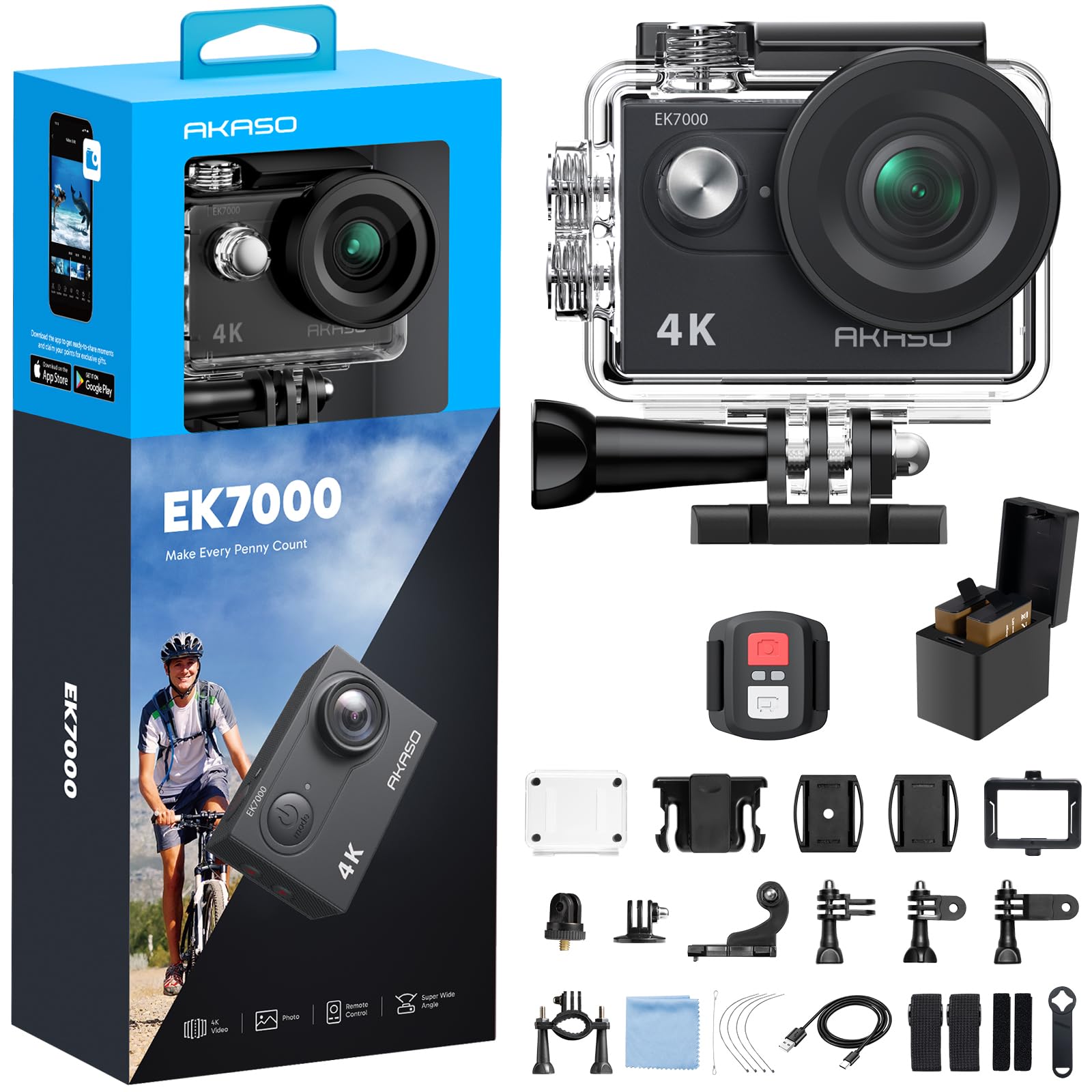
AKASO EK7000
Key Features
- Stabilization Type: EIS (digital)
- Video Resolution / Frame Rate: 4K30fps
- Battery Life: 90 min (2 batteries)
- Price: Budget
The AKASO EK7000 bundles a complete action camera starter kit — two batteries, a wireless wrist remote, waterproof housing, and a bag of mounts — for a price that makes first-timer risk almost nonexistent. It arrives ready to take on snorkeling trips or bike rides, not as a bare camera that requires extra accessories before you can use it.
Video output leans on upscaling to claim 4K, so expect footage that looks softer and less detailed than native ultra-HD. The digital stabilization helps tame handheld jitter, but a fair expectation is crisp 1080p rather than true 4K. Battery runtime per charge can be as brief as 25 minutes in the real world, which is why the second battery in the box isn’t a luxury — it’s necessary. Swapping packs mid-outing makes continuous shooting possible, as long as you plan around the short cycle.
This is a camera for kids learning to frame a shot, teenagers capturing pool jumps, or families wanting vacation clips without worrying about damage or cost. Hardcore riders, skiers chasing cinema-grade detail, or anyone who will pixel-peep should look elsewhere. Accept it as a tough 1080p shooter, and the bundle’s generosity far outweighs the marketing exaggeration.
Pros
- Tremendous out-of-box value with two batteries, waterproof housing, remote, and mounts for a rock-bottom price
- Casual picture quality holds up for poolside, beach, and outdoor clips in good light
- Wireless wrist remote lets you start/stop recording without touching the camera, handy on a helmet or handlebar
- Included housing keeps it waterproof to 40 meters, ready for shallow diving and snorkeling right away
Cons
- Battery runtime per charge can drop to around 25 minutes, well below the 90-minute claim
- Recorded 4K footage may appear soft and lacks true ultra-HD detail; treating this as a 1080p camera yields more honest results
If you want a take-anywhere camera for pool days and family vacations without worrying about the price tag, this kit delivers. Just set it to 1080p and carry the spare battery.
Best for Short Clips Streaming
Canon PowerShot V10

Key Features
- Sensor Size: 1-inch CMOS
- Stabilization Type: Optical IS
- Video Resolution / Frame Rate: 4K 30fps
- Price: Mid-Range
Canon’s PowerShot V10 packs a 1-inch sensor and crisp 4K video into a body small enough for a shirt pocket. The integrated kickstand and 19mm wide lens make one-handed vlogging and tabletop streaming effortless, while Canon’s color science produces natural, flattering tones that stand out in low light.
The main tradeoff is battery endurance: 4K recording can drain it in 20–30 minutes, so longer shoots need a USB-C power source. Overheating may cause shutdowns during extended use, and some units have been known to stop working after a few weeks. This camera fits streamers who stay plugged in and brief urban clips—not travel or event videography.
Pros
- 4K video with Canon’s natural colors, especially good for streaming in low light.
- Pocket-sized design with built-in kickstand for instant tabletop or handheld recording.
Cons
- Battery drains in as little as 20 minutes when recording 4K, requiring frequent USB-C power.
- Overheating can force shutdowns; some units may stop working after several weeks.
Streamers and desk-bound creators who can power the V10 over USB-C will enjoy Canon color in an ultra-compact body. Travel vloggers and long-form shooters should factor in the short battery and thermal limits.
Best for Beginner Vlogging
Sony ZV-1F

Key Features
- Sensor Size: 1-inch CMOS
- Stabilization Type: Digital IS
- Video Resolution / Frame Rate: 4K 30fps, 1080p 120fps
- Price: Premium
The ZV-1F delivers crisp 4K video and sharp photos from its 1-inch sensor in a body that fits in a coat pocket. The side-articulating touchscreen and simple interface make solo filming straightforward. However, the fixed 20mm wide-angle lens means no zoom reach, and the battery lasts roughly 30–40 minutes of continuous recording—carrying at least two spares is necessary for a day out. This limits its appeal compared to the premium ZV-1 or the DJI Pocket 3, but makes it a sensible starting point for short-form content creators who value Sony’s color science and autofocus.
Pros
- Crisp 4K video and pleasing color from a compact 1-inch sensor
- Simple, user-friendly interface designed for solo vloggers
- Lightweight and easy to carry in a small bag or purse
Cons
- Fixed 20mm wide-angle lens offers no optical zoom, limiting framing options for varied subjects
- Battery lasts roughly 30–40 minutes of continuous recording, requiring multiple spare batteries for a day’s shooting
Best for beginner vloggers shooting short clips who already trust Sony’s imaging, but not for travel-heavy days or zoom-dependent shots.
Best for Creative Pov
Insta360 GO 3S

Key Features
- Sensor Size: Small CMOS
- Stabilization Type: FlowState EIS
- Video Resolution / Frame Rate: 4K 30fps
- Battery Life: 140 min (with Pod)
- Price: Mid-Range
The GO 3S thrives where size and mounting creativity overshadow endurance. Its thumb-sized body pairs with an incredibly strong magnetic system to cling to hats, pet collars, or any metal surface, producing smooth, first-person perspectives no larger camera can replicate. FlowState stabilization removes shake so effectively that footage resembles a compact gimbal. However, the standalone camera overheats rapidly during 4K shooting—often becoming too hot to hold and shutting down to cool—and the battery drains in 10 to 15 minutes away from the charging pod. These boundaries don’t ruin the experience for someone who works in 90-second social clips or pet POV bursts, but they rule out all-day travel vlogging or any scenario where you press record and forget about it.
Pros
- Magnetic mounting lets you place the camera on nearly any metal surface for hands-free POVs that larger cameras can’t achieve.
- FlowState stabilization delivers gimbal-like smoothness, even when clipped to a running dog or a moving bicycle.
- The ultra-compact, nearly invisible body draws no attention, making it easy to film in public without self-consciousness.
Cons
- Standalone battery can drain in 10–15 minutes of 4K recording, far shorter than the 140-minute total when docked in the pod.
- The camera may overheat and shut down within a few minutes of 4K recording, even in comfortable indoor temperatures.
If your goal is quick, discreet POV shots where mounting flexibility matters more than runtime, the GO 3S captures perspectives no larger camera can—just plan on short takes and frequent pod recharges.
How to Choose
A portable video camera’s true travel worth comes down to sensor size, stabilization mechanics, and battery endurance—not pixel counts alone.
Sensor Size: Where Light Gets Captured
A 1-inch sensor gathers roughly four times more light than the tiny sensors in most budget action cams. This directly impacts how clean your footage looks at dusk or indoors. When sensors are too small, the camera compensates by digitally boosting the signal, which introduces grain and flattens colors.
If you shoot mostly outdoors in bright sun, a 1/1.3-inch sensor is sufficient, but for low-light travel vlogging, a 1-inch sensor makes the difference between a usable clip and a muddy one.
Stabilization: Mechanical Gimbal vs. Electronic Tricks
A 3-axis mechanical gimbal physically moves the lens to counteract shake, keeping your walking shots buttery smooth without cropping the frame. Advanced electronic stabilization like DJI’s RockSteady or HorizonSteady can mimic a gimbal well, but it crops the image and may struggle with rotational movement.
Basic digital EIS found in budget cameras often introduces jitter or ‘wobble’ when panning, making walking footage hard to watch. For travel, prioritize mechanical gimbals or top-tier EIS if you plan to move and shoot.
Video Resolution: Marketing vs. Pixels
Many budget cameras print ‘4K’ on the box, but their sensors capture far fewer pixels and upscale the image. The result is soft, muddy footage that lacks fine detail. True 4K requires a sensor with enough native resolution and a processor that can handle high bitrates without overheating.
For travel videos, 4K/30fps is the sweet spot, while 4K/60fps or 120fps allows smooth slow motion if your camera stays cool. Don’t be swayed by ‘8K’ labels on sub-$150 models; those are always upscaled.
Battery Life: The Hidden Limiter
Manufacturers quote runtime figures in ideal lab conditions—often with Wi-Fi and stabilization turned off. Real-world travel use, with the screen on and 4K recording, can cut that claim by half. A camera rated for 160 minutes might give you 80-90 minutes of actual shooting.
Always carry at least one spare battery, and if you film all day, a camera with USB-C charging while powered is a lifesaver. Action cams with cold-resistant batteries also hold up better in winter travel.
Waterproofing: Peace of Mind or Necessity
Action cameras thrive in rain and surf with IP68 ratings, while most pocket gimbal cameras offer no water resistance. If your travels include snorkeling, skiing, or monsoon seasons, built-in waterproofing avoids the hassle of bulky housings.
For dry land vlogging, skip it; the trade-off in camera size and heat dissipation isn’t worth it. But if water is part of your trip, look for at least IPX8 or a rated housing included.
FAQ
Why does my action camera keep overheating and shutting down?
Overheating often results from a combination of high bitrate 4K recording, warm ambient temperatures, and insufficient thermal design. To minimize shutdowns, shoot in shorter clips, lower resolution to 1080p for extended recording, and avoid direct sunlight. If your camera consistently fails, a unit with better heat dissipation, like the DJI Action 5 Pro, is engineered to run longer without stopping.
Is 4K on a budget action camera really 4K?
No, most budget cameras that claim 4K use sensors with far fewer pixels and upscale the image, resulting in soft, muddy detail. True 4K requires a sensor with at least 8 megapixels and a processor capable of handling high data rates. Look for reviews that show side-by-side footage; if the crispness doesn’t hold up to a smartphone, the 4K is likely fake.
How to choose between a DJI Pocket 3 and a Sony ZV-1 for travel vlogging?
The DJI Pocket 3 gives you gimbal-smooth walking shots and a true pocket size with great low-light due to its 1-inch sensor, ideal for active travel vlogging. The Sony ZV-1’s optical zoom and superior autofocus are better for sit-down reviews or product demos. Choose the Pocket 3 if stabilization matters most; pick the ZV-1 if you need zoom flexibility and don’t mind carrying spare batteries.
Does the DJI Osmo Pocket 3 work well in low light?
Yes, the DJI Pocket 3’s 1-inch sensor excels in low light compared to action cameras and smartphones. It delivers clean, detailed 4K footage in dim restaurants or city streets, especially when using D-Log M for color grading. The mechanical gimbal also helps by keeping the camera steady without digital cropping, preserving light.