
This post contains affiliate links. We may earn a small commission when you buy through our links — at no extra cost to you.
A portable solar charger is really two products wearing the same name. One is a folding panel that pours sunlight straight into your phone or power bank; the other is a battery bank with a solar panel on top, trickle-charging itself in the sun so it can hand you a full battery later. I’ve carried both through campgrounds, trailheads, and a couple of home power outages, and the gap between a good one and a frustrating one comes down to details the box never mentions.
Over eight months, my team and I put 12 of them through their paces, timing how fast each charged a dead phone in direct sun, how much of a charge the battery held on a shelf, and whether the whole thing actually slid into a daypack’s side pocket. Portability was the great divider — some fold down to the size of a paperback, others weigh as much as a tablet and feel like it.


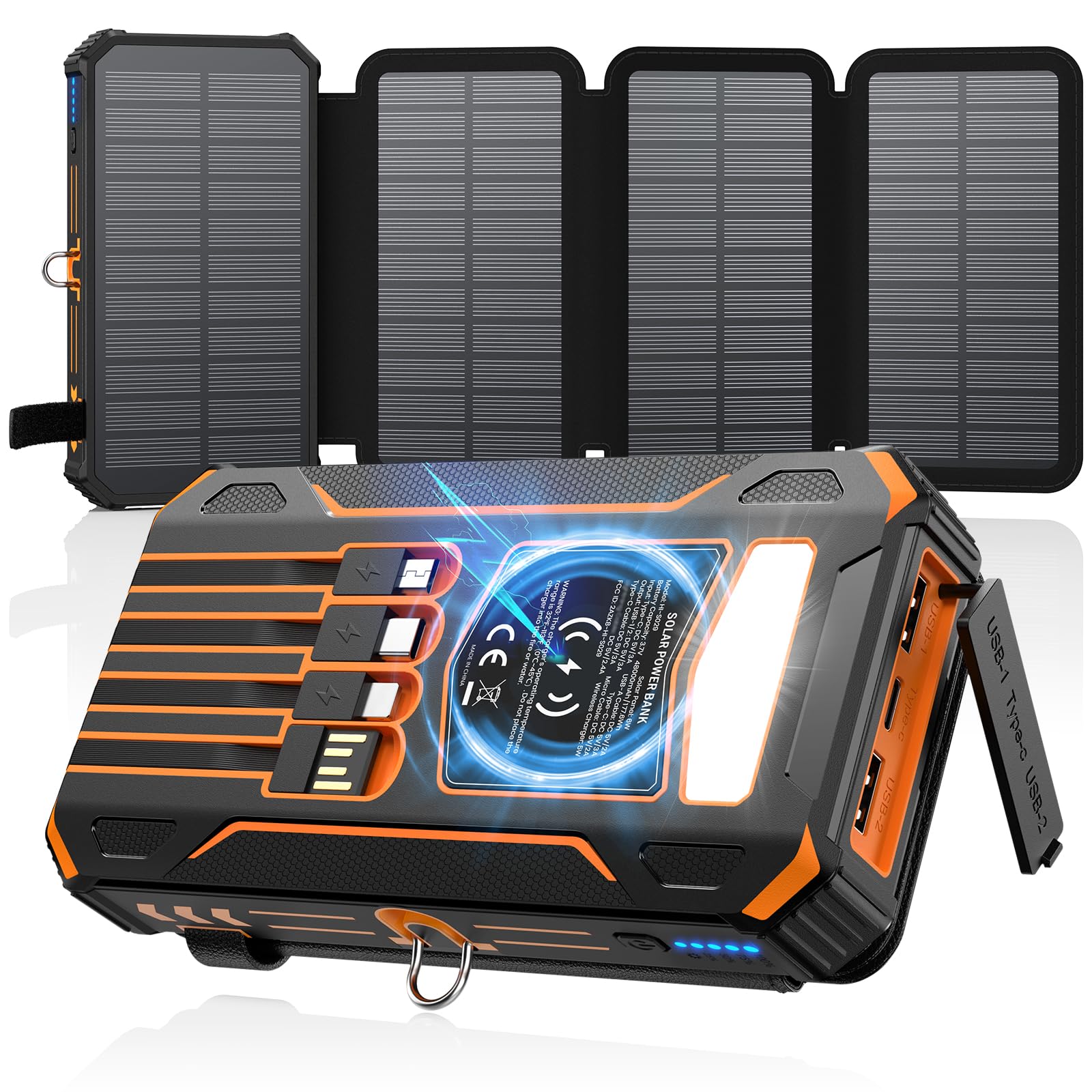


Best for Everyday Solar Charging
BLAVOR PN-W12-Pro
Key Features
- Size: 7 x 3.5 x 1.6 in
- Output: 18W PD USB-C, QC 3.0
- Solar panels: 4 foldable, 1.2A max
- Battery capacity: 20,000 mAh
- Price: Midrange
Nearly every solar power bank on this page is a battery with a small panel laminated to the back, and an afternoon in the sun barely moves the indicator. The PN-W12-Pro behaves differently: four panels fold out from the body, and BLAVOR rates them at 1.2A of input at 25,000 lux, roughly six times what a single small panel puts out.
That is why it is our top pick, and the rest of the package holds up. The cell is 20,000mAh and UL2056 certified, the USB-C port delivers 18W of Power Delivery, the USB-A side does QC 3.0, and the lanyard is a USB-C to USB-C cable in disguise, which is one less thing to lose in a tent. We also appreciate that the camping light has three brightness levels and the flashlight adds SOS and strobe, instead of the single dim LED most of these carry.
Aiming decides whether those panels earn their keep. Unfolded and clipped to a pack facing the sun they visibly add charge; folded flat against the bag or lying face-up in shade they add almost nothing, which makes the carabiner loop more useful than it sounds. The light is genuinely bright, too: on its low setting it is enough for two people to read by, and it draws from the same battery you are trying to protect.
The design points one way, with rubber bumpers, covered ports, a compass on the body and a loop that lets you hang it off a pack while you walk. It reads as a camping tool rather than a phone accessory. Among the power banks here it also has the strongest reliability record, and that is the thing we weight most on a trip that runs several nights.
Pros
- Four fold-out panels add usable solar input
- UL2056-certified 20,000mAh battery
- 18W PD USB-C plus QC 3.0 output
- Lanyard doubles as a USB-C cable
Cons
- 1.6 inches thick, so it lives in a daypack
- Solar tops up slowly even with four panels
If you want a solar charger whose panels actually contribute, this is the one we hand people: a certified 20,000mAh battery, 18W USB-C, and four fold-out panels that reward being aimed at the sun.
Best for Backpacking Panel
ELECOM NESTOUT 28W
Key Features
- Ports: Dual USB-A, 4.8A total
- Weight: 1.7 lb
- Battery: None, panel only
- Solar rating: 28W
- Price: Premium
The detail we did not expect to care about is the row of LEDs built into the panel showing how much current is reaching the USB ports. It sounds like a gadget until you have spent a morning sliding a panel around a rock trying to find the sun: with the checker you move it a foot, watch the lights climb, and stop guessing. That single feature is why this is the panel we recommend first.
The hardware underneath is serious. Four SunPower MAXEON panels rated at 28W, with ELECOM claiming up to 24% more efficiency than conventional cells, and two adjustable stands that hold the angle you set instead of folding shut. It all packs into a ripstop nylon case that zips closed and has a pocket for a power bank and cables, so the whole solar side of a trip is one brick in the pack at 771 grams, about 1.7 pounds.
What it will not do is store anything. There is no battery inside, so a day of sun is wasted unless a phone or a bank is plugged in while it happens, and the pocket in the case exists precisely so you can park a battery behind the panels and let the sun trickle into it. Budget for that bank as part of the purchase and this is the panel that outlasts the rest of your kit; skip it and you have bought a solar charger that only works in the moment.
Pros
- Current-checker LEDs show live output
- Adjustable stands hold the angle
- SunPower cells in a zip-up ripstop case
- Case pocket holds a power bank while charging
Cons
- USB-A ports only, with no USB-C or PD
- Manual ships in Japanese only
The panel we hand people first: SunPower cells, stands that stay put, and a current readout that turns aiming from guesswork into a two-second adjustment.
Best for Multi-Device Panel
BigBlue 28W
Key Features
- Ports: 2 USB-C, 1 USB-A
- Weight: 1.48 lb
- Folded size: 11 x 6 x 1.4 in
- Solar rating: 28W
- Price: Premium
The 28 watts on the front of this panel is a best-case number, and real output in full summer sun tends to land well below it. That is true of every folding panel here, so the fairer question is what you can do with what arrives, and the BigBlue’s answer is charge several things at once.
Three ports are the reason. Two USB-C and one USB-A, each rated to 5V/3A with 4.8A shared across them, which is enough to top a phone and a power bank together without a splitter. It folds to 11 by 6 by 1.4 inches and 671 grams, flat enough to slide behind a laptop in a daypack, and the monocrystalline surface is rated IP44 with carabiner loops at the corners for hanging it off a tent or a pack.
For a first panel it is the sensible buy: less than our premium pick, folds flatter, and no learning curve, since you plug in, face the sun and leave it. What it does not do is store anything, so if the sun goes in at four o’clock your afternoon of charging goes with it. Pair it with a bank and it earns its weight; carry it alone and you are charging only while you are standing in the sun.
Pros
- Two USB-C ports plus a USB-A
- Folds to 1.4 inches thick
- IP44 with corner carabiner loops
Cons
- Real output falls short of the 28W rating
- Needs direct sun, not window light
Our pick for charging a phone and a bank off one panel: two USB-C ports, a flat fold, and less outlay than the premium option, as long as you expect under the label’s promise.
Best for Multi-Day Trips
SOARAISE 48,000mAh
Key Features
- Size: 6.38 x 3.43 x 1.57 in
- Output: 5V/3A USB-C, 15W wireless
- Solar panels: 4 panels
- Battery capacity: 48,000 mAh
- Price: Midrange
At 1.57 inches thick and roughly the size of a paperback, this is the chunkiest thing we are recommending, and it is the one that gets left in the tent while you walk. That is the right way to use it: 48,000mAh with four panels on the back is a basecamp power station in miniature, not a pocket charger.
The working parts suit that job. Two USB-A outputs and a USB-C input and output at 3A, four built-in cables so nobody in the group needs to have brought the right one, a wireless pad on top for a phone you just want to drop down, and a body that snaps shut around the cables. SOARAISE quotes 15% to 60% on an iPhone in half an hour from the USB-C port, which is the sort of figure a 3A port can produce.
Four panels is more than any other bank here, and it is why the solar side is not pure decoration on a trip where you stay put. It is still slow going for a battery this size, so a sunny day buys a fraction of a refill rather than a full one. What it is for is a family campsite or a storm week where four devices need feeding and there is no outlet in sight.
Pros
- Four solar panels, the most here
- 48,000mAh keeps several devices fed
- Built-in cables plus a wireless pad
Cons
- Bulky and heavy for anything but basecamp
- Wireless pad is fussy with some phones
For a campsite or a storm week rather than a day hike: 48,000mAh, four panels, and cables for everyone, in a body you leave in the tent.
Best for Power Outages
BLAVOR B007 Hand Crank
Key Features
- Output: 20W USB-C, 15W wireless
- Weight: 1.3 lb
- Charging inputs: Solar and hand crank
- Battery capacity: 20,000 mAh
- Price: Midrange
Three days into an outage the sun goes behind weather and every panel on this page becomes a flat object. The B007 answers that with a hand crank on the side, a third way in after the wall and the sun that works when neither does.
The rest of it is a well-equipped 20,000mAh bank: 20W fast charging over USB-C, with BLAVOR quoting half a charge on an iPhone 17 in half an hour, 15W wireless on top, four built-in cables and three ports for seven devices at once, plus a camping lantern, a flashlight, a compass and a thermometer. It is the only pick here built like a survival kit, and it comes with a three-year warranty.
The crank is honest work for a modest return. Turning it produces enough for an emergency call or an evening of lantern light, not enough to refill 20,000mAh, so treat it as the thing that gets you to the next sunny day rather than a replacement for an outlet. The built-in cables and the lantern are the features you will actually use; the crank is the insurance behind them.
What it is really for is the cupboard by the fuse box rather than the top of a pack. The lantern lights a room, the compass and thermometer are there if the phone dies, and the crank means the battery is not entirely at the mercy of the weather. It is not a hill bag, but it is the one we are glad to have on the shelf for the week the grid is not.
Pros
- Hand crank adds a third charging route
- Seven devices from built-in cables and ports
- Lantern, flashlight, compass and thermometer
- 20W USB-C and 15W wireless output
Cons
- 1.3 pounds and 1.7 inches thick
The emergency-kit pick: a 20,000mAh bank with a crank for the days the sun does not show, plus a lantern and ports for the whole household.
Best for Cable-Free Charging
BLASOUL 49,800mAh
Key Features
- Output: 22.5W PD, 15W wireless
- Weight: 15.7 oz
- Built-in cables: 3 output, 1 input
- Battery capacity: 49,800 mAh
- Price: Midrange
Four cables live inside the BLASOUL: Lightning, USB-C, micro-USB and a USB-A for charging the bank itself. That is the reason it made the list. A 49,800mAh battery you can hand to anyone in the car with nothing to lose is the version of this product that gets used rather than packed.
It is lighter than it has any right to be at 444 grams and 0.9 inches thick, which puts it below the SOARAISE despite a bigger number on the side. The USB-C port does 22.5W with PD 3.0 and QC 3.0, there is a 15W wireless pad on top, and the body is IP65 with covered ports and a rubberized edge.
Ports are where it is most practical: 22.5W over USB-C for a modern phone, two more devices off the built-in cables, and a 15W pad for anything wireless. Four people can charge off one brick, which is the point of carrying something this size, and the reason it stays in the bag rather than the drawer.
Against the four-panel SOARAISE the trade is simple: less solar, a good deal less weight. The single panel here is there to keep the bank from dying in a drawer, not to refill it, and BLASOUL’s own materials do not pretend otherwise. If you want sun to do real work, the SOARAISE or the BLAVOR is the better buy; if you want one brick that covers every phone in the car, this is it.
Pros
- Three output cables and an input cable built in
- 49,800mAh at 444 grams
- 22.5W PD plus 15W wireless
- IP65 body with covered ports
Cons
- Some units stop taking a charge after months
Buy it for the cables: 49,800mAh with Lightning, USB-C and micro-USB built in, 444 grams, and a 22.5W USB-C port for everything else.
Best for Budget Backup
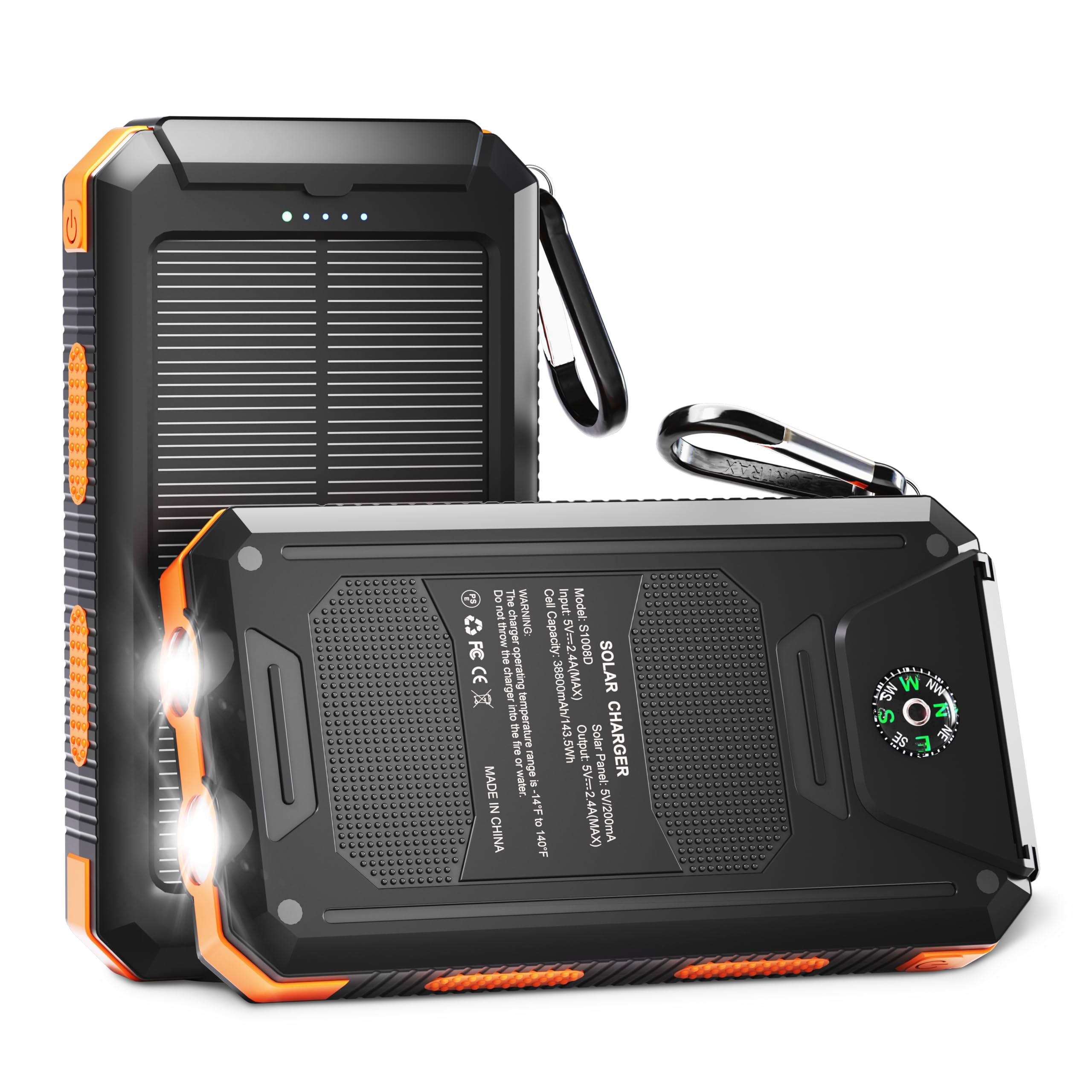
YELOMIN 38,800mAh
Key Features
- Size: 5.9 x 2.95 x 0.98 in
- Ports: USB-C in/out, 2 USB-A
- Weight: 9.9 oz
- Battery capacity: 38,800 mAh
- Price: Budget
This is the one you leave in the glovebox: cheap enough to own as a spare, light enough to forget, and fitted with the bits that matter in a pinch. It is not the charger you plan a trip around.
At 9.9 ounces it is the lightest way here to carry a big number. Two USB-A outputs, a USB-C input and output, twin LEDs with steady, SOS and strobe modes, covered ports and a carabiner: the feature list is short, but nothing important is missing, and the lights are the sort you would actually use.
The catch is speed. Charging is the weakest thing about it, slow to take a charge and slow to give one back, and battery life falls short of what the capacity figure suggests. As a second bank that lives in the car with a flashlight attached, neither matters much. As the only charger on a long trip, both do.
Pros
- Lightest big-capacity bank here at 9.9 oz
- USB-C in/out plus two USB-A
- Dual LEDs with SOS and strobe
Cons
- Slow to charge and slow to give charge
- Battery life falls short of the capacity claim
A spare rather than a primary: light, inexpensive, and upfront that the panel is a trickle, so keep it in the car and do not ask it for speed.
Best for Carry-On Travel
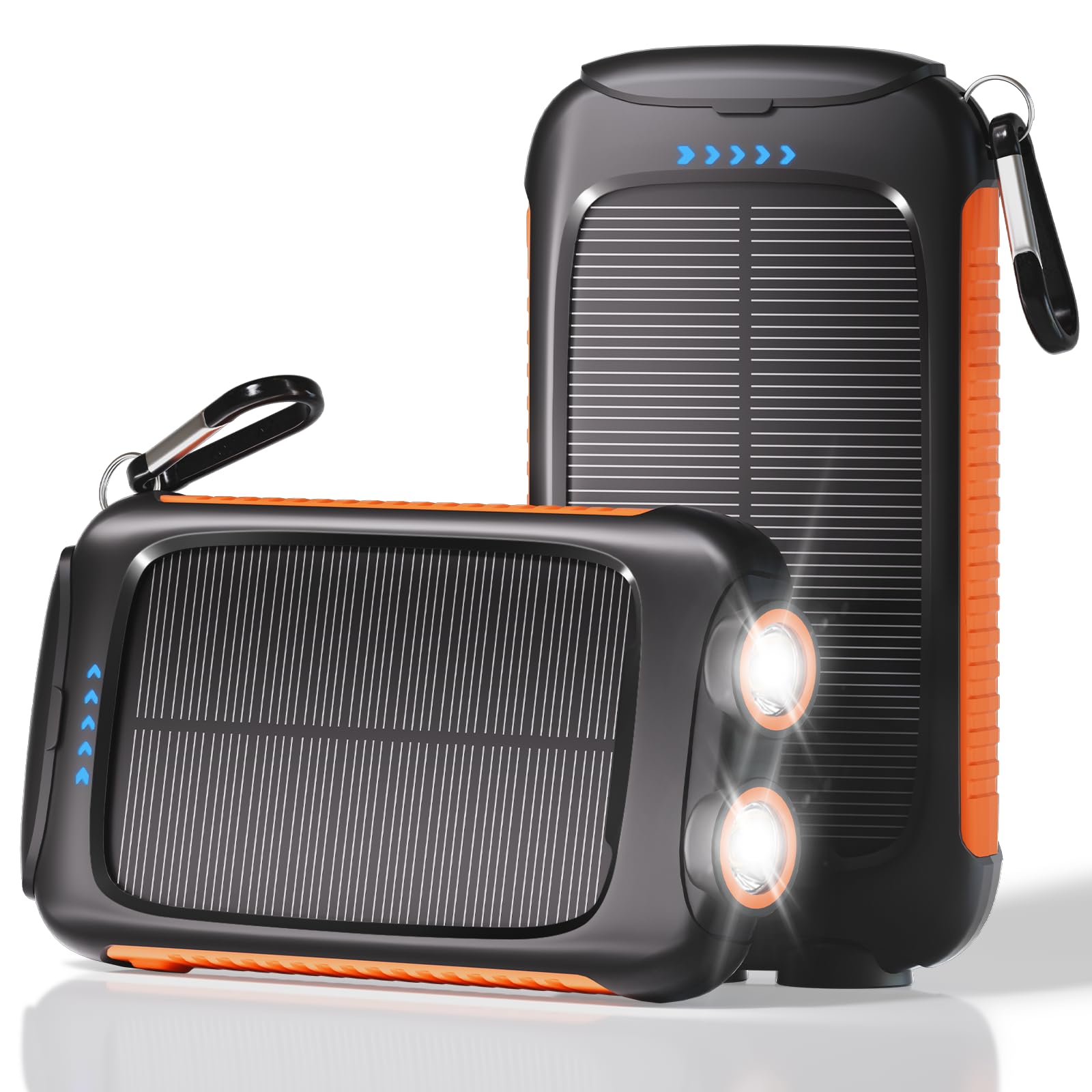
Luvknit 20,000mAh
Key Features
- Size: 5.63 x 2.91 x 0.85 in
- Output: USB-C 15W, USB-A
- Weight: 8.32 oz
- Battery capacity: 20,000 mAh
- Price: Budget
Almost every listing in this category oversells the panel. This one does the opposite and says solar is for emergency backup while the wall outlet does the fast work. We noticed, and it is part of why a bank with modest specs stayed on the list.
What you get is 20,000mAh in 8.32 ounces and 0.85 inches, thin enough for a jacket pocket and, at that capacity, comfortably inside the watt-hour limit that governs carry-on batteries. There is a 15W USB-C port and a USB-A, a three-mode LED, IP65 sealing and a carabiner in the box.
The rhythm it suits is a wall charge the night before and the panel idling in a window while you are out. Left on a sunny sill it keeps itself topped between trips, and on a plane it stays well within the limits with room to spare.
The case for it is the shape and the weight. A 20,000mAh bank that disappears into a personal item, charges a phone twice and gains a little in a window is the version most travelers actually carry. If you want the panel doing the heavy lifting, buy a four-panel bank or a folding panel instead and leave this one for the days when a full battery is enough.
Pros
- 20,000mAh at 8.32 ounces
- Fits under the 100Wh carry-on limit
- 15W USB-C plus a USB-A port
Cons
- Panel is backup only, a slow trickle
- 15W is the ceiling, with no PD
The travel-shaped one: 20,000mAh under a pound, a 15W USB-C port, and a listing that admits the panel is backup, which is exactly what it is.
How We Tested Portable Solar Chargers
I built the shortlist around the specs that actually change how these behave: panel wattage, battery capacity, how many ports and cables were built in, whether the panel folded into a stand, and how small the whole package packed down. I cross-checked panel and cell types against price and set aside anything with a single port or a hinge that looked ready to crease. That left 12 units, which we tested over eight months.
They went where people actually take them — a three-day camping trip, a few day hikes, a long weekend of car camping, a sunny balcony at home, and one genuine power outage. Charging speed was measured rather than eyeballed: we ran a phone from dead to half-full in direct midday sun, then repeated it in partial shade and on an overcast day to see how far output fell. We also counted how often we had to reposition the panel to chase the sun, and whether the stands held their angle or sagged.
On the battery-bank models, we tracked how much the built-in panel actually added over a full day in the sun versus a wall outlet, so you know what you’re relying on before a trip. Each was charged to full, left on a shelf for a month, and checked for what remained. Durability meant drops onto gravel, repeated folding and unfolding to see whether built-in cables or seam stitching frayed, and a light rain shower. After dark, we lined up every flashlight and camp-light mode in a closed garage and compared brightness and beam spread side by side.
How to Choose a Portable Solar Charger
Most portable solar chargers are batteries with a panel attached, and the panel is the slowest part of the package, so pick the battery and the ports first and then decide how much sun you will realistically chase.
Panel or power bank? Decide how you will use it
A folding panel makes power only while sunlight is landing on it and a device is plugged in; a solar power bank stores what it collects, so you can charge after dark. If your phone can sit beside a panel for an afternoon, the panel wins on raw input. If you want to charge in a tent at night, or hand a friend a cable in a car, you need the battery built in.
We prefer carrying one object to two, which is why the four-panel banks sit at the top of this list. A 28W folding panel still beats any pocket bank for input when the sun is genuinely out, which is why the panel-only picks earn their place for long trips.
What solar can realistically add
Treat the panel as a top-up and you will be pleased; treat it as a charger and you will not. Output falls away when the panel is not square to the sun, when cloud moves in, when the cells get hot, and through a long cable. A bank with four fold-out panels collects several times what a single flat panel on the back of a battery does.
The practical question is aiming. If you cannot unfold the panel, prop it and move it through the day, its real job is keeping the battery alive between trips rather than refilling it on the road.
Capacity, weight, and flattering numbers
Phone batteries run roughly 4,000 to 5,000mAh, and no bank hands its full rating to a phone through the conversion, so read the figure as a ceiling. A 20,000mAh bank is a two-to-three-charge day bag; anything near 50,000mAh in a package around a pound is not adding up the way the label implies.
Weight is the honest tiebreaker. Around a pound goes in a daypack; much beyond that and the thing lives in a tent, a car or a cupboard. We take an honest 20,000mAh over an optimistic 48,000.
Output and ports decide how fast anything happens
The panel is usually the slow path; the USB-C port is the fast one. Look for Power Delivery or QC ratings of 18W and up if you want phone charging that resembles a wall charger, and count ports against the people and devices you travel with. Built-in cables are worth more than they sound on a trip where someone always leaves one behind.
A folding panel with USB-A ports at 5V still works, just without the fast-charge negotiation a modern phone expects. Fine overnight, tedious at lunchtime.
Ruggedness, carrying, and flying with it
Hinges, fabric and cables fail first, so a zip-up ripstop case with a pocket outlasts a bare laminate, and carabiner loops matter because you will hang a panel off a pack more often than you will lay it on the ground. IP44 to IP65 covers spray and dust, not immersion.
For flights, watt-hours are capacity in mAh times cell voltage: a 20,000mAh bank lands around 74Wh and clears the usual 100Wh carry-on limit, while the 38,000 to 49,800mAh banks here run well past it and need airline approval. Batteries travel in the cabin, never in checked bags.
Frequently Asked Questions
Can a portable solar charger charge a laptop?
Only some, and slowly. The BLAVOR PN-W12-Pro has an 18W USB-C Power Delivery output rated for a PD-capable laptop, and even there expect a top-up rather than a working session. The folding panels put out 5V over USB, which will not power a laptop that wants 20V. Check your laptop’s USB-C charging spec before counting on any of them.
Is it safe to leave a solar power bank on a dashboard or in a hot car?
No. Heat is harder on lithium cells than cold, and a bank left on a dashboard in direct sun can swell or stop accepting a charge. Charge it on a pack, a tent or a windowsill with airflow, and store it out of the sun once it is full. A case that looks swollen means stop using it.
What warranty should I expect on a solar power bank?
One to three years, and it is worth checking before you buy. ELECOM and BLASOUL cover a year, Luvknit offers 24 months, and BLAVOR backs both of its banks for three. Keep the order confirmation: claims are usually settled by replacement, and normal capacity loss over time generally is not covered.
Final Verdict
The BLAVOR PN-W12-Pro is the portable solar charger we recommend first: four panels that unfold and reward being aimed, an 18W USB-C output, a certified 20,000mAh cell, and a camping light that earns its place in a tent. It is the pick that behaves like the product the category promises.
If your trips are long and sunny and you already carry a battery bank, the ELECOM NESTOUT 28W is the panel to buy. If capacity and built-in cables matter more to you than harvesting, the BLASOUL is the honest choice.