
This post contains affiliate links. We may earn a small commission when you buy through our links — at no extra cost to you.
Many travelers and campers buy a solar power bank expecting it to charge their phone under the sun. The reality: those tiny panels deliver negligible power, making the solar feature more of a marketing checkbox than a functional tool. Direct solar panels are a different story — they can match wall speeds in full sunlight but come with their own limits.
The key distinction is between power banks with integrated solar cells and standalone panels. Power banks are best treated as large portable batteries charged at home; standalone panels can keep your phone alive indefinitely as long as the sun is out.
Choices range from ultralight panels under 1.5 pounds to high-capacity banks with built-in cables. The right fit depends on how much sun you’ll have and how much weight you can carry. Understanding this trade-off is the first step toward a solar charger that actually works for your trips.



Best for Backpackers, Hikers
BigBlue 28W Solar Panel
Key Features
- Power Rating: 28W
- Weight & Size: 1.5 lbs, 11x6x1.4 in
- Output Ports: Dual USB-C, USB-A
- Price: $$
At 1.5 pounds with a folded footprint smaller than a water bottle, the BigBlue 28W packs down tight enough for a backpack side pocket. Unfolded, its three monocrystalline panels push up to 28W through dual USB-C and USB-A ports, each capable of 5V/3A. In full sun, that means a phone charges at roughly the same speed as a wall adapter — no waiting around all afternoon for a partial top-off.
That speed depends on direct, unobstructed sunlight. A passing cloud or a patch of tree shade can cut output dramatically, and under heavy overcast the panel may deliver little more than a trickle. Some units have also shown inconsistent output in less-than-ideal conditions — worth testing with your device before relying on it for a multi-day trip. The panel itself is IP44-rated against splashes, but the charge controller and ports are best kept dry.
This is a tool for scenarios where sun exposure is predictable and weight is the limiting factor — backpackers covering long miles, emergency kits stashed in a car or go-bag, or base-camp charging when you can leave it aimed at the sky. It is not a solution for cloudy climates, shaded campsites, or overnight use; there is no internal battery, so once the sun drops, charging stops. The build feels solid — reinforced stitching on the fabric panels and a sturdy zippered pouch for the controller — but a small number of buyers have reported the charge controller failing or melting under sustained use, which underscores the value of inspecting the unit on arrival.
The BigBlue 28W has been a consistent choice in this category for years, with tens of thousands of owners and a long track record of performing as advertised under the right conditions. The tradeoffs are clear: you trade all-weather flexibility for a weight that is hard to beat. For anyone who can work within that boundary, this panel delivers exactly what it promises.
Pros
- Folds to 11x6x1.4 inches at just 1.5 lbs — easy to stow in a backpack.
- Charges a single phone at wall-adapter speed in direct sunlight.
- Durable fabric and stitching hold up to repeated outdoor use.
- Dual USB-C and USB-A ports let you charge two devices at once.
Cons
- Output drops sharply in partial shade or overcast conditions — requires clear, direct sun to be useful.
- In some cases the charge controller has failed or melted during extended use; inspecting the unit early is wise.
For backpackers and emergency kits where weight and direct sun are constants, this is the panel to pack — just test it before you trust it on a long trip.
Best for Travelers, All-In-One
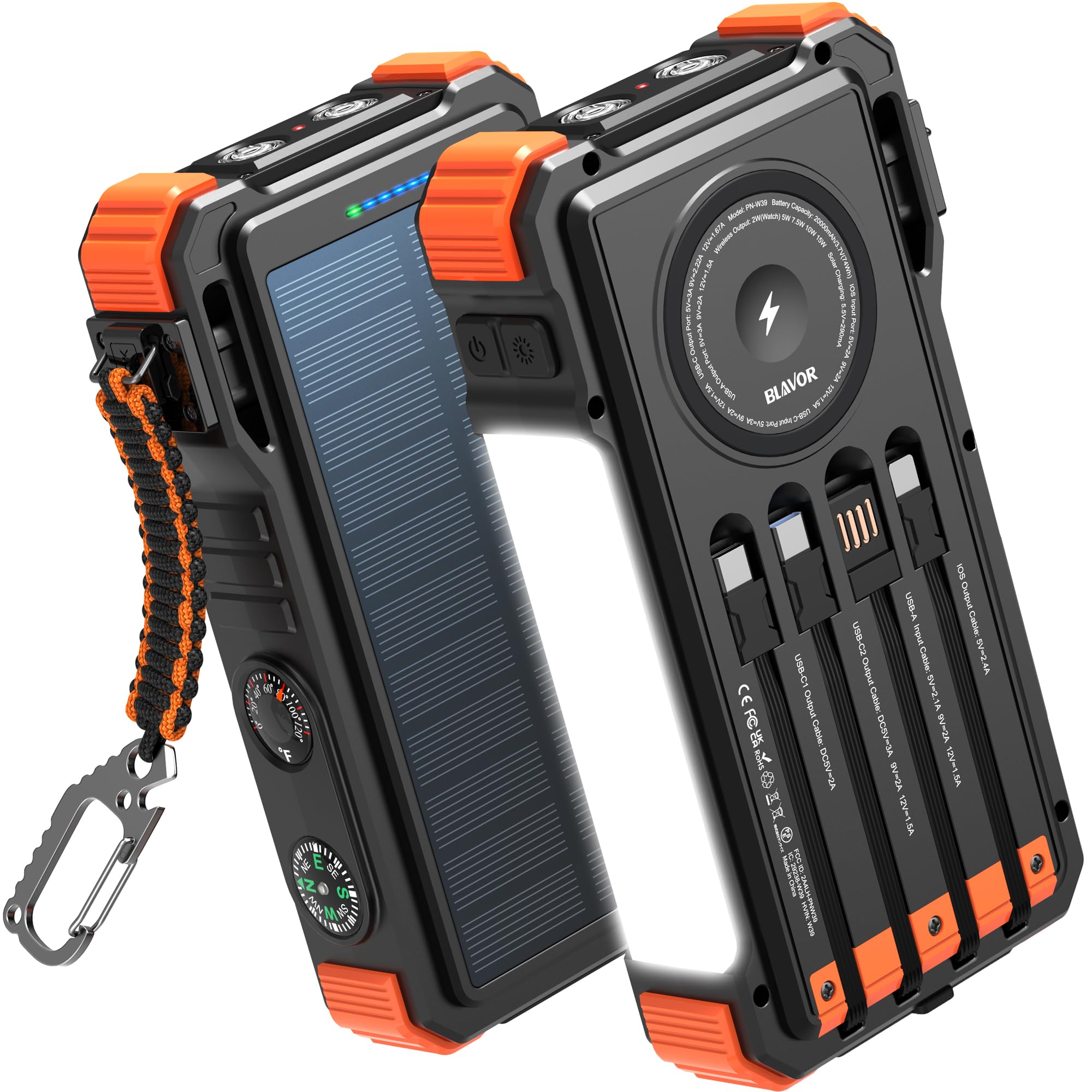
BLAVOR 20K Power Bank
Key Features
- Power Rating: 20000mAh
- Output Ports: USB-C, Lightning, Micro
- Price: $$
The BLAVOR 20K Power Bank distinguishes itself from the slimmer everyday power banks by bundling a 20000mAh capacity, four built-in cables (two USB-C, iOS, USB-A), and wireless charging that supports both phones and Apple Watch — all in one unit. The tradeoff for this convenience is extra bulk and weight, which limits its appeal for ultralight packing but fits well in a glove compartment or duffel.
This bank is best suited for travelers and car campers who want to minimize the number of accessories they carry. The built-in cables mean no hunting for cords, and the dedicated Apple Watch charger is a rare addition. The integrated solar panel is present but delivers a trickle charge at best — treat it as an emergency backup rather than a primary power source. The weight (heavier than typical 20000mAh banks) is manageable if you’re not hiking long distances with it.
Charging speed via the USB-C port can be slower than the rated 20W suggests — expect overnight charging for a depleted phone rather than a quick boost. The build quality feels solid, and the 20000mAh capacity comfortably recharges multiple devices over a weekend. Occasional reports of built-in cable fraying after extended use are worth noting; careful handling helps extend their life.
Pros
- Premium build quality with a solid feel
- Charges multiple devices multiple times on a single charge
- Built-in cables and Apple Watch charger reduce gear clutter
- Compact enough for glove compartments and bags
Cons
- Solar charging is very slow — impractically so as a primary source
- Heavier and bulkier than typical 20000mAh power banks
- Charging speed via USB-C can be slower than expected from a 20W bank
A feature-packed all-in-one for road trips and campsites where weight isn’t a concern — but the solar panel is more of a novelty than a functional charging source.
Best for Car Campers
FlexSolar 40W Foldable Panel
Key Features
- Power Rating: 40W
- Weight & Size: 1.76 lbs, 8.0×11.1×1.8 in
- Output Ports: USB-A QC3.0, USB-C PD, DC
- Price: $$
The FlexSolar 40W delivers the highest wattage among foldable solar panels under two pounds, with a DC port that opens charging options for larger devices like power banks and 12V gear. The ETFE coating and IP67 water resistance make it well suited for outdoor conditions, and the folded size fits into day packs easily.
This panel suits car campers who need to charge multiple devices and power banks simultaneously, and who value high wattage over ultralight weight. Real-world output tends to settle around 30W rather than the advertised 40W, so plan charging sessions accordingly. The 1.76 lb weight is heavier than lower-wattage alternatives, but manageable for vehicle-based trips.
The DC port adds flexibility for charging larger battery packs or 12V devices, a feature missing from most sub-40W panels. Build quality is consistent across the panel surface, and the included USB-C and USB-A ports support quick charging for phones and tablets.
Pros
- Consistent output and sturdy build
- Durable materials with ETFE coating
- Portable for its wattage
Cons
- Heavier than lower-wattage panels at 1.76 lbs
- Charging may cease intermittently after initial use in some units
For car campers who need high wattage and a DC port, the FlexSolar 40W is a capable option—just account for the output variance and occasional charging quirks.
Best for Design Enthusiasts
ELECOM NESTOUT 28W
Key Features
- Power Rating: 28W
- Weight & Size: 1.18 lbs, 14x7x2 in
- Output Ports: Dual USB-A
- Price: $$$
The ELECOM NESTOUT 28W is the rare solar panel that treats organization as a core feature. Its built-in pouch neatly stows cables, a small power bank, or a phone — no separate case needed. The 1.18-pound unit folds into a compact ~14x7x2-inch package that slips into a daypack without adding clutter. This design-first approach sets it apart from the simpler, lighter BigBlue 28W that earns the top pick slot.
This panel is best for the design-conscious outdoor enthusiast who wants a premium, all-in-one solution. The SunPower MAXEON cells deliver steady charging in full sun, and the adjustable stands make positioning easy. However, the premium price buys style and organization rather than raw wattage — and in very hot, direct sunlight, the panel may reduce output to manage heat. That tradeoff matters less for moderate-climate hiking or campsite charging.
Pros
- Integrated storage pouch keeps cables and accessories organized without extra gear.
- Consistent charging from SunPower MAXEON cells in full sunlight.
- Award-winning build with premium ripstop nylon and water-resistant construction.
- Lightweight at 1.18 pounds and folds compactly for easy packing.
Cons
- Premium price offers less wattage per dollar compared to many competitors.
- In very hot, direct sun the panel may throttle output to manage internal temperature.
If you want a solar panel that looks as good as it works and keeps your gear tidy, the NESTOUT is a smart buy — but if you’re counting pennies or need maximum power for your dollar, the BigBlue 28W stretches further.
Best for Budget Buyers
BLAVOR 10K Power Bank
The BLAVOR power bank packs 10,000mAh capacity, wireless charging support, and a compact design that slips into a pocket — a practical everyday companion for keeping phones topped up. Unlike dedicated solar panels that require direct sunlight, this power bank charges via wall outlet and wireless pad, making it a reliable backup for travel, commuting, or short camping trips where grid power is available.
This unit suits budget-conscious buyers who want a small, affordable power bank for urban or car-camping use. However, the integrated solar panel is effectively decorative — its tiny surface area delivers negligible charge, so you should treat this strictly as a standard power bank. For anyone expecting solar to keep their phone alive during a multi-day hike, this is not the tool.
Charging performance as a power bank is generally solid for the price: it can fully charge most phones twice, and the 20W USB-C output handles quick top-ups. Build quality feels durable, and the dual flashlight is a handy extra. That said, some units may see battery capacity decline after months of use, and charging consistency can vary between units — occasional quirks that are typical at this price point.
Pros
- Solid build quality for the price
- Fully charges phones multiple times
- Highly portable compact design
Cons
- Solar panel provides negligible charge — effectively a marketing feature, not functional
- Charging performance can vary between units; some may struggle to deliver consistent power
- Battery capacity may degrade over time, with some units losing charge-holding ability after extended use
For anyone who needs a compact, everyday power bank and has no illusions about solar charging, the BLAVOR offers strong value. Ignore the panel and treat it as a standard backup — it works well within those bounds.
Best for Fast Usb-C Pd
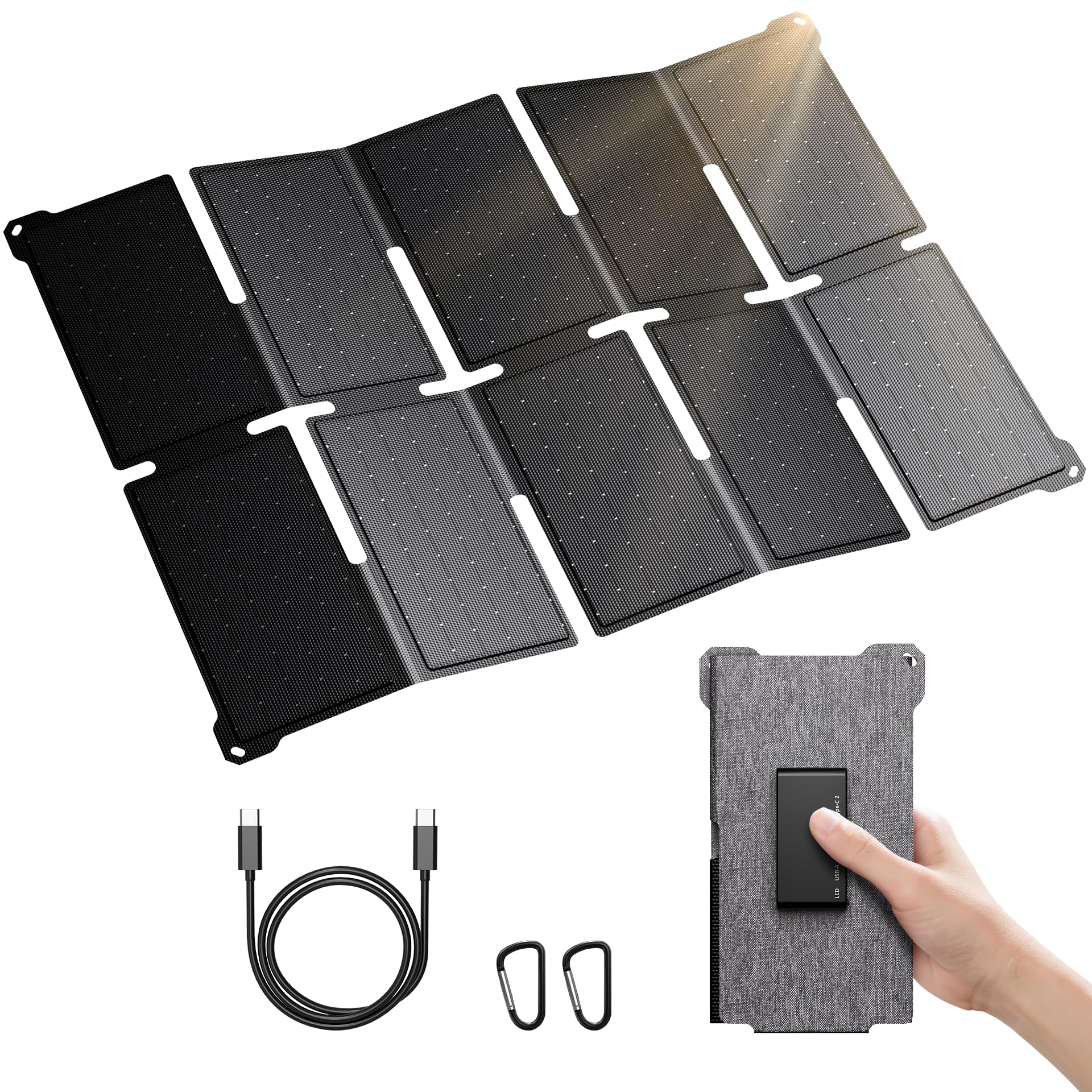
BigBlue 35W Solar Panel
Key Features
- Power Rating: 35W
- Weight & Size: 1.54 lbs, 8.3×4.8×1.9 in
- Output Ports: 2 USB-C PD25W, USB-A
- Price: $$
The BigBlue 35W panel delivers fast USB-C PD charging at 25W, making it one of the quicker direct-charge options for phones and tablets. As a newer model, real-world performance data is still limited compared to the established 28W version—campers who prioritize proven reliability may want to wait for more feedback before committing. The IP68-rated fabric handles rain well, but the junction box itself isn’t waterproof, requiring some care in downpours. At 1.54 lbs, it remains moderate weight for a 35W panel, suitable for car camping or shorter hikes rather than ultralight backpacking.
Pros
- Direct USB-C PD 25W charges phones at speeds comparable to wall outlets.
- 35W output in a foldable panel that packs smaller than many competitors of similar wattage.
- IP68-rated fabric and cells withstand rain and splashes for all-weather camping.
Cons
- Junction box lacks waterproofing—connection points need protection in sustained rain.
- At 1.54 lbs, it adds noticeable weight for minimalist backpackers focused on gram savings.
A strong pick if you want 35W direct charging and are comfortable with a newer, less-vetted design—best for weekend car campers or as a secondary panel where weight isn’t critical.
Best for Budget Campers
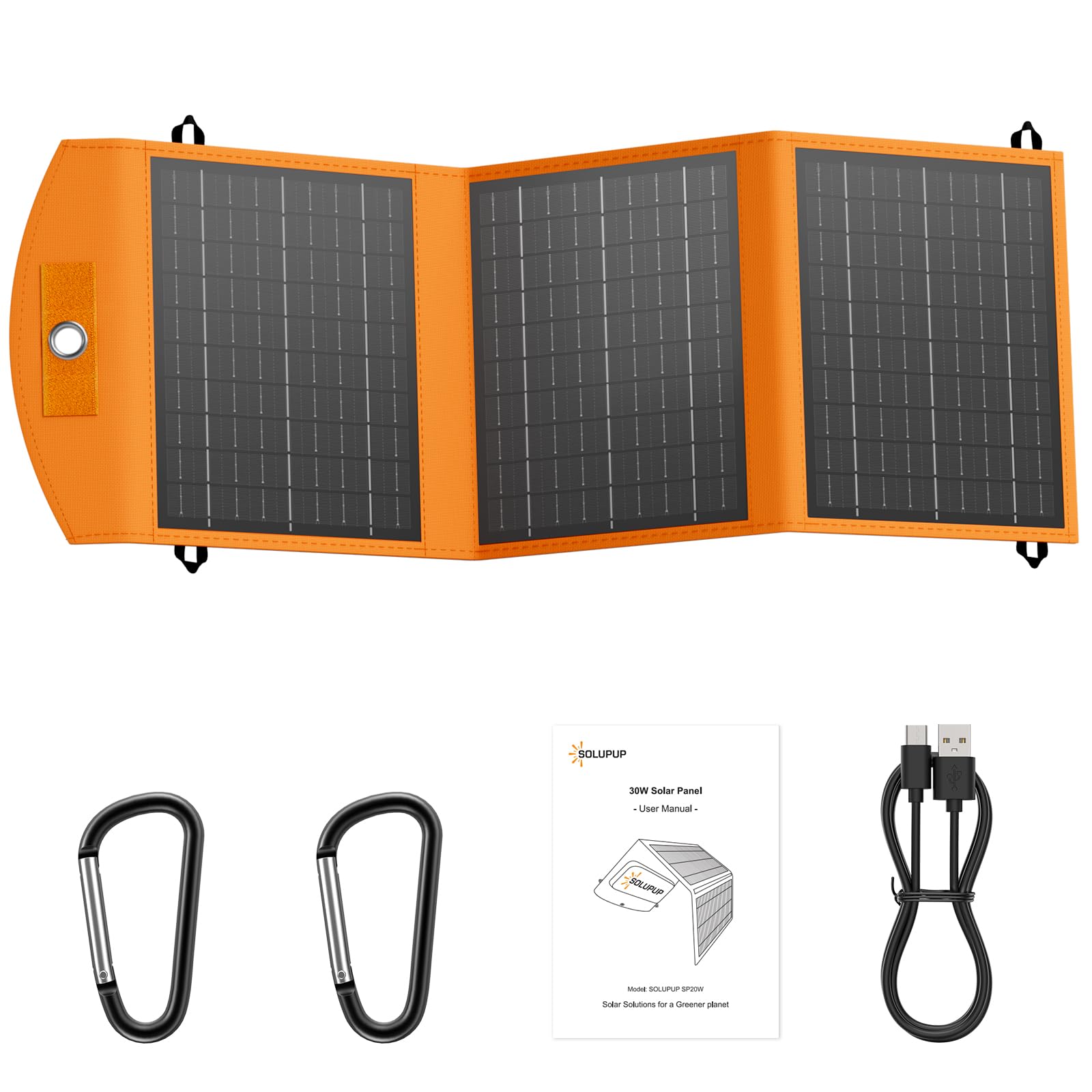
SOLUPUP 30W Panel
Key Features
- Power Rating: 30W
- Weight & Size: 2.4 lbs, 10.63in
- Output Ports: USB-A, USB-C
- Price: $
This SOLUPUP 30W panel delivers solid charging performance under direct sunlight, with both USB-A and USB-C outputs providing up to 15W combined. The IPX5 rating means it handles light rain without issue. However, the 2.4 lb weight makes it better suited for car camping or base camp use rather than backpacking, and with relatively few user reports available, long-term behavior is less documented than more established models like the top pick. For budget-conscious campers who value simplicity and weather protection over portability, this is a reasonable choice.
Pros
- Provides consistent 1.5A charging from each port in full sun — enough to top off a phone during a day out.
- IPX5 water resistance adds peace of mind for outdoor use in damp conditions or sudden showers.
- Dual USB ports allow charging two devices at once, reducing the need for a separate hub.
Cons
- At 2.4 lbs, it’s heavier than foldable panels from top competitors — fine for car camping but too heavy for hiking trips.
- USB output maxes out at 15W per port — won’t fast-charge newer iPhones or Samsung phones that require 20W+ Power Delivery.
This panel works well for budget campers who drive to the site, don’t mind extra weight, and need a simple, weather-resistant solar charger for topping off devices.
Best for Budget Campers
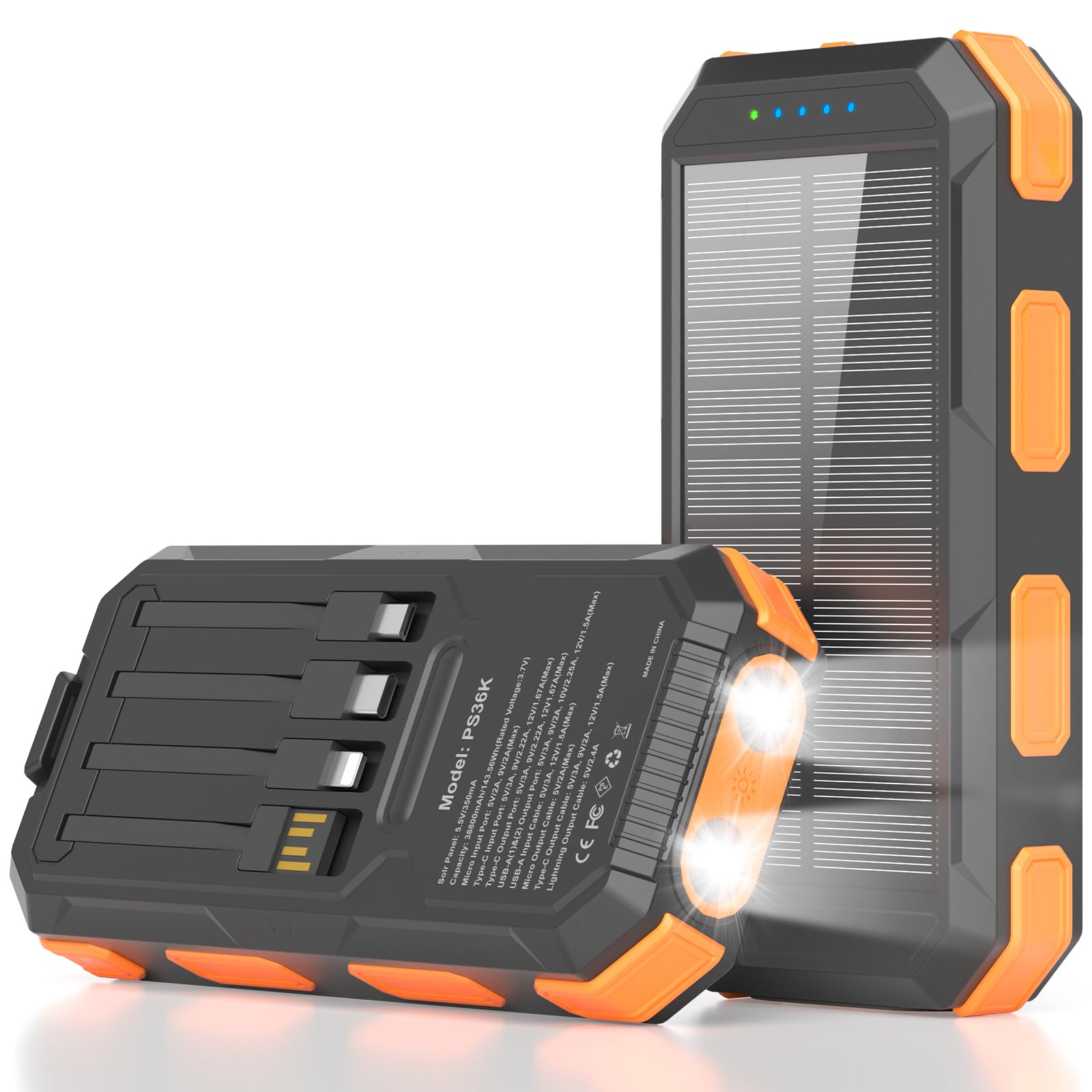
YELOMIN 38800mAh Bank
Key Features
- Power Rating: 38800mAh
- Output Ports: USB-C, Lightning, Micro
- Price: $
For the price, this power bank delivers massive capacity (38800mAh) and includes four built-in cables plus PD 22.5W fast charging — useful for topping off phones and small devices during short trips. The integrated solar panel can trickle charge the battery over many hours in direct sun, but its output is very slow and long-term durability under regular use is unconfirmed. This works best as a pre-charged wall-outlet power bank for budget campers who only need solar as an emergency reserve, not a primary charging method.
Pros
- High capacity (38800mAh) at a budget price point
- Four built-in cables (USB-C, iOS, USB-A, Micro) reduce carry needs
- Supports PD 22.5W fast charging for compatible devices
Cons
- Solar panel charges at a very slow rate, insufficient as primary power source
- Long-term battery life and build consistency may vary between units
A cost-effective option for short outings where you can pre-charge via wall outlet, but not for those who need reliable solar charging or have long-term reliability concerns.
Best for Trickle Charging
Anker Solix PS30 30W

Key Features
- Power Rating: 30W
- Weight & Size: 2.2 lbs, 10.7×8.8×1.7 in
- Output Ports: USB-A, USB-C
- Price: $$$
The Anker Solix PS30 folds down to a tidy 10.7 x 8.8 x 1.7 inches and weighs just over two pounds, making it one of the smallest 30W-class panels to slip into a backpack. That portability is its primary strength—the panel opens quickly, and the built-in kickstand makes aiming at the sun simple enough. However, the 30W rating doesn’t translate to 30W in your gear. Under typical outdoor sunlight, the PS30 delivers roughly 10–15W, enough to trickle-charge a phone slowly or maintain a power bank’s charge over several hours. That gap between spec and reality means this panel works best when you aren’t in a hurry and can leave it deployed for long stretches.
Pros
- Compact folding design fits easily into a daypack or hiking bag.
- Lightweight at 2.2 lbs, easy to carry on multi-day trips.
- IP65 water and dust resistance can handle light rain or dust.
Cons
- Real-world output (10–15W) falls well short of the advertised 30W, making it a slow charger in practice.
- Premium-priced for what you get; cheaper panels offer similar real-world performance.
This panel suits Anker loyalists or campers who need a lightweight trickle charger for topping off a phone over a long day—not anyone expecting fast, reliable power on demand.
How to Choose
The most important decision is whether you need a direct solar panel or a power bank with a solar cell — they solve completely different problems.
Wattage vs. Battery Capacity
Direct solar panels are rated in watts, indicating instantaneous power output. Power banks use milliamp-hours (mAh), which measure total energy storage. A 28W panel can charge a phone in 1–2 hours in direct sun, but requires constant repositioning to follow the sun. A 20000mAh power bank can charge a phone 4–5 times, but its integrated solar cell may add only 10% capacity per day in full sun.
If you’ll be moving through open terrain with clear skies, a panel gives you unlimited charging. For fixed campsites or cloudy areas, a pre-charged power bank is more dependable.
Portability
Weight determines portability. Panels under 1.5 lbs fit easily in a backpack; those over 2 lbs are better for car camping. Folded size also matters — some panels fold to the size of a notebook. The trade-off: larger panels capture more sunlight but are heavier and bulkier.
If you’re hiking miles each day, prioritize a panel under 1.5 lbs and accept slower charging. For basecamp setups, a heavier 40W panel can recharge multiple devices quickly.
Output Ports
The number and type of output ports determine compatibility and charging speed. USB-C Power Delivery (PD) is the fastest for modern phones, supporting 18–25W. USB-A supports 5V/2.4A (12W) typically. A panel with both USB-C PD and USB-A allows simultaneous charging, but total output is limited by the panel’s wattage — charging two devices halves speed per port.
If you need to charge only a phone, a single PD port is sufficient. For a phone plus power bank, look for a panel with at least 30W and two ports.
Solar Charging Efficiency
Real-world solar efficiency is often lower than advertised. Panels need to be perpendicular to the sun; even a 30° angle reduces output by 10–20%. Clouds, tree cover, or dirt on the panel can cut it further. Most power banks’ solar cells are only a few watts — expect to charge the bank over several days in full sun.
For reliable charging, use a panel with at least 20W and keep it aimed at the sun. Check weather forecasts and plan charging windows.
FAQ
Why does my solar power bank take forever to charge in the sun?
Most solar power banks use a tiny panel (3–5W) that provides only a slow trickle. A 20000mAh bank would need 50+ hours of direct sun to fully charge. Pre-charge via wall outlet before your trip and treat the solar as a last-resort backup.
How many watts do I need from a solar panel to charge my phone directly?
For direct phone charging, 20W is the minimum to get a useful charge speed in good sun. A 28W panel can match a wall charger (18–25W). Anything under 15W will charge very slowly, often too slow to keep up with phone drain if the screen is on.
Are foldable solar panels waterproof enough to leave in the rain?
Most foldable panels are water-resistant (IPX4–IP67) but not designed to be left out in heavy rain. The junction boxes and connectors are often not sealed. If rain is forecast, stow the panel or cover the ports. Always dry the panel before folding and storing.
Can I charge a power bank and a phone at the same time from a solar panel?
Yes, but the total wattage is shared. If a 28W panel is connected to a phone (15W) and a power bank (15W), each device gets less than its maximum, slowing charging. For fastest results, charge one device at a time, especially if the panel is under 30W.