
This post contains affiliate links. We may earn a small commission when you buy through our links — at no extra cost to you.
The quickest way to ruin a good pair of hiking boots isn’t a rocky descent — it’s the wrong waterproofing treatment. I’ve watched a spray turn a favorite nubuck pair two shades darker in a single afternoon, and I’ve used a grease that kept water out beautifully but left a smell in the closet that outlasted the season. Sealing the outside of a boot is what keeps its membrane from having to work alone, and it’s the cheapest maintenance you’ll ever do on a pair.
What you reach for matters more than how much you use. Suede and synthetic uppers want a fine, even spray that won’t flatten the nap; full-grain leather drinks up wax, grease, and oil and looks better for it. Over the past four months, our team has run 14 treatments through muddy trail days, slushy sidewalks, and a garden hose, watching for darkening, scent, stiffness, and color change before anything went near a real pair. The picks below kept their looks as well as their repellency.



Best for Mixed-Material Boots
Collonil Carbon Pro XL
Key Features
- Form: Aerosol spray
- Size: 13.5 fl oz
- Suits: Suede, leather, mesh, membranes
- Color effect: Dries clear, no darkening
- Price: Premium
Waterproofing advice tends to assume a full-grain leather boot, and that assumption is where most people go wrong. Plenty of hiking boots are nubuck, suede, a textile-and-leather hybrid, or built around a membrane, and those are exactly the uppers a wax can clog or a thin spray can fail on. Carbon Pro is the can we hand someone when we don’t know what their boots are made of: it’s labeled for suede, leather, mesh, textiles, GORE-TEX, and SympaTex.
What settled it for us is the finish. The spray dries clear, and on tan nubuck and pale suede we couldn’t see where it had landed — no darkening, no ring around the stitching, which is the thing that makes people nervous about treating a boot they like the look of. Water sits on the surface and rolls rather than soaking in, and it’s a 13.5-fluid-ounce can, big for a shoe spray and enough to cover a pair of boots and a pack without rationing.
Two things to plan around. The propellant is potent, so spray outdoors and let the boots air before you wear them. And a spray adds repellency, not oil: if the leather has dried out and gone stiff at the flex point, this won’t soften it the way a grease will. It’s a rain barrier, not a conditioner.
It is the most expensive treatment on this page, and we still think it earns that for anything that isn’t smooth full-grain leather. Membrane boots, suede hikers, and two-tone boots are where it makes the most sense — the finishes a wax would mark permanently.
Pros
- Dries clear on suede, nubuck, and pale leather
- Labeled for GORE-TEX and other membranes
- Large 13.5-fluid-ounce can
- Repels water without blocking breathability
Cons
- Adds repellency without conditioning dry leather
Our default for hiking boots of any material: it beads water, dries clear, and won’t wreck a suede or membrane boot the way a wax can.
Best for Full-Grain Leather Boots
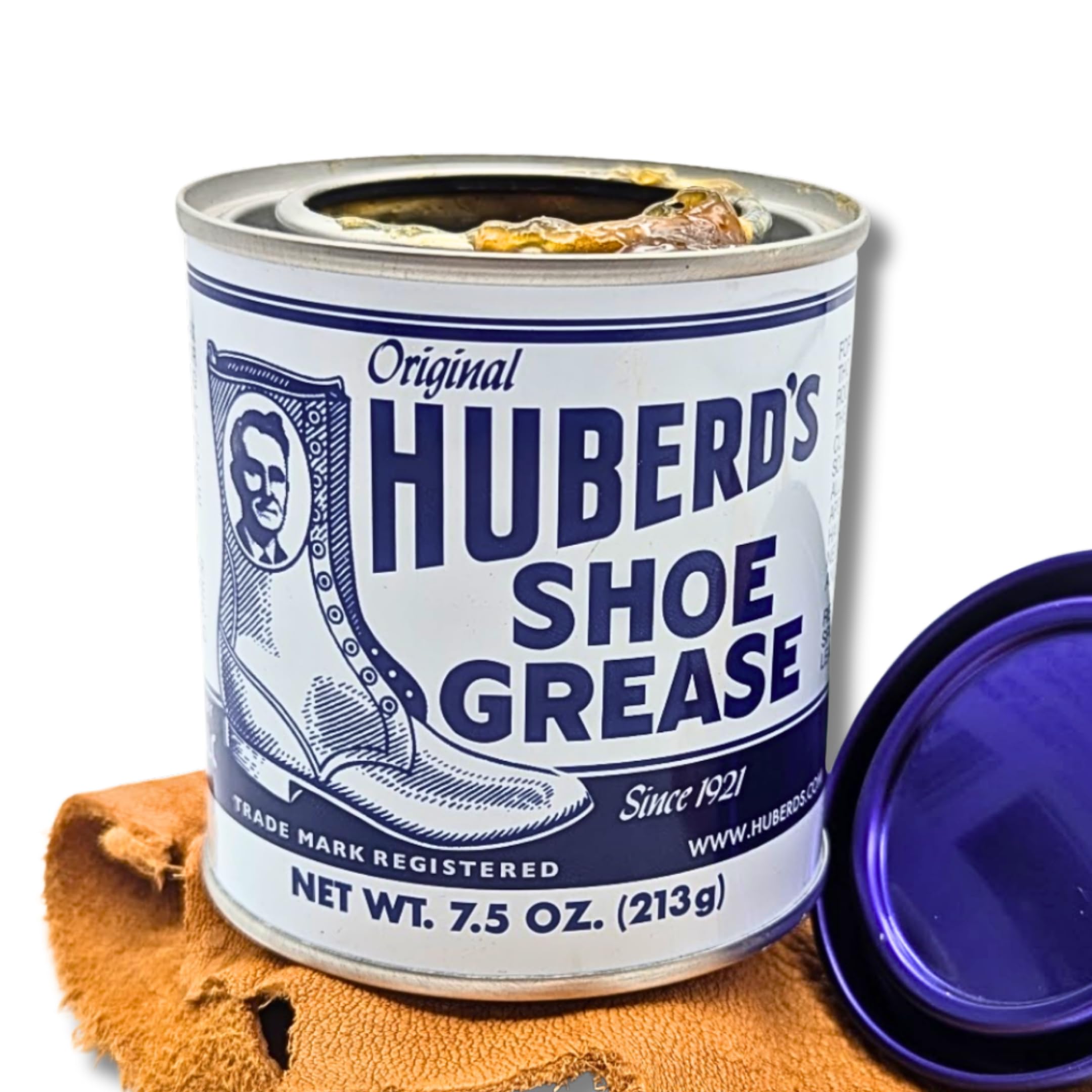
Huberd’s Shoe Grease
Key Features
- Form: Beeswax and pine tar grease
- Size: 7.5 oz can
- Suits: Leather boots and gear
- Color effect: Darkens most leather
- Price: Midrange
The pine tar hits you the moment the lid comes off, and it tells you what kind of product this is: a working grease, not a spray. It’s what we reach for when an all-leather boot has gone dry and stiff, because it does two jobs in one pass — it puts oil back into the leather and leaves a barrier that water runs off.
The formula is beeswax and pine tar in a 7.5-ounce can, and it wants warm leather. Work it in with your fingers, a cloth, or a brush until the surface stops looking greasy, wipe off the surplus, and the leather comes back supple rather than slick. The waterproofing sits in the fiber instead of on top of it, which is why boots treated this way keep shedding water at the end of a long wet walk rather than halfway through it.
Two things to know. The color moves: it darkens most leather, usually by a couple of shades, which is a bonus on scuffed brown boots and a deal-breaker on light tan. And the pine tar smell hangs around after application, so treat them on a day you won’t be wearing them. Black and dark brown boots get the best of this product; pale ones should get a clear spray.
Pros
- Conditions dry leather and waterproofs in one step
- Beeswax and pine tar soak into the fiber
- Noticeably softens stiff boots
Cons
- Darkens most leather by a shade or more
- Takes hand-work to spread evenly
Buy this if your boots are full-grain leather and thirsty — nothing here conditions a dry boot better, provided you accept the darker color.
Best for Wet-Weather Leather Boots
Sno-Seal Leather Protection
Key Features
- Form: Solid wax
- Size: 7 oz
- Suits: Leather boots and shoes
- Color effect: Darkens leather
The step that decides whether this wax works is the one most people skip: warming the boot first. Run a hair dryer over the panel until the leather is warm to the touch, then work the wax in until it disappears into the grain. Done cold, it sits on the surface; done warm, it goes into the fiber and stays there.
That’s the appeal for us. A waxed leather boot keeps shedding water long after a sprayed one needs topping up, and a thin coat on a pair of boots uses very little of the 7-ounce tin. For a boot that goes out in wet weather every week, this is the treatment that asks the least of you between trips.
It also changes the boot. The wax darkens leather noticeably, and on a light boot that’s the end of the original color. Rush it with one heavy pass and the surface can stay tacky and collect grit, so thin coats and heat are the technique. On an all-leather hiker in black or dark brown, none of that matters much, and the finish looks better than it did before.
Pros
- Bonded wax keeps shedding water between trips
- Holds up through a wet season of use
- A thin coat uses very little of the tin
Cons
- Darkens leather noticeably
- Needs heat and patience to apply
We reach for this wax when a leather boot has to stay dry through a wet season, not just a wet afternoon.
Best for Fabric and Mesh
Scotchgard Outdoor Water Shield
Key Features
- Form: Aerosol spray
- Size: 13 fl oz
- Suits: Canvas, nylon, polyester, leather, suede
- Breathability: Doesn’t impede fabric breathability
- Price: Budget
If your boots are mostly fabric — mesh panels, a synthetic upper, a canvas hiker — most of this page doesn’t apply to you, and this is what we use instead. It’s labeled for canvas, polyester, nylon, cotton, leather, and suede, it doesn’t stop the fabric breathing, and one 13-ounce can covers a pair of boots and then keeps going through packs, rain shells, and the tent.
Treat it as a top-up rather than a cure. Rain beads and rolls off the upper, but a boot with a failed seam will still take water, and the protection thins out over a season of use. Spray it outdoors, since the solvent smell is strong while it’s wet, and give the boots a day to cure before you wear them.
Pros
- Covers canvas, mesh, nylon, and leather
- Doesn’t impede fabric breathability
- One can treats boots plus tents and packs
Cons
- Repels water rather than sealing it out
- Strong solvent smell while wet
For fabric-and-mesh boots — and the rest of your gear — this is the can we keep on the shelf.
Best for Light-Colored Suede Boots
Bickmore Gard-More Repellent
Key Features
- Form: Aerosol spray
- Size: 5.5 fl oz
- Suits: Leather, suede, nubuck, all colors
- Color effect: Won’t darken
- Price: Midrange
Pale boots are the reason people hesitate over waterproofing at all. A wax or an oil on sandstone suede is a permanent decision, and the wrong one makes a nearly new boot look old before its time.
Gard-More is the answer we give in that situation. It’s a 5.5-ounce aerosol that goes on as a fine, even mist and dries clear — no blotching, no ring marks, nothing to buff — and it’s labeled for suede, nubuck, and leather in any color. On light brown and off-white it left no visible trace, which is the entire point. Unlike silicone-heavy sprays, it’s also formulated to leave the material breathing, which matters on a boot with a membrane inside.
Where it gives ground is staying power. It sits on the surface rather than bonding into the fiber, so it wants reapplication more often than a wax does, and the can is a small one. Treat boots before a trip rather than at the trailhead, and spend the second application on the crease at the toe and along the seams.
Pros
- Won’t darken light leather, suede, or nubuck
- Fine, even mist with no blotching
- Dries clear and quickly
Cons
- Needs reapplying more often than a wax
- Small 5.5-ounce can
The pick for pale suede and light-colored leather, where any hint of darkening would be the end of the boot you liked.
Best for Budget Leather Care
Sof Sole Mink Oil

Key Features
- Form: Mink oil in a tin
- Suits: Smooth leather boots and shoes
- Function: Conditions and waterproofs leather
- Price: Budget
Mink oil is the old answer for leather, and this tin is the least expensive way onto the ladder here. It conditions and waterproofs in the same pass, which is more than any spray on this page can claim, and the tin lasts long enough that the cost per treatment stops being a consideration.
Apply it sparingly with a cloth and give it time to soak in. A buff afterwards takes off the surplus and leaves a soft sheen rather than a greasy film, and the leather underneath comes back with some of its original depth. It’s also the best-smelling treatment of the group — closer to a woody polish than the solvent tang of an aerosol.
The catch is the leather it suits. Mink oil is for smooth full-grain, and it will darken pale hides: on a dark brown or black boot that’s a fair trade for the softening, and on sand-colored leather you’ll notice every bit of it. Suede, nubuck, and textile panels are out. For a work boot or a dark all-leather hiker, that leaves very little to argue with.
Pros
- Conditions and waterproofs in one pass
- Leaves dark leather looking restored
- Mild, pleasant smell next to the waxes
Cons
- Smooth leather only — not suede, nubuck, or fabric
A dependable way to keep dark leather boots supple and shedding water, if you don’t mind one tin doing two jobs at once.
Best for All-Natural Leather Care
Otter Wax Boot Wax

Key Features
- Size: 2 oz bar
- Suits: Hiking, work, and hunting boots
- Formula: All-natural beeswax
- Color effect: Darkens leather significantly
- Price: Budget
A bar is the most controllable format on this page. You rub it straight onto the leather like a crayon, work it in with a cloth or your fingers, and warm the panel to settle it, which means you decide exactly how much goes where instead of watching an aerosol drift onto the laces and the lining.
The formula is beeswax and natural oils, with no silicone and no petroleum solvents, made in Portland and sold with hiking, work, hunting, and military boots in mind. We like that it feeds the leather while it seals: the panel goes supple, the grain looks deeper, and water beads and runs off the surface.
The catch is color. This wax darkens leather, and not subtly — on a dark boot that reads as a rich, oiled finish, and on tan it reads as a different boot. It also rewards a light hand, since laid on thick it can stay tacky for a while. Buy it for dark leather you want to feed and protect, not for a pale pair you’re trying to keep pale.
Pros
- All-natural beeswax, no silicone or petroleum
- Bar format puts you in control of coverage
- Conditions leather as it seals
- Named for hiking and work boots
Cons
- Darkens leather significantly
- Small 2-ounce bar
Worth it if you want an all-natural bar you can control precisely on dark leather boots; skip it on anything light.
How We Tested Boot Waterproofers
We started with a shortlist of roughly 30 treatments sold for hiking boots and cut it to 14 based on format, price, and what each one is actually built to sit on — suede and nubuck, full-grain leather, or synthetic mesh. Anything claiming to work on everything got a closer look, and we noted which ones were PFAS-free, since that has become a real deciding factor for people who treat their gear more than once a season. Then we bought them and matched each treatment to boots, or to cut panels from a worn-out pair, made of the right material.
Applying the stuff was a test in itself. We timed how long a full pair took, noted whether a spray went on evenly or spat out droplets, and let every treated pair cure for a full day before it went outside. Then the boots went into rotation: wet morning hikes, dewy grass on early dog walks, slushy sidewalks, and one snowy weekend. Between outings we checked the things reviews complain about — whether the leather had gone a shade darker, whether the closet smelled like a hardware store, whether suede felt chalky or stiff under a thumb.
For waterproofing we ran two checks: a garden-hose spray to see whether water beaded and rolled or soaked straight in, and a ten-minute stand in an inch of water with a dry paper towel stuffed into the toe to catch any leak. We also smeared mud onto treated panels, let it dry, and brushed it off to see how much came away. Each treatment was scored on value — how many pairs a can or tin covers for the money — and we revisited every boot a month later to see whether repellency had faded or the finish had changed.
How to Choose Waterproofing for Hiking Boots
What keeps a hiking boot dry is decided less by brand than by what the upper is made of, and pairing the two wrongly is how a boot ends up permanently patchy or permanently wet.
Match the treatment to the upper
The most useful question you can ask is what the boot is made of. Smooth full-grain leather takes wax, grease, or oil, because those soak into the fiber and stay there. Suede, nubuck, textile, mesh, and anything with a membrane bonded inside need a spray that dries clear and is labeled for those materials — Collonil Carbon Pro and Scotchgard both are. Get it backwards and you either flatten the nap on a suede boot with a wax or watch a spray wear off a full-grain boot within a few walks.
The care tag sewn inside the tongue usually names the upper material, and the maker’s care instructions settle the membrane question. When the boot is a mix — leather heel, textile panels, membrane liner — a clear spray is the only treatment that covers every part of it safely.
Decide what a color change is worth to you
Waxes, greases, and mink oil darken leather, and the change is usually permanent; sprays dry clear and leave the color where it was. On black or dark brown boots that costs you nothing, and on scuffed brown leather the deepening can even out the wear. On sand, grey, or two-tone boots it is the difference between the boot you bought and one you tolerate.
Test any darkening product on the tongue or the inside of the heel and give it a day. The shade settles once the product has fully absorbed, for better or worse, so a quick check while it is still wet tells you very little.
Weigh durability against convenience
A wax bonds into the leather and keeps shedding water for weeks of walking; a spray sits on the surface and wants refreshing as the season goes on. Compare containers rather than prices alone: a 13.5-fluid-ounce aerosol treats several pairs, while a 2-ounce bar looks small but goes further than its size suggests because you are rubbing on a thin film rather than misting a cloud into the air.
For a boot that sees wet weather every week, we take the wax and the afternoon it costs to apply it. For a boot that gets treated once in spring, a spray is the sane choice.
Application decides the result
Start with clean, dry boots. Dirt under a treatment stops it bonding, and a damp boot traps moisture beneath the layer you just added. Warm leather takes wax deeper, so a minute with a hair dryer is worth more than a second coat, and thin layers worked in with the excess wiped off beat one heavy pass that stays tacky and collects grit.
Then leave them overnight somewhere ventilated — aerosols especially want outdoor application and a full cure before you wear them. Work the seams and the crease at the toe first, since those are where water actually gets in.
Frequently Asked Questions
Can waterproofing save a pair of boots that already leak?
Sometimes, and it depends where the water is getting in. A treatment restores repellency on an intact upper, but it cannot close a split seam or a tired membrane. Stand the boot in a shallow tray of water and watch where damp shows up — usually the welt or the crease at the toe — before you spend a tin on the wrong problem. A new boot that leaks is a warranty claim, not a waterproofing job.
Does treating my boots affect the warranty?
Check the care card before you open a tin on a new pair. Makers typically exclude damage from improper care, and some name approved treatments for their leather and membrane models. A boot you have waxed yourself is also harder to assess for a manufacturing fault, so if a seam has failed, claim first and treat afterwards.
Will waterproofing make my boots too hot?
Waxes, greases, and oils sit in the leather and slow moisture vapor on its way out. Sprays are formulated to leave airflow alone, and both Collonil Carbon Pro and Scotchgard state they do not block breathability. If you run hot or hike through summer, choose a spray, particularly on a membrane boot. Keep the wax for cold, wet conditions where warmth matters more than venting.
Final Verdict
If you want one can that will treat whatever hiking boots you own now or buy next, Collonil Carbon Pro XL is the pick: it beads water, dries clear on suede and nubuck, and is labeled for the membranes inside modern boots. For all-leather boots that need feeding as much as waterproofing, Huberd’s Shoe Grease does both jobs better than any spray — accept the darker color. Fabric and mesh boots belong to Scotchgard, with the rest of your kit thrown in.