
This post contains affiliate links. We may earn a small commission when you buy through our links — at no extra cost to you.
The first sign your ski boot bag is wrong usually shows up in a slushy parking lot, with one boot half in the bag and a glove clamped in your teeth. The right bag swallows bulky boots, a helmet, goggles, gloves, and a jacket without a wrestling match—then carries comfortably from the car to the lodge. We spent one full ski season testing 12 ski boot bags, from compact backpacks to roomy duffels, on weekend trips and quick local hill days. The difference wasn’t just capacity; it was whether the compartments fit real gear, the zippers behaved when the bag was stuffed and my hands were cold, and the whole thing felt worth bringing back season after season.
Capacity numbers can be misleading. A spacious duffel and a well-organized backpack can haul similar gear if the boot compartment is shaped well and the helmet pocket isn’t an afterthought. Value comes down to how much usable storage you get without fighting the bag every time.
Zipper quality is the quiet make-or-break here—cheap ones snag at the corners, especially when wet snow and overpacking are involved. We kept that in mind all season, and the picks below are the bags that made loading and unloading feel easy rather than like a chore.




Best for All-Around Ski Days
Unigear 50L Ski Boot Bag Backpack
Key Features
- Carry: Padded backpack straps
- Capacity: 50 liters
- Material: Tarpaulin and 1050D nylon
- Dimensions: 11.8 x 12.6 x 19.7 in
- Price: Midrange
The first thing we noticed about the Unigear is how little ceremony it makes of a full ski load. Boots go in their own compartment, helmet and goggles have room in the main body, and the padded back panel keeps buckles from digging in on the walk from the lot. That practicality is why it’s our top pick for most skiers.
The 50L capacity is the sweet spot in this group. It’s big enough for boots, a helmet, goggles, gloves, and a layer or two, but it doesn’t turn into a duffel you have to wrestle through a lodge door. The tarpaulin and 1050D nylon shell is the kind of material you can wipe down after a slushy day, and the three compartments make it easy to assign one pocket to wet boots and another to clean gear.
The bag is a little narrower than some of the duffel-style options here, so a very bulky helmet and thick snow pants can make the main compartment feel tight. That’s a packing-style issue more than a dealbreaker: if you’re carrying for one person, it’s plenty.
The lined boot compartment is also easy to wipe out at the end of the day, which matters more than it sounds when you’re packing up wet gear. It’s the bag we grab for everything from a day trip to a week away.
Pros
- Separate boot compartment keeps wet gear contained
- Comfortable padded backpack carry
- Weather-ready tarpaulin and nylon shell
- 50L capacity suits resort days and short trips
Cons
- Narrow body can feel tight when overpacked
The Unigear is the ski boot bag we recommend first: 50 liters, a separate boot compartment, and a comfortable backpack carry that suits most resort and travel days.
Best for Gear-Heavy Trips
RESVIN Ski Boot Bag
Key Features
- Carry: Padded backpack straps
- Boot fit: Up to US men’s size 12.6
- Material: 1680D nylon
- Compartments: Six
- Price: Budget
RESVIN’s pitch is simple: a lot of bag for very little money. The body is divided into six compartments, and the main boot area is sized for men’s boots up to 12.6. In this group, it’s the gear-heavy bargain.
What makes it worth recommending isn’t just the price. The organization actually follows through: boots, helmet, goggles, and gloves each have a place, and the side pockets give you somewhere to stash a water bottle or a pair of socks without opening the main hold. In our test load, we could keep wet boots away from a dry jacket without adding a separate stuff sack.
The 1680D nylon shell feels built for snowy parking lots, and the padded back panel keeps boot heels from jabbing you. This is a big bag, though, so it’s for gear-heavy trips, not a minimalist carry-on; pack it for the car or a checked bag, and let the six compartments do the sorting.
Pros
- Six compartments keep a full kit sorted
- Tough 1680D nylon shell
- Fits men’s boots up to 12.6
- Budget-friendly large-capacity option
Cons
- Shoulder straps are the least robust part under heavy loads
We recommend the RESVIN for skiers who want maximum gear capacity and six-compartment organization at the lowest cost in this group.
Best for Carry-On Travel
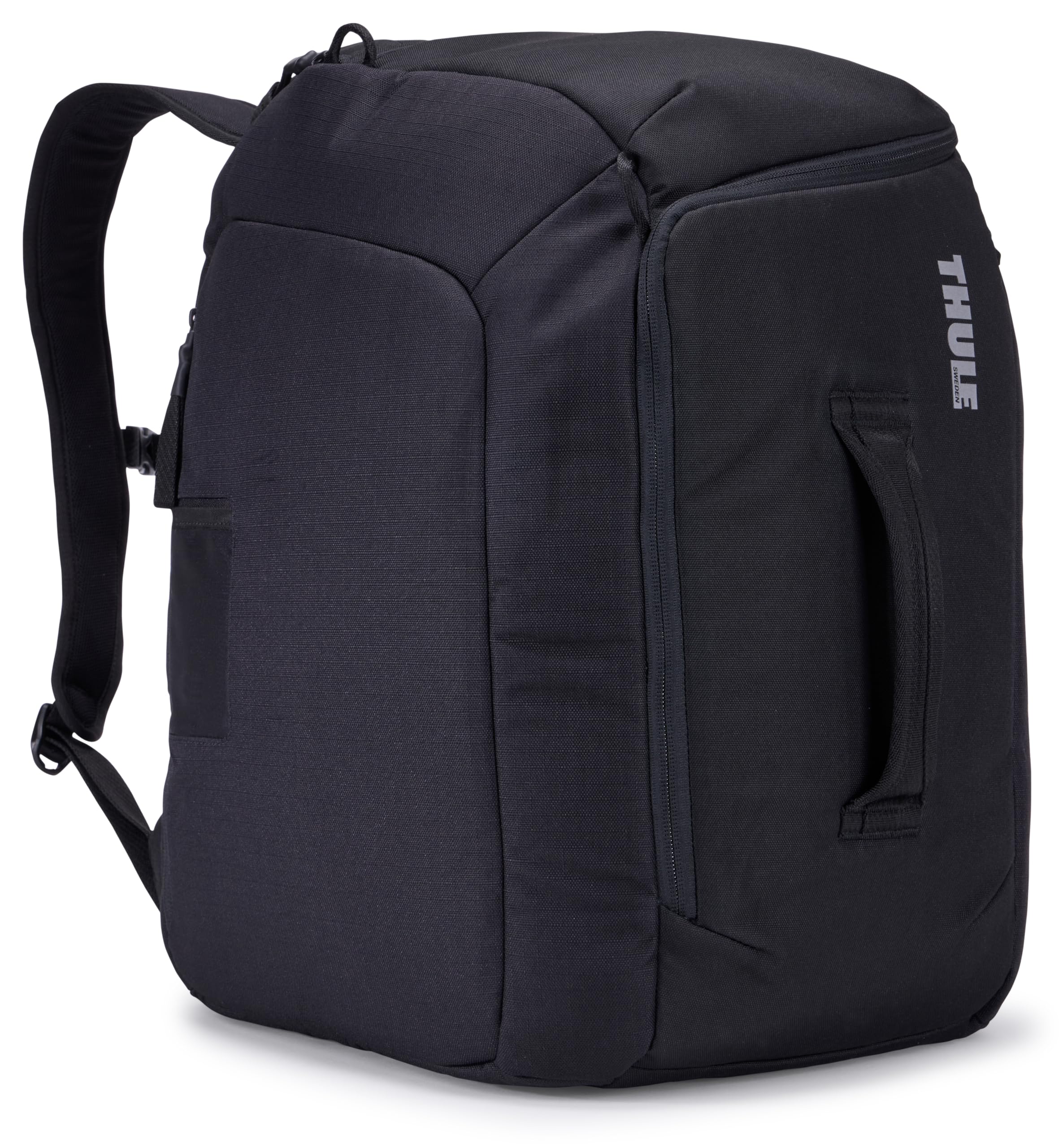
Thule RoundTrip 45L Boot Backpack
Key Features
- Weight: 1.83 lb
- Boot fit: Up to Mondopoint 30.5 / US 13 / UK 12 / EU 47
- Capacity: 45 liters
- Boot access: Rear-loading standing mat
- Price: Premium
The Thule RoundTrip 45L has a trick we kept coming back to: the rear panel flips down into a standing mat, so you can step out of your boots in a snowy parking lot without soaking your socks. That’s the kind of detail that separates a premium boot bag from a generic duffel.
At 45L, it’s the compact premium option here. It holds boots up to Mondopoint 30.5 / US 13 / UK 12 / EU 47, plus a helmet, goggles, gloves, and a layer or two. The separate padded goggle pocket and top or front access make it easier to live out of than a single-opening bag, and the backpack carry is comfortable when it’s fully loaded.
We think it’s the best choice for a skier who flies carry-on and wants a place for everything. The trade-off is capacity: 45L is enough for boots, helmet, and a layer, but not a full weekend’s clothing. If you need to pack for two people or a long trip, the 80L version makes more sense.
Pros
- Flip-down standing mat keeps feet dry
- Separate padded goggle pocket
- Fits boots up to Mondopoint 30.5 / US 13
- Compact carry-on-friendly backpack
Cons
- Premium price for a compact bag
If you fly carry-on and want premium organization, the Thule RoundTrip 45L earns its price with a standing mat and thoughtful compartments.
Best for Long Ski Trips
Thule RoundTrip 80L Duffel
Key Features
- Carry: Duffel with shoulder strap
- Boot fit: Up to Mondopoint 30.5 / US 13 / UK 12 / EU 47
- Capacity: 80 liters
- Luggage pass-through: Yes
- Price: Premium
The Thule RoundTrip 80L is less a boot bag than a base camp duffel with a boot compartment. It’s 80L, 29 inches long, and built to swallow a full ski kit—boots, helmet, goggles, gloves, layers—and it comes with a dry bag for the wet stuff.
The boot compartment is the reason to consider it over a generic duffel: it fits boots up to Mondopoint 30.5 / US 13 / UK 12 / EU 47, and the standing mat gives you a dry place to change. The luggage pass-through strap is a small detail that matters if you’re also rolling a ski bag through the airport.
The rest of the bag is organized around the last-on, first-off pieces: a dedicated helmet, goggles, gloves, and buff compartment keeps the small stuff from disappearing into the main hold. The dividers are fixed, which helps keep wet boots away from clean clothes but limits how you can reconfigure the bag.
We think it’s the best long-trip pick here for skiers who check a bag or drive to the mountain with a car full of gear. It’s more bag than a day-tripper needs, and at 80L it’s a checked-bag or trunk item, not a carry-on. The pass-through strap is the quiet win: it lets the duffel ride on a rolling ski bag instead of swinging from your shoulder.
Pros
- 80L holds a full ski kit and extra layers
- Boot mat and dedicated small-gear compartment
- Luggage pass-through works with rolling ski bags
- Fits boots up to Mondopoint 30.5 / US 13
Cons
- Premium price
For long trips and families, the Thule RoundTrip 80L is the roomy, organized duffel we reach for when one bag has to carry everything.
Best for Large Boots
Element Equipment Deluxe Boot Bag
Key Features
- Carry: Backpack straps
- Dimensions: 15 x 9 x 15 in
- Boot storage: Separate side compartments
- Price: Midrange
If your boots run big, the Element Equipment Deluxe is the bag that makes the least fuss about it. The two side compartments take a men’s size 30 boot without a wrestling match, and the 15 x 9 x 15-inch body still has room for a helmet, goggles, and a few layers.
The layout is simple and useful: boots in their own side pockets, main compartment for gear, zippered pockets for small stuff. We like the backpack straps for the walk from the lot, and the bag is comfortable enough when loaded.
The 15 x 9 x 15-inch body is the number to check against your own boots; there’s no liter rating to lean on. For a large-footed skier who wants a straightforward bag, that’s a fair trade for the simple layout and easy packing. The side pockets are the difference: you can load dirty boots without opening the clean-gear side.
Pros
- Side boot pockets fit large boots
- Backpack straps make the carry easy
- Simple layout keeps gear accessible
Cons
The Element Equipment Deluxe is our pick for large boots, with two side compartments that take a men’s 30 boot and leave the main bag for gear.
Best for Family Gear Hauls
Athalon Everything Boot Bag
Key Features
- Carry: Backpack straps and handles
- Weight: 3.8 lb
- Capacity: 58.5 liters
- Dimensions: 14 x 15 x 17 in
- Price: Midrange
Athalon’s Everything bag has been around long enough to feel familiar, and the name is not overselling it: boots go in ventilated side pockets, and the center compartment takes a jacket, helmet, pants, and whatever else you can stuff in.
We think it’s the best classic all-gear hauler here for skiers who want one bag for the whole day. The 58.5L body is roomy without being a duffel, and the backpack straps hide away when you want to carry it by the handles.
The details are thoughtful: drainage grommets, a waterproof PVC bottom, reflective piping, and a bungee cord for a jacket. The separate boot pockets are ventilated, which helps if you’re changing out of them in a lodge and don’t want the whole bag to smell like a wet locker.
The bright patterns are a bonus at baggage claim, but this is a car-to-lodge bag more than a minimalist carry-on. The pattern is also easy to spot on a crowded rack, which is a small thing until you’re hunting for your bag at the end of the day.
Pros
- Ventilated side boot pockets
- Center compartment takes jacket and helmet
- Drainage grommets and waterproof bottom
- Hidden backpack straps
Cons
- Heavier empty than most rivals
The Athalon Everything is the roomy classic we recommend for skiers who want one bag to carry boots, helmet, jacket, and pants without a separate duffel.
Best for Wet-Weather Resort Days
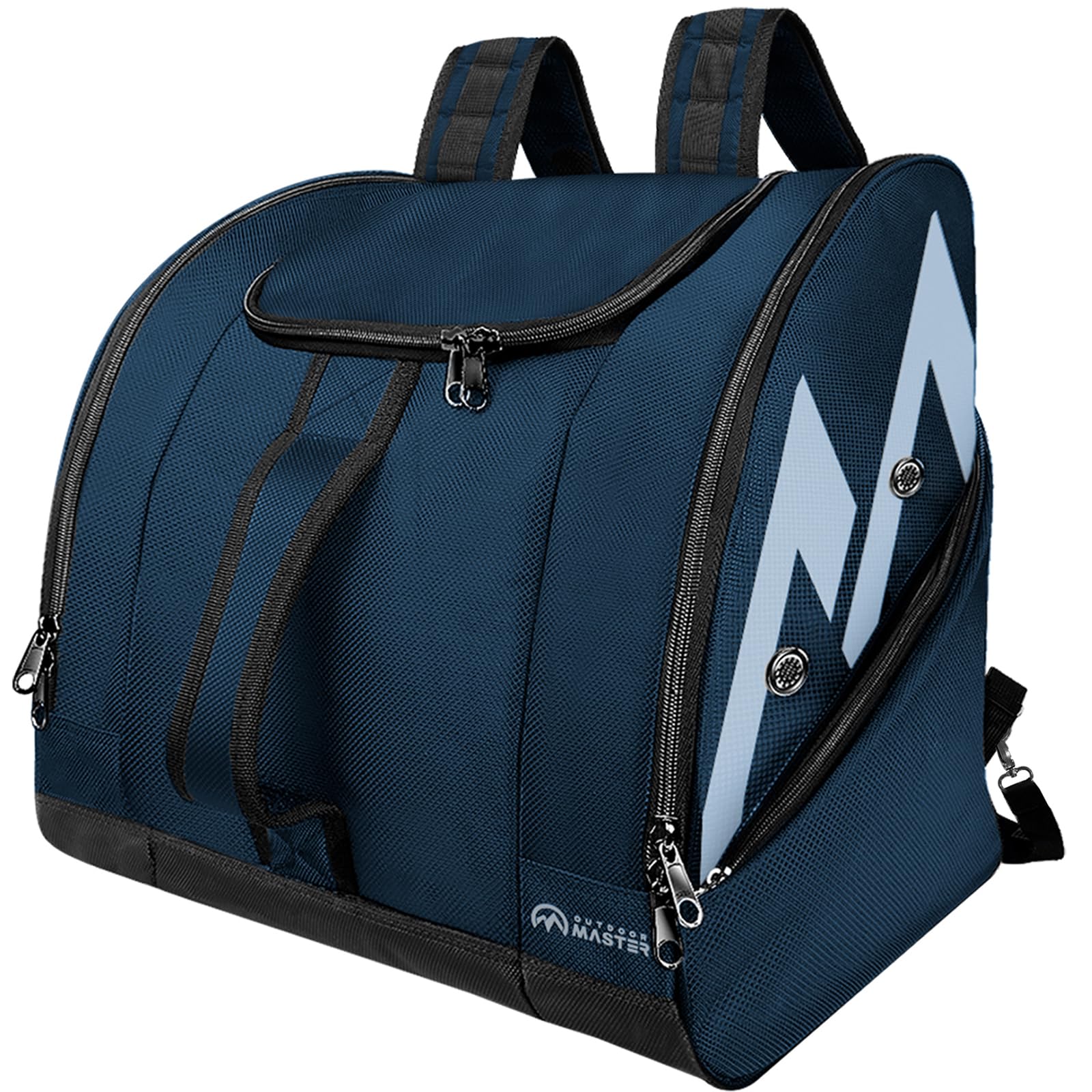
OutdoorMaster Polar Bear 50L
Key Features
- Carry: Backpack or handles
- Capacity: 50 liters
- Dimensions: 15.74 x 13.78 x 16.92 in
- Boot storage: Two vented side compartments
- Price: Midrange
The OutdoorMaster Polar Bear is built for the messy part of ski days: wet boots, slushy parking lots, and the walk back to the car. The two boot compartments have drainage holes and ventilation, and the bottom is reinforced with a non-slip material.
The 50L body has four compartments, including a main helmet and gear area and three quick-access zippered pockets. The backpack straps are adjustable, and the bag can also be carried by two handles, which is useful when you’re loading it into a locker.
We think it’s the best choice here if your boots are usually wet when they go in. The drainage holes are the detail that earns it a place: slush has somewhere to go instead of soaking the helmet, and the non-slip bottom keeps the bag from sliding across a wet tailgate.
Pros
- Drainage holes and ventilated boot pockets
- Non-slip reinforced bottom
- Three quick-access exterior pockets
- Backpack or dual-handle carry
Cons
- Handle and strap durability can be a weak point
The OutdoorMaster Polar Bear is our wet-boot specialist, with drainage, ventilation, and a non-slip base that make slushy resort days easier.
Best for Local Boot Transport
Element Equipment Simple Boot Bag

Key Features
- Carry: Shoulder strap and handles
- Boot fit: Up to men’s 13
- Material: 600D polyester
- Dimensions: 15 x 15 x 9 in
- Price: Budget
The Element Equipment Boot Bag is the anti-roundup pick: a simple 15 x 15 x 9-inch bag for one pair of boots up to men’s 13, plus gloves, goggles, and a hat.
That simplicity is the point. The 600D polyester shell is water-resistant, the bottom is padded, and the shoulder strap is removable—useful if you check it or want to sling it over a shoulder for a short walk.
We used it as a boot-only bag for days when the rest of our gear was already in a locker or a larger duffel. It kept wet boots contained and didn’t take up much space in the car.
We think it’s the best minimalist pick here for local skiers or anyone who already has a gear bag. The removable shoulder strap is a small thing, but it makes the bag easier to check or stash when you don’t need it.
Pros
- Small enough to stash in the car
- Water-resistant 600D shell
- Removable shoulder strap
- Fits boots up to men’s 13
Cons
- Won’t fit a helmet and full layering system
The Element Equipment Boot Bag is the minimalist pick we recommend for local skiers who only need boots, gloves, and goggles in the car.
Best for Two-Pair Trips
Athletico Ski Boot Bag

Key Features
- Carry: Backpack straps and handles
- Dimensions: 15 x 15 x 18 in
- Boot storage: Side-entry zippered compartments
- Water resistance: Water-resistant polyester
- Price: Midrange
The Athletico Ski Boot Bag is one of the few bags here that can make a case for carrying two pairs of adult boots. The side-entry compartments are separate from the main hold, and the 15 x 15 x 18-inch body has enough room for helmets, jackets, and a surprising amount of soft gear.
That makes it a useful couples bag or a family bag for short trips, especially if you’re loading the car rather than flying. The backpack straps are hidden, the top and front handles are padded, and reflective piping helps when you’re crossing a dark lot.
The bag is water-resistant polyester with a soft shell, so it’s more about keeping snow out than surviving a baggage conveyor. The separate side compartments do a good job of isolating boots from clean clothes.
The bag is not subtle: when both boot compartments are full, it’s wide enough that the backpack straps feel like a secondary way to carry it. We found the top handle more natural for hauling it from the car to the lodge.
We think it’s the best two-pair pick here for couples and families who drive to the hill. It’s not the bag for a solo flyer with a tight packing list, and the wide body is the tell: this is a bag you load once and keep loaded, not one you repack for every outing.
Pros
- Separate side-entry boot compartments
- Roomy main hold for helmets and layers
- Reflective piping and padded handles
- Backpack straps hide away
Cons
- Zippers can fail under heavy use
The Athletico Ski Boot Bag is our two-pair pick for couples and families, with separate boot compartments and enough room for helmets and layers.
How We Tested Ski Boot Bags
We built the shortlist by researching boot bags designed for skiers and snowboarders—backpacks, duffels, and hybrid styles—then filtered for separate boot storage, helmet and goggle pockets, weather-resistant exteriors, venting or drainage, and carry comfort. We ordered 12 and used them for one full ski season, from the first cold-weekend trip through the slushy end of spring skiing. They lived in car trunks, lodge boot-up rooms, and cramped hotel entryways, and we loaded them exactly as most people do: boots, helmet, goggles, gloves, base layers, and a jacket, often while standing in a parking lot.
The first test was packing. We loaded each bag with a pair of ski boots and a snowboard boot to see how easily they slid into the boot compartment, whether the bag stayed upright while we packed, and how much room was left for a helmet, goggles, gloves, and outerwear. We noted whether the bag felt genuinely spacious or just deep. We carried each one from car to lodge by every handle and strap, including with gloves on.
Zippers got their own stress test. We overstuffed bags, zipped around corners, and opened and closed main compartments with cold hands and wet gloves, watching for snags, split seams, and pulls that felt ready to break. We also left damp boots and gloves inside overnight to see whether venting and drainage did anything, and checked whether the exterior kept meltwater away from dry layers. At the end of the season, we compared wear, stitching, and layout against how each bag was priced to judge value.
How to Choose a Ski Boot Bag
Start with the boots, then decide how much of the rest of your kit the bag has to carry—because a great boot bag is the one that makes the walk from the car easier, not the one with the longest feature list.
Fit the Boots Before Anything Else
A ski boot bag has one non-negotiable job: hold your boots without mashing the liners or forcing the zipper. Check the stated boot fit, especially if you’re near the top of the size range. The Thule RoundTrip bags fit boots up to Mondopoint 30.5 / US 13 / UK 12 / EU 47, the Element Equipment Simple bag goes to men’s 13, and the RESVIN lists US men’s size 12.6. If you’re between sizes or wear a bulky aftermarket liner, bring your boots to the store or buy where returns are easy.
Separate side compartments are worth prioritizing if you often pack wet boots next to clean clothes. A single main compartment can work, but you’ll want a stuff sack or a dry bag to keep the mess contained.
Match Capacity to the Trip
Liters are a rough guide, not a guarantee. A 45L bag like the Thule RoundTrip 45L is enough for boots, helmet, goggles, and a layer; a larger bag like the RESVIN is for skiers who want to add clothing or a second pair of boots. An 80L duffel like the Thule RoundTrip 80L is for long trips, families, or anyone who checks a bag.
Don’t assume a bigger bag is better for travel. A full 80L duffel is a trunk or checked-bag item, while a 45L backpack is the more plausible carry-on. Pack your boots and helmet first, then see how much room is actually left.
Choose a Carry System You’ll Actually Use
The walk from the parking lot is where a boot bag earns its keep. Backpack straps distribute weight better than a single shoulder strap, and a padded back panel keeps boot buckles from digging in. The Unigear and Athletico both hide backpack straps when you want to carry by the handle; the Thule RoundTrip 80L uses a duffel shape with a luggage pass-through for rolling ski bags.
If you’re mostly loading the car, handles and a wide opening matter more than a harness. If you’re flying or taking a shuttle, prioritize a backpack carry and check that the packed bag still fits your airline’s carry-on size.
Plan for Wet Gear
Snow melts. Look for ventilated boot compartments, drainage grommets, and a waterproof or water-resistant bottom. The OutdoorMaster Polar Bear has drainage holes in its boot compartments and a non-slip reinforced bottom; the Athalon Everything adds a waterproof PVC bottom and bottom drainage grommets; the Thule RoundTrip 45L flips its rear panel down into a standing mat.
A dry bag is cheap insurance for gloves, socks, or a jacket. Even a water-resistant bag can soak through at the seams if you leave wet boots inside for hours, so empty and air the bag at the end of the day.
Inspect the Hardware
Zippers, handles, and strap attachments are the parts that fail first. Look for chunky zipper pulls, reinforced stitching at the handle, and a warranty you can actually use. The Thule bags carry a limited lifetime warranty; budget bags usually don’t.
Don’t judge a bag by its shell alone. A tough nylon body is little help if the top handle rips or the zipper track separates. If you’re hard on gear, spend more on hardware or plan to replace a budget bag sooner.
Frequently Asked Questions
Do ski boot bags fit snowboard boots?
Many do, but snowboard boots are bulkier and taller than ski boots, so the stated ski-boot size is only a starting point. A bag with separate side compartments, like the OutdoorMaster Polar Bear or Element Equipment Deluxe, is more likely to swallow a snowboard boot than a slim boot-only bag. Try your boots in the bag before the return window closes, and check that the zipper closes without strain.
Can I check a ski boot bag on a plane?
Yes, but treat it like any checked bag: remove or tuck away the shoulder strap, make sure the zippers are closed and tagged, and weigh it before the airport. A fully packed boot bag can creep toward airline weight limits, especially if you add a helmet and layers. A duffel or backpack with protected hardware is the safer choice for checked travel.
How do I clean and dry a ski boot bag?
Empty every pocket, wipe the liner and shell with a damp cloth, and leave the boot compartments open to air-dry. Don’t put a soft boot bag in the washing machine; the agitation can damage zippers, coatings, and padding. If the bag smells, a sprinkle of baking soda left overnight and vacuumed out is gentler than soap.
Do I need a dedicated boot bag if I already have a duffel?
Not always, but a dedicated bag earns its place if you want wet boots kept away from clothes, drainage holes, and a shape that doesn’t let boots slide around. A simple boot-only bag like the Element Equipment Simple is enough for local days; a larger boot backpack makes more sense if you’re carrying helmet, goggles, and layers too.
Final Verdict
For most skiers, the Unigear 50L is the bag we recommend first. It has the best balance of capacity, organization, and comfortable carry in this group, and the separate boot compartment keeps wet gear away from everything else.
If you fly carry-on and want the most thoughtful layout, the Thule RoundTrip 45L is the upgrade; if you’re packing for a family or a long trip, the Thule RoundTrip 80L duffel is the roomier answer. The right choice comes down to whether you’re packing for a day or a week.