
This post contains affiliate links. We may earn a small commission when you buy through our links — at no extra cost to you.
Every walkie talkie box boasts a mileage number that sounds impressive—36 miles, 20 miles, sometimes more. In real life, behind trees, hills, or a few walls, that number drops to a mile or less. That’s not a flaw in the product; it’s physics. The key is matching the radio’s actual performance to your typical environment.
We focused on what matters for families, campers, and hikers: consistent sound in the 0.5–2 mile range you’ll actually use, battery life that lasts a full day, and a design that doesn’t feel like a chore to carry. Some prioritize lightweight and USB-C charging; others need waterproofing for wet trails. The best choice depends on where you’ll be pressing the talk button.
This guide cuts through the noise to help you pick a set that delivers where it counts—so your next trip has clear communication, not inflated promises.



Best for Family & Events
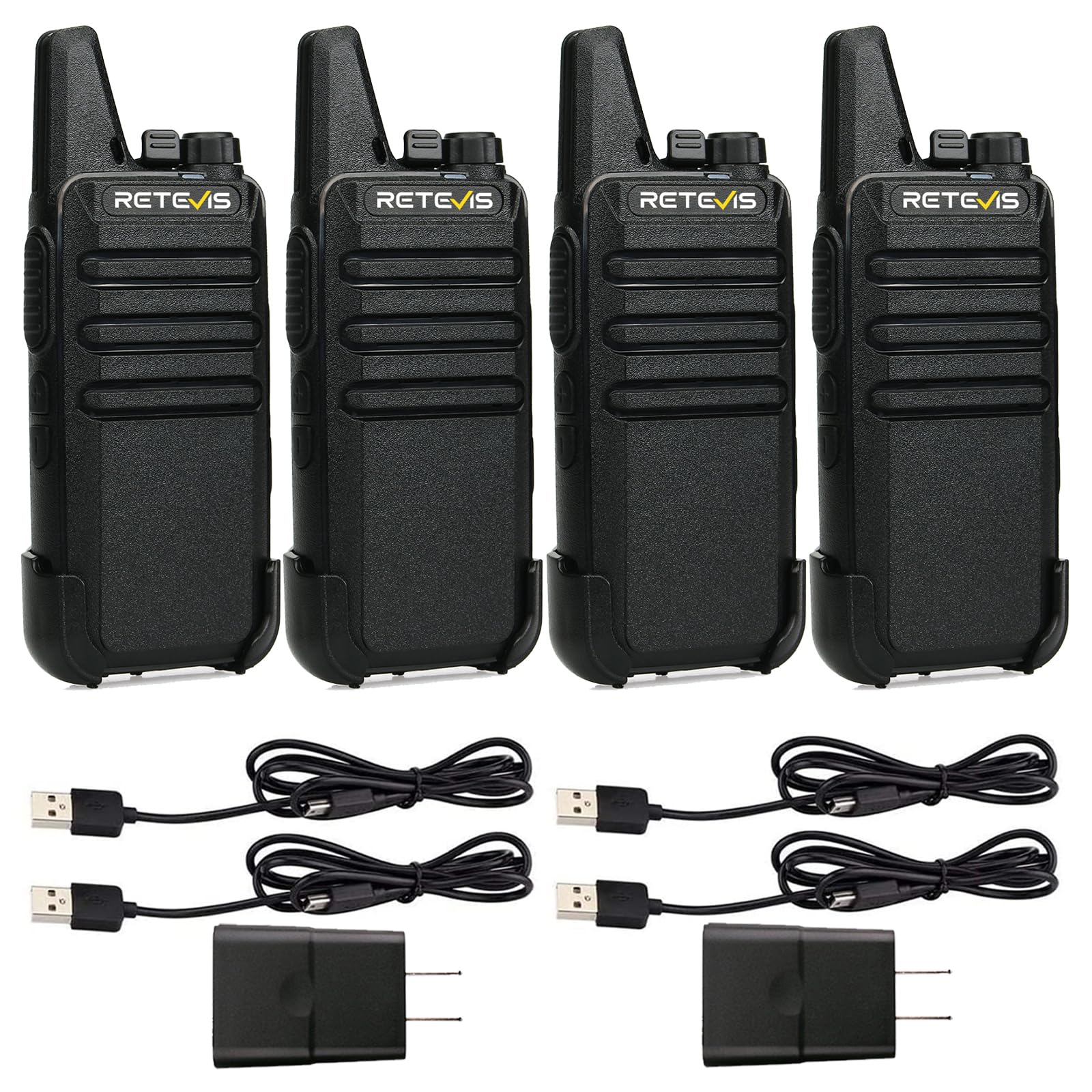
Retevis RT22
Key Features
- Frequency Band: FRS
- Range: 2 miles
- Battery Type: Li-ion USB-C
- Water Resistance: IP65
- Channels: 16
- Price: Mid-Range
The Retevis RT22 packs full-featured two-way radio capability into a compact USB-C rechargeable frame that fits comfortably in a palm or pocket. Its IP65 water resistance handles light rain, making it a practical choice for family hikes and cruise ship decks. Audio stays clear even in busy environments, cutting through background noise to keep conversations understandable.
The advertised 2-mile range assumes open, flat terrain. In wooded hiking trails or suburban neighborhoods, expect ¼ to ½ mile at best. That’s enough for keeping a group together on a family outing, but insufficient for backcountry treks where party members may spread out. For users who need rugged waterproofing and drop protection, the Retevis RB48 is a better fit — though it sacrifices the RT22’s slim profile and USB-C convenience.
This radio suits families who stay within a half-mile radius on the trail, cruise passengers coordinating meetups on a ship, and restaurant staff handling short-range communication. It is not designed for wilderness expeditions or heavy industrial use. The combination of compact design, USB-C charging, and solid battery life makes it a practical everyday radio for short-range group communication.
Pros
- Compact enough to carry in a pocket or clip to a belt — easy for day hikes.
- Audio stays clear even on a busy cruise ship deck or event floor.
- 12-hour battery covers a full day of family hiking or a weekend trip.
- USB-C charging means the same cable as your phone — no proprietary dock needed.
- IP65-rated build handles light rain and dust on outdoor adventures.
Cons
- Range drops to about a quarter mile in neighborhoods with buildings or trees — not suitable for long-distance wilderness.
- Voice-activated transmission may not trigger reliably for everyone; using the push-to-talk button gives more consistent results.
For families and event staff who need simple, pocketable radios with modern charging, the RT22 hits the right balance of size, battery life, and real-world range.
Best for Wet Rugged Use
Retevis RB48
Key Features
- Frequency Band: FRS
- Range: 25 floors
- Battery Type: 2000mAh Li-ion
- Water Resistance: IP67
- Channels: 22
- Price: Mid-Range
The RB48 sets itself apart with IP67 waterproofing that lets it float in water and a military-grade build that survives drops that would crack most consumer radios. Where the slimmer RT22 prioritizes pocketability, this radio is built for the worst conditions — wet decks, muddy job sites, or emergency kits stored in damp basements.
Battery life reaches 20 hours on a 2000mAh pack, and the included charging cradle refills quickly. Audio clarity holds up in noisy environments, and the range covers large buildings or short outdoor distances — enough for a marina or a worksite, but not for a multi-mile hike.
This radio suits outdoor workers, anglers, and anyone preparing for emergencies where water and impact are real concerns. The tradeoff: the volume knob sits exposed and can be turned accidentally in a pack, and the range is limited to under a quarter mile in obstructed areas — fine for a construction crew on the same floor, less ideal for family camping where members spread out.
Pros
- Fully submersible and buoyant – survives drops and full immersion.
- 20-hour battery life with fast-charging cradle – lasts a full workday.
- Clear audio in noisy environments – enough range for large buildings or short outdoor use.
Cons
- Volume knob protrudes and can be turned accidentally when radio is in a pack or pocket.
- Range is limited to under a quarter mile in obstructed areas – suits building distances, not open trails.
For anyone who needs a radio that can get wet, muddy, or knocked around, the RB48 delivers where lesser radios would quit – just know the range is building-scale, not trail-scale.
Best for Budget 4-Pack
pxton 4-Pack
Key Features
- Frequency Band: UHF
- Range: 3 miles
- Battery Type: Li-ion
- Water Resistance: Water resistant
- Channels: 16
- Price: Mid-Range
Four radios with earpieces at an entry-level price deliver clear sound and usable range for group outings. While the feature-packed alternative adds a flashlight and SOS siren, the pxton keeps the setup simple—just basic communication with no extra frills.
In open terrain, the pxton delivers clear communication up to 1.5 miles, matching its price point well. The included earpieces function adequately for quiet environments, though they may not withstand frequent handling without care.
This set works best for small groups who want multiple radios for short-range hikes, camping, or events without overspending. Battery capacity can diminish over months, and earpieces may not hold up to regular use—a limitation to note for those expecting long-term daily performance.
Pros
- Good range for the price, up to 1.5 miles in open area
- Excellent value for a 4-pack with earpieces
- Clear sound quality
Cons
- Included earpieces may break under regular use
- Battery charge life can decline after several months; some units may stop holding a charge
A budget-friendly 4-pack for groups needing simple radios on occasional weekend trips, but battery degradation makes it a short-term investment.
Best for Kids Ages 6-12
Retevis RT628 Kids
Key Features
- Frequency Band: FRS
- Range: 0.6 mi
- Battery Type: 6 AA
- Channels: 22
- Price: Budget
The RT628’s controls are sized for small hands, with a large PTT button that requires no fumbling — a design that stands apart from adult-oriented radios. Unlike the rechargeable kids’ alternative in this category, the RT628 runs on AA batteries, so there’s no downtime for charging — just swap and go.
Communication stays clear through walls and across a typical house, and the audio quality is good enough for indoor hide-and-seek or back-yard adventures. The simplicity means kids pick it up instantly, with no instruction needed.
Parents looking for an affordable walkie for kids ages 6-12 will find the RT628 fits that role precisely. The tradeoff is that this is not a general family radio: it lacks water resistance and its range tops out at about 0.6 miles, so it’s best for backyard play, camping within base camp distance, or supervised indoor use.
Pros
- Works through walls and across floors in home settings, keeping kids connected indoors.
- Budget-friendly price for a dedicated kids’ set with clear audio quality.
- Large PTT button and lightweight grip make it easy for small hands to use independently.
Cons
- In rain or wet outdoor conditions, the RT628 has no water protection — intended for dry use only.
- Range is about 0.6 miles in open terrain; communication will drop beyond that distance.
For parents who want a simple, budget-friendly walkie that kids can operate without supervision, the RT628 delivers — just stay within its range and keep it dry.
Best for Licensed Enthusiasts
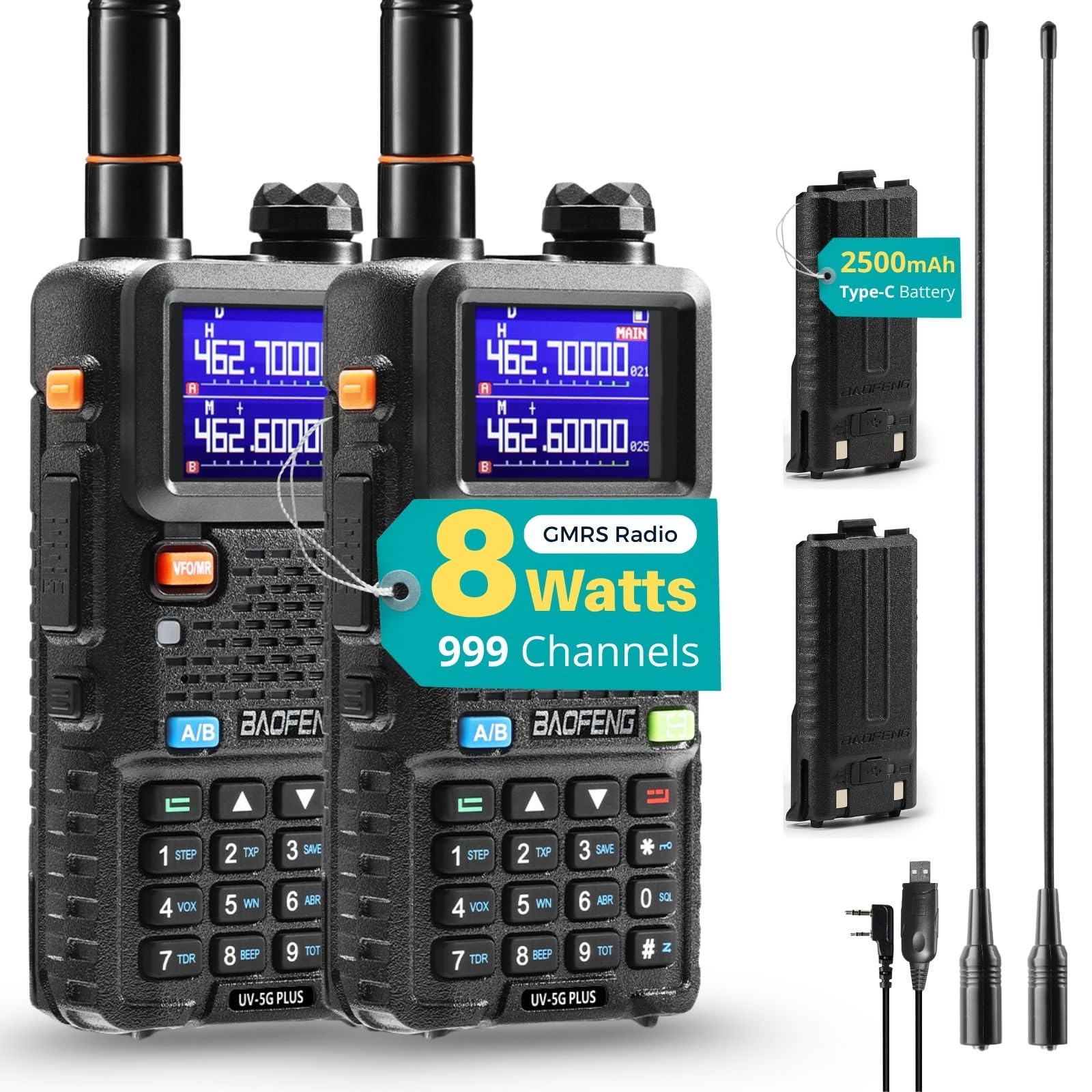
Baofeng UV-5G Plus
Key Features
- Frequency Band: GMRS/VHF/UHF
- Range: 7 miles
- Battery Type: 2500mAh USB-C
- Water Resistance: Water resistant
- Channels: 999
- Price: Mid-Range
The UV-5G Plus provides 999 programmable channels, USB-C charging, and Chirp software support – capabilities that distinguish it from the basic ham radio alternative. This radio is pre-configured for GMRS frequencies, and Chirp simplifies frequency management for those comfortable with the software.
Built for licensed GMRS users who enjoy customization, the UV-5G Plus requires a GMRS license (no test, but a fee) and some technical know-how. The manual programming via keypad can be time-consuming, so using Chirp is recommended. It’s not intended for casual family users or those wanting license-free communication – the top pick fills that role better.
In real-world outdoor conditions, the radio delivers clear audio and a useful GMRS range of two to four miles in open areas. The 2500mAh battery lasts a full day of sporadic use and recharges via USB-C, a convenience also found on the top pick. The extensive channel capacity and programmability give enthusiasts flexibility for various setups.
At a mid-range price, this radio competes with more expensive programmable GMRS models without sacrificing core features. The physical trade-off is the battery clip, which may detach during active movement; a secure carry case or retention strap helps. The larger size also makes it less pocketable than the top pick.
Pros
- More programmable channels (999) than typical GMRS radios at a mid-range price.
- Chirp software support enables quick frequency programming from a computer.
- Clear audio and reliable GMRS range for outdoor use.
Cons
- When carrying on a belt during active movement, the battery clip may come loose – a padded case offers a more secure option.
- Manual frequency entry without a computer requires navigating a menu system with a learning curve.
- Legal transmission requires a GMRS license – not for unlicensed users.
For GMRS-licensed enthusiasts who want extensive channel programmability and USB-C charging without the premium price, the UV-5G Plus is a capable choice. It’s not a general-purpose family walkie-talkie.
Best for Heavy-Duty Jobs
DEWALT DXFRS800
Key Features
- Frequency Band: UHF/FM FRS
- Range: 2 miles
- Battery Type: Li-Polymer
- Water Resistance: IP67
- Channels: 22
- Price: Premium
The DEWALT DXFRS800 is engineered for wet, rough, and drop-prone environments – IP67 sealing lets it survive submersion, and the 18-hour battery keeps crews connected through long shifts. Clear audio quality holds up even around machinery, and the housing withstands falls that would crack lesser radios. This is the radio you take to a construction site or a muddy trail, not the one you toss in a picnic bag.
This radio suits builders, surveyors, and outdoor workers who need a tool that keeps working after a dunk in a puddle or a drop off a ladder. Families hiking or camping may find the front-mounted push-to-talk button awkward when the radio is clipped to a belt – it works naturally when held in hand. The belt clips themselves can break under repeated stress, and the premium price for an FRS set may feel steep for occasional outdoor use. If your priority is compact size and intuitive ergonomics, a slimmer model like the compact USB-C alternative is a better fit.
Sound quality is notably clear in noisy settings, and the 22 FRS channels offer enough privacy codes to keep conversations separate on busy job sites. Range is rated at 2 miles in open terrain, though obstructed areas like dense woods or steel buildings shorten that considerably – typical for FRS radios at this power level.
Pros
- Extremely rugged construction with IP67 waterproofing
- Dependable performance in demanding environments
- Clear sound quality even around background noise
Cons
- Front PTT button can be awkward when radio is clipped to a belt
- Belt clips may break under heavy use – inspect before mounting
- Premium-priced for an FRS radio, better value for those who need the ruggedness
For worksites and outdoor professionals who need a waterproof, drop-resistant radio, the DEWALT DXFRS800 delivers the toughness to earn its premium. Families and casual users will find the ergonomics and price better served by a compact alternative.
Best for Kids Backyard Play
Inspireyes Kids

Key Features
- Frequency Band: FRS
- Range: 3 miles
- Battery Type: Li-Polymer
- Channels: 22
- Price: Mid-Range
This set works well for parents who want a rechargeable alternative to the RT628 for kids ages 3-12. The buttons are easy for small hands, and the battery holds enough charge for weekend play sessions. However, the units lack water resistance, so they should stay indoors during rain. Real-world range in residential areas is about half a mile rather than the advertised three miles — sufficient for a backyard or nearby park, but not for extended outdoor adventures. For families focused on supervised, close-range play, this is a dependable option that avoids disposable batteries.
Pros
- Easy for children ages 3-12 to operate independently with simple push-to-talk.
- Rechargeable battery provides extended play time without disposable cells.
- Clear audio quality for neighborhood and park communication.
Cons
- Not water-resistant; rain or wet grass can damage the electronics.
- Effective range in typical suburban settings is around 0.5–1 mile, not the claimed 3 miles.
A practical pick for parents who want rechargeable walkie talkies for close-range backyard and park play, where simplicity and battery life matter more than extended range or weather resistance.
Best for Backup Radios
MaxTalker MT10

Key Features
- Frequency Band: UHF
- Range: 5 miles
- Battery Type: 1200mAh Li-ion
- Channels: 22
- Price: Budget
The MaxTalker MT10 delivers a very low price point and includes NOAA weather alerts, making it suitable for short-range indoor communication. Real-world range is under a mile, and some units may exhibit charging issues over time. Its intuitive controls and lightweight design are convenient for quick access, but the audio can be hard to hear in noisy surroundings. This combination makes it best suited as a backup set for household or emergency use rather than for outdoor activities.
Pros
- Affordable two-pack for essential communication
- Simple controls require no manual
- Built-in weather alert receiver
Cons
- Battery charging may cease on some units, affecting long-term usability
- Audio output can be hard to hear in noisy settings
This pair fits as a low-cost backup for the home or car, where short range and moderate audio are acceptable.
Best for Casual Family
Wishouse M9

Key Features
- Frequency Band: FRS
- Range: 5 miles
- Battery Type: Rechargeable AA
- Channels: 22
- Price: Mid-Range
The Wishouse M9 stands out for packing a bright flashlight and SOS siren into a radio that’s simple enough for all ages to use. In open fields, range holds up fine for the price. Where it falls short: some units can turn off without warning during use, which makes it a backup option rather than a primary companion for longer trips.
Pros
- Built-in flashlight and SOS siren add usefulness beyond basic communication
- Easy operation suits kids and adults alike
- Open-area range is decent for mid-range FRS radios
Cons
- Battery charge drains faster than expected; units may need mid-trip recharging
- Belt clips can detach with light pressure
Fits best as a low-stakes family radio for short outings or emergency kits where the extra features are welcome, but plan around shorter battery life and occasional shutdowns.
Best for Day Hikes
Midland T10

Key Features
- Frequency Band: UHF
- Range: 20 miles
- Battery Type: 3 AAA
- Water Resistance: IP65
- Channels: 22
- Price: Budget
The Midland T10 delivers straightforward two-way communication with crisp audio and intuitive controls, making it an accessible choice for families or emergency kit inclusion. However, the unit relies on AAA batteries that deplete quickly during active use – a few hours of intermittent transmission can exhaust them. Real-world range also falls short of the 20-mile advertising, typically reaching around half a mile in suburban settings and slightly more in open areas. This places the T10 in the niche of short-duration, close-proximity scenarios rather than all-day adventures.
Pros
- Simple controls and clear audio for quick, hassle-free communication
- Affordable entry point for a two-pack of FRS radios
- Sound quality remains clear within its limited real-world range
Cons
- Battery life is short; AAA cells may need replacing after a few hours of regular use
- Range is about 0.5–1 mile in typical conditions, not the advertised 20 miles
Pick up the T10 for emergency kits, short backyard sessions, or as a backup pair – but plan on carrying spare batteries and keeping distances under a mile.
Best for Ham Operators
Baofeng UV-5R

Key Features
- Frequency Band: VHF/UHF
- Range: 3.1 mi
- Battery Type: 1800mAh Li-ion
- Water Resistance: Not rated
- Channels: 128
- Price: Budget
The Baofeng UV-5R offers dual-band VHF/UHF coverage and 128 programmable channels at a price that appeals to ham radio enthusiasts. Its feature set includes scanning, dual-watch, and a large battery, providing a strong foundation for licensed operators. However, this radio requires an FCC amateur radio license to transmit legally – it is not permitted for unlicensed family use, hiking, or camping. Additionally, some units may stop transmitting after programming, so verifying function after setup is prudent.
Pros
- Dual-band VHF/UHF coverage for ham radio bands
- 128 programmable channels for flexible configuration
- Budget-friendly price for entry into amateur radio
Cons
- Some units may stop transmitting after programming
- Requires FCC amateur radio license to transmit legally
For licensed amateur radio operators seeking an inexpensive way to get on the air, the UV-5R is a capable option. Unlicensed buyers should look at FRS or GMRS radios instead.
Best for Commercial Teams
SAMCOM FPCN30A

Key Features
- Frequency Band: Part 90 UHF
- Range: 5 miles
- Battery Type: 1500mAh
- Water Resistance: Water resistant
- Channels: 20
- Price: Luxury
The SAMCOM FPCN30A is a 5-watt UHF radio designed for commercial teams operating under a Part 90 license. Its rugged build and clear signal in large buildings make it a dependable tool for construction crews, event staff, and warehouse coordination. The 1500mAh battery provides a full shift of use, and the water-resistant housing handles job site conditions. However, this radio is not suited for family camping or casual outdoor use — the license requirement and premium pricing are purposeful tradeoffs for professional environments.
Pros
- Built for heavy-duty commercial use
- Clear communication across large buildings
- Responsive customer service from SAMCOM
Cons
- Requires a Part 90 license to operate legally — not intended for unlicensed users
- Premium price that makes sense only for commercial buyers
For professional teams with a Part 90 license, this radio delivers the power and durability needed for demanding environments. For family or outdoor recreation, it’s the wrong tool.
How to Choose
Ignoring advertised range and focusing on real-world terrain is the single biggest factor in walkie talkie satisfaction.
FRS vs GMRS: License Matters
FRS radios are license-free and limited to 2 watts, making them the default for family use. GMRS allows higher power (up to 5 watts) and better range but requires a $35 fee and no test. For occasional family trips, FRS is sufficient; if you regularly hike in remote areas, a GMRS license opens up more reach.
Understanding Real-World Range
Advertised range is measured in flat, open desert with perfect line of sight. Trees reduce it by 50%, hills by 80%, and houses by 90%. When a radio claims 30 miles, expect 1–2 miles in woods and 0.25 miles through buildings. Focus on user reviews describing range in conditions similar to your own use case.
Battery: Rechargeable vs Disposable
Rechargeable lithium-ion packs offer convenience and long-term savings, but quality varies—some lose capacity after a few months. Removable AA batteries let you swap in fresh ones anywhere, making them ideal for multi-day trips without charging access. Check whether the rechargeable unit uses a standard USB-C port or a proprietary cradle.
Water Resistance: How Much Do You Need?
IPX4 handles light rain and splashes. IP67 means the radio can survive submersion in 1 meter of water for 30 minutes and is dust-tight. If you’ll use radios in steady rain, around lakes, or on boats, IP67 is worth the premium. For occasional drizzle, IPX4 is enough—and many budget models have no rating at all.
Channels and Privacy Codes
More channels don’t automatically mean better performance—FRS radios all share the same 22 channels. Privacy codes (CTCSS/DCS) filter out other users on the same frequency, but they don’t create private channels; they just mute your speaker when someone else transmits. For group outings, a radio with at least 121 privacy codes helps reduce chatter in crowded areas.
FAQ
Why do my walkie talkies only work 1 mile when the box says 36 miles?
The 36-mile figure is achieved only in ideal conditions: flat, open desert with no obstacles and the radios held at head height. Real-world range is limited by terrain, trees, buildings, and even weather. For family use in wooded or hilly areas, expect 0.5–2 miles. Always read user reviews that describe range in your type of environment.
Can I use Baofeng UV-5R without a license?
No. The UV-5R operates on amateur radio (ham) bands, which require an FCC license passed by exam. Transmitting without a license is illegal and can result in fines. If you want license-free operation, look for FRS radios. For higher power without a test, consider a GMRS license ($35, no exam) and a GMRS-compatible radio.
Are GMRS walkie talkies better than FRS for family camping?
GMRS radios can use higher power (up to 5 watts vs 2 watts for FRS) and often have better range in open areas, making them better for larger groups or more remote campsites. However, each user in your family needs a separate GMRS license (one license covers immediate family). For short-range camping near the car, FRS is simpler and sufficient.
How long should rechargeable walkie talkie batteries last?
Most quality rechargeable walkie talkies claim 12–20 hours of typical use. In practice, heavy transmitting can cut that to 6–8 hours. After 6–12 months, battery capacity may degrade by 20–30%. Models with removable batteries or standard USB-C charging are easier to maintain than those with proprietary cradles.