
This post contains affiliate links. We may earn a small commission when you buy through our links — at no extra cost to you.
A mosquito announces itself. A biting fly doesn’t — it lands, saws through your skin, and is gone before your hand arrives, leaving a welt that itches for days. That’s the tax on a beach day near dunes or marsh grass, and it’s why the repellent in your tote matters as much as the sunscreen.
My team and I spent five months — a full beach season plus the humid backyard dinners on either end — rotating 14 repellents through real beach days: aerosols, lotions, wipes, pump sprays, DEET and DEET-free. The main thing I learned is that the percentage on the front isn’t a strength score, it’s a clock. A high number buys hours, not immunity, and the smell is usually what stops people from reaching for it.
What I want from a beach repellent is narrower than "strongest." It has to survive a swim and a sweat, it can’t leave a film that sand sticks to, and it can’t stink so much that nobody uses it. The picks below cleared that bar — including a few gentle enough for a kid’s arms.



Best for All-Round Beach Repellent
Sawyer SP563 Picaridin Lotion
Key Features
- Format: 3 oz lotion
- Gear-safe: Won’t damage plastics or synthetic coatings
- Active ingredient: 20% picaridin
- Biting fly protection: Up to 8 hours
- Price: Midrange
The line that settled our top pick sits on the Sawyer label: 20% picaridin is described as more effective than DEET at repelling biting flies, and that is the whole problem at a beach where the bites come from greenheads, deer flies, and no-see-ums rather than mosquitoes alone. The stated windows back it up — up to 14 hours against mosquitoes and ticks, up to 8 against biting flies — and the formula is fragrance-free and won’t damage plastics or synthetic coatings, which matters when you are wearing sunglasses and holding a phone.
Lotion is also the right format for a windy shoreline. An aerosol at the beach loses a good share of its payload to the breeze and coats whoever is standing downwind; a lotion goes exactly where you put it. We worked it into ankles, the backs of the knees, and the neck, gave it a minute to dry, and the sand brushed off rather than sticking.
Our reservations are practical. You need to wash your hands after applying it, which is one more thing to think about with a cooler and three towels to manage, and the label makes no water-resistance claim, so we reapply after every swim rather than trusting the 8-hour figure through the surf. Neither is a dealbreaker on a product that otherwise asks nothing of you.
What settles it is the trade we are happiest making: a slightly slower application in exchange for a formula that doesn’t announce itself, doesn’t mark your clothes, and doesn’t require a wind forecast before you use it.
Pros
- Labeled more effective than DEET on biting flies
- Up to 8 hours against biting flies
- Fragrance-free and kind to plastics and coatings
- Lotion lands where you aim, even in wind
Cons
- Three ounces doesn’t go far across a family
Picaridin is the active we want against biting flies, and this fragrance-free lotion is the easiest version to live with — no spray cloud, no wrecked sunglasses.
Best for Heavy Fly Pressure
OFF! Deep Woods Dry
Key Features
- Format: 4 oz aerosol, 2-pack
- Dry-down: Powder-dry, non-greasy
- Pests listed: Mosquitoes, ticks, biting flies, gnats, chiggers
- Active ingredient: 25% DEET
- Price: Midrange
Powder-dry is the phrase that earns this spray its place. Most high-DEET aerosols leave a shine that turns your forearms into flypaper for sand, and this one goes on dry enough that you can sit back down on a towel a minute or two after spraying.
We reach for it on the days that actually hurt — a muggy afternoon when the greenheads have found the umbrella. A 25% DEET load covers mosquitoes, ticks, biting flies, gnats, and chiggers, and the aerosol does a back and a pair of shoulders in about five seconds, which is what you want when you are treating three people before the cooler is open.
The trade-offs are manageable. The can doesn’t put an hour figure on protection, so we work on a reapply-every-few-hours rhythm instead of trusting a number, and we keep it off sunglasses, watch crystals, and synthetic straps, because DEET at this concentration is unkind to plastics and coated fabrics. Spraying into wind also means spraying your neighbor, so we spray into a palm first and wipe.
Two cans is the other reason it stays in the rotation: one lives in the beach bag, one in the glovebox for the walk back through the dunes.
Pros
- Covers biting flies, gnats, chiggers, ticks, and mosquitoes
- Dries powder-dry, so sand brushes off
- Two cans split between bag and car
- Covers a whole group in seconds
Cons
- Sharp scent for the first few minutes
When the flies are landing on everyone, we hand out this one: 25% DEET that dries powder-dry, in a two-can pack that covers the whole group.
Best for Severe Conditions
Repel 100 Insect Repellent
Key Features
- Format: 4 oz pump spray
- Pests listed: Mosquitoes, ticks, gnats, biting flies, chiggers, fleas
- Active ingredient: 98.11% DEET
- Stated protection: Up to 10 hours
- Price: Budget
At 98.11% DEET, this is the outlier of the group — roughly four times the load of our top aerosol and the highest concentration here. The label claims up to 10 hours and lists mosquitoes, ticks, gnats, biting flies, chiggers, and fleas, a longer roster than most beach sprays bother with.
We treat it as equipment rather than a cosmetic. The 4-ounce pump fits a shorts pocket or a tackle box, the spray is aimed rather than fogged, and on a day when the flies have won every other argument this is the bottle that ends the discussion. It is also the one we don’t hand to a child or use on a face.
The reason it sits behind the Sawyer rather than in front of it is everything else about it. It smells like a solvent, and that smell is the most divided thing about the product. We use it deliberately, on an afternoon that warrants it, rather than leaving it in the beach bag all summer.
Pros
- Highest DEET concentration in this set
- Up to 10 hours of stated protection
- Compact 4-ounce pump fits a pocket
- Broad pest list including fleas
Cons
- Attacks plastics, sunglasses, and synthetic straps
- Solvent smell that lingers
This is the emergency bottle we keep for a bad fly week: 98% DEET, ten stated hours, and no pretense of being pleasant.
Best for Faces and Carry-Ons
OFF! Deep Woods Wipes
Key Features
- Format: 12 individually wrapped wipes
- Pests listed: Mosquitoes, ticks, biting flies, gnats, chiggers
- Active ingredient: 25% DEET
- Stated protection: Up to 8 hours
- Price: Budget
Spraying your own face on a windy beach is a losing game — you either hold your breath and hope or you coat your sunglasses. A wipe solves it. You unfold one, do your neck, ears, and the backs of your hands, fold it and do your ankles, then deal with the wrapper.
Each towelette carries 25% DEET with up to 8 hours of stated protection, and the box holds 12 individually wrapped. That packaging is why two boxes live in our beach bag and one in the glovebox: nothing to leak on a towel, nothing to pressurize in a hot car, and nothing that counts against a liquids allowance.
Where it falls down is supply. Twelve wipes is a short run for a family of four, and the DEET load means the same care around plastics as any 25% spray — keep it off coated lenses and watch faces.
Pros
- Reaches faces and necks without a spray cloud
- 25% DEET with up to 8 hours stated
- Individually wrapped, nothing to leak
- Packs flat in a pocket or carry-on
Cons
- Opened wipes dry out in a hot car
- Twelve per box runs out fast for a family
The format we end up using most: a 25% DEET wipe for a face and neck with no spray cloud, and no liquids argument at security.
Best for Families and Kids
Boogie Insect Repellent Lotion
Key Features
- Scent: Fragrance-free
- Format: 6 fl oz lotion
- Active ingredient: 20% picaridin
- Stated protection: Up to 14 hours mosquitoes and ticks
- Price: Midrange
Six ounces against our top pick’s three is the whole argument for this bottle. Twice the lotion at the same 20% picaridin means one bottle per family rather than one per person, and the stated windows are the generous ones — up to 14 hours for mosquitoes and ticks, up to 8 for flies, gnats, chiggers, and no-see-ums.
It is fragrance-free and genuinely non-greasy, closer to a light moisturizer than to the repellents people dread, which is why it is the one we hand to kids. You can see where you have rubbed it, unlike a clear spray, so there is less of the did-you-get-my-back business on the sand.
We also like that it is a pump rather than an aerosol: nothing lost to the wind, and no propellant hiss that makes a small child flinch. The trade-off is speed — rubbing lotion into four sets of arms and legs takes longer than a thirty-second spray pass, and on a hot day the bottle gets slippery with sunscreen on your hands.
For faces, we put a dab on our own palms first and press it on, which is easier with a lotion than with anything else in this group.
Pros
- Six ounces, twice the top pick’s lotion
- 20% picaridin with 8 hours against flies and no-see-ums
- Fragrance-free and non-greasy on skin
- Pump bottle, no aerosol cloud
Cons
- Bulkier than a three-ounce bottle in a pocket
Our family-size answer: the same 20% picaridin we trust against flies, in twice the lotion, with a pump a teenager can use without instruction.
Best for Deet-Free Protection
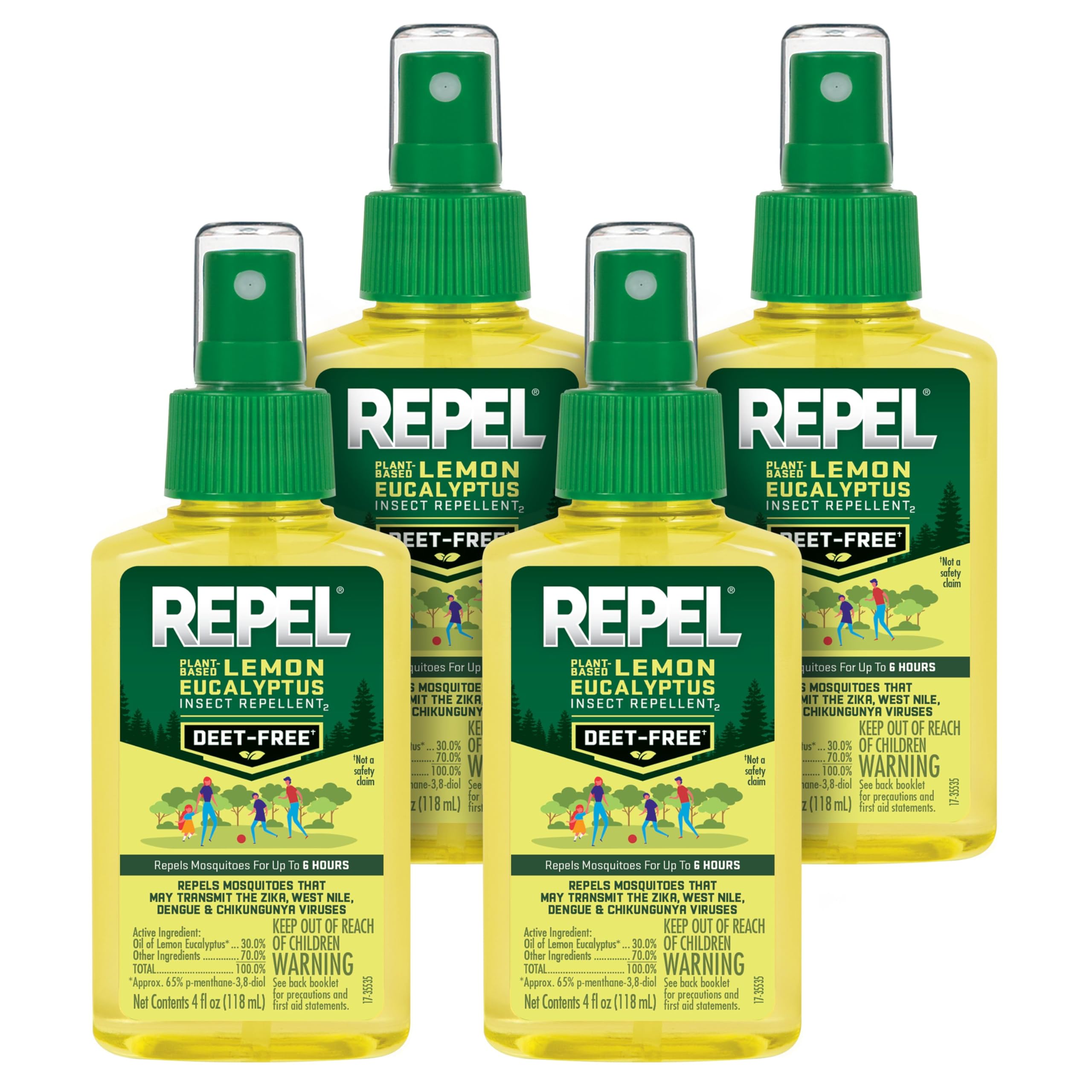
Repel Lemon Eucalyptus
Key Features
- Feel: Not sticky or greasy
- Format: 4 oz pump, 4-pack
- Active ingredient: Oil of lemon eucalyptus
- Stated protection: Up to 6 hours
- Price: Midrange
Oil of lemon eucalyptus is the botanical with a real registration behind it, and Repel leans on it for up to six hours of mosquito protection. Four 4-ounce pumps arrive in one box, which is a practical way to kit out a rental house: one per beach bag, one in the kitchen drawer, one in the car.
The scent is the fork in the road. It is a strong, citronella-adjacent lemon — some of us like it, some of us don’t, and in a hot car it gets louder. If you are sensitive to smell, this is not the pick; if you are avoiding DEET for other reasons, it is a fair trade.
Six hours is also shorter than the picaridin lotions manage, and it is the number we plan around rather than argue with: reapply after lunch and again after a swim. The label’s claim is mosquitoes, and that is how we use it — on a greenhead beach we take the picaridin bottle as well.
What we appreciate most is the pump. No propellant, no hiss, no can left half-full and unusable in October — and you can hand it to an older kid who wants to do it themselves.
Pros
- DEET-free oil of lemon eucalyptus
- Four bottles, one for every bag
- Pump spray with no propellant
- Up to six hours of stated protection
Cons
- Strong lemon-citronella scent some people dislike
- Shorter stated window than the picaridin lotions
For a DEET-free beach bag we buy the four-pack: oil of lemon eucalyptus, up to six hours, and a pump bottle for every chair.
Best for Sun and Bugs
AVON Bug Guard Plus SPF 30
Key Features
- Scent: Gentle Breeze fragrance
- Format: 4.2 fl oz lotion
- Water resistance: 80 minutes
- Active ingredients: IR3535 repellent plus SPF 30
Two products in one bottle sounds like a gimmick until you have tried to reapply sunscreen and repellent to a squirming child on a windy beach. This lotion carries SPF 30 and an IR3535 repellent, lists deer ticks, black flies, gnats, and no-see-ums, and comes in a 4.2-ounce tube-shaped bottle that slips into an outside pocket.
The advantage is compliance rather than potency. People reapply one lotion; they don’t reliably reapply two, and the practical result at the beach is a family that is actually covered at three in the afternoon. It also smells like the old Skin So Soft — soft and powdery rather than chemical — and it is non-greasy, with aloe and vitamin E in the mix.
Two honest caveats. SPF 30 is on the low side for a full beach day, so we layer a dedicated sunscreen underneath when we are out from noon. And when the flies are heavy rather than occasional, we take the picaridin lotion plus a separate sunscreen instead.
For a pool bag, a boat cooler, or a day with kids in and out of the water, though, one bottle that gets used beats two that stay in the car.
Pros
- SPF 30 and an IR3535 repellent in one lotion
- Soft powdery scent rather than a chemical one
- Non-greasy, with aloe and vitamin E
- Travel-ready 4.2-ounce bottle
Cons
- Water resistance lasts only 80 minutes
One bottle for sun and flies is why this earns a spot: SPF 30 plus an IR3535 repellent, in a size that fits a beach bag pocket.
Best for Botanical Alternative
Murphy’s Naturals Repellent

Key Features
- Format: 4 fl oz pump, 2-pack
- Registration: EPA-registered
- Active ingredient: 30% oil of lemon eucalyptus
- Stated protection: Up to 6 hours mosquitoes, 4 hours ticks
- Price: Premium
Thirty percent oil of lemon eucalyptus is a higher load than the Repel botanical, and this one is EPA-registered, with up to six hours against mosquitoes and four against ticks. The two-pack of 4-ounce pumps puts it in the same territory as the other premium botanical here.
The catch is skin. A concentration this high can sting on contact, especially on the face and on anyone who reacts to strong plant oils. We spray it into a palm and press it on rather than misting directly, which solves most of it.
Where it earns its place is gear. It won’t damage outdoor equipment or cloud a plastic watch the way DEET will, which makes it the bottle to take fishing or hiking along the dunes. The four-hour tick window is the shortest here, though, and that matters more in dune grass than on open sand.
For a short evening on the beach it is plenty. For an all-day fly assault, it isn’t the bottle we reach for.
Pros
- 30% oil of lemon eucalyptus, EPA-registered
- Won’t damage outdoor gear or plastics
- Six hours against mosquitoes, DEET-free
Cons
- Feels oilier on skin than the picaridin lotions
- Four-hour tick window is the shortest here
A stronger botanical for readers who want the label on their side: 30% oil of lemon eucalyptus, EPA-registered, with the caveats a heavy oil load brings.
Best for Short Evening Outings
Cutter Skinsations

Key Features
- Scent: Clean fresh scent
- Format: 6 oz aerosol
- Formula: Aloe and vitamin E
- Active ingredient: 7% DEET
- Price: Budget
The scent is what sells this one. Cutter’s clean, fresh formula doesn’t read as insect repellent at all, it goes on non-greasy, and it carries aloe and vitamin E — which is why it is the can people reach for without being asked.
We keep it for the low-stakes hours: a sunset walk, a picnic, a couple of hours on a towel before the light goes. The 6-ounce aerosol is a comfortable size for a tote, and the spray goes on light enough to forget about.
Seven percent DEET is the lightest load in this group, so plan on reapplying every couple of hours in mosquito country, and don’t count on it through a greenhead afternoon. That is a boundary rather than a flaw: this is the bottle for the last two hours of light, when the breeze drops and the sand flies come out.
Pros
- Pleasant scent people don’t mind reapplying
- Non-greasy, with aloe and vitamin E
- Six-ounce can suits a tote bag
Cons
- Can leaks when carried on its side
Our pick for a short, low-stakes evening: the mildest DEET spray here, and pleasant enough that people actually reapply it.
How We Tested: Five Months, Fourteen Repellents, a Lot of Sand
We started by narrowing to repellents that list an EPA-registered active ingredient — DEET, picaridin, IR3535, or oil of lemon eucalyptus — along with a stated protection window on the label. From there we filtered by cost per use, whether the format would survive a beach bag without leaking, and how it’s applied; wipes and lotions behave nothing like an aerosol in a stiff onshore wind. Fourteen units made the cut.
Testing happened where the product actually lives: a bay beach from mid-morning until the afternoon sun got serious, the bottle riding sideways in a tote next to sunscreen, two or three swims, a sandy picnic lunch, and the walk back through dune grass at dusk. On still evenings we sat in a backyard near standing water. Each repellent got at least two full outings, applied as the label directed, with one ankle left bare as a control.
Bite resistance was the number that mattered. We counted new welts on exposed skin at 30, 60, and 90 minutes and logged exactly when the first bite landed. Scent was rated by whoever shared the car ride home — some were truly unnoticeable, others announced themselves from the back seat. We blotted a treated forearm with a paper towel to see how much residue came off, then watched how much sand stuck to it. Every container spent a day rolling around in a tote so leaks showed up on a towel instead of a car seat.
Sensitive-skin testers flagged stinging or redness within ten minutes of application, and we noted when a treated hand left a bitter taste on a cracker. Value got figured as cost per protected hour, since a cheap bottle that needs reapplying every 90 minutes isn’t actually cheap.
How to Choose a Repellent for Biting Flies at the Beach
At the beach the repellent has to survive wind, wet skin, and blowing sand, which is why the active ingredient matters a little less than most shoppers expect and the format matters a lot more.
Start With the Active, Then Read the Fly Window
Picaridin at 20% is where we start when flies are the problem: the Sawyer and Boogie labels both pitch it at biting flies, gnats, and no-see-ums, and it is easy on gear. DEET is the other workhorse, with 25% a sensible beach dose and 98% reserved for severe pressure rather than a normal afternoon. Oil of lemon eucalyptus is the credible DEET-free route, on a shorter clock.
Whatever you pick, read the pest list and the hours separately. Labels commonly claim a longer window against mosquitoes than against flies — 14 hours against one and 8 against the other on the same bottle — and the fly number is the one that governs your day.
Aerosol, Lotion, or Wipe: Pick for Wind and Wet Skin
The shoreline is the worst place in the world for an aerosol. A share of the can leaves on the breeze, and it lands on the person under the next umbrella. Lotion goes exactly where your hand goes and works on a shoulder that is already damp with sunscreen; a wipe does the same job on a neck and a face without any cloud at all.
We keep an aerosol for speed with a group at the car, and a lotion or wipe for faces, kids, and anything downwind of strangers.
Watch the Dry-Down, Not Just the Percentage
Sand sticks to anything tacky. A repellent that stays shiny turns forearms and calves into a grit magnet within minutes, which is why the formulas described as dry or powder-dry earn their place on a towel. Fragrance is the other half of this decision: a fragrance-free lotion is the considerate choice in a packed row of umbrellas, and the scented options run from soft and powdery to a sharp solvent smell.
Keep DEET Off Your Sunglasses
DEET is a solvent at beach concentrations. It clouds plastic watch crystals, marks coated lenses, softens some synthetic straps, and lifts the print off a phone case. Picaridin and oil of lemon eucalyptus do not carry the same reputation, which is one reason we hand the picaridin lotion to anyone wearing good sunglasses.
If you prefer a high-DEET spray, spray it into your palm rather than onto your wrist, and wash your hands before you touch your gear.
Plan for Water, Sweat, and Sunscreen
Every stated protection window assumes the product stays where you put it, and a swim, a towel-dry, and an hour of sweating all work against that. Treat the label figure as a ceiling and reapply after each swim rather than arguing with it.
Sunscreen goes on first and gets a minute to dry; repellent goes on top. If you use a combination product, remember that the sun clock and the repellent clock run out at the same moment.
Frequently Asked Questions
Can I take insect repellent in a carry-on bag?
Liquids and aerosols in a carry-on are limited to 3.4 ounces (100 milliliters) per container, so most of the full-size cans here stay home. The 3-ounce Sawyer lotion and the individually wrapped wipes both clear that limit easily.
Bag them with your toiletries. If you are checking a bag, pack the two-packs there and buy nothing at the resort gift shop.
What is the best repellent for a toddler at the beach?
Age limits live on the label, and they differ by active. Oil of lemon eucalyptus products are labeled for children 3 and older; 20% picaridin lotions and DEET products are labeled for the whole family when used as directed.
For a toddler, put a picaridin lotion on your own hands first and press it onto arms and legs, skipping the hands they will put in their mouth.
Do repellents actually stop horse flies and greenheads?
They reduce landings rather than ending them. The labels say as much: the picaridin lotions claim 14 hours against mosquitoes but 8 against flies, and the botanical sprays claim 6 against mosquitoes only.
On a bad greenhead day, cover up — long sleeves, a hat, socks — and reapply your strongest product every couple of hours instead of trusting the printed number.
Should I treat clothes and gear as well as skin?
For sustained fly pressure, treated fabric is the layer that keeps working when flies ignore what is on your skin. Permethrin spray goes on clothing, hats, and pack straps, and it needs to dry completely before you wear them.
Never apply permethrin to skin, and follow the label for how many washes the treatment survives.
Final Verdict
Buy the Sawyer SP563 if you want one bottle for a beach where the bites come from flies as well as mosquitoes: 20% picaridin, a lotion that will not blow away on the wind, and a formula that leaves your sunglasses alone. If the flies are genuinely brutal, add the OFF! Deep Woods Dry two-pack for a 25% DEET spray that dries powder-dry, and keep a box of the Deep Woods wipes for faces, carry-ons, and the glovebox.
Families who want more lotion per bottle should take the Boogie instead — same active, twice the volume, pump instead of aerosol.