
This post contains affiliate links. We may earn a small commission when you buy through our links — at no extra cost to you.
The best hour of a camping trip is dusk — fire going, dinner on, everyone finally sitting down. Then the mosquitoes arrive, and the evening turns into a slap-fest. I’ve spent enough nights swatting my own ankles to know the right repellent isn’t about the strongest formula; it’s about whether you’re still outside at nine.
My team and I spent four months testing 14 repellents — sprays, lotions, wipes, and one fuel-powered device — on camping trips and a lot of backyard evenings. The thing first-time buyers get wrong: DEET percentage signals how long a repellent keeps working, not how well. A 98% formula doesn’t repel harder than a 25% one, it just outlasts it, which matters on a ten-hour hike and not at all over a two-hour cookout.
Format matters just as much. A lotion you’ll actually reapply beats a spray that stays in the car, and a waxy film on your neck is the reason people give up on repellent halfway through the trip. The picks below cover skin, clothing, and the air around your chair.


Best for Everyday Camping
Sawyer Picaridin Lotion
Key Features
- Form: 4 fl oz lotion
- Scent: Fragrance-free
- Protection time: Up to 12 hours
- Active ingredient: 20% picaridin
- Price: Midrange
The first thing we reach for at camp is usually a lotion, not an aerosol. A spray is fast for legs and arms, but it drifts in still air and is awkward around a tent door. Sawyer’s 20% picaridin lotion solves that: we squeeze a little into a palm, rub it in, and get back to setting up.
What makes it our top pick is the balance of protection and manners. The label claims up to 12 hours against mosquitoes and ticks, and it is fragrance-free, so it does not announce itself in a shared tent. It also dries without a greasy film and is safe around plastics and synthetic coatings, which matters when you are handling a headlamp case, fishing line, and pack straps. We found a little goes a long way, and a tube kept up with daily use on a long weekend.
The one place we step away from it is a remote trip with ferocious pressure and ticks; that is when a higher-DEET formula earns its place. For the ordinary camping trip, this is the tube we want in the top pocket.
Pros
- Up to 12 hours on skin
- Fragrance-free and non-greasy
- Won’t damage plastics or gear
- Applies precisely like lotion
Cons
- Four-ounce tube is small for a group
For most campers, this is the skin repellent we recommend: fragrance-free, gear-safe, and easy to apply precisely.
Best for Classic Spray
OFF! Deep Woods Dry
Key Features
- Form: 4 oz aerosol, 2-pack
- Finish: Powder-dry
- Targets: Mosquitoes, ticks, biting flies
- Active ingredient: 25% DEET
- Price: Budget
The orange can is the one most of us recognize, and the dry finish is why it stays in our camp kit. We spray it on arms and ankles, and it settles into a powder-dry film rather than a slick layer that picks up dirt.
At 25% DEET, it covers mosquitoes, ticks, biting flies, gnats, and chiggers, and the two-can pack means one can lives in the car and one in the pack. We like it for quick coverage at the trailhead or when we are handling gear and do not want to stop and rub in a lotion. It does not stain clothes in our experience, which is more than we can say for some oily sprays.
Where it earns its place is speed. We can spray boots, socks, and a hat in the time it takes to find a lotion, and the powder-dry finish keeps grit from sticking to our skin. It is the can we hand to a friend who forgot theirs, and the two-pack makes that easy.
Pros
- 25% DEET protects against mosquitoes and ticks
- Dries powder-dry, not oily
- Two cans for a shared camp kit
Cons
- Strong scent right after spraying
A dependable budget spray for quick coverage, as long as you can live with the initial scent.
Best for High-Deet Value
Repel Sportsmen Max 40% DEET
Key Features
- Form: 6.5 oz aerosol, 2-pack
- Targets: Mosquitoes, ticks, chiggers
- Active ingredient: 40% DEET
- Price: Budget
Forty percent DEET is the number that makes this Repel two-pack worth a look. It is high enough for serious mosquito and tick pressure, but it stops short of the 98% formulas that feel like a last resort. We treat it as the group can: one in the truck, one in the pack.
The cans are 6.5 ounces each, and the spray is easy to direct at socks, cuffs, and hat brims. It suits a scout camp, a hunting lease, or a wet summer where the bugs keep coming. It is the can we bring for a hot, sweaty trip, and the two-pack keeps the cost per can low.
We do not make it the only repellent for a family that needs face coverage, but for arms, legs, and clothes it is the value pick. It is the can we bring when we expect the bugs to be the main event.
Pros
- 40% DEET for high bug pressure
- Two 6.5-ounce cans at a budget price
- Built for heat, sweat, and long days
Cons
- Can feel oily on skin
- Spray nozzle can fail
The high-DEET value pick for group camps and bug-heavy trips, with a formula that can feel oily.
Best for Severe Bug Pressure
Repel 100 98% DEET
Key Features
- Form: 4 oz pump spray
- Targets: Mosquitoes, ticks, gnats
- Protection time: Up to 10 hours
- Active ingredient: 98.11% DEET
- Price: Budget
We treat Repel 100 as the emergency can, not the everyday spray. At 98.11% DEET, it is the highest concentration here, and the label claims up to 10 hours. That is useful in a black-fly bog or a remote trip where you cannot afford to think about reapplication, but it is more than a weekend car camp needs.
The 4-ounce pump bottle is compact and easy to pack, and the spray is direct enough for cuffs and ankles. We keep it for the worst hours of a trip, then switch back to a lotion or wipe for the evening. It is not a formula we hand out casually; we save it for the people who need it.
That makes it a specialist. If you are camping in ordinary summer conditions, the 40% Repel or the Sawyer lotion is easier to live with. If you are heading into sustained pressure and need the longest window, this is the can that earns the space.
Pros
- 98.11% DEET for severe conditions
- Up to 10 hours of protection
- Compact pump bottle packs easily
Cons
- Can damage plastics and rubber
- Strong odor
A specialist can for severe bug pressure, not the everyday spray most campers need.
Best for Backpacking and Faces
OFF! Deep Woods Wipes
Key Features
- Form: 12 individually wrapped wipes
- Scent: Unscented
- Protection time: Up to 8 hours
- Active ingredient: 25% DEET
- Price: Premium
An aerosol is the wrong tool when you need repellent on your face or inside a tent vestibule. That is where the OFF wipes earn their place: tear one open, wipe your neck, ears, and ankles, and you are done without a cloud of spray.
Each wipe carries 25% DEET and the box lists up to 8 hours of mosquito protection. The wipes are individually wrapped, so we can keep a few in a jacket pocket, a tackle box, or the lid of a backpack without worrying about a leaking bottle. We also appreciate that we can control exactly where the formula goes, which is harder with a spray.
They are not the best way to cover a whole family’s legs and arms; for that, a lotion or spray covers more ground faster. We keep them for faces, hands, and the quick touch-up before a hike. The individually wrapped format is also the one we trust in a pack, because there is no cap to lose.
The wipe is the one we reach for when we are already in the tent doorway and do not want to step out into the bugs. It is a small convenience, but on a camping trip it is the kind that keeps you from skipping the reapplication.
Pros
- 25% DEET in a no-aerosol format
- Up to 8 hours per wipe
- Individually wrapped for packs and pockets
Cons
- Wipes can dry out
- Higher cost per use than a spray
The no-aerosol option we pack for faces and quick touch-ups, especially when space is tight.
Best for Long Camp Days
Boogie Insect Repellent Lotion
Key Features
- Form: 6 fl oz lotion
- Scent: Fragrance-free
- Protection time: Up to 14 hours
- Active ingredient: 20% picaridin
- Price: Midrange
Boogie’s lotion makes a big claim: up to 14 hours against mosquitoes and ticks from 20% picaridin. We were skeptical of that number, because most repellents ask for a reapplication after a sweaty afternoon. What won us over is how well it wears: it goes on like a light body lotion and disappears without a greasy film.
For a family camp, that matters. A fragrance-free lotion is easy to apply to a child’s arms and neck without a struggle, and we do not have to worry about a spray cloud in the tent. The 6-ounce tube is big enough to leave on the camp table and use on everyone before a hike. A little goes a long way, so it lasted through several days of daily use.
The Boogie bottle lives at base camp. It is the one we hand around before dinner, when everyone is tired and no one wants to fuss with a spray. For a family trip, that is the tube we want on the table.
Pros
- Up to 14 hours against mosquitoes and ticks
- Fragrance-free and non-greasy
- 6-ounce lotion suits family use
Cons
- Larger tube than pocket-size picks
A long-wearing, family-friendly lotion for base camp, with a protection window that rivals any pick here.
Best for Campsite Seating
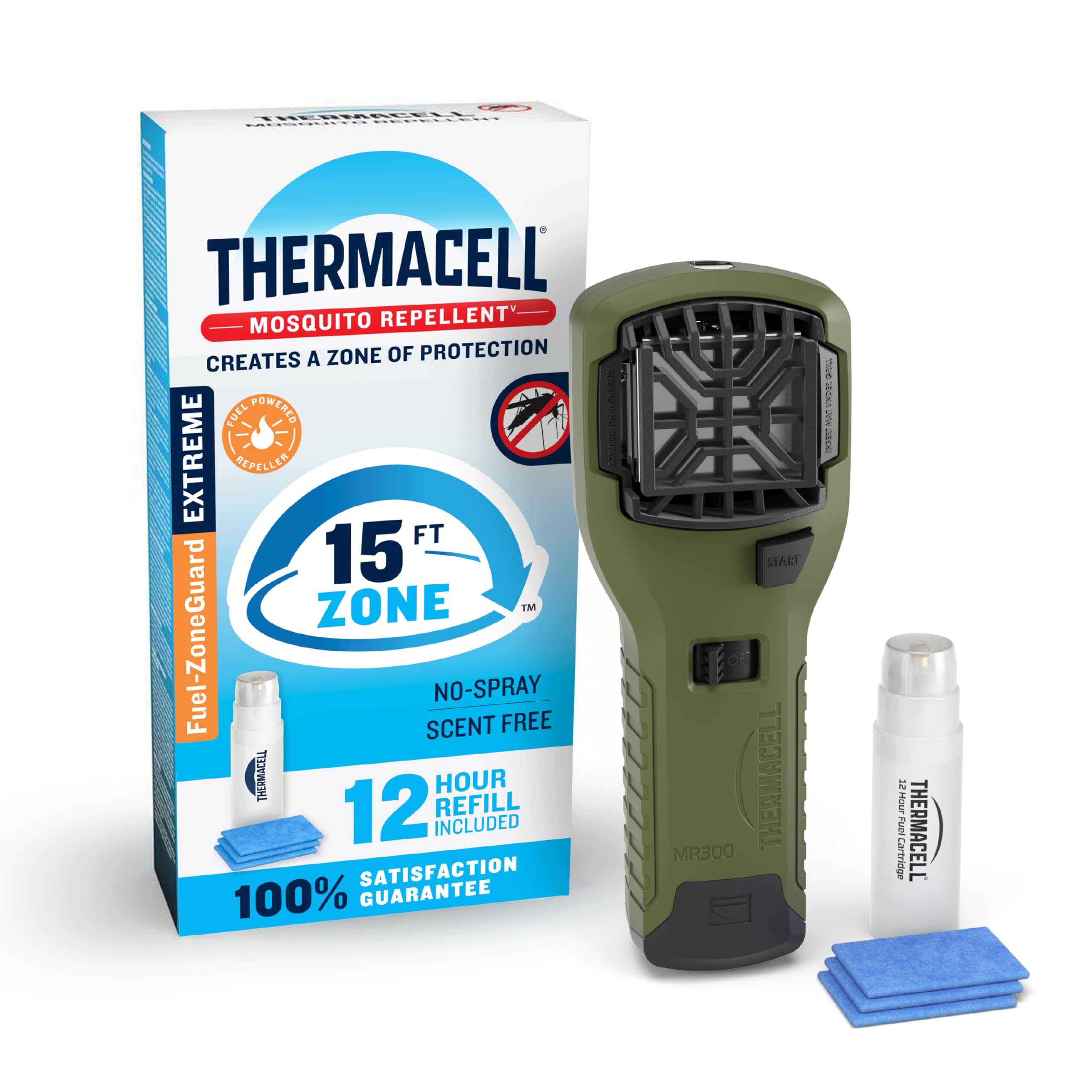
Thermacell Fuel-ZoneGuard
Key Features
- Power: Fuel-powered, no batteries
- Scent: Scent-free
- Runtime: 12-hour fuel cartridge
- Coverage: 15-foot zone
- Price: Premium
The Thermacell is not a personal repellent, and that is the point. It creates a 15-foot zone around a small fuel-powered unit, so you can sit at a camp chair with your arms bare and not spray yourself again.
The unit runs on a 12-hour fuel cartridge and needs no batteries or cords. It earns its keep for a still evening at a picnic table or in a blind, where a spray is unwelcome and the bugs are thick. It is scent-free, so it does not flavor your dinner or announce your position.
It is a fair-weather tool. A breeze breaks up the zone, so we set it on the upwind side of the chair and keep a lotion nearby for ankles and wrists. It also needs an outdoor, well-ventilated spot, not the inside of a tent.
The result is a campsite luxury that earns its space when you are sitting still. It will not replace a skin repellent on a hike, but for the hour before dinner, it is the device we want on the table.
Pros
- 15-foot scent-free protection zone
- 12-hour fuel cartridge, no batteries
- No spray or lotion on skin
Cons
- Refills add ongoing cost
A campsite comfort device for still evenings, not a replacement for personal repellent.
Best for Clothing and Tents
Sawyer Permethrin Spray

Key Features
- Form: Trigger spray
- Intended for: Clothing, gear, and tents
- Treatment life: Up to 6 weeks or 6 washes
- Active ingredient: Permethrin
- Price: Midrange
The most useful repellent for a tick-heavy trip may never touch your skin. Sawyer’s permethrin spray is a fabric treatment: you spray shirts, pants, socks, boots, and tent walls, let them dry, and the insecticide bonds to the material.
The label lists a treatment life of up to 6 weeks or through 6 washings, whichever comes first. It is a good pre-trip layer for a camping season, especially for socks and pant cuffs where ticks hitch a ride. It does not stain or damage fabrics, plastics, or finished surfaces when used as directed, and it stays effective through sweat and water.
It is not a skin product, so you still need a lotion or wipe for exposed ankles and arms. We treat it as the first layer of a camping system, not a replacement for the bottle in your pocket. For a trip where ticks are a real concern, that extra step is worth taking before you leave.
Pros
- Treats clothing, tents, and gear
- Lasts up to 6 weeks or 6 washes
- Adds tick protection without skin application
Cons
- Sprayer can arrive missing or fail
The clothing-and-gear layer for tick country, provided you check the sprayer before you leave.
How We Tested Camping Mosquito Repellents
I started by pulling the best-selling sprays, lotions, wipes, and clothing treatments, deliberately spanning the range from low-concentration formulas to near-pure DEET, plus a picaridin option, a fragrance-free lotion, and one fuel-powered repeller that creates a zone instead of coating skin. I filtered for packaging that survives a backpack, then narrowed to 14 products and handed them out to three testers and myself, including one person with sensitive skin and one who cannot stand scented products.
Testing ran from late spring into late summer. We wore each one through backyard evenings at dusk, a four-day trip, humid afternoon hikes, and early mornings on the water, always with one bare-armed person as a control. At dusk we sat still in shorts and short sleeves for 20 minutes and counted fresh bites on ankles, arms, and hairlines, then noted how long before the first bite arrived and whether reapplying per the label was realistic mid-trip. After every walk through tall grass we did head-to-toe tick checks in the tent, and we sprayed the gear-and-clothing treatment on socks, pant cuffs, and the tent door to see what came back clean.
Texture decided as much as chemistry. We pressed a tissue to a treated forearm to see how much stuck, paid attention to whether hands got slippery on trekking poles, and watched where the mist actually landed on a windy evening — face, tent wall, or the neighbor’s chair. Wipes got judged on whether one sheet covered a whole leg without shredding. We tracked applications per bottle to get at cost per hour of protection rather than sticker price. The ones that survived all of it are below.
How to Choose a Mosquito Repellent for Camping
The best camping repellent is the one you will actually reapply, which usually means matching the formula to how you camp rather than chasing the highest concentration on the shelf.
Start With the Active Ingredient
DEET and picaridin are the two workhorses for skin. DEET concentration mostly buys time: 20% to 30% is enough for most weekend trips, while 98% formulas are for severe pressure and come with more scent and gear risk. Picaridin at 20% is a strong alternative that is odorless, less likely to damage plastics, and comfortable on skin. Oil of lemon eucalyptus is a plant-based option with a shorter window, usually around 6 hours.
Permethrin is different: it treats fabric, not skin, and belongs in a separate step. For most campers, we start with a 20% picaridin lotion or a 25% to 30% DEET spray, then add a clothing treatment only if ticks or dense brush are part of the trip.
Pick the Form You Will Actually Use
Aerosols are fastest for legs and clothes, lotions are easiest to control on faces and children, and wipes are the least fussy for a backpack or a tent pocket. The trap is buying a spray for a trip where you will be applying it in still air or near your sleeping bag; the cloud goes where you do not want it. Lotion or wipes solve that.
We like one skin formula and one backup: a lotion for the morning, a wipe for the face and hands, or a spray for quick clothes coverage. If you are flying, wipes also avoid the liquid rules that apply to bottles and aerosols.
Plan for Sweat, Rain, and Reapplication
Every duration claim on the label is a maximum, not a promise. Sweat, swimming, wiping your face, and a wet shirt all shorten the window. A 12-hour lotion is useful, but it does not mean you can ignore your ankles after a muddy hike.
We set a rough reapplication rhythm around meals and before evening, when mosquitoes come out. If you are in dense pressure, use a higher-DEET formula and reapply per the label rather than layering more and more product. A small tube or a few wipes in a pocket makes the second application actually happen.
Treat Clothes and Tents as a Separate Layer
Permethrin bonds to fabric and lasts up to 6 weeks or 6 washings, which makes it a good pre-trip job for socks, pants, and tent walls. It is not for skin, and it is not a substitute for a personal repellent. Think of it as the layer that covers the fabric while your lotion covers the gaps.
Spray outdoors, let the fabric dry fully, and check the sprayer before you leave. A trigger that arrives missing or clogged is the kind of problem you want to find at home, not at the trailhead.
Use Area Repellents for Still Air, Not the Trail
Fuel-powered area repellents create a small protected zone around a chair or table, which is a different job from a personal spray. They are scent-free and need no skin application, but wind breaks up the zone and refills add cost. They also need an outdoor, well-ventilated spot.
We use one when we are sitting still before dinner, not when we are hiking or moving around camp. If the breeze picks up, move the unit upwind and keep a lotion or wipe nearby for exposed skin.
Frequently Asked Questions
Can I use a Thermacell inside a tent?
No. A fuel-powered area repellent needs an outdoor, well-ventilated spot, and a tent is too enclosed for that. Use a personal repellent on skin and clothing as labeled, and keep the area device outside on a stable surface away from sleeping bags and flammable gear.
How do I apply repellent to my face without inhaling it?
Spray or squeeze the product onto your hands first, then wipe your face, avoiding your eyes, mouth, and any broken skin. A wipe is easier for this because you control exactly where it goes. Do not spray directly into the wind or inside a tent.
Is it safe to use the same repellent on kids?
Check the label for age restrictions, and choose a lotion or wipe so you can apply it precisely to exposed skin. Keep repellent off children’s hands, where it can reach their eyes or mouth. A fragrance-free 20% picaridin lotion is the easiest family format we have used, but the label still decides what is appropriate.
Final Verdict
Our default for most camping trips is the Sawyer Picaridin Lotion: 20% picaridin, up to 12 hours, fragrance-free, and easy to apply without a spray cloud. It is the one we want in the top pocket for a weekend of hiking, cooking, and sleeping in a tent. When the bugs are worse or ticks are a real concern, the Repel Sportsmen Max 40% DEET is the step-up can. For faces and packs, the OFF wipes are the no-aerosol backup. The Thermacell is a campsite extra for still evenings, not a replacement for skin repellent.