
This post contains affiliate links. We may earn a small commission when you buy through our links — at no extra cost to you.
Every year, dozens of ‘super-bright’ flashlights appear online claiming 100,000 lumens – a figure that would rival car headlights. The reality: a handheld light physically can’t output that much. Most of these lights deliver a fraction of what’s advertised.
That doesn’t mean you can’t get a genuinely bright, useful rechargeable flashlight without overpaying. The key is knowing which specs to trust and which to ignore. This guide focuses on lights that either provide honest numbers or deliver real-world brightness that matches user expectations.
Whether you need a pocket EDC, a camping companion, or an emergency backup that turns on automatically, the best choice depends on matching the light to the task – not the marketing claims.


Best for Camping, Emergencies
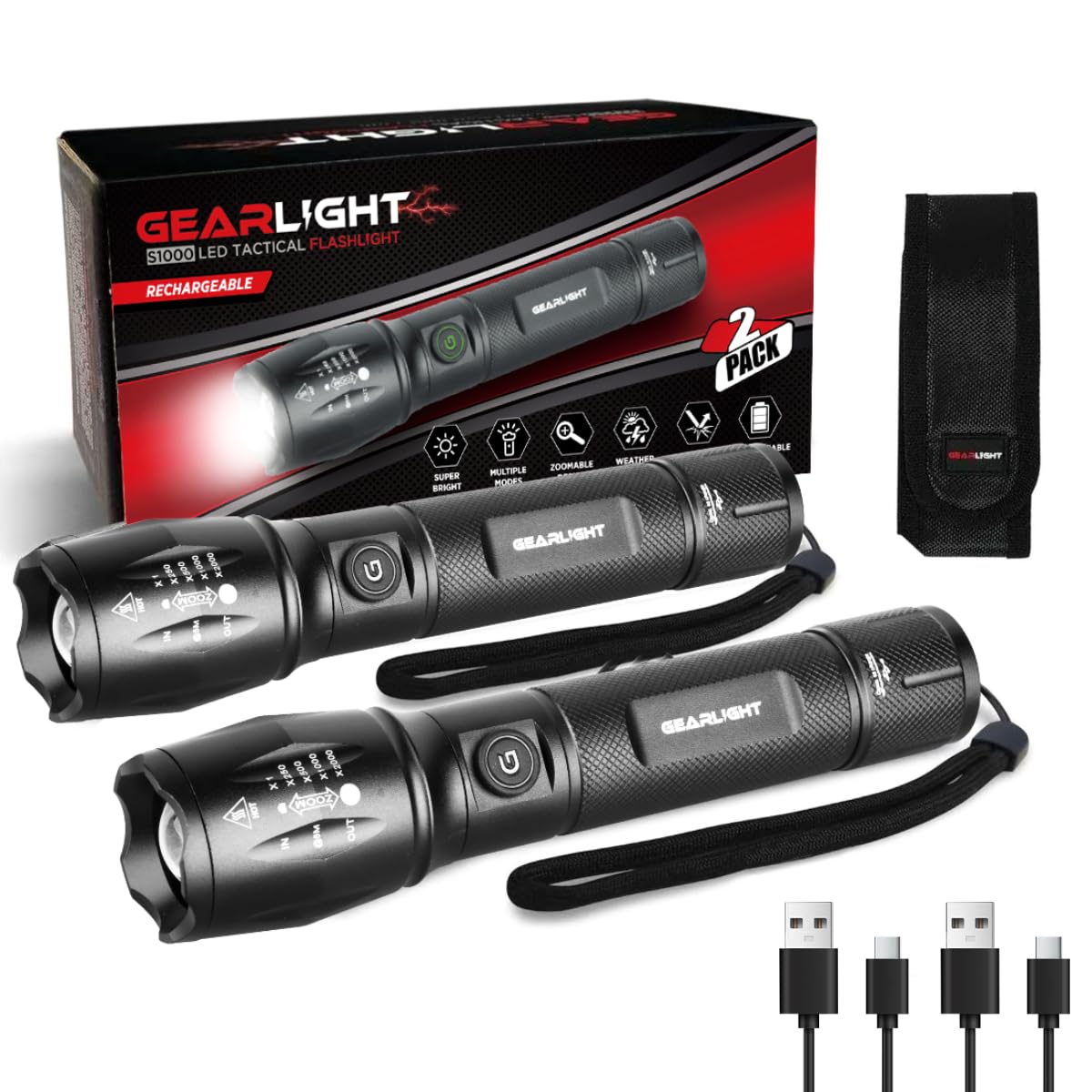
GearLight S1000 2-Pack
Key Features
- Lumens: 800-1000 (est.)
- Battery: 2x2000mAh
- Charging: USB-C
- Water Resistance: IPX4
- Price: $
At this price point, the GearLight S1000 delivers notably bright light from a compact aluminum body. The USB-C charging and included batteries mean it’s ready to use out of the box, and having two lights in the package makes it easy to stash one in the glove box and keep another by the back door.
On the highest setting the battery drains in roughly an hour or two – fine for quick searches but not for all-night use. The medium mode stretches runtime considerably. A small number of units have shown issues after a few months, so it’s worth verifying function early on rather than assuming it will hold up indefinitely.
This is a solid fit for budget-conscious households, campers, and anyone building an emergency kit who wants two functional lights without paying for a single premium model. If you need a light for sustained high-output use or absolute long-term certainty, a more expensive single light would be a better match.
Pros
- Impressive brightness for the price – easily lights up a dark trail or room.
- Sturdy aluminum build that feels solid and durable in hand.
- Two lights included make it simple to cover multiple locations without buying extra units.
Cons
- High mode drains the battery quickly – best reserved for short bursts rather than continuous use.
- Individual units can vary in longevity – some may develop issues after a few months of use.
A practical choice for anyone needing dependable lights without overspending. Just keep in mind that the highest setting eats battery fast.
Best for Everyday Carry
Streamlight MicroStream
Key Features
- Lumens: 250
- Beam Distance: 68 m
- Battery: 1.5h
- Charging: Micro-USB
- Water Resistance: IPX4
- Price: $$
The MicroStream packs 250 genuine lumens into a body that disappears in a pocket – a rare combination of portability and real output. Compared to the GearLight two-pack, it trades runtime and value for a slimmer profile and a more durable aluminum build. This is the light for professionals who carry a flashlight daily and need something that won’t weigh them down. The tradeoff: high mode runs only 90 minutes, and the tail switch can become intermittent after months of use – a known limitation rather than a universal failure.
Pros
- Bright enough for most tasks despite being smaller than a marker
- Disappears in a pocket – virtually unnoticeable until needed
- Charges via USB-C without needing a separate battery charger
Cons
- Continuous high output tops out at about 90 minutes – too short for extended outdoor work
- Tail switch may become intermittent over time – worth checking periodically
If your priority is a light that vanishes in a pocket with genuine 250 lumens, this is the one – just be mindful of the short high-mode runtime and occasional switch behavior.
Best for Keychain Carry
OLIGHT IMINI 2
Tiny enough to disappear on a keyring, the IMINI 2 packs 50 lumens into a 19.5g aluminum body with a magnetic tailcap that sticks to metal surfaces. The integrated USB plug plugs directly into a port for charging without a separate cable. This is a light for quick tasks in the dark, opening locks, or finding dropped items — not for walks or camping. The battery lasts one hour on full output, so it stays useful in short bursts, and some units have exhibited charging or switch hiccups that may cut life short.
Pros
- Weighs 19.5g and slips onto a keychain without adding bulk.
- Magnetic base lets you stick it to metal surfaces for hands-free use.
- Built-in USB plug charges directly — no cable to lose.
Cons
- Battery runs for only one hour on high — limits use to quick tasks.
- Charging or switch issues have been noted in a portion of units.
A purpose-built keychain companion for momentary light needs, not for sustained use.
Best for Power Outages
Energizer Auto-On 3-Pack
The Energizer Auto-On flashlights focus on one thing: being ready the moment the lights go out. They stay plugged into a wall outlet, always charging, and switch on automatically when power fails. No fumbling for batteries or digging through a drawer in the dark.
These are a specialist tool, not a general flashlight. The 40-lumen output is enough to navigate a room or find the circuit breaker, but too dim for outdoor use or searching a yard. Ideal for home emergency kits, seniors, or anyone who wants a light that requires zero thought during a blackout.
Pros
- Turns on automatically during a power outage – no searching in the dark.
- Always charged via plug-in, with no batteries to replace.
- Compact size stays put in an outlet without clutter.
Cons
- Only 40 lumens – works for close tasks and blackout navigation, not for outdoor use.
- Battery duration can be shorter than claimed in some units.
A dedicated emergency light that prioritizes convenience over brightness – best for homes where a simple, automatic backup is the goal.
Best for Tactical Use
Streamlight ProTac 2.0
Key Features
- Lumens: 2000
- Beam Distance: 262 m
- Battery: 2.5h
- Charging: USB-C
- Water Resistance: IP67
- Price: $$$
With a true 2000-lumen output and 262-meter beam, the Streamlight ProTac 2.0 delivers honest brightness and throw that few competitors match. Its durable construction resists drops and water ingress (IP67), making it suitable for demanding fieldwork. This light is designed for law enforcement, security, and outdoor professionals who need a high-powered, fixed-beam tool. The lack of zoom means close-up tasks require a separate light, and a minority of units have experienced switch reliability issues – worth inspecting upon purchase.
Pros
- True 2000-lumen output with a 262m beam – real brightness for search and outdoor use.
- Build quality feels rugged and durable for heavy-duty professional use.
- 2.5-hour runtime on high is solid given the output level.
Cons
- Fixed beam limits close-up versatility – works best as a dedicated thrower.
- Switch may exhibit intermittent operation in some units – verify function upon receipt.
If you need a no-compromise tactical light with honest specs and military-grade construction, the ProTac 2.0 delivers. The fixed beam and premium price make it a specialized tool, not a general-purpose light.
Best for Home Emergencies
TrixHub TH005 2-Pack
The TrixHub two-pack stands out with an LCD display showing exact battery percentage — a convenience rarely seen at this price. With three brightness levels and a claimed 700 lumens, it’s bright enough for household and camping tasks, though it doesn’t match the straightforward reliability of our top pick, the GearLight S1000 2-Pack.
This set suits budget-conscious buyers outfitting home or car emergency kits who value a battery gauge. Be aware that the USB-C charging port may loosen with frequent use, and battery life on high is moderate — fine for occasional use, not all-night outings.
Pros
- Bright output with three adjustable levels.
- LCD battery indicator shows remaining charge clearly.
- Great value for a two‑pack at this price.
Cons
- USB-C charging port may loosen over time, risking charge failure.
- Battery life on high is moderate, draining faster than some prefer.
A capable two-pack for emergency kits and light around-the-home use, provided you’re not relying on heavy daily charging.
Best for Camping, Outdoor
PeakPlus LFX1000

Key Features
- Lumens: 1000 (claimed)
- Beam Distance: 500 m (claimed)
- Battery: 2200mAh
- Price: $
Bright output and solid build make this kit a practical pick for weekend camping trips or stashing in an emergency bag. The included rechargeable battery and dual AAA option add convenience, but durability can vary between units and battery life on high is shorter than some alternatives – a fine choice for light use, less so for daily reliance.
Pros
- Bright output for outdoor tasks
- Includes rechargeable battery, charger, and carrying case
Cons
- Durability can vary; some units may develop switch or lanyard issues
Best suited for budget-conscious campers or as a backup emergency light, but not a dependable everyday workhorse.
Best for Camping, Hiking
Esgreen ED2405B

Key Features
- Lumens: 100000 (claimed)
- Beam Distance: 3280 ft (claimed)
- Battery: 6000mAh
- Charging: USB-C
- Price: $
This budget light delivers genuinely useful brightness (around 2000 real lumens) and a massive battery that lasts over 10 hours on low. The USB-C port also serves as a power bank. However, the advertised 100,000 lumens is pure fiction – treat it as a 2000-lumen light, not a marketing number. Build quality is solid for the price, but occasional switch or battery inconsistencies have been noted. Best suited for campers or emergency kits who want a simple, powerful tool without paying for honest specs.
Pros
- Very bright for the price – ample light for camping or power outages.
- Long runtime on low mode thanks to the 6000 mAh battery.
Cons
- Lumen claim is massively overstated; actual output is around 2000 lumens, not 100,000.
A good buy if you need a bright budget light with long battery life and can accept that the brightness spec is a marketing exaggeration.
Best for Car Emergency
Shadowhawk S1476

Key Features
- Lumens: 10000 (claimed)
- Beam Distance: 5000 ft (claimed)
- Battery: 6000mAh
- Charging: USB-C
- Water Resistance: IP67
- Price: $
The Shadowhawk S1476 throws a genuinely bright beam for its size and feels solid in hand. It also doubles as a power bank, so you can top off a phone in a pinch. But its 10,000‑lumen and 5,000‑foot beam claims are wildly overstated—treat it as an 800–1000 lumen light. Battery life consistency varies between units; some may lose charge capacity over time. The result is a capable emergency‑kit companion if you accept that the specs are marketing fluff and the battery is a gamble.
Pros
- Impressive brightness for a budget‑priced light
- USB‑C port can charge your phone in an emergency
Cons
- Lumen and beam distance claims are heavily exaggerated; battery performance can vary between units
Works well in a car or home emergency kit where the power‑bank feature adds real value—just don’t rely on the advertised specs.
Best for Camping, Hiking
PHIXTON PH2401

Key Features
- Lumens: 100000 (claimed)
- Beam Distance: 3280 ft (claimed)
- Battery: 6000mAh
- Charging: USB-C
- Price: $
The PHIXTON includes a carrying case, AAA battery adapter, and USB-C cable – extra value for a beginner camping kit. Brightness is enough to light a campsite, but the 100,000 lumen claim is unrealistic. Build feels sturdy, though some units may develop charging issues. A suitable entry-level light if you value included extras over honest specs.
Pros
- Good set of included accessories (case, AAA adapter, USB-C cable) for an entry-level camping light.
- Bright enough for typical camping and outdoor use.
Cons
- Marketed 100,000 lumens is heavily exaggerated; actual output is much lower.
Best for budget campers who want a bundled light and can accept inflated marketing numbers.
Best for Budget Gifts
CHILDBOT Y1915C

Key Features
- Lumens: 100000LM (claimed)
- Beam Distance: 3640 ft (claimed)
- Battery: Rechargeable
- Charging: USB-C
- Water Resistance: IP67
- Price: $
The LCD battery indicator and three brightness levels make this an appealing entry-level option for budget buyers or as a gift. However, the claimed 100,000 lumens are not realistic – actual output is bright but far lower – and battery life can vary between units, making it less suited for situations where dependable light is essential.
Pros
- Three brightness levels provide ample light for everyday tasks and camping.
- Battery percentage display helps avoid unexpected shutdowns.
Cons
- Claimed 100,000 lumen output is unrealistic – actual brightness is significantly lower, which may mislead buyers expecting that level of performance.
A suitable pick for gift-giving or occasional use where maximum reliability isn’t a priority.
Best for Camping, Gift
ZioeYiue 2-Pack

This two-pack offers bright main output and red/warm side lights for tent use. Build quality is decent for the price, with USB-C charging. Durability can vary between units, and battery life on high is short. Best for campers who want colored side lights or emergency backups; choose the top pick for more consistent longevity.
Pros
- Very bright main beam with additional red/warm side lights for camping or reading
- Solid build quality and USB-C charging at a budget price
Cons
- Battery runtime on high is short, and some units may show reduced performance over a few months
Ideal for campers who value colored side lights over long-term reliability, or as a low-cost emergency backup.
Best for Enthusiasts Backup
WUBEN C3

Key Features
- Lumens: 1200
- Beam Distance: 587 ft
- Battery: 18650
- Water Resistance: IP68
- Price: $$
This pocket-sized light throws 1200 honest lumens and survives full submersion, making it remarkably capable for its size. Its multiple modes with memory are handy. However, the tradeoff: some units have been known to lose power without warning, so it’s best kept as a backup if you have warranty coverage.
Pros
- Very bright with multiple modes including a memory function
- Compact size with IP68 waterproofing – fits in a pocket and can be submerged
Cons
- Sudden power loss without warning has been noted in some units
Keep this as a backup for emergency kits if you have warranty protection — the brightness is real, but so is the risk.
Best for Junk Drawer
Blukar Rechargeable

Key Features
- Lumens: 2000 (claimed)
- Battery: 1800mAh
- Charging: USB-C
- Price: $
The Blukar Rechargeable is the least expensive rechargeable flashlight we tested. It delivers enough light for looking under the couch or grabbing something from the garage at night, and the USB-C port means no hunting for AAAs. Just keep expectations in check: the “2000 lumens” on the box is pure marketing – actual output sits around 400‑500 lumens. Also, some units have been known to stop working within weeks, so reliability is a roll of the dice. This is a glove‑box or junk‑drawer light, not something to depend on for camping trips or emergencies.
Pros
- Bright enough for everyday tasks despite the inflated claims
- USB-C rechargeable – no need for disposable batteries
Cons
- Lumen spec is wildly overstated – real output is about a quarter of the claimed 2000
Grab it for a spare light in the car or junk drawer, but don’t rely on it for anything critical – the inflated specs and occasional early failures make it a riskier choice than a few dollars more.
Best for Night Walks
Esgreen ED0330

Key Features
- Lumens: 100000 (claimed)
- Beam Distance: 5000 ft (claimed)
- Battery: 6000mAh
- Charging: USB-C
- Price: $$
The Esgreen ED0330 includes a UV mini light, holster, and a 6000mAh battery that can charge your phone — useful extras for campers. It feels solid and lights up close areas well. But lumen and beam claims are dishonest; actual brightness is far lower. Good only if you buy it for the accessories, not the advertised numbers.
Pros
- Illuminates large areas with decent intensity for a budget light
- Sturdy aluminum body gives a reassuringly solid feel
Cons
- Lumen and beam distance ratings are grossly inflated; actual output is far lower than claimed
A passable budget light if you need the phone-charging feature and UV light, but only if you can ignore the exaggerated specifications.
How to Choose
The single most important thing to know when buying a rechargeable flashlight: ignore the lumen number on the box – especially if it’s 100,000 or more. That’s physically impossible for a handheld light.
Lumens and Beam Distance
Raw lumens measure total light output, but beam distance tells you how far that light reaches. A 2000-lumen floodlight may only throw 50 meters, while a 1000-lumen focused beam can reach 200 meters. Cheap lights inflate lumens to appear brighter, but their beam distance is often poor. For outdoor use, prioritize beam distance over raw lumens.
When comparing lights, look for candela ratings – the higher the candela, the farther the throw. Established brands provide both numbers. Budget brands often omit real candela data, relying on exaggerated lumen claims instead.
Battery Capacity and Runtime
Runtime on high mode is the most honest spec – and it rarely exceeds 2 hours for compact lights. A 6000mAh battery can stretch to 3–5 hours on high, but only if the LED is efficient. Many budget lights pair large batteries with inefficient LEDs, draining power quickly.
Products that claim 10+ hours on high almost certainly use a much lower output level. Check user reviews for real-world runtime estimates. If you need extended use off-grid, look for lights that accept replaceable 18650 batteries so you can swap spares.
Charging Connector
USB-C is now the standard – it’s faster, reversible, and found on most modern phones and laptops. Flashlights still using micro-USB or proprietary connectors are outdated. Newer lights with USB-C also often support power delivery (PD) for faster charging.
If you own multiple devices, a USB-C flashlight means one cable for everything. Some budget lights still ship with micro-USB, so check before buying. All lights in this guide that specify charging use USB-C.
Water Resistance
Water resistance is rated by IP codes: IPX4 protects against splashes, IPX7 allows submersion up to 1 meter for 30 minutes, and IP68 is for deeper immersion. For outdoor camping or tactical use, aim for IP67 or better. For home use, IPX4 is sufficient.
Flashlights with zoom mechanisms often have lower water resistance because the moving lens breaks the seal. If you expect heavy rain or drops in water, choose a fixed-beam light with a solid IP rating.
Size and Weight
Size determines where you can carry the light. Pocket-sized lights (under 4 inches) disappear in a pocket but have limited battery life and output. Larger lights (6+ inches) accommodate bigger batteries and produce more heat, allowing sustained high output.
For everyday carry, a light under 3 ounces is ideal. For camping or emergencies, a heavier light with a 6000mAh battery provides peace of mind. The trade-off is always portability versus runtime and brightness.
FAQ
Why do cheap rechargeable flashlights claim 100,000 lumens when they are nowhere near that bright?
Marketing tactics prey on buyer ignorance. A 100,000-lumen light would require hundreds of watts and active cooling – impossible in a $20 handheld. Real high-output lights like the Streamlight ProTac 2.0 produce 2,000 lumens and cost over $100. Stick to established brands and ignore triple-digit lumen numbers from unknown manufacturers.
How long should a rechargeable flashlight actually last on high mode before needing a recharge?
Most compact flashlights run 1–2 hours on high. Larger lights with 6000mAh batteries can manage 3–5 hours. If a product claims 10+ hours on high, it’s either using a very low-lumen output or the spec is fake. Always check runtime in user reviews.
Can a zoomable flashlight still be waterproof?
Zoom mechanisms rely on a moving lens that breaks the water seal. Even lights advertised as waterproof may leak after repeated zoom adjustments. If water resistance is critical, choose a fixed-beam light with a solid IP rating like IPX7 or IP68.
What is the real beam distance of a 2000 lumen tactical flashlight?
A genuine 2000-lumen light with a focused reflector typically throws 250–300 meters. The Streamlight ProTac 2.0, for example, claims 262 meters. Budget lights that claim 5000 feet (over 1500 meters) are exaggerating by 5–10x. Compare candela ratings instead.