
This post contains affiliate links. We may earn a small commission when you buy through our links — at no extra cost to you.
Few travel moments are as quietly stressful as watching a gate agent eye your backpack. I’ve been the person blocking the aisle, knee jammed into a bulging bag, trying to talk it into the sizer. A good lightweight travel backpack settles that whole scene: it rides on your back, stays light enough for a long layover, and slips under the seat when it was bought with real measurements in mind.
Advertised capacity is optimistic at best, and the pockets that matter most are the ones you can reach without taking the bag off. We spent six months carrying 12 lightweight backpacks through airports, onto trains, up day hikes, and around town, and the difference came down to stitching, strap padding, and pocket layout rather than logos.
Cheap doesn’t mean flimsy here, and expensive doesn’t guarantee comfort — a budget pack has outlasted a fancier one on the same trip. The picks below are the ones that earned their spot, whether you’re squeezing a weekend into a personal item or carrying a laptop and a day’s gear.


Best for Everyday Travel Carry
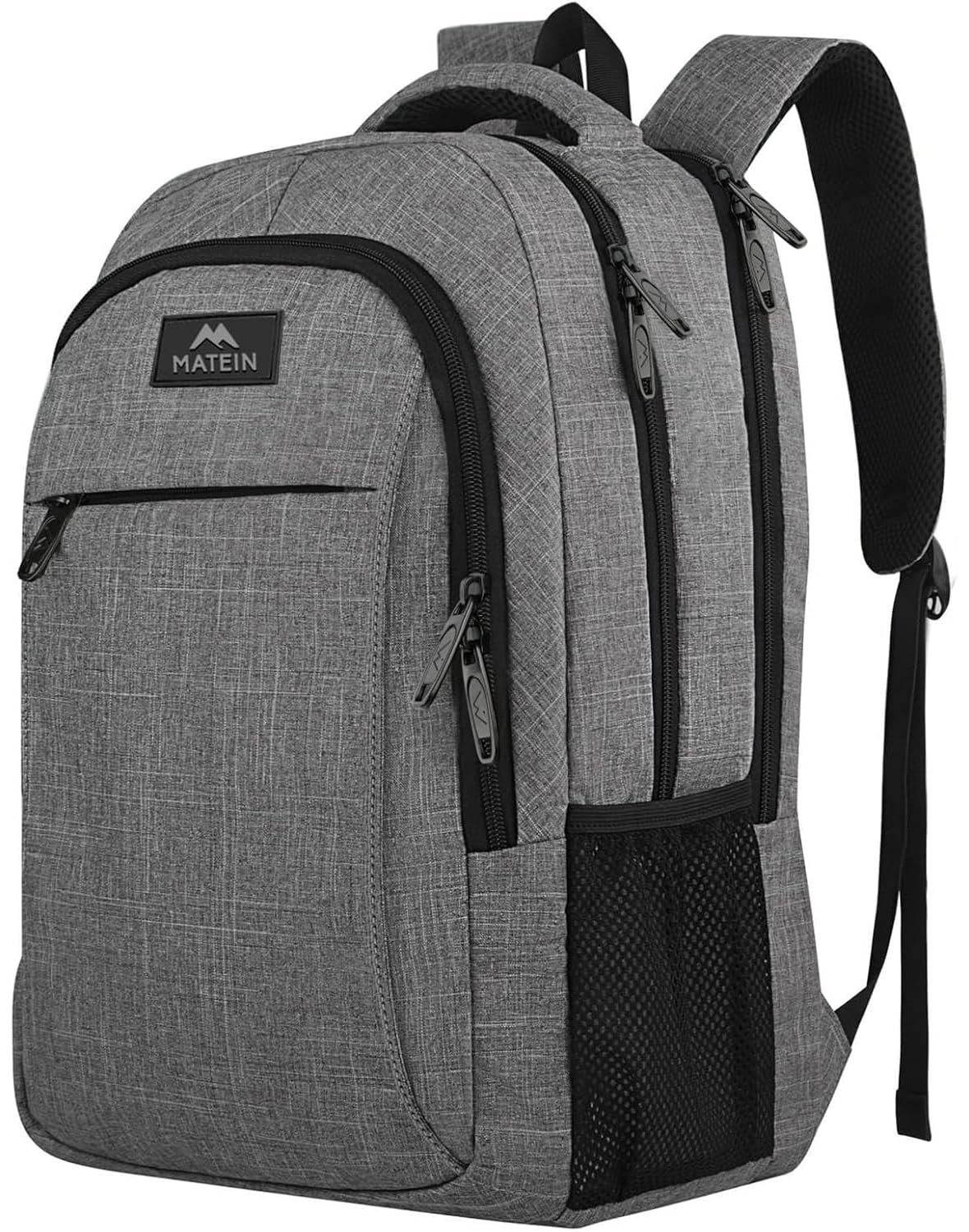
MATEIN Travel Laptop Backpack 30L
Key Features
- Capacity: 30 liters
- Dimensions: 18 x 12 x 7.8 in
- Empty weight: 1.56 lb
- Laptop sleeve: Up to 15.6 in
- Price: Budget
At 1.56 pounds empty, this is not the lightest bag on the page, and the packable daypacks undercut it by more than a pound. What we keep coming back to is the ratio: 30 liters of usable space, a padded laptop sleeve, and six pockets for a weight that stops registering once the straps are set. For a bag you wear through two airports and a train station in a day, that balance is the whole argument.
The layout sells it for travel. Three compartments mean the laptop, the clothes, and the small stuff do not have to share one cavity, and the luggage strap on the back slides over a roller bag handle so you can wheel both through the terminal. The pocket we use most is the hidden one flat against your back, which is where a passport goes while you walk through a crowd.
Comfort is better than the budget build suggests: a ventilated, multi-layer back panel keeps your shirt drier than a flat nylon sheet does, and the water-resistant polyester shell wipes clean and tolerates a machine wash. Nothing about it feels precious, which is exactly what you want in a bag that gets shoved under a seat.
Where it stops is a long trip. Thirty liters is three or four days of clothes if you pack carefully, and there is no compression strap to buy you more room. As a personal item, a weekend bag, or a daily carry that doubles for travel, we have not found a better balance of weight, organization, and comfort in this group.
Pros
- Light for its size at 1.56 pounds
- Personal-item dimensions of 18 x 12 x 7.8 inches
- Slides over a roller bag handle
- Hidden anti-theft pocket against your back
Cons
- Shoulder straps can loosen while you walk
- Top-loading main compartment limits access
The pack we recommend to most travelers: 30 liters at 1.56 pounds, with the pockets, laptop sleeve, and luggage strap that make a travel day easier.
Best for All-Day Comfort
Osprey Daylite Plus
Key Features
- Capacity: 20 liters
- Back panel: AirScape mesh
- Empty weight: 1.3 lb
- Laptop sleeve: Up to 14 in
- Price: Premium
After a day in the budget packs, the first thing you notice about this one is how little it moves. The AirScape back panel sits close to your body, and the sternum strap and light hipbelt take load off your shoulders in a way the flat-backed bags here cannot manage.
That is what the extra money buys, and we think it is the right trade when the bag stays on your back for hours rather than minutes. The shell is bluesign-approved recycled polyester with a DWR finish made without PFAS, the zippers and stitching feel like they will outlast the trip, and the 20-liter body suits a day hike, a commute, or a long layover.
The details are thoughtful in the way that matters while you are moving: a stretch shove-it pocket across the front takes a rain shell or a wet towel, the two side pockets are deep enough for a big bottle, and the front compartment has a key clip. It is also the one pack here we take on a hike on purpose rather than as a compromise.
Pros
- Hipbelt and sternum strap spread the load
- Stretch front pocket takes a wet layer
- Recycled fabric with a PFAS-free DWR
- Deep side pockets for large bottles
Cons
- Laptop sleeve fits 14 inches only
- The priciest pack in this group
Our pick for anyone who wears the pack all day: a real harness, a ventilated back panel, and 20 liters that carry like more than they are.
Best for One-Bag Carry-On
LOVEVOOK 40L Travel Backpack
Key Features
- Capacity: 40 liters
- Empty weight: 2.2 lb
- Laptop sleeve: Up to 17 in
- Packing cubes: 3 included
- Price: Midrange
At a security checkpoint, a bag that opens flat like a suitcase is the difference between repacking on the floor and being done before the bin comes back. This one unzips around three sides, lays both halves out, and keeps the laptop in a padded pocket you can reach without unpacking clothes.
Forty liters, four compartments, and 18 pockets is a lot of bag, but the three packing cubes, two storage bags and a shoe bag, are what make it usable rather than merely roomy: you pack the cubes, drop them in, and unpack by lifting them out at the hotel. There is a wet pocket too, which is the feature we notice most on a return trip with a damp swimsuit in it.
What convinced us is that access paired with a build the cheaper carry-ons here do not match: tear-, water-, and abrasion-resistant fabric, sturdy straps, and zips that are not the weak point. At 2.2 pounds empty it is the heaviest pack we are recommending, and that is the honest trade, since the structure and the 17-inch laptop sleeve cost you weight before you have packed a thing.
It is a poor daypack, though: too big, too structured, and it does not compress down when it is half empty. Treat it as a one-bag carry-on that stays in the hotel room once you arrive, and the shoe bag as the laundry sack you did not think to pack.
Pros
- Opens flat for packing and security
- Three packing cubes included
- Separate padded 17-inch laptop pocket
- Built-in wet pocket for damp clothes
Cons
- Care label says dry clean only
Our pick when the backpack is the whole trip: 40 liters, a suitcase-style opening, three packing cubes, and a padded 17-inch laptop pocket.
Best for Budget Carry-On
Taygeer 35L Travel Backpack
Key Features
- Pockets: 11
- Capacity: 35 liters
- Dimensions: 16.8 x 11 x 7 in
- Empty weight: 1.74 lb
- Price: Budget
Thirty-five liters, 1.74 pounds, and 16.8 x 11 x 7 inches: by the numbers this is the most space per ounce in the carry-on group, and that footprint is why it is the bag we hand a traveler flying a low-cost carrier with a sizer at the gate.
We like how it opens. The main zip runs 180 degrees around three sides so the bag lies flat like a weekender, and the three main compartments and nine inner pockets keep clothes, cables, and a laptop from turning into one pile. A bonus shoe bag takes the pair you do not want against your shirts, and a wet pocket handles a swimsuit or a towel.
The two padded grab handles let you carry it briefcase-style down a jet bridge, which we did more often than expected once it was full, and the soft shell squashes into an overhead bin even at capacity. For a two- or three-night trip it is one of the least expensive ways into a flat-opening bag here.
Pros
- Lies flat for packing and security
- Bonus shoe bag and wet pocket
- Two padded grab handles
- 35 liters within personal-item dimensions
Cons
- Zippers and strap anchors can give out early
- Hand wash only
The budget pick for a short flight: 35 liters that lie flat, a shoe bag, and two grab handles, in a footprint that clears the sizer.
Best for Short-Trip Daypack
coofay 25L Travel Backpack
Key Features
- Capacity: 25 liters
- Empty weight: 1.43 lb
- Laptop sleeve: Up to 15.6 in
- Shoe compartment: Yes
- Price: Budget
A shoe compartment usually costs a travel pack weight and a slice of the main bag. This one gives both back: 650 grams total, and the compartment sits at the bottom where it does not fight the clothes above it. That combination makes it the lightest structured pack in this group.
Twenty-five liters across four compartments is a sensible shape, with the clothing pocket sized for four to six thin tops or pairs of pants, plus a separate wet pocket for anything damp, a padded 15.6-inch laptop sleeve, and an airflow back panel that keeps the bag off your spine.
The shell is waterproof-coated polyester that machine washes, which is more than most bags at this end of the group offer, though we dry it completely before a laptop goes back in. As a daypack it is perfectly fine; as the single bag for a long weekend it is the one we reach for first.
Pros
- 650 grams with a shoe compartment
- Wet pocket keeps damp items apart
- Machine washable shell
- Fits a 15.6-inch laptop
Cons
- Two to three days of clothes at most
The lightest structured travel pack here, with a shoe compartment, a wet pocket, and a laptop sleeve in a bag that still slides under the seat.
Best for Packable Backup
4Monster Packable Daypack 16L
Key Features
- Fabric: 30D water-resistant nylon
- Pockets: 4
- Capacity: 16 liters
- Packed size: Folds into attached pouch
- Price: Budget
It folds into a pouch sewn to the inside of the bag, so there is no separate stuff sack to lose and nothing to unpack twice. Pull it out, shake it open, and it is a backpack.
Sixteen liters is a day of gear: a light layer, trail shoes, sunscreen, snacks. The two mesh side pockets are deep enough that a full bottle stays put when you swing the bag off one shoulder, and the front zip pocket keeps keys and a phone out of the main compartment.
We treat this as the bag that lives at the bottom of a suitcase and earns its place on arrival, for a beach day, a market, or a hike nobody planned. Packed, it takes up less room than a folded shirt, which is the whole reason to own one.
Pros
- Folds into its own attached pouch
- Two deep mesh bottle pockets
- Water-resistant 30D nylon
- Barely there in a packed suitcase
Cons
- Unpadded webbing straps dig in under load
- Thin nylon shows seam wear with heavy use
The spare bag we keep folded in a suitcase: 16 liters of water-resistant nylon that stuffs into its own attached pouch.
Best for Minimal Day Bag
SKYSPER 10L Packable Daypack
Key Features
- Capacity: 10 liters
- Folded size: 6.7 x 7 in
- Empty weight: 0.6 lb
- Security pocket: Hidden back zip
- Price: Budget
The most useful pocket here is the one on your back. A flat zip pocket sits against the spine, where a pickpocket cannot reach it and where a passport or a phone stays out of the weather. We did not expect that on a bag this small.
Folded, it measures 6.7 by 7 inches, which the listing compares to a pencil pouch, and it weighs 0.6 pounds empty. That is the case for owning one: it goes into a carry-on flat and comes out as a real daypack for a city or a trail.
Two deep mesh pockets hold a bottle at each side, there is a vertical zip pocket at the front for the small stuff, and the ripstop polyester has a water-resistant finish that sheds a shower. Simple hardware, nothing to break.
It goes in the carry-on for city days and short hikes, where a bottle, a layer, and a camera are the whole list. It is also the pack we hand someone who wants a bag that disappears into a tote until it is needed.
Pros
- Folds down to 6.7 x 7 inches
- Hidden zip pocket against your back
- 0.6 lb empty
- Deep mesh pockets for bottles
Cons
- Unpadded straps limit how much you carry
- Ten liters holds a day’s essentials, no more
A 10-liter daypack that folds to pencil-pouch size, hides a flat security pocket against your back, and weighs 0.6 pounds.
Best for Strict Sizer Fit
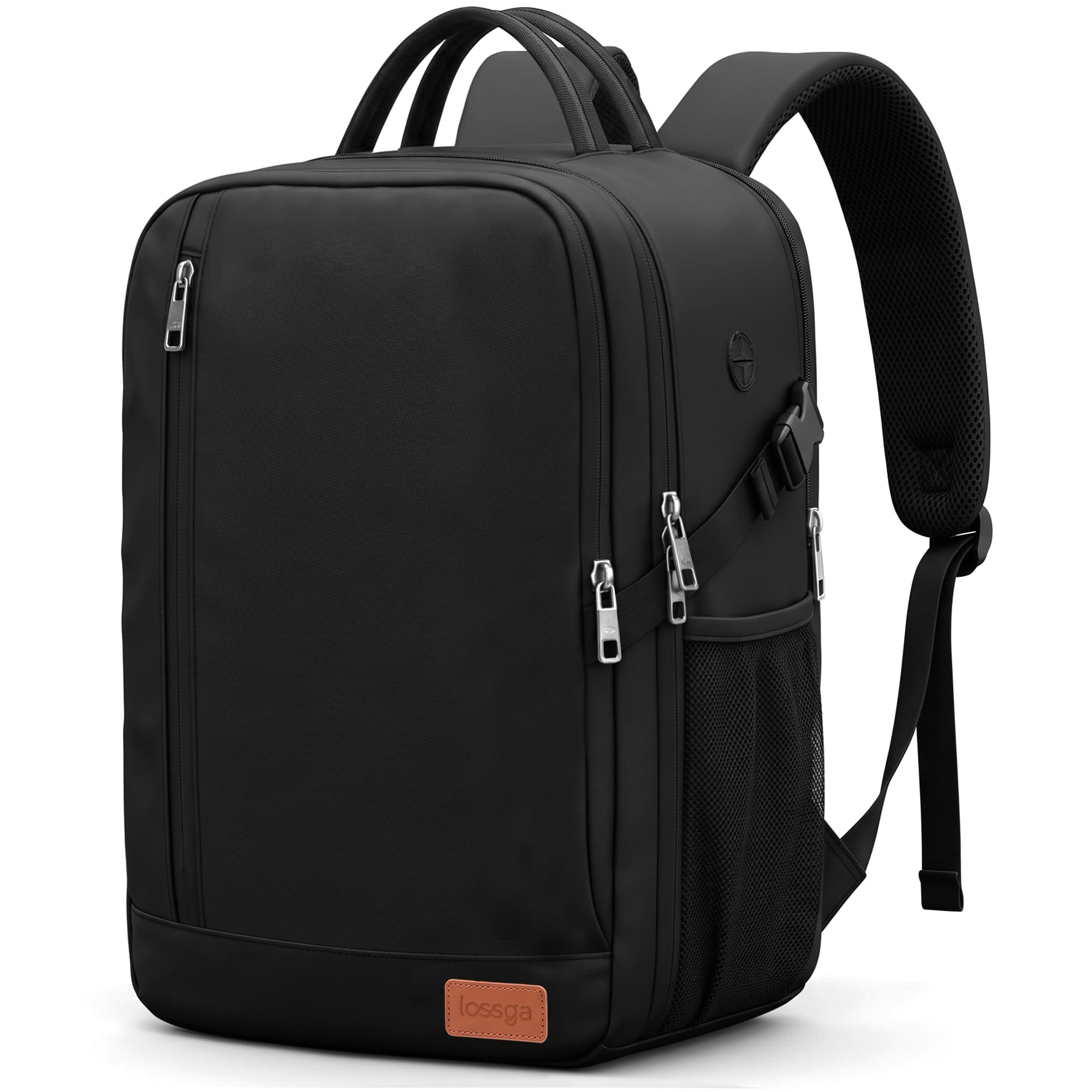
Lossga 30L Personal Item
Key Features
- Pockets: 13
- Capacity: 30 liters
- Dimensions: 18 x 14 x 8 in
- Laptop sleeve: Up to 15.6 in
- Price: Midrange
The dimension line on this one is unusually specific: 18 x 14 x 8 inches when it is fully loaded, and roughly 16.5 x 11.8 x 7 when it is empty. That is worth knowing if you are flying a carrier that measures personal items in a frame, because the bag only grows into its claimed size as you fill it.
Inside, three main compartments and nine pockets give it more structure than most 30-liter bags, with a padded 15.6-inch laptop compartment and a suitcase-style opening that lays it flat at security. There are side pockets outside and a stash pocket in the lower back pad, which is where we put a passport.
The build is thicker than the price suggests: tear-resistant polyester, reinforced stitching at the stress points, and metal zippers. It is a soft shell, so it squashes into an overhead bin and springs back into shape when you pull it out.
For a strict sizer, this is the bag to look at, with one piece of homework: pack it to its real dimensions before you leave. A half-empty bag measures smaller than the frame, and a bag stuffed past 8 inches deep does not fit it at all.
Pros
- Matches the 18 x 14 x 8 sizer
- Suitcase-style opening at security
- 13 pockets including a back stash
- 30 liters in a personal-item frame
Cons
- Water protection is inconsistent for rain
Built to the 18 x 14 x 8 personal-item frame, with a flat opening, three compartments, and a padded 15.6-inch laptop sleeve.
How We Tested the Best Lightweight Travel Backpacks
We built the shortlist from retailer listings, travel forums, and the bags our staff already own, starting with roughly 40 contenders and cutting by dimensions, empty weight, claimed capacity, and price. Anything that couldn’t plausibly clear a personal-item sizer came off the list, as did bags whose listed weight looked invented. Twelve made the cut, from packable daypacks you can crush into a tote to structured 30-liter carry-ons, and we used each one for six months.
Testing happened where these bags actually live: at airport gates and under seats, on trains and buses, on day hikes with a water bottle and a rain shell, and on ordinary grocery runs. We weighed every bag empty, then packed the same load — a weekend of clothes, a 15-inch laptop, a dopp kit, a charger pouch — and weighed it again. While wearing each one, we counted how many pockets we could reach without taking it off, and noted which zippers opened one-handed.
Durability got the ugliest treatment. We shoved bags under seats, overstuffed them past the zipper, dragged them by one strap, and left them in the sun. Every few weeks we checked the stitching at the shoulder-strap joins and looked for fraying zipper pulls. To judge water resistance, we ran a faucet over the front panel for two minutes and then felt inside for damp patches. For value, we asked what each bag gave you over the cheapest one in its size class. The winners weren’t the feature-heaviest — they were the ones still comfortable at hour six and still tidy at month six.
How to Choose a Lightweight Travel Backpack
The lightest bag is not automatically the easiest trip, because what you feel at the end of a travel day is the harness under the weight, not the number printed on the spec sheet.
Weight matters less than what holds it
A packable daypack can weigh under a pound and still be the wrong bag for a laptop and a jacket across a city, because unpadded webbing straps put every ounce on the same narrow strip of shoulder. The structured packs here run 1.3 to 2.2 pounds empty and carry far more comfortably for it. Our rule: if the bag will be on your back for more than an hour at a stretch, spend the weight on a padded back panel and a sternum strap. If it lives inside another bag until you arrive, buy the lightest thing that folds.
Fly by the sizer, not the liter count
Airlines measure height, width, and depth, and liters tell you none of those. Frontier’s personal-item frame, for instance, is 18 x 14 x 8 inches, and a 40-liter bag can be built to that or miss it entirely. Check packed dimensions rather than empty ones: the Lossga only reaches its claimed 18 x 14 x 8 when it is full, so a half-packed bag measures smaller than the frame and an overstuffed one blows past the depth limit.
Flat openings versus top-loaders
A suitcase-style opening, like the one on the LOVEVOOK and the Taygeer, lays the bag flat so you can see everything and repack in a security line. The cost is floor space, because a flat bag needs roughly twice its footprint to open, which is awkward in a crowded gate area or a hostel dorm. Top-loaders like our top pick take less room to open and are quicker to reach into one-handed, but they bury whatever sits at the bottom. Choose flat if you repack often; choose top-load if you mostly pull out a jacket and a bottle.
What a packable daypack can and cannot do
Packable bags are built around thin nylon and webbing straps, and that is a fair trade only within limits. They are excellent as a second bag for day trips, a spare for souvenirs, or a hiking pack that vanishes into a suitcase. They are poor as a laptop bag or a one-bag travel pack, because there is no padding, the fabric abrades at the seams under load, and everything lands on your shoulders. Keep the load to what you carry in a tote and treat water resistance as a shower guard rather than a rain guarantee.
Frequently Asked Questions
Are lightweight travel backpacks waterproof?
Almost none of them are. The packable daypacks here are water-resistant at best: the coating sheds a shower, but the seams are not taped and steady rain gets through. Structured bags such as the LOVEVOOK claim more protection, and we still would not trust a laptop to a coating alone.
Put anything electronic or paper in a sealed dry bag inside the main compartment. It weighs an ounce, costs very little, and does the job no finish on a nylon shell can promise.
Can you machine wash a travel backpack?
Sometimes, and the care label decides. The MATEIN and the coofay are labeled machine washable, the LOVEVOOK says dry clean only, and the Taygeer and SKYSPER ask for hand washing.
Use cold water and mild soap, never a dryer, and spot-clean first, since heat and tumbling are what strip the water-resistant finish off a shell.
How do you keep a full backpack from digging into your shoulders?
Pack the dense items flat against your back rather than at the bottom or in an outside pocket, then tighten the sternum strap so the bag moves with your torso instead of swinging away from it. Shorten the shoulder straps until the bag sits high and close.
On a packable daypack with unpadded webbing, no adjustment fixes a heavy load. Carry less, or move up to a structured bag.
Final Verdict
Most travelers should start with the MATEIN. Thirty liters at 1.56 pounds, a luggage strap for the terminal, and enough pockets to keep a laptop away from your clothes make it the balance of weight, organization, and comfort the rest of this group is measured against.
Two things change the answer. If the pack stays on your back all day, the Osprey Daylite Plus carries better than anything here and is worth the step up. If you want a spare that disappears into a suitcase and reappears at a beach, take the 4Monster and forget about it until you land.