
This post contains affiliate links. We may earn a small commission when you buy through our links — at no extra cost to you.
Cycling backpacks promise convenience, but many hydration systems leak within weeks, turning a ride into a wet mess. The real solution isn’t just a cheap bladder – it’s a pack built to keep water where it belongs, with a fit that stays put on the trail.
This guide focuses on packs that prioritize leak-free hydration and a stable, bike-specific shape. Whether you ride gravel, commute, or hit singletrack, you’ll find a pack that matches your needs without the common pitfalls.
From budget daypacks to premium engineering, each pick earns its place by delivering on the two things that matter most: water security and minimal bounce.


Best for Serious Mountain Bikers
Osprey Raptor 10
Key Features
- Hydration Bladder Included: 2.5L
- Capacity (Liters): 10L
- Weight: 725g
- Price: Premium
The LidLock helmet holder clips a helmet securely without dangling straps, and the magnetic sternum strap snaps closed one-handed while riding. The included Hydrapak bladder delivers clean-tasting water with no plastic tang, and the roll-top closure seals cleanly. The frame-mounted design keeps the load stable on technical descents, eliminating the bounce that generic packs allow.
This pack is built for riders who prioritize trail performance over storage volume. The 10L capacity suits half-day rides with a spare layer and tools, but it won’t carry extra gear for overnight trips. The premium price is a barrier for budget-conscious cyclists, though frequent riders will see the value in the durable materials and tailored features.
Pros
- Premium materials and stitching hold up to rough trail conditions.
- LidLock helmet holder and integrated tool roll keep gear organized and accessible.
- Contoured hipbelt and chest strap distribute weight without bouncing on descents.
Cons
- For budget-focused cyclists, the premium price is a significant outlay.
- The 10L capacity limits water and gear storage for all-day or multi-day tours.
If you spend weekends on singletrack and want a pack that stays put, the Raptor 10 is worth the investment—just know its 10L volume won’t stretch beyond day rides.
Best for Budget-Conscious Day Hikers
TETON Oasis 18L Hydration Pack
Key Features
- Hydration Bladder Included: 2L/3L
- Capacity (Liters): 18-22L
- Weight: 771g
- Price: Mid-Range
The TETON Oasis comes with a 2L bladder, a sewn-in rain cover, and a bungee system — all at a mid-range price that undercuts many cycling packs. Its 18L capacity and multiple pockets keep snacks, tools, and layers organized for day rides. The back panel and padded straps offer decent ventilation, though the fit works best for riders with broader shoulders or those who can adjust the sternum strap snugly. A few users have noted the waist strap stitching can pull apart under heavier loads, so this pack is best kept to lighter day trips rather than fully loaded tours.
Pros
- Bladder, rain cover, and bungee cord included at a mid-range price.
- 18L capacity with well-organized pockets for ride essentials.
- Padded shoulder straps and mesh back provide decent ventilation.
Cons
- Shoulder straps are wide; fit may feel loose for riders with narrower torsos.
- Waist strap stitching can separate under heavier loads — best for lighter packing.
For cyclists who want a hydration pack with a rain cover and bladder out of the box without spending over $60, the TETON Oasis delivers. Just check the fit and avoid overloading it for extended durability.
Best for Budget-Conscious Day Hikers
Maelstrom 20L Hydration Pack
Key Features
- Hydration Bladder Included: 2L/3L
- Capacity (Liters): 20L
- Price: Budget
The Maelstrom packs more pockets than any competitor near its price. It includes reflective elements and helmet storage, making it suitable for cycling and hiking. Budget-conscious riders who want to keep gear separated will appreciate the layout, but strap durability is uncertain – expect some wear after months of regular use.
Pros
- Excellent organization with eight compartments for easy gear separation.
- Good value for features – feels premium for the price.
Cons
- Shoulder straps may feel too wide for smaller frames.
A smart pick for cyclists who need pocket space without overspending – just be aware that long-term durability isn’t guaranteed.
Best for Short Day Trips
Thule UpTake 4L
Key Features
- Hydration Bladder Included: 2.5L
- Capacity (Liters): 4L
- Weight: 499g
- Price: Mid-Range
The Thule UpTake 4L differentiates itself with an innovative magnetic hose return system that keeps the drinking tube docked and accessible while riding. Its compact 4-liter capacity and 1.1 lb weight make it exceptionally portable for short day trips. However, the limited storage means it cannot accommodate extra layers, tools, or a jacket. This pack suits minimalist riders who want a no-fuss hydration solution for rides under two hours, and skiers needing a lightweight pack for short outings. The occasional nozzle leakage reported is worth checking before long rides.
Pros
- Magnetic hose return securely docks the tube for one-handed access
- Compact and lightweight design minimizes bounce while riding
Cons
- Very limited 4L storage — only enough for hydration and small essentials
- Nozzle leakage may occur in some units, requiring pre-ride inspection
Best for minimalist riders who prioritize a clean, low-profile hydration pack over gear storage.
Best for Cyclists Prioritizing Ventilation
Deuter Race Air 14+3
Key Features
- Hydration Bladder Included: No
- Capacity (Liters): 14+3L
- Weight: 690g
- Price: Premium
The Race Air 14+3 prioritizes back ventilation with its Aircontact mesh system, keeping sweat in check on long climbs. The 3L zip expansion adds flexibility for extra layers or snacks. It’s built with solid German construction, offering a stable fit for road and trail cycling. This pack appeals to cyclists who value airflow and plan to use their own hydration system, as no bladder is included. Its 14L base capacity suits shorter to half-day rides where comfort matters more than storage volume.
Pros
- Stable, well-constructed fit stays put on rough terrain
- 3L expandable capacity for extra gear when needed
Cons
- Premium price for its 14L base capacity
A ventilated, expandable pack for cyclists who prioritize back comfort over cost-per-liter.
Best for Short Day Trips
sunhiker 20L Lightweight Daypack
Key Features
- Hydration Bladder Included: No
- Capacity (Liters): 20-25L
- Weight: 349g
- Price: Budget
At 349g and under $20, this is the lightest pack on the list – a straightforward carry for essentials on short rides. Multiple zippered pockets keep small items organized, and the nylon fabric shrugs off light rain.
Best for budget-conscious cyclists, children, or small-framed adults on day trips where stopping to drink is fine. There’s no bladder sleeve, so hydration-on-the-go isn’t an option. The waist belt fits snugly on smaller waists; larger riders may find it too short. Strap or seam separation is possible under repeated heavy loads.
Pros
- Extremely lightweight at 12.3 oz – easy to carry or stow when not in use.
- Five pockets provide ample organization for keys, phone, snacks, and a light layer.
Cons
- Waist belt may be too short for adults with above-average waist size.
- Strap or seam failure can occur under extended heavy use, limiting long-term durability.
A practical choice for short, light outings where low weight and low cost are the priorities, but not for riders who need to drink while pedaling or want a pack that will survive daily abuse.
Best for Short Commutes
WINDCHASER 10L Waterproof

Key Features
- Hydration Bladder Included: No
- Capacity (Liters): 6L
- Price: Budget
The WINDCHASER keeps your phone, keys, and a light jacket bone-dry in a downpour, with reflective details for low-light visibility. At roughly 6L of usable space, this pack suits short wet-weather commutes rather than longer rides or hydration use. No bladder is included, and the small capacity rules out carrying a full change of clothes.
Pros
- Waterproof shell keeps essentials dry in heavy rain
- Lightweight and comfortable for short trips
Cons
- Actual capacity is about 6L, not the advertised 10L — enough for a phone, keys, and a light layer, but little else
A practical choice for short rainy commutes where you only need to carry a few small items.
Best for Day Hikers
Lemuvlt 15L Hiking Daypack

Key Features
- Hydration Bladder Included: No
- Capacity (Liters): 15L
- Weight: 490g
- Price: Budget
The Lemuvlt 15L Daypack brings a lightweight build and hydration sleeve at a budget-friendly price, making it a practical companion for day hikes or cycle commutes. Its main compromise is that the side pockets are too small for standard water bottles—a tradeoff worth knowing if you rely on bottle storage. Occasional reports of seam wear after extended use suggest inspecting the pack periodically, but for the price it handles casual outings well.
Pros
- Lightweight and comfortable for all-day wear
- Great value for a hydration-compatible daypack
Cons
- Side pockets may not fit standard water bottles
A capable budget option for cyclists or hikers who carry a hydration bladder and don’t need bottle pockets—ideal for short trips where weight matters most.
Best for Occasional Use
NOOLA 22L Hydration Pack
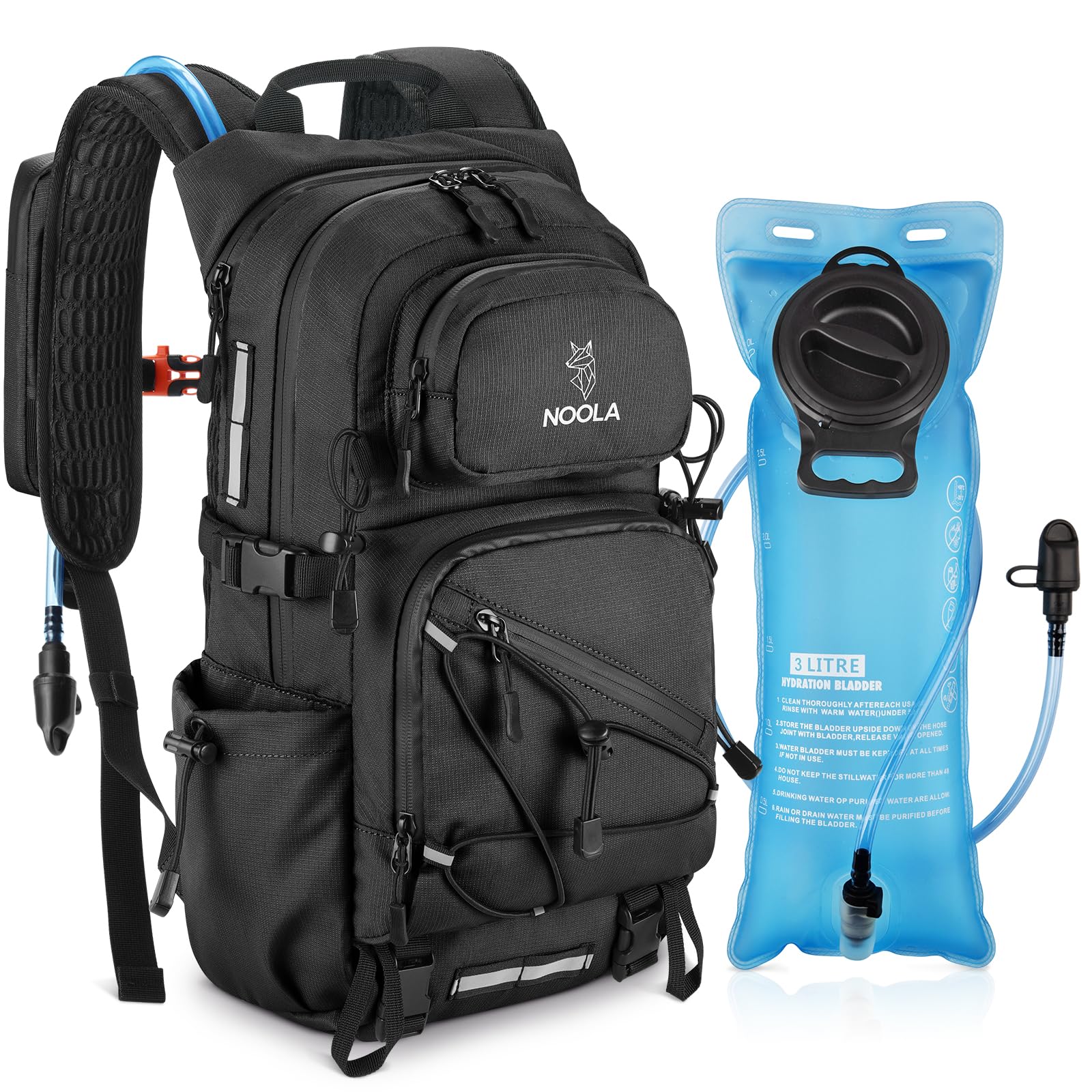
Key Features
- Hydration Bladder Included: 3L
- Capacity (Liters): 22L
- Price: Budget
The NOOLA delivers a 3L bladder and 16 pockets at a low price, but build quality varies—some straps may tear—and the pack is smaller than its 22L rating suggests. With limited reviews, durability is unproven; best for occasional cycling use.
Pros
- 3L bladder provides ample hydration for long rides.
- Includes numerous pockets and accessories at a budget price.
Cons
- Size runs smaller than the rated 22L capacity.
A good fit for budget-conscious cyclists who need a large bladder for weekend trail rides and can accept some size variability.
Best for Minimalist Road Cyclists
Deuter One 5L Road Bike

Key Features
- Hydration Bladder Included: No
- Capacity (Liters): 5L
- Weight: 370g
- Price: Premium
At 370g, this Deuter pack is the lightest road-specific option, with a neat pump holder for essentials. The 5L capacity and absent bladder make it suitable only for minimalists who carry no more than a phone, pump, and snacks — not for riders needing gear or hydration.
Pros
- Weighs only 370g, ideal for riders who notice every gram.
- Dedicated pump holder keeps tire repair organized.
Cons
- Only 5L capacity limits carry to bare essentials.
Fits the road cyclist who values minimal bulk and carries only pump, phone, and snacks.
Best for Wet Climate Commuters
Ettore 30L Waterproof Roll-Top

Key Features
- Hydration Bladder Included: No
- Capacity (Liters): 30L
- Price: Mid-Range
The Ettore backpack keeps gear dry in heavy rain thanks to its tarpaulin construction and welded seams. The 30L capacity accommodates bulky items for commuting or touring. However, it lacks a hydration bladder sleeve and the material adds weight when fully loaded, making it less suitable for those prioritizing a hydration system or ultralight carry.
Pros
- Fully waterproof design for wet-weather commuting
- Large 30L capacity holds substantial gear
Cons
- No hydration bladder sleeve; must carry water separately
Best suited for cyclists who need uncompromising waterproof gear storage and don’t require a hydration system or lightweight pack.
How to Choose
Bladder quality is the most overlooked factor in cycling backpacks – a leak can ruin a ride faster than any other failure.
Hydration Bladder Included
A hydration bladder is the core of any cycling pack. Cheaper bladders use thin film seams that separate under pressure or temperature changes, leading to leaks inside the pack. Look for bladders from established makers like Hydrapak or CamelBak, or plan to replace the included bladder with a reliable aftermarket unit.
Even if a pack claims a bladder is included, check the brand reputation. Many budget packs bundle low-quality bladders that fail within weeks, so factor in an extra $20–$30 for a replacement if you ride regularly.
Capacity (Liters)
Capacity determines what you can carry. For short rides under two hours, 4–10 liters is enough for water, phone, and a snack. All-day adventures or commutes with layers and tools push you toward 15–20 liters. Overloading a small pack causes sway; an oversized pack for a short ride adds unnecessary weight and heat.
Choose capacity based on the longest ride you’ll take, not the average. A pack that expands (like the Deuter Race Air’s 3L zip) offers flexibility without committing to a single volume.
Ventilation and Breathability
A cycling backpack sits directly against your back, so airflow matters. Mesh back panels with air channels create a gap that lets heat escape, reducing sweat buildup. Without ventilation, you’ll have a soaked shirt after every climb, especially in warm weather.
Full-contact foam panels are more stable but trap heat. If you ride in hot climates or sweat heavily, prioritize packs with a raised mesh system like Deuter’s Aircontact or Osprey’s AirSpeed.
Helmet Holder
A helmet holder lets you stow your helmet when off the bike or during cafe stops. Most systems use a mesh pocket or clip straps. Magnet-based holders (like Osprey’s LidLock) are quicker and more secure. Check that the holder fits your helmet shape – some road helmets with large vents may not lock in place.
If you frequently transition between riding and walking, a helmet holder saves you from carrying a sweaty helmet in hand. It’s a convenience, not a necessity, for commuters who always wear their helmet.
Weight
Every gram counts on long rides. A heavy pack increases fatigue and shifts your center of gravity. Lightweight packs (under 500g) are ideal for minimalists and racers, but they often sacrifice padding and features like sternum straps or tool rolls. A 700g pack with good suspension can feel lighter than a 400g pack that bounces.
Balance weight against load stability. A pack that distributes weight well and stays tight against your body is more important than a few grams saved.
FAQ
Which cycling backpack has the best hydration bladder that doesn’t leak?
The Osprey Raptor 10 uses a Hydrapak bladder with a reliable bite valve and magnetic retention, and it has nearly no leakage complaints. For a budget option, the TETON Oasis includes a 2L/3L bladder that holds up well for day rides. Avoid packs from brands where bladder leakage appears in many reviews – replacing the bladder separately is often the safer route.
How much capacity do I need in a cycling backpack for a day ride?
For a typical day ride under four hours, 10–15 liters is sufficient for water, snacks, phone, and a light layer. If you carry a full repair kit, extra clothing, and a 2–3 liter bladder, aim for 18–22 liters. Overpacking leads to a bulky, unstable load, so match capacity to your actual gear list.
Can I use a hiking hydration pack for cycling? Is it comfortable?
A hiking pack works for cycling if it has a snug fit and sternum strap, but most lack the bike-specific features like a helmet holder or low-profile shape. They tend to bounce on rough terrain because the load is not centered as tightly as a dedicated bike pack. For occasional paved rides, it’s fine; for mountain biking, a bike-specific pack is noticeably more stable.
Do cycling backpacks with helmet holders work for all helmet types?
Most helmet holders accommodate standard road and mountain bike helmets, but aero helmets or those with large rear vents may not fit securely. Mesh pocket holders are more universal, while clip-and-strap systems need adjustment. Check the pack’s description for helmet compatibility before buying if you have an unusual helmet shape.