
This post contains affiliate links. We may earn a small commission when you buy through our links — at no extra cost to you.
When you need a gift for someone living with dementia, the options can feel overwhelming. Digital clocks promise to end time confusion, but many stop working within months. Puzzle books labeled “large print” sometimes contain images too dark or small for older eyes. This guide cuts through the noise to highlight gifts that actually deliver calm, consistent engagement—whether that’s a word search book that never frustrates or a robotic cat that reduces anxiety.
The best gift isn’t about the most features; it’s about the right fit for your loved one’s current abilities. A simple sticker-by-number art project can build confidence, while a trivia book sparks joyful conversation. We focus on products that real families consistently praise for durability, ease of use, and dignity—because a gift should bring pleasure, not frustration.


Best for Hands-On Engagement
WSCXSC 16-Piece Large Puzzles
Key Features
- Display Clarity & Size: Vibrant images, 5-inch pieces
- Cognitive Appropriateness: Early to mid-stage, age-appropriate themes
- Ease of Setup: No setup needed
- Long-term Reliability: No failure reports
- Physical Accessibility: Embossed grip, large tiles
- Price: Budget
The WSCXSC set includes six individually bagged 16-piece puzzles, each measuring 12 by 8.6 inches when completed. Pieces are a full 5 inches across and cut from thick cardboard with a tactile embossed surface that aids grip without drawing attention. Nature, animal, and landmark images steer clear of the overly simple motifs that can alienate — the meadow scenes and golden retrievers feel like an adult activity.
Solving one takes only a few minutes, yet the clear visual cues and large format make assembly intuitive without written instructions. Users return to them independently, preserving a sense of autonomy. The puzzle stays flat on a tabletop, and the included storage bags keep pieces organized across a nightstand drawer.
These puzzles work for early to mid-stage dementia where basic jigsaw logic remains intact. For advanced cognitive decline, the 16-piece count can still overwhelm — in that situation a simpler sensory task like a sticker-by-number garden scene or a large-print word search often fits better. For everyone else, the dignity-preserving artwork and frustration-free process make this the safest gift in the category.
Pros
- Large 5-inch pieces with subtle embossing provide grip assistance without looking assistive.
- Thick, durable cardboard stands up to repeated handling and resists bending.
- Engaging adult themes build confidence and lift mood in minutes.
Cons
The most dignified, low-friction gift for early to mid-stage dementia — zero durability concerns and images that respect the user.
Best for Daily Orientation
FLYRUIT Dementia Clock
Key Features
- Display Clarity & Size: 7-inch HD, spells out time periods
- Cognitive Appropriateness: Reduces time/day confusion
- Ease of Setup: Remote control, auto-set
- Long-term Reliability: Minority fail early
- Physical Accessibility: Large display, remote
- Price: Mid-Range
A large, sharp display spells out time, date, and day of week in numbers visible across the room. The included remote lets caregivers update settings without forcing a senior to interact with small buttons. Auto-dimming adjusts brightness to stay comfortable day and night — a thoughtful touch for those who may be sensitive to glare.
This clock suits families caring for a loved one with moderate dementia who benefits from a clear orientation aid and simple medication reminders via its 6 alarms and 10 custom alerts. The power cord is short, so placement near an outlet is necessary. While some units have been noted to stop working after a few months, the risk appears lower than many simpler digital clocks in this price range.
Pros
- Display is large enough to read from across a room without glasses
- Remote control makes adjustments easy for caregivers without disturbing the user
- Auto-dimming keeps the screen comfortable in low light and bright rooms alike
Cons
- In some cases the clock may stop working after a few months of use
- The power cord is short, which limits where the clock can be placed near an outlet
The FLYRUIT clock delivers best-in-class readability and caregiver convenience, making it a strong choice for families who prioritize clear orientation over absolute long-term reliability.
Best for Calm Brain Exercise
Brain Games Large Print Word Searches
Key Features
- Display Clarity & Size: Truly large, high-contrast print
- Cognitive Appropriateness: Early-stage, progressive difficulty
- Ease of Setup: Open and play
- Long-term Reliability: No failure reports
- Physical Accessibility: Large print, lightweight book
- Price: Budget
Brain Games Large Print Word Searches offers a focused word puzzle experience with print size that’s genuinely easy on aging eyes, setting it apart from activity books that rely on stickers or images. The puzzles start simple and gradually increase in difficulty, providing hours of calm engagement and gentle mental exercise for seniors.
This is best for seniors who enjoy word searches and need large print, including those with early-stage memory loss who benefit from self-directed activity. While the early sections can feel too basic for dedicated puzzle solvers, that gentleness is precisely what makes it accessible to its target audience.
Pros
- Truly large print that significantly reduces eye strain for aging eyes
- Engaging and fun puzzles that keep seniors occupied for hours
- Provides effective brain exercise for memory and focus
Cons
- The earlier puzzles, while confidence-building, can feel too straightforward for avid word search fans.
A budget-friendly, high-satisfaction word search book that delivers exactly what it promises — large print puzzles that entertain and gently challenge older adults.
Best for Reminiscence & Sharing
I Remember That! Trivia Book
Key Features
- Display Clarity & Size: Large print, short chapters
- Cognitive Appropriateness: Early-stage, reminiscence-focused
- Ease of Setup: No setup
- Long-term Reliability: No failure reports
- Physical Accessibility: Lightweight, easy to hold
- Price: Budget
The book’s real value emerges when read together. Unlike solo brain games, its trivia and nostalgic stories from the 1950s to 1980s give families a reason to stop and talk — each short chapter invites ‘Do you remember?’ moments that spark multi-generational sharing.
Seniors in early-stage dementia who enjoy reading independently will latch onto the familiar references, but the format shines brightest during visits. The collection leans toward male-dominated topics like automobiles and sports; those wanting more balanced content may find some pages less engaging.
Pros
- Entertaining and informative, packed with nostalgic history
- Excellent for triggering memories and starting conversations
- Easy to read with large print and short, engaging sections
Cons
- Content can skew toward male-oriented topics, which may not resonate with every senior
For families hoping to turn a quiet visit into a shared nostalgia trip, this book’s conversation-starting power makes it the gift that keeps the room talking.
Best for Emotional Comfort
JOY FOR ALL Orange Tabby Cat
Key Features
- Cognitive Appropriateness: Reduces anxiety, tactile comfort
- Ease of Setup: Insert batteries, no pairing
- Long-term Reliability: Robust, no major complaints
- Physical Accessibility: Soft fur, responds to touch
- Price: Luxury
Unlike puzzles or activities that demand active focus, the JOY FOR ALL Orange Tabby Cat delivers passive, tactile comfort. It purrs when stroked, moves its head and paws, and slowly closes its eyes — responsive details that soothe without requiring feeding, cleanup, or special care. This makes it especially useful for dementia patients who find reassurance in pet-like contact, including those in care communities who miss a former companion. The premium price makes it a luxury gift, and it won’t replicate the dynamic play or full emotional range of a real cat, so it’s best reserved for individuals who find calm in simple, rhythmic interaction.
Pros
- Provides calming, lifelike companionship that consistently reduces anxiety and agitation in dementia patients.
- Purpose-built, award-winning design requires no feeding, grooming, or litter, and activates through natural petting.
Cons
- Premium pricing puts it out of reach for buyers who need a strictly budget-friendly option.
- Limited to purring and gentle head/paw motion; it does not play, chase, or offer complex interaction like a real pet.
For families seeking a non-pharmacological way to ease dementia-related anxiety, the soothing presence this cat provides often makes the cost worthwhile.
Best for Tv Independence
Flipper Big Button Remote
Key Features
- Cognitive Appropriateness: Eliminates remote confusion
- Ease of Setup: Simple programming, locked settings
- Long-term Reliability: Channel preset glitches possible
- Physical Accessibility: 6 oversized color buttons
- Price: Mid-Range
The six oversized, color-coded buttons give seniors with dementia a direct path back to watching TV, eliminating the overwhelm of standard remotes. Programming up to 25 favorites locks the remote to just channel and volume control, preventing accidental input switching that frustrates many users. This remote suits households with traditional cable setups and no streaming-only devices. Caregivers looking to restore a loved one’s ability to watch TV without constant assistance will find it a practical gift, though channel preset programming can be unreliable with some cable boxes, requiring patience during initial setup.
Pros
- Gives seniors with dementia the ability to watch TV independently by stripping away all extraneous buttons.
- Large, color-coded buttons eliminate confusion and prevent accidental menu changes.
- Easy for caregivers to program, even without tech expertise.
Cons
- Favorite channel presets may not work reliably with some cable boxes, requiring trial and error.
Manage expectations around channel presets, and this remote becomes a low-cost way to give a loved one back the TV independence they’ve lost.
Best for Basic Time Orientation
SSYA Digital Calendar Clock

Key Features
- Display Clarity & Size: Large non-abbreviated text
- Cognitive Appropriateness: Early to mid-stage orientation
- Ease of Setup: Auto time set
- Long-term Reliability: Some units fail within months
- Physical Accessibility: Large display, wall or tabletop
- Price: Mid-Range
The SSYA clock’s large, non-abbreviated display clearly spells out the time of day, helping seniors with dementia stay oriented. A minority of units stop working within months or develop time drift that can undermine that benefit. For a more dependable option, the FLYRUIT clock delivers similar clarity with fewer reliability risks.
Pros
- Large, non-abbreviated display is legible across a room, reducing daily confusion.
- Spells out time of day (Morning, Afternoon, etc.) to reinforce orientation for dementia patients.
Cons
- Some units may stop functioning within months of purchase, requiring replacement.
This clock makes sense for families who prioritize immediate clarity and low cost, and are prepared to replace a unit that stops working early.
Best for Rich Alarm Features
Soobest Digital Dementia Clock

Key Features
- Display Clarity & Size: Large bold HD display
- Cognitive Appropriateness: Reduces confusion, icons for reminders
- Ease of Setup: Easy initial setup
- Long-term Reliability: Moderate early failure rate
- Physical Accessibility: Tabletop design, wall-mount silent alarm issue
- Price: Mid-Range
Twenty alarms with nature ringtones and a large, clear display help seniors stay oriented throughout the day. Wall-mounting turns the alarm into a puzzle — you have to take the clock down to silence it. Occasional reports of early failure mean this clock works best on a tabletop where it’s easy to reach, and for caregivers who prioritize alarm features over proven longevity.
Pros
- Big, bold numbers readable from across the room.
- Day, date, and large-print time are instantly clear, with reminder icons that support daily orientation.
Cons
- When wall-mounted, the alarm cannot be silenced without removing the clock — a real hassle for caregivers.
Choose this for tabletop use when 20 alarms with gentle sounds are essential, but avoid the wall mount — a few extra dollars buys a clock with stronger long-term performance.
Best for Voice Time Alerts
Mitoart Voice Clock
Key Features
- Display Clarity & Size: Clear digital display, voice time
- Cognitive Appropriateness: Auditory orientation for low vision
- Ease of Setup: One-click simple interface
- Long-term Reliability: Spotty, some units fail early
- Physical Accessibility: Large buttons, no remote
- Price: Budget
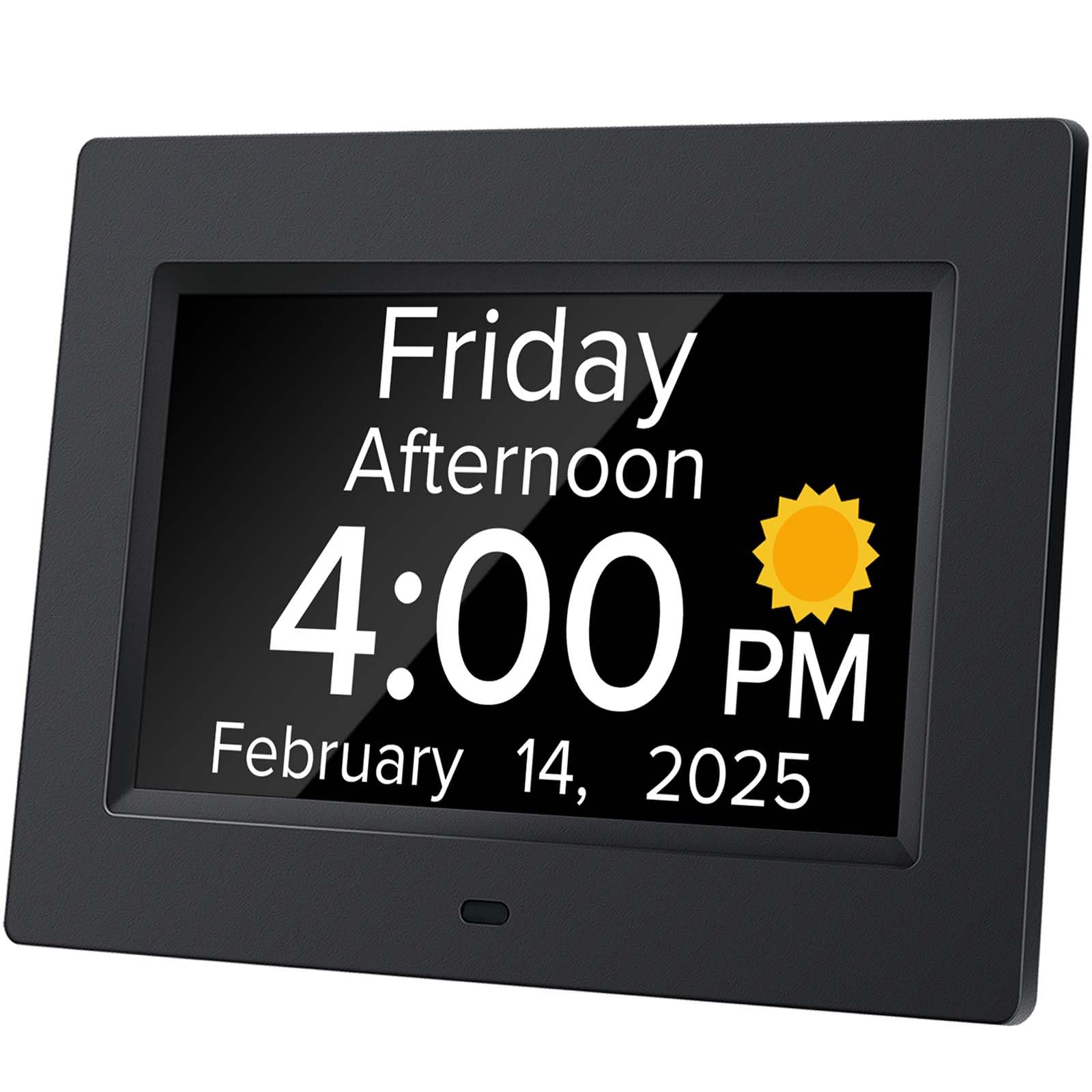
The voice announcement feature sets this clock apart from similarly priced orientation models, reading the time aloud in nine languages for those who can’t easily see the screen. The large 7-inch display and simple one-click buttons further reduce confusion. Reliability can be inconsistent — occasional units may lose functionality sooner than expected — so it works best as a companion device rather than a primary daily clock.
Pros
- Large, 7-inch display makes the time and date easy to see from across the room.
- Voice announcement in nine languages provides crucial auditory orientation for low-vision seniors.
Cons
- Longevity can be inconsistent; some units may stop working after a period, limiting long-term usefulness.
This clock suits families who need a voice announcement feature for a low-vision senior and are willing to accept a shorter lifespan for the low price. Those needing a long-term daily clock should look for a more robust option.
Best for Gentle Brain Games
Easy Relaxing Memory Activity Book

Key Features
- Display Clarity & Size: Large print, clear layout
- Cognitive Appropriateness: Very early memory loss only
- Ease of Setup: Open and play
- Long-term Reliability: No failure reports
- Physical Accessibility: Light paperback
- Price: Budget
With 154 pages of varied, easy puzzles, this book offers reassuring simplicity that builds cognitive confidence without frustration. Adults with sharper cognitive abilities may find the puzzles too gentle, lacking the challenge they seek, so it’s best reserved for those in very early stages of cognitive decline.
Pros
- Keeps users entertained for hours with a wide variety of relaxing puzzles.
- Stimulates memory and cognitive function gently, boosting confidence.
Cons
- For cognitively sharper adults, the simplistic activities can feel underwhelming.
This book suits seniors in very early cognitive decline who need confidence-building activities, but it’s not for those wanting a true mental challenge.
Best for Creative Art Project
Sticker by Number Garden

Key Features
- Display Clarity & Size: Bright garden images, square stickers
- Cognitive Appropriateness: Early to mid-stage, builds confidence
- Ease of Setup: Peel and stick, no instructions
- Long-term Reliability: No failure reports
- Physical Accessibility: Square stickers easy to handle
- Price: Budget
The square stickers and gentle garden themes provide a frustration-free creative outlet that yields genuinely pretty results. Because the book is consumable, each page offers a single-use project — fine for occasional crafting, but it won’t provide the daily replay value of a reusable puzzle set.
Pros
- Calming art activity builds confidence and provides a sense of accomplishment for dementia patients.
- Square stickers allow easy, forgiving placement, minimizing frustration.
Cons
- Completed pages are permanent — the book offers a one-time project with no repeatable use.
For a dementia patient who enjoys hands-on crafting and would appreciate a beautiful finished product, this sticker book is a thoughtful, low-stress gift. If you need a daily, repeatable activity, the reusable puzzle set in this roundup offers more ongoing value.
Best for Memory Care Activities
Keeping Busy Match Dots

Key Features
- Display Clarity & Size: Color-coded tiles, some colors hard
- Cognitive Appropriateness: Mid-stage, matching cognitive game
- Ease of Setup: Lay out board and tiles
- Long-term Reliability: Frame may loosen over time
- Physical Accessibility: Wooden tiles, moderate size
- Price: Mid-Range
Match Dots engages mid-stage dementia patients with its thick tiles and multiple challenge boards. Dark greens and blues can blend together, and the wooden frame may separate with regular use, which limits its long-term durability compared to the top puzzle set.
Pros
- Engages dementia patients with a rewarding matching task that builds a sense of accomplishment.
- Sturdy wooden tiles withstand handling and feel substantial in the hand.
Cons
- The wooden frame can separate under repeated use, compromising stability.
Best suited for calm, supervised sessions where the frame won’t be subject to rough handling, and for users who can differentiate the color shades.
How to Choose
Focus first on the stage of dementia and what the person can still enjoy, rather than on a product’s feature count or brand name.
Display Clarity & Size
Large, high-contrast displays directly lower cognitive load. A clock with a 7-inch screen spelling out “Friday Afternoon” reduces confusion far more than a tiny digital date in the corner. Books need genuinely large print—14-point type or higher—and images must be bright and detailed; dark, murky photos frustrate aging eyes and can cause a person to stop engaging altogether.
Cognitive Appropriateness
Match the activity to the person’s current comfort zone, not their past ability. A 16-piece jigsaw with a clear reference picture gives a sense of accomplishment, while a complex word puzzle may cause shutdown. Look for products that progress gently in difficulty or offer multiple levels, so you can choose the right challenge without triggering anxiety.
Ease of Setup
Many digital dementia clocks promise auto-time setting, but in practice they can drift or require manual overrides. A remote control or a caregiver-friendly button layout makes daily adjustments painless. Books and puzzles, by contrast, have zero setup—just open and use. When dealing with memory loss, simplicity at the start often translates to less disruption later.
Long-term Reliability
The hidden trade-off in the dementia clock market is that a sleek display can mask power-sensitive internals; roughly a third of complaint reviews mention early failure, often tied to loose adapters or voltage fluctuation. Puzzles and books have no electronics, so they don’t stop working. If a clock is essential, choose a model with the lowest reported failure rate and plan to check it regularly.
Physical Accessibility
Dexterity, vision, and mobility shape the real-world usability of any gift. Five-inch puzzle pieces with embossed grip let arthritic fingers participate. Sticker books with square, numbered stickers are easier to manipulate than round, tiny ones. Clocks with short power cords force awkward placement and can create a tripping hazard; a remote control often solves both issues.
FAQ
Why do dementia clocks stop working after a few months?
Many budget digital calendar clocks use power-sensitive components that can fail if the adapter wiggles loose or experiences a power surge. Because they sit plugged in 24/7, heating and voltage drift can degrade the circuit. If reliability is a priority, skip the clock and choose a puzzle or book that never breaks.
Are sticker-by-number books good for someone with dementia?
Yes, especially for a person who enjoys crafts but finds jigsaw puzzles daunting. The square stickers in a product like Sticker by Number Garden are forgiving to place, and the numbered guide removes guesswork. The finished picture delivers a visible sense of accomplishment without the frustration of misfitting pieces.
What’s better for a dementia patient, a clock or a puzzle?
It depends on the primary need. A clock reduces repeated time-and-date questions, which can calm anxiety; a puzzle provides active brain stimulation and a tangible reward. For early- to mid-stage dementia, many families find a large-piece puzzle or word search brings more joy and engagement, while a clock is best reserved for those who genuinely need constant orientation.
How do I choose a puzzle book that won’t frustrate my elderly parent with memory loss?
Look for books with oversized print, plenty of white space, and puzzles that increase gradually in difficulty. Avoid anything with dark or tiny images, even if the title says “large print.” The most successful books for dementia, like the large-print word search collections, use crisp, simple layouts that let the person succeed independently.