
This post contains affiliate links. We may earn a small commission when you buy through our links — at no extra cost to you.
Packing a power bank for a trip used to be simple: grab the smallest one and go. But now that we expect a single bank to charge phones, tablets, and even laptops, the trade-off between weight and capability becomes impossible to ignore. Add in airline rules about watt-hours, and it’s easy to buy a bank that’s either useless at 35,000 feet or confiscated at security.
The right choice depends on what you actually carry and where you’re headed. By focusing on wattage, cable type, and real-world portability instead of spec-sheet promises, you can land a charger that stays legal in your carry-on and keeps all your devices alive without weighing you down.



Best for Laptop & Phone Travelers
Anker 20K 87W
Key Features
- Capacity: 20,000mAh
- Max Single-Port Output: 87W
- Weight: 440g
- Built-in Cable: Built-in USB-C cable
- Ports: Built-in USB-C, 1 USB-C, 1 USB-A
- Price: Premium
The Anker 20K 87W charges a 14-inch MacBook Pro to 50% in under 40 minutes using its own built-in USB-C cable, delivering the same speed as a dedicated laptop charger. It handles simultaneous top-ups for a phone and tablet without slowing down, thanks to the 87W total output shared across three ports.
The built-in cable is sturdy and supports the full 87W output, making it a direct replacement for a wall charger in many situations. Pass-through charging works as expected: plug the bank into a wall outlet and it charges both the internal battery and any connected device. At 0.97 lb, it’s too heavy for pocket carry but slides easily into a backpack’s laptop sleeve.
This power bank suits business travelers and digital nomads who carry a laptop and phone and want a single device to keep both running. The 20,000mAh capacity provides multiple phone recharges or a full laptop top-up. It’s not for ultralight backpackers who only need occasional phone charging, nor for budget buyers who can get by with a smaller 10K option.
Among high-capacity power banks, the Anker stands out for its simple design with a built-in cable and fewer long-term concerns compared to feature-heavy rivals that pack TFT displays or 130W output. For most travelers, the combination of consistent performance and a single cord is more practical than chasing peak wattage.
Pros
- Charges laptops and phones at full speed simultaneously via 87W total output.
- Built-in USB-C cable is durable and convenient for travel, no extra cord required.
- 20,000mAh capacity balances high power with backpack-friendly size.
- Supports pass-through charging: powers devices while recharging the bank itself.
Cons
- At nearly 1 lb, it’s too heavy for pocket carry – best stored in a backpack.
For travelers who need one power bank for both laptop and phone, the Anker 20K 87W delivers a practical mix of speed, capacity, and a built-in cable without the complexity of display-laden competitors.
Best for Ultralight Phone Charger
INIU P41 45W
Key Features
- Capacity: 10,000mAh
- Max Single-Port Output: 45W
- Weight: 182g
- Built-in Cable: Detachable USB-C lanyard
- Ports: 2 USB-C, 1 USB-A
- Price: Budget
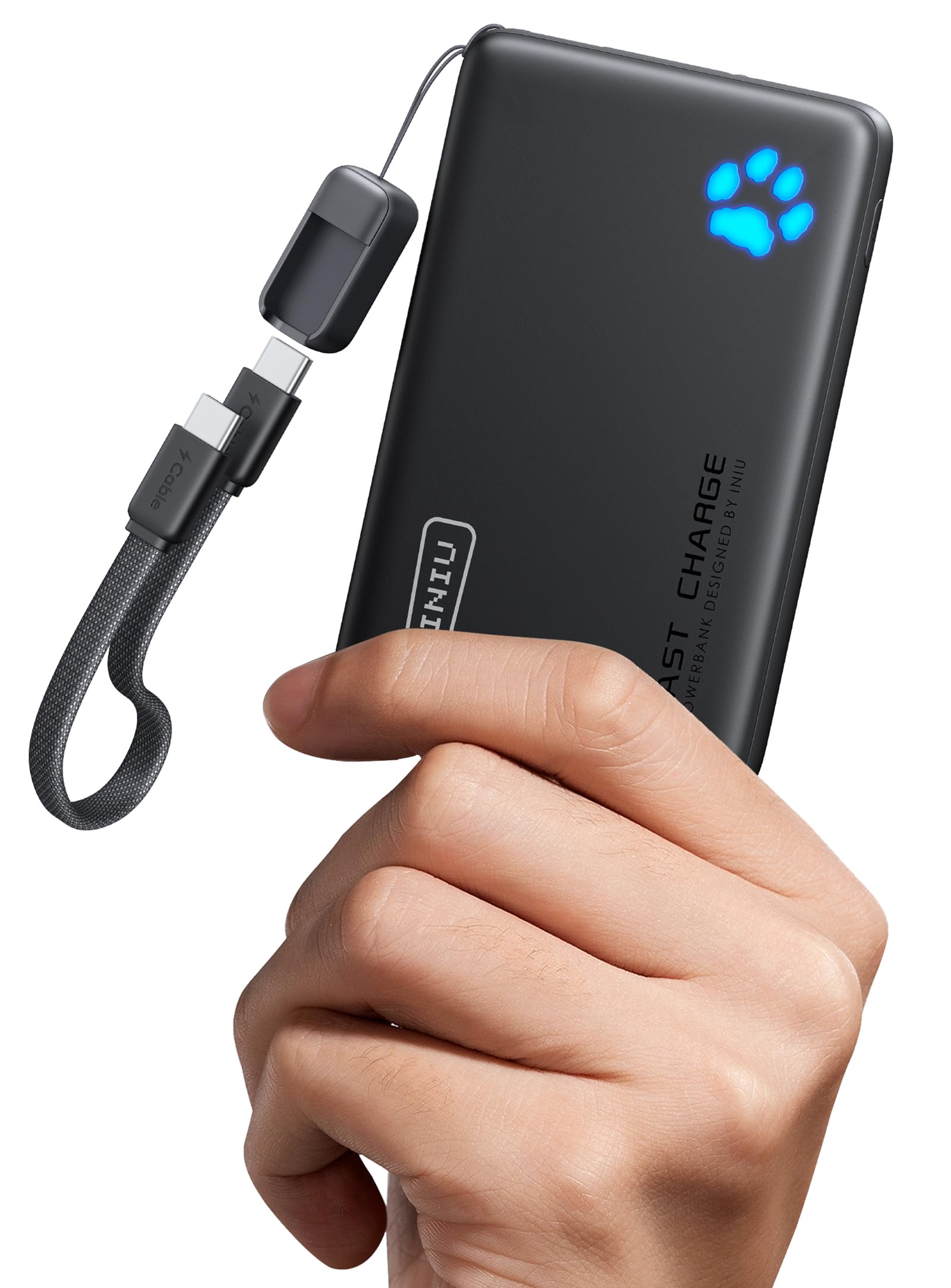
The INIU P41 45W tips the scale at just 182g — about the weight of a deck of cards — while outputting enough power to top off a modern smartphone in under an hour. Its detachable braided USB-C cable doubles as a carry strap, eliminating the need to pack a separate cord. This combination of ultralight weight and 45W throughput makes it the go-to choice for travelers who prioritize pocket space over laptop charging.
Charging performance is consistent: a Galaxy S23 reaches 50% in roughly 25 minutes via the USB-C port. The detachable cable is a clever space-saver, though it adds a small risk of misplacing the cord if not reattached after use. The bank slips easily into a jeans coin pocket or small pouch, making it one of the most travel-friendly options at this power level.
This power bank suits commuters and budget-conscious buyers who want fast wired charging without bulk. It is not designed for laptops — at 10,000mAh, it barely provides a full charge for a 13-inch MacBook. Also, some units have shown battery capacity fade after several months of heavy daily use; if you need a bank for frequent high-drain cycles, consider a model with a larger battery and higher build tolerance.
Pros
- Pocketable 182g design that fits in a jeans coin pocket
- 45W USB-C output charges flagship phones faster than most 20W banks
- Detachable cable doubles as a lanyard for grab-and-go convenience
Cons
- Battery capacity can degrade over several months of heavy daily use
A remarkably lightweight 45W bank for phone-first travel; accept occasional battery fade for the class-leading portability.
Best for Iphone Wireless Charging
Anker MagGo Slim 10K
Key Features
- Capacity: 10,000mAh
- Max Single-Port Output: 30W
- Weight: 199g
- Ports: 1 USB-C
- Price: Premium
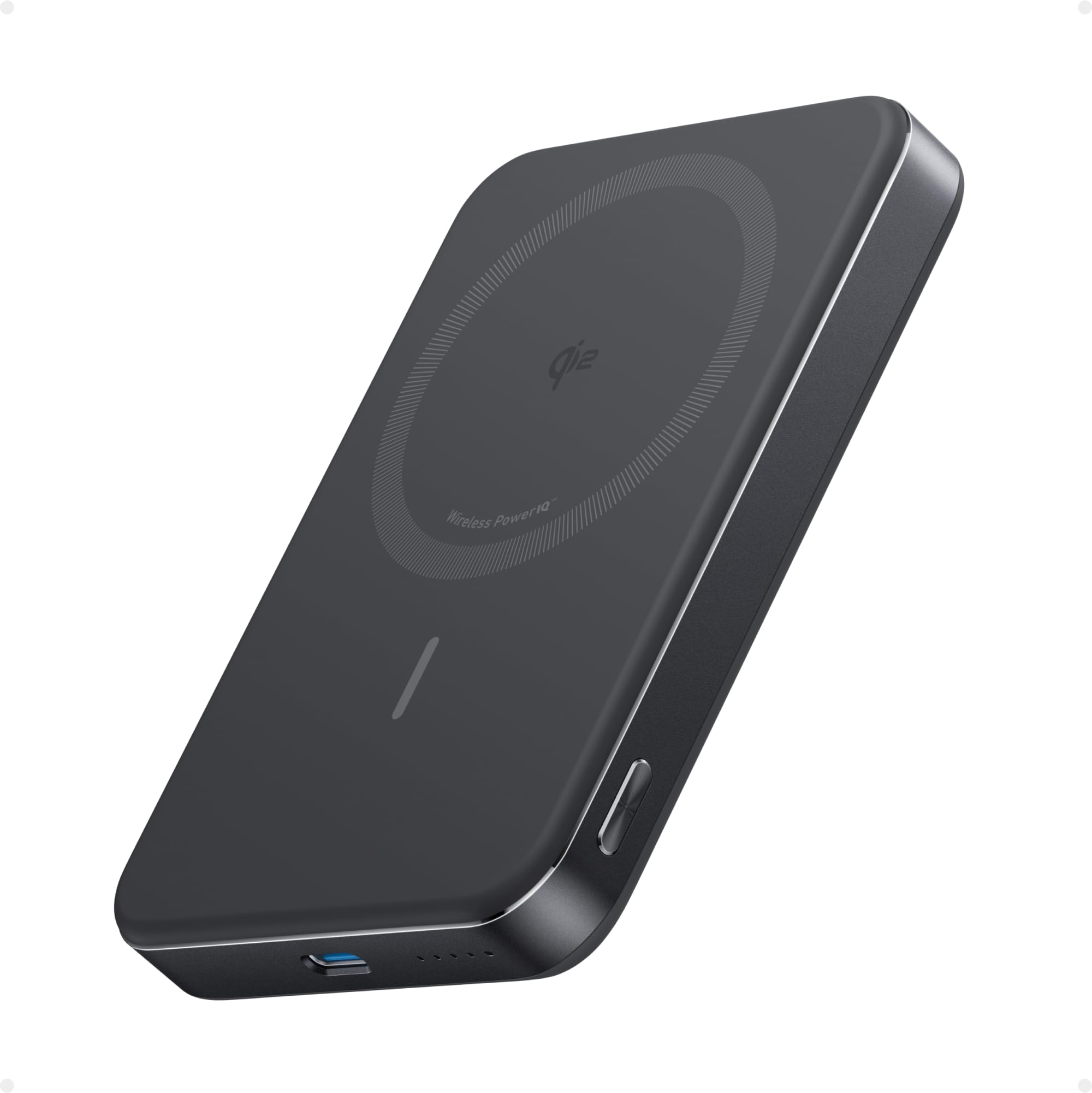
The MagGo Slim 10K trades the top pick’s laptop-charging muscle for a magnetic, grab-and-go design that feels like a natural extension of the iPhone. At 199 grams and barely thicker than the phone itself, it attaches securely via Qi2’s magnetic ring, aligning instantly without cables. The strong magnetic grip holds firm even when the phone is jostled in a bag, making it a cable-free companion for mid-day top-ups.
iPhone 12 through 16 owners who prize wireless freedom and pocketability will find this bank squarely aimed at their daily routine. The wireless coil generates noticeable heat on the back of the phone during a charge, and the 15W output means a full refill takes longer than a wired bank. Light travelers and those who only need a 30-50% boost midday will accept that thermal tradeoff for the sheer convenience of snapping a battery onto the back and forgetting about cables.
When speed matters, the USB-C port delivers 30W of wired output—enough to fast-charge an iPhone or a small tablet—though you’ll need to supply your own cable. This wired fallback sidesteps the heat issue and cuts charge times noticeably, making the MagGo Slim a flexible daily charger that leans on magnets for convenience and a cable for urgency.
Pros
- Strong magnetic hold keeps iPhone securely attached even in a bag.
- Ultra-portable at 199g and slim enough for a front pocket.
- Qi2 certification ensures safe magnetic alignment and consistent charging logic.
Cons
- Wireless charging can make the phone noticeably warm after 15-20 minutes of use.
- The 15W Qi2 output charges slowly; use the USB-C port for faster speeds but the bank ships without a cable.
If you want a magnetic battery that disappears into your pocket and don’t need to recharge a laptop or tablet, the MagGo Slim 10K is the most portable MagSafe-style option available — provided you can live with the warmer, slower wireless charge.
Best for Data-Focused Users
UGREEN 20K 130W
Key Features
- Capacity: 20,000mAh
- Max Single-Port Output: 100W
- Weight: 480g
- Ports: 2 USB-C, 1 USB-A
- Price: Premium
Unlike the top pick’s built-in cable and straightforward design, this UGREEN 20K bank emphasizes monitoring and raw output. The color display shows voltage, current, power, and estimated fill time for each port, letting you verify charger compatibility and battery health at a glance — not just a percentage bar. A 100W USB-C port (130W total across three ports) charges a MacBook Pro at full speed, while dual USB-C and USB-A handle a laptop, phone, and earbuds without fighting for connections. The columnar shape and 480g weight slide into a laptop bag without adding bulk, and pass-through charging lets the bank refill while powering a device.
The TFT display is the centerpiece. In direct sunlight, brightness keeps the numbers legible, and the data updates fast enough that you can watch wattage change as your device enters trickle charge. Button navigation cycles through the ports without confusion, so you can confirm a tablet is pulling 30W or a laptop is negotiating 20V. The display does add a small draw to the battery’s own reserves, but it shuts off automatically when idle.
This is for tech-savvy travelers who find real-time charging metrics genuinely useful — not as a gimmick. If you juggle a laptop, a tablet, and a fast-charging phone, the display keeps you informed of exact delivery. The trade-off: battery longevity isn’t as consistent as the top pick. In some units, capacity may drop after heavy cycling; careful charging habits (avoiding deep discharges, keeping the bank cool) help. It’s better suited to users who value insight over bulletproof endurance and who can return the unit if early issues appear.
Pros
- Vivid TFT screen shows voltage, current, wattage, and remaining time for each port in real time
- 100W USB-C output charges a laptop at full speed without throttling
- Pass-through charging lets you refill the bank while powering a device
- Compact column shape and 480g weight fit easily into a laptop bag or daypack
Cons
- Battery capacity may degrade sooner than expected under heavy cycling — treat it gently and monitor performance over the first few months
The UGREEN 20K 130W is the right charger for data-curious travelers who’ll use that display daily — provided you’re comfortable monitoring battery health over time.
Best for Family Multi-Device
UGREEN 20K 45W
Key Features
- Capacity: 20,000mAh
- Max Single-Port Output: 45W
- Weight: 468g
- Built-in Cable: Built-in braided USB-C
- Ports: Built-in USB-C, 1 USB-C, 1 USB-A
- Price: Mid-Range
The UGREEN Nexode 20K 45W packs 20,000mAh into a body with a built-in braided USB-C cable that’s long enough to use comfortably and holds up to daily packing. A simple LED digital display shows exact remaining battery – no guesswork, no app needed.
This bank suits travelers who want the most mAh per dollar without expecting laptop-level wattage. At 468g it’s heavier than a 10K bank and won’t sustain most laptops above 45W, but for phones, tablets, and some ultrabooks it’s a reliable companion for multi-day trips or family outings where multiple devices need a top-up.
Pros
- 20,000mAh capacity with 45W output fast-charges phones and tablets quickly.
- Built-in braided cable is durable and stays attached – no separate cord to lose.
- Strong value: mid-range price for a high-capacity bank with a handy display.
Cons
- Weight (468g) makes it feel heavy in a jacket pocket or small daypack.
- 45W output is too low for charging most laptops; treat it as a phone/tablet bank.
A solid choice for travelers who value capacity and a built-in cable over pocketability – just be sure your laptop doesn’t need more than 45W.
Best for Camping & Off-Grid
OHOVIV 50K

Key Features
- Capacity: 50,000mAh
- Max Single-Port Output: 22.5W
- Weight: 485g
- Built-in Cable: 4 built-in cables
- Ports: 4 built-in, 2 USB-A, 1 USB-C
- Price: Budget
With a 50,000mAh battery and four built-in cables covering Lightning, USB-C, Micro-USB, and USB-A, this charger can keep phones, tablets, and small devices alive for days without hunting for spare cords. It adds 1.07 pounds to your pack and can charge up to six devices at once — a feature that makes sense for car camping basecamps and emergency kits. The tradeoff is bulk and charging speed: 22.5W output tops out at modest rates, and recharging the bank itself takes overnight or longer. The capacity also puts it above typical airline watt-hour limits, so air travelers should leave this one at home. For off-grid weekends or power outage prep, it’s a budget-friendly endurance tool that trades away any pretense of pocketability.
Pros
- Holds enough power to recharge a smartphone more than 10 times, covering days off-grid.
- Integrated Lightning, USB-C, Micro-USB, and USB-A cables cut cord clutter and keep all your devices connected.
- Charges up to six gadgets simultaneously, making it a practical base station for group camping or emergency preparedness.
Cons
- At 1.07 lb and roughly the size of a paperback, it’s too bulky for pocket carry and heavy for daily bags.
- TSA limits lithium-ion batteries to 100Wh in carry-on luggage; this pack at 185Wh may be confiscated at security.
For car camping, emergency kits, or multi-day outdoor events where outlet access is scarce, the OHOVIV 50K provides unmatched staying power at a budget-friendly price — but it’s not for anyone who needs pocket portability or travels by plane.
How to Choose
The single most important decision you’ll make is how much weight you’re willing to carry for the capacity to charge a laptop, because 20,000mAh banks are double the weight of 10,000mAh ones and often the only option for laptop power.
Battery Capacity (mAh and Wh)
A 10,000mAh bank gives one full phone charge, while 20,000mAh can top up most ultrabooks once. But capacity also determines airline legality: anything over 100 watt-hours (Wh) requires airline approval, and 27,000mAh is roughly the 100Wh limit at 3.7V. If you fly, stick to banks under 27,000mAh unless you enjoy explaining battery chemistry at security.
Max Single-Port Wattage
The wattage number on a single port decides whether you can charge a laptop at all. Most modern phones need 18-30W, but laptops require 45W, 65W, or higher. A bank that shares 45W across all ports may stall on a MacBook Air unless that 45W is available on a single USB-C port.
Weight and Dimensions
Weight is the price you pay for capacity: a 10K pocket charger is often under 200g, while a 20K charger may tip the scales at 440g or more. That extra weight is worth it for a laptop, but if you only carry a phone, you’ll feel every gram in your pocket.
Built-in Cables
Built-in cables eliminate the frustration of untangling cords at the airport, but they introduce a single point of failure. A retractable or detachable design can extend life, but once a built-in cable frays, the entire bank becomes far less useful. Treat a built-in cable as a convenience that should still be backed by spare ports.
Port Variety
Multiple ports let you charge several devices at once, but the total output will split across them. A bank with two USB-C and one USB-A is ideal for modern gadgets, but older devices like wireless headphones still rely on USB-A, so one legacy port can save you an adapter.
FAQ
Do 20,000mAh power banks meet TSA carry-on limits?
Yes, most 20,000mAh packs are under 100 watt-hours and fine for carry-on. The TSA limit is 100Wh per battery; at a typical 3.7V, 20,000mAh equals 74Wh. Always verify the Wh rating on the bank’s label, and never pack lithium batteries in checked luggage.
Why does my portable charger get hot when I use wireless charging?
Wireless charging converts electricity into a magnetic field, and that process generates waste heat—especially at Qi2 15W speeds. The heat can feel alarming on a phone, but it’s normal. To reduce it, switch to the USB-C port for fast charging, or use wireless for slow overnight top-ups.
Can a 45W power bank charge a MacBook Air?
Yes, a 45W USB-C power bank can charge a MacBook Air (M1 or M2) while it’s asleep or in light use, though it may charge slowly if you’re running demanding apps. For consistent full-speed charging while working, look for a 60W or higher bank, but 45W is enough for emergency top-ups.
How do I know if a power bank is airline-approved for international flights?
Check the Wh rating printed on the power bank itself—most regulatory authorities, including the FAA and EASA, use a 100Wh limit. If the number isn’t printed, multiply the mAh by voltage (usually 3.7V) and divide by 1,000. Banks between 100Wh and 160Wh may require airline approval; above 160Wh are banned.