
This post contains affiliate links. We may earn a small commission when you buy through our links — at no extra cost to you.
You see ’35-mile range’ on the box, but in the woods you’re lucky to get a quarter mile. The problem isn’t the technology – it’s that most walkie talkies are designed for open fields, not tree cover and hills. This guide focuses on radios that actually work where you hike.
Beyond range, battery life and weather resistance separate hiking radios from casual ones. A radio that dies after six hours or fails in a drizzle won’t cut it on a multi-day trip. We’ve prioritized models with verified battery performance and genuine waterproofing – not just splash resistance.
The tough choice often comes down to budget versus backcountry readiness. Lower-priced radios can handle day hikes, but for serious expeditions, the premium for extended battery and rugged build is worth it. The right radio depends on how hard you push it.



Best for Wet Rugged Hiking
Retevis RB48 2-Pack
Key Features
- Real-World Range: Typical 1-5 miles
- Battery Life: 18-20 hours
- Weatherproof IP: IP67
- Durability: MIL-STD-810H, drops
- Ease of Use: Simple controls, clear audio
- Price: Mid-Range
The RB48 is built to handle rain, drops, and even submersion – it floats. The IP67 rating means you can drop it in a creek and fish it out without damage, and the MIL-STD-810H standard covers 26 drops from 1.5 meters. The battery pushes 18-20 hours on a charge, recharges via USB-C, and the high-vis yellow shell makes it easy to spot if you set it down on a trail.
Range of any FRS radio is limited by terrain and foliage – expect 1-2 miles in forest, less in hills. The RB48 doesn’t break physics, but its NOAA weather scan and emergency features add genuine utility for backcountry trips. Clear audio holds up in moderate wind, and the PTT button is large enough for gloved hands.
This radio is for hikers and backpackers who prioritize toughness over weight. If you routinely cross streams, get caught in downpours, or need a radio that can take a fall from a pack pocket, the RB48 handles that. The one tradeoff: the volume knob is easy to bump to silent – something to be aware of if you stash the radio in a side pocket where it could get accidentally adjusted.
Compared to premium backcountry options, the RB48 offers a similar level of ruggedness for about a third of the cost. For hikers who don’t need the absolute lightest radio, this set balances durability and value better than any other model in its price range.
Pros
- IP67 waterproof and floats – survives drops into streams and rain.
- 20-hour battery with USB-C charging – covers multi-day trips with recharging convenience.
- Clear audio with large, glove-friendly controls.
- Solid value for a rugged two-pack – competes with radios costing twice as much.
Cons
For hikers who need waterproofing and drop resistance without paying premium prices, the RB48 is the best-balanced option in this class.
Best for Backcountry Climbing
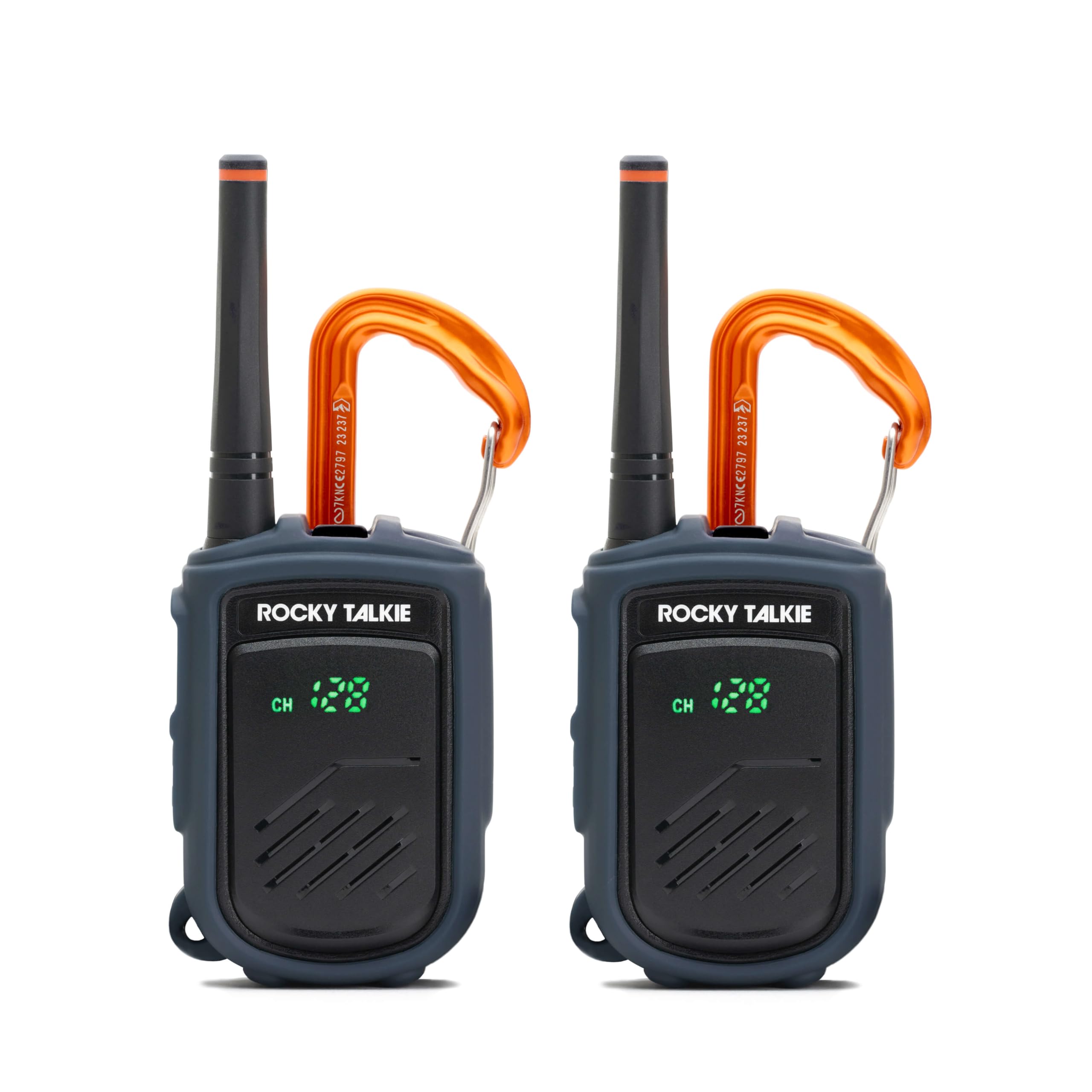
Rocky Talkie Mountain 2-Pack
Key Features
- Real-World Range: Typical 1-5 miles
- Battery Life: 4 days
- Weatherproof IP: IP56
- Durability: Shatterproof, carabiner
- Ease of Use: Intuitive controls
- Price: Premium
The Rocky Talkie Mountain Radio delivers a 4-day battery life on high power and a shatterproof screen — features that set it apart for multi-day backcountry trips without access to charging. Its IP56 splash and snow resistance and integrated carabiner clip make it a natural companion for climbers and ski tourers.
This radio is built for serious hikers and mountaineers who prioritize ruggedness over price. The 2W FRS transmission covers 1–5 miles in typical forested terrain — adequate for coordinating within a rope team or between camp and a summit push, but not a long-range tool for open fields. The high price reflects the build and battery, so casual family hikers will find cheaper options like the Retevis RB48 more suitable.
Audio clarity holds up well even in windy conditions, and the controls remain intuitive with gloved hands. The battery consistently lasts through multi-day outings, though the lithium-ion pack recharges via USB-C, requiring a power bank for extended trips.
Pros
- Robust construction handles drops and rough handling on rock and ice.
- Up to 4 days of battery life on high power eliminates the need for daily charging.
- Clear audio transmission even in gusty mountain winds.
- Intuitive controls and built-in carabiner clip make one-handed operation simple.
Cons
- Premium price — costs significantly more than comparable FRS radios.
- Range drops to 1–5 miles in dense forest; not suited for long-distance communication under tree cover.
The Rocky Talkie is a purpose-built radio for backcountry climbers who need reliable communication over a few miles and multi-day battery life — just don’t expect it to cover long, forested valleys.
Best for Family Short Hikes
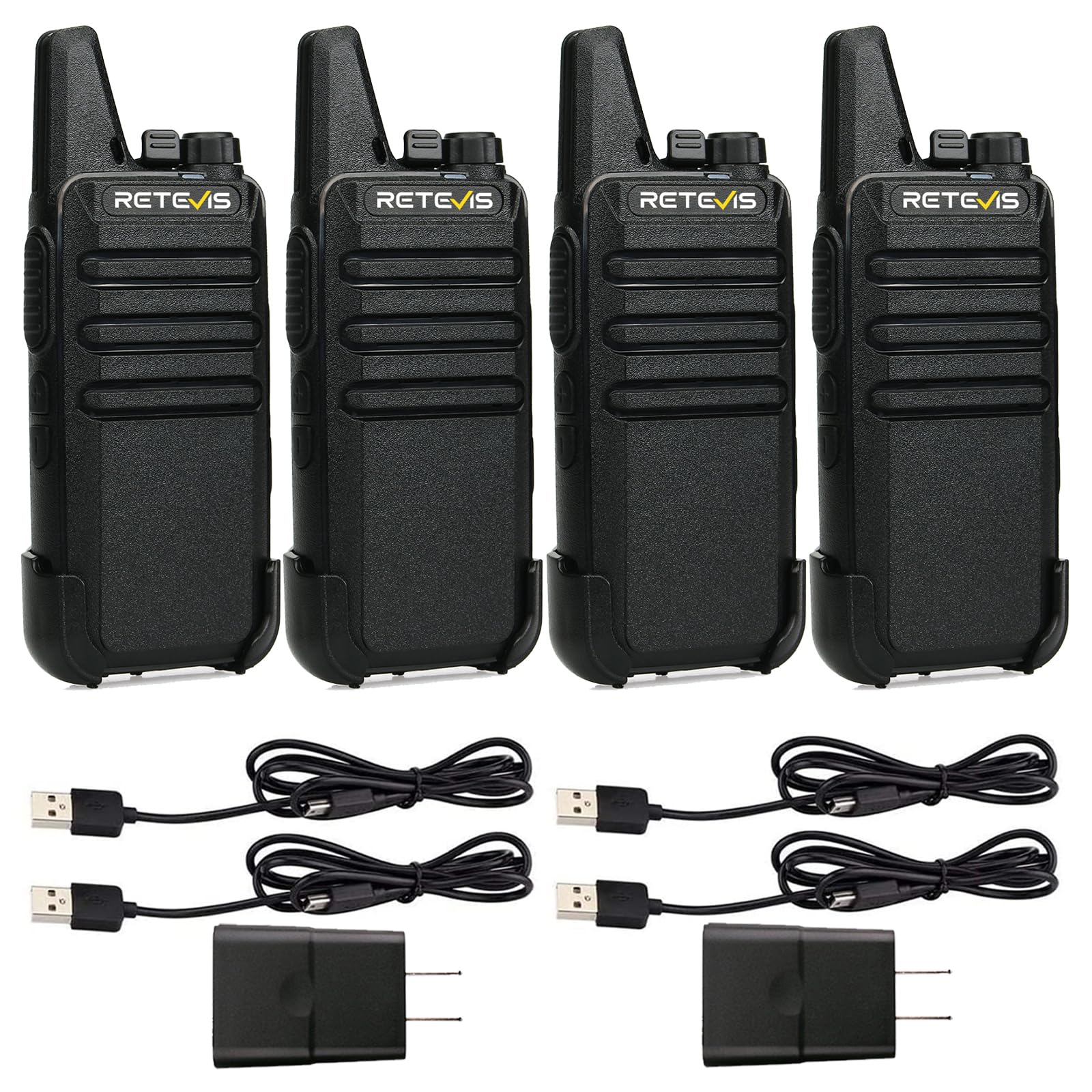
Retevis RT22 4-Pack
Key Features
- Real-World Range: Under 1/3 mile wooded
- Battery Life: 12 hours
- Weatherproof IP: IP65
- Durability: Fragile antenna
- Ease of Use: Easy for kids
- Price: Budget
The Retevis RT22 delivers four ultra-compact radios that fit easily into a pocket or clip onto a backpack strap. USB-C charging means you can top up from the same cable as your phone, and the clear, loud audio keeps conversations intelligible even in mild wind. The push-to-talk and channel controls are simple enough that kids can operate them without instruction — a practical convenience for group trips where not everyone is tech-savvy.
Where this 4-pack shines is in casual, short-range scenarios: families hiking open trails, groups coordinating on a cruise ship deck, or children learning radio etiquette. The IP65 water resistance handles light rain, and the 12-hour battery covers a full day of intermittent use. However, in wooded terrain the real-world range drops to under a third of a mile — fine for line-of-sight communication but not for dense forest. The antenna connection can become loose after a hard drop, so a lanyard is worth using on rocky ground.
Compared to the top pick’s rugged build, the RT22 prioritizes portability and value. The trade-off is less durability and range, but for the price of a single premium radio you get four functional units that cover the basics well. Casual hikers and cruise-goers will find the performance sufficient, while serious backcountry users should look elsewhere.
Pros
- Compact, pocket-friendly design — easy to carry for everyone in the group
- Four radios at a budget price, outstanding value for families or small teams
- Very simple operation, suitable for children and first-time users
- Clear, loud audio quality even in moderate outdoor noise
Cons
- Antenna can detach after a hard drop — use the lanyard to avoid loss
- In wooded terrain the effective range drops to under 0.3 mile — fine for open areas but not heavy tree cover
A cost-effective 4-pack that excels in casual, short-range group use. If most of your hiking is on open trails or ship decks, this is hard to beat for the money.
Best for Wet Tough Environments
DEWALT DXFRS800 2-Pack
Key Features
- Real-World Range: 2 miles open area
- Battery Life: 18 hours
- Weatherproof IP: IP67
- Durability: Rugged, clip fragile
- Ease of Use: Front PTT design
- Price: Mid-Range
The DEWALT DXFRS800 stands out for its IP67 waterproofing and 18-hour battery life — a combination that handles wet environments and full-day use without recharging. Audio clarity in buildings is notably clear, with decent range through walls and floors for jobsite or trail communication.
This pair suits hikers who regularly encounter rain, streams, or muddy conditions and need a radio that survives submersion. The trade-off: the belt clips can loosen or snap under heavy loads, and the front-mounted push-to-talk button differs from the side-button layout many users expect. Those who clip radios to a pack strap or rely on muscle memory from traditional designs may need a few outings to adjust.
For its price, the DXFRS800 delivers waterproofing and battery life that more expensive options often lack. The clips are replaceable, and the front PTT becomes intuitive after a short period — making this a capable companion for wet-condition hiking once you account for those quirks.
Pros
- IP67 waterproofing allows submersion up to one meter
- 18-hour battery supports full-day trips without recharging
- Clear audio in buildings and through walls
Cons
- Belt clips can loosen or snap under heavy load
- Front push-to-talk button differs from traditional side placement
A rugged, waterproof radio for wet hikes — expect to replace the clips and adapt to the front PTT.
Best for Day Hikes Ski Touring
Motorola T380 2-Pack
Key Features
- Battery Life: 18 hours
- Weatherproof IP: IP54
- Durability: Lightweight, untested
- Ease of Use: Simple controls
- Price: Mid-Range
Weighing less than most competitors, the T380 slips into a jacket pocket without adding noticeable bulk. The included charging dock makes recharging simple after a day on the trail. Its compact design is a clear advantage for anyone who values portability over rugged, bulkier builds.
Range and audio clarity hold up well on forested trails, with NOAA weather alerts adding a safety net. Battery life reaches 18 hours on a full charge, enough for multiple short outings. However, the radio has only been out for a limited period, so its ability to withstand repeated drops and prolonged sun exposure is not yet fully established.
This radio suits day hikers and ski tourers who want a lightweight, rechargeable unit with simple controls. The IP54 splashproof rating handles light rain but not submersion. If you need a radio with a long history of surviving years of heavy use, another model may be a better fit.
Pros
- Ultra-compact and lightweight – easy to carry on day hikes.
- Good range and clear audio in forested terrain.
- Simple controls with one-touch access to NOAA weather.
- Convenient charging dock eliminates separate battery chargers.
Cons
- Long-term durability under frequent outdoor use has not been demonstrated yet.
The Motorola T380 works well for day hikers who value light weight and simple recharging over a long-established reliability record.
Best for Short Casual Use
MOICO T5 2-Pack

Key Features
- Real-World Range: Under 1 mile
- Battery Life: 12 hours (AAA)
- Weatherproof IP: IP65
- Durability: Stops working early
- Ease of Use: Easy for kids
- Price: Budget
With a price that undercuts almost any other two-pack, the MOICO T5 is a tempting option for families wanting a simple walkie-talkie for backyard play or very short outings. The controls are straightforward enough for kids, and the sound clarity is decent for the money. However, the unit’s appetite for AAA batteries is notable—it can drain them rapidly under continuous use—and the build quality has shown variance, with some units may not hold up beyond light use. For a hike lasting more than an hour, the battery life and reliability concerns become a genuine limitation, making this better suited as a spare set for brief, supervised activities than as a primary hiking radio.
Pros
- Exceptionally affordable two-pack for casual use.
- Simple operation that children can learn quickly.
- Clear audio and adequate range for short distances.
Cons
- Heavy battery consumption can require frequent AAA replacements.
- Durability may be inconsistent; some units may show issues after limited use.
Best left for short backyard sessions or as an emergency backup set, rather than a hiking companion.
Best for Off-Road Overlanding
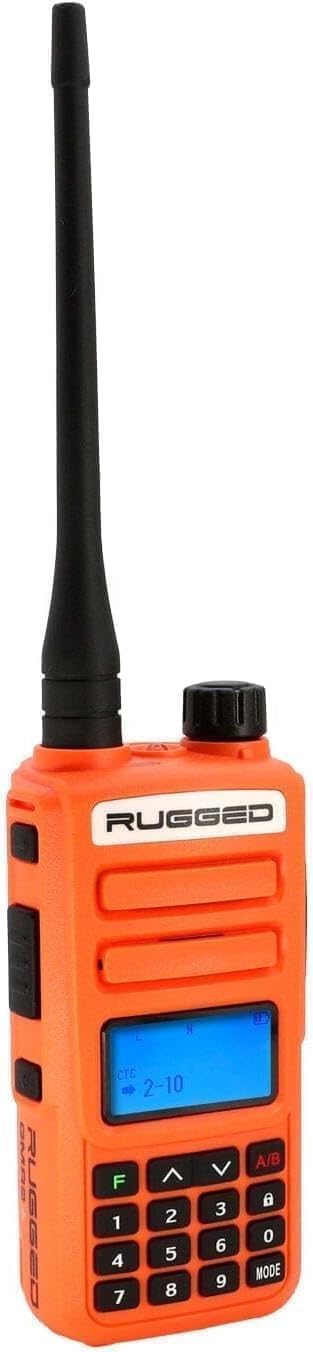
Rugged Radios GMR2+
Key Features
- Real-World Range: Up to 3 miles open
- Weatherproof IP: Water repellent
- Durability: Good build
- Ease of Use: Simple
- Price: Mid-Range
This radio shines on open trails and off-road routes where GMRS license holders can take advantage of its clear audio and respectable range. The build quality holds up to the bumps and dust of vehicle-based adventures. However, its water-repellent coating is not enough for sustained rain or creek crossings, and the need for an FCC GMRS license makes it a poor fit for casual hikers who want grab-and-go FRS communication. It fills a specific niche for licensed overlanders who value range over weather protection.
Pros
- Clear audio and dependable range on open trails and off-road routes.
- Build quality withstands the bumps and dust of vehicle-based outdoor use.
- Mid-range price for a GMRS radio with NOAA weather channels and rechargeable battery.
Cons
- Requires an FCC GMRS license for legal operation – not a license-free option for quick hikes.
- Water-repellent only, not waterproof – limits use in prolonged rain or wet terrain.
For overlanders and off-roaders who already hold a GMRS license, this radio delivers clear range on open trails at a reasonable price – just keep it dry and leave the creek crossings to an IP-rated model.
Best for Dry Weather Play
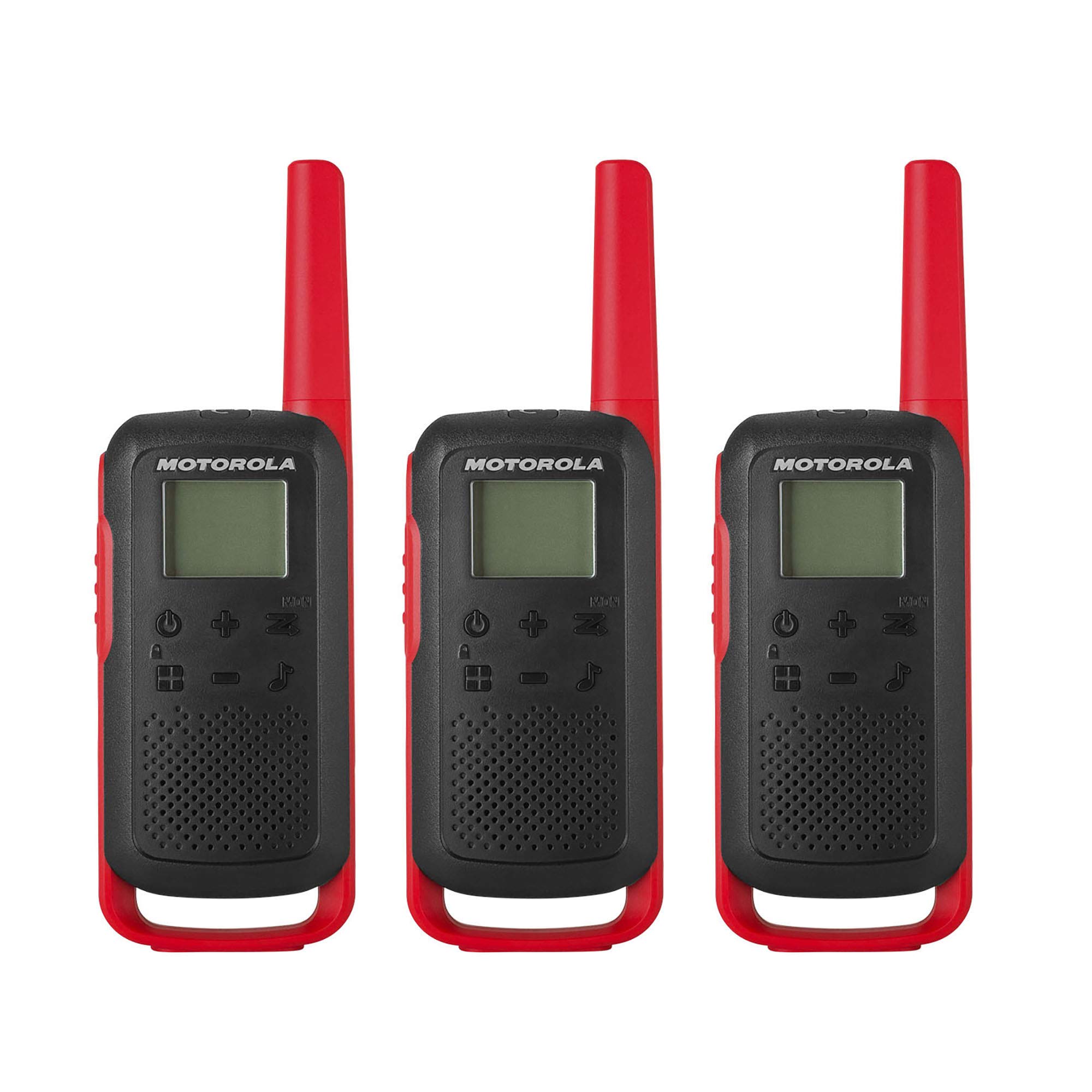
Motorola T210TP 3-Pack
Key Features
- Real-World Range: Under 1 mile
- Battery Life: 18 hours
- Weatherproof IP: Not water resistant
- Durability: Sticky buttons
- Ease of Use: Easy
- Price: Mid-Range
The Motorola T210TP 3-pack delivers clear audio and stable battery life for neighborhood play, caravan trips, or dry-weather outings. The 22 FRS channels provide solid range in open areas, and the rechargeable NiMH batteries last through moderate daily use. However, the radios are not water resistant—rain or splash exposure can damage them—so they are limited to dry conditions. Some units may also develop sticky buttons over time, though this is not universal.
Pros
- Clear audio for group communication in open areas.
- Battery lasts multiple days with moderate use.
- Good neighborhood-range for kids playing outdoors.
Cons
- Not water resistant – rain or heavy moisture can cause issues.
- Sticky buttons can occur on some units, reducing ease of use.
Best for dry-weather group activities like caravan trips or backyard play; skip if you need a radio that can handle wet hiking conditions.
Best for Off-Road Emergency Kits
Midland GXT1000VP4 2-Pack

Key Features
- Real-World Range: Good open terrain
- Battery Life: 11 hours (NiMH)
- Weatherproof IP: JIS4 splash
- Durability: NiMH battery degrades
- Ease of Use: Easy to use
- Price: Mid-Range
The Midland GXT1000VP4 brings strong range potential in open terrain and clear audio, along with NOAA weather alerts that make it a solid choice for emergency kits and car-to-car communication in dry areas. However, the NiMH rechargeable batteries can lose capacity notably after a few months, and the splash-resistant housing is not suitable for rain or stream crossings — making it less suited for hiking than the IP67-rated alternative. It’s best for groups with GMRS licenses who need a feature-rich radio for overlanding or preparedness, not for wet or long-trail use.
Pros
- Strong range in open terrain and clear audio
- NOAA weather alerts and 50 channels for group communication
Cons
- NiMH batteries can lose capacity within months, requiring replacement or AAs
- Only splash-resistant; not suitable for rain or water exposure
Best for emergency preparedness and overlanding in dry, open areas where consistent range matters — skip for hiking in wet or dense terrain.
How to Choose
The ‘up to 35 miles’ claim on the box is meaningless in the woods – real-world range depends on terrain, foliage, and weather, not marketing numbers.
Real-World Range
Manufacturers test range in open, flat conditions with clear line of sight. Add trees, hills, or rain, and signal drops dramatically – often to less than a mile in dense forest. Antenna height also matters: a radio clipped to a hip pack will transmit shorter than one held overhead. For hiking, look for models with consistent user reports of at least 1 mile in wooded terrain, and accept that 3+ miles is rare outside open ridges.
Battery Life
Battery chemistry dictates real-world runtime. NiMH rechargeables (common on older models) lose capacity quickly and drain faster in cold weather. Lithium-ion packs hold charge longer and perform better in temperatures near freezing. Some radios accept standard AA batteries as backup, which is useful for multi-day trips without power. Check both rated hours and user reports – a claimed 18-hour battery might deliver half that with heavy transmit use.
Weatherproof IP
IP ratings indicate dust and water resistance. IPX4 (splashproof) handles light rain but not submersion. IP67 (dust-tight and immersion up to 1 meter) is the minimum for reliable use in heavy rain or creek crossings. Many radios marketed as ‘water resistant’ lack any IP rating – avoid those for serious hiking. A radio that fails in a downpour is worse than no radio.
Durability
Drop resistance matters on rocky trails. MIL-STD-810H certification means the radio survived multiple drops on concrete from 4 feet. Cheaper models often have fragile antennas and belt clips that snap off within weeks. A carabiner clip or reinforced antenna adds cost but saves replacement. For hiking, prioritize a radio that can survive a fall onto stone – not just a carpet.
Ease of Use
Simple controls reduce fumbling with gloves or in the dark. Look for large, tactile buttons, a clear volume knob, and an intuitive channel selector. Audio clarity in wind is critical – a speaker that distorts at high volume makes communication impossible. VOX hands-free mode is useful for climbing but can be triggered by wind noise; a good radio lets you adjust sensitivity.
FAQ
Why does my walkie talkie only reach half a mile in the woods when it says 35 miles?
The advertised range is measured in ideal conditions: flat open ground with no obstacles. Trees, hills, and weather absorb and reflect radio waves, reducing range by 80–95%. A 35-mile claim usually means 1–2 miles in typical forest. For hiking, trust real-world user reports over marketing numbers.
What IP rating do I need for a hiking walkie talkie in heavy rain?
IPX4 resists splashes but not steady rain. IP67 (protection against immersion in 1 meter of water for 30 minutes) is the safe choice for hiking in downpours or near streams. If a radio lacks an IP rating, consider it unsuitable for wet conditions.
Can I use FRS walkie talkies without a license for hiking?
Yes. FRS (Family Radio Service) radios operate on designated channels with a maximum power of 2 watts and require no license. GMRS radios need a license from the FCC ($35 for 10 years) but offer higher power and better range. For most hiking, FRS is sufficient and simpler.
How long do rechargeable walkie talkie batteries last in cold weather?
Cold temperatures slow battery chemistry. Lithium-ion batteries retain about 80% capacity at 32°F, dropping further below freezing. NiMH batteries perform worse, sometimes losing half their runtime. Keep radios close to your body to warm them, and consider models that also accept disposable alkaline AA batteries as backup.