
This post contains affiliate links. We may earn a small commission when you buy through our links — at no extra cost to you.
Many beach umbrellas claim heavy-duty wind resistance, but in real coastal gusts, the story changes. The difference often comes down to anchor design and frame construction, not just fabric.
Budget options under $50 typically lack the structural integrity to handle sustained wind, while premium systems offer tested stability. The key is matching the umbrella to your typical beach conditions and frequency of use.
This guide focuses on the umbrellas that deliver on their wind claims, helping you avoid the frustration of a collapsed canopy or a runaway pole.



Best for Windy Beach Families
BEACHBUB All-In-One
Key Features
- Canopy Size: 90 inches
- Anchor Type: ULTRA Base (ASTM)
- Weight & Portability: 9 lbs
- Price: Premium
The BEACHBUB meets the ASTM F3681-24 safety standard and holds steady in winds up to 44 mph, a claim few beach umbrellas can make. The corkscrew anchor twists into sand quickly, and the 220G UPF polyester canopy resists sun and salt. Assembly takes minutes with no extra bags or stakes.
This is the umbrella for frequent beachgoers in windy coastal areas who prioritize safety over small conveniences. The lack of a tilt mechanism means you reposition the whole unit to track the sun – a minor tradeoff for the stability. The upfront cost is substantial, but the stainless steel hardware and dense fabric hold up season after season, making it a long-term investment rather than a disposable item.
Pros
- Holds steady in winds up to 44 mph – no need to chase your umbrella down the beach.
- Corkscrew anchor installs in minutes without extra tools or weighted bags.
- Stainless steel hardware and dense UPF fabric resist salt and sun damage season after season.
Cons
- For occasional beachgoers, the upfront cost may be higher than needed – regular users find it cost-effective over time.
- In sustained winds exceeding the 44 mph tested limit, the fiberglass frame may show signs of stress.
For families who frequent windy beaches and want a sun shelter that stays put, the BEACHBUB is a durability-focused purchase that delivers on its safety promise.
Best for Wind-Prone Beach Travelers
Solbello Shade
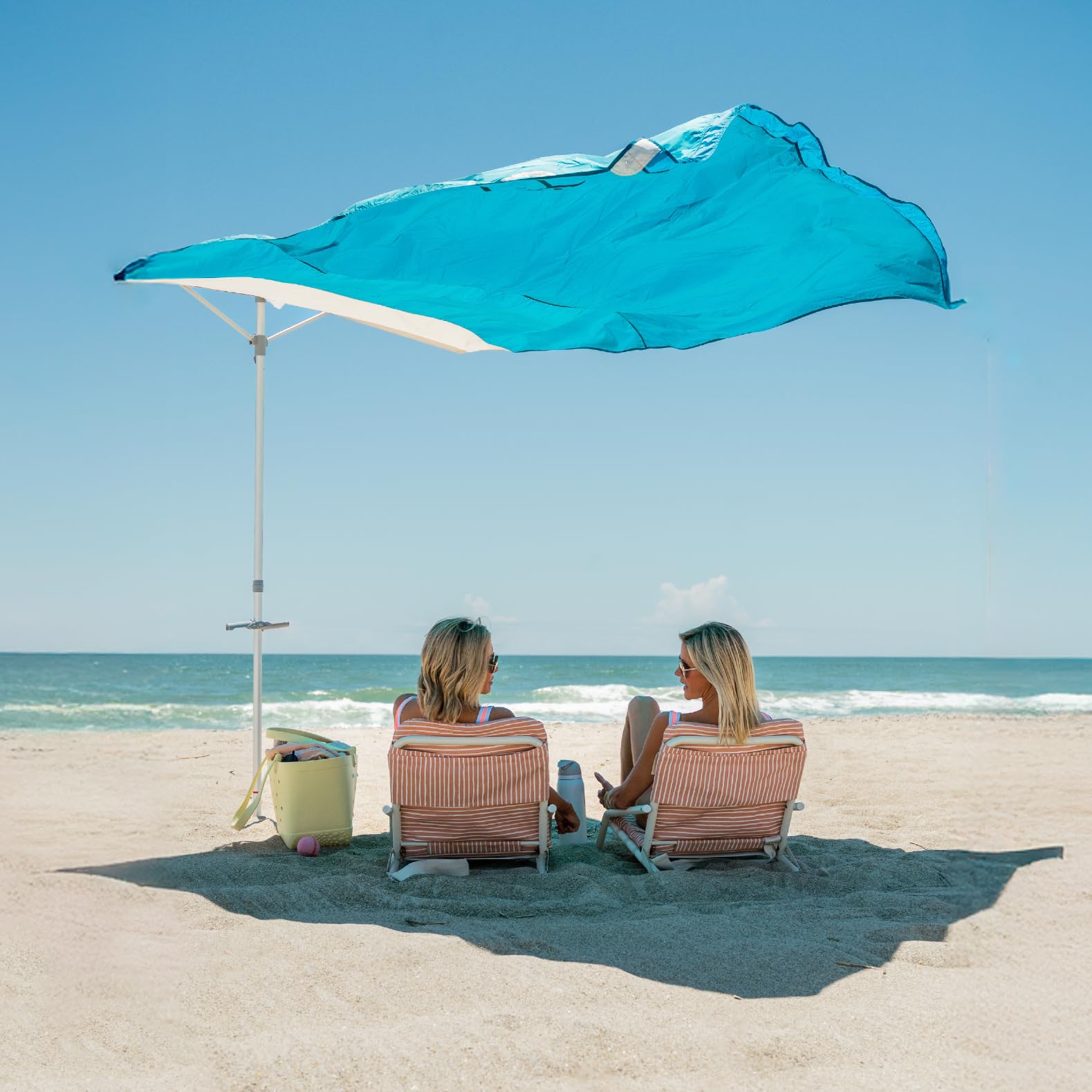
Unlike traditional umbrellas that fight the wind, the Solbello Shade uses a sail-inspired shape to harness breezes for stability. Setup takes about two minutes with one person, and at 4.5 lbs it’s among the lightest beach shades available. This design thrives on consistently windy coastlines; calm days may require extra staking to prevent the shade from collapsing.
Pros
- Sets up in under two minutes without tools.
- Weighs only 4.5 lbs and includes a carry bag for easy transport.
- Stays stable in gusty winds thanks to its wind-driven design.
Cons
- On calm, windless days the shade may collapse without extra staking.
Best for beachgoers on breezy coastlines who prioritize lightweight portability over calm-day convenience.
Best for Solo/couple Occasional
PICNIC TIME 5.5ft
Key Features
- Canopy Size: 66 inches
- Tilt: Yes
- Weight & Portability: 4.9 lbs
- Price: Budget
Weighing under 5 pounds and packing into a drawstring tote, this umbrella is the go-to for solo beachgoers or couples who want quick, portable shade without the bulk of larger models. The tilt mechanism lets you track the sun, and the steel pole holds steady in light breezes. Where it fits in the lineup: it’s lighter and cheaper than the full-sized budget option, but the 5.5-foot canopy means one person sits comfortably—two is a squeeze. The plastic end caps on the frame can wear over time, so it’s best reserved for occasional trips rather than daily use.
Pros
- Lightweight at 4.9 lbs with a carry bag for easy transport
- Tilt pole and lifetime guarantee add value at this price point
Cons
- Canopy is 5.5 ft — comfortable for one, tight for two
- Plastic end caps on the frame can break after extended use
If you need a light, packable umbrella for solo sun protection on calm beach days, this is the most cost-effective option that doesn’t skip tilt or a carry bag.
Best for Budget Family Occasional
AMMSUN 7ft Heavy Duty
Key Features
- Canopy Size: 84 inches
- Anchor Type: Screw-in
- Tilt: Yes
- Weight & Portability: 6 lbs
- Price: Budget
The AMMSUN 7ft Heavy Duty packs a screw-in sand anchor, tilt mechanism, and UPF 50+ fabric into a lightweight 6-lb frame for a practical price. Where it diverges from premium options like the top pick is wind resistance — this umbrella is best for mild breezes, not coastal gusts.
It fits well for families on a budget who hit the beach a few times a year, or as a secondary patio umbrella. Wind resistance is adequate only for calm conditions; the canopy may lift in gusts over 20 mph.
Pros
- Solid value with included sand anchor and tilt at a budget price
- Quick to set up in sand with hassle-free assembly
- Effective UPF 50+ shade with adjustable tilt for sun tracking
Cons
- Possible frame breakage with snapped ribs or poles in some units
A cost-effective choice for families who only need shade on calm, sunny beach days.
Best for Budget Calm-Weather Use
Aoxun 6.5ft
Key Features
- Canopy Size: 78 inches
- Anchor Type: Screw-in
- Tilt: Yes
- Weight & Portability: ~4.5 lbs
- Price: Budget
This Aoxun umbrella delivers the core features for a relaxed beach day without stretching the budget. The fiberglass frame and tilt pole are straightforward to set up, and the UPF 50+ canopy blocks UV effectively. Durability is mixed in user reports — the frame or fabric may show wear under repeated use, so it’s best reserved for occasional outings in mild conditions. It suits shoppers who want a simple, portable sun shelter for the occasional calm beach trip or poolside lounging, but those expecting frequent heavy use or wind resistance should consider a sturdier model like the top pick.
Pros
- Affordable price for a functional beach umbrella
- Simple to set up and lightweight to carry
- Effective UV protection with UPF 50+
Cons
- Durability can be inconsistent — some units may experience frame fatigue or fabric damage over time
Best for budget-conscious beachgoers who only need sun protection on calm, windless days — not for frequent or heavy use.
Best for Family Picnic Convenience
AMMSUN 7ft Table

Key Features
- Canopy Size: 78 inches
- Anchor Type: Included
- Tilt: Yes
- Price: Mid-Range
The integrated table with cup holders sets this umbrella apart for beach picnics or family outings where snacks and drinks stay off the sand. Setup is quick, and the fiberglass ribs provide decent flex. However, the table attachment adds a potential weak point if stressed by wind, and long-term durability under heavy use is a known vulnerability. This umbrella suits calm-weather family trips but is not a wind-resistant pick for breezy coastlines.
Pros
- Built-in table with cup holders keeps food and drinks within easy reach.
- Simple assembly and takedown process saves time at the beach.
Cons
- The table attachment can snap or the pole can bend if the umbrella is stressed by sudden gusts.
Best for calm-weather family beach trips where the convenience of a built-in table outweighs potential wind limitations.
How to Choose
The most important factor in choosing a beach umbrella is not the fabric but the anchor system and frame.
Canopy Size
A larger canopy provides more shade but catches more wind. For two adults, 7–8 feet (84–96 inches) is the sweet spot. A 5.5-foot canopy works for one person but offers minimal coverage.
Wind Resistance
Wind resistance comes from three things: a vented canopy that lets gusts pass through, flexible fiberglass ribs that bend without snapping, and a secure anchor. A screw-in anchor or base that buries deep into the sand provides more grip than a separate bag or plate.
Look for independent wind testing (e.g., 44 mph) rather than marketing claims. Many budget umbrellas start to lift or invert above 15 mph.
Anchor Type
Screw-in augers work well in compact sand but can twist loose in dry, loose sand. The BEACHBUB’s ULTRA Base uses a wide, low-profile design that resists pull-out. For windy beaches, a dedicated anchor system is more reliable than a simple stake.
Tilt Mechanism
Tilt allows you to follow the sun, but the joint creates a weak point under stress. Umbrellas without tilt (like the BEACHBUB) tend to be more wind-resistant because the pole is a single continuous structure. For moderate wind, a push-button tilt is convenient but check for metal fatigue.
Weight and Portability
Heavier umbrellas (9–11 lbs) are more stable but a chore to carry. Lighter models (4–6 lbs) are easier to transport but may need extra anchoring on windy days. If you walk far to the beach, weight matters more than absolute stability.
FAQ
How much wind can a beach umbrella with a sand anchor actually withstand?
Most budget umbrellas with screw-in anchors can handle up to 15–20 mph before threatening to lift. Premium systems like the BEACHBUB are independently tested to 44 mph. For consistent gusts above 25 mph, look for a vented canopy and a heavy-duty anchor system.
Why do some beach umbrellas have a tilt mechanism and others don’t?
Tilt allows you to angle the canopy as the sun moves, extending shade coverage. However, the added joint can become a weak point under wind stress. Umbrellas without tilt (like the BEACHBUB) are often more wind-resistant because the pole is a single continuous structure.
Is a heavier beach umbrella always more wind-resistant?
Not necessarily. While weight helps, the anchor system and frame geometry matter more. A lightweight wind-driven design like the Solbello can outperform a heavy steel umbrella with a weak anchor. Focus on the anchor’s grip and the frame’s flexibility rather than total weight.
Can I use a patio umbrella on the beach with a sand anchor?
Patio umbrellas are not designed for beach wind loads. Their frames are heavier but often lack the flexible ribs and vented canopies needed for coastal gusts. Even with a sand anchor, they can snap in moderate wind. Stick to umbrellas specifically made for the beach.