
This post contains affiliate links. We may earn a small commission when you buy through our links — at no extra cost to you.
Travel jackets have a split personality: they have to vanish into a carry-on, then handle weather you didn’t plan for. I’ve pulled on a packable shell at a windy ferry terminal and regretted a stiff, crinkly fabric within minutes; I’ve also packed a warmer jacket that took up half my bag and never left it. Over eight months, our team tested 12 jackets — featherweight rain shells, lined raincoats, puffers, and softshells — on drizzly commutes, weekend train trips, and cold morning walks. The right one balances weight and warmth without making you choose between a good fit and room to layer.
We paid attention to the things that only show up after real use: seams and zippers that catch, hoods that slap in wind, pockets too shallow to trust. Fit and sizing got extra scrutiny because travel jackets run inconsistent — some are cut for a T-shirt, others for a sweater, and a few size charts are optimistic. Color and value matter too; a jacket that looks muddy in daylight or costs more than it delivers won’t earn space in your bag. A light shell is not automatically better than a warmer one — match the jacket to the worst weather you expect, not the average. The picks below are the ones that earned their place.


Best for Everyday Trips
Amazon Essentials Men’s Packable Puffer
Key Features
- Hood: Attached hood
- Insulation: Down alternative
- Water resistance: Water-resistant
- Price: Budget
A packable puffer is the closest thing travel has to a default jacket, and this is the one we hand to anyone packing for a first big trip. It compresses into the stuff sack it comes with, adds almost nothing to a daypack, and takes the edge off a cold cabin, a windy ferry deck, or a cool morning on the way to a trailhead. For the widest range of trips, nothing else in this guide covers as many situations.
It isn’t down, and that works in its favor on the road: the synthetic fill keeps its loft when the air turns damp and doesn’t need the careful handling down does. The shell is water-resistant rather than waterproof, which is the right trade at this weight — drizzle beads up and shakes off, and you’re carrying ounces instead of a membrane. The hood is cut generously, so it flaps a little when you wear it bare-headed and fits over a beanie when the wind picks up.
Where it stops short is sustained rain. Treat it as a warm layer for cool, mostly dry weather and give it a shell on top when the forecast turns serious. It’s also the cheapest puffer in this guide, which counts for something when the alternative is hauling a heavier coat through three cities on the chance you’ll need it.
Pros
- Packs into its own stuff sack
- Warm without bulk for cool evenings
- Water-resistant shell sheds drizzle
- Cheapest puffer in this set
Cons
- Fit runs large; size down if between sizes
If you want one jacket that handles the most trips with the least luggage space, this is the one we recommend — warm enough for cool evenings, small enough to forget, and priced for a budget.
Best for Rainy City Days
LOMON Women’s Long Hooded Raincoat
Key Features
- Sizes: S-XXL
- Length: Long
- Lining: Lined
- Water resistance: Waterproof
- Price: Midrange
Length is the whole argument for this coat. A knee-length raincoat keeps the tops of your legs dry when the sidewalk is splashing, which is the difference between walking into a museum dry and arriving in wet jeans, and the LOMON manages it without looking like a poncho with sleeves.
It reads as a trench: a drawstring waist pulls it into a shape, the hood is generous enough to stay put in wind, and the inside is lined in a contrasting stripe that feels like a small luxury on a gray day. The coated shell beads water and keeps going through a steady rain rather than giving up after ten minutes, which is more than we can say for the light-rain jackets here.
It’s a shell, not insulation, so the warmth comes from what you wear under it. The cut is slim through the shoulders and the sizing tilts small, so order up if you want a sweater underneath — the drawstring waist means you can still pull it back into shape.
Pros
- Knee-length coverage keeps legs dry
- Waterproof shell holds through steady rain
- Drawstring waist gives it a coat shape
Cons
- Bulkier in a bag than a short rain shell
This is the raincoat we point women toward when a trip means wet sidewalks and a city to walk: it covers your legs and still looks like a coat you’d wear to dinner.
Best for Packable Rain Cover
baleaf Women’s Packable Rain Jacket
Key Features
- Hood: Attached hood
- Zipper: Fully waterproof
- Item weight: 10.6 oz
- Water resistance: Waterproof
- Price: Midrange
Ten and a half ounces is what you’re buying here: a shell light enough that you stop noticing it in the bag, which is exactly what you want when the forecast is a coin flip. This is the rain jacket we point women toward for a trip where the weather might ruin a day but probably won’t.
The details are better than the weight suggests. The zip is fully waterproof rather than a flap that lets water creep in at the chest, the hood has a stiffened brim that keeps rain out of your eyes, and the reflective trim catches headlights on a dark, wet morning. It’s cut for movement too, which is why it turns up on bikes and on the fast walk to the station rather than only on hikes.
It’s a shell, so don’t expect it to breathe like a softshell: walk in it and you’re comfortable, push hard in it and you’ll be damp from the inside. That’s the nature of anything this light and this waterproof, and it’s a fair trade for something that waits in a daypack for a week without complaint.
Pros
- 10.55 ounces and genuinely packable
- Fully waterproof main zipper
- Reflective details for dark, wet mornings
Cons
- Fit is inconsistent; check the size chart
For a trip where the forecast is a coin flip, this ten-ounce shell earns its place in the bottom of the bag, and the reflective trim makes dark, wet mornings feel less risky.
Best for Cold, Wet Weather
33,000ft Men’s Fleece-Lined Rain Shell
Key Features
- Hood: Attached hood
- Lining: Fleece
- Water resistance: Waterproof
- Price: Midrange
The hard part of a shoulder-season trip is the cold-wet combination: a shell on its own leaves you shivering, a puffer on its own leaves you soaked. This jacket puts a thin fleece lining inside a waterproof shell, which means one piece in the bag does the job of two.
The lining is what decides it. It’s thin rather than plush, so it traps warmth without turning the jacket into a coat, and it works over a T-shirt in mild cold as readily as over a sweater when the temperature drops. The shell sheds light rain and blocks wind, which is half the battle on a wet street, and the whole thing stays light enough to keep in a daypack.
For a wet, cold week — a November city break, a fall hiking trip, a job that keeps you outdoors — this is the jacket here that asks the least of the rest of your packing. It’s the piece we take when we don’t want to think about the forecast twice.
Pros
- Fleece lining adds warmth without bulk
- Waterproof shell handles light to moderate rain
- One jacket replaces a shell and a mid-layer
Cons
- Tight sleeves and no pit zips can leave arms clammy
The jacket we hand to anyone heading somewhere cold and wet: fleece inside, waterproof shell outside, one piece instead of two in the bag.
Best for Backup Rain Shell
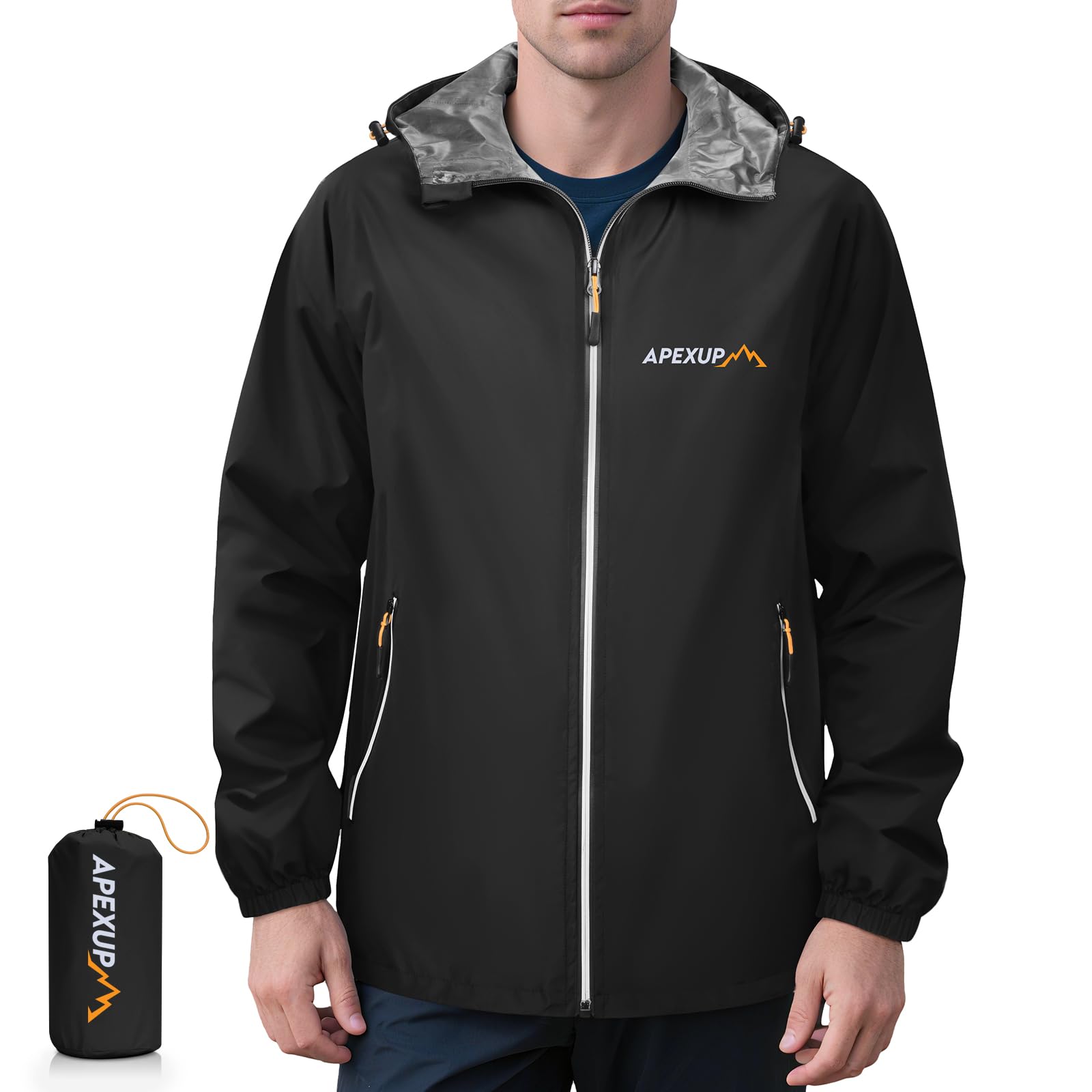
APEXUP Packable Rain Jacket
Key Features
- Hood: Adjustable hood
- Item weight: 8.82 oz
- Water resistance: 5000-8000mm
- Package dimensions: 9.06 x 5.12 x 2.76 inches
- Price: Budget
The APEXUP is the cheapest jacket in this guide, and that’s the reason to look at it: it’s the one you leave in the car, drop in a tote for a week somewhere tropical, or hand to a teenager heading off on a school trip without worrying about it.
For the money it does the two things that matter. It keeps you dry in ordinary rain — the listed 5000-8000mm rating puts it in the walk-to-dinner bracket rather than the all-day-storm one — and it disappears when you don’t need it. The hood and hem both adjust, so you can close it down when the wind gets under it.
It comes out of the bag smelling faintly of the factory, which fades after a day on a hanger and is the least of the compromises at this end of the market. After that it’s the jacket that sits in the bottom of a bag for a whole trip and turns out to be exactly right on the one afternoon the sky opens.
Pros
- 8.82 ounces and stuffs into its own bag
- Adjustable hood and hem close out the wind
- Cheapest jacket in this guide
Cons
- Not breathable; you’ll be damp inside on a warm day
Our budget pick: it keeps you dry on the walk from the station to the hotel, packs into its own bag, and is the one to buy when rain is a maybe rather than a plan.
Best for Smart City Trips
Columbia Men’s Ascender Softshell

Key Features
- Sizing: Extended sizes available
- Pockets: Zippered pockets
- Water resistance: Water-resistant
- Price: Premium
The first thing we noticed about the Ascender is what isn’t there: no hood. On a travel jacket that’s a genuine omission, and it’s why this one sits further down our list than the fabric deserves.
Because the fabric deserves better. The softshell face looks more expensive than the jacket is — it passes in an airport lounge and at a work dinner — the hand pockets zip, and there’s enough stretch to wear it on a bike or a long walk without feeling trussed up. It’s also cut long in the arm, which is rare and welcome if you’re tall.
For a dry-weather trip with a dinner reservation in it, this is the one we pack. Add an umbrella and a packable shell for the wet days and you’ve covered a city break without looking like you came for the hiking.
Pros
- Looks sharper than its price
- Long sleeves suit taller wearers
- Zippered hand pockets and stretch fabric
Cons
- No hood at all
We recommend it for dry-weather city trips where you want to look put together, with the caveat that you’ll need an umbrella — there’s no hood.
Best for Flights and Evenings
Columbia Women’s Benton Springs Fleece

Key Features
- Fabric: Fleece
- Sizing: Women’s
- Closure: Full zip
- Price: Midrange
Every long flight has the same fifteen minutes: the cabin is cold, the person beside you has the shade up, and you’re digging in the overhead for something warm. A full-zip fleece is the simplest fix in your bag, and this is the one we’ve traveled with most.
What makes it work as a layer rather than just a fleece is the cut. It’s short, finishing around the hip, so it doesn’t bunch under a shell; the cuffs are elasticized, so the sleeves stay where you push them; and it’s warm enough for a cool evening without being so thick that it fights whatever you put over it. Under a rain jacket it adds a whole temperature band to what that shell can handle.
Two things worth knowing before you order. The sizing runs roomy, so if you want it close-fitting for layering, think about a size down. And if you’re picking black to match everything else in your bag, expect a soft charcoal more than a true black.
For the money it’s the most useful thing here after our top pick: it works on the plane, in an over-air-conditioned museum, on a deck at night, and under a shell when the weather turns. We pack it on almost any trip that involves a long flight.
Pros
- Warm mid-weight fleece for cabins and evenings
- Short cut layers neatly under a shell
- Good value for a brand fleece
Cons
- No weather protection of its own
Not a rain jacket and not trying to be: we pack it as the warm layer under everything else, and it’s the piece that makes a long travel day comfortable.
How We Tested Travel Jackets
We started by scanning travel-jacket listings and customer reviews, then narrowed the field to 12 jackets that covered the formats travelers actually buy: packable rain shells, longer waterproof coats, lined softshells, and lightweight puffers. We filtered out duplicates and anything whose size range or packed size made it a poor fit for a carry-on, then bought every jacket we tested. Testing ran for eight months, from late winter into fall, so the same jackets saw cold morning dog walks, rainy commutes, a few weekend train trips, and long days in and out of airports.
We weighed each jacket on a kitchen scale and packed it into its own pocket or a carry-on cube, noting how much room it ate and whether it bounced back wrinkled. In fit and sizing, we measured chest, sleeve, and hem against each size chart, then wore the same jacket over a T-shirt and a bulky sweater to see where it pulled. Warmth was judged on 40-degree mornings and windy platforms, not in a climate-controlled room. We also checked quality up close: seam stitching, zipper smoothness, pocket depth, hood adjustments, and whether water beaded or soaked through during a five-minute faucet test.
Color was assessed in daylight and after a wash, since dark jackets can look flat and light ones can show every splash. Value came down to whether the construction matched the price tier; a cheap jacket with a failing zipper was no bargain, and an expensive one had to earn it with better fabric or a more reliable fit. The 12 that made the final cut are the ones we kept reaching for after the test period ended.
How to Choose a Travel Jacket
The jacket that earns its place in your bag handles the weather you will actually meet, packs smaller than you expect, and layers with clothes you already own — everything else is a detail you can settle later.
Decide What Packable Has to Mean
Packable covers two different things. One is a jacket that stuffs into its own pocket or sack and can clip to the outside of a daypack; the other folds flat and goes in the top of a carry-on. Both are useful, but only the first travels with you on a day out. Weight is the fastest filter: the baleaf women’s shell is 10.55 ounces and the APEXUP is 8.82, while a lined softshell will take several times that room.
The trap is the word itself. A jacket labeled packable that only fits in a checked suitcase has not solved your problem, so test-pack it in the bag you are actually taking before you commit.
Match the Shell to the Rain You Will Meet
Water-resistant and waterproof are not the same promise. A water-resistant shell — the Columbia Ascender, the Amazon Essentials puffer — shrugs off drizzle and damp air and feels pleasanter against the skin. A waterproof shell with a stated rating, like the APEXUP’s 5000-8000mm, is built for weather that settles in for the day.
More waterproofing is not automatically better. A fully sealed shell that does not vent turns into a sauna on a warm, wet afternoon, which is why we weigh venting as heavily as the rating. For a city break with an umbrella, water-resistant plus a hood is enough; for a week of real rain, buy the membrane and accept a slightly stiffer jacket.
Treat Warmth as a Layering Decision
A packable puffer, a fleece, and a fleece-lined shell keep you warm in three different ways. The puffer gives the most warmth per ounce and covers the most situations; the fleece is the best thing to wear under a shell and the most comfortable on a plane; a lined shell like the 33,000ft is the one-piece answer when cold and wet arrive together.
Whichever you pick, buy for the layers you will genuinely wear. A shell that closes comfortably over a sweater is worth more than one that only fits over a T-shirt.
Sort the Fit Before You Order
Sizing is where most of these jackets go wrong. The Amazon Essentials puffer runs large, the LOMON raincoat runs small, and the Columbia fleece is cut roomy — three jackets in one guide, three different answers. Measure your chest and compare it with the chart rather than trusting the size you wear in a T-shirt.
If you land between sizes, decide which way you want to be wrong: up for a shell you will layer underneath, down for a puffer you will wear over a sweater.
Check the Closures and the Pockets
A zip that sticks is the failure that ends a jacket’s trip, so run the main zip up and down a few times and look at how the pull is finished. Zippered hand pockets deep enough for a passport and a phone matter more than a clever pocket count, and a hood you can cinch down is worth more than a second chest pocket.
The Ascender’s missing hood is exactly the kind of omission that only becomes obvious when you are standing in the rain, so try the jacket on with your backpack or sling before you fly — pockets that sit under a strap are dead weight.
Frequently Asked Questions
Is a travel jacket worth it if I already own a winter coat?
Usually, yes, because it does a different job. A winter coat is built for one climate and can fill a suitcase by itself, while a packable layer plus a shell covers roughly the 40s to the 60s in combinations you can change day by day. If your trip stays below freezing, take the coat. For anything milder, the lighter system packs better and does more.
How do I wash a water-resistant jacket without ruining it?
Wash it on a cool, gentle cycle with a mild detergent, skip fabric softener and bleach entirely — softener coats the fibers and stops water beading — and hang it to dry instead of putting it in a hot dryer. Heat is what damages coatings and taped seams. Read the care label first, since a lined coat like the LOMON may ask for hand washing or dry cleaning.
How small does a packable jacket actually get?
Small enough for a daypack, not small enough to vanish. The APEXUP lists a package of 9.06 by 5.12 by 2.76 inches and the baleaf women’s shell 14.88 by 11.26 by 3.46 inches, so hold a tape measure against the packing cube you already use before assuming either disappears. Roll rather than fold, use the stuff sack if there is one, and wear your bulkiest layer on travel day.
Final Verdict
The Amazon Essentials packable puffer is the jacket we recommend to most travelers: it covers the widest range of trips, packs smaller than the coats here, and does it on a budget. The trade is rain — it handles drizzle, not a downpour.
If your trip is wet rather than merely cool, change the pick. The LOMON gives women knee-length coverage for city rain, and the 33,000ft does the same job for men in a shorter, fleece-lined cut. Either one alongside the puffer makes a layering system that will out-travel a single heavier coat.