
This post contains affiliate links. We may earn a small commission when you buy through our links — at no extra cost to you.
Finding a travel power bank means navigating a sea of exaggerated capacity claims and misleading flight-safety labels. Many models advertised for travel aren’t actually allowed on planes or charge far slower than promised. The real task is identifying which ones combine genuine portability with reliable output for your specific trip.
The critical trade-off is between size and stamina: a compact 10,000mAh unit can fit in a jacket pocket and refuel your phone twice, while a 20,000mAh bank adds heft but covers a full day of use across multiple devices. This guide cuts through the marketing to highlight the models that deliver on their claims without weighing you down.


Best for Everyday Travel
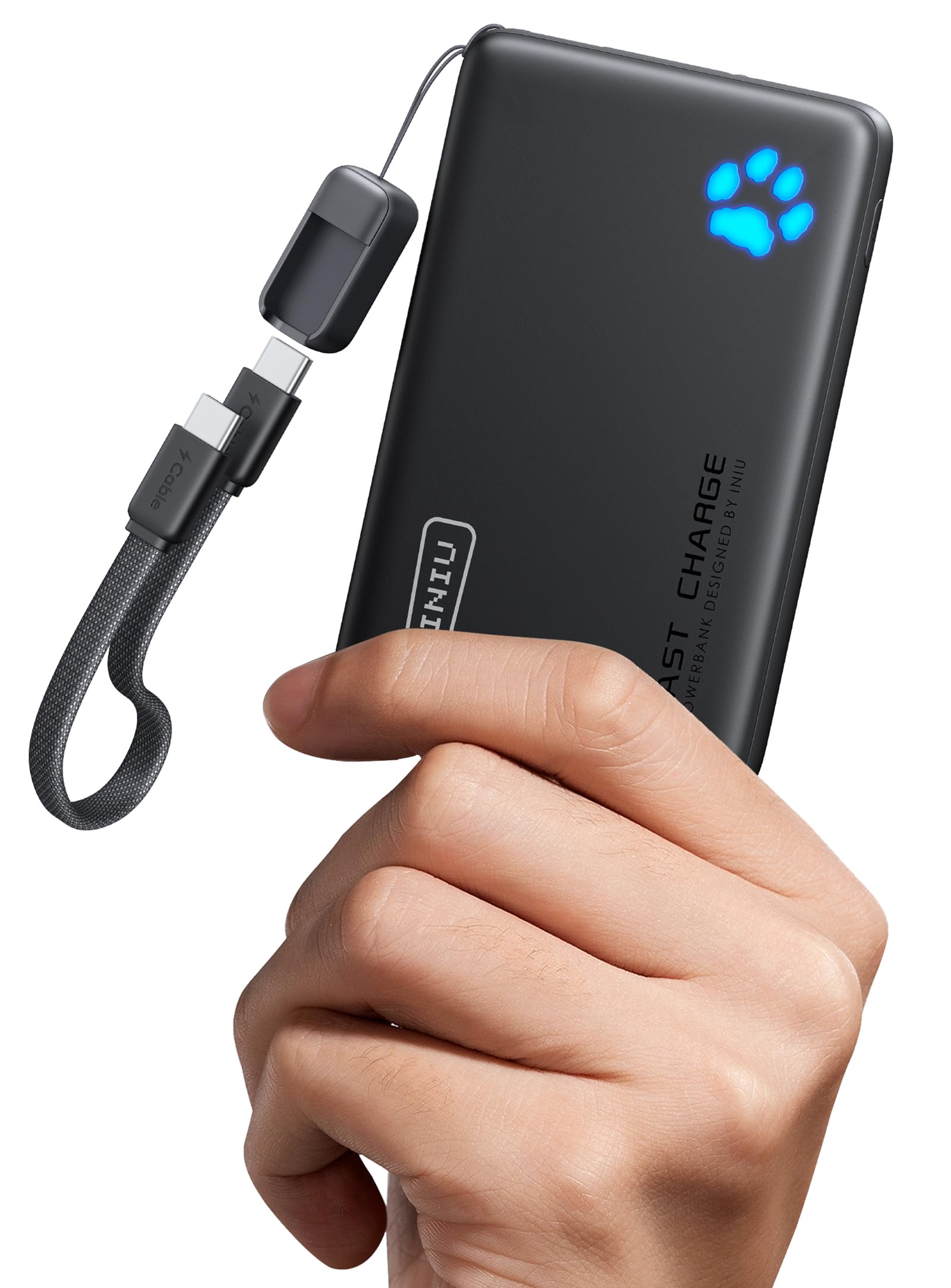
INIU 45W 10000mAh
Key Features
- Capacity: 10000mAh
- Max Power: 45W
- Portability: 182g
- Cable Type: Detachable cable
- Ports: 3 ports
- Price: $
Delivers a full 45W charge that brings an iPhone to 76% in 30 minutes – among the fastest speeds for a 10000mAh bank. Weighs just 182g, small enough to slide into a jacket pocket or small pouch. The detachable USB-C cable doubles as a carry strap, reducing clutter. Flight-safe rating means it travels without restrictions.
Charging performance is consistent: a typical phone gets 1.5 to 2 full top-ups. The 10000mAh capacity suits daily commuters and short trips, though it won’t cover multiple days away from a wall outlet. Build quality feels solid with no rattles or loose ports.
Battery longevity can vary between units – some owners report noticeable capacity loss after several months, and occasional units have stopped holding a charge entirely. This is a risk for anyone expecting multi-year daily use. The compact size is a trade-off for those who need sustained capacity over long trips.
Pros
- Juices an iPhone to 76% in 30 minutes – among the fastest for a 10k bank.
- Compact and lightweight at 182g – fits easily in a pocket or small bag.
- Build quality feels solid with consistent charging performance over weeks of use.
- Detachable cable doubles as a carrying strap, reducing cable clutter on the go.
Cons
- Battery capacity may degrade noticeably after a few months of regular use.
- Some units have been reported to stop holding a charge entirely – a potential issue for long-term owners.
For travelers who prioritize pocket-friendly size and fast emergency charging over marathon battery life, this power bank hits the right balance of speed, portability, and cost.
Best for Minimalist All-In-One
Anker Nano 3-in-1 10K
Key Features
- Capacity: 10000mAh
- Max Power: 30W
- Portability: 250g
- Cable Type: Built-in cable
- Ports: 2 ports
- Price: $$
The Anker Nano 3-in-1 combines a wall charger, power bank, and built-in USB-C cable into one compact unit – no separate brick or cord to pack. Its 30W output charges an iPhone to 50% in about 30 minutes, and the foldable plug stows neatly for pocket carry.
This all-in-one design suits travelers who want a single device for both wall charging and on-the-go top-ups. The 10,000mAh capacity provides roughly one full phone charge – enough for a day of light use but not for heavy users or multiple devices. Durability has been inconsistent after months of regular use, so those expecting years of service may find it a shorter-term solution.
Pros
- 3-in-1: wall charger, power bank, and cable – no extra adapters needed
- Fast 30W charging for rapid phone top-ups
- Compact and flight-safe – ideal for minimalist packing
Cons
- 10,000mAh capacity covers about one full phone charge – insufficient for heavy usage or recharging multiple devices
- Some units may malfunction after several months of use, raising questions about long-term reliability
If you value minimalism and don’t need more than a single phone charge away from an outlet, the Nano 3-in-1 simplifies your travel kit – just keep an eye on its longevity.
Best for Ultra-Light Packing
INIU Ultra Mini 45W
Key Features
- Capacity: 10000mAh
- Max Power: 45W
- Portability: 40g
- Cable Type: Detachable lanyard
- Ports: 3 ports
- Price: $$
The INIU Ultra Mini fits in a coin pocket while delivering a genuine 45W output that charges an iPhone to 50% in roughly 30 minutes. That speed and size combination isn’t matched by the top pick, which offers double the capacity but in a noticeably larger package. The detachable lanyard cable keeps you from hunting for a cord, and at 40 grams you’ll forget it’s there.
This is the backup for ultralight travelers who pack by the ounce and only need a single device recharge before finding a wall outlet. The tradeoff is clear: you get about 1.5 full phone charges, not enough for a day of heavy use or multiple devices. A small number of units have arrived with charging faults or stopped working early, so testing it right away is sensible.
Pros
- Ultra-compact design fits in any pocket like an AirPods case
- True 45W fast charging that speeds up iPhones and Galaxies
- Detachable lanyard cable is durable and convenient
Cons
- For travelers needing multiple device top-ups during a day trip, the 10,000mAh capacity falls short — it’s a single-round backup rather than all-day power
- Some units may arrive with charging issues or stop functioning after a few uses
The INIU Ultra Mini is for the minimalist traveler who prioritizes pocketability over capacity — if you need more than one full phone recharge, the top pick with 20,000mAh is a better fit.
Best for All-Day Charging
Anker Zolo 20000mAh 45W
Key Features
- Capacity: 20000mAh
- Max Power: 45W
- Portability: 354g
- Cable Type: Built-in dual USB-C
- Ports: 3 ports
- Price: $$
The Anker Zolo packs a full 20,000mAh into a portable shell, enough for multiple device charges on a travel day. Unlike the slimmer 10,000mAh top pick, this bank trades compactness for extra power — and adds two built-in USB-C cables that eliminate the need to pack separate cords. For travelers who regularly top up a phone, tablet, and wireless earbuds, that extra capacity is a practical advantage.
Charging speed reaches 45W from the USB-C port, which refills an iPhone 15 Pro from empty in about 1.5 hours. The built-in cable matches that speed, so you don’t lose performance by using an included cord. Anker’s active temperature control keeps heat in check during fast charging — a detail that matters when the bank is stuffed in a bag.
This bank suits travelers who want a single power source for a full day of device use across phones, tablets, and accessories. The 0.78 lb weight will be noticeable in a small pocket or daypack, though not cumbersome in a carry-on. Some units have exhibited reduced performance after extended use, so checking the initial charge cycle and keeping the warranty active is wise.
Pros
- Two built-in USB-C cables simplify travel — no need to carry separate cords.
- 20,000mAh capacity provides multiple full charges for phones and tablets.
- Anker’s build quality and temperature control keep charging stable.
Cons
- At 0.78 lb, it’s heavier than many similarly rated power banks — more suited for a bag than a pocket.
- Occasional units have experienced charging issues after months of use, so initial testing is recommended.
For travelers who need extra capacity and appreciate built-in cables, the Anker Zolo delivers consistent power without the price premium of premium-tier banks.
Best for Budget Built-In Cables
HELLEE 15000mAh 22.5W
Key Features
- Capacity: 15000mAh
- Max Power: 22.5W
- Portability: 200g
- Cable Type: Built-in cables (4)
- Ports: 6 outputs
- Price: $
This HELLEE power bank packs four built-in cables — USB-C, Lightning, Micro-USB, and USB-A — so you can charge multiple devices without rummaging for cords. Unlike the similarly cabled option that tops out at 15W, this one delivers 22.5W fast charging: plug in a compatible phone and you’ll see a 50% charge in about 30 minutes. The 15000mAh capacity provides a full recharge for most phones and then some, all in a 200g package that slips into a jacket pocket.
The built-in cables are short — about six inches — which works fine when the power bank sits next to your phone on a table or in a bag, but can be awkward when you need to hold the device while charging. This is not a power bank for laptops (22.5W won’t keep up with a MacBook), and the fixed cables mean you can’t swap in a longer cord. For budget-conscious travelers who want one cable setup for family devices and don’t mind keeping the battery close, this offers solid value.
Given the low price, the combination of built-in cables, 15000mAh capacity, and 22.5W charging is hard to beat. It’s flight-safe, compact, and covers the basics for a week-long trip where you’re near an outlet each night. The short cables are the main compromise, but for many travelers they won’t be a dealbreaker.
Pros
- Built-in USB-C, Lightning, Micro-USB, and USB-A cables eliminate the need to carry separate cords.
- 22.5W fast charging refuels a phone to 50% in 30 minutes.
- Compact 200g design slips into small pockets or bags easily.
Cons
- Built-in cables are short — may require positioning the power bank close to the device, especially with larger phones or tablets.
A solid value for travelers who prioritize cable convenience and capacity over top charging speed — just keep the short cables in mind.
Best for Family Multi-Device
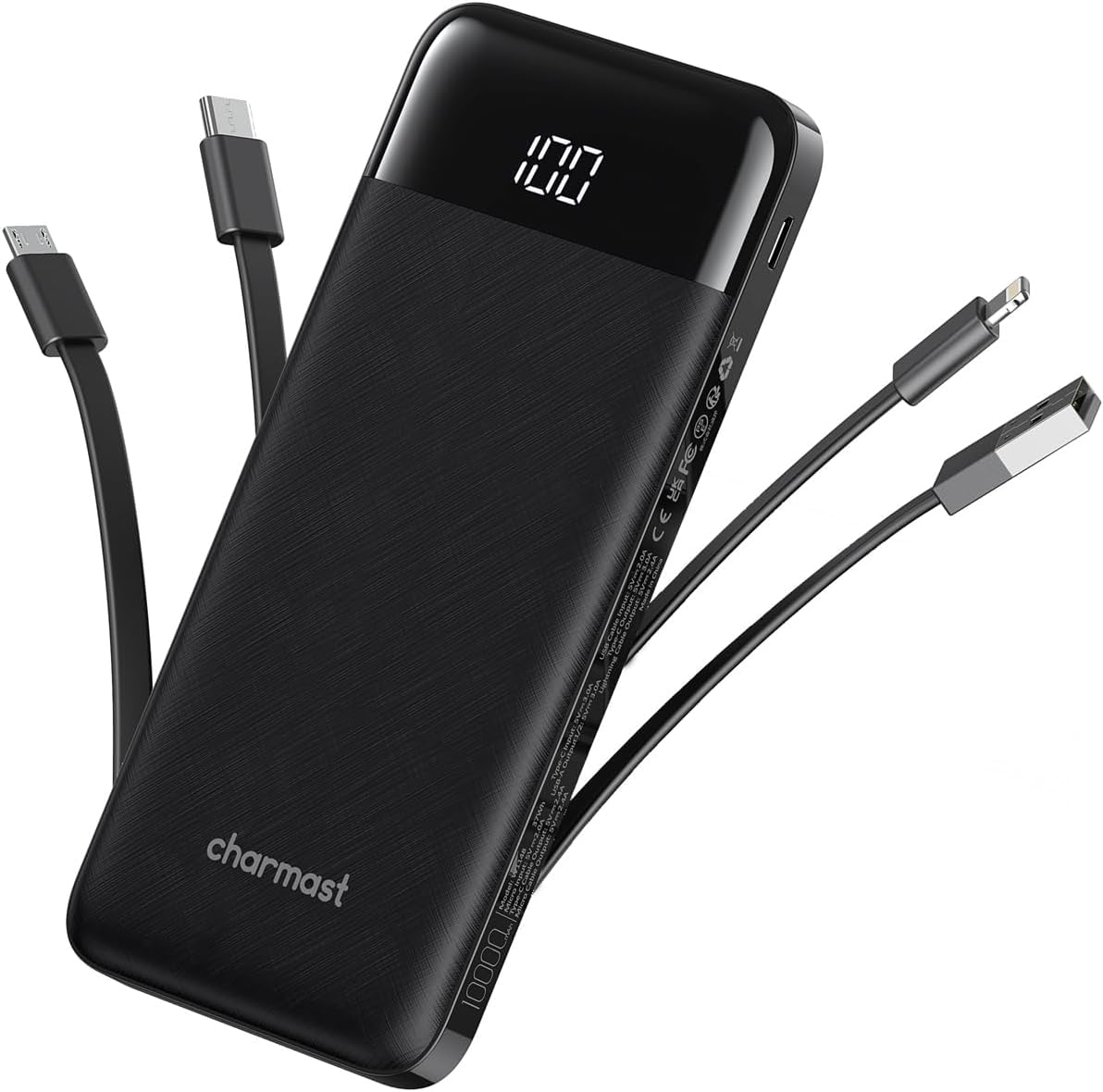
charmast 10000mAh 3A
Key Features
- Capacity: 10000mAh
- Max Power: 15W
- Portability: 240g
- Cable Type: Built-in cables (4)
- Ports: 6 outputs
- Price: $$
The charmast power bank eliminates the need to carry separate cords—its four built-in cables cover Lightning, USB-C, Micro, and USB-A, making it a straightforward pick for family travel where devices vary. Charging speed is limited to 15W, so replenishing a phone can take several hours, and some units may experience a gradual decline in battery capacity over time. This suits casual users who prioritize cable convenience over rapid top-ups, not those needing fast charging between flights.
Pros
- Built-in cables for Lightning, USB-C, Micro, and USB-A reduce cord clutter.
- Slim and lightweight design fits easily into a bag or pocket.
Cons
- Charging at 15W may require several hours to fully recharge a phone.
- Battery capacity can degrade over time, with some units losing the ability to hold a charge.
Best for families or groups who value not carrying extra cables and can charge devices overnight or over extended periods. Not a fit for travelers who need quick power boosts between flights.
Best for Retractable Convenience
Anker Nano 45W 10000mAh

Key Features
- Capacity: 10000mAh
- Max Power: 45W
- Portability: 232g
- Cable Type: Retractable cable
- Ports: 3 ports
- Price: $$
The Anker Nano packs 45W charging into a compact body with a retractable USB-C cable that eliminates cable clutter—a genuine convenience for travelers who dislike loose cords. The smart display shows remaining capacity at a glance. However, at 8.2 ounces it’s noticeably heavier than similarly sized 10,000mAh competitors like the slimmer 45W option in this set, and the retraction mechanism can be fussy, occasionally requiring a nudge to fully seat the cable. Its 10,000mAh capacity and flight-safe design suit short trips where one to two device top-ups suffice, but those wanting lighter gear or higher capacity should look elsewhere.
Pros
- Built-in retractable USB-C cable keeps storage tidy and tangle-free.
- 45W output charges iPhones and Samsung devices at full speed.
- Compact size with a clear battery display for checking remaining charge.
Cons
- Heavier than other 10,000mAh power banks, making it less pocket-friendly during long carries.
- Retractable cable may require manual assistance to retract fully in some cases.
Best for travelers who value a built-in retractable cable over absolute lightweight portability, and who don’t need more than one full phone recharge.
Best for Road Trip Power
YBYP 50000mAh 22.5W
Key Features
- Capacity: 50000mAh
- Max Power: 22.5W
- Portability: 340g
- Cable Type: Built-in cables
- Ports: 7 outputs
- Price: $
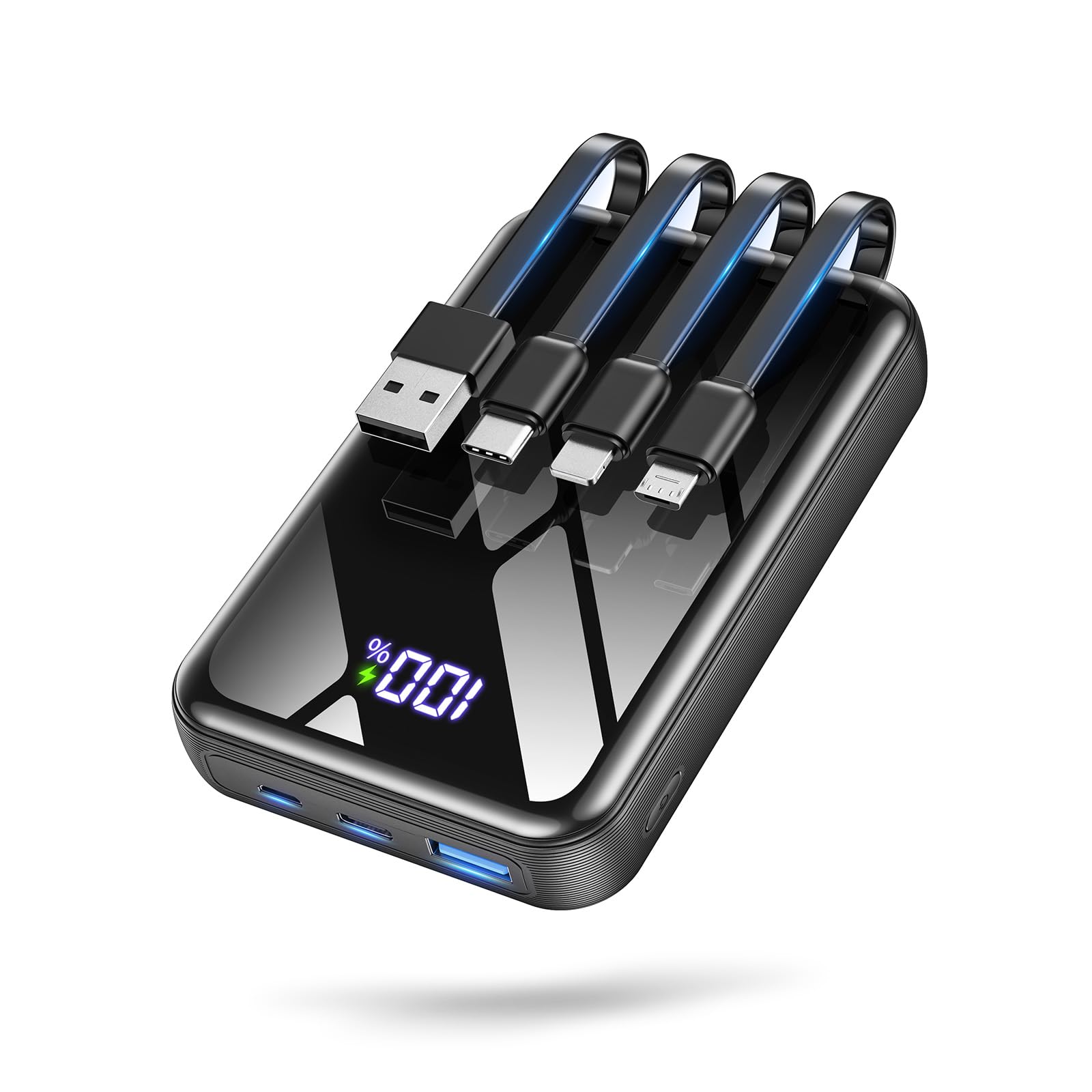
This 50,000mAh power bank delivers enough capacity to recharge an iPhone nine times or a tablet multiple times, with four built-in cables covering Lightning, USB-C, Micro, and USB-A. At roughly the size of a pack of cards for its capacity, it’s surprisingly compact given the battery cell. However, the 50000mAh rating exceeds the 100Wh airline limit (100Wh = ~27000mAh), so it cannot be taken on flights. At 0.75 lb, it’s heavy enough to be felt in a pocket or bag. For road trips, camping, or any situation where air travel isn’t a factor, it offers massive power at a budget-friendly price. But for the traveler seeking a flight-safe daily carry, this power bank is not the right fit.
Pros
- Enormous capacity – charges iPhone up to 9 times
- Built-in cables for all major connector types
- Compact for its capacity – about the size of a pack of cards
Cons
- Exceeds airline carry-on limits – not allowed on planes
- Heavy – 0.75 lb, noticeable in pockets or bags
Best for road trips, camping, and off-grid use where flight restrictions are not a concern – delivers immense power at a budget price.
Best for Camping Backup
OHOVIV 50000mAh 22.5W

Key Features
- Capacity: 50000mAh
- Max Power: 22.5W
- Portability: 485g
- Cable Type: Built-in cables
- Ports: 7 outputs
- Price: $
The OHOVIV packs 50000mAh and four built-in cables (Lightning, USB-C, Micro-USB, USB-A), making it a capable backup for camping or long drives where weight isn’t a concern. However, its 1.07 lb weight and capacity over 100Wh bar it from flight cabins, and the 22.5W charging is adequate but slower than modern fast-charging standards. For those staying grounded, the price-to-capacity ratio is compelling – you get a weekend’s worth of phone recharges without a second outlet.
Pros
- Holds charge for days and refuels a phone over ten times on a single full charge.
- Built-in cables for Lightning, USB-C, Micro-USB, and USB-A – no need to carry separate cords.
- Cost-effective for the massive capacity – budget-friendly alternative to smaller banks.
Cons
- At 1.07 lb it’s too heavy and bulky for pocket or daypack carry – best left in a bag.
- Not permitted on flights due to capacity exceeding the 100Wh airline limit.
Best left in the car or at a campsite where its weight and size don’t matter, and where the sheer capacity saves you from hunting for outlets.
How to Choose
The most important factor is understanding your real power needs versus marketing claims, especially around capacity and flight limits.
Capacity (mAh)
Capacity determines how many full charges you get, but advertised mAh doesn’t account for conversion losses. A 10,000mAh bank typically delivers 6,500–7,500mAh in practice, enough for about 1.5-2 phone charges. If you need a full day of heavy use, step up to 20,000mAh, but expect triple the weight.
Charging Speed (Watts)
Wattage dictates how fast your phone charges. 45W can top an iPhone from 20% to 75% in 30 minutes, while 15W takes over two hours for a full charge. However, faster charging generates more heat, which can degrade battery life over time. For most travelers, 22.5W to 45W is the sweet spot.
Portability (Weight & Size)
Weight is the hidden trade-off. A 10,000mAh power bank can weigh as little as 180g (pocketable), while a 20,000mAh model often exceeds 350g. Consider where you’ll carry it: jacket pocket, backpack, or carry-on. Ultra-compact options like the INIU Mini (40g) disappear in a pocket but limit capacity.
Built-in vs Detachable Cables
Built-in cables are convenient – you never forget a cord – but they’re often short (under 6 inches) and non-replaceable if they break. Detachable cables are longer and replaceable, but add one more thing to lose. Think about your typical charging situation: if you charge while holding the phone, a longer detachable cable is easier; if you plug in and set down, a short built-in cable works fine.
Number of Ports
More ports let you charge multiple devices at once, but each port shares the total output. A power bank with three USB-C ports may still only deliver 45W total, so charging a laptop and phone together will slow both. For solo travelers, two ports is enough; for families, look for at least three outputs plus built-in cables.
FAQ
Can I take a 50000mAh power bank on a plane?
No. Airlines enforce a 100Wh limit on carry-on batteries. A 50,000mAh bank at 3.7V equals about 185Wh, well over the limit. These must be checked or left behind. Stick to 20,000mAh or less for worry-free travel.
Why does my power bank charge slower than advertised?
Two main reasons: conversion losses (10-15% of energy is lost as heat) and shared output. Many power banks split wattage across ports; plugging in two phones halves the speed per port. Also, cheap cables limit charging speed – use a quality USB-C to USB-C cable for full speed.
How many times will a 10000mAh power bank charge my iPhone 17?
Roughly 1.5 to 2 full charges. Actual usable capacity is around 6,500–7,500mAh after losses, and the iPhone 17 likely has a 4,500–5,000mAh battery. So expect one full charge plus a 50% top-up, not the two to three times often claimed.
Is a power bank with built-in cables better than one with detachable cables?
It depends on your habit. Built-in cables are never forgotten and are great for quick top-ups, but they are short and can’t be replaced if damaged. Detachable cables are longer, replaceable, and let you use your preferred cord. If you’re prone to losing cables, built-in wins; if you need length or durability, detachable is better.