
This post contains affiliate links. We may earn a small commission when you buy through our links — at no extra cost to you.
Every mini umbrella claims to be windproof, but most invert the first time a gust hits. The real gap isn’t marketing – it’s physics: a light frame can’t anchor a canopy in a strong crosswind without a design that sheds force.
That doesn’t mean you have to carry a heavy brick. A fiberglass rib count, vented canopy, and closed length under 12 inches separate the ones that actually work from those that fold for good after a single storm. The trade-off is usually between portability and wind hold – you can have one without sacrificing the other if you know what to look for.
This guide focuses on the handful of compact umbrellas that balance weight, durability, and real-world wind resistance. Whether you commute in a breezy city or need a backup for a backpack, the right pick comes down to how you’ll actually use it – not what the spec sheet says.


Best for Style-Conscious Travelers
TUMELLA Windproof Travel
Key Features
- Weight: 1.06 lbs
- Canopy: ~40 in
- Frame: Fiberglass ribs
- Price: $$
The TUMELLA umbrella uses fiberglass-reinforced ribs that give it a noticeably sturdy feel without excessive weight. The compact folded size slips into a backpack or car door pocket, and the color options have drawn consistent praise for their appearance. The auto-open mechanism works smoothly, making it easy to deploy in sudden rain.
Though marketed as windproof, moderate gusts can push the canopy inside out – a limitation to keep in mind for exposed coastal walks or stormy days. Collapsing the umbrella also takes more effort than some competitors. For everyday urban use, occasional rain, and travel where packability matters, this umbrella delivers a solid balance of build and looks at a reasonable price.
Pros
- Fiberglass ribs provide a sturdy, durable frame that feels well-built.
- Compact size ideal for travel – fits in most backpacks and car compartments.
- Attractive design with multiple color options that customers appreciate.
Cons
- Canopy may invert in moderate gusts despite windproof claims.
- Closing the umbrella requires firm pressure and sometimes two hands.
A well-built travel umbrella that balances style, portability, and price – best for everyday urban commutes and occasional rain, not heavy storms.
Best for Wind-Prone Cities
EEZ-Y Compact 42
Key Features
- Weight: 1.2 lbs
- Canopy: 42 in
- Frame: Fiberglass+steel vented
- Price: $$
Engineered with a vented double canopy and backed by a lifetime warranty, the EEZ-Y Compact 42 handles wind better than any other compact umbrella in this comparison. The tradeoff is a closing mechanism that demands noticeable force – those with limited hand strength should look elsewhere. This suits commuters in wind-prone cities who need a compact (11-inch folded) umbrella that won’t invert in gusts. Be aware that some units have exhibited rib breakage, but the overall build quality is sturdy for the price.
Pros
- Withstands strong gusts thanks to vented double canopy design.
- Folds to 11 inches for hassle-free storage in bags or backpacks.
- Fiberglass and steel frame holds up to regular use.
Cons
- Closing the umbrella requires significant hand strength and coordination.
- Some units have reported breakage of ribs or auto-open mechanism.
If your daily commute involves gusty conditions and you can manage a stiff close, this EEZ-Y offers the best wind performance in a travel-friendly size.
Best for Car Commuters
LANBRELLA Reverse Fold
Key Features
- Weight: 0.79 lbs
- Canopy: 46 in
- Frame: Fiberglass ribs
- Price: $$
The reverse-folding design solves the wet-seat problem by keeping the wet canopy on the inside when closed, so you can step into a car or building without dripping water everywhere. The compact shape and 46-inch canopy offer solid coverage for one person, making it a practical choice for short commutes. That said, the mechanism and ribs can be inconsistent in build – some units require extra force to collapse fully, and longevity under regular use is not guaranteed.
This umbrella is best for car commuters who frequently enter vehicles from rain and want to avoid soaking the interior. If you prioritize simple mechanical reliability above all else, a standard folding umbrella may serve you better. The mixed durability means this is less suited for daily heavy use or for buyers who need a guaranteed long-term tool.
Pros
- Innovative reverse folding keeps the wet side inside, ideal for car entry.
- Compact and portable – fits in most bags and purses.
- Large canopy provides good coverage for one person.
Cons
- Durability can vary – the mechanism or ribs may need replacement after limited use.
- Closing requires extra effort despite the auto feature, especially to collapse fully.
A niche solution for those who hate wet car seats – worth trying if that specific annoyance outweighs the gamble on longevity.
Best for Premium Build
LifeTek Premium
The LifeTek Premium delivers a Teflon-coated canopy that beads water effectively and a steel-and-fiberglass frame built to withstand gusty winds. Its weight is noticeable compared to similarly sized travel umbrellas, and the auto-close mechanism requires more force than smooth one-button models. This umbrella suits professionals who prioritize durability over ultralight portability, but buyers seeking a truly compact travel umbrella may find the heft and closing effort off-putting.
Pros
- Strong frame resists wind without adding excessive bulk.
- Teflon coating sheds water on contact, keeping the canopy dry.
- Folds to a size that fits most bags for daily carry.
Cons
- At over a pound, it’s heavier than many compact umbrellas – a tradeoff for those prioritizing pack weight.
- The auto-close mechanism can require firm pressure to lock closed, which may slow you down in a hurry.
A sturdy rain umbrella with premium water repellency, best for commuters who can accept slightly more weight and a stiffer close in exchange for long-term durability.
Best for Mild Climate Carry
GORILLA GRIP Compact
Key Features
- Weight: 0.9 lbs
- Canopy: 42 in
- Frame: Fiberglass+iron+stainless
- Price: $$
Dropping to just 0.9 pounds and folding to 11.5 inches, it slips easily into a purse or backpack. The one-click auto open/close works reliably for quick deployment and stowing. This umbrella suits light rain in mild climates – wind resistance is poor, and the canopy can invert in light breezes, so it’s not for gusty conditions. Occasional frame weakness has been reported after several uses, but for occasional calm-weather use, the portability and price offer good value.
Pros
- Lightweight and compact design fits easily in bags and under 1 lb.
- One-click auto open/close allows convenient one-handed operation.
- Good build quality for the mid-range price.
Cons
- Frame inconsistency may occur over time, especially with frequent use.
A practical choice for calm-day portability, but wind performance limits its versatility.
Best for Daily Commuters
Repel Windproof Travel
Key Features
- Weight: 1.85 lbs
- Canopy: ~42 in
- Frame: Fiberglass ribs
- Price: $$
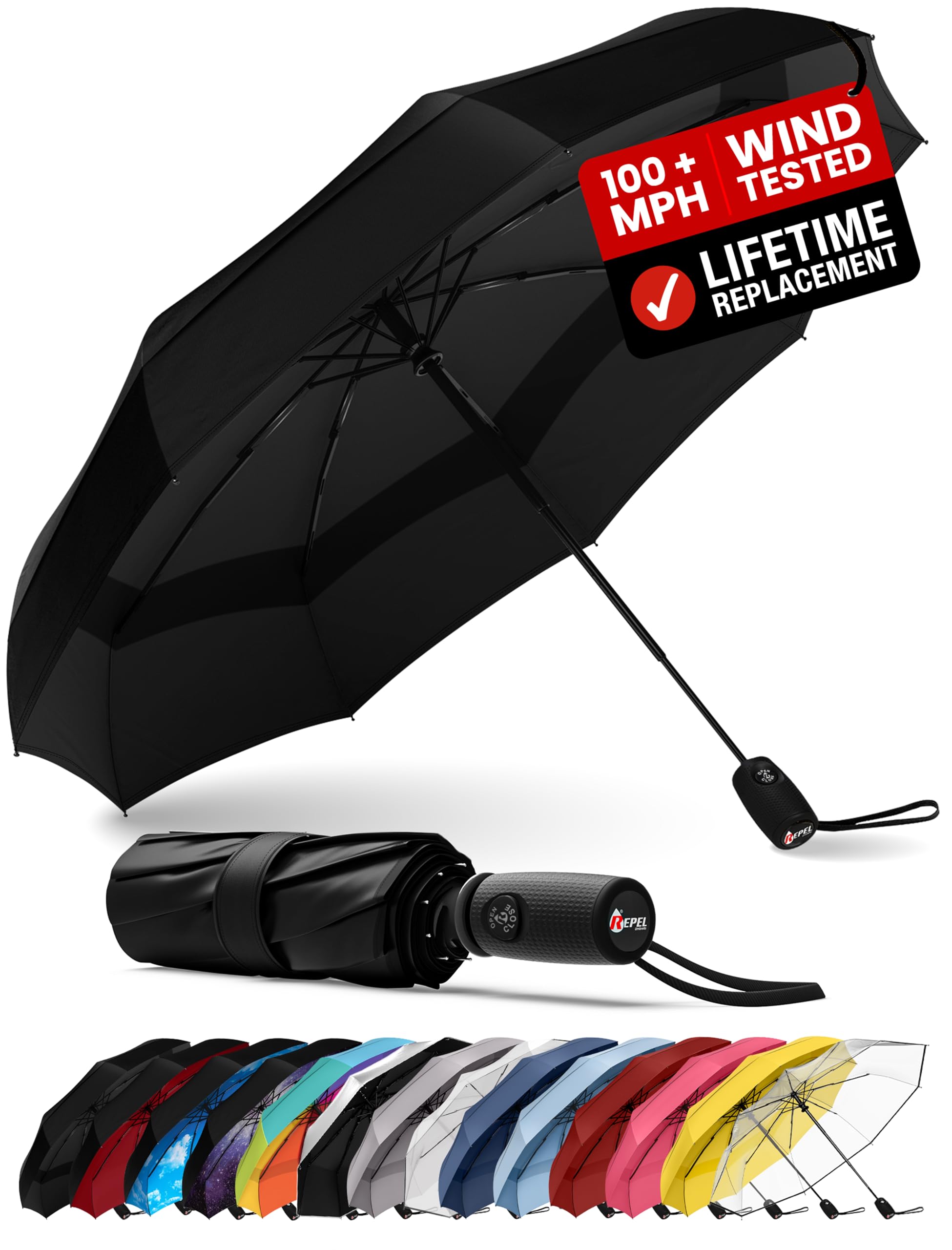
The Repel Windproof Travel Umbrella features a sturdy fiberglass frame and a canopy that covers one person well. At 1.85 lbs, it’s heavier than most compact umbrellas, and closing requires significant force. Some units may experience rib snapping after limited use. It’s a solid choice if you value build over portability, but not ideal for ultralight packing.
Pros
- Sturdy fiberglass frame holds up well in gusty conditions.
- Canopy provides ample coverage for one person.
Cons
- At 1.85 lbs, it’s heavier than many travel umbrellas.
Pick this if you prioritize wind resistance and build quality, and can accept the extra weight and stiff closing mechanism.
Best for Ultralight Travelers
SIEPASA Compact

At 0.46 lbs and folding to 11.8 inches, the SIEPASA adds negligible weight to a backpack or purse. However, structural durability may limit its lifespan in windy conditions or frequent use. This makes it a practical emergency umbrella for occasional light rain rather than a daily companion.
Pros
- Ultralight at 0.46 lbs – easily fits in any bag without adding weight.
- Budget-friendly price makes it a low-risk addition to a car or bag.
Cons
- Closing mechanism can be stiff and requires extra effort.
Ideal as a spare umbrella for light drizzle when weight matters most, but not for regular use or windy conditions.
Best for Emergency Car Umbrella
Anntrue Windproof

The Anntrue offers a 46-inch canopy at a budget-friendly price, folding to 11.6 inches for easy storage. Wind protection is limited — the umbrella may invert in light gusts — and build consistency can vary between units. Best as an emergency car or purse backup rather than daily use in wet climates.
Pros
- Wide 46-inch coverage at a budget price, easily fits in purses or backpacks.
- Lightweight 0.9 lb design folds to 11.6 inches for easy portability.
Cons
- Wind resistance can be insufficient; the canopy may invert in light breezes, limiting use in windy conditions.
Fits as a cheap backup for emergencies or occasional light rain, but not for windy days or daily use.
Best for Car Commuters
QWB Inverted

The carabiner handle and inverted closure add real convenience for car commuters who want to hook the umbrella on a seat or bag and keep the wet side contained. However, the closing mechanism can be stiff, and long-term durability feedback is limited — making this a better fit for occasional use than daily carry in a purse or backpack.
Pros
- Carabiner handle clips easily to bags or car seats for hands-free carrying.
- Reverse-folding design traps wet canopy inside to keep surfaces dry.
Cons
- Closing requires firm pressure, which may be challenging for some users.
Pick this if you prioritize easy hook-on storage and wet canopy containment over a smooth closing experience and long-term reliability.
Yoobure Travel
Yoobure Travel

The Yoobure Travel umbrella delivers good value for light, infrequent rain protection. Its compact folded size fits easily in a small bag, and the UV coating adds sun protection. However, durability is inconsistent – some units show wear after limited use, and the closing mechanism can be stiff. This suits occasional use as a backup, not daily reliance.
Pros
- Great value for the price
- Compact and portable design fits small bags
Cons
- Durability can be inconsistent; some units show wear after limited use
Best as a low-cost backup for travelers who need a compact umbrella for occasional light rain.
How to Choose
Understanding how each spec affects real-world performance is the only way to avoid buying an umbrella that fails the first time it meets a gust.
Folded Length
A folded length under 12 inches is the universal threshold for a true travel umbrella. Anything longer won’t fit in a standard purse, backpack hydration pocket, or glove compartment.
But shorter doesn’t always mean better. The mechanism that collapses the shaft into a very short package often uses more parts, which increase the chance of jamming. A 11.5-inch umbrella typically has a simpler telescoping shaft than a 9-inch model.
Weight
One pound is the practical ceiling for an everyday-carry umbrella. Above that, you’ll start leaving it at home or feeling the bulk in a bag. Below 0.7 pounds, you enter the ultralight zone – but those models trade structural stiffness for weight.
The trade-off is physical: lighter frames use thinner ribs and a shorter shaft. That works fine for occasional light drizzle, but in steady rain or wind, an ultralight umbrella will flap and may invert. For daily use, 0.9–1.1 pounds is the sweet spot.
Canopy Diameter
A 42-inch canopy covers one person’s shoulders and head without dripping onto your pant legs. Larger canopies (46 inches) give more coverage but catch more wind, putting extra stress on the frame.
A 38-inch canopy is the minimum for effective rain protection – anything smaller leaves your back wet. But wider is not always better: in a crowded urban environment, a 46-inch umbrella can become a shoulder-hitting hazard.
Frame Material
Fiberglass ribs are the industry standard because they bend without breaking. Aluminum ribs are lighter but dent permanently; steel ribs add durability at a weight penalty. A mix of fiberglass and steel (common in mid-range models) balances flexibility and strength.
The rib count matters too: eight ribs is typical, but ten-rib frames handle wind far better because the canopy is divided into smaller panels that each take less force. A vented canopy (a double layer with an opening at the top) is the single best engineering feature for wind resistance.
Auto Open/Close
An automatic button that both opens and closes the umbrella is convenient, but the closing mechanism is the primary failure point. The spring that retracts the shaft often requires significant force to collapse – a recurring complaint in this category.
Models with a separate manual close after the button release tend to last longer because the push-button only releases the lock, not retracts the entire shaft. If easy closing is a priority, look for reviews that specifically mention ‘smooth close’ rather than ‘one-button close’.
FAQ
Why is my automatic umbrella so hard to close?
The spring that collapses the shaft has to be strong enough to retract the canopy against air resistance, so it takes effort. Some models use a two-stage button: press to release the latch, then push the shaft down manually. That design is easier to operate than a single-button auto-close that does both. If daily ease matters, look for umbrellas where the button only unlocks the shaft.
Can a mini travel umbrella really handle windy conditions?
Yes, but only if it has a vented double canopy and at least eight fiberglass ribs. The vent allows wind to pass through instead of inverting the canopy. Models like the EEZ-Y with a vented design handle gusts up to 55 MPH. A solid-panel mini umbrella, regardless of price, will invert in moderate winds above 20 MPH – the physics of the small frame can’t anchor a large surface otherwise.
How long does a compact travel umbrella typically last?
For mid-range models ($12–20) with fiberglass ribs, you can expect 6–12 months of regular use before the closing mechanism or rib joints wear out. Budget umbrellas under $10 often fail within the first few uses, while premium models ($30+) with steel-reinforced frames can last several years if the auto-close holds up. The closing mechanism is the weakest link across all price points.
What’s the best mini umbrella for a backpack?
Look for a folded length under 11.5 inches and weight under one pound. The TUMELLA (11.5 inches, 1.06 lbs) fits most backpack side pockets. For ultralight packing, the SIEPASA at 0.46 lbs and 11.8 inches folded is the lightest option, but it won’t survive heavy rain. A carabiner handle (like the QWB) lets you clip it to the outside of the pack, saving internal space.