
This post contains affiliate links. We may earn a small commission when you buy through our links — at no extra cost to you.
Every hiking backpack asks the same trade: the more it carries, the more you feel it. A 50-liter pack that swallows a sleeping bag and three days of food turns into a boulder on your shoulders by the second climb, while a featherweight daypack that disappears on your back runs out of room the moment you add a rain shell and lunch. The right pack splits that difference for the way you actually hike.
Fit decides more than capacity does. Torso length, where the hip belt lands, whether the shoulder straps curve with you or dig in — those matter far more than the number printed on the tag, and they’re why a pack that’s perfect for one hiker can be miserable for another. Over the past six months, my team and I carried 14 packs on day hikes, up long climbs, and through one memorably wet overnight.
Liters also lie. Two packs rated the same can swallow very different loads once you factor in pocket placement and compression straps, and one side pocket you can reach without unclipping anything beats three you can’t. The picks below are the ones that carried well, kept their shape, and held up.
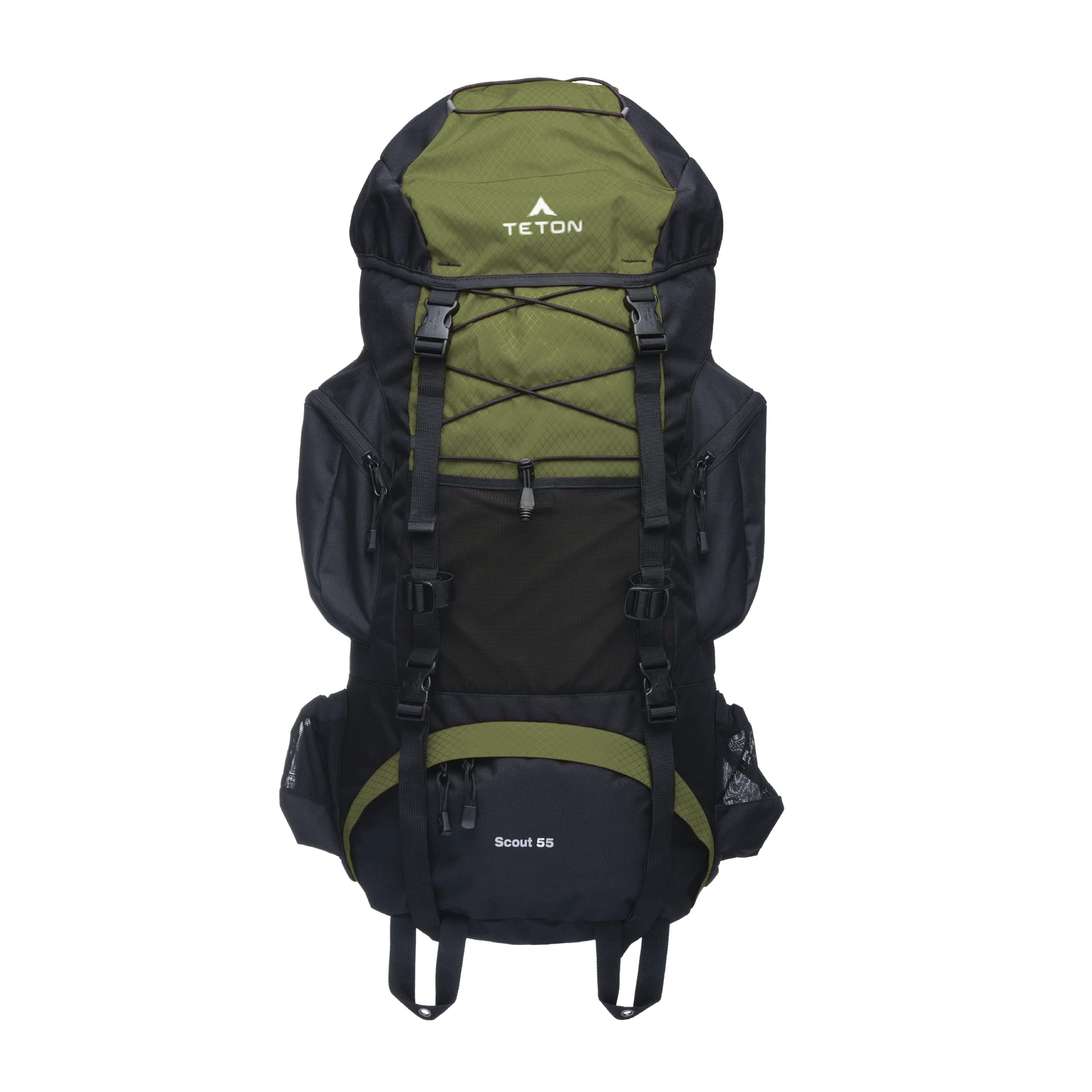


Best for Multi-Day Backpacking
Teton Sports Scout 55L
Key Features
- Capacity: 55 liters
- Torso fit: Multi-position adjustable
- Rain cover: Included
- Empty weight: 4.1 lb
- Price: Premium
A torso panel that slides through several positions is the reason the Scout leads this list. That one adjustment is what turns a pack from something hanging off your shoulders into something sitting on your hips, and it’s paired here with contoured shoulder straps, an open-cell foam lumbar pad and a proper hip belt. Teton describes the torso range as suiting medium to tall frames, so measure from the bump at the base of your neck to the top of your hip bones and compare it with the stated range before you order — the adjustment covers a lot of ground, not all of it.
At 55 liters it’s sized for a two- to four-night trip, and the frame is built for that weight: internal stays, multi-directional compression straps that stop a full pack swaying on descents, and a 600D diamond ripstop shell with a polyurethane lining that is comfortably the most substantial fabric here. It’s also the heaviest pack on this list at 1.86 kg, though once the belt is tight you feel that weight in the bag rather than on your back. A rain cover is included, which we count as a real feature rather than a freebie on a shoulder-season trip.
Storage is generous and mostly well judged: seven pockets and compartments, a sleeping bag compartment at the base, a hydration sleeve with a hose port, and bottle holders on both sides. If a squeak develops at the frame as you walk, it usually comes down to the torso setting or a slack compression strap, and it’s worth chasing in the first week rather than at a trailhead.
The 55-liter body also cinches down small enough to work as a daypack from a base camp, which is more flexibility than the capacity figure suggests, and the limited lifetime warranty is the sort of thing that matters more the longer you keep a pack. What we keep coming back to is how little fuss the setup takes: set the torso length once, tighten the belt, and the load stays where you put it.
Pros
- Adjustable torso panel fits a range of back lengths
- Hip belt and lumbar pad carry the weight
- 600D ripstop is the sturdiest shell here
- Rain cover and lifetime warranty included
Cons
- Sleeping bag compartment is snug for bulky bags
- Side bottle pockets run tight for wide bottles
The Scout’s sliding torso panel is what makes a multi-day load comfortable on a shorter back, so this is the one to buy if you want a single pack for real backpacking trips.
Best for Overnight Trips
Maelstrom 40L Hiking Backpack
Key Features
- Pockets: 10
- Capacity: 40 liters
- Rain cover: Included
- Empty weight: 2.2 lb
- Price: Midrange
Forty liters is the size that covers the trips most people actually take — a long day with a shell, lunch and two liters of water, or one night out with a light bag and a stove — and the Maelstrom carries it at 2.2 pounds. That’s light enough to notice on the shelf and forget about on the climb.
The organization is the loudest argument for it: ten pockets across seven zippered compartments, a hydration sleeve, deep bottle holders and elastic loops on the sides for trekking poles. The padded back panel and shoulder straps are comfortable with a moderate load, the reflective detailing is a small bonus for early starts, and the rain cover packs small enough to live in the bottom until the weather turns.
Where we hesitate is the fabric. 210D ripstop saves the weight, but it’s the thinnest shell in this group, and seams and zippers are where a loaded pack gets tested. Ours handled long day hikes and a single overnight without complaint; keep loads moderate, check the stitching at the strap anchors before a big trip, and it will do everything a weekend asks. For occasional overnights and everyday trail days, that’s a fair trade.
Pros
- 2.2 pounds for long days and overnights
- Ten pockets across seven zippered compartments
- Rain cover included and packs small
- Padded back panel and shoulder straps
Cons
- One-year warranty is short for a load-bearing pack
A light, well-organized 40-liter pack for long day hikes and single overnights — just don’t ask it to haul expedition weight.
Best for Light Multi-Day Loads
Loowoko 50L Hiking Backpack
Key Features
- Capacity: 50 liters
- Dimensions: 7.9 x 11.8 x 23.6 inches
- Rain cover: Included
- Empty weight: 2.8 lb
- Price: Midrange
The Loowoko does most of what the Scout does at 2.8 pounds, which makes it the lightest route to a full-size multi-day pack here. A rain cover is included, the compression straps do real work, and the frame-and-hip-belt layout is the same idea as our top pick’s, just built lighter.
Our view is that it suits a particular hiker: someone who counts ounces, packs a lean kit, and prefers capacity without heft. The pocket layout is sensible if unremarkable, the external extension straps let you lash a tent or a mat on top, and it reduces down well when it’s half empty. It also scales down further than most full-size packs — a five-foot frame can carry it, which isn’t true of everything here.
The trade for that weight sits in the straps and seams, which is where a 2.8-pound pack has to save something. Load it as designed rather than beyond it, check the stitching at the shoulder anchors before a big trip, and it will handle three-season weekends without drama. If you routinely carry a heavy, bulky kit, spend the weight on the Teton instead.
Pros
- 2.8 pounds for a full-size multi-day pack
- Compression straps and external extension for bulky gear
- Rain cover included
- Harness scales down to a five-foot frame
Cons
- Volume runs smaller than the 50-liter figure suggests
The lightest full-size multi-day pack here, and a good match for a lean packer who wants the capacity without the heft.
Best for Packable Day Hikes
SKYSPER Iminix 15L
Key Features
- Capacity: 15 liters
- Chest strap: With safety whistle
- Folded size: 7.9 x 6.7 inches
- Empty weight: 0.75 lb
- Price: Budget
Two deep side pockets that swallow 32-ounce bottles and a chest strap with a whistle built into the buckle: those details tell you SKYSPER built this as a hiking pack that happens to fold, not a stuffable tote with shoulder straps.
At 0.75 pounds it disappears into a daypack or a carry-on, and it unfolds into a real 15-liter daypack: six pockets and compartments, a zippered back pocket for a wallet and phone, a bungee cord across the front for a shell, and bottle pockets you can reach without taking the pack off. The polyester is water resistant rather than waterproof, so a sustained downpour will find its way in.
For a short hike — three or four hours, one layer, water and lunch — it’s the pack we reach for, and the chest strap makes more difference than its size suggests on a climb. It’s a mild-weather daypack rather than a summit pack for a full kit, and as a travel bag that can handle a real trail it’s the best of the small packs here.
Pros
- Chest strap with a built-in safety whistle
- Deep side pockets take 32-ounce bottles
- 0.75 pounds and folds into its own pouch
- Six pockets including a zippered back pocket
Cons
- 15 liters fills fast once layers and lunch go in
A genuinely trail-ready packable daypack — the chest strap and bottle pockets make it worth choosing over a plain stuffable bag.
Best for Travel and Day Hikes
WATERFLY 20L Packable Daypack

Key Features
- Pockets: 4
- Capacity: 20 liters
- Folded size: 8.7 x 6.3 inches
- Empty weight: 10.2 oz
- Price: Budget
Folded, it’s about the size of a paperback — 8.7 x 6.3 inches and 10.2 ounces — which is why it ends up in a suitcase rather than on a gear shelf. It opens into a 20-liter daypack with four pockets: a main compartment, two front pockets and a zip-out one.
Twenty liters is the right size for a proper day hike — shell, fleece, lunch, first-aid kit and a bottle in each mesh side pocket — and we were struck by how much it swallows for something that packs this small. The recycled nylon is water resistant and wipes clean, and a three-year warranty backs it.
Where it gives ground to the SKYSPER is structure: it’s a soft bag with simple webbing straps, so it belongs to the light-day school of packing rather than the long-day one. It’s at its best as the second bag in your luggage, the one that comes out for a shore day or an afternoon on a rail trail, and it takes up less room than a pair of shoes.
Pros
- 10.2 ounces and packs to 8.7 x 6.3 inches
- 20 liters across four pockets
- Mesh side pockets take a 32-ounce bottle
- Three-year warranty
Cons
- Unpadded straps cut in once the pack is loaded
A 10-ounce daypack that fits in a suitcase and carries a light day’s gear comfortably — our pick for travel with short hikes built in.
Best for Minimal Day Hikes
G4Free 10L Packable Daypack

Key Features
- Pockets: 6
- Capacity: 10 liters
- Empty weight: 8.82 oz
- Price: Budget
At 0.25 kg the G4Free adds almost nothing to whatever else you’re carrying, and that’s the entire case for it: this is the smallest pack on the list, a 10-liter stuffable bag for the summit push, the evening walk into town, or the theme-park day when a full pack is overkill. We keep it folded inside a bigger bag and forget it’s there until we need it.
Ten liters holds more than it sounds: a shell, snacks, sunscreen, phone and keys, with mesh side pockets that take a 16.9-ounce bottle and a front pocket sized for a 7-inch phone. The SBS metal zippers are a genuine surprise on a pack this light and should outlast the coil zips on cheaper stuffables. It isn’t a day-hike pack in the way the SKYSPER is — it’s a soft bag with shoulder straps, happiest carrying water and a layer rather than a full day’s kit.
Pros
- 0.25 kg and folds into its own pocket
- Metal SBS zippers on a very light pack
- Mesh pockets fit 16.9-ounce bottles
Cons
- Folding it back into its own pocket takes patience
The smallest, lightest bag here — a stuffable spare for short walks and travel days when a full pack is more than you need.
How We Tested These Packs on the Trail
We started with a list of more than two dozen packs and cut it down before anything arrived: each one needed a stated torso range, a hip belt that transfers weight rather than a token strap, and a size that matched a real use — a fast day hike, a full day, or an overnight. That filtering left us with 14 packs, from 10-liter foldables up to 55-liter internal-frame haulers.
Every pack got weighed empty on a kitchen scale, then loaded with the same core kit: rain shell, insulation layer, two liters of water, lunch, first aid, and a headlamp. The larger packs went out for six-mile days with a climb and a 20-pound load, then came back for an overnight trip. The packable ones got folded into their own pockets, stuffed into a carry-on, and carried through a week of errands to see whether they sprang back into shape.
With each pack on, we noted which pockets we actually reached for mid-walk, whether a bottle came out of its sleeve one-handed, and whether a wet layer could be separated from dry gear. At the trailhead we ran each rain cover under a running faucet for five minutes, then checked the contents. Back home, we cycled every zipper, tugged every compression strap, and inspected the bottom panel and shoulder seams for abrasion after months of use.
The packs that scored highest weren’t the lightest or the biggest — they were the ones whose hip belts landed in the right place, whose storage matched how we pack, and whose stitching and zippers still looked new after a season of being set down on rock.
How to Choose a Hiking Backpack for Women
A pack only works if its harness can be set to your back, so start with torso length and the hip belt and let capacity and features follow from the trips you actually take.
Torso length comes before the women’s label
Women-specific packs shorten the torso and reshape the shoulder straps and hip belt, and when one fits, it’s the best answer. But an adjustable unisex pack like the Scout gets most women to the same place, because the panel slides to your back length instead of assuming one. Measure from the bony bump at the base of your neck to the top of your hip bones, then compare that number with the pack’s stated torso range before you order.
The hip belt is the other half of the fit. It should wrap the crest of your hips and carry most of the load; if a full pack aches across the tops of your shoulders after an hour, the torso setting is wrong before the pack is.
Match liters to nights, not ambition
Think in trip length rather than in the biggest number you can carry: 15 to 25 liters covers a day hike with layers and lunch, around 40 liters covers a night out or a very long day, and 50 to 55 liters is the multi-day range for two to four nights. Winter gear pushes you up a size.
The trap is buying the big pack first and then filling it — a 55-liter pack stuffed with things you don’t need weighs more and carries worse than a 40-liter pack packed properly. Lay your kit on the floor before you choose, and if it fits in 40, buy 40.
Empty weight is a trade-off, not a score
A 2.2-pound nylon pack and a heavier ripstop pack feel identical on the shelf and completely different at hour six of a climb, but the light one pays for its weight at the seams and strap anchors. The Teton here is the heaviest pack on this list and the most substantial; the Loowoko is 2.8 pounds and noticeably thinner.
Choose the lighter pack when your loads stay moderate and your trips are short, and spend the weight on heavier fabric if one pack will be dragged through scrub and rock for years.
Rain covers, bottle pockets and the details you notice on day two
Water-resistant means a shower, not a downpour, so an included rain cover is worth having on a shoulder-season trip — and worth confirming in the box before you leave. Bottle pockets decide whether you drink: if you can’t reach a bottle with the pack on, you’ll stop.
Test the side pockets with your own bottles, and check whether a hip belt pocket will hold the phone and snacks you reach for every hour, because that’s what you’ll use most.
Frequently Asked Questions
Can I take a hiking backpack as a carry-on?
A soft 40-liter pack can work if you don’t overstuff it — the Maelstrom compresses down and slides into tight spaces. A 55- or 65-liter framed pack usually can’t. Check your airline’s published carry-on dimensions and measure the packed bag rather than the empty one, because a full pack bulges past its listed size.
How do I clean a hiking backpack?
Hand wash in a tub of lukewarm water with a little mild soap, work the straps and hip belt with a soft brush, then rinse thoroughly — every pack here is hand-wash only. Empty and rinse the hydration sleeve, and air-dry out of direct sun with the pockets open. Skip the washing machine and dryer; heat and agitation are what wreck coatings and seam tape.
Why does my backpack squeak when I walk?
A rhythmic squeak usually comes from the frame moving against the harness, or a plastic buckle working against webbing. Re-set the torso panel so it locks in one position, tighten the compression straps so the load can’t shift, and check that the hip belt buckle is fully seated. If it persists, raise it with the manufacturer while the pack is still under warranty.
Final Verdict
The Teton Scout 55L is the pack we point to first: a sliding torso panel, a hip belt that actually takes the load, and a 600D shell that will survive the trips you’re planning. If your trips are shorter, the answer changes — the Maelstrom 40L for a single overnight or a long day, the SKYSPER 15L when the pack has to fold into a suitcase and still handle a trail.
Buy for the trip you take most often, then set the torso length before you load it.