
This post contains affiliate links. We may earn a small commission when you buy through our links — at no extra cost to you.
A car tent makes a simple promise: back the SUV up to a site, unroll the thing, and turn the cargo area into a bedroom. The reality is usually one seam away from that. The skirt or sleeve that joins tent to vehicle is where these succeed or fail — a gap at the wheel arch, a zipper that snags halfway around, water finding the one corner nobody sealed.
My team and I spent six months pitching 12 of them on driveways, at trailheads, and through a few genuinely wet weekends, hitching each to a hatchback, an SUV, and a pickup to see how the fit actually goes.
Setup claims deserve skepticism: pop-up frames really do spring open fast, but the rainfly and the vehicle attachment eat the afternoon. Person counts run optimistic, too — a six-person tent sleeps six seated, not six with pads and duffels. Spacious, sturdy, and quick to pitch rarely come in the same package, which is the knot the list below untangles.



Best for Family Suv Camping
UNP 6-Person SUV Tent
Key Features
- Floor area: 90 square feet
- Setup time: 15 minutes
- Peak height: 78 inches
- Packed weight: 20 lb
- Price: Midrange
The 78-inch ceiling and 90-square-foot floor are what make this the first tent we point family campers toward. We could stand to pull on a jacket, and there was room for two air mattresses plus duffels without the floor turning into an obstacle course. The cabin shape helps: the walls stay high at the edges, so the space is usable at shoulder height rather than only at the center seam.
Setup took us about 15 minutes with two people, and the sleeve-and-strap connection to the hatch was straightforward once we centered the tent on the rear opening. At 20 pounds, the bundle is light enough for one person to carry from the car, though the initial lift onto the roof line is easier with a second set of hands. The rainfly covers the roof and door, and the four windows give you cross ventilation when the hatch is open.
The adjustable sleeve rewards careful centering; on a very wide hatch, check the top corners before you tighten the straps, because that is where a gap is most likely to show up. We also liked the full rainfly, which covers the roof and door and makes the tent feel finished rather than bare. The single door is the one place a family will queue up at bedtime, but the cabin is open enough that it never felt cramped.
Pros
- 90 square feet with standing height
- Straightforward 15-minute setup
- 20-pound pack is easy to carry
- Four windows and full rainfly
Cons
- Zippers can snag around the sleeve curves
We recommend this as the default family car tent: it has the best balance here of standing room, floor space, and setup time, and it costs less than the premium picks.
Best for Tall Campers
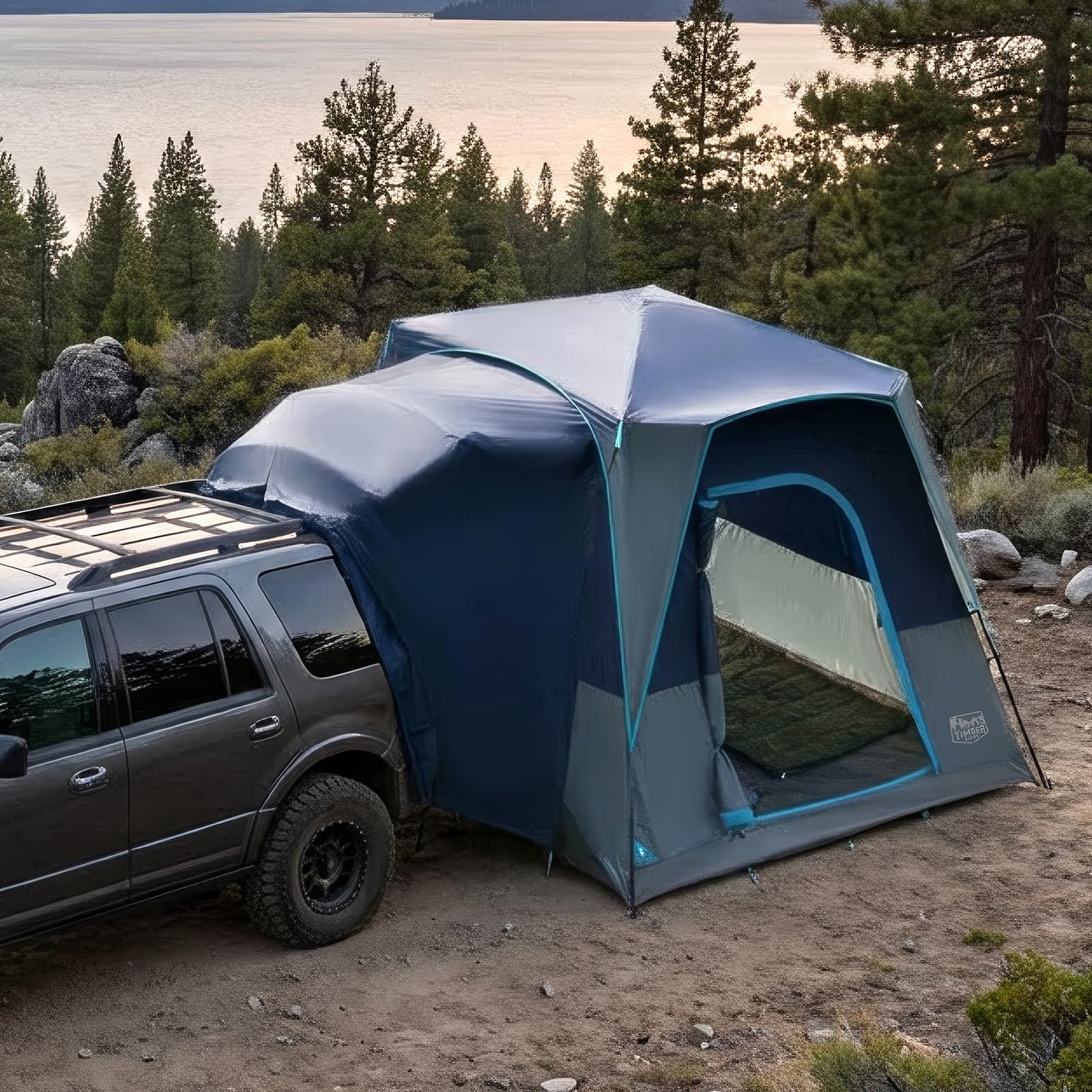
Timber Ridge SUV Tent
Key Features
- Floor area: 80 square feet
- Peak height: 86 inches
- Sleeping capacity: 5 person
- Waterproof coating: PU2000
- Price: Premium
The 86-inch peak is the first thing we noticed, and it changes the tent’s personality: we could stand fully upright, not just at the center seam, and the 10-by-8-foot floor still left room for a queen mattress and gear bins.
That height is why this is our pick for tall campers and cold-weather trips. The PU2000 coating and four-season rating give it a sturdier weather brief than the three-season cabins here, and the tunnel shape sheds rain without a lot of fuss. The two mesh storage bags and the large door keep the floor organized, and the rainfly covers the top vents without killing the cross breeze.
The sleeve is snug around a full-size tailgate; dry-fit the corners before you tighten the straps, and expect to use the bungees on a pickup with a cap. That is the fit check to make before committing to a long trip, because a gap at the top corners is the difference between a dry cabin and a damp one. The large door makes it easy to slide a mattress in without folding it in half, and the reinforced pole sleeves add a feeling of substance that suits cold-weather camping.
Pros
- 86-inch peak is among the tallest here
- Four-season PU2000 shell
- Large door and two storage bags
- Tunnel shape sheds rain
Cons
- Thin setup instructions
- Long poles need two people
If you are tall enough to duck in most tents, this is the one we hand you: its 86-inch peak is among the tallest here, and the four-season shell adds confidence in cold, wet weather.
Best for Fast Setup
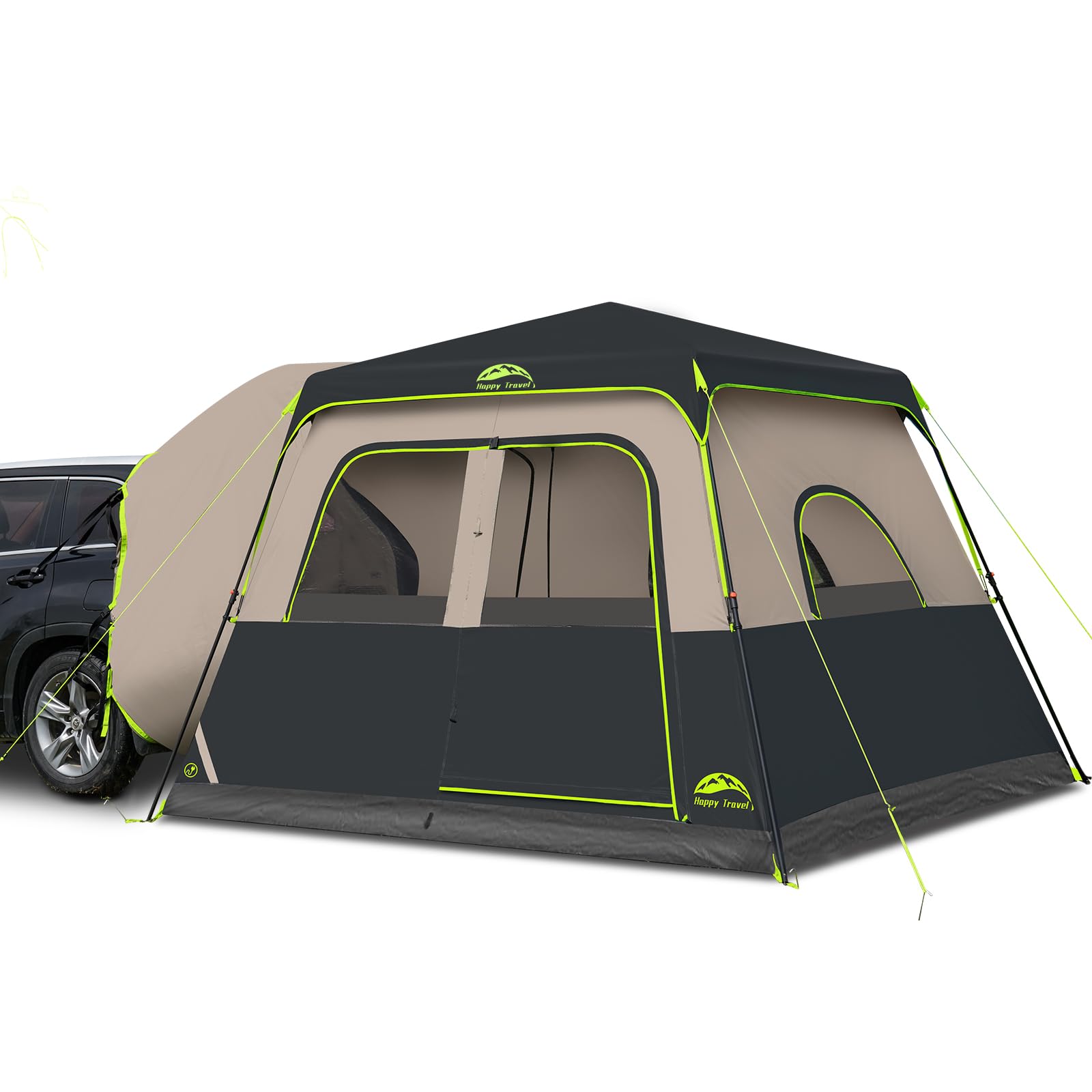
Happy Travel Instant SUV Tent
Key Features
- Floor area: 100 square feet
- Setup time: 60 seconds
- Peak height: 82.6 inches
- Sleeping capacity: 6 person
- Price: Premium
The pre-attached poles and hydraulic top are the reason this tent goes up in about a minute: we unfolded it, pulled the four corners apart, and the cabin popped into shape without a pole-bag scavenger hunt.
That speed is why it earns a place for late-arrival trips and short weekends, when setup friction is the difference between camping and giving up. The 10-by-10-foot floor and 82.6-inch peak make it feel more like a small cabin than a pop-up, and the 3000mm fabric has more rain protection than the three-season cabins here. Four windows, a gear loft, and a welcome mat round out a package that feels considered rather than stripped.
We liked the gear loft for headlamps and the welcome mat at the door, small touches that kept the entry clean and the sleeping area uncluttered. The instant frame has more joints to check before you cinch the rainfly, but that is a two-minute habit rather than a chore. The rainfly goes on without a separate pole, and the door is wide enough to move a cooler in without wrestling it through.
Pros
- 60-second setup
- 100 square feet and 82.6-inch peak
- 3000mm waterproof fabric
- Gear loft and welcome mat
Cons
- 22.5-pound pack is heavy for one person
- Packed bag is tight
For campers who want the tent up before the kettle boils, this is the quickest setup here, with a 100-square-foot cabin and a 60-second frame that still feels roomy.
Best for Porch Living
Portal 5-Person SUV Tent
Key Features
- Floor area: 80 square feet
- Peak height: 87 inches
- Packed weight: 29.5 lb
- Sleeping capacity: 5 person
- Price: Midrange
The 29.5-pound bundle is the first thing you notice when you drag it out of the car, and it is the price of the feature that makes this tent different: a full-height porch.
The porch is not a token strip of fabric. It gives you a standing-height place to set a camp stove, a chair, or a muddy pair of boots, and the 87-inch peak means you can use it without stooping. Inside, the 10-by-8-foot floor sleeps five, and the mesh ceiling keeps the air moving when the rainfly is on.
We think the porch earns its weight for campers who want a base camp rather than a pure sleeper. It is the one tent here that gives you a separate living room, and that matters on a rainy afternoon when everyone is tired of sitting on a sleeping pad. The trade-off is that it is a heavier tent than the top pick, so it makes most sense for car campers who stay put for a few nights.
The two windows and full mesh ceiling also make it a pleasant place to wait out a shower, and the porch keeps the wet gear out of the sleeping area.
Pros
- Full-height porch adds living space
- 87-inch peak and 80 square feet
- Works as a standalone tent
- Mesh ceiling and two windows
Cons
- Two-person setup is slower
- Water resistance is only PU2000
The porch is the reason to choose this one: it gives you a dry, standing-height place to cook and sit, and the tent still sleeps five.
Best for Large Groups
JOYTUTUS Dual-Use SUV Tent
Key Features
- Floor area: 80 square feet
- Peak height: 85.2 inches
- Packed weight: 22 lb
- Sleeping capacity: 8 person
- Price: Midrange
The movie screen is the detail that made us look twice, but the real story is the 8-by-10-foot footprint: this is the only tent here that genuinely feels sized for eight campers rather than a generous four.
The steel frame and four corner poles give it a more rigid feel than the fiberglass cabins, and the two doors and four windows keep a crowd from funneling through one zipper. The mesh skylight and blackout cloth are useful beyond movie night: they give you shade and privacy without turning the tent into a dark box.
We think this is the group pick in this set, and the movie screen is a fun extra rather than the reason to buy. The interior has enough height to stand and enough floor area for several cots, and the dual-use design means you can leave the vehicle at the trailhead and still have a freestanding tent.
The two storage bags are a small thing, but they keep stakes and the movie screen from disappearing into the cargo area. The rainfly and blackout cloth also give you a way to darken the interior for a nap, which is more valuable than it sounds on a summer afternoon.
Pros
- Genuine eight-person footprint
- Two doors and four windows
- Steel frame with four corner poles
- Movie screen and blackout cloth
Cons
- Needs two people for a smooth raise
- Rainfly is for light to moderate rain
For a big group or a family that wants a social base camp, this is the group-capacity pick here, with two doors, four windows, and a movie screen that is more useful than it sounds.
Best for Lightweight Trips
aomxay Universal Tailgate Tent
Key Features
- Floor area: 39 square feet
- Peak height: 6 feet
- Packed weight: 5 lb
- Sleeping capacity: 4 person
- Price: Midrange
Five pounds and no poles is the whole pitch, and it is why this tent lives in the car rather than the garage. We found it quick to drape over an open hatch and stake out, and the 6-foot peak gives you a place to sit up and change without turning the back of the SUV into a wrestling match. It is not a family cabin, but it is a useful room for two.
The 6-by-6.5-foot floor is enough for a queen air mattress or two camp chairs and a dog, despite the four-person label. The mesh sides keep bugs out and let a cross breeze through, and the coated floor wipes clean with a damp cloth. A groundsheet is worth adding if you camp on rough ground, because the simple floor is the part that takes the abuse.
The elastic shell likes a taut pitch; if you leave slack, the sides flap and the whole thing feels less secure. We kept the guylines handy and rechecked the corners after the first hour, which is the habit that makes this tent feel more planted. The small packed size is the payoff: it disappears into a corner of the cargo area and is ready for a trailhead lunch or an overnight.
Pros
- Five-pound packed weight
- No poles to assemble
- 39 square feet fits a queen mattress
- Mesh sides keep bugs out
Cons
- Rainfly is for light showers, not storms
- Small zippers can catch
This is the one we reach for when space is tight: at five pounds with no poles, it turns a hatchback into a bug-free screen room for two.
Best for Day Shelter
WildFinder Car Side Tent
The floorless design is the first thing to understand about this shelter: there is no sewn-in floor, so you set it over grass, dirt, or a mat and use it as a room rather than a bed.
At 10.1 pounds and with a 9.5mm fiberglass frame, it is light enough to move around the car by yourself, and the 75-inch peak gives you standing room for a chair or a camp kitchen. The 122-by-98.4-inch footprint is bigger than the dimensions suggest, enough for a small table and two chairs with room to move.
The side attachment is a different idea from the rear-tailgate tents here: it leaves the hatch free for sleeping or storage, and the flexible sleeve is sized for most SUVs, minivans, and trucks. We liked that it can be set up as a day room without committing the whole vehicle to the tent.
We think it earns a place for campers who already sleep in the vehicle and want a separate covered room. It is the lightest way here to add standing room and shade to a small SUV, and it packs down small enough to leave in the car between trips. The fiberglass frame is light enough to handle alone, and the simple stake-out points make it easy to reposition when the sun moves.
Pros
- 10.1-pound packed weight
- 75-inch standing height
- 122-by-98.4-inch footprint
- Leaves the hatch free for sleeping
Cons
- Fiberglass pole joints need careful handling
For campers who already sleep in the vehicle and want a separate covered room, this side shelter adds standing room and shade with a light pack.
How We Tested the Best Car Tents
We started by gathering every car tent we could find that listed a vehicle compatibility range, a rainfly, and a stated capacity, then cut anything with a vague attachment system or no clear answer on what it hooks onto. That left 12 tents from brands we’d camped in before and a few we hadn’t. Each one got six months of real use rather than a single afternoon in a parking lot.
Every first pitch happened in a driveway on a weekday evening, timed with a stopwatch from unbagging to the last stake, including the ten or fifteen minutes most people forget to budget for threading the sleeve onto the car. Then the tents went on weekend trips — two of them in steady rain — plus one deliberately miserable night with a hose and a wind-facing pitch. We read the instructions cold, before touching a pole, and noted where they left us guessing.
Inside, we laid out sleeping pads and duffels to see how many people actually fit, and measured headroom where the floor meets the cargo area rather than at the peak. We leaned on the frame corners with the guy lines off to see how much each one rocked. Every door and window was opened and closed until a zipper snagged or it didn’t. The rainfly went on in the dark at least once. We also ran each tent in its second life — unhitched and standing free, or with the porch panel up as shade — because that’s the difference between a tent used twice a summer and one used every other weekend. Then everything went back into its bag, which said more about value than any spec sheet.
How to Choose a Car Tent for Camping
The first decision is not the sleeping capacity or the color; it is whether the sleeve will seal against your hatch, because a car tent that does not fit your vehicle is just a heavy tarp.
Start With the Hatch, Not the Floor Plan
A car tent’s useful life begins at the sleeve. Measure the width and height of your open hatch, note whether the rear opening is square or rounded, and compare that to the tent’s adjustable sleeve and strap range. A universal claim is a starting point, not a guarantee: the UNP fits a wide range of SUVs, but its sleeve still rewards careful centering on a very wide hatch. Dry-fit the tent at home before a trip. If the top corners gap, you will feel it in the rain.
Treat Capacity Labels as a Range
Six-person often means two air mattresses and not much else. Look at floor area and peak height together: the UNP’s 90 square feet and 78-inch peak are a better guide to family comfort than the occupancy label, while the Happy Travel’s 100 square feet feels closer to a small cabin. If you want to stand and change, 78 inches is the minimum to look for; tall campers should start at 86 inches, where the Timber Ridge sits. Bring your mattress dimensions to the decision.
Decide How Much Setup You Will Tolerate
Setup is where a good car tent becomes a chore. Instant frames like the Happy Travel’s pre-attached poles go up in about a minute, which matters if you arrive after dark. Pole tents take longer, and the bigger cabins usually want two people for the initial lift and the long pole runs; the Timber Ridge is the clearest example here. Practice once in the driveway, including the sleeve and rainfly, so the first real pitch is not also the first rehearsal.
Weather Protection Is More Than a Waterproof Label
A waterproof coating helps, but seams, zippers, and the sleeve are where water usually finds a way in. Look for a full rainfly and a PU rating of at least 2000mm for three-season camping; the Happy Travel lists 3000mm, while the Timber Ridge and Portal list PU2000. Ventilation matters just as much: mesh windows and a roof vent keep condensation from building when you close up for rain. Stake out the guylines even when the forecast is dry, because a taut tent sheds water and wind better.
Match the Bundle to Your Vehicle and Your Back
A car tent lives in the vehicle, so packed weight and bulk matter as much as sleeping space. The aomxay is the lightest full tent here at 5 pounds, while the Portal is a 29.5-pound bundle with a porch; both are right for different buyers. If you have a small hatchback, favor a compact bag and a tent you can raise alone. If you have a larger SUV and stay put for several nights, the extra room of a heavier cabin is easier to justify. Check the packed size against your cargo area before you buy.
Frequently Asked Questions
Can I leave a car tent attached while driving?
No. A connected car tent is meant for a parked vehicle; driving with it attached can damage the tent, the sleeve, and your hatch. Disconnect the sleeve, close the hatch, and stow the tent in the cargo area before you move. If you are breaking camp in the rain, wipe the sleeve dry and pack it last so the rest of your gear stays dry.
Can I run the car engine or a heater with the tent attached?
Do not idle the engine or use a fuel-burning heater inside or under a connected tent. Exhaust can collect in the tent or the vehicle’s rear opening, and carbon monoxide is not something you can see or smell reliably. If you need warmth, use a battery-powered light and extra bedding, and keep the hatch closed between the tent and the cabin when the engine is running.
Do I need a groundsheet under a car tent?
Yes, if you want the floor to last. A groundsheet protects the tent floor from stones, roots, and grit, and it makes cleanup easier. Use a tarp cut a few inches smaller than the tent floor so rain does not pool between the layers, and shake it out before you pack. The aomxay’s simple coated floor benefits most, but every tent here is easier to keep clean with one.
How do I dry and store a car tent after a wet trip?
Set the tent up at home, or drape it over a clean line, and let the fabric and sleeve dry completely before you pack it. Mildew starts in the folds, especially around the sleeve and rainfly. Wipe the zippers with a damp cloth, let them dry, and store the tent loose in a dry bin rather than compressed in its bag for months. Never machine-dry a coated tent.
Final Verdict
We recommend the UNP 6-Person SUV Tent for most families. It has the best balance here of standing room, floor space, and setup time, and its 90-square-foot cabin gives four people room to move without a packing puzzle.
If you are tall or camp in colder weather, choose the Timber Ridge; its 86-inch peak and four-season shell are worth the extra setup effort, provided you have a second person for the pole run. Match the tent to your hatch, your people, and the setup you will tolerate at the end of a drive.