
This post contains affiliate links. We may earn a small commission when you buy through our links — at no extra cost to you.
There’s nothing more frustrating than finally reaching a scenic overlook, setting up your tripod, and finding that a slight breeze turns your shot into a wobbling mess. Many travel tripods are marketed as sturdy, but their lightweight legs and thin center columns often shake when the wind picks up.
This guide cuts through that confusion, picking tripods that balance portability with real-world stability. You’ll find models built to stay planted with a 70-200mm lens, as well as ultra-compact options that pack down to under 16 inches without sacrificing trustworthiness on uneven ground.
We also address the hidden trade-off nobody talks about: fluid-head video tripods that deliver silky pans are surprisingly heavy, so we’ve separated the true studio workhorses from the travel-friendly ones. By the end, you’ll know exactly which type matches your heaviest lens — not just your camera body.


Best for Travel & Vlogging
XXZU 75" Tripod
Key Features
- Maximum Height: 75 inches
- Head Type: Ball Head
- Load Capacity: 17.64 lbs
- Weight & Folded Size: 2.18 lbs, 14.17 in
- Price: Budget
The XXZU 75-inch tripod folds down to just over 14 inches and weighs under 2.2 pounds, making it one of the most packable full-height options at this price. For travel photographers and vloggers who need a reliable support that disappears into a daypack, this is the setup to beat. The Bluetooth remote is a practical addition for self-portraits and group shots, and the twist-lock legs deploy quickly without fuss.
At 75 inches fully extended, it provides eye-level shooting for most users without needing to hunch. The ball head offers smooth adjustment for composition, and the included phone mount covers the smartphone side. Over 11,000 buyers have put it through its paces, and the consistent feedback is that it handles mirrorless bodies and lightweight DSLRs with no drama — even moderate breeze won’t ruin a shot if you’re careful about setup.
Where this tripod earns its keep is for the shooter who values weight savings over absolute rigidity. If you routinely carry a 70-200mm f/2.8 or heavier glass into windy conditions, the lightweight legs will transmit vibration — that’s physics, not a failure. Similarly, the ball head can slip when you’re tilting a heavy camera downward under load; it’s a usability boundary, not a defect. For everyday mirrorless and phone work, these limits rarely come into play.
Pros
- Folds to 14.17 inches for easy daypack storage
- Bluetooth remote included for self-portraits and group shots
- 75-inch max height suits eye-level shooting for most users
- Sturdy enough for mirrorless and light DSLR kits in calm conditions
- Easy twist-lock leg deployment and quick setup
Cons
- Ball head may drift when holding a heavy lens at steep angles
- Light legs can wobble in gusty wind with telephoto lenses attached
Pack this tripod when weight and size matter more than absolute wind resistance — it’s the right tool for travel, vlogging, and everyday mirrorless shooting, not for heavy telephoto rigs in exposed conditions.
Best for Heavy Telephoto
NEEWER TP77
Key Features
- Maximum Height: 77 inches
- Head Type: Ball Head
- Load Capacity: 34 lbs (vert) / 11 lbs (tilt)
- Weight & Folded Size: 3.13 lbs, 19 in
- Price: Budget
The NEEWER TP77 stands out for its ability to support heavy telephoto lenses while still folding to a travel-friendly 19 inches. The detachable monopod adds flexibility for walking shots or secondary support, making it a rare do-it-all option at this price point. Compared to the more travel-oriented top pick, the TP77 prioritizes load capacity over ultralight packing—it’s heavier but far more capable with large glass.
This tripod suits DSLR and mirrorless shooters who regularly carry long lenses and want one support that can handle both studio and outdoor work. The ball head can struggle to lock at extreme tilt angles when loaded with heavy gear—a tradeoff worth noting for low-angle or overhead compositions. Plastic components on the leg locks and twist collars may show wear over time with frequent heavy use, which is a consideration for daily professionals rather than weekend shooters.
Pros
- Supports heavy telephoto lenses without sagging, even at full extension.
- Converts to a monopod in seconds, adding walking-stick stability for long exposures.
- Full 77-inch maximum height accommodates tall users without crouching.
Cons
- When tilting a heavy lens downward for low‑angle shots, the ball head can slip out of position.
- Plastic leg‑lock components may degrade over extended daily use in dusty or wet conditions.
The NEEWER TP77 delivers exceptional load capacity for its weight and price, making it a smart choice for photographers who carry heavy glass and want a single tripod that also serves as a monopod—just keep the ball head’s tilt limitations in mind for steep angles.
Best for Tall Photographers
K&F Concept 90" Tripod
Key Features
- Maximum Height: 90 inches
- Head Type: Ball Head (28mm)
- Load Capacity: 22 lbs
- Weight & Folded Size: 4.5 lbs, 21.3 in
- Price: Mid-Range
The K&F Concept 90-inch tripod stretches to a rare 90-inch maximum height, letting photographers over six feet frame at eye level without stooping. A horizontal arm swings the center column 90 degrees for flat lay photography, product shots, and real estate work — an angle the top pick’s travel-oriented design cannot match.
This tripod suits tall photographers who need full standing height, real estate pros capturing overhead views, and anyone who wants a detachable monopod for quick setup. However, it weighs 4.5 lbs and folds to 21.3 inches, so travelers counting ounces or trying to fit a carry-on backpack will find it cumbersome. The build quality and 28mm ball head hold up to 22 lbs securely, but the extra size is the price of that reach.
Pros
- Outstanding 90-inch height eliminates stooping for tall photographers and enables unique overhead angles
- Smooth 28mm ball head with solid, confidence-inspiring build quality
- Excellent value for a specialist tall tripod with horizontal arm
- Horizontal arm and detachable monopod add real shooting versatility
Cons
- At 4.5 lbs and a 21.3-inch folded length, it carries more weight and bulk than compact travel tripods, and may not fit smaller carry-ons
If eye-level framing without a stepladder or flat lay capability matters more than compact portability, this K&F tripod extends your shooting envelope without a premium price.
Best for Ultracompact Travel
K&F Concept 64" Tripod
Key Features
- Maximum Height: 64 inches
- Head Type: Ball Head
- Load Capacity: 17.6 lbs
- Weight & Folded Size: 2.53 lbs, 15.5 in
- Price: Budget
The K&F Concept 64-inch tripod stands out for its remarkably compact folded length of 15.5 inches, easily the smallest in its class. That extreme portability comes at the cost of a modest 64-inch maximum height — shorter than many full-size alternatives and potentially below eye level for taller users. At full extension, leg stability is less solid than bulkier tripods, so careful weight distribution matters with heavier gear.
This tripod suits backpackers and travelers who pack light, as well as vloggers using mirrorless or lightweight DSLR kits. The ball head and phone mount are functional for casual shooting, but the height limit makes it less practical for anyone over 5’10" or those needing eye-level framing. For its target audience, the tradeoff between size and reach is a fair exchange.
Build quality is good for the budget price, with leg locks and a quick-release plate that operate smoothly. The plastic leg clamps can feel less robust than metal ones, and occasional wobble has been noted when the center column is fully raised. Still, for the price, this tripod delivers a capable travel setup that outperforms expectations for its folded size.
Pros
- Folded size of 15.5 inches — fits in a backpack or carry-on
- Surprisingly stable for a tripod this lightweight under typical mirrorless loads
- Quick-release ball head and leg locks make setup fast
- Build quality punches above its budget price point
Cons
- Maximum height of 64 inches may be too short for users over 5’10" or anyone seeking eye-level framing
- At full extension, leg stability suffers especially with heavier lenses; plastic clamps may feel less durable
For travelers who value space savings above all, this tripod delivers a remarkably small folded size without sacrificing everyday usability for lightweight kits.
Best for Fluid Video Pans
NEEWER TP74
Key Features
- Maximum Height: 74 inches
- Head Type: Fluid Head
- Load Capacity: 17.6 lbs
- Weight & Folded Size: 10.9 lbs, 36 in
- Price: Mid-Range
Where many full-size tripods chase packability, the NEEWER TP74 stakes out the other end of the spectrum: a studio anchor built around a fluid head that delivers genuinely cinematic pans and tilts. The fluid drag mechanism lets you dial in precise resistance, so tracking shots flow without the stutter that mars ball-head video motion.
Build quality mirrors the head’s precision. The chassis stays planted even under a 17.6‑lb payload, absorbing minor bumps that would telegraph through lighter legs. Separate pan and tilt drag adjustments let you match the resistance to your lens and technique, and the quick‑release plate locks securely without wobble.
The trade-off is mass: at 10.9 lbs, this tripod is not leaving the studio or the car’s trunk without a shoulder workout. That weight is partly why it’s so stable, but it rules out hiking, run‑and‑gun vlogging, and carry‑on travel. Flip leg locks may arrive stiff; a few dozen cycles during setup breaks them in. For videographers who shoot interviews, events, or product demos in controlled spaces, the TP74 offers motion smoothness that normally costs far more.
Pros
- Tank-like stability keeps even heavy cine rigs vibration‑free
- Fluid head pan and tilt drag is silky-smooth for professional‑looking movement
- Professional build and materials at a fraction of cinema fluid‑head prices
Cons
- Flip leg locks can feel stiff out of the box — a short break‑in cycle resolves it
- At nearly 11 lbs, the tripod is impractical for hikes or air travel; best for permanent setups
A studio video workhorse that brings cinema‑smooth pans within reach of serious hobbyists and pros — provided you never need to carry it beyond the parking lot.
Best for Still Photography
CAMBOFOTO 74" Tripod
Key Features
- Maximum Height: 74 inches
- Head Type: Pan Head
- Load Capacity: 8.8 lbs
- Weight & Folded Size: 2.8 lbs, 20.5 in
- Price: Budget
The CAMBOFOTO 74-inch tripod uses a pan head with separate locks for tilt and pan, letting you adjust each axis without disturbing the other. That distinguishes it from the travel-friendly top pick, which uses a ball head. The independent controls suit photographers who frame landscapes, architecture, or product shots methodically. The head movement is stiff rather than fluid — fine for stills but noticeable when tracking motion.
This tripod is light enough at 2.8 lbs to carry on a day hike, yet reaches 74 inches fully extended. It works with phones, mirrorless cameras, and even small projectors. But with a heavy DSLR and telephoto lens, leg wobble can appear — especially at full height. The pan head’s stiffness also means video pans will be jerky, not smooth. Buyers who shoot mostly stills and want a full-size tripod without spending much will find it suits their needs.
Setup is quick: flip-leg locks and a center column that raises in seconds. The included phone mount and Bluetooth remote add casual convenience. Build quality feels solid for the price — no creaking or loose joints out of the box. For a photographer who values independent head control and needs a lightweight, full-height tripod for outdoor stills, this is a sensible choice.
Pros
- Separate pan and tilt locks allow precise framing without cross-axis drift
- Lightweight 2.8-lb body makes it easy to carry for outdoor shoots
- Compatible with cameras, phones, and small projectors out of the box
- Quick setup with flip-lock legs and center column
Cons
- Pan head motion feels stiff, producing jerky pans for video recording
- Stability can waver with heavy DSLR bodies or long telephoto lenses at full extension
A capable still-photography tripod that prioritizes composition control over video smoothness — best for shooters who don’t need fluid pans.
Best for Lightweight Video
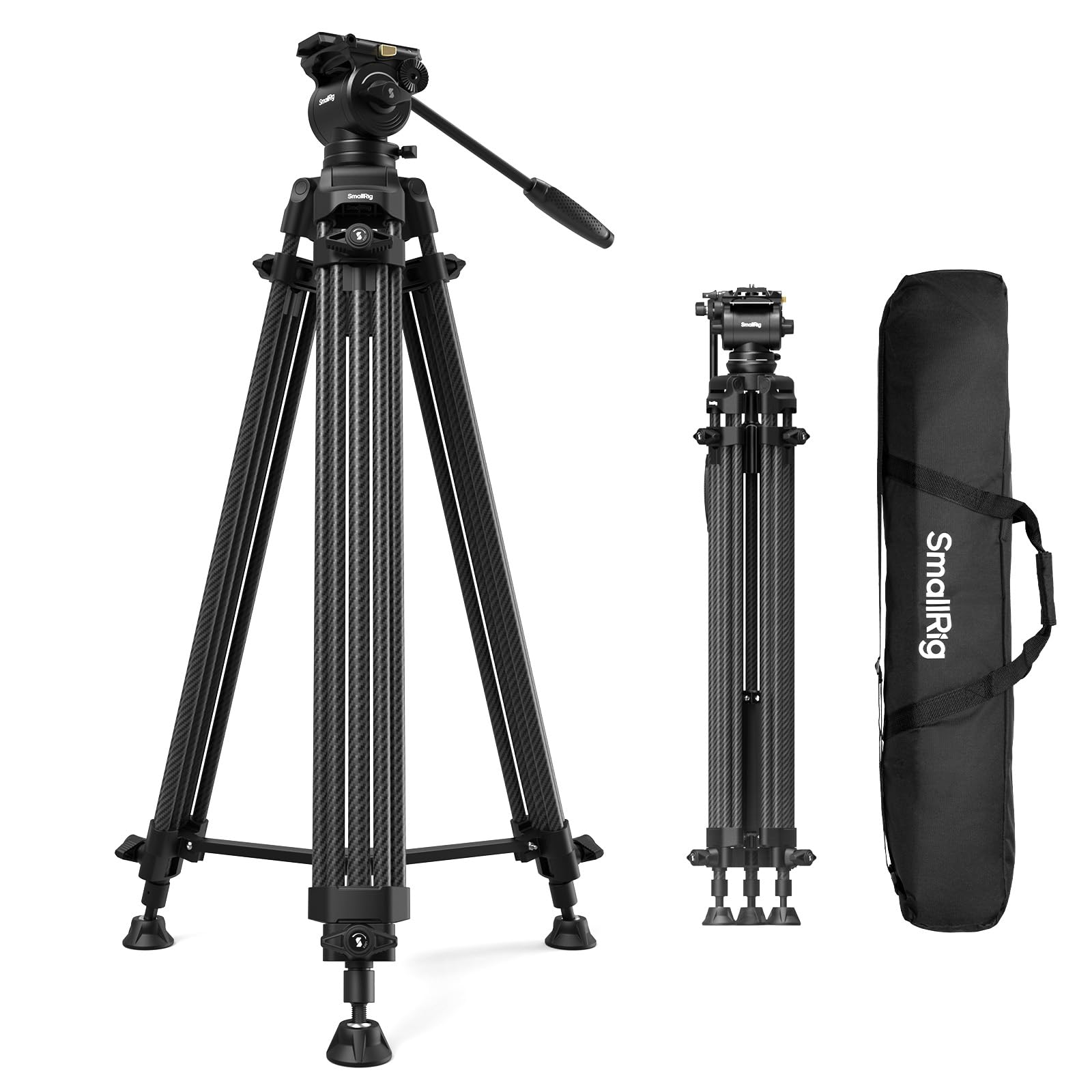
SMALLRIG CF 73"
Key Features
- Maximum Height: 73 inches
- Head Type: Fluid Head
- Load Capacity: 22 lbs
- Weight & Folded Size: 6 lbs, 34 in
- Price: Mid-Range
The SmallRig CF 73" pairs a carbon fiber chassis with a fluid head at 6 lbs—a rare combination that yields smooth panning and tilting for video work without the back strain. Fluid damping is ready to go, and the 22-lb capacity comfortably handles mid-weight rigs. However, the long-term resilience of the carbon fiber legs and the consistency of the fluid mechanism after prolonged daily use remain open questions. For shooters who need a lightweight video tripod and can accept that its track record is still being written, this is a compelling mid-range gamble.
Pros
- Carbon fiber legs keep total weight down to 6 lbs for easier carry and setup.
- Fluid head delivers well-damped pan and tilt movements straight out of the box.
Cons
This tripod fits videographers who need a light, fluid-damped setup for run-and-gun shooting and can accept that its long-term durability hasn’t been established outside of initial use.
Best for Heavy Video Studio
NEEWER 79" Video Tripod

Key Features
- Maximum Height: 79 inches
- Head Type: Fluid Head
- Load Capacity: 17.6 lbs
- Weight & Folded Size: 12.4 lbs, 35.8 in
- Price: Mid-Range
The NEEWER 79-inch Video Tripod anchors a camera with tank-like stability and a fluid drag head that delivers cinematic panning for stationary video work. Its 17.6 lb payload handles full DSLR rigs without drift. The 12.4 lb heft rules out any notion of portability; this tripod lives where you set it up. For a studio that never moves, that mass translates to rock-solid footing and vibration absorption that lighter tripods can’t match. The panning smoothness may vary slightly between units, but the core value in a dedicated studio setup is hard to beat.
Pros
- Heavy‑duty stability that absorbs vibration and keeps a heavy camera locked in place
- Smooth fluid head operation enables controlled cinematic pans and tilts
- Outstanding value for a studio‑grade fluid‑head tripod
Cons
- Panning drag can feel uneven on some units, affecting slow-motion starts
- Over 12 lbs; only practical for a permanent studio position
A dedicated studio camera support that stays put and delivers fluid head performance at a mid-range price — worth the stationary tradeoff if portability isn’t part of your workflow.
Best for Compact Travel
Manfrotto Befree Advanced

Key Features
- Maximum Height: 59.45 inches
- Head Type: Ball Head
- Load Capacity: 8.8 lbs
- Weight & Folded Size: 3.51 lbs, 15.8 in
- Price: Premium
The Befree Advanced folds to just 15.8 inches, making it an effortless choice for carry-on travel. Manfrotto’s aluminum construction feels reassuringly solid, and the included carrying bag adds to its travel-ready nature. At full extension, the tripod reaches 59.45 inches, which is shy of the 60-inch eye-level mark for many adults—you’ll need to stoop slightly. The ball head’s friction can be stiff out of the box, and the quick-release plate mechanism can jam, slowing setup.
Pros
- Premium aluminum construction delivers sturdy, confidence-inspiring support
- Folds to an ultra-compact 15.8 inches with a padded carrying bag for carry-on convenience
Cons
- Maximum height of 59.45 inches falls just below the 60-inch full-size mark, requiring a slight stoop
- Ball head friction can feel overly stiff, and the quick-release plate may jam, delaying quick setup
For travel photographers who prioritize packability and don’t mind working a few inches below standard eye-level, the Befree Advanced offers premium build quality in an extremely compact package.
How to Choose
A tripod’s real-world stability—especially in wind—depends more on leg diameter, head lock strength, and center column stiffness than on its rated load capacity.
Maximum Height
Every time you raise the center column, you create a top-heavy lever that amplifies vibration. The most stable setup uses a tripod whose leg height alone reaches your eye level, with the column down or only slightly extended.
If you’re over 6 feet tall, a 64-inch tripod forces you to stoop and can cause backache after a long shoot. Look for models that reach 72–77 inches without the column, and save the column for fine-tuning—not as a primary height gain.
Head Type
Ball heads use a single locking knob for quick adjustments but can drift under heavy tilt loads when the friction isn’t perfectly matched to your gear. Pan heads split control into independent pan and tilt locks—ideal for precise stills but too stiff for smooth video.
Fluid heads use internal oil or cartridge damping to deliver cinematic pans and tilts. The hidden cost is weight: they add 5–8 lbs and turn a travel-ready kit into a studio anchor. If you shoot mostly run-and-gun video, a ball head with software stabilization often works better than a heavy fluid head.
Load Capacity
A 15-lb load rating means the tripod can hold that weight vertically with legs fully extended and column down. Tilt the camera 45 degrees with a long lens, and the torque on the head can be 3–4 times greater—causing ball heads to slip.
Double your heaviest lens-body combo weight when choosing a tripod, and pay close attention to whether the head locks securely at extreme angles. A 34-lb vertical capacity doesn’t guarantee a locked 70-200mm f/2.8 at a steep tilt will stay put.
Weight & Folded Size
Ultralight aluminum or carbon fiber reduces fatigue but cuts inertia, making the setup more susceptible to wind shake. A 14-inch folded length might require 5-section legs, which are thinner and wobblier than the thicker 4-section legs of an 18-inch package.
For travel, packed size matters more than weight alone—nothing sours a hike like a tripod that won’t fit in a carry-on. Sweet spot for flying: 2.5–3.5 lbs and a folded length under 18 inches. In windy conditions, hang a camera bag from the center column hook to add ballast without carrying a heavy tripod.
Leg Locks & Stability
Flip locks are fast to deploy but plastic versions can crack after months of use, while twist locks resist sand and dirt better but may loosen gradually in rough handling. The leg tubing and lock material dictate long-term reliability just as much as the head.
Check whether the locks are all-metal or use plastic internals—this single detail separates tripods that last five years from those that wobble after one beach trip. Studio users can prioritize speed with metal flip locks; outdoor shooters in sandy environments should lean toward sealed twist locks.
FAQ
Why does my tripod wobble when I use a telephoto lens?
Long lenses shift the center of gravity forward and create a lever that magnifies tiny vibrations. Most budget ball heads can’t clamp hard enough at extreme angles to counteract that torque. Choose a tripod with a tilt-tested load capacity at least double your heaviest lens-body combo, and never extend the center column more than strictly necessary.
Can a lightweight travel tripod really support a DSLR with a 70-200mm lens?
It can, but only in calm, controlled conditions. Lightweight legs have low mass and stiffness, so even a moderate breeze can induce shake that blurs your shot. If you regularly shoot with a 70-200mm outdoors, look for a model with a weight hook to hang ballast, or step up to the NEEWER TP77’s 34-lb payload and thicker legs.
What’s the difference between a ball head and a fluid head for video?
A ball head moves in all directions from one locking point, so pans almost always show stutter unless you use slow-motion post-processing. A fluid head uses oil or mechanical damping to produce smooth, consistent movement even at slow pan speeds—but it weighs five times more. For serious video work, the fluid head is essential; for mixed-use travel, a ball head with in-body stabilization is the practical compromise.
How do I stop my tripod from tipping over in wind?
First, avoid extending the center column—it transforms your tripod into a sail on a pole. Lower the legs to their widest angle and hang a heavy camera bag from the center column hook to lower the center of gravity. For persistent breezes, position one leg directly downwind and, if you’re using a travel tripod, add weight directly over that leg.