
This post contains affiliate links. We may earn a small commission when you buy through our links — at no extra cost to you.
A cooler is only as good as the walk you have to carry it. I’ve parked as close to the sand as I could get and still arrived with dead arms and drinks that had already given up, and that’s the exact gap a backpack cooler fills: the weight rides on both shoulders, your hands stay free for chairs and kids, and the ice gets a fighting chance. What separates a good one from a leaky bag with a logo comes down to the zipper, the seams, and whether it still stands up on its own when you set it down full.
Over the past eight months we’ve lived with 12 of them — beach days, tailgates, hikes, and the unglamorous Saturday grocery run — and the differences showed up fast. Start with the can counts, which assume cans and nothing else: no ice, no food, no room for the sandwich you actually brought, so shop by usable space rather than the number on the tag. The picks below are the ones that held their cold, didn’t leak in the trunk, and still looked respectable after a season of getting dragged around — bags I’d happily pay for again.


Best for All-Day Outings
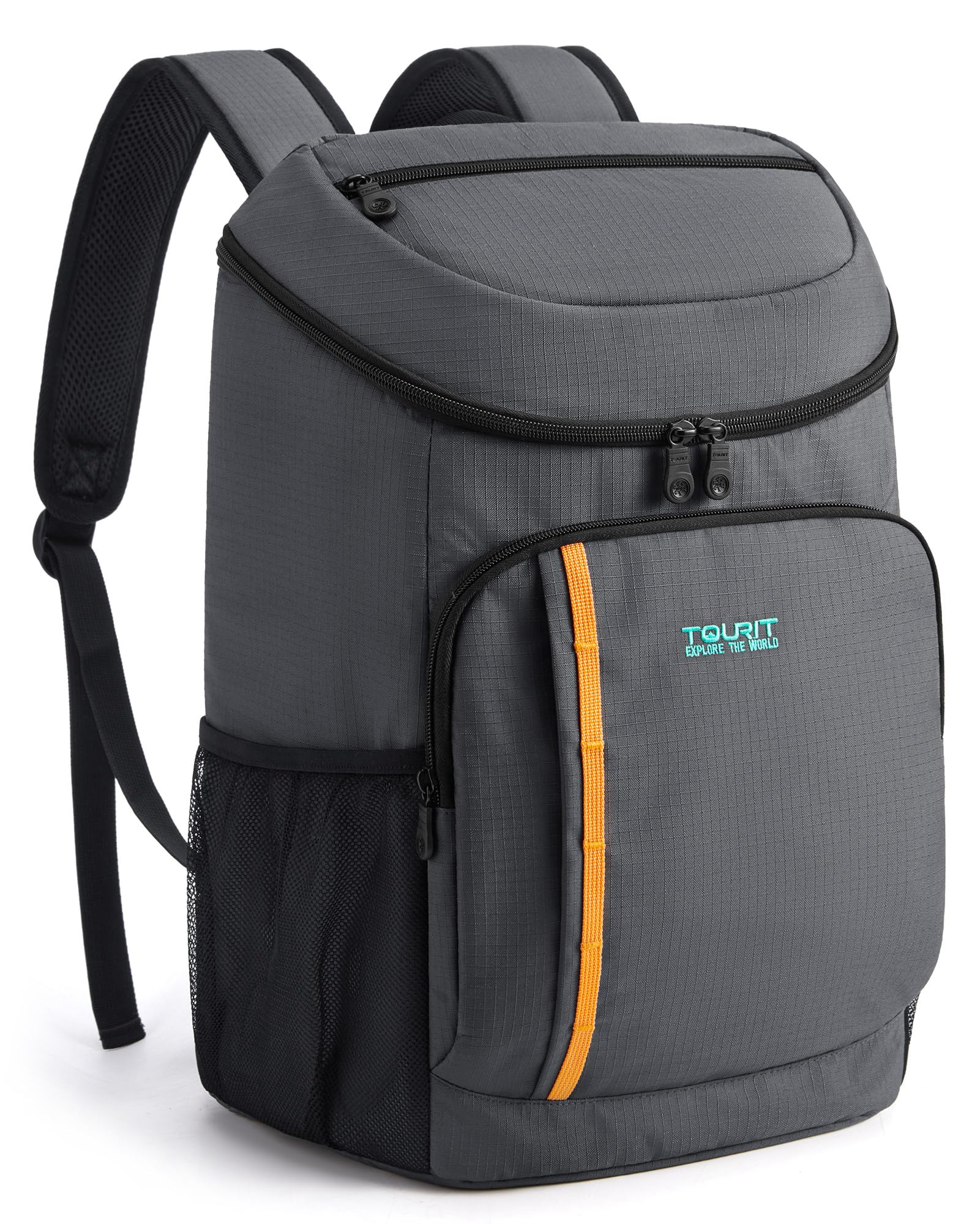
TOURIT 30-Can Cooler Backpack
Key Features
- Cans: 30 cans
- Capacity: 28 liters
- Dimensions: 13 x 7.5 x 17 inches
- Empty weight: 1.1 lb
- Price: Midrange
Twenty-eight liters at 1.1 pounds is the pairing that won this bag its place: a day’s drinks and lunch for two, on something you barely notice on your shoulders until it’s full. The 13-by-7.5-by-17-inch body sits close to your back instead of swinging behind you, which is exactly what you want on the walk from the parking lot to the sand.
The layout is the other reason we kept reaching for it. A main compartment takes the ice and the cans, two mesh side pockets swallow a big water bottle, two zipped front pockets take keys and a phone, and there’s a bottle opener on the strap. The shell is 600-denier Oxford over high-density foam with a welded liner, and it held cold drinks cold through a long afternoon in the sun.
The liner is leakproof; the zipper isn’t, and that’s where a soft cooler gives up. Tip this one on its side with melting ice and you can end up with a damp back seat. Frozen bottles or ice packs instead of loose ice, kept upright in the car, and you’ll likely never see it. The 24-month warranty is one of the longer ones here, and it covers the kind of seam or zipper failure that would otherwise be the end of the bag.
Pros
- 28 liters at just 1.1 pounds
- Six pockets plus a bottle opener on the strap
- Holds cold through a long afternoon
- 24-month warranty
Cons
- Lining and front pockets wear first
- Hand wash only and slow to dry
Buy it if you want one light, roomy bag for a day out with two people; it’s the best balance of capacity, weight, and price in this group.
Best for Beach and Boat
YETI Hopper M20 Backpack Cooler
Key Features
- Size: M20
- Closure: Magnetic MagShield
- Capacity: 2741.61 cubic inches
- Dimensions: 9.9 x 15.3 x 18.1 inches
- Price: Premium
This is several times the price of anything else on this list, and that’s the first decision, not the last. What the money buys is the thing every other bag here fights: a closure that isn’t a zipper. YETI’s MagShield uses magnets to seal the top, so there’s no toothed seam for meltwater to find, and the opening stays where you put it instead of gaping.
For a beach day or a boat day, where the bag sits in the sun, gets dragged around, and a cooler full of ice water is a genuine problem, we think it earns that. ColdCell foam and the DryHide shell are built for scrapes and UV, and the HitchPoint grid on the front takes YETI’s add-on pouches if you want a bottle opener or a dry box on the outside. It’s also the biggest bag here by volume, which is good news for a family and less good on a crowded trail.
It isn’t frictionless. The magnetic top needs a firm two-handed pull when the bag is loaded, and it doesn’t hinge wide, so getting ice into a full bag is fiddly — the kind of thing you notice every time for a week and then stop noticing. What you’re paying for is the closure and the cold, and neither has an equivalent on this page.
Pros
- Magnetic closure seals without a zipper
- ColdCell foam and a puncture-resistant shell
- HitchPoint grid takes YETI add-ons
- Largest capacity in this group
Cons
- Costs several times the rest of the list
- Top is stiff to open when loaded
Worth it if you’re hard on coolers and tired of a wet back seat; skip it if spending several times the rest of the list will make you baby the bag.
Best for Long Hikes
Maelstrom 35-Can Cooler Backpack
Key Features
- Cans: 35 cans
- Capacity: 32 liters
- Dimensions: 12.87 x 8.97 x 18.72 inches
- Empty weight: 15.2 oz
- Price: Midrange
There’s a bottle opener riveted into the shoulder strap of this bag, and a small survival whistle on the sternum strap. Neither is a reason to buy a cooler. Both are a sign that someone thought about the walk and not just about the packing.
The numbers are the argument. Thirty-two liters on a 15.2-ounce frame makes this the lightest of the big bags here, and the back panel and shoulder straps are thickly padded and ventilated in a way the cheaper bags aren’t. There’s a buckle above the right mesh pocket to stand a wine bottle upright, two spots on top for condiment bottles, and the usual spread of zipped pockets for keys and a phone. Maelstrom rates it at 16 hours of cold.
We take this one on real trails rather than parking-lot picnics, and the padding is why — with a full load of drinks on your back, the straps are the whole experience. Water at the zipper is the one dimension where we rank it below the TOURIT, so this is a bag to keep upright in the trunk rather than lay flat under a seat.
Pros
- Lightest of the big bags here
- Padded, ventilated back and shoulder straps
- Bottle opener plus a wine-bottle buckle
- 16-hour cold rating
Cons
- Zipper seeps if the bag rides on its side
- Tall 18.7-inch body — check an airline sizer
The one to take when you’re the person carrying everything: 32 liters of space, padded where it counts, and light enough to stay comfortable on a long walk.
Best for Two People
RTIC 15-Can Backpack Cooler
Key Features
- Cans: 15 cans
- Capacity: 5.63 quarts
- Empty weight: 1.6 lb
- Ice retention: Up to 24 hours
- Price: Midrange
If your cooler day is two people, a short walk, and lunch, this is the bag we hand over first. Fifteen cans, 5.63 quarts, 1.6 pounds empty — small enough to carry by the top handle when the strap is overkill, and light enough that bringing it doesn’t feel like a decision.
RTIC rates it for up to 24 hours of cold, the longest claim in this group, and the heavy-duty polyester and high-density insulation are why it doesn’t feel like a tote bag with a liner. Mesh side pockets hold a bottle each and the lid has an interior pocket for keys and a phone. What 15 cans means in practice is a handful of drinks and a couple of sandwiches: if you’re feeding four, take the TOURIT or the YETI instead.
Pros
- 15 cans at 1.6 pounds
- Up to 24 hours of cold
- Mesh side pockets and a lid pocket
- Slim enough to stash behind a seat
Cons
- Costs more per can than the big bags here
- Shortest warranty here at 90 days
The right small cooler for two people and an afternoon: light, genuinely cold, and honest about how little it holds.
Best for Food and Drinks
SPARTER 33-Can Backpack Cooler
Key Features
- Cans: 33 cans
- Capacity: 21 liters
- Empty weight: 1.1 lb
- Ice retention: Up to 20 hours
- Price: Midrange
Two insulated compartments, stacked: drinks and ice in the bottom, sandwiches and fruit and a phone up top. That’s the whole idea of this SPARTER, and 21 liters split that way makes a different bag from 21 liters in one wet cavity.
We like it for picnics where you actually pack food, because the alternative is a single compartment where everything tastes faintly of cooler water by noon. The insulation is 8mm foam under a silver PEVA liner rated for up to 20 hours, the whole bag weighs 1.1 pounds, and there’s a bottle opener on it. For the money, this is the most usefully organized bag here.
Two things to know before you order. SPARTER’s own listing is unusually honest that the zipper isn’t leakproof — true of nearly every bag on this page, so plan on ice packs and keep it upright. And the shoulder strap and top handle are the parts that let go on bags like these over time; the lifetime warranty is the backstop that makes it a fair bet rather than a gamble.
Pros
- Two insulated compartments, cold below and dry above
- Up to 20 hours on 8mm foam
- 1.1 pounds empty at 21 liters
- Lifetime warranty
Cons
- Strap and top handle wear first
The pick if your cooler carries lunch as well as drinks: the split keeps sandwiches dry, and it costs about what the plain bags here do.
Best for Flying with Gear
SINVICKO Double Deck Cooler Backpack
Key Features
- Capacity: 30 liters
- Material: 1680D nylon
- Dimensions: 12 x 6.6 x 17.3 inches
- Compartments: Double deck
- Price: Midrange
There’s a band across the back of this bag sized for a rolling suitcase handle, and that one detail changes how you travel with a cooler. The bag rides on your roller through the terminal instead of hanging off your shoulders, which is the difference between arriving fresh and arriving sore.
Thirty liters of space, 1680D nylon on the outside, a PEVA liner inside, and a split double deck — cold in the bottom, dry in the top. The 12-by-6.6-by-17.3-inch body is close enough to a personal-item limit that we’d measure it against your airline’s sizer before committing, and it’s hand wash only, so a spill means a day of drying with the top propped open.
We pick this one for a drive-and-stay trip or a flight where the cooler is your second bag. It behaves like luggage rather than a beach accessory, and 30 liters means the drinks and the dry snacks travel together without a second tote.
Pros
- Luggage strap rides on a roller bag
- 30 liters with a cold-and-dry split
- Heavy 1680D nylon shell
- Holds cold through a work day
Cons
- Seams wear under heavy daily loads
- Slumps and won’t stand up when empty
Buy it if the cooler has to travel like luggage: the pass-through strap and tall shell make it the easiest bag here to wheel through an airport.
Best for Big Picnic Loads
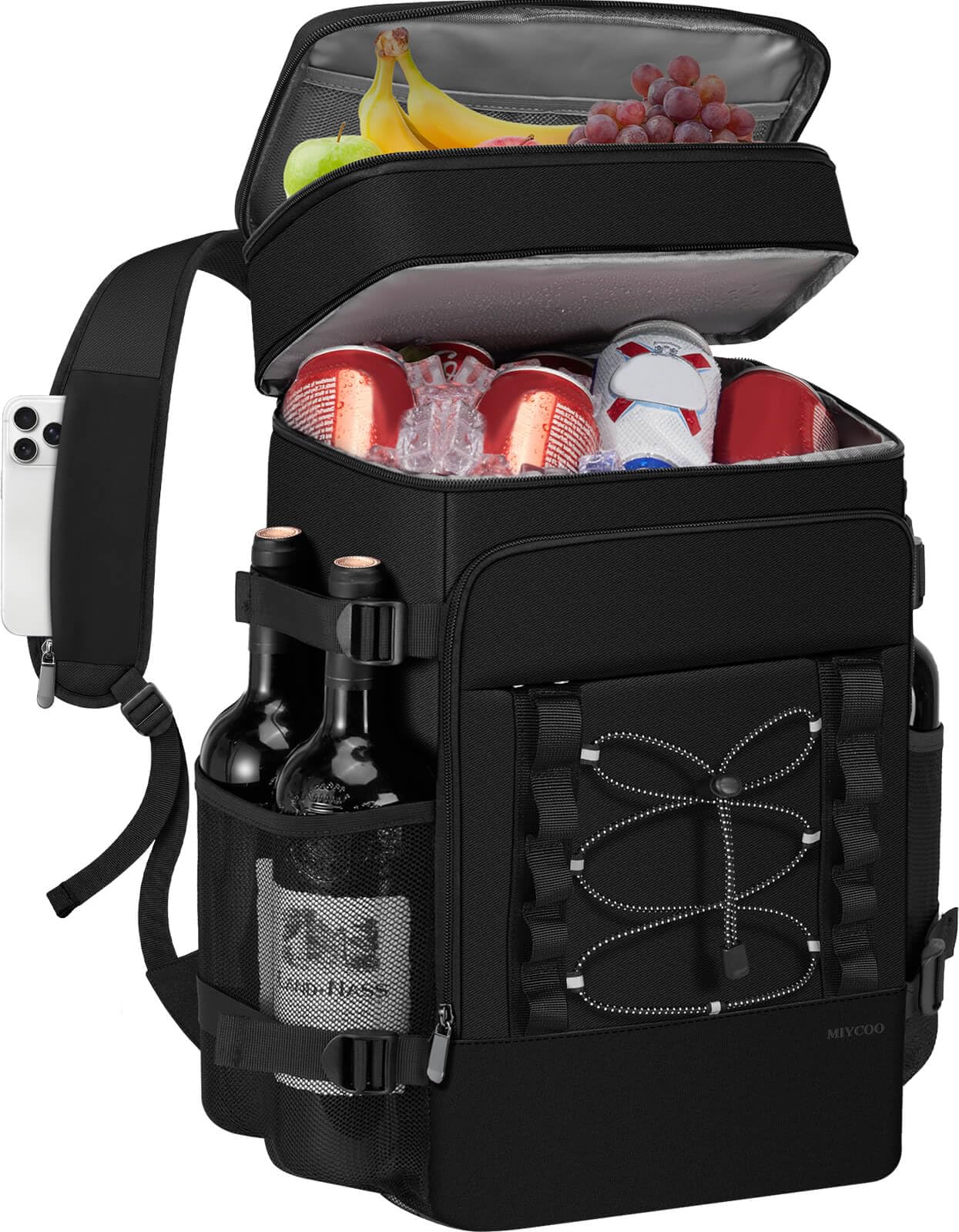
MIYCOO 40-Can Cooler Backpack
Key Features
- Cans: 40 cans
- Capacity: 28 liters
- Dimensions: 11 x 8.6 x 15.7 inches
- Compartments: Two
- Price: Budget
Forty cans is the claim on this MIYCOO, and 28 liters is what you’re actually packing — a big capacity rating on a mid-size body. Ice takes a bite out of that, as it does on every bag here, but you’re still getting more cans per liter than anything else on this list.
The interesting part is the pair of side straps. They’re adjustable and they hold a bottle upright on each side, which is more than most cooler backpacks manage — bottles usually end up lying in the ice or rattling loose in a pocket. Add a bottle opener on the strap, two compartments so the dry food stays dry, and a zipped pocket for valuables, and the layout is genuinely thought through.
At 11 by 8.6 by 15.7 inches it’s the shortest bag here, a foot and a half of height instead of the 17- and 18-inch bodies elsewhere, so the weight sits lower on your back and it slides under a seat more easily. If you’re tall, that shorter shape is a little less comfortable over a long walk.
For the money this is a lot of cooler: a big rating, a bottle-friendly layout, and a cold half that stays cold through an afternoon. We take it over a plain single-cavity bag at the same price. Just don’t treat 40 cans as a target to fill.
Pros
- Most cans per liter here
- Side straps hold two bottles upright
- Two compartments keep dry food dry
- Bottle opener on the strap
Cons
- Seams and inner lining fail under overload
- Leaks at the zipper once ice melts
A lot of cold storage for the money if your trips run car to picnic table; the seams are the part to keep an eye on.
Best for Commuting to Work
LTINVECK Double Deck Cooler Backpack

Key Features
- Cans: 30 cans
- Pocket: RFID-lined
- Capacity: 20.67 liters
- Dimensions: 12 x 6.5 x 17.3 inches
- Price: Midrange
An RFID-lined pocket is a strange thing to find on a cooler backpack, and it tells you what this bag thinks it is: a commuter pack that keeps lunch cold. The pocket takes cards, a passport, or a phone, and it’s shielded so the data on them can’t be read through the fabric.
Underneath that it’s a 20.67-liter double-decker — a dry top half for keys, a phone, and a paperback, and a PEVA-lined bottom half that takes 30 cans’ worth of lunch. The 12-by-6.5-by-17.3-inch body is slim enough to sit against your back without pulling you off balance.
It’s a bag for a shift rather than a beach: lunch, a few drinks, and the things that normally live in your pockets, in one bag instead of two. On a construction site or a long shift, that consolidation is the whole appeal.
We like it best when the cooler genuinely doubles as your work bag. If it’s a party cooler instead, the split costs you cold space you’d rather have, and the extra pockets don’t earn their keep.
Pros
- RFID-lined pocket for cards and passport
- Cold below, dry above
- 30 cans in a 20.67-liter body
- Holds cold through a work day
Cons
- Top half collapses into the bottom when one side is empty
- Zippers are the first thing to give
The best fit here for someone who wants one bag for the commute and the job site, with a shielded pocket for cards and a passport.
How We Tested Backpack Coolers
Research came first: we compared stated capacities, liner and zipper construction, strap design, and how each bag was meant to be carried, then set aside anything too small to hold a day’s worth of food or so bulky it defeated the point of wearing it. From that pool we bought 12 coolers outright and used them as our only cooler for eight months.
Cold retention got the most attention. Each bag was loaded the same way — roughly two-thirds drinks, one-third ice, plus a container of real food — then parked in a hot trunk, left on open sand, and kept at a campsite overnight. We checked meltwater and felt the cans every time we opened it, including on the bags that promised all-day cold.
Leak testing was deliberately unkind. We filled each cooler with water and ice, zipped it shut, laid it on its side on the driveway for an hour, then ran a hand along every seam and the fabric underneath. Zippers were opened and closed dozens of times, and again after a season of sand and grit, to see which ones started catching or splitting. We also packed each one to around 25 pounds, set it down on pavement to see whether it stood or slumped, and carried it two miles to judge whether the straps cut in.
For capacity we packed an actual picnic for four instead of a tidy grid of cans — the point where most advertised counts fell apart — and noted how much usable room was left once ice and food went in. We recorded how easily each bag opened one-handed while still wearing it, whether the outer pockets were reachable mid-walk, and how the fabric looked after months of wiping down and being dragged through parking lots. Then we weighed all of it against what each bag cost.
How to Choose a Backpack Cooler
Nearly every disappointment with a backpack cooler comes down to two numbers and one seam: the can count, the empty weight, and the zipper that lets the meltwater out.
Can counts assume no ice
Capacity is usually quoted in 330ml cans, and that number describes cans alone — no ice, no ice packs, no lunch. Add ice and a 30-can bag holds noticeably fewer, which is why we treat the rating as a ceiling rather than a packing list. Work backwards instead: if you need 20 cold drinks for the day, buy a bag rated around 30 cans, and go up another size if food is coming too. A full bag also holds cold better than a half-empty one, so dead space is the enemy.
The liner holds water; the zipper doesn’t
Nearly every bag here has a welded or heat-pressed liner, and that part genuinely keeps water in. The zipper is a gap in the wall, and it’s where meltwater escapes once the bag lies on its side in a trunk. SPARTER’s own product copy admits as much about its own bag. The fix is behavioral: frozen bottles and ice packs instead of loose ice, the bag upright on the floor of the car rather than flat on a seat, and a quick look at the bottom before you pick it up. The YETI is the one bag here that sidesteps the problem, because its magnetic top has no zipper at all.
Empty weight is the number you feel
1.1 pounds empty reads like a footnote until you’re carrying 30 pounds of drinks and ice up a hill, and then the padding in the straps matters more than the shell does. Structured bags carry well when loaded but weigh more before you put anything in them. If you’re walking more than a few blocks, look for a ventilated back panel, wide shoulder straps, and a strap that clips across your chest. If the bag goes kitchen to car to picnic table, skip all of that — for a picnic, we take the lighter bag every time.
One cavity or two
A single compartment holds the most ice and the most cans for its size, because it is one cold space and everything inside it gets cold. Two compartments buy you a dry half for sandwiches, a phone, and a jacket, at the cost of cold volume — and sometimes at the cost of structure, since a loaded top half can sag into the bottom. If food and drinks travel together, the split earns its keep. If you’re hauling drinks for a crowd, one big cavity serves you better.
Frequently Asked Questions
Is a backpack cooler better than a hard cooler?
It depends on how far you have to carry it. A hard cooler wins on ice retention over a long hot day, and nothing here matches a rotomolded box sitting in the back of a truck. But if the cooler has to travel a quarter mile from the car to the sand, the backpack wins by default: a cold bag you actually carried beats a cold box you left behind. For tailgates where the cooler stays put, buy the hard cooler.
How long will a backpack cooler keep drinks cold?
The bags here claim between 16 and 24 hours, and those figures assume a full bag, a closed lid, and shade. Real days run shorter because every opening lets the cold air out. Pre-chill the drinks and the bag, fill the empty space with ice or frozen packs rather than leaving air in it, and keep it out of direct sun, and you’ll get a full afternoon comfortably. A half-empty bag on a hot beach is the worst case.
Can you take a backpack cooler on a plane?
Yes, as your carry-on or personal item, but size it before you commit. Most U.S. airlines publish a personal-item limit around 18 by 14 by 8 inches, and the taller bags here measure 17 to 18.7 inches, which gets tight once they’re packed out. Freeze your ice packs solid before security, since slushy ones tend to get pulled for screening. Empty, the bag folds down and packs inside a suitcase for the trip home.
How do you clean a backpack cooler so it doesn’t smell?
Hand wash it — a machine cycle wrecks the insulation and the liner’s seal. Wipe the interior with mild soap and warm water, rinse with a damp cloth, and dry it fully open and upside down in the shade rather than in direct sun. Never store it zipped shut: leave the top open with a dry cloth inside so air moves through, and the sour smell that settles into soft coolers never gets started.
Final Verdict
We take the TOURIT 30-can bag. It’s the best balance here of room, weight, and price, it holds a day’s food and drinks for two, and the 24-month warranty covers the seam failures that would otherwise end the story.
If a wet back seat is the thing you can’t live with, the YETI Hopper M20 is the only bag on this list that closes without a zipper, and the premium buys real peace of mind on beach and boat days. If it’s two of you and an afternoon, carry the RTIC 15 and keep the change.