
This post contains affiliate links. We may earn a small commission when you buy through our links — at no extra cost to you.
Shopping for a first birthday often means choosing between flashy electronic toys that promise learning and simpler classics that might not seem as exciting. But many parents find the talking books and musical ride-ons lose their voice after a few tumbles, while the quiet blocks and rocking horses stay in rotation for years. The gap between marketing and real toddler life is wide.
A great gift for a 1-year-old doesn’t just light up—it withstands the drop test, fits small hands, and rewards curiosity without frustrating fine motor limits. This guide focuses on toys that balance engagement with everyday durability, and it flags the design quirks (short pull strings, loose lids, jam-prone mechanisms) that turn play into tears.
Whether you’re after a bilingual vocabulary builder, a first balance bike, or a classic shape sorter that won’t spill everywhere, these picks match how 1-year-olds actually play. Each one earned its spot by surviving the real-world toddler gauntlet, not just the product demo.




Best for Bilingual Learning
LeapFrog 100 Words Book
Key Features
- Age Range: 18–48 months
- Durability: Withstands drops, toddler handling
- Educational Value: 100+ words, bilingual, letters, colors
- Interactive Elements: Touch pages, sounds, lights, star button
- Size & Storage: 9.4" wide, 9.2" high
- Price: Mid-Range
Every page offers a new discovery: press a picture to hear the word, a fun fact, or the animal’s sound. A sliding switch toggles instantly between English and Spanish, letting the same book serve both languages. The hard plastic casing has survived drops from table height and enthusiastic toddler handling without cracking, and the light-up star button adds a sensory reward that keeps little fingers exploring.
This is built for the 15-to-36-month window when vocabulary begins to explode, but the bilingual mode extends its usefulness for families raising multilingual children. The occasional unit may develop lower volume or audio inconsistencies over time, and heavy daily use can drain AA batteries faster than expected. For most households, the core touch-and-learn experience holds up well through the intended age range — just be aware that sound quality isn’t identical on every copy.
Pros
- Bilingual English/Spanish vocabulary with 100+ words across categories
- Durable plastic build withstands drops and rough toddler handling
- Engaging sounds, light-up star, and fun facts hold attention during quiet play
Cons
- Sound quality can vary between units; occasional volume loss has been noted
- Battery life may be shorter than expected under heavy daily use
The most balanced first interactive book for a 1-year-old’s vocabulary growth, bilingual family needs, and daily handling — just keep a spare set of AA batteries nearby.
Best for Pretend & Social Play
LeapFrog Shapes Picnic Basket
Key Features
- Age Range: 6 months–4 years
- Durability: Survives rough handling
- Educational Value: Shapes, colors, manners, sharing
- Interactive Elements: Voice recognition, music, lights
- Size & Storage: 15-piece set, basket
- Price: Mid-Range
Unlike vocabulary books that drill words, this picnic set turns early learning into a social ritual—passing out plates, matching food shapes, and hearing cheerful “please” and “thank you” prompts. Voice recognition and songs reinforce shapes and colors as toddlers host their own picnics, building social-emotional skills alongside cognitive ones.
The 15-piece set suits pretend-play lovers who learn through imitation and sharing, not page-tapping. The shape-sorting slots are tight, so very young toddlers may need a guiding hand, but that help is short-lived as motor skills improve. It’s a standout choice for first birthdays and tea-party fans.
Pros
- Adorable picnic theme sparks endless tea-party role play for toddlers.
- Songs and voice prompts teach shapes, colors, and polite phrases like ‘please’ and ‘thank you’.
- Durable construction withstands drops and rough handling by active one-year-olds.
Cons
- Shape-sorting slots can be tight, demanding precise alignment that frustrates very young children.
If your little one lights up at tea parties, this musical picnic set teaches shapes and manners through play—just be ready to lend a hand with the puzzle pieces early on.
Best for Vehicle Pretend Play
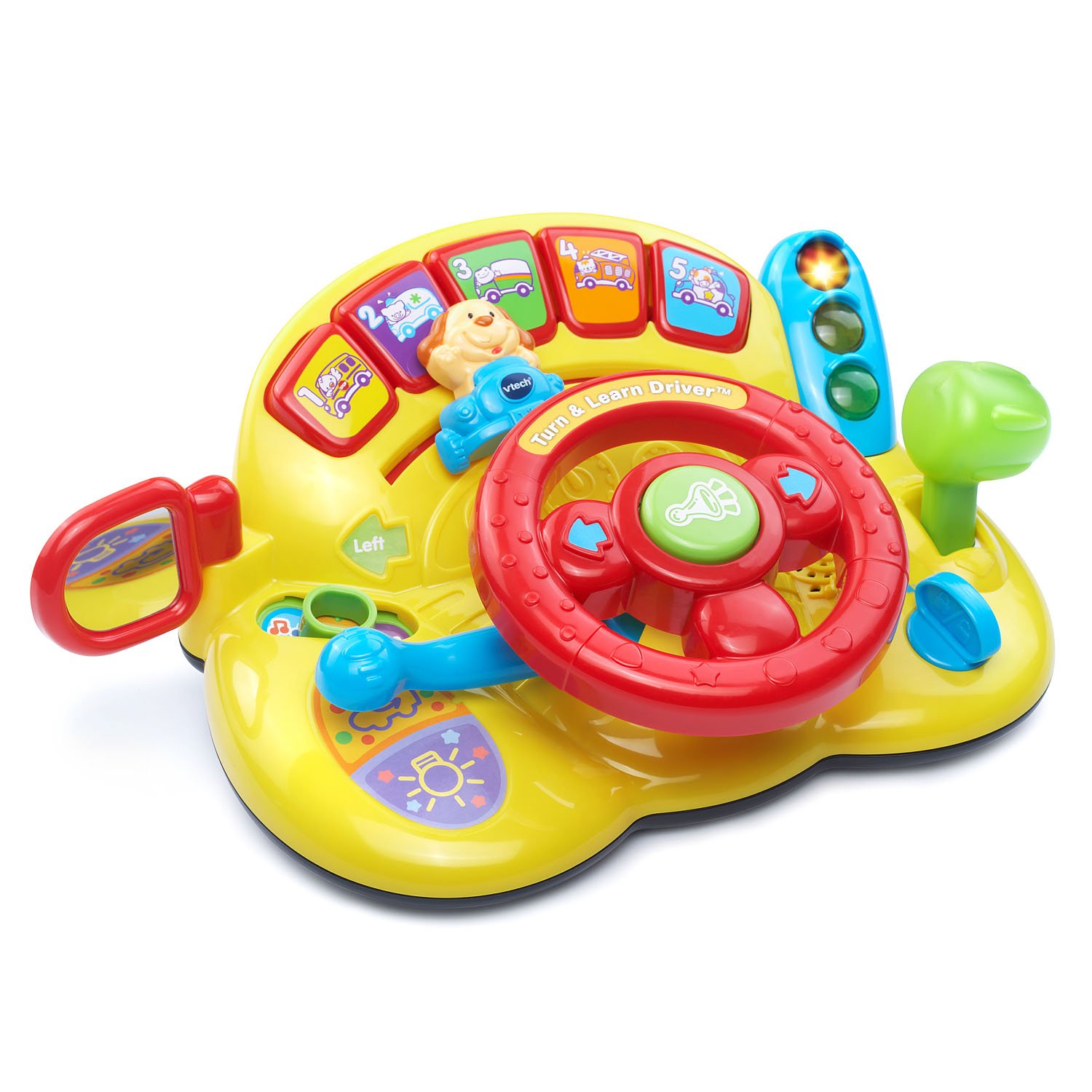
VTech Turn and Learn Driver
Key Features
- Age Range: 6–36 months
- Durability: Survives drops, sturdy
- Educational Value: Animals, vehicles, colors
- Interactive Elements: Steering wheel, horn, gear shift, 3 modes
- Size & Storage: Compact floor toy
- Price: Mid-Range
Unlike the push-and-go dump truck in this set, the VTech Turn and Learn Driver is a stationary steering-wheel cockpit that lights up, beeps, and responds to every twist and press. Turn signals, a gear shift, horn, and rear-view mirror create a dashboard experience that holds a baby’s attention from tummy time through sitting play. Multiple modes teach animals, vehicles, and colors while the build withstands drops. The volume has a low setting but can still feel sharp in quiet rooms. It lacks any strap to attach to a high chair or stroller, so it stays on the play mat. This is a strong first-birthday gift for a vehicle-loving child whose family can accept electronic sound and doesn’t need on-the-go attachment.
Pros
- Lights, steering wheel, gear shift, and horn keep a baby engaged for long stretches.
- Works from tummy time through sitting play, and holds interest well into toddlerhood.
- Animal, driving, and music modes introduce vehicles, colors, and animals.
Cons
- Volume can be startlingly loud for quiet homes, even on the low setting.
- No strap to secure to a high chair or stroller, so it’s limited to floor play.
For a car-obsessed first birthday, this compact cockpit delivers engaging floor play that grows into toddler pretend driving — just keep it on the play mat, where the volume stays manageable.
Best for Budget Shape Sorter
Fisher-Price Baby’s First Blocks
Key Features
- Age Range: 6 months+
- Durability: Classic plastic, sturdy enough
- Educational Value: Shapes, colors, motor skills
- Interactive Elements: Non-electronic
- Size & Storage: 10 blocks + bucket, handle
- Price: Budget
The Fisher-Price Baby’s First Blocks offers a straightforward shape-sorting experience without any batteries or screens. Unlike larger building block sets, these blocks are sized for tiny hands and focus on matching shapes and colors.
This set suits parents on a budget who want a basic developmental toy for stationary home play. The lid does not lock, so blocks spill easily when carried—the bucket is best left on the floor or shelf rather than taken on outings.
Pros
- Encourages fine motor skills, shape recognition, and color matching in a single activity.
- Simple, distraction-free play keeps toddlers engaged without lights or sounds.
- Budget-friendly entry price for a classic developmental toy.
Cons
- When carrying the bucket by its handle, the lid may pop off and blocks scatter—fine for storage but not for travel.
A cost-effective shape sorter for home playrooms, but its loose lid makes it impractical for on-the-go use.
Best for First Balance Ride
SEREED Baby Balance Bike
Key Features
- Age Range: 12–24 months
- Durability: Aluminum frame, lightweight
- Educational Value: Balance, coordination
- Interactive Elements: Non-electronic, no pedals
- Size & Storage: 3.5 lbs, compact
- Price: Mid-Range
At 3.5 lbs with an aluminum frame and four non-slip wheels, this bike assembles in minutes without tools and lets a 12-month-old scoot confidently. Unlike models with light-up wheels, the SEREED prioritizes stability and balance training. Best for children 12-18 months on smooth indoor floors, the fixed seat means toddlers approaching 2 years or above average height may find it cramped.
Pros
- Assembles in under 5 minutes with no tools
- Four-wheel design gives toddlers confidence and promotes balance
- Lightweight frame makes it easy for a 1-year-old to maneuver indoors
Cons
- Fixed seat height can feel small for children approaching 18 months or above average height; outgrown quickly
For the youngest 1-year-olds, this is a functional first bike that builds balance without fuss — just keep the size limit in mind.
Best for Open-Ended Building
MEGA BLOKS First Builders Bag
Key Features
- Age Range: 12 months+
- Durability: Large blocks, sturdy
- Educational Value: Creativity, fine motor, color
- Interactive Elements: Non-electronic, open-ended
- Size & Storage: 150 pieces, zip storage bag
- Price: Mid-Range
The 150-piece bag unleashes open-ended building rather than the single-task play of a shape sorter. Toddlers grip the oversized blocks and create towers, bridges, or whatever comes to mind, then topple them with a delighted swipe. The zip-up storage bag holds everything neatly between sessions. With 150 pieces, the set spans from toddler to preschool years at a mid-range cost. The piece mix includes many 1×1 studs and fewer large plates, so taller structures can tip more easily for novices — this suits a child who loves the stacking and crashing process more than a stable final product.
Pros
- Blocks sized for small hands to grip and stack securely
- Open-ended building keeps toddlers engaged without screens
- Zip-up bag makes clean-up effortless and portable
Cons
- Tall towers can topple easily due to the abundance of 1×1 blocks and few baseplates
The Mega Bloks First Builders Bag is the screen-free building toy that grows with a child, ideal for parents who want creative play and tidy storage — just know that toddlers focused on building tall may need help or more baseplates.
Best for Classic Active Play
Little Tikes Rocking Horse

Key Features
- Age Range: 12–36 months
- Durability: Plastic, rare sharp seams
- Educational Value: Gross motor, balance
- Interactive Elements: Non-electronic
- Size & Storage: 33"L, 10"W, indoor/outdoor
This classic rocking horse builds balance and leg strength without batteries, and its no-assembly design has proven durable across generations. Pricing is currently unavailable, and a small number of units have been noted with sharp seams along the plastic edges, so a quick pre-gift inspection is wise.
Pros
- No assembly needed; lightweight yet sturdy enough for up to 50 lbs
- Wide base and low seat minimize tip-over risk for new sitters
Cons
- Occasional sharp plastic seams along edges; worth checking upon delivery
For families seeking a screen-free, active toy and who can check pricing on a current listing, this rocking horse remains a time-tested gift for 1-year-olds.
Best for Ball & Push Play
VTech Drop and Go Dump Truck

Key Features
- Age Range: 6–36 months
- Durability: Sturdy, survives throws
- Educational Value: Numbers, colors, cause-effect
- Interactive Elements: Balls, buttons, sounds, pull string
- Size & Storage: Truck, 3 balls
- Price: Mid-Range
The truck’s ball-dropping action and chunky buttons teach numbers, colors, and motor skills through satisfying, rumbly feedback. The pull string is shorter than ideal for upright walking, making it better suited to seated floor play where filling and dumping remain captivating.
Pros
- Ball-drop action with tumbling, rumbling sound rewards cause-and-effect play.
- Buttons teach numbers, colors, and build fine motor skills through active loading and dumping.
Cons
- Pull string forces toddlers to hunch when walking behind it, limiting upright mobility.
A strong interactive toy for seated play; if your 1-year-old wants to pull a truck while walking, the short string may frustrate.
Best for Fine Motor Practice
Fisher-Price Smart Stages Piggy Bank

Key Features
- Age Range: 6–36 months
- Durability: Durable plastic
- Educational Value: Numbers, animals, fine motor
- Interactive Elements: Coins, songs, door, low volume
- Size & Storage: Piggy bank, 10 coins
- Price: Mid-Range
The Smart Stages Piggy Bank introduces counting and animal sounds while 1-year-olds practice grasping and releasing the 10 colorful coins. Speaker output is subdued even at maximum, so responses can get lost amid background noise. It’s best for quiet, one-on-one play sessions where the low volume becomes a feature, not a frustration.
Pros
- Encourages grasping and releasing, strengthening early fine motor control and hand-eye coordination.
- Coin-dropping, door-opening, and 40+ songs keep toddlers entertained through short, focused play sessions.
Cons
- In busy playrooms, the maximum volume may be too quiet to compete with ambient noise, and some units produce a muffled tone.
If you’re gifting for a home that values quiet, focused play and a parent will be nearby to reinforce the learning, this piggy bank delivers fine motor and counting practice in a calm package.
Best for Light-Up Balance Bike
Gamfeiny Baby Balance Bike

Key Features
- Age Range: 10–36 months
- Durability: Carbon steel, sharp-turn instability
- Educational Value: Balance, coordination
- Interactive Elements: Light-up wheels (movement), silent
- Size & Storage: 4.6 lbs, compact
- Price: Mid-Range
The self-powered lights spark excitement, and assembly is genuinely tool-free in minutes. During turns, the bike can tip if a child leans sideways, so it’s only suitable for flat indoor surfaces under close supervision. This bike suits a first-birthday gift where the visual magic outweighs the need for a child to ride fully independently.
Pros
- Motion-activated light-up wheels need no batteries, creating instant visual delight.
- Snap-together assembly takes only a few minutes with no tools required.
Cons
- Stability can be compromised during sharp turns; a leaning toddler may tip sideways.
Best for supervised indoor scooting on hardwood or tile, where the light-up wheels turn a cautious child’s first ride into a delightful event.
How to Choose
The single most important factor in choosing a gift for a 1-year-old is whether the toy matches their current motor skills and frustration tolerance—not the age range printed on the box.
Age Range and Developmental Fit
Many toys labeled for 6 months and up require fine movements—inserting a coin, aligning a shape piece, or threading a food puck into a slot—that are still difficult for a one-year-old. A mismatch leads to meltdowns, not learning. Look for forgiving entry points: shapes that drop in from a wide opening, buttons that activate with a light palm press, and balls that tumble freely rather than needing a precise push.
If the child is just beginning to walk, ride-on toys and walkers with stable four-wheel bases build confidence, but those with a higher seat and narrow turning radius can tip during a typical lurch. Check the age span—many bikes and rockers fit best between 12 and 18 months, after which the child may outgrow the seat height or weight capacity.
Durability and Drop Survival
Electronic toys promise longevity but often fail after repeated drops onto hardwood or tile. Internal circuit boards and delicate speaker wires aren’t designed for the 20th high-chair launch. When a sound module dies, the toy loses its core learning value. Non-electronic options—blocks, rockers, stackers—have no such failure point.
Plastics vary, too. Thick-walled blow-molded pieces (like the Little Tikes Rocking Horse) survive years, while thinner snap-together components can crack. Examine user feedback for patterns: reports of “stopped working after two weeks” signal a durability gap, not a fluke.
Educational Value
Bilingual books and talking toys promise a head start on vocabulary, but muffled speakers or low maximum volume can make the words unintelligible. The LeapFrog 100 Words Book succeeds because its touch sensors and clear voice output deliver consistent audio feedback, but other talking toys struggle with clarity—defeating the educational purpose.
Shape sorters, block sets, and pretend play kitchens teach spatial reasoning and social scripts without any electronics. The learning happens through repeated manipulation and imaginative scenarios rather than scripted phrases. If you prioritize screen-free engagement, classic toys often provide deeper, longer-lasting developmental benefits.
Interactive Elements and Sound
Lights, songs, and buttons are a surefire way to capture a 1-year-old’s attention, but they can become a source of daily frustration when volume controls are inadequate. Some toys are piercingly loud even on the lowest setting, while others are so quiet they’re inaudible in a room with normal conversation. Parents frequently mention that a toy with a single volume level—loud—gets banished to the closet.
Additionally, interactive mechanisms like ball poppers and pull-along strings have mechanical parts that can jam or wear out. If the main gimmick fails, the toy becomes dead weight. Prioritize toys where the interactive element is backed by a simple, robust mechanism: a spinning wheel, a pop-up flap, or a chunky button with a solid switch underneath.
Size and Storage for Your Home
Parents often underestimate how much space a gift will occupy. A sports center or rocker needs a dedicated floor area, while toys with dozens of pieces demand a containment strategy. The MEGA BLOKS zip bag and the picnic basket’s self-contained design solve storage elegantly; a shape sorter with a loose lid guarantees scattered pieces under the couch.
If you travel frequently or the toy needs to move between rooms, look for built-in carry handles that actually stay closed. Several products on the market advertise a travel handle but have lids that pop off, creating a mobile mess rather than mobile convenience.
FAQ
What’s the best gift for a 1-year-old who likes cars and steering wheels?
The VTech Turn and Learn Driver is easily the favorite for vehicle-obsessed toddlers. It offers a realistic steering wheel, horn, gear shift, and turn signals with three learning modes that teach animals, colors, and driving concepts. It works best as a stationary floor toy—it doesn’t strap to a stroller, but it keeps a baby engaged during tummy time and independent sitting.
Is the LeapFrog 100 Words Book worth it if I only want English?
Yes, because its core strength—touch-sensitive pages that say words, play sounds, and offer facts—doesn’t depend on the bilingual switch. You can leave it in English mode and still get 100+ words, letters, and animal sounds with clear audio. The bilingual feature is a bonus with no downside, and the book’s durability and frustration-free packaging make it a standout gift regardless.
Why does my toddler’s shape sorter lid keep falling off?
On the classic Fisher-Price Baby’s First Blocks, the lid simply rests on top without a locking mechanism. It’s designed for easy removal so babies can dump and refill the bucket, but it also means blocks spill out when the toy is carried or tipped. This isn’t a defect—it’s a known trade-off—so the set works best on a play mat at home rather than on the go.
Do balance bikes for 1-year-olds really help with walking?
They help build core strength, balance, and the confidence to shift weight from foot to foot, all of which support walking. The four-wheel designs like the SEREED and Gamfeiny are stable on smooth indoor floors and let a pre-walker scoot without pedals. Supervision is key—turning sharply at speed can still cause a tip, so these bikes shine as a first ride-on under watchful eyes.
How can I make pull toys easier for my toddler to walk with?
Many pull toys come with strings shorter than 14 inches, forcing a hunched-over posture that’s unnatural for a 1-year-old still mastering upright walking. An easy fix is to tie a short ribbon or shoelace extension to the existing string, lowering the pull point. If you’d rather avoid the DIY, consider push toys with a stable bar or vehicles like the VTech Drop and Go Dump Truck that can be used seated or crawling.