
This post contains affiliate links. We may earn a small commission when you buy through our links — at no extra cost to you.
A 1-year-old baby boy is a delightfully messy collection of new skills: sitting, crawling, pulling up, maybe taking first steps. The right gift can support that journey, but pick wrong and you end up with a toy that gets ignored or drives you up the wall. The trick isn’t finding any toy labeled ’12+ months’—it’s matching the toy to your child’s actual mobility stage and your tolerance for noise, because many products are either too advanced or too loud for their age labels.
We’ve sorted through the top-rated options to highlight gifts that align with real developmental milestones, from sitting and cruising to first independent steps. Whether you need a quiet ride-on, a bilingual word book for language bursts, or a travel-friendly cause-and-effect toy for the car, there’s a pick that fits your little one’s pace—and your family’s lifestyle. No single toy is right for every 1-year-old, but focusing on where he is now—and where he’s headed next—makes all the difference.


Best for Early Cruisers
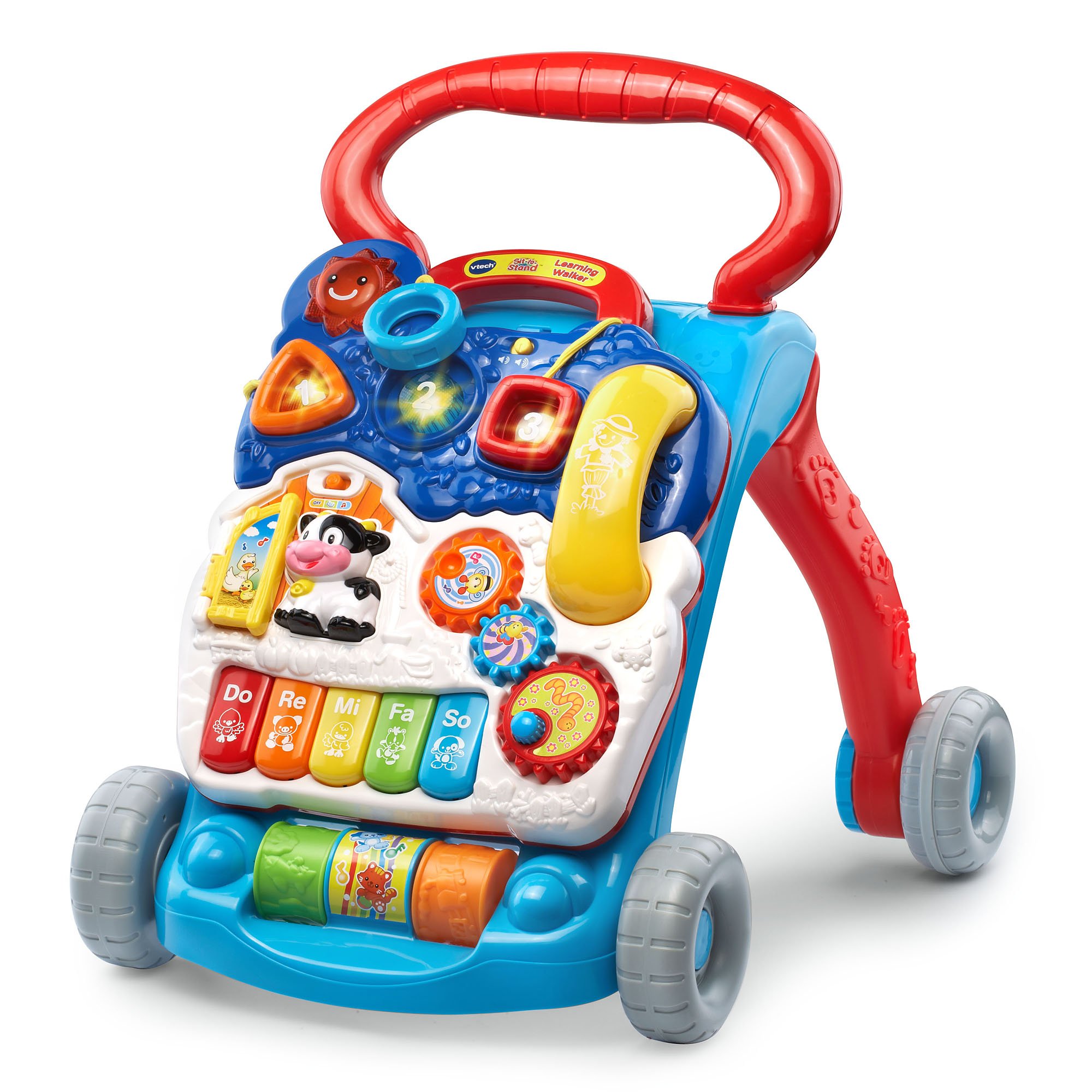
VTech Sit-to-Stand Walker
The VTech Sit-to-Stand Learning Walker transitions from a sit-down activity panel to a push walker, supporting a baby’s progression from floor play to cruising. The removable panel includes five light-up piano keys, shape sorters, and a telephone handset that introduce cause-and-effect and fine motor skills.
The walker’s two-speed control and sturdy base provide stability for new walkers, even on uneven floors, and the frame holds up to 35 pounds. Assembly requires no tools and takes minutes. The panel can be used separately for seated play, extending the toy’s usefulness beyond the walking stage.
This walker is designed for babies who are pulling up and starting to cruise, typically 9–12 months old, and who will continue using it as they gain walking confidence. The electronic sounds—melodies, songs, and sound effects—are repetitive and have only two volume levels, so families who prefer quiet play may find them intrusive. Detaching the panel for separate floor use reduces the noise and keeps the toy engaging for older toddlers.
Pros
- Supports multiple developmental stages from sitting to walking
- Removable activity panel keeps sitters entertained before they stand
- Sturdy build rarely tips even on uneven floors
Cons
- Songs and sounds can be repetitive for parents; only two volume levels mean it’s never truly quiet
A developmentally timed walker that matches a baby’s sitting-to-cruising phase, with the only tradeoff being the persistent electronic noise.
Best for New Walkers
SEREED Baby Balance Bike
Unlike sit-to-stand walkers that support cruising, the SEREED is for toddlers already steady on their feet. The lightweight aluminum frame and four non-slip wheels let one-year-olds practice balance and steering without pedals. Assembly requires no tools — the bike is ready in minutes.
This suits indoor use on hard floors or low-pile carpet. The narrow size means it’s outgrown by around 20 months, so it serves as a short bridge to a bigger bike, not a long-term ride.
Pros
- Helps walking one-year-olds build balance and steering confidence
- Four-wheel design and 135° steering limit prevent tipping
- Assembles in minutes with no tools required
Cons
- Short usable window — toddlers may outgrow it by 20 months, making it a brief transition toy
For a one-year-old already walking, this is a well-priced indoor balance bike that builds steering confidence before a larger bike. Just don’t expect it to last beyond the toddler’s second birthday.
Best for Bilingual Vocabulary
LeapFrog 100 Words Book
Touch each picture to hear 100+ words in English and Spanish, boosting vocabulary through songs and sounds. Unlike the activity-driven walkers and ride-ons, this book zeroes in on language development, making it a smart pick for families who want to introduce a second language early.
It works well for 12- to 24-month-olds who are ready to name objects, and for children in speech therapy who benefit from interactive audio feedback. Durable, tear-resistant pages survive eager page turns. Be aware that sound can cut out after battery changes on a small number of units, so it’s not a gift for households wanting a completely silent toy (it makes sounds and songs).
Pros
- Introduces 100+ words in English and Spanish through touch-to-hear interaction, building early vocabulary
- Tear-resistant pages survive rough toddler handling and can last through years of use
- Songs, lights, and sound effects hold a one-year-old’s attention and encourage independent play
Cons
- Sound may cut out after battery changes on some units
For a one-year-old’s language development, this bilingual book delivers high engagement and durability at a budget price. The small risk of sound failure after battery swaps is a manageable trade-off for its educational value, especially in bilingual or speech therapy contexts.
Best for Quiet Explorers
Radio Flyer Busy Buggy
Unlike the walker-focused top pick, the Busy Buggy adds ride-on play and 17 built-in sensory activities without a single battery. It transitions from push walker to scooter, engaging toddlers with gears, beads, and a horn while the under-seat storage holds small treasures. The decorative steering wheel doesn’t turn, so the buggy only moves forward and backward on wide, indoor floors—not a steerable ride-on. For parents seeking a quiet, multi-stage toy that combines movement and fine-motor play, it’s a strong alternative to pedal-less bikes that demand more balance than a newly walking one-year-old may have.
Pros
- Grows with child from push walker to ride-on scooter
- 17 engaging activities keep little hands busy
- Easy, tool-free assembly out of the box
Cons
- Steering wheel is decorative; the buggy only moves forward/backward
The Busy Buggy is a silent, multi-sensory ride-on that bridges the gap between cruising and scooting, particularly for families with open indoor spaces where straight-line play works well.
Best for Vehicle Lovers
VTech Drop and Go Dump Truck
Colorful rocks trigger counting phrases and rumbling sounds when pushed, making it a favorite for truck- and car-obsessed toddlers. Unlike the sit-to-stand walker that supports cruising, this dump truck is a floor toy — no assisted walking here. It’s ideal for babies working on fine motor skills and cause-and-effect play while seated or scooting. The compact, lightweight design makes it easy to bring to grandma’s house or keep in the living room. The pull string is short, so confident walkers won’t be able to pull it behind them comfortably — think of it as a push-along for crawlers rather than a pull toy.
Pros
- Dropping rocks triggers counting and rumbling, reinforcing cause-and-effect and early number skills.
- Withstands drops and throws from enthusiastic toddlers.
- Great value for a multi-feature push toy that’s a popular gift choice.
Cons
- The pull string is short, making it difficult for standing toddlers to pull the truck behind them.
A high-value cause-and-effect toy for car-obsessed crawlers and sitters — but once they’re walking, the short string limits its use as a pull-along.
Best for Cause & Effect
iPlay iLearn Press to Go Cars
Four chunky animal cars zoom forward with a satisfying press on the head, introducing simple cause-and-effect without a single screen, song, or battery. The action is immediate and rewarding enough to hold a baby’s attention on a hardwood or tile floor, but the friction motor doesn’t propel them far on carpet — unlike noisy electronic driving toys that demand batteries and volume control.
This set is a quiet, diaper-bag-friendly choice for travel, waiting rooms, or quick floor play. It suits babies still mastering the press-and-release motion, but the spring mechanism can weaken over time; occasional cars may stop propelling after minimal use. Best for households with hard-surface floors and a willingness to replace a dud.
Pros
- Simple push-and-go action even younger babies can activate.
- No small parts to lose or batteries to replace.
- Chunky cars fit small hands and slip easily into a diaper bag.
Cons
- A car may lose its spring action and stop propelling after minimal use.
Budget-friendly and blissfully quiet, this set is a low-risk gift for hard-floor play spaces, but expect that at least one car may lose its spring action.
Best for Animal Learners
Eric Carle Around the Farm Sound Book
Thirty large sound buttons trigger realistic animal noises that align with Eric Carle’s signature illustrations, helping toddlers link animal names to their sounds. This makes it a natural companion for quiet, language-building time, distinct from motor-focused toys. Buttons require a firm press—small hands may need adult help—and the paper pages can tear with unsupervised handling. It’s best given as a supervised reading activity for animal-loving toddlers who are starting to pick up first words, not as a solo-occupier for a baby who mouths everything.
Pros
- Realistic animal sounds delight toddlers and teach animal recognition.
- Beautiful, colorful Eric Carle illustrations hold a child’s attention.
- Educational design supports first words and animal name learning.
Cons
- Sound buttons require a firm push and may become less responsive over time.
- Paper pages can tear with rough handling by young toddlers.
For a one-year-old who loves animals and benefits from quiet, shared reading sessions, this book is a smart gift — provided an adult is there to press the buttons and handle the pages.
Best for Indoor Riders
Gamfeiny Balance Bike

Silent wheels glow without batteries as your toddler scoots, adding visual excitement to indoor balance practice. Tool-free assembly takes just a few minutes. The narrow size suits small toddlers early in walking, but the hard wheels and compact frame mean it’s outgrown by age 2, making it a shorter-lived ride than the SEREED balance bike.
Pros
- Battery-free light-up wheels engage toddlers visually
- Tool-free assembly takes just a few minutes
Cons
- Narrow frame is outgrown by 24 months
If a flashy, light-up indoor ride for a very young toddler appeals, this bike adds a fun twist, but plan on upgrading once walking is confident.
Best for Bath Distraction
ALASOU Suction Spinners

The spinners flick smoothly and hold attention during baths and mealtime waits. Suction is strong on wet surfaces but unreliable on dry walls or high chairs — they’re best kept in the tub. For a low-cost sensory distraction, the tradeoff is a toy that works within narrow surface conditions.
Pros
- Keep babies entertained during baths and highchair waits
- Spin smoothly and fast with a simple flick
Cons
- Stems can break at the connection point if thrown or dropped, separating the cup from the spinner body.
A budget-friendly bath toy that delivers flick-and-spin fun on wet tub sides, though not dependable enough for dry high-chair or window use.
Best for Keepsake Decor
GUND My First Sports Bag

Soft plush balls each produce a distinct sound — crinkle, rattle, squeak — engaging infants during tummy time. The 3-inch balls and 8-inch bag, however, are too small for a one-year-old to grip and throw. It works best as a decorative baby shower gift or newborn keepsake, not as a primary toy for a mobile toddler.
Pros
- Super-soft plush material is safe for teething and cuddling
- Four different sound mechanisms provide crunchy, rattling, squeaking, and chiming sensory variety
Cons
- Balls measure just 3 inches — smaller than product photos imply, making them challenging for active toddlers to throw or catch
For a sports-themed baby shower gift or newborn tummy time prop, this set is a cute addition; if you need a toy a one-year-old can actively play with, look elsewhere.
Best for Quiet Pounders
Fisher-Price Tap & Turn Bench

This double-sided bench with five pegs and a chunky hammer delivers screen-free hammering play that helps build fine motor skills and hand-eye coordination. However, the pegs can be stiff for some one-year-olds, requiring adult help, and it doesn’t offer letters, numbers, or songs like electronic alternatives. It fits best in a quiet playroom where simplicity matters.
Pros
- Classic, screen-free pounding toy that develops fine motor skills
- Durable and withstands enthusiastic hammering
Cons
- Pegs can be too stiff for some one-year-olds to push through without adult help — hammer handle is also thick.
It suits a quiet playroom where simplicity matters, as long as an adult is nearby to help if the pegs stick.
How to Choose
The key to picking a gift that lasts beyond the first few minutes is matching it to your baby’s current gross motor stage—whether he’s still sitting, crawling, or pulling up to stand.
Age Suitability and Developmental Stage
Manufacturers often slap a ‘6+ months’ label on toys that actually require sitting balance or pincer grip a 6-month-old hasn’t yet developed. Look for honest age recommendations in parent reviews rather than trusting the box: a toy that’s frustratingly out of reach is quickly ignored.
If your baby is just pulling up, a sit-to-stand walker with a stable base offers the right challenge. A balance bike, on the other hand, demands independent standing and some core strength—so it’s best reserved for toddlers who have already taken a few steps unassisted.
Noise and Volume Control
Electronic toys often ship with only two volume settings—’loud’ and ‘louder’—and no off switch for the songs. In enclosed spaces like a car or plane, a driving toy with incessant melodies can fray nerves within minutes. Conversely, non-electronic options like ride-ons and pounding benches stay completely silent, making them better for open-plan living or travel naps.
Physical Size and Outgrow Potential
Small toys seem ideal for little hands, but if they’re too compact, they can be a choking hazard or simply lose interest quickly. Balance bikes marketed for 10–36 months often become too short by age 2, forcing an early hand-me-down. Check seat height or overall dimensions to gauge how many months of use you’ll actually get—some bikes offer just a 6-month window before knees hit the handlebars.
Battery Life and Replacement Hassle
All the electronic toys in this category come with ‘demo’ batteries that die within days of regular play. Factor in the cost of fresh AA or AAA batteries, and check whether the battery compartment requires a screwdriver—many do, making mid-play swaps a multi-step ordeal. If you’re gifting, include a pack of batteries so the fun starts immediately.
Durability of Moving Parts and Attachments
Popping mechanisms, suction cups, and hinge joints are the first things to break. Toys with simple, solid construction—like a one-piece frame or thick plastic pegs—tend to survive drops and teething. Avoid designs where a tiny spring or ball-bearing can jam, as these often fail silently after the return window closes.
FAQ
Why won’t my VTech learning walker play sounds even with new batteries?
A few VTech sit-to-stand walkers develop sound loss if the battery contacts corrode or the wiring loosens. Try cleaning the terminals with a dry cloth and ensuring fresh alkaline batteries are seated snugly. If the problem persists, contact VTech for a replacement—this is a known but minority issue.
How long do demo batteries last in VTech and LeapFrog toys?
Demo batteries are intended for store display, not full play. They typically last a few hours to a couple of days. Always pair the gift with a fresh set of AA or AAA batteries so the toy is ready the moment the wrapping comes off.
Are 4-wheel balance bikes safe for a 1-year-old who just started walking?
Yes, 4-wheel balance bikes with a 135° steering limit are built for new walkers, as they resist tipping and keep the bike from jackknifing. The low, wide stance and no-pedal design let toddlers push with their feet while developing balance. Just make sure the seat is low enough that both feet sit flat on the floor.
Why is my Radio Flyer Busy Buggy not turning when my toddler steers?
The Radio Flyer Busy Buggy’s steering wheel is purely decorative—it doesn’t connect to the wheels. The buggy moves in straight lines on smooth floors, not around corners. If maneuverability matters, consider a balance bike that actually steers.
What’s the best travel toy for a 1-year-old boy?
The VTech Turn and Learn Driver is a favorite for car trips because its steering wheel, gear shift, and sound buttons mimic real driving and keep hands busy. However, it has no mounting strap and can be loud on the highway; the iPlay Press & Go Cars offer a silent, battery-free alternative that packs flat in a diaper bag.