
This post contains affiliate links. We may earn a small commission when you buy through our links — at no extra cost to you.
At 10 months, babies are moving fast—pulling up, cruising, and exploring everything with their mouths. Parents often face a wall of toy options: electronic walkers with flashing lights, soft teething plushies, or classic stacking cups. The real challenge isn’t finding a toy—it’s picking one that actually matches how a 10-month-old plays.
Most developmental milestones at this age revolve around sensory exploration and cause-and-effect. Fancy features like bilingual songs or counting games don’t matter much if the toy doesn’t invite mouthing, dropping, and pushing. The toys that get the most love are often simpler than you’d expect.
This guide cuts through the noise by focusing on what actually keeps a 10-month-old engaged—texture, sound, and easy manipulation—so you can choose a gift that works now and holds up through the next few months.


Best for Standing Babies
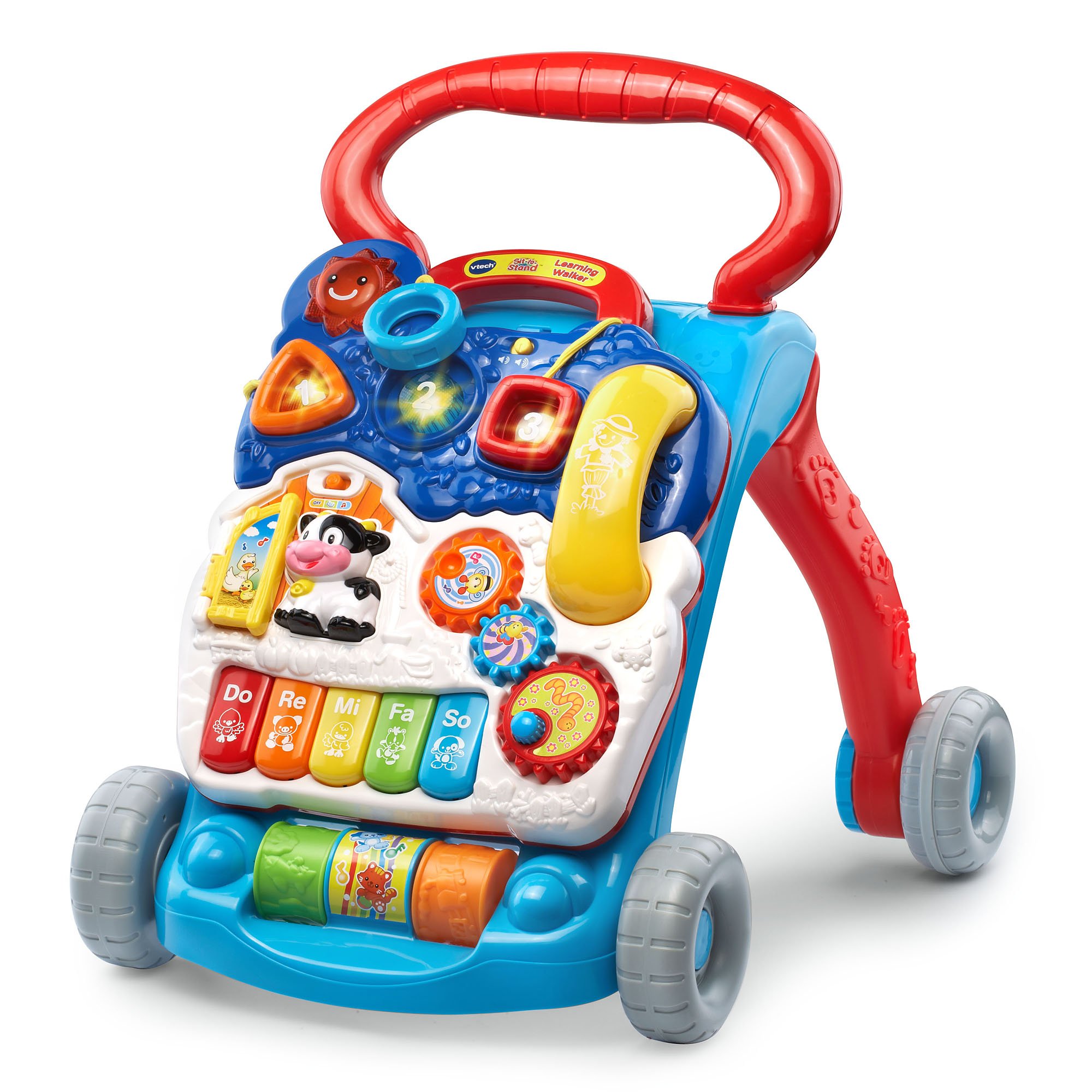
VTech Sit‑to‑Stand Walker
Key Features
- Age Range: 9–36 months
- Interactive Features: Lights, sounds, 3 modes
- Material Safety: BPA‑free plastic
- Portability: Removable panel
- Developmental Focus: Walking, balance, motor
- Price: Mid-Range
The Sit‑to‑Stand Walker actively helps babies learn to walk by providing a stable push handle with two‑speed wheels that adjust as they gain confidence. The removable activity panel lets younger babies explore lights, sounds, and manipulative toys while seated, then reattaches for walking support — a design that covers multiple developmental stages in one unit.
For a 10‑month‑old just beginning to pull up and cruise, this walker offers direct practice with balanced pushing. The music and sound effects loop frequently and can grate on parents in quiet homes, and the toy telephone handpiece pops off and may get misplaced. These are inconveniences, not safety concerns, and they don’t diminish the walker’s core value for a toddler learning to take first steps.
Pros
- Encourages walking and balance by providing a stable push handle.
- Detachable activity panel offers floor play before walking, extending usable age range.
- Long‑lasting engagement with varied activities that keep babies entertained for months.
Cons
- Songs and sound effects can become repetitive for parents in quiet settings.
- Telephone handpiece detaches completely and can be easily lost.
A practical walking aid that grows with the baby — best for families prioritizing standing and cruising milestones over quiet play.
Best for Seated Play
VTech Activity Cube
Key Features
- Age Range: 6–36 months
- Interactive Features: 25+ songs, 5 sides
- Material Safety: BPA‑free plastic
- Portability: Compact, no parts
- Developmental Focus: Sitting, fine motor, sensory
- Price: Mid-Range
Five sides of activities with over 25 songs and sound effects make this cube a stationary hub for fine motor exploration. Unlike the Sit-to-Stand Walker, it stays put—designed for babies learning to sit up and reach, not for walking practice. Best for 10-month-olds who are stable in a seated position and enjoy pressing, sliding, and spinning. The volume is loud even on the lowest setting, and there’s no mute button, so it may be too much for quiet nurseries.
Pros
- Encourages sitting up and balance with interactive sides that invite reaching and grabbing.
- Keeps babies engaged with a mix of lights, sounds, songs, and shape activities.
Cons
- In a quiet room, the sound is loud even on the lowest setting and can’t be muted.
If your baby is sitting well and you want a compact toy with lots of variety, this cube delivers—just be prepared for the volume level.
Best for Budget‑conscious
The First Years Stacking Cups
Key Features
- Age Range: 6–24 months
- Interactive Features: Numbers, water holes
- Material Safety: BPA‑free plastic
- Portability: Nests small
- Developmental Focus: Motor, color, stacking
- Price: Budget
Unlike single-purpose electronic toys, these stacking cups adapt to whatever the baby wants to do — stacking, nesting, pouring, or sorting by color and numbers. The BPA-free plastic holds up to teeth and drops, and the bright rainbow palette appeals even at 10 months. At a budget-friendly price, they outperform many expensive ‘developmental’ toys in raw engagement. However, the cups are smaller than many expect; they work best for babies 6–18 months and may feel petite for older toddlers who want to fill them with large bath toys.
Pros
- Exceptional value — inexpensive set that provides years of play.
- Durable construction — survives teething, drops, and daily use.
- Bright colors help teach color recognition while stacking.
Cons
- Cups may be smaller than expected — not ideal for filling with large bath toys.
For parents who want a simple, durable toy that grows with the baby’s imagination, these stacking cups are an unbeatable value.
Best for Teething Relief
Skip Hop Bandana Buddies Elephant
Key Features
- Age Range: 0+ months
- Interactive Features: Crinkle, rattle, squeaker
- Material Safety: Polyester, BPA‑free teether
- Portability: Clip‑on, 5x4x10 in
- Developmental Focus: Teething, sensory
- Price: Budget
The Skip Hop Bandana Buddies Elephant offers four distinct sensory features — crinkle ears, rattle, mirror, and a detachable bandana teether — giving a 10-month-old reasons to keep exploring. The teether clips onto a parent’s shirt or stroller, making it easy to have on hand during walks. It’s larger than expected, so it won’t slip into a small diaper bag, but that size also means more surface area for teething and grabbing. For parents who prioritize sensory variety and durable construction over absolute portability, this toy fits the bill.
Pros
- Multiple textures and sounds (crinkle, rattle, mirror) encourage extended play.
- Detachable teether bandana clips to parent or stroller for easy access.
- Sturdy build withstands drops and constant chewing without damage.
Cons
- Larger than expected — may not fit in a standard diaper bag.
A well-designed sensory toy that works both on-the-go and at home, as long as you’re not counting on it fitting in a tiny bag.
Best for Shape Learning
Fisher‑Price Baby’s First Blocks
Key Features
- Age Range: 6+ months
- Interactive Features: Shape sorter, storage
- Material Safety: BPA‑free plastic
- Portability: Bucket with handle
- Developmental Focus: Shapes, colors, motor
- Price: Budget
The Fisher‑Price Baby’s First Blocks uses hands‑on shape‑sorting to teach colors and shapes, with a bucket that stores all 10 pieces. The plastic is sturdy enough to survive drops and bites, and the carry handle makes cleanup tidy. It’s best for toddlers learning shapes and colors, not for travel—the bucket is too bulky for a diaper bag. The lid fits loosely, so blocks may spill if the bucket is tipped; that’s a minor irritation you can work around by carrying it upright.
Pros
- Helps develop fine motor skills and shape/color recognition through sorting play.
- All pieces store inside the bucket, making cleanup and organization simple.
- Durable plastic withstands biting and dropping during active play.
Cons
- Lid doesn’t snap on tightly, so blocks can spill when the bucket is carried or tipped.
For parents who want a no‑frills shape‑sorter with storage, this set delivers strong learning value—the loose lid is a manageable tradeoff given the low price and durable build.
Best for Pretend Driving
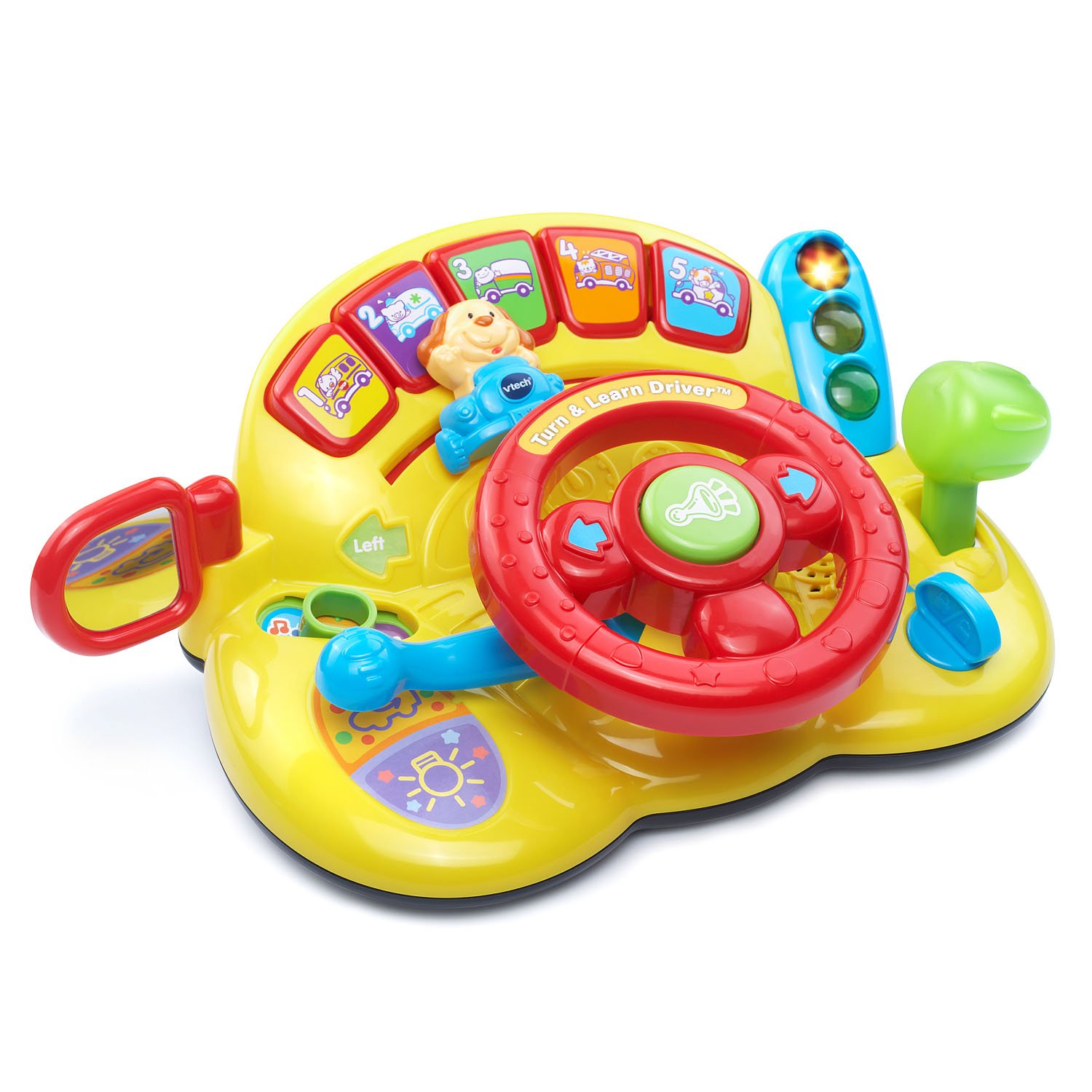
VTech Turn and Learn Driver
Key Features
- Age Range: 6–36 months
- Interactive Features: 60+ songs, horn, gear
- Material Safety: Plastic
- Portability: Lightweight, no clip
- Developmental Focus: Cause/effect, pretend
- Price: Mid-Range
Its steering wheel, turn signal, and gear shifter engage babies who love cause‑and‑effect play, with 60+ songs and phrases. At 10 months, the easy‑grip wheel and horn trigger sounds that hold attention during car rides. The plastic feels lighter than older versions, and there’s no built‑in clip for strollers or high chairs, so it works best on flat surfaces or with a DIY strap. This suits parents who want a travel‑focused distraction rather than a walking aid.
Pros
- Engaging cause‑and‑effect play with steering wheel and horn keeps babies occupied in the car.
- Teaches road safety basics through stoplight and horn sounds during play.
- Good value with three play modes (Animal, Driving, Music) at a mid‑range price.
Cons
- Plastic feels thinner than earlier models, though function remains unaffected.
- No attachment strap for strollers or high chairs – the toy can tip over easily without a flat surface.
Best for parents seeking a portable, interactive car toy for 10‑month‑olds who enjoy pretend driving; less suited for stroller or high‑chair use without a DIY strap.
Best for Textured Teether
Sassy Stacks of Circles

Key Features
- Age Range: 6–24 months
- Interactive Features: Textures, rattle bead
- Material Safety: BPA‑free
- Portability: Compact, 9 pieces
- Developmental Focus: Sensory, stacking
- Price: Budget
The Sassy Stacks of Circles offers more sensory variety than classic stacking rings — different textures, a rattle bead, and bright colors that engage teething babies. The stacking post requires some dexterity, so younger 6-month-olds may need help, but the tactile exploration makes up for it. Just note that trapped water can lead to mold inside the base, so thorough drying after washing is essential.
Pros
- Textured rings soothe teething gums and provide varied sensory input.
- Bright colors and multiple ring sizes aid early learning of color and size.
Cons
- Mold may form if water gets trapped in the base — requires careful drying after washing.
Best for parents wanting a sensory-rich, budget-friendly stacking toy for babies who love mouthing, provided they are willing to dry the base after cleaning.
Best for Early Counting
Fisher‑Price Smart Piggy Bank

Key Features
- Age Range: 6–36 months
- Interactive Features: Songs, counting, bilingual
- Material Safety: BPA‑free plastic
- Portability: 10 coins, bucket
- Developmental Focus: Counting, fine motor
- Price: Mid-Range
This piggy bank builds fine motor skills via coin insertion and door opening, while Smart Stages teaches numbers, counting, colors, and Spanish phrases. But the sound is fixed at one level and can be muffled – a drawback for parents who prefer quieter play. The coin placement demands precise fine motor control, so it’s best suited for toddlers 12+ months rather than younger infants.
Pros
- Develops fine motor skills through coin insertion and door opening.
- Teaches numbers, counting, colors, and Spanish words via Smart Stages.
Cons
- Fixed volume and occasionally muffled sound – may not suit quieter households.
Best for parents whose top priority is fine motor practice and early number learning, and who don’t mind a non-adjustable sound level – ideally for toddlers past the 10-month mark.
Best for Pretend Feeding
VTech Chomp & Count Dino

Key Features
- Age Range: 12–36 months
- Interactive Features: 130+ phrases, feeding
- Material Safety: BPA‑free plastic
- Portability: 8 food discs
- Developmental Focus: Numbers, colors, pretend
- Price: Mid-Range
The Chomp and Count Dino engages toddlers with feeding play that teaches numbers, colors, and food names, and its build holds up through heavy use. However, the food discs require a precise angle and force to insert — a frustration for smaller hands — and the 12+ month age recommendation means a 10-month-old won’t yet have the dexterity or developmental need for this toy.
Pros
- Teaches numbers, colors, and food names through engaging feeding play.
- Durable construction survives rough toddler play and multiple children.
Cons
- Food discs require precise angle and force to insert, which can frustrate younger toddlers.
Best saved for when your baby reaches 12 months; for a 10-month-old, a simpler sensory or stacking toy will better match their current fine motor skills.
Best for Truck Lovers
VTech Drop & Go Dump Truck

Key Features
- Age Range: 6–36 months
- Interactive Features: Dump action, counting
- Material Safety: BPA‑free plastic
- Portability: Pull string short
- Developmental Focus: Cause/effect, push
- Price: Mid-Range
This yellow dump truck teaches counting and cause-and-effect with a satisfying drop-and-dump mechanism. Its sturdy build handles rough play, and the three buttons introduce colors and tools. However, the pull string is too short for a standing toddler to tow, and the music volume is low even at the highest setting. For a 10-month-old still playing on the floor, the dump action works well, but it won’t double as a walking aid.
Pros
- Teaches counting and cause-and-effect through drop-and-dump play.
- Sturdy plastic construction holds up to daily toddler use.
Cons
- Pull string is short enough that a walking toddler cannot pull the truck behind them.
Best for floor play with a 10-month-old who loves dropping objects – not suited for walking practice.
Best for Newborns to 12M
VTech Moosical Beads

Key Features
- Age Range: 0–24 months
- Interactive Features: 30+ songs, light‑up cheeks
- Material Safety: Plush, BPA‑free beads
- Portability: Compact, plush
- Developmental Focus: Sensory, music
- Price: Mid-Range
The VTech Moosical Beads offers a gentle sensory experience with over 30 songs, light-up cheeks, and crinkly ears that young infants find engaging. However, the compact size may surprise parents expecting a larger toy from photos, making it best suited as a comfort companion for babies under 12 months rather than a robust developmental toy for older infants.
Pros
- Soft plush and gentle songs safe and soothing for the youngest babies.
- Multiple sensory features (lights, crinkles, textures) keep infants occupied.
Cons
- Compact size may feel less substantial than expected from product photos.
This toy works well as a comforting first plush for a 10-month-old who still enjoys gentle stimuli, but if you need more interactive or durable features, consider alternatives like the Sit-to-Stand Walker or Activity Cube.
Best for Eric Carle Fans
Eric Carle Soft Book

Key Features
- Age Range: 0–24 months
- Interactive Features: Crinkle, squeaker, teether
- Material Safety: Polyester, BPA‑free
- Portability: Clip, 5.25 in
- Developmental Focus: Sensory, teething
- Price: Budget
The Very Hungry Caterpillar soft book delivers classic artwork, crinkle sounds, and a teether corner that babies love to chew – all clipped to a stroller or diaper bag. The 5.25-inch pages are small, so older toddlers seeking more complex stories may find it too simple.
Pros
- Crinkle pages and squeaker provide engaging sensory feedback.
- Teething corner is a practical addition babies love to chew.
Cons
- For babies who have moved beyond board books, the 5.25-inch pages can feel cramped.
Best for newborns up to 12 months who enjoy sensory play and teething relief – a budget-friendly addition to a baby’s toy rotation.
How to Choose
At 10 months, the best gifts are those that invite hands-on exploration—simple textures, sounds, and moving parts often engage more than complex electronics.
Age Range
Many toys claim to be for newborns to 36 months, but the way a 10‑month‑old interacts is specific. Look for toys labeled 6‑24 months or 9‑36 months. The key is that the toy offers accessible actions—grasping, banging, dropping—without requiring fine dexterity a 10‑month‑old hasn’t developed yet.
Toys with a 12+ month rating (like the VTech Chomp & Count Dino) might frustrate a 10‑month‑old because of precision needed. Stick to age ranges that start at 6 or 9 months for immediate engagement.
Interactive Features
Lights and sounds are attention magnets, but volume control matters. Many electronic toys have a single loud setting that can grate on parents after minutes of play. If you buy a musical toy, verify whether it has a mute button or adjustable volume.
Simple cause‑and‑effect (press a button, hear a sound) is ideal for this age. Avoid toys with multiple modes that require understanding—babies just want immediate feedback.
Material Safety
Everything goes in the mouth. BPA‑free plastic is standard, but watch for small parts that could break off. Soft books and plush toys should have securely stitched parts and no loose beads. For stacking cups and rings, ensure the material is thick enough to resist cracking if thrown.
Some toys (like the Sassy Stacks) have internal water traps that can grow mold if not dried properly. If you plan to use in the bath, check whether the toy can be fully dried.
Portability
10‑month‑olds are mobile but not walking far. Toys with clips or handles (like the Skip Hop Elephant) are great for strollers or car seats. For walking aids, check the pull string length—many are too short for actual pulling, making them more suited for floor play.
If you travel often, compact toys that nest or stack (stacking cups) save space. Avoid sets with many loose pieces unless they store in a container.
Developmental Focus
At this age, motor skills (reaching, grasping, pushing) and sensory exploration (textures, sounds) are more important than educational content like counting or letters. A toy that encourages your baby to sit up, balance, or transfer objects from hand to hand directly supports physical milestones.
Toys that combine multiple actions—like a walker that also has a removable panel or a cube with different activities on each side—offer the most mileage. One toy can replace several single‑purpose items.
FAQ
Is the VTech Sit‑to‑Stand Learning Walker safe for 10‑month‑olds who are just starting to pull up?
Yes, it’s designed for babies 9 months and older who are beginning to stand. The walker has two wheel speeds, so you can set it to slow for new cruisers. Always supervise use near stairs or uneven surfaces. The removable panel lets younger babies play while seated first.
Do stacking cups with holes in the bottom actually work as bath toys without getting moldy?
The holes allow water to drain, but if the cups aren’t dried thoroughly after each bath, moisture can get trapped inside the hollow areas. To prevent mold, shake out excess water and let them air dry fully. Many parents store them outside the bathroom to avoid moisture buildup.
Why do some baby walkers have a short pull string – can I replace it safely?
Most pull strings on baby toys are intentionally short (under 12 inches) as a safety measure to prevent strangulation. Replacing it with a longer string is not recommended because it could pose a choking or strangulation hazard. If you want a toy for pulling, look for one with a built‑in long cord that meets safety standards.
Which baby toy is best for a 10‑month‑old who is teething and still needs sensory stimulation?
The Skip Hop Bandana Buddies Elephant combines multiple textures (crinkles, rattle, mirror) with a detachable teether. It clips onto strollers or car seats, making it easy to keep clean. For a cheaper option, the Eric Carle soft book also has a teething corner and crinkle pages.