
This post contains affiliate links. We may earn a small commission when you buy through our links — at no extra cost to you.
Shopping for a one-year-old’s birthday means wading through toys that promise educational value but deliver short battery life, repetitive songs, and pieces too small for tiny fingers. The most praised gifts avoid those traps entirely.
The best options balance language development with open-ended play, sturdy construction with age-appropriate interaction. Whether a child prefers flipping pages, stacking blocks, or pushing a walker, the right toy matches how they actually play at this stage.
This guide focuses on gifts that hold up to daily use and keep a toddler engaged without overwhelming parents with noise or cleanup. The choice often comes down to whether you want a tool for early words or a canvas for creativity.



Best for Language Development
LeapFrog 100 Words Book
Key Features
- Age Range: 12+ months
- Educational Focus: Language, bilingual
- Interactivity Level: Buttons, sounds
- Price: Mid-Range
The LeapFrog 100 Words Book teaches over 100 words in English and Spanish through touch-sensitive pages that play clear audio, sound effects, and fun facts. Its board pages withstand drops and rough handling typical of toddlers, making it one of the sturdier electronic toys in this category. The bilingual mode works seamlessly – switch between languages with a single slide, and the same pictures trigger different vocabulary sets.
This book suits first birthdays and families wanting early language exposure, whether English-only or bilingual. The interactive modes grow with the child: younger toddlers enjoy pressing pages for sounds, while older ones use the vocabulary and song features. Battery life can be shorter than expected with daily heavy play – keep spare AA batteries nearby. It’s not for families who prefer screen-free or battery-free toys, but for those comfortable with electronics, it delivers consistent educational value.
Pros
- Teaches over 100 words in both English and Spanish with clear pronunciation and engaging sound effects.
- Sturdy board pages survive drops, throws, and rough toddler handling without tearing or losing function.
- Content grows with the child – works as a sound exploration toy at 12 months and a vocabulary tool later.
Cons
- Battery life can drain within a few weeks under heavy daily use – spare AA batteries are essential.
For families seeking a durable, bilingual toy that teaches vocabulary without screens, this book is the most reliable option in its class.
Best for Creative Play
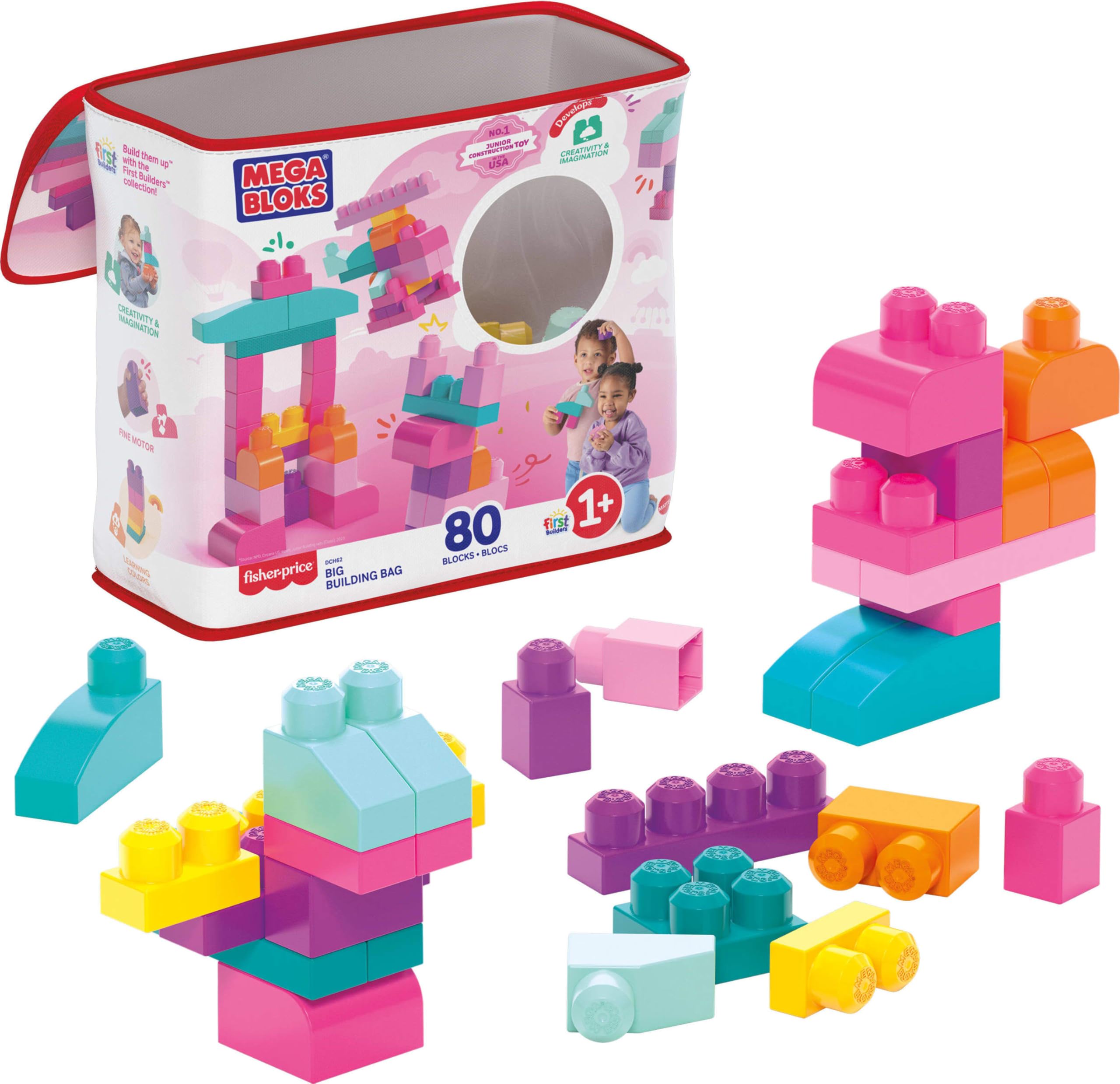
Mega Bloks 80-Piece Set
Key Features
- Age Range: 1+ years
- Educational Focus: Fine motor, creativity
- Interactivity Level: Open-ended play
- Price: Budget
80 large blocks in a storage bag offer open-ended play for under $20 — a sharp contrast to the LeapFrog book’s electronic approach. The blocks are sized to prevent choking and come in 10 shapes across 9 colors, giving toddlers plenty of raw material for stacking, sorting, and knocking down.
This set suits families who want non-electronic, imagination-driven playtime. The occasional loose-fitting block can make tall towers tricky, so it’s best for toddlers who enjoy the process rather than demanding perfectly stacked structures.
Pros
- Helps develop fine motor skills and creativity through open-ended play
- Age-appropriate and safe for toddlers as young as 12 months
- Includes a reusable storage bag for quick cleanup
Cons
- Some blocks may fit together loosely, which can frustrate toddlers aiming for sturdy towers
For families that value open-ended, screen-free play and don’t mind occasional loose connections, this set delivers remarkable longevity and skill-building at a budget price.
Best for Walking Readiness
VTech Sit-to-Stand Walker
Key Features
- Age Range: 9 months – 3 years
- Educational Focus: Motor skills, shapes
- Interactivity Level: Activity panel
- Price: Mid-Range
The VTech Sit-to-Stand Learning Walker combines a detachable activity panel with a sturdy walker, giving toddlers a reason to stand and take steps. Unlike the top pick’s focus on vocabulary, this targets physical development.
Best for parents of a child beginning to stand or walk who want a 2-in-1 toy. The sounds can be loud and repetitive, so it works best in homes where background noise is normal. The detachable phone handpiece is easy to misplace — a small storage spot helps.
Pros
- Helps toddlers gain confidence in standing and taking first steps.
- Detachable panel with shape sorters and piano keys keeps children engaged during seated play.
- Requires no tools to assemble — ready in minutes.
Cons
- The detachable phone handpiece is not tethered and can be misplaced easily.
- In quiet homes, the repetitive sounds may wear on parents – less of a concern in active playrooms.
For families focused on physical milestones, this walker delivers – just be prepared for the audio repetition.
Best for Speech Imitation
Ms. Rachel Speak & Sing Doll
Key Features
- Age Range: 6 months – 3+ years
- Educational Focus: Speech, imitation
- Interactivity Level: Songs, phrases
- Price: Budget
Ms. Rachel’s Speak & Sing Doll stands apart from simple plush toys by incorporating four songs and over 16 spoken phrases from the popular YouTube channel. The 16-inch size is substantial for cuddling, and the soft fabric holds up well to repeated play.
Best for toddlers already familiar with Ms. Rachel — the character recognition drives engagement. Buttons require a firm press, so younger 1-year-olds may need adult help to activate sounds initially.
Pros
- Soft, premium fabric and authentic design make it a comforting companion.
- Familiar songs and phrases from Ms. Rachel keep toddlers singing and mimicking.
Cons
- Buttons can be difficult for small fingers to press — some 1-year-olds may need assistance.
For families whose child loves Ms. Rachel, this doll offers immediate recognition and engagement, though button sensitivity expects adult participation at first.
Best for Balance Skills
SEREED Balance Bike
Key Features
- Age Range: 12–24 months
- Educational Focus: Balance, coordination
- Interactivity Level: Riding
- Price: Mid-Range
Lightweight aluminum frame and closed TPU tires give toddlers a stable, safe first scoot – no tools needed for assembly. While larger balance bikes stretch into the toddler years, this one prioritizes low height and a wide stance so new walkers feel secure. The tradeoff is sizing: children on the taller side or above average weight may outgrow it before 18 months, making this a better fit for smaller 12–18 month olds or as a first birthday introduction to riding.
Pros
- Four-wheel design provides exceptional stability for beginners.
- Tool-free assembly with snap-fit parts gets the bike ready in minutes.
- Lightweight frame and closed tires help toddlers learn to scoot and steer early.
Cons
- Smaller sizing means some toddlers may outgrow it before 18 months – best for younger or smaller children.
A stable introduction to balance biking for small 12–18 month olds, but not a long-term investment for larger toddlers.
Best for Animal Sounds
Eric Carle Sound Book
Key Features
- Age Range: 1–2 years
- Educational Focus: Animal sounds
- Interactivity Level: 30 buttons
- Price: Budget
30 buttons with clear animal sounds and Eric Carle’s beloved illustrations make this an engaging literacy tool for toddlers. The buttons can require firm pressure, so some 1-year-olds may need help pressing them. Sound quality has been noted to vary between units over time. This budget-friendly option works well for families who want an art-rich book for animal recognition and are willing to assist with button pressing.
Pros
- Eric Carle’s recognizable artwork paired with realistic animal sounds keeps children engaged.
- Teaches animal names and sounds, supporting early language development.
Cons
- Sound quality may degrade on some units over time.
- Buttons can be hard for small toddlers to press independently.
A charming, budget-friendly option for Eric Carle fans – just be ready to help little fingers with the buttons.
Best for Pretend Play
LeapFrog Picnic Basket

Key Features
- Age Range: 6 months – 4 years
- Educational Focus: Shapes, colors
- Interactivity Level: Music, shape sorter
- Price: Mid-Range
The LeapFrog Shapes and Sharing Picnic Basket combines shape sorting with a darling tea-party theme that encourages social pretend play. Its 15 pieces teach colors, shapes, and sharing, though the handle can be awkward for small children to open. This makes it a better fit for little ones who enjoy role-play and have some dexterity, rather than for families seeking a purely educational shape sorter.
Pros
- Adorable pretend-play picnic basket that toddlers love.
- Teaches shapes, colors, and sharing through interactive play.
Cons
- Handle design can be awkward for small children to open.
Best for 1-year-old girls who enjoy pretend tea parties and are not yet frustrated by a slightly tricky handle.
Best for Interactive Toy
VTech Pull and Sing Puppy

Key Features
- Age Range: 6 months – 3 years
- Educational Focus: Cause-effect
- Interactivity Level: Buttons, music
- Price: Budget
The VTech Pull and Sing Puppy charms toddlers with a light-up nose, music, and three easy buttons—great for a 1-year-old who enjoys pressing and listening. The pull string, however, is too short to serve as a walking companion; this is a sit-down interactive toy first. It delivers good value for the price as a button-pressing activity rather than a functional pull-along.
Pros
- Engaging lights and sounds keep toddlers entertained during seated play.
- Budget-friendly price point for an interactive electronic toy.
Cons
- Pull string is too short to use as a walking aid—works best as a sit-down activity.
Best for young toddlers who enjoy button-pressing and music rather than a functional pull toy for walking practice.
Best for Tea Party
VTech Party Playset

Key Features
- Age Range: 6 months – 3 years
- Educational Focus: Shapes, colors
- Interactivity Level: Pouring sound, sorting
- Price: Mid-Range
The interactive pitcher makes realistic lemonade pouring sounds that toddlers love, while the shape-sorting treats teach colors and shapes. Adults should expect repetitive songs, so this set works best for children who enjoy pretend tea parties and social play. It offers similar fun to the top picnic basket but with fewer pieces, making it a focused choice for party-themed play.
Pros
- Realistic pouring sound makes tea parties feel authentic
- Shape-sorting treats teach colors and shapes through play
Cons
- Repetitive songs may annoy adults during extended play
Best for toddlers who adore tea parties and interactive pretend play, but not for parents seeking a quiet toy.
Best for Role-Play
Fisher-Price Smart Purse

Key Features
- Age Range: 6–36 months
- Educational Focus: Role-play, language
- Interactivity Level: 50+ songs, stages
- Price: Mid-Range
This smart purse delivers 50+ songs and role-play accessories that toddlers love, using three Smart Stages to grow with the child. The weight from the sound module makes it challenging for children under 12 months, and some plastic parts may break with rough use.
Pros
- Cute, engaging role-play purse that toddlers love mimicking mommy.
- Portable with handle and accessories that little hands can take everywhere.
Cons
- Heavy due to sound module at bottom; can be difficult for younger toddlers to carry.
Best for toddlers over 12 months who enjoy imitating parents — a fun gift if you’re comfortable with the weight and possible plastic wear.
Best for First Doll
Baby Starters Snuggle Doll

Key Features
- Age Range: Newborn+ (1+ years)
- Educational Focus: Nurturing
- Interactivity Level: Rattle inside
- Price: Budget
This 12-inch doll offers a soft, cuddly body and embroidered features that are safe for infants. The rattle inside adds gentle auditory interest, and the machine-washable construction survives frequent cleaning. However, the petite size means some toddlers outgrow it quickly, making it best as a starter companion rather than a long-term toy.
Pros
- Extremely soft fabric makes it a comforting snuggle buddy.
- Embroidered face eliminates choking hazards for young chewers.
Cons
- Small size (under 12 inches) may be outgrown by toddlers who prefer larger dolls.
Best for a first birthday gift when you want a safe, washable doll that will serve as a cuddly companion for the first year or so.
Best for Animal Care
VTech Pet Carrier

Key Features
- Age Range: 9 months – 3 years
- Educational Focus: Animal care
- Interactivity Level: 100+ songs, lights
- Price: Mid-Range
This role-play set pairs a soft plush puppy with feeding and grooming accessories in a take-along carrier, encouraging nurturing play. However, the 100+ songs and phrases repeat quickly, so toddlers may lose interest after initial novelty – best for short, supervised play sessions rather than sustained independent engagement.
Pros
- Cute role-play set that encourages nurturing behavior.
- Teaches animal care and opposites through interactive play.
Cons
- Sounds and songs repeat quickly, which may limit long-term engagement.
A sweet gift for a 1-year-old who loves animals and pretend care, but expect the audio content to wear thin before other toys do.
How to Choose
The key to a successful first birthday gift is finding one that matches your child’s current developmental stage – not just the age on the box.
Age Range
A toy labeled for 18+ months may be fine for a 1-year-old under supervision, but the opposite is rarely true: toys designed for younger babies often lack the challenge needed at 12 months. Look for a range that starts at or near 12 months to avoid frustration.
Toys that span 6 months to 3 years often have adjustable modes or multiple difficulty levels, extending their usable life. The sweet spot is a toy that grows with the child, not one that’s outgrown in three months.
Educational Focus
The most common split is between language-development toys (books, talking dolls) and open-ended creative toys (blocks, shape sorters). A child who loves mimicking sounds will benefit more from a bilingual book than a stacking set, while a child who prefers hands-on manipulation will thrive with blocks.
Many toys claim to teach multiple skills, but the ones that excel focus on one or two mechanisms. A shape sorter that also plays music can distract from the sorting task. Decide whether you want to encourage vocabulary or fine motor skills first.
Interactivity Level
Buttons, lights, and sounds hold attention short-term, but they can also lead to repetitive play that parents find grating. Open-ended toys like blocks require more adult involvement initially but foster longer independent play as the child grows.
If you choose an electronic toy, check whether the volume has an off switch or adjustable levels. A toy that can be muted is a parent’s sanity saver. Also consider button sensitivity: some require a strong press that small fingers can’t manage alone.
Durability
A 1-year-old’s play involves throwing, dropping, and chewing. Toys with glued-on parts or thin plastic shells often break within weeks. Look for sealed electronics, reinforced seams on fabric toys, and blocks that are large enough to avoid becoming choking hazards.
The most durable gifts are those designed for repeated drops: thick cardboard pages, solid plastic bodies, and metal frames on ride-ons. A toy that survives a tumble down two stairs is worth the extra few dollars.
Portability
If the gift will be used on trips or stored in a small space, weight and size matter. A heavy purse or a large walker can be frustrating to move between rooms or pack in a car. Lightweight options with carrying handles or storage bags add practical value for traveling families.
Toys that collapse or fit into a bag are easier to bring to grandma’s house or on a plane. For families who travel often, a compact option like a sound book or a small doll beats a bulky activity center.
FAQ
My 1-year-old keeps pressing the same button on her LeapFrog book – is that normal?
Yes, repetition is how toddlers learn cause and effect and reinforce vocabulary. It’s a sign of engagement, not boredom. If the sound quality remains clear after dozens of presses, the toy is doing its job.
Do VTech walkers work on thick carpet or only hard floors?
They work on low-pile carpet and hard floors, but thick carpet can slow the wheels and make pushing harder for a new walker. The walker’s speed control helps, but on plush carpet the child may need extra effort to get rolling.
Can I use rechargeable batteries in interactive baby toys?
Yes, rechargeable AA and AAA batteries work well in most toys. Just ensure they are fully charged before first use, as the included demo batteries often die quickly. Nickel-metal hydride (NiMH) rechargeables are safe and cost-effective for high-drain toys.
What’s the best first birthday gift for a girl who already has too many stuffed animals?
Skip the plush and choose a toy with a different interaction style – a bilingual sound book, a shape-sorting picnic basket, or a balance bike. These offer new skills and play patterns rather than another soft friend.