
This post contains affiliate links. We may earn a small commission when you buy through our links — at no extra cost to you.
Every traveler has been there — you pull out your power bank on a long layover, and it sputters out after one charge, or the cable frays in your bag. Portable chargers promise freedom, but too many turn into dead weight faster than a forgotten souvenir.
This guide skips the marketing fluff to focus on what matters when you’re actually moving: real-world charge cycles, build durability, and the right balance of weight versus speed. Because the best charger is one that works reliably, not just on a spec sheet.
Whether you need an ultralight companion for a weekend getaway or a laptop-friendly pack that survives multi-day trips, there’s a smart pick that fits your packing style — without the early failures that plague so many chargers in this category.


Best for Pocketable Fast Charging
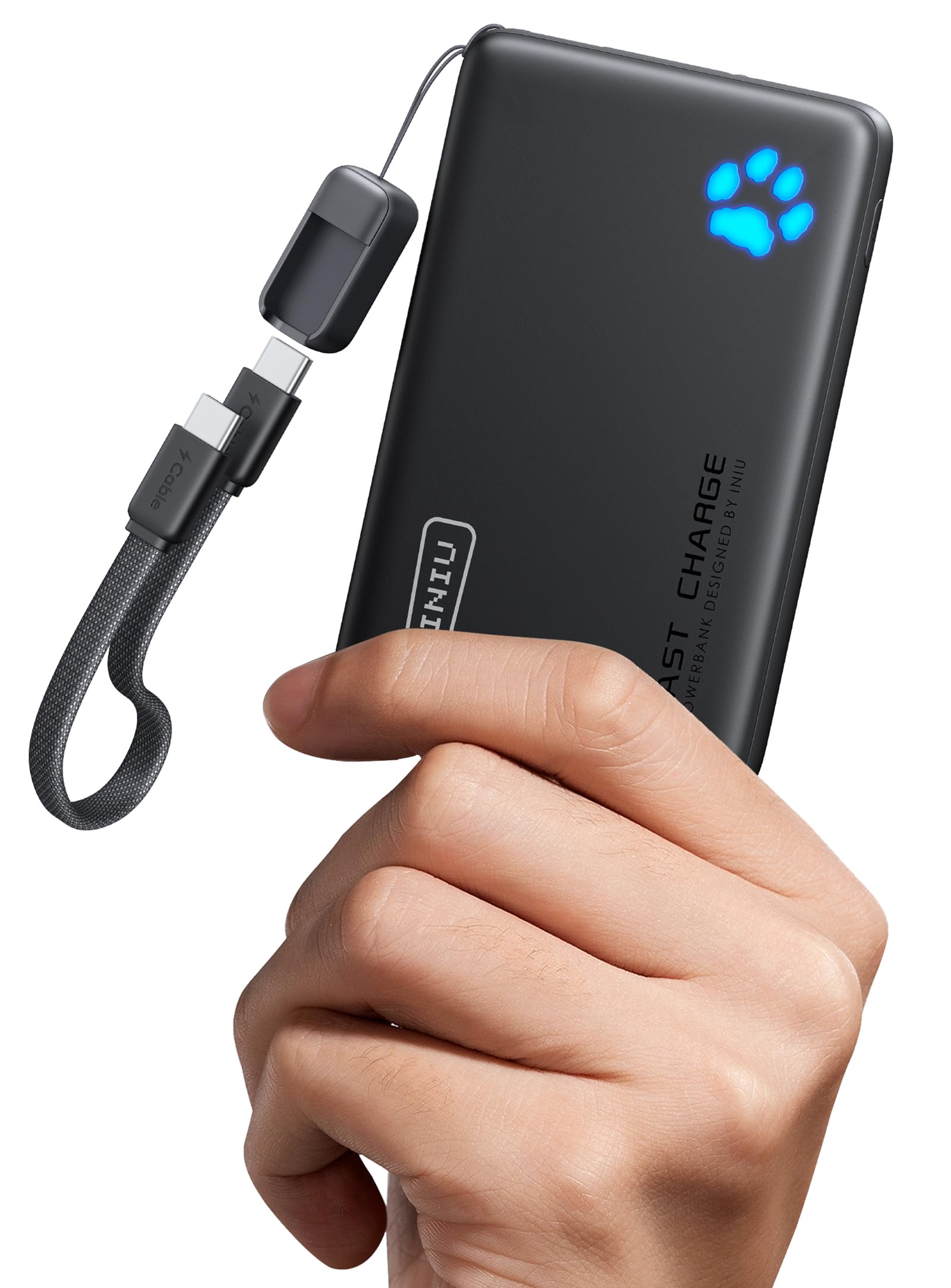
INIU 45W 10K Detachable
Key Features
- Capacity: 10,000mAh
- Weight & Dimensions: 182g, 5.3 x 2.7 x 0.5 in
- Max Output: 45W
- Ports: 2x USB-C, 1x USB-A
- Special Features: Detachable cable
- Price: Budget
A 45W USB-C output pushes enough power to fast-charge most modern phones at full speed — a 30-minute top-up can take a Galaxy S23 from empty to over 60%. Two USB-C ports and one USB-A port let you charge three devices at once, though total wattage is shared. The standout feature is the detachable 0.4ft USB-C cable: it snaps out of the bank and doubles as a lanyard strap, so you never hunt for a cord.
At 182 grams and half an inch thin, the bank slips into a front jeans pocket without sagging fabric or bulging outlines. The scratch-resistant shell holds up to daily shuffling with keys and earbuds, and the stubby form factor fits into tight purse compartments and tech pouches. Because the cable is replaceable, a frayed cord doesn’t retire the whole device.
Battery cell longevity is the pack’s main compromise. Under repeated heavy cycling — draining it fully every day — capacity may dip sooner than you’d encounter with pricier competitors. Light or intermittent users are less likely to notice any change, but if you plan on deep-cycling it daily for years, the low entry price reflects a tradeoff in cell endurance.
This is the right companion for urban commuters, students, and travelers who want a fast, featherweight charger that stays out of the way. It’s not for laptop charging (45W won’t sustain a drained notebook) and not for anyone demanding a battery bank that stays at like-new capacity after two years of heavy daily service. For those needs, a pack with user-replaceable cells or a longer warranty makes more sense.
Pros
- 45W USB-C output charges most phones from 0-60% in under 30 minutes — quick enough for top-ups between meetings.
- Weighs just 182 grams and fits into small pockets, purses, and tight organizers without added bulk.
- Sturdy plastic shell resists scratches and accidental drops better than typical budget packs.
- Detachable 0.4ft USB-C cable functions as a carrying strap and is replaceable if damaged.
- Dual USB-C plus USB-A lets you top up a phone, earbuds, and a tablet simultaneously.
Cons
- Battery capacity can degrade after months of heavy daily use; some units may show shorter runtime than when new.
If you need the lightest, fastest phone charger at a price that’s hard to argue with, this INIU 45W is the clear choice — just don’t expect it to retain full capacity forever under punishing daily cycles.
Best for Minimalist Travel
Anker Nano 3-in-1 10K
Key Features
- Capacity: 10,000mAh
- Weight & Dimensions: 250g, 4.25 x 1.97 x 1.22 in
- Max Output: 30W
- Ports: Built-in USB-C cable + 1 USB-C
- Special Features: Foldable wall plug
- Price: Mid-Range
Where most travel power banks require a separate wall adapter, the Anker Nano 3-in-1 folds its charger directly into the battery pack. The 30W GaN plug deploys from the bottom, so you can recharge from any outlet without digging for an accessory. A short USB-C cable unfurls from the side and tucks back into a groove that doubles as a carrying loop, making it possible to arrive with one item instead of three.
This streamlined design suits frequent travelers who top up at airport gates, coffee shops, or hotel nightstands. The 10,000mAh capacity recharges most phones once or twice, and the 30W output handles tablets and smaller laptops at moderate speed. However, the integrated cable introduces a hard-to-service failure point. If it frays or stops communicating, the entire charger becomes unusable. For that reason, it’s better suited to occasional travel rather than as a daily driver where the cable sees dozens of plug cycles every day.
Pros
- Eliminates a separate charger — the foldable wall plug means one less item to pack
- 30W bidirectional speed recharges phones and tablets quickly, and tops up the bank itself fast
- Built-in USB-C cable doubles as a carrying lanyard, trimming another loose cord
- Compact, dense build quality feels solid in hand and slips easily into a pocket
Cons
- The integrated cable is a potential point of failure — prolonged daily use may lead to damage that renders the whole unit inoperable
If your packing checklist values consolidation above all, this all-in-one eliminates two items from your bag. For daily use where the cable endures constant handling, a power bank with a user-replaceable cable is a wiser long-term bet.
Best for Laptop Power User
Anker 20K 87W Built-in Cable
Key Features
- Capacity: 20,000mAh
- Weight & Dimensions: 440g, 6.2 x 2.89 x 1.02 in
- Max Output: 87W (65W single)
- Ports: Built-in USB-C cable + 1 USB-C + 1 USB-A
- Price: Premium
While all-in-one travel chargers focus on wall-plug convenience, this Anker prioritizes raw capacity and laptop-level output. The built-in USB-C cable means one less thing to pack, and the 87W total power can top up a laptop and phone simultaneously without slowdown. That 30-minute laptop boost is the headline, and it delivers.
At 440g, this is a bag-only item — not something you’ll slip into a jeans pocket. That tradeoff suits digital nomads, students, or long-haul travelers who already carry a laptop bag and need enough juice for a full day of device charging. The 20,000mAh capacity is airline-safe and can recharge a phone four times over.
The body feels dense and well-constructed, matching Anker’s typical build quality. Recharging the bank itself takes about 1.5 hours with a 65W PD wall charger — a separate purchase, but common among laptop users. For those who value endurance over pocketability, this pack is a straightforward fit.
Pros
- Rapid laptop charging: tops up a MacBook Air to 52% in 30 minutes
- Built-in USB-C cable means you can’t forget a laptop cable
- High 20,000mAh capacity for multi-day trips, still airline-safe
- Solid build quality with a dense, reassuring feel
Cons
- Heavier than phone-only power banks — best kept in a bag, not a pocket
For travelers who need reliable laptop charging on the go and can accept the added heft, this Anker delivers where compact phone banks fall short.
Best for Multi-Device Families
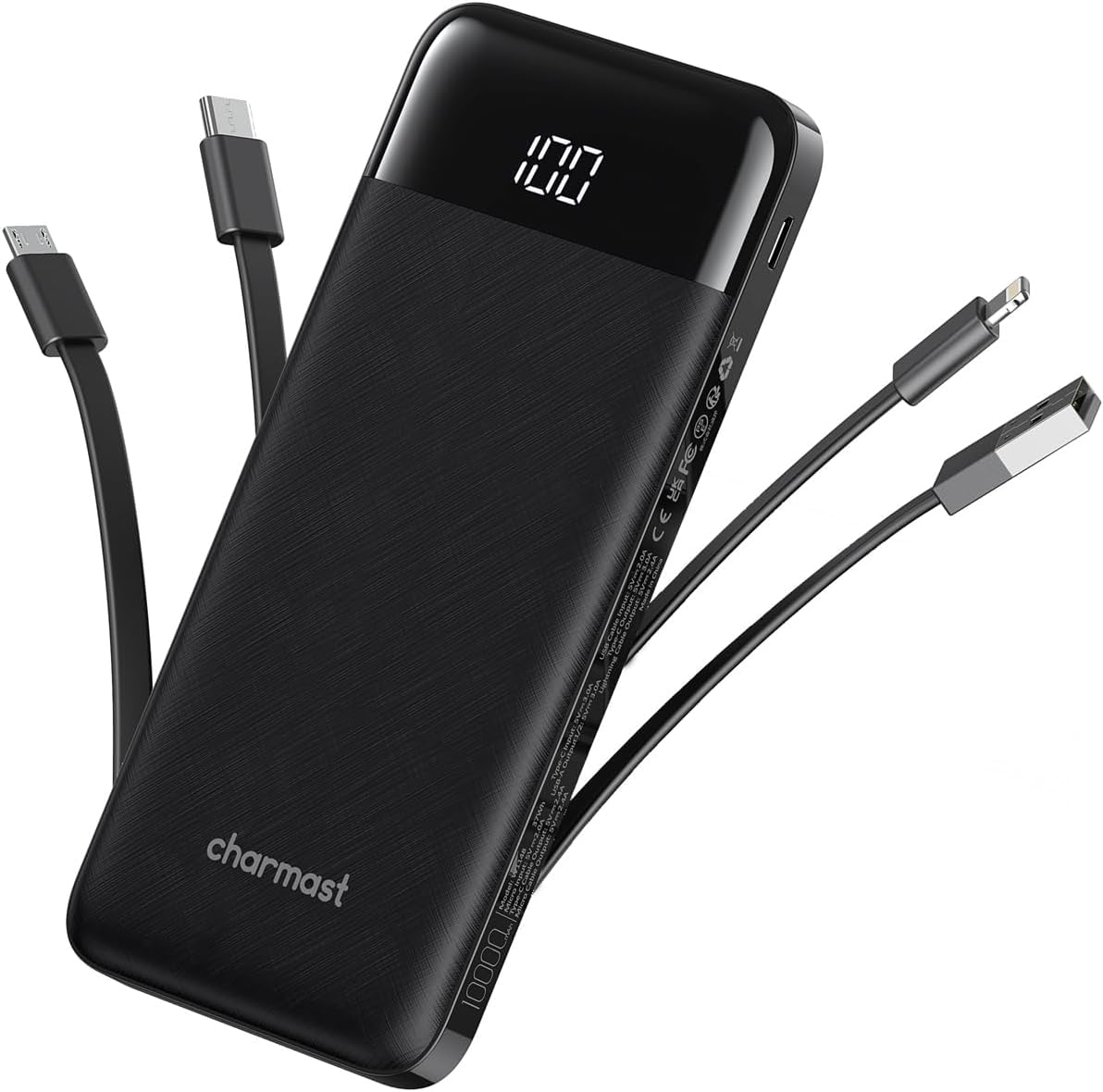
charmast 10K Built-in 4 Cables
Key Features
- Capacity: 10,000mAh
- Weight & Dimensions: 240g, 5.68 x 2.63 x 0.7 in
- Max Output: 15W
- Ports: Lightning, USB-C, Micro, 3 extra ports
- Special Features: Digital display, built-in cables
- Price: Budget
This pack’s integrated output cables (Lightning, USB-C, Micro) eliminate separate cords, while two additional USB ports let it charge up to six devices at once. At 240g, it slips into a bag easily, and the digital percentage display helps track remaining juice. Families with a mix of iPhones, Android phones, and older accessories will find it useful for shared travel.
Charging speed is not its strength. Output can vary between ports, and the 10,000mAh battery may need over six hours to refuel from empty. Battery capacity can also degrade after weeks of use, reducing the total charge it delivers. This model suits overnight recharges and group sharing rather than quick midday refuels.
Pros
- Three built-in cables (Lightning, USB-C, Micro) eliminate the need to carry separate cords
- Can charge up to six devices simultaneously, great for group travel
- Weighs just 240g with a digital percentage display for quick capacity checks
Cons
- Charging speed may be slower than claimed; recharging the bank itself can take over six hours
- Battery capacity can degrade after weeks of use, reducing effective total charge
For families or travelers juggling Lightning, USB-C, and Micro USB devices who value cable-free packing, this pack works well — just plan to recharge it overnight and expect top-up duty, not fast-refueling.
Best for Budget Laptop Power
UGREEN 25K 145W Laptop

Key Features
- Capacity: 25,000mAh
- Weight & Dimensions: 505g, 6.3 x 3.18 x 1.05 in
- Max Output: 145W (140W single)
- Ports: 2x USB-C, 1x USB-A
- Price: Mid-Range
UGREEN packs 145W total output into a 505g body—enough to fast-charge a laptop and phone simultaneously, and the bank itself recharges at 65W in about two hours. The size is compact for a 25,000mAh pack. Long-term use carries a trade-off: USB-C ports can stop functioning and battery capacity may degrade early, sometimes delivering well below the rated figure. For a backup charger used occasionally during travel or power outages, the price is reasonable. Anyone relying on daily laptop top-ups will find more robust alternatives a safer bet.
Pros
- Delivers 145W total output for charging laptops and multiple devices at once.
- Recharges from zero at 65W in roughly 2 hours, minimizing downtime.
- Surprisingly compact for a 25,000mAh battery, at just 505g and 1.05 inches thin.
Cons
- USB-C ports have been known to stop working after several months, leaving you with fewer usable connections.
- The actual capacity can degrade faster than expected, sometimes delivering far less than 25,000mAh.
For someone who needs high-wattage laptop charging on a budget and can treat this as an occasional backup, the UGREEN pack offers a lot of on-paper performance—just don’t stake your workday on it.
How to Choose
A pack’s printed mAh rarely matches the actual charges you’ll get, so match your charger to how you travel — not just the biggest number.
Real-World Capacity
10,000mAh typically delivers about 6,000–7,000mAh of usable power to your phone. The loss comes from voltage conversion (the internal battery is 3.7V but output is 5V or higher) and heat. A power-hungry phone with a 4,500mAh battery may get only 1.3 fills from a 10K pack, not the 2.2 you’d expect from raw math.
If you rely on your phone for navigation and tickets, a 10,000mAh bank is a safe daily backup. For multi-day travel or tablet use, jump to 20,000mAh or more — but check airline limits (under 100Wh, typically 27,000mAh) before packing.
Weight & Dimensions
Every gram in your pocket or day bag matters. Sub-200g models like the INIU (182g) disappear into a jeans pocket, while 440g+ laptop packs are strictly backpack items. Thinner packs slide into passport wallets, but they often use smaller lithium-polymer cells that degrade faster under heat.
For travel, consider where the charger lives: pocket-carry demands slim and light; a bag-carried brick can handle heavier capacity. Dimensions alone don’t tell the story — a 5.3-inch long pack feels fine, but a 6.3-inch pack may dig into your hip when seated.
Charging Speed & Wattage
Wattage dictates how fast your devices recharge. A 15W output is adequate for overnight phone top-ups, but a 30W USB-C PD port adds 50% battery in 30 minutes. For iPhones, 20–30W is the sweet spot; for Android and small tablets, 45W significantly cuts cord-tied time. Laptops need at least 45W, with 65W+ keeping them running under load.
Recharging the power bank itself is just as critical. A 10,000mAh bank that takes 6 hours to refill kills spontaneity. Look for input rates matching the output (30W+ bidirectional charging) and use a compatible PD wall charger, or you’ll wait longer than your flight.
Ports & Cable Strategy
Built-in cables eliminate tangles and forgotten cords, but they’re a single point of failure — once the cable frays or the connector wiggles loose, the pack is junk. Detachable USB-C cables (like INIU’s lanyard) are replaceable and future-proof. Multiple ports let you charge a phone, earbuds, and even a friend’s device simultaneously, but simultaneous loads often split maximum output, slowing each device.
For families or groups, packs with built-in Lightning, USB-C, and Micro cables cover every device in one brick. Just know that a failed built-in Lightning cable on a trip means dead iPhones, so pack a spare cord as insurance.
Special Features
Foldable wall plugs turn the power bank into its own charger — no need to hunt for a USB port in a crowded hostel. Digital displays replace the frustrating 4-LED guessing game with exact percentages and remaining time. Wireless MagSafe pads eliminate cables entirely, but they generate significant heat; Qi2 models throttle to 7.5W when warm, so they’re best for brief top-ups, not full refills.
A detachable cable that doubles as a carrying strap, like INIU’s, prevents the charger from dangling. An integrated kickstand on a magnetic pack lets you watch videos while recharging — useful for airport layovers.
FAQ
Why does my 10,000mAh portable charger only charge my phone once?
Capacity ratings assume a 3.7V internal cell, but USB output runs at 5V or higher. The voltage boost and conversion inefficiency eat 30–40% of the energy, leaving roughly 6,000–7,000mAh usable. Combine that with a modern phone’s large battery, and one full charge is often the realistic range.
Can a portable charger with a built-in cable be repaired if the cable breaks?
In most cases, no. Built-in cables are soldered directly to the circuit board, and a break at the connector or repeated bending at the exit point renders the whole unit useless. Models with detachable USB-C cables let you swap the cord for a few dollars, so they remain functional even if the cable frays.
Why does my power bank get so hot when charging my phone wirelessly?
Wireless charging creates heat through induction coils, and when both the pack and phone generate warmth, temperatures rise quickly. MagSafe and Qi2 packs respond by throttling speed to 7.5W or pausing. For sustained charging, plug in with a cable — it’s faster and generates far less heat.
How many times can a 20,000mAh power bank charge a MacBook Air?
A MacBook Air M2 has a roughly 52Wh battery, and a 20,000mAh pack stores about 72–74Wh. Accounting for conversion losses, you’ll get one full charge plus about 10–20% residual. Expect 0.8–1.2 charges depending on laptop usage and the bank’s efficiency.