
This post contains affiliate links. We may earn a small commission when you buy through our links — at no extra cost to you.
Many bird watchers assume higher magnification is always better, only to find 12x binoculars too shaky to hold steady. The result is a blurry view and a pair that stays in the car.
The real challenge is matching magnification to how you actually bird-watch — handheld in the field or tripod-mounted from a blind. 8x and 10x offer a wide, stable field that tracks birds in flight, while 12x and 15x need support for clear images.
Beyond magnification, optical coatings and weight also shape your experience. A heavier pair with ED glass delivers exceptional clarity but can fatigue your arms during a long hike. The right choice balances your priorities for steadiness, brightness, and portability.



Best for Enthusiast Birders
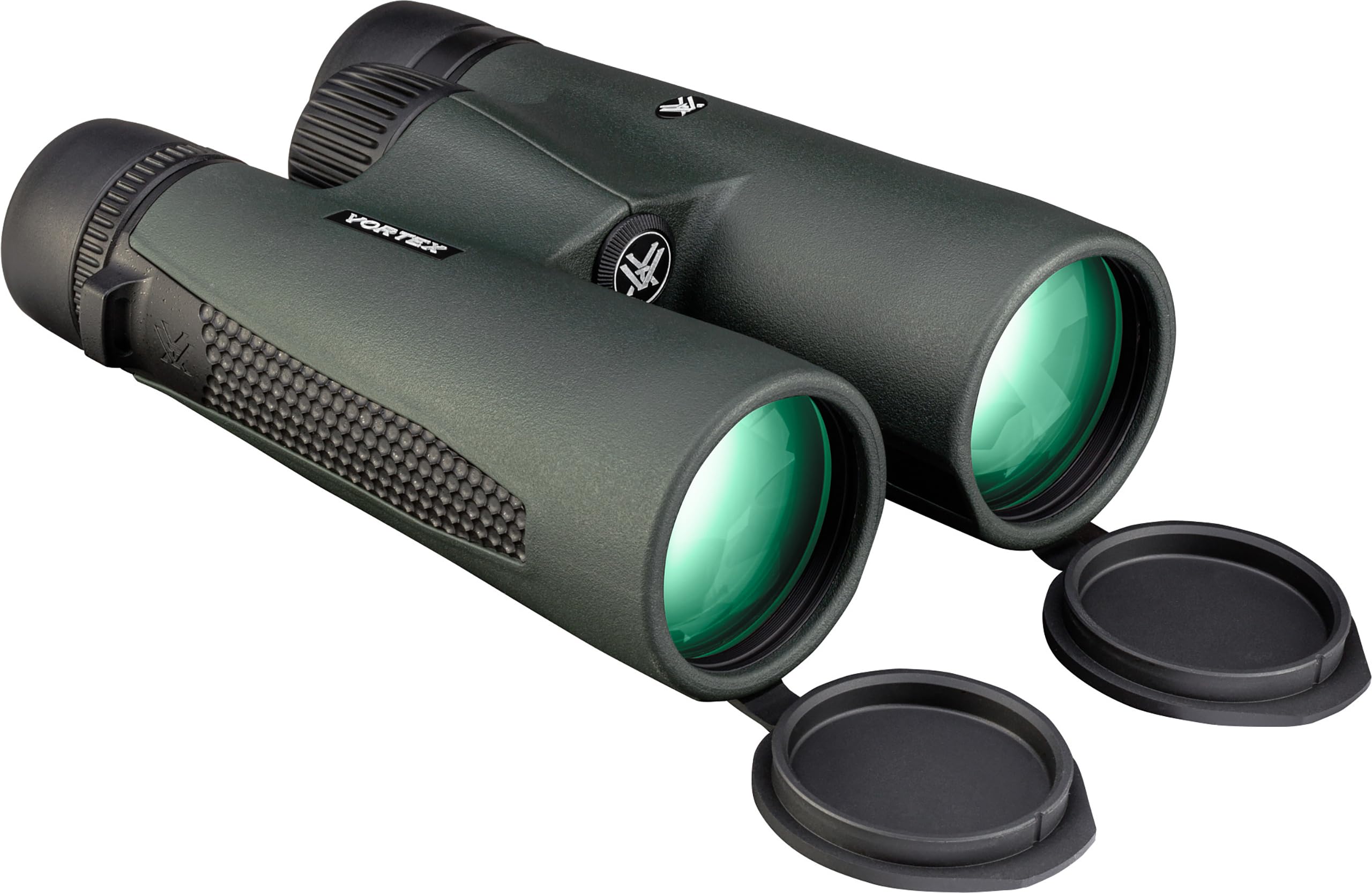
Vortex Diamondback HD 8×42
Key Features
- Magnification: 8x
- Objective Lens: 42mm
- Coatings: Fully Multi-Coated + Dielectric
- Waterproof: Yes
- Price: Premium
The Vortex Diamondback HD delivers bright, crisp images with dielectric prism coatings that minimize chromatic aberration and maximize light transmission — a level of clarity that rivals binoculars costing significantly more. The argon purging and O-ring seals make it fully waterproof and fogproof for use in misty marshes or sudden rain.
At 21 ounces, this 8×42 pair is light enough to carry all day without shoulder fatigue. The open-bridge design helps the binoculars sit naturally in the hands, though a small number of users note that the focus wheel can feel stiff right out of the box — it tends to loosen with a few hours of use.
This is the binocular for enthusiast birders who spend long hours in the field and want near-premium image quality without the ultra-premium price. The included GlassPak case, while functional, can show wear after a few months of heavy use — a tradeoff that is easy to live with given the lifetime warranty protecting the optics themselves.
Pros
- Exceptionally sharp, bright image with edge-to-edge clarity and natural color
- Lightweight and well-balanced for comfortable all-day handling
- Strong optical performance for the price, often compared to much more expensive models
Cons
- Focus wheel may feel stiff during initial use until it breaks in
- Included GlassPak case can show signs of wear after a few months of field use
For birders who demand bright, sharp views and plan to spend many hours outdoors, the Vortex Diamondback HD 8×42 offers the most balanced combination of optical performance, weight, and warranty protection in its price range.
Best for Optical Purists
Athlon Midas UHD 8×42
Key Features
- Magnification: 8x
- Objective Lens: 42mm
- Coatings: Fully Multi-Coated + Dielectric
- Waterproof: Yes
- Price: Premium
The Athlon Midas UHD 8×42 uses ED glass and dielectric coatings to deliver sharp, color-accurate images with minimal chromatic aberration — a meaningful upgrade over standard roof-prism models. In low light, the 42mm objective gathers enough brightness to keep details clear at dawn and dusk.
That optical performance comes at a cost in weight: 1.56 lbs is heavier than the current top pick, making it more noticeable during long walks or extended handheld use. The 17.2mm eye relief works well for glasses wearers, and the focus ring turns smoothly. Birders who can accept the extra ounces for cleaner views will find this a capable companion.
Pros
- ED glass minimizes color fringing for crisp, natural-looking images
- High light-gathering ability keeps low-light scenes bright
- Solid build with a smooth, precise focus adjustment
Cons
- At 1.56 lbs, it may cause fatigue during long handheld sessions
- Eyecup twist-up can be stiff out of the box — looseness may take a few cycles to break in
A serious birding tool for anyone who values optical refinement and can live with the extra weight.
Best for Value Birders
Vortex Crossfire HD 10×42
Key Features
- Magnification: 10x
- Objective Lens: 42mm
- Coatings: Fully Multi-Coated
- Waterproof: Yes
- Price: Mid-Range
The Vortex Crossfire HD 10×42 pairs fully multi-coated optics with an unconditional lifetime warranty at a price that undercuts the top pick. While the Diamondback HD offers dielectric coatings and lighter weight, the Crossfire provides a slightly more affordable entry into Vortex’s optical quality. The view is sharp and color-accurate across most of the field, with only mild softening toward the edges — a tradeoff typical of this price tier.
This binocular suits value-minded birders and hunters who want a durable, all-weather tool backed by a warranty that covers any mishap. At 1.4 lbs, it’s not the lightest option for long treks, and the included GlassPak harness can feel bulky when layered with other gear. The focus wheel may feel stiff at first, but it smooths with use. Those who demand edge-to-edge sharpness comparable to dielectric-coated models should look at the Diamondback HD instead.
Pros
- Sharp, color-accurate image across most of the field.
- Durable construction backed by a no-questions-asked warranty.
- Competitive price for the optical performance and build quality.
Cons
- The focus wheel can require a break-in period before it turns smoothly.
- The included GlassPak harness may feel bulky when worn under a jacket or pack.
For birders and hunters who want a durable binocular with a lifetime warranty and solid optics at a mid-range price, the Crossfire HD delivers without the premium of dielectric coatings.
Best for Low-Light Birders
Vortex Triumph 12×50
Key Features
- Magnification: 12x
- Objective Lens: 50mm
- Coatings: Multi-coated
- Waterproof: Yes
- Price: Mid-Range
The Triumph HD 12×50 pulls ahead of pricier 10×42 options when early-morning or dusk light is scarce. The 50mm objective and 4.17mm exit pupil gather enough light to keep details visible in dim conditions, making it a practical choice for birders who need high magnification without moving to premium glass. Where lighter all-rounders like the Crossfire HD emphasize portability, this model trades weight for reach and brightness.
This binocular suits birders who routinely scan open fields or treetops at dawn and don’t mind a bit of heft. The 26.2-ounce body and 12x power mean handheld stability is limited — a tripod or a steady rest transforms the experience. Chromatic aberration shows as faint fringing on high-contrast edges, but it’s a minor trade-off given the light-gathering ability at this price point. The included GlassPak harness makes carrying less of a chore, and the multi-coated optics deliver a crisp, neutral image for the cost.
Pros
- Effective low-light performance from a large 50mm objective and big exit pupil
- Clear, crisp image at distance that exceeds expectations for the price
- Comfortable GlassPak harness and useful accessories included out of the box
Cons
- Chromatic aberration visible as color fringing at high-contrast edges, especially on white birds against dark foliage
- 26.2-ounce body and 12x magnification make long handheld sessions fatiguing without a tripod
For birders who need maximum light gathering and 12x reach on a budget, the Triumph HD delivers – just keep a tripod handy.
Best for Travel Birders
Nikon PROSTAFF P3 8×42
Key Features
- Magnification: 8x
- Objective Lens: 42mm
- Coatings: Multilayer-coated
- Waterproof: Yes
- Price: Mid-Range
The Nikon PROSTAFF P3 8×42 offers a wider field of view and steadier handheld images than its 10×42 sibling, making it a natural fit for long birding sessions.
With 20.2mm of eye relief, this binocular is especially comfortable for glasses wearers, avoiding the eye strain common with shorter relief models. The 1.1-pound weight suits all-day carry on hikes. However, the included neck strap attachment can be unreliable; some users recommend replacing it. The eyecups may not lock firmly in place, but that’s a minor concern for most.
Pros
- Sharp, true-to-color views with multilayer coatings
- Lightweight 1.1-pound body for easy travel
- Good value for a well-known optics brand
Cons
- Eyecups may not lock firmly in place
- Neck strap attachment can be unreliable
For glasses wearers who want a portable binocular for long birding walks, this Nikon delivers on clarity and comfort – just plan to upgrade the neck strap.
Best for Budget Birders
Adorrgon 12×42

Key Features
- Magnification: 12x
- Objective Lens: 42mm
- Coatings: Fully Multi-Coated
- Waterproof: Yes
- Price: Budget
Exceptional feature set for the price: BAK4 roof prisms, fully multi-coated optics, waterproofing, and a phone adapter plus tripod. The 12x magnification demands a steady hand or tripod to keep images sharp, and the phone adapter alignment can be finicky. While optics are clear for casual use, they lack the refined coatings of mid-range models, making this best suited for budget-conscious birders and backyard observation.
Pros
- Exceptional value for the price
- Sharp, clear image quality
Cons
- 12x magnification requires a steady hand; image shake can be an issue without support
- Phone adapter alignment can be finicky
Best for casual birding on a tight budget, especially if you plan to use the included tripod or can steady the binoculars.
Best for Budget Travelers
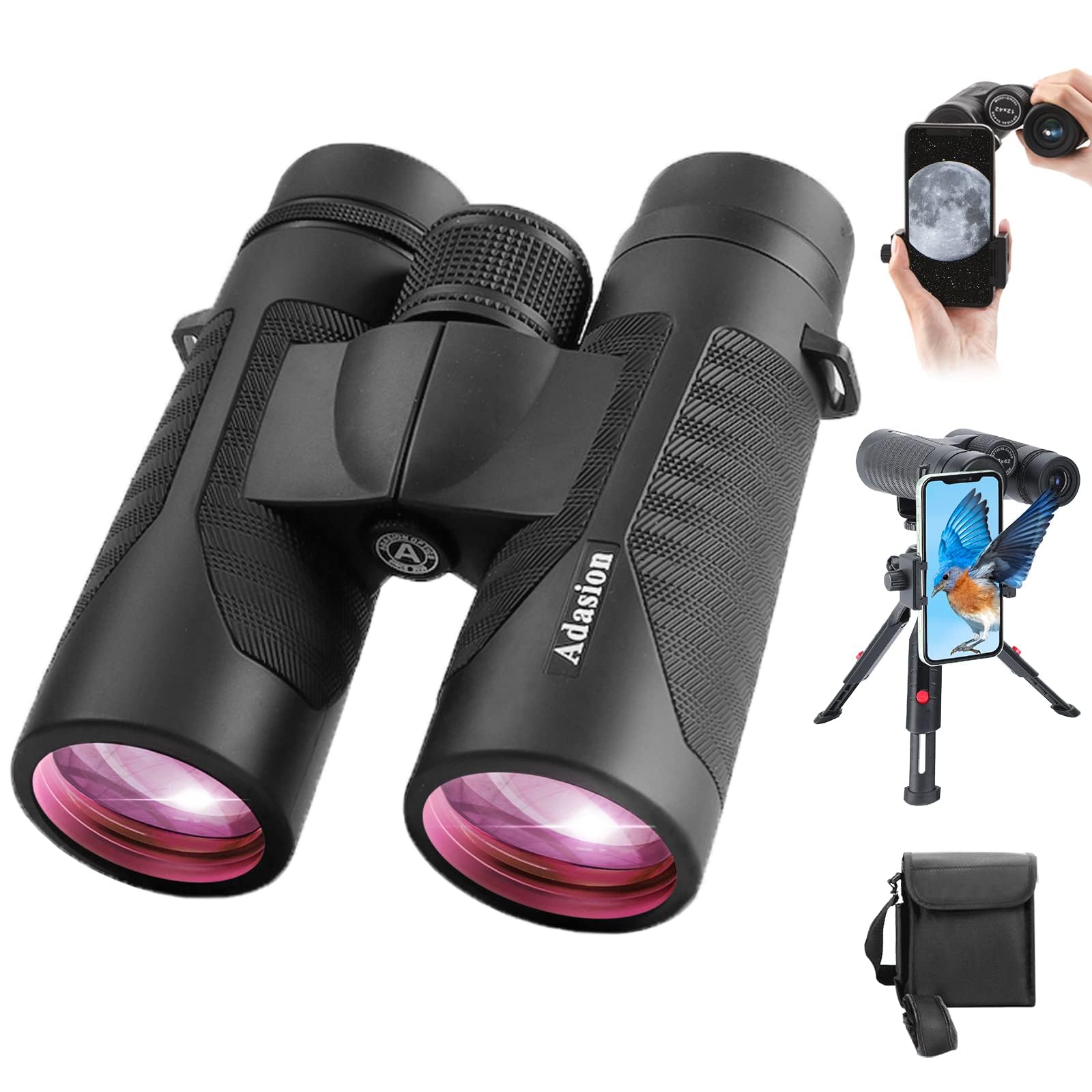
Adasion 12×42
Key Features
- Magnification: 12x
- Objective Lens: 42mm
- Coatings: Fully Multi-Coated
- Waterproof: IPX7
- Price: Budget
The Adasion 12×42 delivers a crisp, bright view with good low-light performance, backed by a lightweight body that’s easy to carry on walks. The included phone adapter and tripod add real utility for digiscoping or extended viewing. However, the 12x magnification amplifies hand shake — steady support, like the provided tripod, is necessary for a clear image. Phone adapter alignment can be finicky with some devices, and optical quality is in line with other budget models, not a step above them. This is a solid value for anyone wanting a complete birding kit without spending more.
Pros
- Crisp, clear image with strong brightness in low light
- Good value with included phone adapter and tripod as useful extras
Cons
- 12x magnification demands a steady support to avoid shake
- Phone adapter may need adjustment for proper alignment with some phones
Best for budget-conscious birders who want a ready-to-use kit with phone adapter and tripod, provided you can steady the view or plan to shoot digiscoped photos.
Best for Modern Birders
Nikon PROSTAFF P7 10×42

Key Features
- Magnification: 10x
- Objective Lens: 42mm
- Coatings: Fully Multi-Coated + Dielectric
- Waterproof: Yes
- Price: Mid-Range
This binocular delivers crisp, bright views thanks to dielectric coatings and a lightweight design that makes extended birding sessions comfortable. The only notable drawback is that the diopter ring can shift with accidental contact, which may require occasional readjustment. For birders who don’t mind that minor quirk, this offers strong optical performance at a mid-range price, but those seeking a more foolproof diopter lock might prefer a different option.
Pros
- Bright, sharp images with clear views
- Lightweight (21.2 oz) and well-designed
Cons
- Diopter ring can be accidentally moved, requiring occasional readjustment
A capable 10×42 for birders who prioritize optical clarity and portability, as long as the diopter adjustment is managed carefully.
Best for Casual Birders
Celestron Outland X 8×42

Key Features
- Magnification: 8x
- Objective Lens: 42mm
- Coatings: Multi-coated
- Waterproof: Yes
- Price: Mid-Range
The Celestron Outland X delivers bright, clear views in a lightweight package that’s easy to carry, making it a solid entry-level 8×42 for casual birding. However, the eyecup adjustment mechanism can become loose over time, and the focus wheel may exhibit slight play, which limits its appeal for those needing precise adjustments. Less sophisticated coatings also mean it doesn’t match the image contrast of higher-priced models.
Pros
- Bright, sharp images with a generous field of view for birding.
- Lightweight and comfortable for extended handheld use.
Cons
- When using with glasses, the eyecup may require frequent readjustment.
- The focus wheel can have slight play, making fine adjustments less precise.
Best for budget-conscious birders who want a light, easy-to-use binocular for short sessions and can tolerate occasional eyecup adjustments.
Best for Brand Loyalists
Celestron Nature DX 8×42

Key Features
- Magnification: 8x
- Objective Lens: 42mm
- Coatings: Fully Multi-Coated + Phase
- Waterproof: Yes
- Price: Mid-Range
The Celestron Nature DX 8×42 delivers impressive image contrast and color fidelity for its price, thanks to phase-coated BAK4 prisms. Optically it punches above its mid-range cost, making it a solid option for birders who prioritize a clear, vibrant view. Build quality, however, can be inconsistent — some units have lens rings or rubber armor that may detach over time. At 1.75 lbs it’s also on the heavier side for extended handheld use. These tradeoffs limit its appeal to those who don’t need a rugged field companion.
Pros
- Crisp, clear image with good contrast and color
- Good value with phase-coated prisms at this price
Cons
- Lens ring or rubber parts may detach in some units
- Weighs 1.75 lbs, which may cause fatigue during long handheld sessions
A good fit for birders who value image quality over durability and don’t mind extra weight, but less ideal for rough field conditions.
Best for Tripod Birders
GIGAPENGUIN 15×52

Key Features
- Magnification: 15x
- Objective Lens: 52mm
- Coatings: Fully Multi-Coated + Dielectric
- Waterproof: Yes
- Price: Budget
The GIGAPENGUIN 15×52 delivers surprisingly clear and bright images for its price point, paired with a functional phone adapter that captures distant subjects. However, the high 15x magnification introduces noticeable shake during handheld use—any slight movement is amplified, making a tripod essential for stable viewing. Some units also exhibit focusing inconsistency where achieving sharp focus may take extra adjustment. This binocular suits tripod-bound observers who prioritize magnification over portability, but it is a poor match for the handheld birding most enthusiasts expect from a compact mid-range model.
Pros
- Very good clarity and brightness for the price
- Includes functional phone adapter
Cons
- High 15x magnification can cause image shake without a tripod, limiting handheld use
- Some units may have focusing issues where fine-tuning sharpness is difficult
Best for tripod-based stargazing or distant landscape viewing where maximum reach is needed on a tight budget, but not for handheld birding.
How to Choose
The most common mistake in birding binoculars is choosing too much magnification for handheld use.
Magnification
Magnification (8x to 12x) determines how much closer the bird appears. Higher magnification amplifies hand shake, making 12x and above impractical without a tripod. An 8x or 10x pair provides a steady, wider field that lets you track birds in motion easily.
For dawn or dusk birding, a larger exit pupil from 8×42 (5.25mm) delivers brighter images than 12×42 (3.5mm) despite the lower magnification. Choose magnification based on your typical stability — if you’ll always use a tripod, 12x or 15x can work; for handheld, stick with 8x or 10x.
Objective Lens Size
The objective lens (32mm to 50mm) controls light intake and physical size. Larger objectives gather more light — a 50mm lets in about 40% more light than a 42mm, improving low-light performance. The trade-off is weight: 50mm bodies often exceed 24 ounces, which can cause arm fatigue during long walks.
A 42mm objective offers the best balance for all-around birding: enough light for early mornings without the bulk of a 50mm. Only choose 50mm if you frequently bird at sunrise or sunset and don’t mind the added weight.
Optical Coatings
Coatings reduce internal reflections and improve brightness, contrast, and color accuracy. Fully multi-coated (FMC) lenses treat every air-to-glass surface, while less expensive ‘multi-coated’ models treat only some. Dielectric coatings on prisms further boost light transmission and color fidelity.
Phase-correction coatings on roof prisms prevent image softness and are standard at $100+. Budget models often skip them, resulting in slightly dimmer, less sharp views. For serious birding, look for fully multi-coated lenses and dielectric or phase-corrected prisms.
Waterproof and Fogproof
Waterproofing (O-ring seals) prevents moisture ingress, while fogproofing (nitrogen or argon purge) stops internal fogging during temperature changes. A sealed binocular is essential for humid mornings, rain, or accidental drops into water — a single internal fogging can ruin your view permanently.
Most models at $100+ are waterproof and fogproof, but budget pairs may only be water-resistant. For saltwater environments or heavy use, look for IPX7 or argon purging for extra protection.
Eye Relief
Eye relief is the distance your eye can be from the eyepiece while still seeing the full image. For glasses wearers, 15mm or more is necessary to avoid vignetting. Longer eye relief (17–20mm) also makes binoculars easier to use quickly without fine adjustment.
If you don’t wear glasses, longer eye relief still offers a more forgiving viewing position. Check this spec when trying out any binocular — it’s often overlooked but directly affects comfort.
Field of View
Field of view (FOV) is the width you see at 1,000 yards, typically 330–430 feet for 8×42 models. A wider FOV makes it easier to locate and follow birds in flight, especially in dense foliage or fast-moving flocks.
Higher magnification usually narrows the FOV: an 8×42 often has 400 ft, while a 12×42 may drop to 300 ft. Prioritize FOV over magnification if you value tracking over distance.
FAQ
Is 12x magnification too shaky for bird watching without a tripod?
Yes, for most handheld use. 12x amplifies hand movements noticeably, making the image jumpy unless you brace against a tree or use a tripod. If you plan to bird unsupervised, stick with 8x or 10x for a steady, enjoyable view.
What does fully multi-coated mean for binoculars and why does it matter?
Fully multi-coated means every air-to-glass lens surface receives multiple anti-reflective coatings, maximizing light transmission and reducing glare. It directly translates to brighter, sharper images, especially in low-light conditions. Budget models with just ‘coated’ lenses will appear dimmer.
Can 8×42 binoculars see well in low light compared to 10×42?
Yes, often better. The larger exit pupil of an 8×42 (5.25mm) lets in more light than a 10×42 (4.2mm), making the image brighter at dawn and dusk. The 10×42 may show more detail at distance but at the cost of brightness. For low-light birding, 8×42 is the superior choice.
Do I really need waterproof binoculars for birding or is just water-resistant enough?
You need waterproof (O-ring sealed) binoculars for reliable birding. Water-resistant offers little protection against rain or accidental submersion, and internal fogging can ruin a pair permanently. Spend the extra $20-$40 for a fully waterproof model — it’s a one-time investment for years of worry-free use.