
This post contains affiliate links. We may earn a small commission when you buy through our links — at no extra cost to you.
Many portable solar chargers on the market include a solar panel that barely trickles power, leaving travelers frustrated under the sun. The real divide is between foldable panels designed to charge devices directly and power banks that use the panel as a backup feature that rarely works as advertised.
This guide focuses on the chargers that actually deliver usable power when you need it, balancing portability, build, and real-world output. The key trade-off comes down to price versus construction quality: a well-built foldable panel can last for years, while a budget panel may save money upfront but deliver inconsistent performance.
By understanding which spec actually matters – panel wattage and direct sunlight requirements – you can pick a charger that keeps your phone, tablet, or camera running during a weekend hike or an extended road trip.


Best for Design Travelers
ELECOM NESTOUT 28W Panel
Key Features
- Capacity / Wattage: 28W
- Weight: 1.7 lbs
- Ports: 2 USB-A
- Price: $$$
The ELECOM NESTOUT 28W panel carries an IF Design Gold Award for its craftsmanship, and that attention to detail shows in the reinforced stitching, weather-resistant fabric, and smooth zippers. The SunPower cells convert sunlight efficiently, delivering consistent charge rates in direct conditions – a phone or power bank gains meaningful charge within a few hours.
Charging performance is steady under clear skies – two devices can charge simultaneously via the USB-A ports. In extreme heat, the panel can pause output to cool down; this is a protective measure rather than a failure, and output resumes once the temperature drops. There is no USB-C port, so modern phones or tablets with USB-C input require a USB-A to USB-C cable or adapter.
This panel suits design-conscious travelers and backpackers who want a panel that will hold up over years of use. The build quality and integrated storage pouch for a power bank make it easy to pack without fumbling for cables. The premium price reflects that durability, but budget shoppers may prefer a more affordable option. Those who need fast USB-C charging should look elsewhere – the NESTOUT sticks to USB-A.
Portability is a highlight: the panel folds into its own case with a zippered pouch that holds a power bank snugly, eliminating the need for separate bags. At 1.7 pounds, it is light enough for backpacking without feeling flimsy. The built-in current checker provides real-time output feedback, so you can see how much power the panel is generating.
Pros
- Build quality and design earn an IF Design Gold Award
- Consistent charging in direct sunlight
- Integrated pouch stores a power bank securely
- High-efficiency SunPower cells
Cons
- In very hot climates, the panel may pause charging to cool down
- Only USB-A ports – devices with USB-C need an adapter
A well-built, durable panel for travelers who prioritize build quality and long-term use over price or USB-C compatibility.
Best for Backpackers Sunny
BigBlue 28W Solar Panel
Key Features
- Capacity / Wattage: 28W
- Weight: 1.5 lbs
- Ports: 2 USB-C, 1 USB-A
- Water Resistance: IP44
- Price: $$
The BigBlue 28W stands apart from premium rivals by pairing dual USB-C ports with a sub-$70 price tag. It folds to a compact 11x6x1.4 inches and weighs just 1.5 lbs, making it practical for backpackers who want direct device charging without the higher cost of boutique panels. While the top pick in this category (ELECOM NESTOUT) adds an integrated storage pouch and SunPower cells, this model delivers comparable charging speed in bright sunlight for about 40% less.
In direct sun, the panel charges phones in under an hour – performance that rivals a wall adapter. But that speed is conditional: under cloud cover or in shade, output drops sharply and may stop entirely. Durability also varies: some units have experienced charge controller malfunctions after limited use, so testing the panel immediately upon arrival is wise. This isn’t a concern for everyone, but it’s worth factoring into an extended trip decision.
This panel suits backpackers and car campers in sunny climates who prioritize price over premium build. It also works well as an emergency preparedness tool for topping off power banks at home. Skip it if you’re hiking in consistently overcast regions or need an ultralight setup – the performance penalty in clouds and occasional controller issues make it better as a fair-weather companion.
Pros
- Lightweight and portable for backpacking
- Fast charging in direct sunlight
- Dual USB-C and USB-A ports allow simultaneous charging
Cons
- In overcast or shaded spots, the panel may deliver little to no charge
- Charge controller can malfunction after short use in some cases
For budget-conscious backpackers who can keep the panel in full sun, the BigBlue 28W provides dependable charging at a lower price than premium alternatives – just be prepared to manage its weather sensitivity.
Best for Emergency Backup
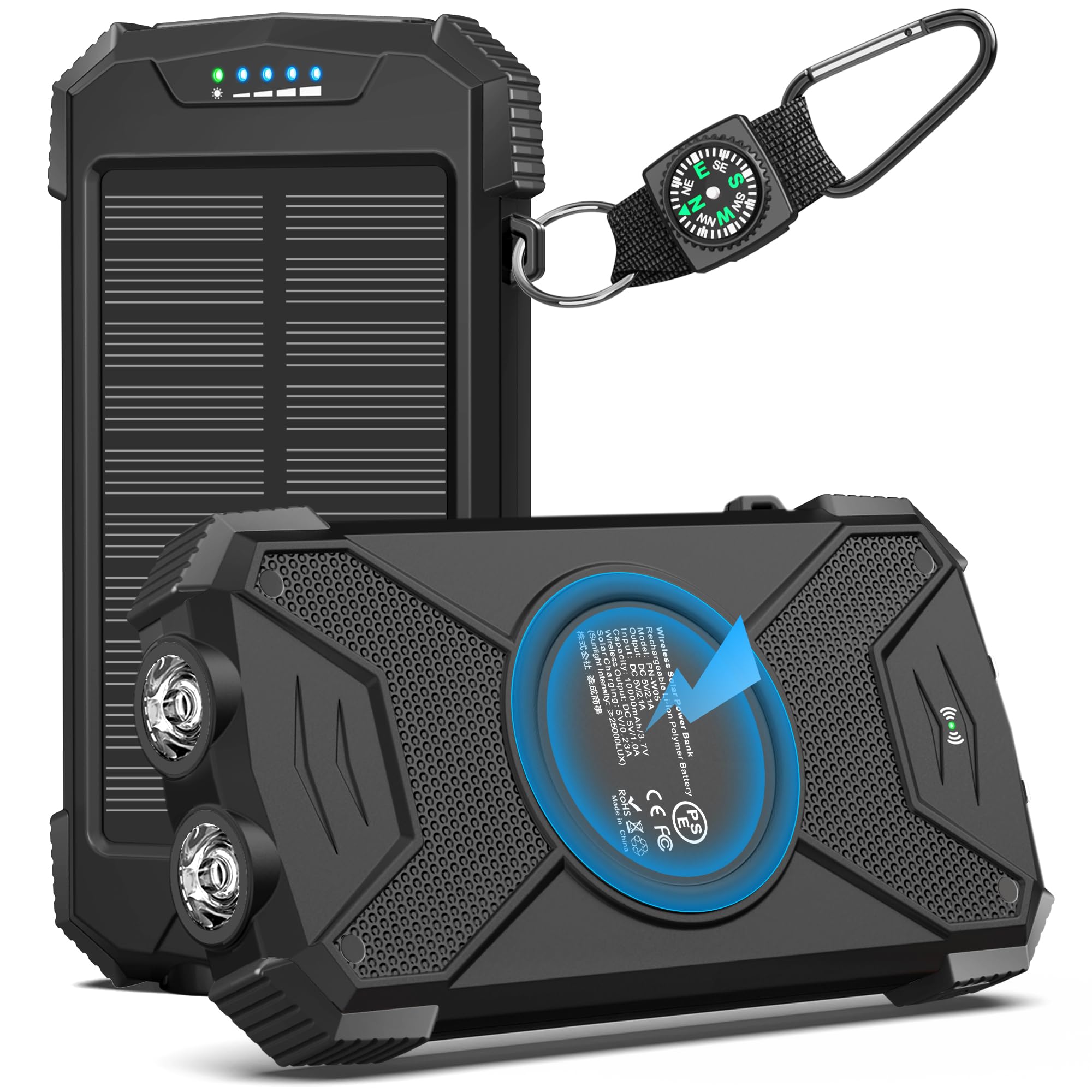
BLAVOR 10,000mAh Power Bank
Key Features
- Capacity / Wattage: 10,000mAh
- Weight: 9.3 oz
- Ports: USB-A, USB-C, Wireless
- Water Resistance: IPX5
- Price: $
With over 46,000 reviews and a pocket-friendly design, the BLAVOR 10,000mAh Power Bank has built a solid reputation as a wallet-friendly travel companion for topping off phones and tablets from a wall outlet. But in terms of solar charging, the integrated panel is too small to produce useful current in most conditions — think of it as a conventional power bank that includes an emergency trickle-charge option rather than a true solar charger.
This model fits best for budget-conscious travelers, everyday carry, and emergency kits where wall power is accessible. It also supports wireless charging, adding convenience for compatible devices. However, if your plan relies on recharging the power bank itself from the sun — say, on a multi-day backpacking trip — the BLAVOR will not meet expectations. For actual solar charging, a dedicated foldable panel such as the BigBlue 28W or ELECOM NESTOUT is a more realistic choice.
When pre-charged from a USB wall charger, the 10,000mAh capacity handles multiple device top-ups with ease, and the compact 9.3-ounce build slides into a jacket pocket or small pouch. Durability is less consistent — occasional units have been noted to stop functioning after a few months, so purchasing from a retailer with a straightforward return policy is sensible. At its price point, the BLAVOR delivers good value as a pocket power bank, provided you don’t count on the solar panel to do the heavy lifting.
Pros
- Compact pocket-size design fits easily in bags or small pouches.
- Charges multiple devices effectively when pre-charged via wall outlet.
- Wireless charging support adds convenience for compatible phones.
Cons
- Solar charging is extremely slow — expect little to no charge even after hours in direct sunlight.
- Durability can vary between units; some may stop working within months.
The BLAVOR is a cost-effective, compact power bank for anyone who primarily charges from a wall outlet. If solar recharging is your core need, skip this and invest in a dedicated foldable panel.
Best for Budget Campers
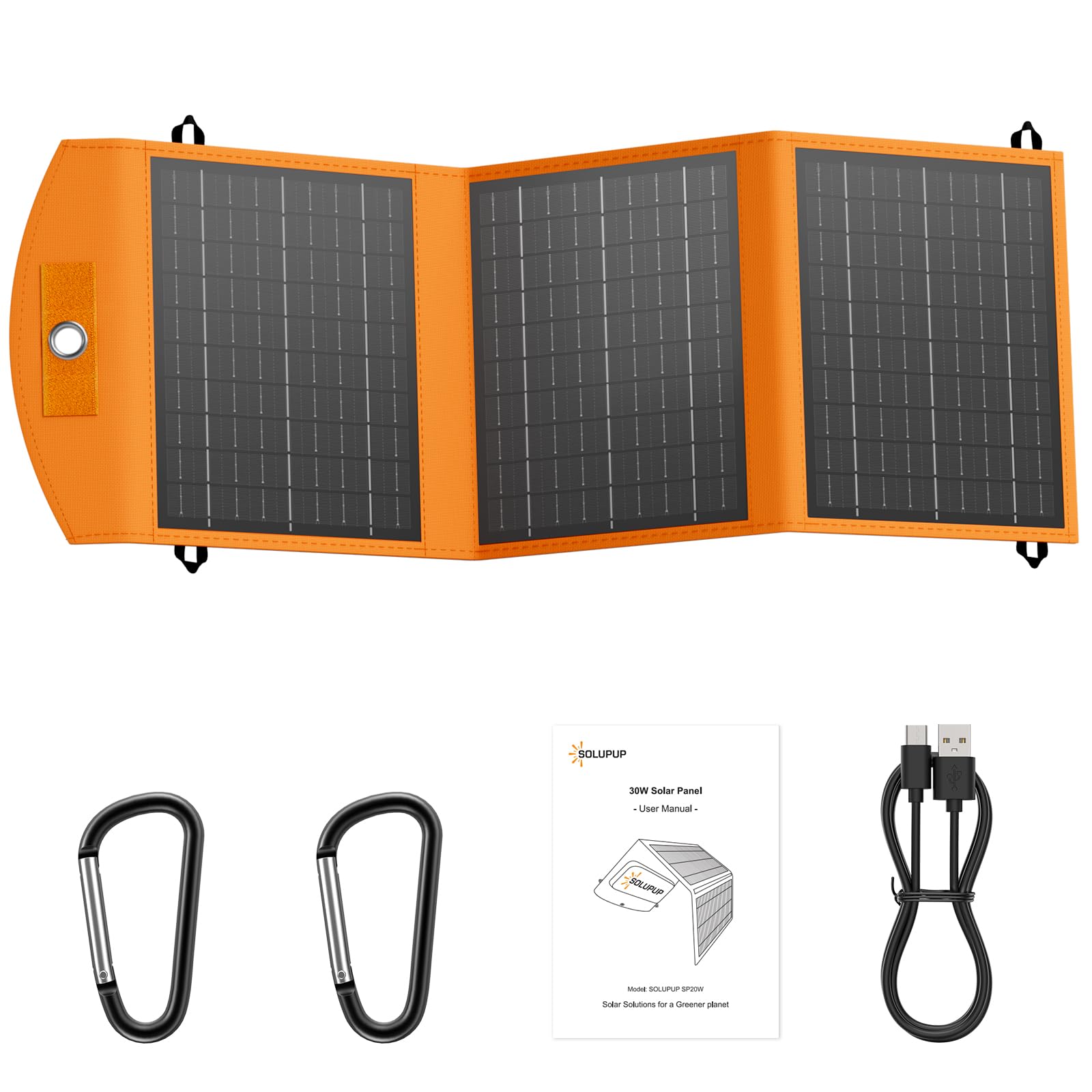
SOLUPUP 30W Solar Panel
Key Features
- Capacity / Wattage: 30W
- Weight: 2.4 lbs
- Ports: USB-A, USB-C
- Water Resistance: IPX5
- Price: $
The SOLUPUP 30W panel delivers solid charging performance for the price, making it a practical choice for day hikes with car support or basecamp use. Its built-in kickstands allow easy positioning to catch the sun, and the IPX5 water rating adds peace of mind against light rain. While heavier than some competing 30W panels at 2.4 lbs, the build feels sturdy and not flimsy for its class.
This panel best suits budget-conscious campers who drive to their campsite and need a backup charger for phones and power banks. Backpackers covering significant distances will find the 2.4 lb weight noticeable compared to slimmer options, and charging speed slows notably in shade – so it works best in full sun conditions. For those who can live with these boundaries, the SOLUPUP offers a practical, cost-effective solar solution.
Pros
- Charges phones and power banks adequately in direct sunlight.
- Feels solid and well-made for a budget-priced panel.
- IPX5 water resistance provides protection against light rain and splashes.
Cons
- Heavier than some competing 30W panels (2.4 lbs) – less suitable for ultralight backpacking.
- Charging speed drops significantly under clouds or shade – performs best in full, direct sun.
For car campers and emergency kit builders on a budget, this panel delivers honest value without overpromising.
Best for Jackery Power Station
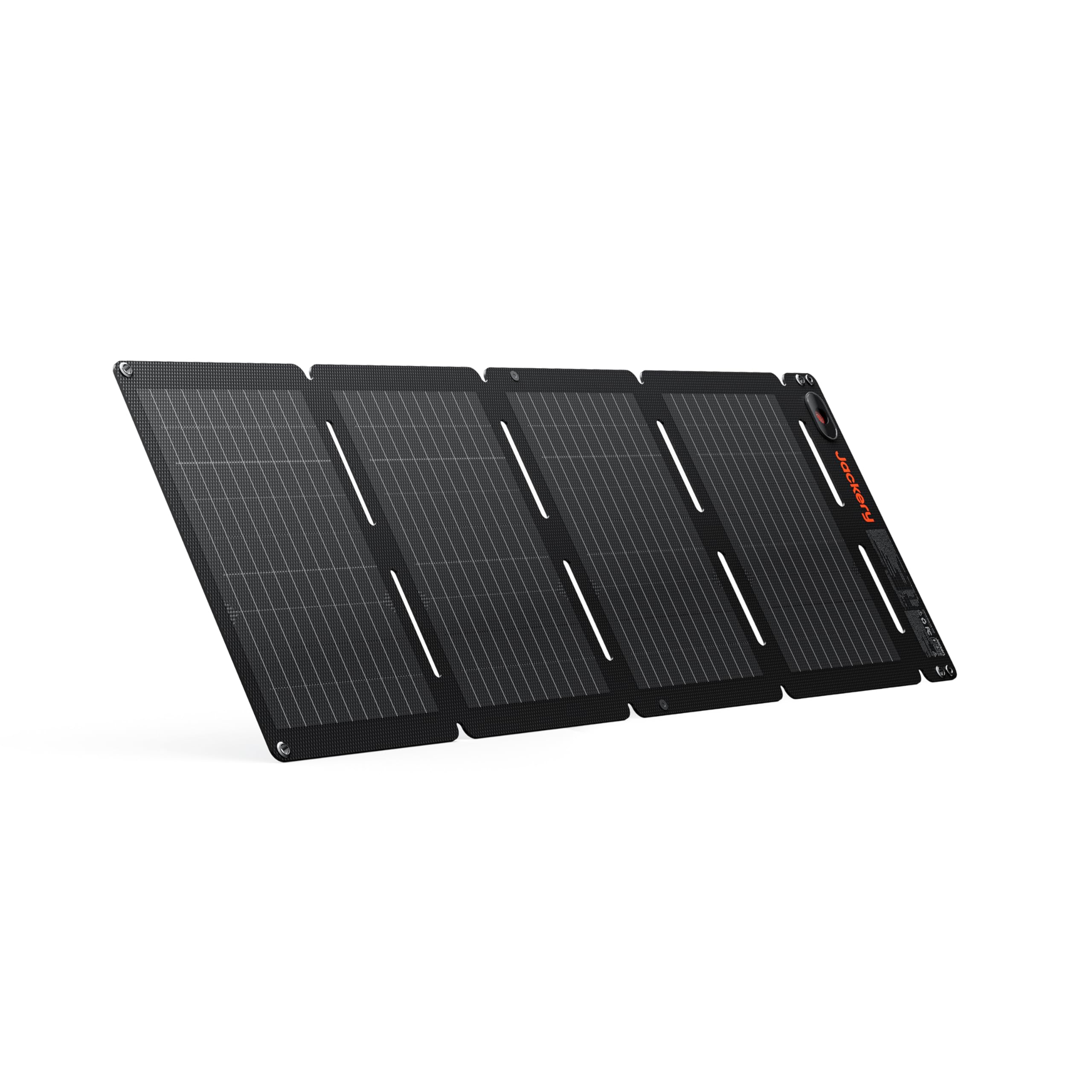
Jackery SolarSaga 40W
Key Features
- Capacity / Wattage: 40W
- Weight: 2.6 lbs
- Ports: USB-A, USB-C, DC8020
- Water Resistance: IP68
- Price: $$$
The Jackery SolarSaga 40W packs an IP68 waterproof rating and a 2.6 lb frame into a panel that works directly with newer Jackery power stations and offers USB-C and USB-A ports for charging phones or cameras on the go. The build is noticeably sturdy, and the compact size makes it easy to stow in a car trunk or camera bag.
In good sunlight, the panel typically delivers 20–25W rather than the advertised 40W—adequate for topping off a power station over a few hours, but noticeably slower for direct USB device charging. That output is still enough for a phone or tablet if you have the time, but it won’t keep up with heavy simultaneous charging.
This panel makes sense if you already own a compatible Jackery power station (Explorer 500 or newer) and want a small solar companion for car camping or photo shoots. Avoid it if you need reliable fast charging for backpacking, or if you don’t own a Jackery station—the DC8020 connector is proprietary, and older models like the Explorer 240/300 require a separate adapter.
Pros
- Lightweight and compact for a 40W panel – easy to pack for car camping or day trips.
- Solid build quality with an IP68 waterproof rating that holds up in unexpected rain.
- Built-in USB-C and USB-A ports allow direct phone/tablet charging without a power station.
Cons
- Older Jackery power stations (Explorer 240/300) may need a separate DC8020 adapter to connect.
- Real-world power output can settle around 20–25W rather than the rated 40W, slowing down direct USB charging.
For Jackery power station owners who already have a compatible model, this is a portable solar companion that fits the ecosystem. Just don’t expect 40W in real sun, and verify your station’s connector before buying.
Best for Group Camping Trips
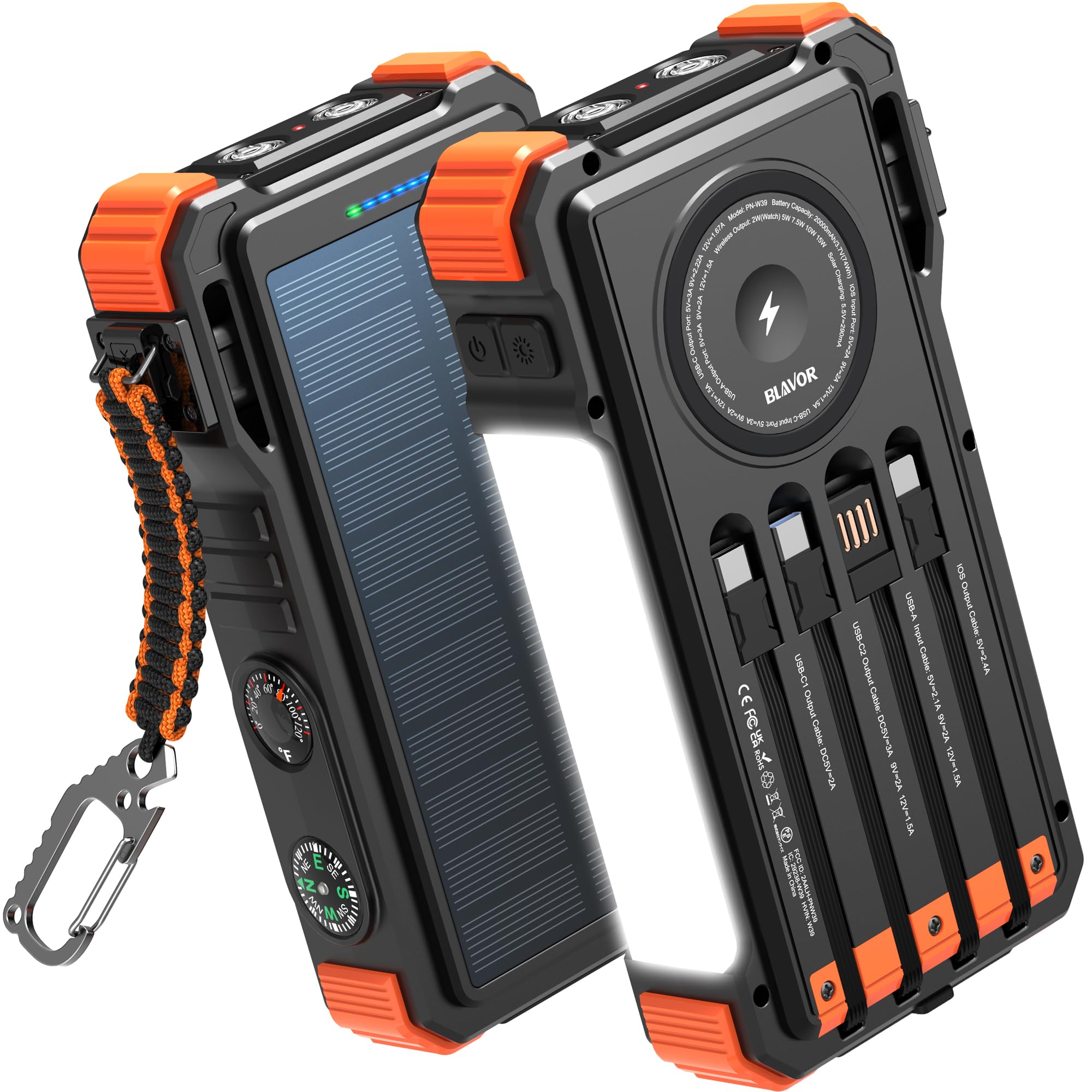
BLAVOR 20,000mAh Power Bank
Key Features
- Capacity / Wattage: 20,000mAh
- Weight: 1.72 lbs
- Ports: USB-A, USB-C, Wireless, Built-in cables
- Price: $
The BLAVOR 20,000mAh power bank delivers high capacity and built-in cables for charging multiple devices without extra cords. The solar panel, however, is so slow that it adds negligible charge even after a full day in direct sun. At 1.72 lbs, it’s bulkier than similarly sized power banks – fine for car camping or power outages but not for lightweight backpacking. If you need the extra capacity for long trips where wall charging is accessible, this is a practical choice; treat the solar panel as a backup trickle charger at best.
Pros
- High 20,000mAh capacity charges phones several times over and can top off a laptop.
- Built-in cables and wireless charging reduce the need for extra cords.
Cons
- Solar charging is extremely slow – may add negligible charge after hours in sunlight.
- At 1.72 lbs, it’s heavier than many alternatives – fine for car camping but not for backpacking.
If you need a high-capacity power bank for group trips with access to wall outlets, this is a cost-effective option – just don’t rely on the solar panel.
Best for Ultralight Hikers
Goal Zero Nomad 5

Key Features
- Capacity / Wattage: 5W
- Weight: 0.79 lbs
- Ports: 1 USB-A
- Price: $
The Goal Zero Nomad 5 packs a 5W solar panel into a 0.79-pound package, making it one of the lightest options for backpackers. It can slowly top off a phone or power bank in direct sun, but its 5W output means charging from empty takes hours. Performance drops sharply in overcast conditions or shade, limiting it to emergency beacon charging or extending a power bank’s life during extended trips. For primary charging needs, this panel falls short—it’s a backup tool, not a main power source.
Pros
- Ultra-lightweight and extremely portable for backpacking
- Works well for trickle charging small devices in full sun
Cons
- Very slow charging; only useful for topping off, not full charging
- Requires very bright, direct sunlight to produce any noticeable charge
Ideal for ultralight hikers who need a backup trickle charger for a power bank or emergency device, but not for anyone relying on solar as a main power source.
Best for Budget Shoppers
YELOMIN 38,800mAh Power Bank
Key Features
- Capacity / Wattage: 38,800mAh
- Weight: 1.1 lbs
- Ports: USB-A, USB-C, Built-in cables
- Water Resistance: IP65
- Price: $
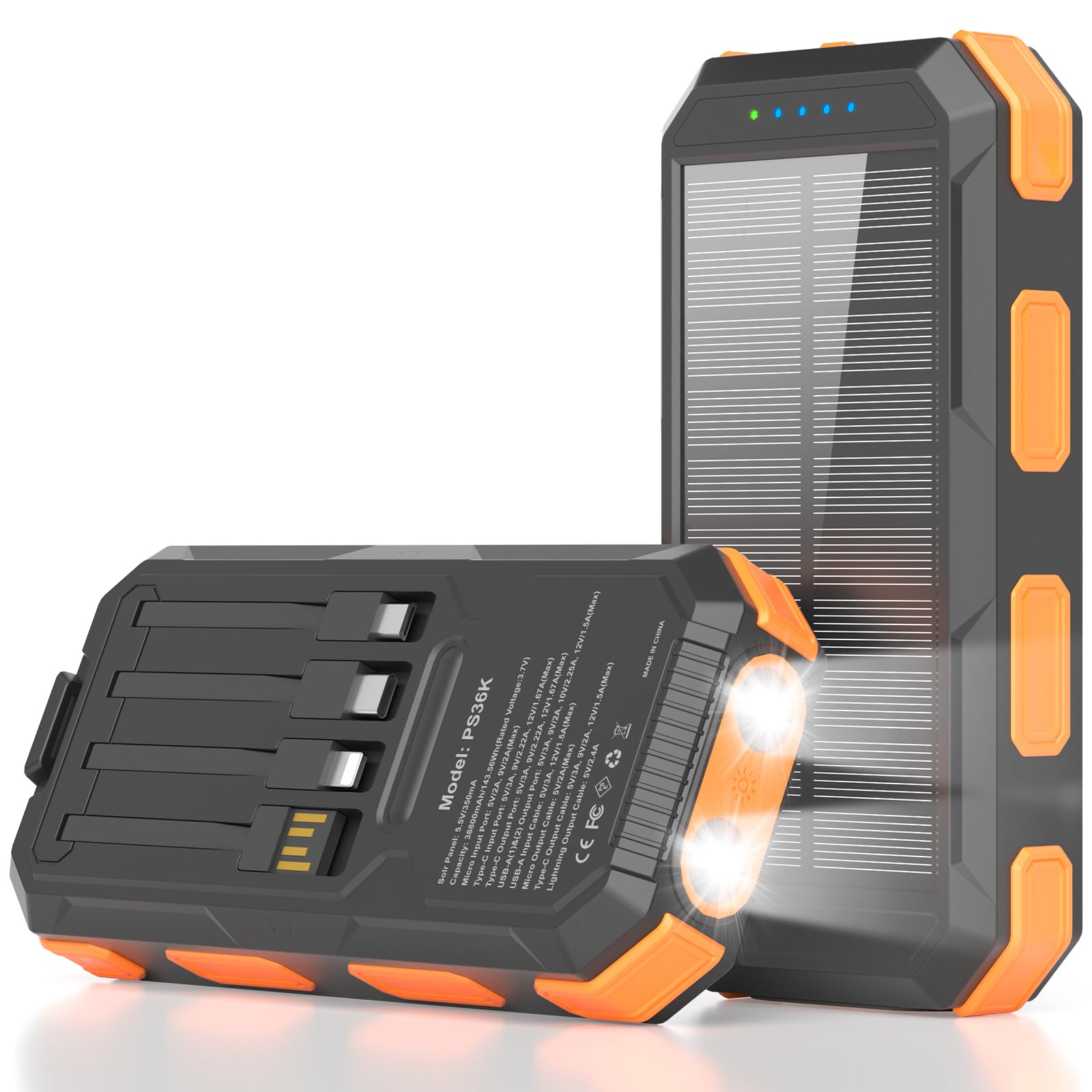
Offering a high 38,800mAh capacity and PD 22.5W fast charging for under $50, this YELOMIN power bank is a solid choice for keeping devices charged during short outages. Its compact, rugged build with IP65 protection suits carrying in a bag. However, the integrated solar panel is slow and only useful as a trickle charge in direct sunlight – not a reliable way to recharge the bank itself. Long-term durability of the battery cells and electronics remains unclear, making this a better fit for occasional use than for regular off-grid trips where you depend on solar.
Pros
- High capacity and fast charging at a budget-friendly price.
- Compact build with IP65 water resistance for outdoor use.
Cons
- Long-term performance in repeated use is not yet clear.
- Solar panel provides slow charging and may not be effective in cloudy conditions.
Best used as a pre-charged battery for emergency backups where wall charging is available beforehand, not as a primary solar charger.
How to Choose
The single most important distinction is between foldable solar panels and power banks with integrated panels — the former actually charge devices in direct sunlight, while the latter rarely deliver meaningful solar power.
Battery Capacity vs. Panel Wattage
For power banks, capacity (mAh) determines how many full device charges you get from a pre-charged unit. For foldable panels, wattage (W) determines charging speed in full sun.
A 28W panel can charge a phone in about an hour under clear skies, but a power bank’s tiny integrated panel often produces less than 2W. If you need to recharge a battery bank during a multi-day trip, a 20W+ foldable panel is essential.
Weight and Folded Size
Every extra ounce matters when you carry gear on your back. A panel under 1.5 lbs folds small enough to strap to a pack or slip into a side pocket. Power banks over 1.5 lbs become dead weight if you only need charge for a day.
Heavier panels (3+ lbs) are better suited to car camping or basecamp use where weight isn’t a constraint. Folded dimensions also affect ease of packing – look for a panel that fits inside your existing bag without forcing the zipper.
Output Ports
USB-A and USB-C are standard for direct device charging. USB-C Power Delivery (PD) offers faster charging for modern phones and tablets. Some panels also include wireless charging pads, but these are slow and inefficient.
Panels with proprietary connectors (MC4, XT60) are designed for power stations, not phones. Ensure the panel has at least one USB port if you plan to charge devices directly – otherwise you’ll need a separate power bank to convert the power.
Solar Charging Effectiveness
Solar panels on power banks are often too small to produce meaningful current – a 5W panel in direct sun needs over 10 hours to fully charge a 10,000mAh bank. Foldable panels use larger, more efficient cells (like SunPower) that convert a higher percentage of sunlight into usable power.
Even with a good panel, you need direct, unobstructed sunlight. Clouds, shade, or even hazy skies can cut output by 50% or more. If you travel in overcast regions often, a pre-charged power bank is more reliable than counting on solar.
FAQ
Why does my solar power bank take all day to charge even in direct sunlight?
Integrated solar panels on power banks are very small – typically 2-5W. A 5W panel in full sun would need 10+ hours to fully charge a 10,000mAh battery, and real-world conditions rarely hit that rate. This is a design trade-off: the panel is a backup feature, not a primary charging method.
Can I use a 100W solar panel to charge my phone directly?
Not unless the panel has a USB output port. Many 100W panels use proprietary connectors (MC4, XT60) and are designed for power stations. Even those with USB ports may supply too much current for a phone. Always check the output ports – if you see only DC connectors, you’ll need a power bank between the panel and your phone.
How long does a 28W foldable solar panel take to charge a 10,000mAh power bank?
In direct, unobstructed sunlight, a 28W panel outputs roughly 1.5-2A at 5V, which will charge a 10,000mAh power bank in about 5-7 hours. Under clouds or shade, expect 10+ hours or no meaningful charge. This is why panels are best used to top off a bank during the day, not as a primary charging source.
Is it worth buying a solar charger for travel if I mostly stay in hotels?
No – a standard power bank is lighter, cheaper, and more reliable. Solar chargers are useful only when you’ll be away from wall outlets for multiple days, such as backpacking, camping, or extended road trips. For hotel stays, a compact power bank pre-charged overnight is all you need.