
This post contains affiliate links. We may earn a small commission when you buy through our links — at no extra cost to you.
First-time safari buyers often reach for the highest magnification they can find, thinking more zoom means closer views. But 12x binoculars are notoriously hard to hold steady without a tripod – and the resulting shake turns every lion sighting into a blurry disappointment.
Then there’s the weight. A full-size 42mm binocular that looks manageable on paper can become a neck ache two hours into a game drive. The real challenge isn’t finding powerful optics – it’s finding a pair you’ll actually use all day without fatigue.
This guide focuses on binoculars that get the fundamentals right: usable magnification for handheld viewing, lightweight builds for all-day carry, and reliable waterproofing for dusty, humid conditions. The best choice isn’t the highest number on the box – it’s the one that stays steady in your hands when it matters.


Best for All-Around Safari
Vortex Diamondback HD 8×42
Key Features
- Magnification: 8x
- Objective Lens: 42mm
- Weight: 22.8 oz
- Waterproof: Yes
- Field of View: 393 ft
- Price: $$
The Diamondback HD’s optical system provides sharp, well-corrected images with excellent light transmission, making dawn and dusk wildlife viewing particularly effective. The 8x magnification offers a steady, wide field of view that suits scanning open landscapes without the shakiness of higher magnifications.
In varied conditions – from dusty jeep trails to sudden rain – the rubber-armored body and O-ring seals keep moisture and debris out. The non-slip grip and balanced weight reduce fatigue during extended glassing sessions. Focus adjustment is smooth and precise, which matters when tracking moving animals.
Best suited for safari-goers who want the best all-around performance without jumping to premium price brackets. Budget shoppers under $150 may find adequate binoculars, but they sacrifice the optical clarity and build integrity this model offers. Those who need 10x or 12x magnification for ultra-distant spotting should look at higher-power alternatives.
Backed by Vortex’s unconditional lifetime warranty, this binocular removes the anxiety of field damage. For the price, the combination of HD glass, durable construction, and warranty support is unmatched in this class.
Pros
- Exceptional clarity and brightness in low light
- High-quality build with solid rubber armor and weather sealing
- Lightweight and well-balanced for all-day carry
- Excellent value given the optical performance
Cons
- Not the cheapest option – buyers under $150 can find capable binoculars but will compromise optical quality and build
- 8x magnification may not provide enough reach for spotting distant animals on vast plains
A balanced choice for safari-goers who value optical clarity and durability without overspending – the Diamondback HD delivers where it counts.
Best for Budget Hd Optics
Vortex Crossfire HD 10×42
Key Features
- Magnification: 10x
- Objective Lens: 42mm
- Weight: 22.4 oz
- Waterproof: Yes
- Field of View: 325 ft
- Price: $
The Crossfire HD brings Vortex’s HD optical system to a price that undercuts many non-HD binoculars. Images appear crisp and color-accurate across the field, a noticeable step up from entry-level glass. Where the Diamondback HD (top pick) refines that clarity into a lighter, wider-view package, the Crossfire HD keeps the same core optics and lifetime warranty at a lower cost — making it the gateway to HD performance for budget shoppers.
This binocular suits the safari-goer who cares more about image fidelity than scanning wide savannas. The 325 ft field of view (at 1000 yd) is narrower than 8x models, so tracking fast-moving animals across open plains requires more head movement. At 22.4 oz it’s still manageable for a full day of game drives, but those who want the lightest possible neck carry should look elsewhere. The 10x magnification reveals detail at distance but can feel shaky without a steady rest — a tripod adapter (included) or a chest harness helps considerably.
Vortex’s VIP warranty backs every Crossfire HD regardless of price tier — damage, wear, or just needing a refresh. That guarantee, combined with a waterproof and fogproof seal, gives this binocular a durability baseline that many budget competitors lack. Rubber armor provides a secure grip even in humid conditions, and the optics stay clear after accidental dips in water.
Pros
- HD optics deliver bright, color-accurate images that rival more expensive binoculars
- Cost-effective entry into HD performance, backed by Vortex’s lifetime warranty
- 22.4 oz weight is light enough for extended day trips without neck strain
Cons
- 325 ft field of view is narrower than 8x models, limiting wide-area scanning on safari
- 10x magnification can feel shaky to some users without a monopod or steady rest
- At 22.4 oz, it’s heavier than some budget 8×42 models, noticeable on long neck carries
For budget-conscious safari-goers who prioritize HD image quality and Vortex’s warranty over a wide field of view or ultralight weight, the Crossfire HD is a smart compromise that delivers where it counts.
Best for Ed Glass Value
Nikon Monarch M5 8×42
Key Features
- Magnification: 8x
- Objective Lens: 42mm
- Weight: 22.2 oz
- Waterproof: Yes
- Field of View: 335 ft
- Price: $$
Nikon’s Monarch M5 8×42 delivers color fidelity that justifies its mid-range price, using ED glass and dielectric coatings to render true-to-life hues in the field. The 22.2-ounce body feels well-balanced for all-day carry, though it’s not the lightest 8×42 available – the PROSTAFF P3 shaves off over an ounce but lacks these optical coatings. Low-light performance holds up well at dawn and dusk, making it a capable companion for early morning game drives.
This binocular suits safari-goers who place a premium on optical clarity and are comfortable with a shorter community track record. The Monarch M5 has shown strong performance in early field use, but its long-term durability under frequent heavy use is less documented than models with years of widespread use. For occasional to regular safari trips, it performs admirably; for those planning years of daily field work, a more established model may offer greater peace of mind.
Compared to the top pick in this safari roundup, the Monarch M5 offers superior optical coatings at a similar weight, but the Diamondback HD benefits from a longer warranty history and broader user base – a tradeoff that matters most to those prioritizing proven reliability over marginal optical gains.
Pros
- ED glass and dielectric coatings produce sharp, bright images with accurate colors.
- Lightweight and well-balanced design makes it comfortable for extended carrying.
- Strong low-light performance ensures clear views during dawn and dusk.
Cons
For safari-goers who value optical precision over a long track record, the Monarch M5 delivers ED glass performance without the premium price – just check that the shorter community history doesn’t give you pause.
Best for Wide Field View
Celestron Nature DX 8×42
Key Features
- Magnification: 8x
- Objective Lens: 42mm
- Weight: 28.8 oz
- Waterproof: Yes
- Field of View: 388 ft
- Price: $$
The Celestron Nature DX 8×42 sets itself apart with a 388-foot field of view at 1000 yards and a close focus of under 10 feet, making it easier to follow moving animals or switch between distant and nearby subjects. Phase-coated BaK-4 prisms and fully multi-coated lenses deliver bright, crisp images that hold up well in varied light. Compared to Celestron’s entry-level Outland X, this model adds meaningful optical refinement and a noticeably wider view that reduces panning during scanning.
Who it’s for: casual birders and safari-goers who value a spacious view over a light carry. The 28.8-ounce weight is manageable for vehicle-based drives or short hikes but can cause fatigue on longer walks. Build quality can vary between units – lens rings have come loose and rubber seals have detached in some cases. Checking these points on arrival and handling with care helps avoid surprises.
Pros
- Wide 388-foot field of view at 1000 yards aids tracking wildlife in motion.
- Phase-coated prisms and fully multi-coated optics produce bright, crisp images.
- Competitively priced binocular with phase coatings, waterproofing, and fogproofing.
Cons
- At 28.8 ounces, it’s heavier than many alternatives; fatigue may set in on longer outings.
- Lens rings and rubber seals can loosen over time, potentially affecting weather sealing.
The Celestron Nature DX gives you the widest view in its price bracket, ideal for scanning open safari landscapes, but its weight and occasional build quirks make it better suited for casual use or vehicle-based trips than for long backcountry treks.
Best for Ed Glass Premium
Athlon Midas UHD 8×42
Key Features
- Magnification: 8x
- Objective Lens: 42mm
- Weight: 25 oz
- Waterproof: Yes
- Field of View: 426 ft
- Price: $$
The Athlon Midas UHD 8×42 uses ED glass and dielectric-coated prisms to produce images with vivid color fidelity and minimal chromatic aberration, even in the challenging light of dawn and dusk. The magnesium chassis and argon purging give it a solid, fog-resistant build that handles humid safari conditions without complaint.
Low-light performance is a standout: the 8×42 configuration gathers enough light to keep details sharp during early morning game drives and into twilight. The 426 ft field of view at 1000 yards provides a comfortable scanning width for tracking moving wildlife.
Serious birders and safari-goers who demand top-tier resolution without paying premium brand prices will find the optical quality rivals units costing twice as much. The 25 oz weight is slightly higher than some competitors, and Athlon’s retail presence is less established than Vortex or Nikon for warranty claims – factors to weigh if you prioritize a lightweight carry or a wide service network.
Pros
- Exceptional clarity and color accuracy with ED glass
- Solid magnesium chassis built to withstand field use
- Strong low-light performance for dawn and dusk viewing
Cons
- At 25 oz, slightly heavier than many competitors, which can be noticeable during extended carries
For safari-goers who prioritize optical clarity over portability and brand familiarity, the Athlon Midas UHD delivers exceptional image quality at a price that undercuts comparable premium models.
Best for Lightweight Travel
Nikon PROSTAFF P3 8×42

Key Features
- Magnification: 8x
- Objective Lens: 42mm
- Weight: 20.8 oz
- Waterproof: Yes
- Field of View: 377 ft
- Price: $
The Nikon PROSTAFF P3 8×42 is the lightest full-size binocular in this group at 20.8 oz, making it a comfortable companion for long days in the field. Its image is clear and color-accurate, and the 20.2mm eye relief accommodates glasses wearers without struggle. However, the optical coatings are less advanced than mid-range models – there is no ED glass – so low-light performance is adequate but not outstanding. This puts it a step below the runner-ups for dawn/dusk wildlife viewing, but for safari-goers who prioritize portability and don’t push low-light extremes, it’s a capable value.
Pros
- Lightweight body reduces fatigue during all-day trekking.
- Sharp image and accurate color reproduction for the price.
- Good value – a Nikon binocular at a budget-friendly price.
Cons
- Focus wheel may feel stiff or less smooth when making quick adjustments in the field.
Best for safari travelers who want a lightweight binocular for long hikes and don’t require ED-glass low-light performance; look elsewhere if you frequently glass at dawn or dusk.
Best for Budget Hunting
Bushnell Trophy XLT 10×42

Key Features
- Magnification: 10x
- Objective Lens: 42mm
- Weight: 25 oz
- Waterproof: Yes
- Field of View: 300 ft
- Price: $
The Bushnell Trophy XLT 10×42 delivers clear, bright views that hold up well in low light, and the included harness makes short walks or stand hunting more comfortable. For the price, the optics are solid and the O-ring sealed body handles light rain. However, at 25 ounces it’s heavier than many competitors in its budget class, and the roughly 300-foot field of view at 1000 yards is noticeably narrower — both factors that matter when scanning for wildlife over long sessions.
This bundle suits hunters or families who want an affordable spare pair for brief, stationary use — not for all-day safari treks where weight compound fatigue or where tracking fast-moving animals requires a wider panorama. The harness helps, but the tradeoffs in portability and viewing angle keep it from being a go-to recommendation for extended wildlife observation.
Pros
- Sharp, bright image quality for a budget-friendly price
- Included harness improves carrying comfort for short treks
Cons
- Narrower field of view (300 ft @ 1000 yd) makes tracking moving wildlife more challenging
- At 25 oz, the binoculars can feel heavy during extended handheld use
A viable budget choice for short, stationary viewing sessions where a harness and low cost matter more than all-day comfort or wide-angle scanning.
Best for Entry-Level Budget
Celestron Outland X 8×42

Key Features
- Magnification: 8x
- Objective Lens: 42mm
- Weight: 28.8 oz
- Waterproof: Yes
- Field of View: 367 ft
- Price: $
This Celestron brings good clarity and a wide 367-foot field of view to a waterproof, fogproof build at an entry-level price. The BaK-4 prisms and multi-coated lenses deliver bright images that hold up well in varied light. Where it falls short for dedicated safari use is in the eyecup adjustment, which can shift under pressure, and a 28.8 oz weight that becomes noticeable on longer treks. These limitations make more sense for occasional use or short sessions rather than all-day game drives.
Pros
- Very good clarity and brightness for the price
- Waterproof and fogproof build at a budget-friendly price
- Wide field of view for scanning open landscapes
Cons
- At 28.8 oz, the binoculars may cause neck strain during extended hikes – less of an issue with a harness or short sessions
- The eyecup adjustment can pop back during use, which may affect the viewing experience for some users
A credible entry point for those who need waterproof binoculars on a tight budget and plan to use them in short bursts rather than all-day game drives.
Best for Kit with Phone
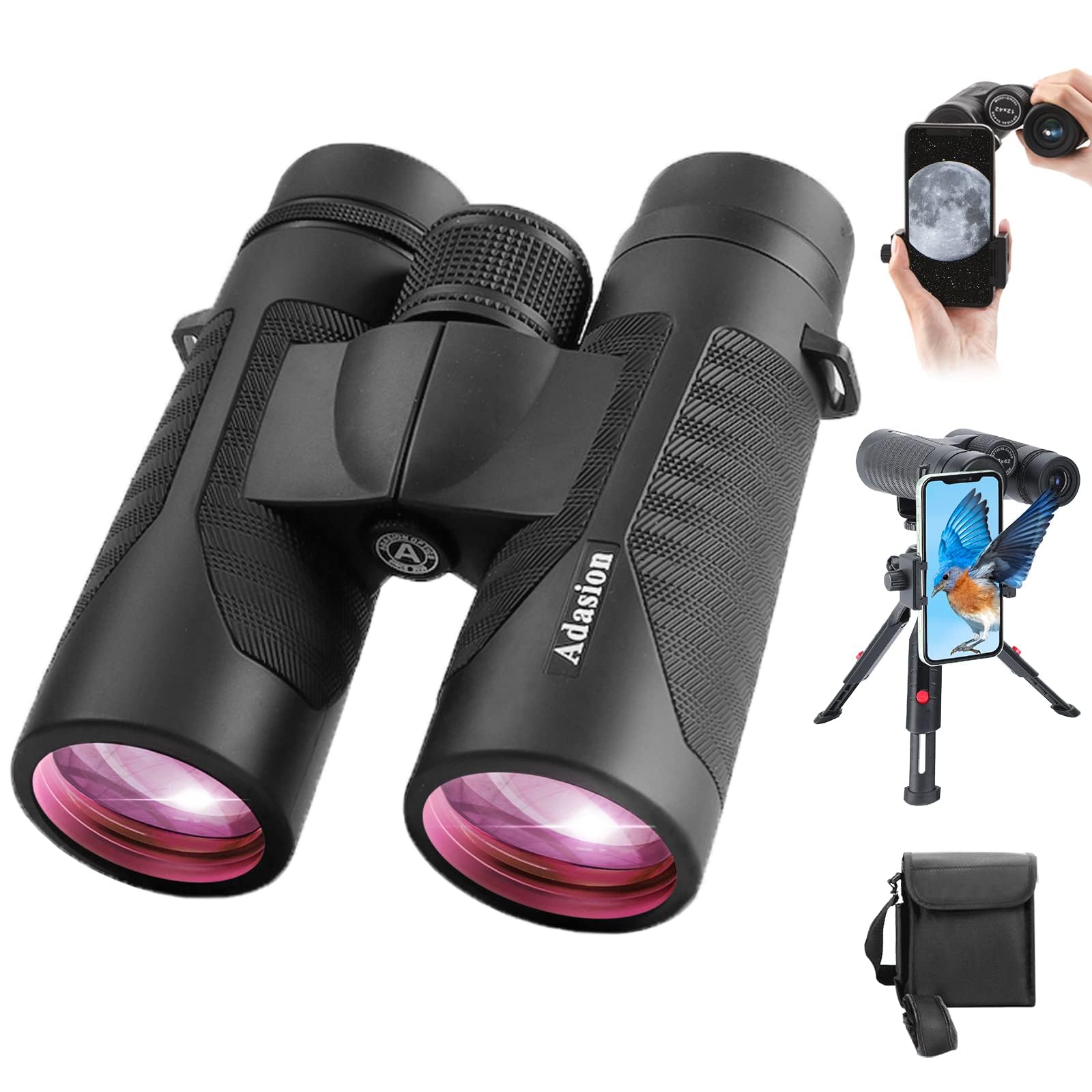
Adasion 12×42 HD
Key Features
- Magnification: 12x
- Objective Lens: 42mm
- Weight: 20 oz
- Waterproof: Yes
- Field of View: 367 ft
- Price: $
The included phone adapter and tripod turn the Adasion 12×42 HD into a versatile tool for safari novices who want to document their sightings. The 12x magnification, however, is difficult to hold steady by hand, so the tripod is essential for clear views. Image clarity is decent for the price, but it doesn’t match the brightness and edge sharpness of mid-range models. This bundle suits occasional safari travelers who prioritize affordability over optical refinement.
Pros
- Complete kit with phone adapter and tripod adds value for beginners.
- Lightweight build (20 oz) makes it easy to carry on long game drives.
- Good image clarity for its price tier, considering the included extras.
Cons
- 12x magnification is hard to hold steady without a tripod; the included tripod becomes necessary for stable viewing.
- Optical quality is a step down from mid-range safari binoculars, with less brightness in low-light conditions.
A smart kit for first-time safari-goers who want a complete entry-level setup without a big investment, but not for those needing consistent handheld clarity or premium optics.
How to Choose
The best binocular for safari is the one you’ll actually carry all day and hold steady – prioritize weight and 8x-10x magnification over extreme zoom.
Magnification
8x to 10x magnification is the sweet spot for handheld safari viewing. Higher than 10x, and even slight hand tremors become magnified, turning distant animals into shaky silhouettes. 12x binoculars require a tripod or a steady rest to be useful, which isn’t always available during a game drive. For most safari-goers, 8x offers the widest field of view and steadiest image, while 10x gives a bit more reach without sacrificing stability when braced against a vehicle.
Objective Lens Diameter
A 42mm objective lens is the standard for full-size binoculars because it balances light-gathering ability with portability. Larger 50mm lenses collect more light for dawn and dusk viewing but add significant weight and bulk. For safari, where you’re often moving between vehicles and walking, 42mm is the practical choice – bright enough for low light yet light enough to carry comfortably.
Weight
Weight is the silent dealbreaker. A binocular that feels fine in the store becomes a burden after four hours. Look for models under 25 ounces – lighter models (under 22 oz) are even better for all-day wear. Every extra ounce adds strain on your neck and shoulders, especially when paired with a harness. The difference between 20 oz and 28 oz is the difference between forgetting you’re wearing them and counting the minutes until you can take them off.
Waterproof and Fogproof
Safari environments are dusty, humid, and prone to sudden rain. Waterproofing (IPX7 or similar) ensures the binoculars survive splashes and downpours, while fogproofing (nitrogen or argon purging) prevents internal lenses from fogging up when moving between air-conditioned vehicles and warm, humid air. Both are non-negotiable for any safari binocular – skip any model that lacks these certifications.
Field of View
A wider field of view lets you track moving animals without constantly adjusting the binoculars. For safari, a field of view around 370-400 feet at 1000 yards is excellent for scanning savannahs and spotting birds. Narrower fields (under 330 ft) require more head movement and can make you miss the action. This trade-off is directly related to magnification – 8x models almost always offer wider views than 10x or 12x.
FAQ
Is 12x magnification too shaky for safari binoculars without a tripod?
Yes, for most people. 12x magnification amplifies every hand tremor, making it difficult to hold a steady image for more than a few seconds. While some experienced users can brace against a vehicle or steady their elbows, the included tripod kit on budget 12x models is a strong hint that the manufacturer expects you to need it. For handheld safari use, 8x or 10x provides a noticeably steadier view.
Why do my binoculars fog up on a humid safari and how can I prevent it?
Fogging occurs when moisture condenses on the internal lenses due to temperature changes. Fogproof binoculars are filled with nitrogen or argon gas, which prevents this condensation. If your binoculars fog up frequently, they likely lack proper sealing. Quick tips: keep them in a dry case between uses and allow them to acclimate slowly when moving from air conditioning to humid air.
How important is eye relief for wearing glasses with safari binoculars?
Eye relief is critical if you wear glasses – it determines how far your eye can be from the eyepiece while still seeing the full image. Look for at least 16-18mm of eye relief; longer is better. Models with adjustable twist-up eyecups let you set the correct distance for glasses or non-glasses use. Without sufficient eye relief, you’ll either see a partial image or have to remove your glasses every time.
Are cheap binoculars with phone adapters worth it for safari photography?
They can be useful for casual sharing on social media, but don’t expect professional-quality digiscoping. The phone adapter kits under $70 typically include a flexible mount that works for short clips and photos if the light is good. However, the binoculars themselves have lower-grade optics and coatings, resulting in softer images and more chromatic aberration. For a dedicated safari photographer, a separate telephoto lens or a premium binocular with a dedicated adapter is a better investment.