
This post contains affiliate links. We may earn a small commission when you buy through our links — at no extra cost to you.
A pair of binoculars stamped with ‘HD’ and ‘waterproof’ might seem trail-ready, but those labels rarely tell the full story. On a hike, what actually matters is whether the image stays bright when you step into tree cover, and whether you can hold the view steady after a long climb.
The best hiking binoculars balance magnification, light-gathering ability, and carry weight in a way that fits your real days outdoors—not just the spec sheet. This guide focuses on the models that deliver the clarity, comfort, and ruggedness that make a difference when you’re scanning a distant ridgeline or tracking a warbler through the brush.
Along the way, you’ll face a quiet trade-off: go lighter and pocket-sized, but sacrifice low-light performance and steadiness; or choose a full-size 42mm binocular with brighter views and a more stable image, at the cost of some ounces in your pack. The picks below help you decide based on where and how you actually hike.


Best for Hiking & Birding
Vortex Crossfire HD 10×42
Key Features
- Magnification & Objective Lens: 10×42
- Weight: 1.4 lbs
- Waterproof / Fogproof: Waterproof, Fogproof
- Eye Relief: 15 mm
- Price: Mid-Range
The HD optical system in the Crossfire HD produces crisp, color-accurate images with edge-to-edge clarity that challenges binoculars costing significantly more. Multi-coated lenses pull in enough light to resolve feather details and bark texture even as shadows lengthen in wooded areas. The 10x magnification and 42mm objective sit in the sweet spot for hiking and birding — enough reach to identify distant species without the shake that plagues 12x compacts.
Build quality matches the optical punch. A rubber-armored polycarbonate body shrugs off rain, mud, and the occasional knock against a rock. Argon purging and O-ring seals keep internal fogging at bay after a sudden temperature drop on a ridgeline. Twist-up eyecups with 15mm eye relief give eyeglass wearers a full field of view without vignetting, a detail often compromised at this price point.
The unconditional lifetime warranty deserves its own mention. Where competitors limit coverage or charge for repairs, Vortex replaces or repairs the Crossfire HD with no receipt and no questions asked. That commitment shifts the calculus for hikers who treat gear hard: a drop onto granite or a dunk in a stream becomes an inconvenience rather than a sunk cost. Among sub-$200 binoculars, this level of support is rare.
For all-purpose hiking and birding, the Crossfire HD fits the profile of a workhorse instrument that resolves the clarity-versus-durability tension common in this category. The trade-off is weight. At 1.4 lbs, it stays within the normal range for a full-sized 10×42, but granholm-counting ultralighters who prioritize every ounce will feel the heft on a six-hour trek. Day hikers using a harness or padded strap will notice it less, and the optical advantage in twilight conditions offsets the extra mass for most.
Pros
- Crisp HD optics deliver sharp, color-faithful views that rival more expensive glass.
- Rugged, rubber-armored body stands up to wet weather and rough handling.
- Lifetime unconditional warranty eliminates repair or replacement costs over years of trail use.
- 15mm eye relief and twist-up eyecups provide a full sight picture for eyeglass wearers.
- 325-foot field of view at 1000 yards keeps fast-moving birds and wildlife in frame.
Cons
- Weight of 1.4 lbs may feel heavy on extended all-day hikes compared to compact 25mm models.
If you want a hiking binocular that will survive years of rough trails and still deliver bright, sharp views at dawn, the Crossfire HD is the buy-it-once option in this category.
Best for Enthusiast Birding
Vortex Diamondback HD 10×42
Key Features
- Magnification & Objective Lens: 10×42
- Weight: 1.33 lbs
- Waterproof / Fogproof: Waterproof, Fogproof
- Eye Relief: 15 mm
- Price: Premium
The Diamondback HD delivers noticeably brighter, more color-accurate views in low light compared to the top pick, thanks to dielectric prism coatings that push light transmission higher. In the dim hours around sunrise and sunset, this translates to crisper detail on feathers, fur, and subtle field marks that lesser binoculars may obscure. Edge-to-edge sharpness holds up well across the wide 330-foot field of view, making scanning forest edges or ridge lines smooth and immersive.
Argon purging and a rubber-armored body seal out moisture and internal fogging, matching the rugged waterproofing of the top pick. Vortex’s unconditional lifetime warranty backs that durability — a promise that covers accidents, not just defects. The build feels dense and secure in hand without unnecessary bulk, though at 21.3 ounces it sits right at the typical weight for a 10×42 roof prism and won’t surprise experienced glassers.
Enthusiast birders, hunters, and serious hikers who glass heavily at dawn or dusk will see the premium as money well spent. The roughly $100 step up from the top pick buys genuine low-light performance gains and richer color fidelity, not just a branding bump. Ultralight backpackers and casual nature watchers may find the weight and price harder to justify; a compact 8×32 or the still-capable top pick can cover brighter daytime outings for less. This Diamondback is for those who value optical refinement over a featherweight carry.
Pros
- Dielectric coatings produce vivid, high-contrast images with excellent brightness in challenging light
- Argon-purged waterproofing and rugged construction backed by an unconditional lifetime warranty
- Optical performance rivals models costing significantly more, offering strong value for committed observers
Cons
- 21.3-ounce weight is standard for a 10×42 but may deter hikers looking for a lighter, compact option
- Costs about $100 more than the top pick, putting it beyond the budget of casual nature watchers
A top-shelf 10×42 for serious wildlife observers who value twilight performance and lifetime protection, provided the extra cost and moderate weight fit their kit.
Best for Eyeglass Birding
Nikon Monarch M5 8×42
Key Features
- Magnification & Objective Lens: 8×42
- Weight: 1.39 lbs
- Waterproof / Fogproof: Waterproof, Fogproof
- Eye Relief: 19.5 mm
- Price: Premium
The Nikon Monarch M5 8×42 stands apart from lighter, simpler binoculars like the Prostaff P3 by delivering 19.5mm of eye relief — enough to keep the full field visible even with thick frames — and ED glass that cuts chromatic aberration to near zero. That combination means eyeglass wearers get the same edge-to-edge sharpness and brightness as someone without glasses, a rarity at this price tier.
The tradeoff for that optical performance is weight: 22.2 ounces (1.39 lbs) is mid-weight for an 8×42, fine for all-day wildlife observation or a full-day hike, but it will be noticeable if you’re used to the 20-ounce Prostaff P3 or a compact 10-ounce model. The eye covers can detach over time — a minor annoyance that doesn’t affect the optics themselves, and one that matters less if you store the binocular in a case rather than clipping it to a pack strap. This is a binocular for serious birders, hunters, and anyone who prioritizes low-light clarity and glasses-friendly use over absolute lightweight portability.
Pros
- 19.5mm eye relief keeps the full image visible with eyeglasses on
- ED glass delivers crisp, color-true images with minimal chromatic aberration
- Bright performance in low light thanks to 42mm objective and dielectric-coated prisms
- Light enough for long days of hiking or birding despite ED glass
Cons
- Eye covers may come loose and detach during use
- At 22.2 ounces, it’s heavier than compact hiking binoculars — noticeable on ultralight trips
If you wear glasses and want ED-glass clarity without spending $400+, the Monarch M5 is the most capable option in this weight class — just don’t expect it to disappear on your pack.
Best for Lightweight Hiking
Nikon Prostaff P3 10×42
Key Features
- Magnification & Objective Lens: 10×42
- Weight: 1.29 lbs
- Waterproof / Fogproof: Waterproof, Fogproof
- Eye Relief: 15.7 mm
- Price: Mid-Range
For hikers who count every ounce, the Nikon Prostaff P3 10×42 stands out as the lightest full-size 10×42 in this comparison, with a 20.6-ounce build that pairs well with Nikon’s clear glass. Where the top pick offers a no-questions warranty, the Prostaff P3 relies on its optical heritage and a mid-range price — but the strap and lens cover attachments may come loose on the trail.
This binocular fits hikers and day-trippers who want one rugged optic for general use without paying for ED glass or a premium warranty. The tradeoff is that the included accessories — specifically the strap retainers and lens covers — can detach during active use, so planning for aftermarket replacements or a small field fix is wise.
Optically, the Prostaff P3 delivers sharp images, a wide 367-foot field of view at 1,000 yards, and waterproof/fogproof sealing that handles trail weather. The 15.7mm eye relief accommodates most users without glasses, though eyeglass wearers may want to test the fit before committing to a long hike.
Pros
- Crisp image clarity that exceeds expectations for a mid-range 10×42
- Lightweight 20.6-ounce design stays comfortable on all-day hikes
- Strong value for the price — Nikon build quality without the premium cost
Cons
- Lens caps may pop off unexpectedly during field use
- Strap attachment slots can allow the neck strap to slide off if not secured
If you prioritize a light load and optical clarity over the security of a lifetime warranty, the Nikon Prostaff P3 is the smarter choice for trail-ready viewing.
Best for Budget Day Hikes
Occer 12×25 Compact
Key Features
- Magnification & Objective Lens: 12×25
- Weight: 0.86 lbs
- Waterproof / Fogproof: Waterproof
- Eye Relief: 20 mm
- Price: Budget
Ultra-affordable, ultra-light, and surprisingly sharp in bright conditions—the Occer 12×25 weighs just 0.86 pounds and slips into a jacket pocket. The wide field of view and large eyepieces make scanning a landscape or sports field comfortable, and for the price the daytime clarity holds its own against more expensive models.
This binocular is best for cost-conscious travelers, kids, and beginners who plan to use it in full daylight during nature walks or at sports events. However, the 12x magnification can be difficult to hold steady without support—arms fatigue quickly—and the 25mm objective lens produces noticeably dim images in shade, dusk, or dawn. It’s not suited for serious birding at low light or for users who want a rugged metal build.
The plastic construction feels hollow and light, which keeps weight down but means a drop onto hard ground can cause damage. For casual handling on well-trodden trails the tradeoff is acceptable, but those who regularly hike rough terrain may prefer something sturdier.
Pros
- Extremely affordable with surprisingly clear, sharp images in daylight.
- Compact and lightweight — easy to carry in a pocket or pack on short hikes.
- Wide field of view and large eyepieces make quick scanning comfortable.
Cons
- 12x magnification can produce shaky images when handheld, especially without a brace.
- Image brightness drops noticeably in low-light conditions such as dawn, dusk, or shaded woods.
- Plastic body has a hollow feel and may not survive a hard drop onto rocks.
A smart buy for hikers who only need binoculars for bright daytime use and can work around the shake by bracing against a tree or rock.
Best for Wide-Fov Birding
Celestron Nature DX 8×42

Key Features
- Magnification & Objective Lens: 8×42
- Weight: 1.75 lbs
- Waterproof / Fogproof: Waterproof, Fogproof
- Eye Relief: 17.5 mm
- Price: Mid-Range
The Celestron Nature DX 8×42 excels at giving hikers and birders a wide, bright view with a close focus of 7 feet, making it ideal for spotting birds in dense foliage. Its 1.75-pound weight is balanced enough for all-day carry, though not the lightest in this roundup. The bundled accessories—lens covers and case—can feel flimsy and may degrade faster than the optics deserve. Occasional QC issues like loose eyecups have been noted, but the core optical performance (fully multi-coated BaK-4 prisms) outshines its price point. The panoramic field of view compensates for the minor accessory compromises, making this a strong consideration for anyone prioritizing sightlines over ruggedness.
Pros
- Wide 388-foot field of view and close focus (7 ft) for birding in dense cover.
- Bright images in low light thanks to 42mm objectives and fully multi-coated glass.
- Lightweight 1.75-pound build suits all-day hikes without fatigue.
Cons
- Lens covers and case may degrade faster than the binoculars themselves.
- Eyecups or focus wheel may feel loose in some units — worth checking on arrival.
Choose the Celestron Nature DX if you want a panoramic view for birding and can overlook minor accessory compromises.
Best for Serious Birding
Athlon Midas UHD 8×42

Key Features
- Magnification & Objective Lens: 8×42
- Weight: 1.56 lbs
- Eye Relief: 17.2 mm
- Price: Premium
The Midas UHD’s ED glass and dielectric prism coatings produce an image that rivals models at $400 and above — edge-to-edge sharpness with minimal color fringing, even in low light. The 8.1° field of view and smooth focus wheel make it a precise tool for bird identification. However, at 1.56 pounds, this 8×42 is noticeably heavier than most hiking competitors, and that bulk taxes the neck and arms on long trails. For short excursions or stationary observation from a blind, the optical payoff outweighs the weight; for all-day hiking where ounces matter, lighter options make more sense.
Pros
- ED glass and dielectric coatings deliver sharp, high-contrast views with almost no color fringing.
- Bright enough to resolve detail during dawn and dusk, thanks to excellent light transmission.
- Wide 8.1° field of view and smooth focus wheel simplify tracking moving birds.
Cons
- On long hikes, the 1.56-pound weight becomes a neck strain — a compromise for the premium optics.
If you need the sharpest possible image for stationary birding or short walks and can accept a heavier build, the Midas UHD competes with binoculars costing $100 more.
Best for Daytime Travel
Nocs Standard Issue 10×25

Key Features
- Magnification & Objective Lens: 10×25
- Weight: 0.74 lbs
- Waterproof / Fogproof: IPX7 Waterproof
- Eye Relief: 10 mm
- Price: Mid-Range
The Nocs Standard Issue 10×25 pairs a sleek, rugged build with IPX7 waterproofing and a lifetime warranty — a combination that stands out in the compact category. Daytime clarity is impressive for its size, making it a capable companion for sunny hikes and travel. However, the 10mm eye relief forces eyeglass wearers to compromise on the full field, and the 25mm objective dims noticeably in dawn or deep shade. For style-conscious hikers who don’t wear glasses and stick to daylight, this binocular delivers a durable, packable option that undercuts the price of the top pick.
Pros
- Stylish, rugged design with IPX7 waterproofing and a lifetime warranty.
- Compact and lightweight (11.85 oz) for effortless packing on hikes and trips.
- Clear, sharp image quality in bright conditions for a 25mm compact.
Cons
- In shaded woods or at dusk, the 25mm objective can produce dimmer views than larger binoculars.
- Glasses wearers may struggle with the tight 10mm eye relief, cutting off the full field.
If you prioritize warranty and waterproofing over optical versatility and don’t wear glasses, the Nocs is a solid, pack-friendly choice for bright-day adventurers.
Best for Ultralight Travel
Nikon Travelite EX 8×25

Key Features
- Magnification & Objective Lens: 8×25
- Weight: 0.66 lbs
- Waterproof / Fogproof: Waterproof, Fogproof
- Eye Relief: 11.1 mm
- Price: Mid-Range
At 10.6 ounces, the Nikon Travelite EX 8×25 is the lightest binocular in this set, slipping into a jacket pocket without pulling on your neck. The porro-prism design produces bright, contrasty images in full sun — a notable achievement for a compact optic — but the 3.13mm exit pupil dims noticeably under forest canopy or around sunset. Eyeglass wearers will find the 11.1mm eye relief too short to see the full field, making these best for users without glasses. For a sunny-day hiking optic that vanishes in a pack, this Nikon delivers where it matters.
Pros
- Featherweight 10.6-ounce body disappears in a daypack or pocket.
- Surprisingly crisp, high-contrast images for a compact porro-prism binocular.
- Waterproof and fogproof construction handles mountain showers and humidity.
Cons
- Images dim noticeably under forest shade or at dusk due to the small exit pupil.
- The 11.1mm eye relief prevents most eyeglass wearers from seeing the full field of view.
For hikers and travelers who don’t wear glasses and stick to daylight hours, this is a sharp, nearly weightless optic that justifies its price with Nikon glass. Twilight birders or glasses users should look to the longer-eye-relief models in this lineup.
Best for Premium Birding
Celestron TrailSeeker ED 8×42

Key Features
- Magnification & Objective Lens: 8×42
- Weight: 1.47 lbs
- Waterproof / Fogproof: Waterproof, Fogproof
- Eye Relief: 17.2 mm
- Price: Premium
The TrailSeeker ED 8×42 provides excellent image quality with ED glass, a wide 426-foot field of view, and a 7-foot close focus—ideal for birders tracking fast-moving subjects. The included GlassPak harness and lifetime warranty are meaningful perks. However, at 1.47 pounds, it’s heavier than many competitors, including the Nikon Monarch M5, which is both lighter and less expensive. The focus wheel feels slightly light, which may not inspire confidence over years of hard use. These tradeoffs position it as a premium optical performer for dedicated birders, but the extra weight and cost rule it out for weight-conscious hikers and budget shoppers.
Pros
- ED glass yields sharp, bright views with barely any color fringing, even at the edges.
- Wide 426-foot field of view and 7-foot close focus let you track fast birds in dense brush.
- Includes a GlassPak harness and lifetime warranty, adding real-world value and long-term assurance.
Cons
- Focus wheel has a light feel that may slip or lack long-term durability under heavy, repeated use.
- The 1.47-pound weight can be tiring on extended hikes, especially compared to lighter 8×42 models.
For dedicated birders who prioritize optical performance and won’t be carrying these all day on foot, the TrailSeeker ED offers ED sharpness, a generous field of view, and a useful harness bundle—just expect to pay more and carry more than with a mid-range option.
Best for Stationary Viewing
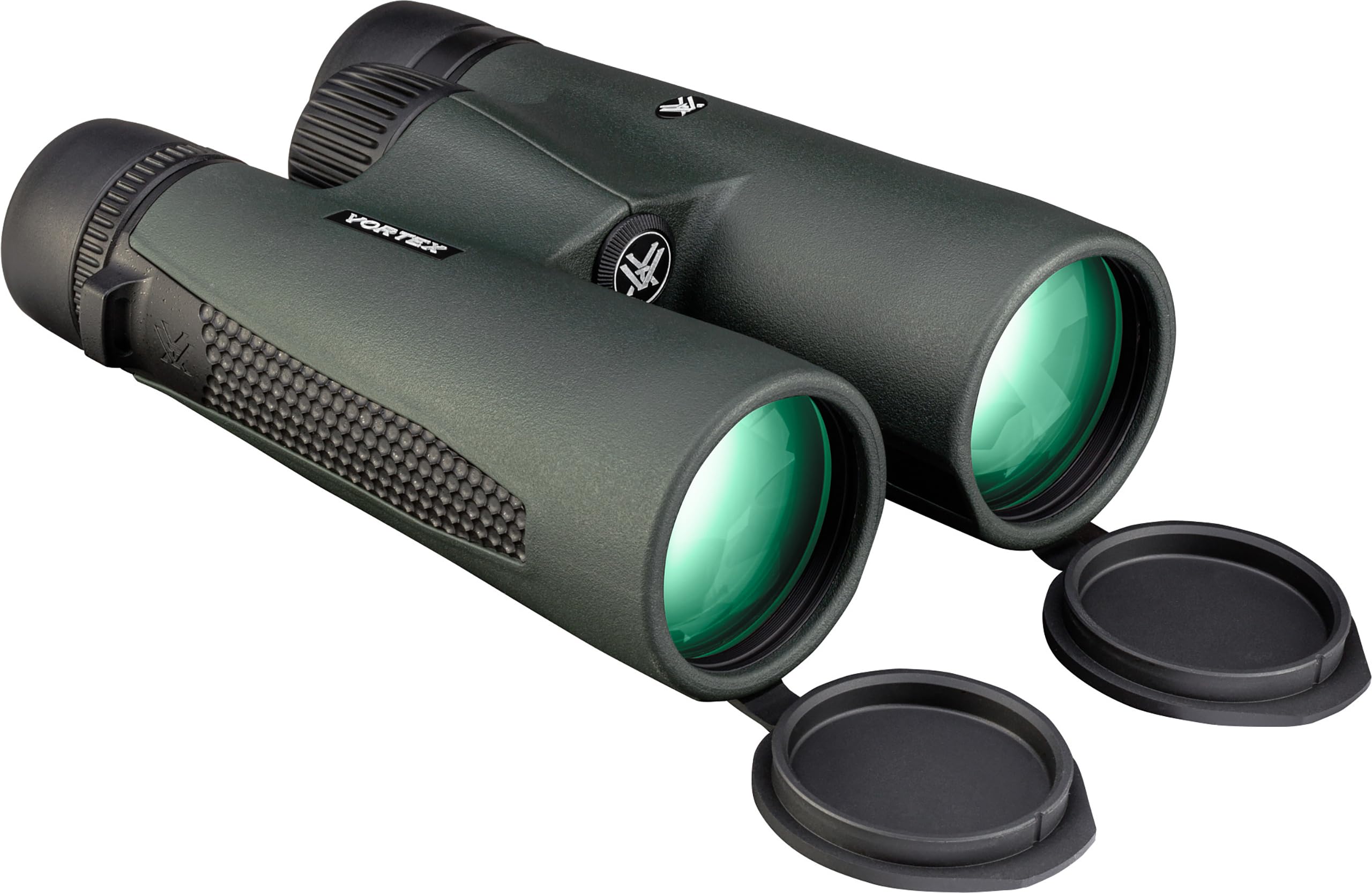
Vortex Triumph HD 12×50
Key Features
- Magnification & Objective Lens: 12×50
- Weight: 1.64 lbs
- Waterproof / Fogproof: Waterproof, Fogproof
- Eye Relief: 16 mm
- Price: Mid-Range
The Vortex Triumph HD 12×50 packs a 50mm objective that pulls in ample light for bright, crisp views at a distance — a rare treat at this price. Build quality is solid and the included GlassPak harness adds real value. But at 1.64 pounds, these are heavy to lug on trails, and 12x magnification exaggerates hand shake, so handheld hiking is frustrating. Steady views come from a tripod, vehicle window, or blind. That’s fine for stationary birdwatching, truck-based glassing, or anyone prioritizing light-gathering over portability — but it’s a poor match for the hiker seeking compact trail optics.
Pros
- Crisp optical clarity and strong distance performance for the price.
- Solid build quality and outstanding value, including a functional GlassPak harness.
- Waterproof and fogproof construction backed by Vortex’s unconditional lifetime warranty.
Cons
- Weight of 1.64 lbs can become fatiguing on all-day hikes.
- 12x magnification amplifies hand shake, often requiring a tripod or steady rest.
If you glass from a blind, vehicle, or fixed position and want maximum brightness without a premium price, this 12×50 makes sense; hikers who need a lightweight, handheld companion should look to the 8×42 options in this set.
Best for Wet Conditions
Bushnell H2O 10×42

Key Features
- Magnification & Objective Lens: 10×42
- Weight: 2 lbs
- Waterproof / Fogproof: IPX7 Waterproof, Fogproof
- Eye Relief: 15.6 mm
- Price: Mid-Range
The Bushnell H2O 10×42 delivers a crisp, high-contrast image with brightness and clarity that make woodland detail and shoreline birds pop. Fully multi-coated lenses and a 42mm objective pair well for midday hikes and open-water scanning. Where it really stands apart is the IPX7 waterproof rating — it’s built to shrug off rain, spray, and brief submersion, giving boaters and kayakers the freedom to use it in foul weather without a second thought.
The trade-off is weight. At 2 lbs, it’s a chunky companion on extended trails, and long-distance backpackers will feel every ounce. Durability can be inconsistent — eyepiece housings or lens covers may loosen over time, so handling with care in rough conditions is wise. For casual hikers who prioritize water resistance over portability and can accept the extra heft, the optical quality and weatherproofing make a convincing case.
Pros
- Crisp, clear image with good contrast and bright views
- Fully waterproof (IPX7) and fogproof, ideal for wet conditions
Cons
- Heavy at 2 lbs, can be tiring on long hikes or all-day carries
- Eyepieces and lens covers may exhibit durability issues with rough handling
The Bushnell H2O 10×42 fits boaters, kayakers, and casual day hikers who regularly face rain, spray, or high humidity and are willing to accept extra weight in exchange for guaranteed waterproofing and optical clarity.
Best for Budget Birding
Celestron Outland X 8×42

Key Features
- Magnification & Objective Lens: 8×42
- Weight: 1.8 lbs
- Waterproof / Fogproof: Waterproof, Fogproof
- Eye Relief: 17.8 mm
- Price: Budget
Celestron’s Outland X 8×42 is a waterproof, nitrogen-purged binocular that offers long 17.8mm eye relief and twist-up eyecups — a real comfort win for glasses wearers at this price. The multi-coated optics produce a crisp, contrasty image that punches above its cost. The handling is where the budget shows: the focus wheel tends to be stiff, and the 1.8-pound body feels notably heavier than competitors like the Nature DX, which also smooths out the focus action for a modest price bump. For casual birding or short hikes where low cost matters more than weight, this is a capable companion; for all-day trail use, stepping up to the Nature DX is the smarter long-term choice.
Pros
- Sharp, high-contrast image that exceeds expectations for a budget binocular.
- Twist-up eyecups and 17.8mm eye relief keep glasses wearers comfortable and centered.
- Waterproof and nitrogen-purged construction at a rare low price.
Cons
- Focus wheel can feel stiff, requiring deliberate effort to micro-adjust — less fluid than competitors.
- The 1.8-pound build is heavier than many hiking-oriented 8x42s, which can become noticeable on longer treks.
The Outland X suits casual birders and budget-conscious hikers who prioritize clarity and eye relief over weight and focus refinement. If you plan to carry binoculars for miles, the lighter, smoother Nature DX is the better long-term investment.
Best for Compact Travel
Steiner Safari 10×26

Key Features
- Magnification & Objective Lens: 10×26
- Weight: 0.66 lbs
- Waterproof / Fogproof: Waterproof
- Eye Relief: 12 mm
- Price: Mid-Range
The Steiner Safari 10×26 packs impressive clarity and robust build quality into one of the lightest hiking binoculars available. Its 2.6mm exit pupil, however, dims the view noticeably in shaded woods or around dusk, restricting it to bright-day use. The diopter adjustment can slip, requiring occasional realignment — a minor nuisance for steady daylight observation. At this price, the small aperture faces stiff competition from compact 25mm models with similar optics for less.
Pros
- Compact and lightweight at 10.5 ounces, disappearing into a daypack for all-day carry.
- Optics produce a crisp, high-contrast image in good light, supported by sturdy construction.
Cons
- Small 2.6mm exit pupil dims the image in shade, forests, or twilight, limiting usability to bright daylight.
- Diopter adjustment can drift with movement, causing focus misalignment that requires periodic correction.
For hikers exclusively in bright conditions who want the lightest possible optic with German build quality, the Safari 10×26 delivers — but twilight birders or forest hikers will feel the aperture compromise immediately.
How to Choose
The difference between a frustrating hike and a memorable one often comes down to whether your binoculars match the light and motion of your actual trail, not a spec sheet.
Magnification & Objective Lens
Numbers like 8×42 or 10×25 determine how much detail you see and how bright the image appears. Higher magnification brings distant wildlife closer, but every hand tremor gets magnified too — 10x is the practical limit for handheld hiking. A larger objective lens (the second number) gathers more light, making dawn and dusk viewing possible, but increases weight.
Compact 25mm models are temptingly light, yet their small exit pupil dims the view the moment you step into forest shade. An 8×42 or 10×42 provides a brighter, more forgiving image for all-day trail use, but you’ll feel the extra ounces on a long climb.
Weight
Weight feels negligible at the store but heavy after miles on the trail. A 1.4-lb 10×42 may be comfortable for a short walk, while ultralight backpackers feel every ounce. Lighter binoculars usually rely on smaller objective lenses, which directly reduces low-light brightness — the weight trade-off is really a brightness trade-off.
A chest harness, even if bought separately, changes the entire experience. It shifts the load off your neck and stops the binoculars from swinging, making a heavier full-size model feel far more wearable over a full day.
Waterproof & Fogproof Rating
Moisture inside the barrel causes fogging that no amount of wiping can fix. Look for nitrogen- or argon-purged models with a genuine IPX rating like IPX7 — that seal prevents internal condensation when temperatures drop suddenly on a misty morning. A vague ‘waterproof’ label without purging often means the lenses can still fog internally.
Prism Type & Coating Quality
BAK4 prisms and fully multi-coated lenses are the gold standard for brightness and contrast, but many budget binoculars skimp here. Each layer of anti-reflective coating reduces light loss at an air-to-glass surface; without enough layers, images look washed out and flat in forest shade. If sharp, vivid color matters when you’re identifying a warbler, prioritize fully multi-coated or dielectric-coated optics.
Eye Relief
If you wear glasses, eye relief under 15mm means you’ll see a narrowed field of view with black rings around the image. Long eye relief—like 19.5mm—lets you keep your glasses on and still see the full picture. Twist-up eyecups help fine-tune the distance, turning a frustrating experience into an effortless one.
FAQ
Can I use 12×50 binoculars for hiking without a tripod?
12x magnification amplifies hand shake so much that fine details blur without a support. A 50mm objective also makes the binoculars heavy and unwieldy for long hikes. Stick to 10×42 for a steadier view unless you plan to use a tripod or monopod.
Why do my new binoculars feel blurry at the edges?
Blurriness at the edges is usually due to field curvature or poor edge sharpness in the optics. Budget binoculars often sacrifice edge-to-edge sharpness to keep costs down. If crisp center images meet your needs, it’s acceptable, but serious birders should look for ED glass and fully multi-coated lenses for better edge performance.
Are compact 25mm binoculars good enough for birdwatching in low light?
No. A 25mm objective lens limits light gathering, so colors fade and detail disappears at dusk or in dense shade. For low-light birding, choose a 42mm model with an exit pupil above 4mm, which keeps images bright when light is scarce.
What does ‘fully multi-coated’ mean for binocular clarity?
Fully multi-coated means every air-to-glass surface has multiple anti-reflective layers, cutting glare and boosting light transmission. This gives you brighter, higher-contrast images compared to single-coated or uncoated lenses, which can look washed out in sunlight.
Is a chest harness worth it for hiking binoculars?
A chest harness keeps binoculars secure and reduces neck strain during long hikes. Even if your binoculars come with a neck strap, a harness distributes weight more evenly and prevents bouncing on steep trails.