
This post contains affiliate links. We may earn a small commission when you buy through our links — at no extra cost to you.
Many campers discover the hard way that a high-capacity power bank often means extra weight that outweighs its benefit. The sweet spot for most trips is 20,000–25,000mAh — enough for multiple device charges without straining your backpack.
But capacity is just one piece. Fast charging, ruggedness, and built-in cables can make or break a camping trip. Solar charging on power banks sounds appealing but rarely delivers practical recharge speeds in the field.
This guide cuts through the specs to match you with the right power source — whether you need to charge a laptop, run a CPAP, or just keep phones alive for a long weekend.



Best for Laptop & Multi-Device
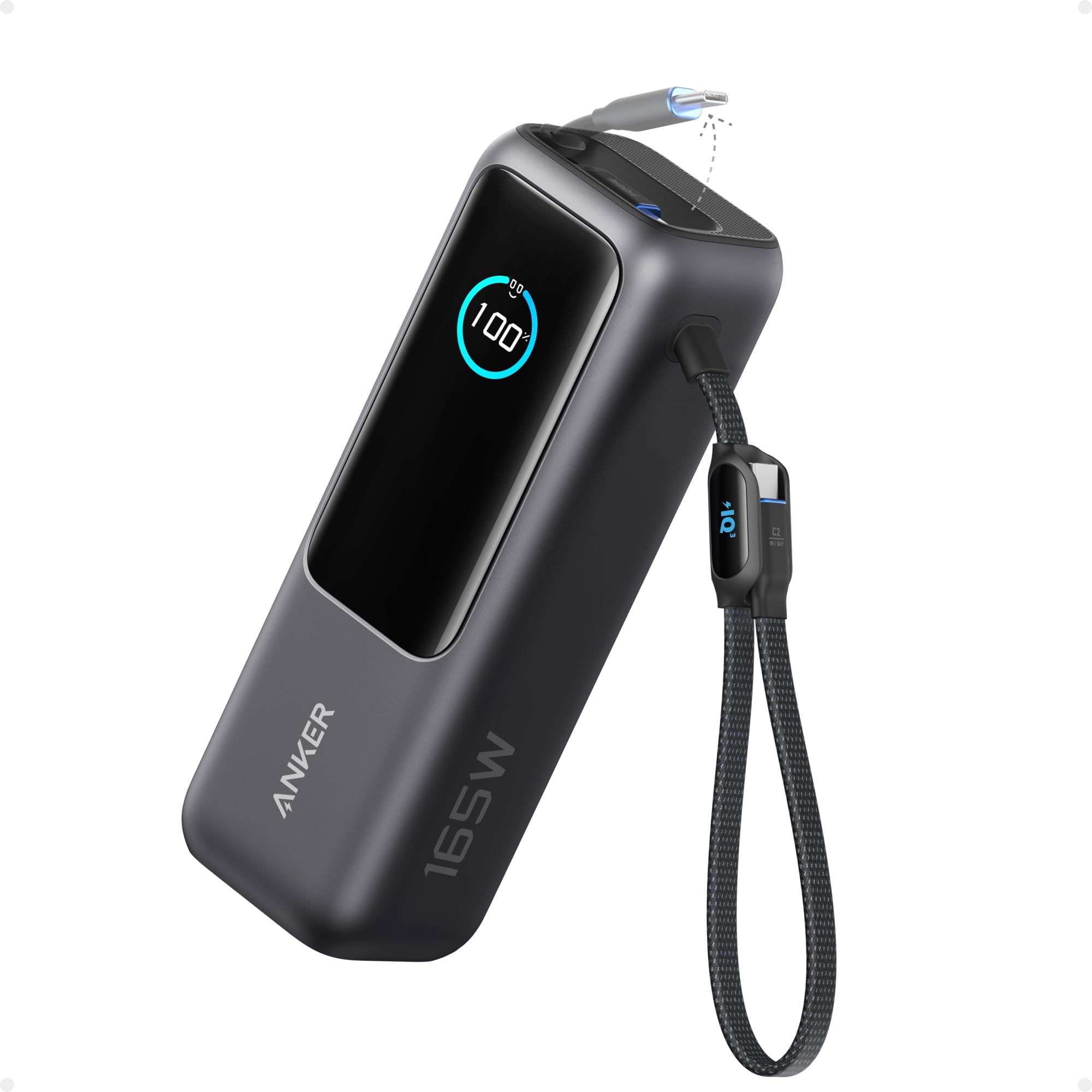
Anker 25K 165W Power Bank
Key Features
- Capacity: 25,000mAh
- Output: 165W total
- Ports: 3 USB-C + 1 USB-A
- Built-in Cables: Yes (2 USB-C)
- Price: $$
Three 100W USB-C ports mean any of them can recharge a laptop at full speed, and the two built-in cables (one retractable) eliminate the need to carry separate cords. At 165W total output, this bank handles a laptop, phone, and headlamp simultaneously without slowing down.
The 1.31-pound weight is noticeable in a jacket pocket but sits fine inside a backpack or camp bag. Some units have shown charging issues after several months of use, so it’s worth testing the unit soon after purchase and keeping an eye on performance over time.
Best for campers and travelers who want one power bank that charges laptops at full speed and includes the cables, so you don’t forget them. The weight and occasional unit variance matter less if the bank lives in a pack rather than a pocket. Those needing an AC outlet or ultralight gear should look at power stations or smaller banks instead.
Pros
- Any of the three USB-C ports delivers 100W for fast laptop charging
- Built-in retractable USB-C cable means one less thing to pack
- 25,000mAh capacity recharges a laptop once plus several devices
- 165W total output handles laptops, tablets, and phones at the same time
- Airline-approved form factor fits carry-on luggage for travel
Cons
- At 1.31 pounds, the weight is noticeable in a pocket during hikes
- Some units may stop charging or show reduced performance after several months
For campers who want one bank that charges laptops at full speed and includes the cables, this is the most straightforward option in its class—just check the unit early to confirm consistent performance.
Best for Rugged Outdoor Use
ELECOM NESTOUT 15K
Key Features
- Capacity: 15,000mAh
- Output: 32W USB-C PD
- Ports: USB-C + USB-A
- Built-in Cables: No
- Price: $$
The ELECOM NESTOUT differentiates itself through IP67 waterproofing, shockproof construction meeting MIL-STD drop test standards, and a tripod mount for securing it at camp. These features make it exceptionally resistant to water, dust, and impacts. The tradeoff is a 32W USB-C output and 15,000mAh capacity that lag behind many similarly priced power banks.
This bank is built for campers, hikers, and outdoor workers who prioritize durability and weather resistance above all else. In heavy rain, muddy trails, or rocky terrain, the NESTOUT will keep functioning when typical banks fail. However, its charging speed is slow enough that users needing quick device replenishment or high capacity for multi-day trips should consider alternatives with faster output or larger battery packs. It is also heavier than ultralight options, so backpackers focused on weight savings may find it bulky.
The tactical aesthetic and compact footprint for its ruggedness class add appeal. The included tripod mount allows attaching it to a tent pole or backpack strap, and modular accessory support extends its usefulness. For those who need a power bank that can survive being dropped in a creek or knocked off a rock, the NESTOUT delivers specialized protection.
Pros
- Solid build quality and rugged design
- Withstands drops and harsh conditions
- Waterproof and dustproof (IP67)
- Compact size for an outdoor battery
Cons
- Battery capacity can degrade over time with heavy use
- Mid-range price offers less capacity than many competitors
- In camp settings, the 32W output charges devices slower than newer high-speed banks
If rain, mud, and drops are your main concerns, the NESTOUT delivers dependable backup. For faster charging or more capacity per dollar, a different bank fits better.
Best for Budget Group Camping
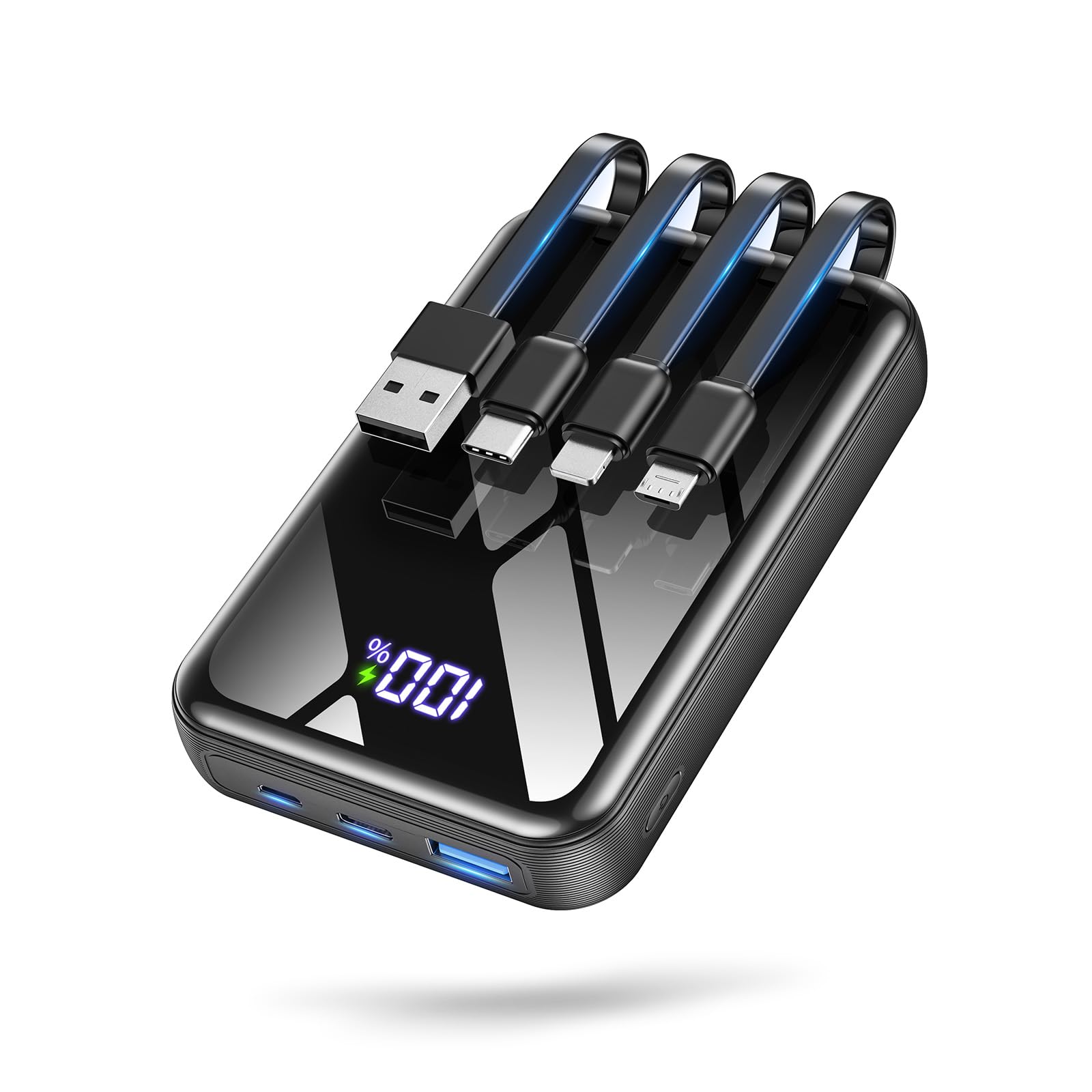
YBYP 50K 22.5W Bank
Key Features
- Capacity: 50,000mAh
- Output: 22.5W PD
- Ports: 4 built-in cables + 3 ports
- Built-in Cables: Yes (4 total)
- Price: $
The YBYP 50K packs 50,000mAh into a 4.8 x 3.1 x 1.1 inch frame — enough to recharge a phone ten times over. Four built-in cables (USB-C and Lightning) eliminate the need to carry separate cords, and the 22.5W PD output tops up modern phones at their full speed. The LED display shows remaining charge at a glance, and the 8-layer safety circuit keeps things cool during overnight charging.
Build quality holds up to camp life: the matte plastic shell resists scratches, and the 99% positive feedback on construction backs that up. The 50,000mAh capacity runs for days on a single charge, making it a reliable companion for multi-day trips where wall outlets are scarce. The 22.5W output is fast enough for tablets and phones, though it won’t power a laptop at full speed.
This power bank suits campers who prioritize capacity and value above all else — group trips with multiple devices, families sharing one pack, or anyone on a tight budget. The tradeoff is weight: at 1.1 lbs it’s not ultralight, so it’s better suited to car camping or base camps than long backpacking carries. It also exceeds the 100Wh airline limit, so leave it at home if you fly.
Pros
- 50,000mAh capacity delivers days of phone and tablet charging for a group.
- Built-in USB-C and Lightning cables mean no extra cords to pack or lose.
- 22.5W PD/QC fast charging matches most phone charging speeds.
- Compact footprint for its capacity — fits in a daypack side pocket.
Cons
- Cannot be taken on airplanes because capacity exceeds 100Wh limit.
- 1.1 lb weight is moderate — noticeable in a pack for long hikes.
If you’re car camping with a group and want one power bank to keep everyone’s devices alive for the weekend, the YBYP 50K offers unmatched capacity per dollar. Just don’t plan on taking it through airport security or backpacking it miles into the backcountry.
Best for Cpap & Appliances
Anker SOLIX C300 DC
Key Features
- Capacity: 288Wh (90,000mAh)
- Output: 300W DC
- Ports: 4 USB-C + 2 USB-A + car
- Built-in Cables: No
- Price: $$$
The Anker SOLIX C300 DC uses a LiFePO4 battery that maintains capacity over hundreds of charge cycles, paired with a 300W DC output for powering CPAP machines and small fridges off-grid. This makes it a different tool than a standard power bank — it prioritizes long battery lifespan and steady DC power over portability or AC outlets.
This station suits campers who need overnight power for CPAP therapy, small DC refrigerators, or a Starlink Mini. Its 288Wh capacity handles a night of standard CPAP use, and the dual 140W USB-C ports can recharge devices quickly. That said, there are no AC outlets, so anything requiring a wall plug is out, and the wall charger to refill the unit itself is not included — a separate purchase.
When you do have the right charger, the SOLIX C300 hits 80% in about an hour via two USB-C inputs, a noticeable speed advantage over many competitors. The build quality is solid, and the size feels compact for the capacity — manageable for car camping or RV trips. A small number of units have shown USB-C port issues, so testing all ports early is wise.
Pros
- Solid build quality that holds up to outdoor transport.
- Fast recharge to 80% in roughly one hour using dual USB-C inputs.
- Long battery life supports overnight CPAP use without recharging.
- Compact size for a 288Wh station, easy to pack for car camping.
Cons
- Wall charger not included, adding an extra purchase and cost to get started.
- USB-C ports may malfunction on some units, so early functionality check is advisable.
For campers who need DC power for CPAP or small appliances and value long battery lifespan over AC outlets, the SOLIX C300 delivers reliable performance despite the missing charger.
Best for Ac Outlet Backup
GENSROCK 24K AC
Key Features
- Capacity: 24,000mAh (88.8Wh)
- Output: 150W AC peak
- Ports: 8 total (incl 2 AC)
- Built-in Cables: No
- Price: $$
The GENSROCK Portable Power Bank stands out in this roundup because it includes a 150W peak AC outlet — a feature usually reserved for larger power stations. With 24,000mAh capacity, eight ports (two AC, two DC, USB-C, and USB-A), and a built-in flashlight, it covers the basics for powering laptops, small fans, and phone chargers at a campsite without the weight of a full power station. The 2.3-pound body is compact enough to toss in a duffel or backpack.
This bank suits campers who need occasional AC power for a laptop or a 12V fan during weekend trips, or as a budget-friendly emergency backup for short power outages. The AC output is limited to 150W peak (roughly 100W continuous), so it won’t run a mini fridge or electric cooler. Fan noise is present while charging devices from the AC outlet — less noticeable outdoors or inside a tent with ambient noise, but worth planning around if you value silence near sleeping areas.
Charging speeds for phones and USB-C laptops are decent: the USB-C port delivers up to 18W, and the AC outlet handles most 65W laptop bricks without issue. Build quality feels solid, and the flashlight adds practical utility for evening camp chores. The 24,000mAh capacity provides several full phone charges plus a laptop top-up, though recharging the bank itself via the included DC adapter takes a few hours.
Pros
- Charges phones quickly from USB ports
- Sturdy build quality that holds up to outdoor handling
- Compact and light enough to pack for camping
- Provides good everyday value given the AC outlet
Cons
- Fan noise can be audible while AC charging — noticeable in quiet tents or bedrooms
A cost-effective choice for campers who need occasional AC power for laptops and small fans, as long as the fan noise during charging doesn’t disrupt your setup.
Best for Max Capacity Budget
YILANS 50K 22.5W

Key Features
- Capacity: 50,000mAh
- Output: 22.5W PD
- Ports: 4 built-in cables + 3 ports
- Built-in Cables: Yes (4 total)
- Price: $
The YILANS packs 50,000mAh into a 1.14-lb frame with four built-in cables (USB-C, Lightning, Micro-USB) for charging phones, tablets, and other devices directly. The 22.5W PD output tops up modern phones quickly, and six output ports handle group charging without an extra hub. But it’s heavier than similarly priced competitors like the YBYP 50K, and the capacity exceeds the 100Wh airline limit, ruling out carry-on travel. The weight is fine for car camping or base camp use, but backpackers covering long distances will feel the extra pound.
Pros
- 22.5W PD fast charging for phones and tablets
- Four built-in cables eliminate the need to carry separate cords
- Massive 50,000mAh capacity can charge multiple devices over several days
Cons
- At 1.14 lbs, it adds noticeable weight to a camping pack for longer hikes
- Cannot be taken on flights due to capacity exceeding 100Wh limit
For car campers or group trips where weight isn’t a priority, this offers massive capacity and convenience at a low cost; backpackers and air travelers should look at slimmer options.
Best for Cpap High Capacity
Renogy 72K 266Wh

Key Features
- Capacity: 72,000mAh (266Wh)
- Output: 60W PD + 150W DC
- Ports: 2 USB-C + USB-A + DC + wireless
- Built-in Cables: No
- Price: $$$
The Renogy 72K delivers 266Wh of capacity with DC and wireless charging, enough to run a CPAP machine for multiple nights or power a small fridge and Starlink setup. The build quality feels solid, and the 2.8 lb weight is reasonable for car camping given the energy stored. However, some units may stop functioning after a few months of use, and recharging the battery takes a full 6–8 hours — a slower pace than alternatives like the Anker SOLIX C300. Individual battery life can also vary, so the actual runtime on a CPAP may fall short of expectations.
Pros
- 72,000mAh capacity powers high-draw devices like CPAP, fridge, and Starlink
- Solid build quality and included flashlight and wireless charging pad
- Portable enough for vehicle-based camping despite large energy storage
Cons
- Some units may stop working after a few months of ownership
- Recharging the battery requires 6–8 hours, limiting turnaround between trips
Best for campers who need high capacity for CPAP and can accept the possibility of unit variation and the slow recharge time.
Best for Rugged with Lantern
aswayke 20K Rugged

Key Features
- Capacity: 20,000mAh
- Output: ~18W PD
- Ports: USB-C + USB-A
- Built-in Cables: No
- Price: $
The aswayke 20K Rugged stands out for its IP68 waterproofing and integrated 420lm lantern with a tripod mount — a practical combo for campers who want to reduce gear. It charges phones consistently and the digital display helps track remaining power. However, the included charging cable is thin and can wear out after a few days; a simple replacement resolves that. Long-term durability is harder to assess given the limited reviews, but for weekend trips where you need a rugged power source and light in one package, it delivers the essentials.
Pros
- Rugged IP68 waterproof and shockproof construction withstands outdoor conditions
- 420lm lantern with tripod mount provides useful hands-free illumination at camp
Cons
- Included charging cable can wear out quickly; replacing it with a higher-quality cable resolves the issue
A solid two-in-one for campers who prioritize durability and built-in lighting over fast charging speeds or multiple ports.
Best for Solar-Ready Portable
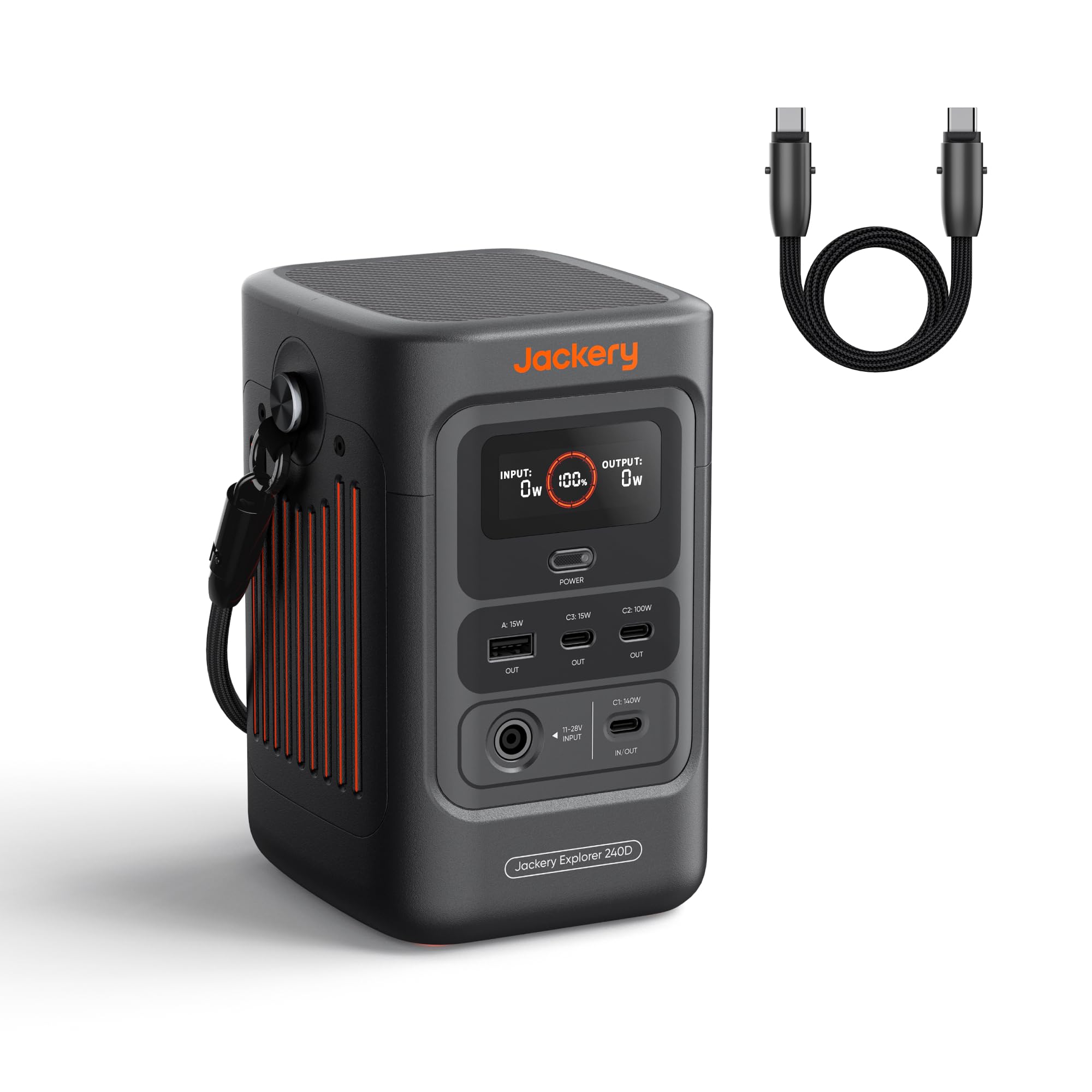
Jackery Explorer 240D
Key Features
- Capacity: 256Wh (80,000mAh)
- Output: 200W DC
- Ports: 3 USB-C + 1 USB-A
- Built-in Cables: No
- Price: $$
The Jackery Explorer 240D packs a 256Wh LiFePO4 battery in a lightweight 4.85-pound unit, recharging in about an hour via USB-C. Solar input capability adds flexibility for weekend trips. Yet with a limited number of early reviews, the service life and real-world capacity are not yet well-documented. The DC-only output (200W) restricts it to charging phones, tablets, and small DC appliances — no AC outlet for laptops or higher-draw gear. This suits campers who need a light backup power source for short outings, but not those expecting proven long-term durability or AC power.
Pros
- Lightweight and compact for a power station, easy to pack for camping trips.
- Solar charging input extends runtime on weekend outings.
Cons
- DC-only output (200W) means no standard AC outlet for household devices.
- Early review pool leaves questions about long-term reliability and actual capacity.
A good lightweight option for weekend campers who prioritize portability and solar charging, but only if you accept the DC limitation and uncertain long-term durability.
How to Choose
The most important buying insight is that capacity isn’t everything — port spacing, recharge speed, and durability often determine whether a power bank actually works on a camping trip.
Capacity: How Much Power Do You Need?
Capacity is measured in mAh or Wh. A 10,000mAh bank charges a phone about 2 times; 20,000mAh covers a phone plus a tablet for a weekend. Higher capacity adds weight and bulk — 50,000mAh banks often weigh over a pound and feel like a brick in a backpack.
For most car campers, 20,000–25,000mAh is the practical sweet spot. Backpackers should aim for 10,000–15,000mAh to minimize weight. If you need to run a CPAP or mini fridge, you need a power station with Wh ratings (200Wh+) instead of a simple power bank.
Output Wattage: How Fast Does It Charge?
Output wattage determines how fast your devices charge. Standard USB-A is 5–15W; USB-C Power Delivery can reach 100W or more. A 20W+ PD port will charge a phone much faster than a standard 5V/3A port.
For laptop charging, you need at least 45W output — ideally 65W or higher. Many budget banks advertise high capacity but only deliver 22.5W, making them useless for laptops. Check the single-port output, not just the total.
Ports: More Isn’t Always Better
The number and type of ports determine how many devices you can charge at once. A mix of USB-C and USB-A covers modern and older gadgets. Some banks include a DC barrel or car socket for appliances.
But more ports often mean slower shared charging. Many banks split total wattage across ports — plugging in two laptops may halve the speed. Look for ports that deliver full power individually, especially if you plan to charge multiple high-draw devices.
Built-in Cables: Convenience vs. Durability
Built-in cables eliminate the need to carry separate cords, reducing clutter. They are handy for quick charging at camp, especially for phones and tablets. However, they are a common failure point — cables can fray or detach after months of use.
If you choose a bank with built-in cables, check user reviews for durability. Some brands offer replaceable cables; others are sewn in. For reliability, a bank with separate high-quality cables might last longer.
Ruggedness: Water and Drop Resistance
IP ratings indicate dust and water resistance. IP67 means fully dust-tight and can survive immersion up to 1 meter for 30 minutes. MIL-STD drop ratings certify survival from 4-foot drops onto concrete.
Rugged power banks are heavier and often more expensive, but they are essential for kayaking, rain, or rocky terrain. Standard plastic banks can crack from a short fall. If you camp in harsh conditions, invest in a rugged model.
Weight and Size: The Real Portability Factor
Weight is the hidden cost of high capacity. A 10,000mAh bank weighs about half a pound; a 50,000mAh bank can exceed 1.1 pounds. Every 10,000mAh adds roughly 0.2–0.3 pounds.
For backpacking, every ounce matters. A 10,000–15,000mAh bank is a practical choice. For car camping, weight is less of a concern, but bulk still matters — a thick, long bank may not fit well in a pants pocket or small daypack.
FAQ
How long does a 20000mAh power bank last camping?
A 20,000mAh power bank typically charges a modern smartphone 4–5 times from zero. For a weekend camping trip (2–3 nights) with moderate phone use, that’s usually enough. If you also need to charge a tablet, e-reader, or camera, you might run out by the second night. Consider 25,000–30,000mAh for longer trips.
Can I take a 50000mAh power bank on a plane?
No. Airlines limit power banks to 100 watt-hours (Wh) — 50,000mAh at 3.7V equals 185Wh, nearly double the limit. Any power bank over 100Wh (roughly 27,000mAh) is prohibited in carry-on and checked luggage. For flights, stick to 20,000–27,000mAh models that are TSA-approved.
Why does my power bank take so long to recharge?
Power banks recharge at a rate determined by their input wattage. A standard 5V/2A input (10W) takes 10 hours to fill a 20,000mAh bank. Models with USB-C Power Delivery input (45W or higher) can recharge in 2–3 hours. If you have a large capacity bank (50,000mAh) with only micro-USB input, expect 15+ hours.
What power bank do I need for CPAP camping?
CPAP machines draw 30–60W, depending on settings and humidity. A standard power bank cannot supply that for a full night. You need a portable power station with at least 200Wh capacity and a DC car outlet or USB-C PD output (60W+). Look for models like the Anker SOLIX C300 or Jackery Explorer 240D. Expect 1–2 nights per charge.