
This post contains affiliate links. We may earn a small commission when you buy through our links — at no extra cost to you.
A waterproof duffel bag that fails to keep gear dry in a sudden downpour or a tipped kayak is worse than a regular bag—you trusted it. Most ‘waterproof’ duffels on the market are designed for rain and splashes, not full submersion. The difference isn’t a marketing trick; it’s a design trade-off between closure type, material thickness, and seal quality.
The real choice comes down to your typical exposure: light rain and damp storage, or the real risk of taking a swim. A roll-top bag with sealed seams handles the first scenario reliably, but the same bag may let water in when dunked. That’s why buying based on the highest rating or lowest price alone often leads to disappointment.
This guide cuts through the waterproof claims by matching each bag’s actual sealing mechanism and hardware durability to specific use cases—whether you’re a kayaker who might capsize, a motorcyclist riding through a storm, or a traveler needing rainproof luggage. You’ll know exactly which bag fits your conditions before you buy.


Best for Rainproof Travel
Earth Pak Duffel 50L
Key Features
- Waterproofing: Rain & splash only
- Closure: Roll-top with buckle
- Material: 500D PVC
- Carrying Options: Shoulder strap, handles
- Capacity: 50L (multiple sizes)
- Price: Budget
The Earth Pak duffel uses thermo-welded seams and heavy-duty PVC to keep gear dry through steady rain and splashes. It handles wet deck conditions, damp motorcycle gear, and canoe trips without leakage — though it is not built for submersion. The 50L, 70L, 90L, and 120L capacity options let you match size to trip length without carrying excess weight.
This bag suits travelers, motorcyclists, and paddlers who need reliable rain protection without spending premium dollars. The roll-top closure works well, but the buckles can snap under heavy stress — adding a backup strap eliminates that risk. For anyone who expects full submersion or abusive handling, a submersible model would be a better fit.
Pros
- Welded seams and thick PVC hold up to regular use in rain and damp conditions.
- Keeps contents dry from rain and splashes in wet environments.
- Multiple capacity options allow choosing the right size for different trip lengths.
Cons
- Not designed for full submersion — only rain and splash protection.
- Buckles may crack under heavy load or rough handling.
For anyone needing a no-fuss dry bag for rain, splash, and everyday travel, this Earth Pak delivers dependable performance at a budget-friendly price.
Best for Kayak & Paddle
Gonex Dry Duffel 60L
Key Features
- Waterproofing: Rain & splash only
- Closure: Roll-top with velcro + buckle
- Material: PVC
- Carrying Options: Shoulder strap, handles
- Capacity: 60L (multiple sizes)
- Price: Budget
The Gonex Dry Duffel stands out with its external drainage pocket, which lets you stash wet shoes or a soggy wetsuit without soaking the rest of your bag. The 60L capacity handles a weekend’s worth of gear, and the PVC construction with sealed seams keeps contents dry in rain and splash conditions. For kayakers and paddleboarders who need wet-gear separation, this is a practical upgrade over a standard dry bag. That said, the Velcro roll-top closure may not form a watertight seal when fully submerged, and the buckles can break under repeated heavy loading — so this bag is best for splash zones and surface spray, not full immersion.
Pros
- Drainage pocket keeps wet gear separate from dry items.
- Spacious 60L volume fits a weekend’s clothing and accessories.
- Budget-friendly build with sealed seams and robust PVC material.
Cons
- Roll-top Velcro seal can allow water entry when bag is submerged; suited for rain and splash, not pool crossings.
- Buckles may snap under heavy or frequent use — worth inspecting after a few trips.
If you paddle or boat in wet conditions and want to keep damp gear away from dry clothes without spending much, this bag delivers. Skip it if you need submersible waterproofing or strap reliability for hardcore expeditions.
Best for Motorcycle Camping
Wild Heart Motorcycle Duffel
Key Features
- Waterproofing: Rain & splash only
- Closure: Roll-top with buckles
- Material: 500D PVC
- Carrying Options: Rope straps, D-rings
- Capacity: 66L (multiple sizes)
- Price: Mid-Range
The Wild Heart stands apart from standard dry bags thanks to its double-bottom construction and integrated rope straps that keep the load planted on a bike or kayak. It’s ideal for motorcycle campers who need a bag that stays strapped during off-road travel. The water resistance is splash-proof but not fully submersible; heavy rain can find its way through the roll-top closure in some cases.
Pros
- Double-bottom construction protects against abrasion from road grit and gear.
- Rope straps with D-rings attach firmly to luggage racks for stable highway speeds.
- Good value for the price given the build quality.
Cons
- Size can run larger or smaller than expected depending on how you pack it – verify dimensions before ordering.
- Water resistance is not reliable in sustained downpours – the roll-top seal may let moisture in.
For motorcyclists who prioritize stable attachment over full waterproofing, this duffel delivers rugged utility at a fair price.
Best for Hiking & Travel
Haimont Duffel Backpack 60L
Key Features
- Waterproofing: IPX7 submersible (1m)
- Closure: Roll-top (IPX7 rated)
- Material: 500D Tarpaulin
- Carrying Options: Backpack straps, shoulder strap, handles
- Capacity: 60L (multiple sizes)
- Price: Mid-Range
The Haimont duffel backpack stands out with its IPX7 submersible rating and removable backpack straps, offering genuine waterproofing for kayakers and canoeists who need hands-free portability. The thick tarpaulin build feels robust, and the 60L main compartment handles multi-day gear well. However, the included shoulder strap can detach early under moderate load — this bag is best used in backpack mode. It suits travelers and hikers who will primarily rely on the backpack straps, but less ideal for anyone planning to sling it over one shoulder regularly.
Pros
- Thick tarpaulin build with well-stitched seams
- Removable backpack straps for comfortable hands-free carry
- Spacious 60L main compartment with multiple pockets
Cons
- Roll-top seal may let moisture through in heavy rain despite proper rolling
- Shoulder strap can detach early under moderate load – better to use backpack mode
Decent value for kayakers and hikers if you stick with the backpack straps — the shoulder strap is best reserved for light loads only.
Best for Budget Kayaking
Lanedo 80L Dry Bag
Key Features
- Waterproofing: Rain & splash only
- Closure: Roll-top with velcro
- Material: PVC
- Carrying Options: Shoulder strap, handles
- Capacity: 80L
- Price: Budget
With 80L of capacity at a budget price, the Lanedo dry bag is the go-to for anyone needing to haul a lot of gear without spending much. The PVC construction and heavy-duty straps hold up well on day trips.
It’s best suited for kayakers and fishermen who need massive volume for dry clothes, tents, or food, and understand that the water resistance handles rain and waves well but is not guaranteed if the bag goes underwater. For those who need guaranteed submersion protection, the top pick’s thermo-welded seams are a safer bet.
Pros
- Massive 80L capacity fits a full camping setup or all your fishing gear for a day on the water.
- Rugged PVC seams and straps hold up to rough handling on kayaks and rocky shorelines.
- Hard to beat the value – you get this much dry storage for less than most 40L bags.
Cons
- Roll-top only design (no zipper) may be unfamiliar to some – takes a few tries to get a reliable seal.
- Water resistance is splash-proof but not submersible – best kept above water to stay dry.
If you need maximum dry storage volume on a tight budget and can work within its splash-proof limits, the Lanedo 80L is a practical choice.
Best for Occasional Trips
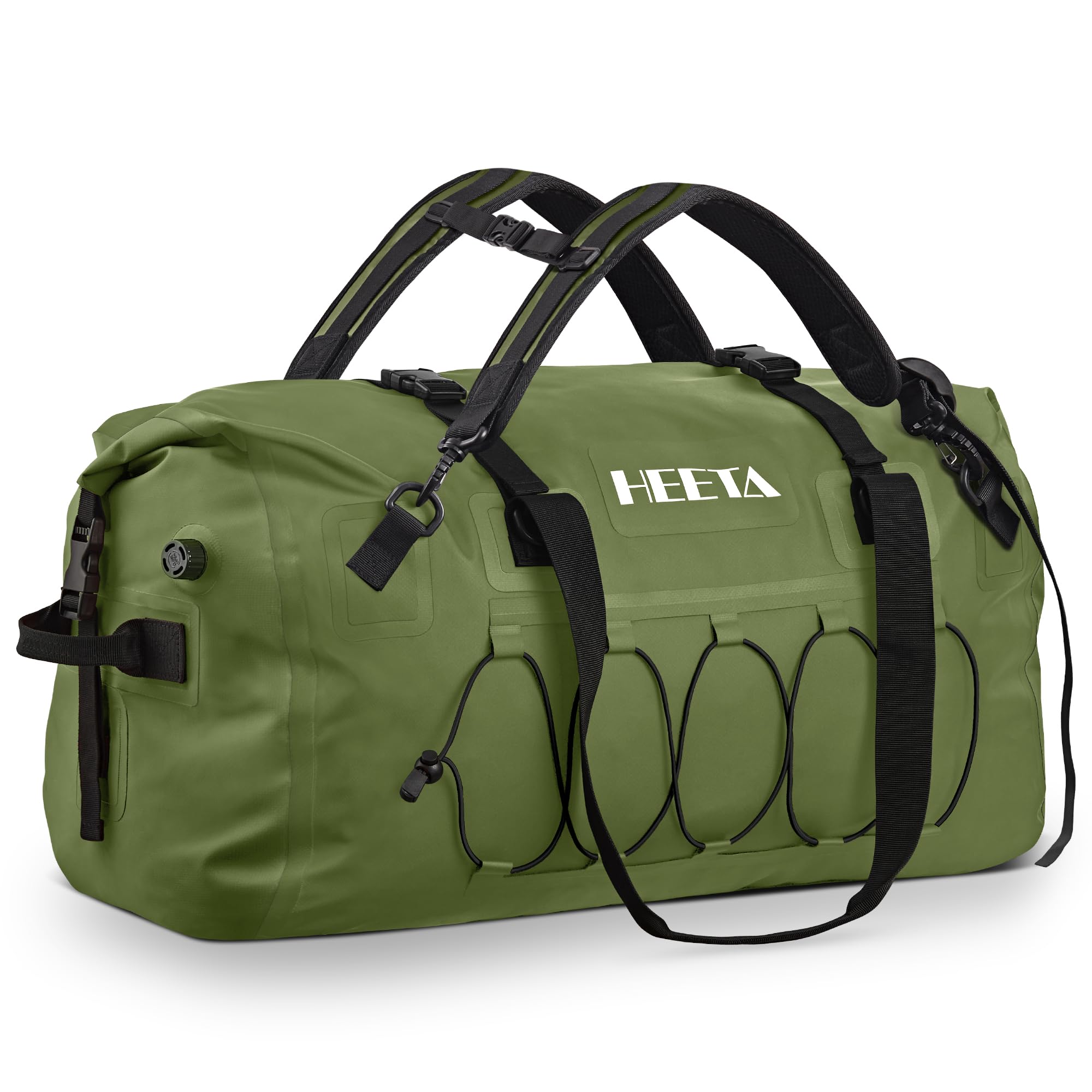
HEETA Rolltop Duffel 60L
Key Features
- Waterproofing: Rain & splash only
- Closure: Roll-top with buckles
- Material: 500D PVC
- Carrying Options: Backpack straps, shoulder strap
- Capacity: 60L (multiple sizes)
- Price: Budget
The HEETA roll-top duffel brings a budget-friendly price and effective rain protection thanks to thick PVC and sealed seams, plus an air release valve for easy compression. However, the shoulder and backpack straps can detach or break under heavier loads, making this best suited for occasional trips where the bag isn’t carried far or relies on the handles.
Pros
- Thick PVC and sealed seams deliver solid rain protection.
- 60L capacity at a budget price fits a weekend’s gear.
Cons
- Shoulder and backpack straps can detach or break under load.
A fine choice for a car camping duffel or dry bag that stays in place, but not for anyone who needs to carry it like a backpack.
How to Choose
The most critical spec isn’t the material—it’s matching the closure seal and hardware to your actual water exposure.
Waterproofing Level
Duffel bags labeled ‘waterproof’ typically fall into two camps: those that handle rain and splashes, and those that survive full submersion. The difference lies in the closure seal—a simple roll-top with a buckle is adequate for rain, but a submersible bag (IPX7) uses a tighter seal and often a pressure-release valve to prevent water ingress when dunked.
If you kayak in calm water and only worry about splashes, a rainproof bag is sufficient. Whitewater rafters or canoeists who risk capsizing need an IPX7-rated bag and must test the seal before each trip.
Closure Type
All waterproof duffels use a roll-top closure, but the execution varies. Some use a plastic buckle clip, others add a Velcro strip to hold the roll in place before buckling. Velcro adds security but can wear out over time and may not seal perfectly if debris gets caught.
A buckle-only closure is simpler and less likely to fail, but requires the user to roll the top at least three times and clip it tight. If the buckle breaks—a common issue across budget bags—you lose all waterproofing. Look for reinforced buckle attachment points.
Material
PVC and tarpaulin are the two main materials. PVC (500D or similar) is heavier, more abrasion-resistant, and holds up well against sharp edges inside a kayak. Tarpaulin is lighter and more flexible, making it easier to pack, but punctures more easily on rough surfaces.
Material thickness matters more than type for waterproofing. A 500D PVC bag will resist wear longer than a thin tarpaulin bag, but both will leak if the seam tape fails. Welded seams outperform stitched-and-taped seams in longevity.
Carrying Options
Most duffels come with a shoulder strap and side handles, but for hands-free portage, backpack straps are a game-changer. However, backpack straps add failure points—buckles that snap, straps that detach. If you plan to carry the bag any distance, prioritize bags with reinforced strap attachment and metal hardware.
Tie-down points (D-rings, rope loops) are essential for motorcycle and kayak use. A bag that shifts during transit can cause dangerous imbalance. Look for multiple anchor points and straps that tighten securely without slipping.
Capacity
Manufacturers list external volume, but rolling the top reduces usable space by 10–20%. A 60L bag typically holds about 50L after proper sealing. For a weekend trip, 50–60L is enough for one person; for a family outing, 80–100L is safer.
Oversizing has a downside: a half-empty bag is harder to roll tightly and may leak. Choose a size that matches your typical load—don’t buy bigger than you need just to have extra room.
FAQ
How many times do you need to roll a dry bag to make it waterproof?
At least three to four full rolls, then clip the buckle tight. Fewer rolls leave air gaps that let water seep in. After rolling, press down on the bag to check for air leaks—if you hear air hissing, reroll.
Can a roll-top duffel bag be used as checked luggage on a plane?
Yes, but check airline size limits for checked bags (typically 62 linear inches). A 60–70L duffel usually fits. Use a bag with reinforced handles and secure the roll-top with a zip tie or extra strap to prevent tampering.
Why does my dry bag still leak after rolling it correctly?
Debris on the sealing surface, a pinhole in the material, or an incomplete clip are common causes. Inspect the roll-top edge for dirt, test the bag in a bathtub with a paper towel inside, and check seams for tiny punctures. Most leaks are fixable with seam sealant or a patch kit.
Are PVC dry bags more durable than tarpaulin dry bags?
PVC is heavier and more abrasion-resistant, making it better for rugged use like kayaking and motorcycling. Tarpaulin is lighter and more flexible but punctures more easily. For long-term durability in harsh conditions, choose PVC with welded seams.