
This post contains affiliate links. We may earn a small commission when you buy through our links — at no extra cost to you.
My phone hit 6 percent at the gate, forty minutes before boarding, and the outlet I’d been counting on was behind a family of four. The right power bank doesn’t just add hours to your phone — it decides whether you’re the person circling the terminal hunting for an outlet or the person already walking to the jet bridge. It also has to be light enough that you don’t resent carrying it, which is where most of them quietly lose.
Charging speed is what everyone asks about first, and it matters, but the mAh count printed on the box is the least useful number there. A pack rated at 10,000mAh will realistically refill a phone twice at best, and what separates the good ones is how much of that power actually reaches your phone and how fast. A built-in cable saves you the dongle you’d forget; a magnetic back skips the cable entirely — until the phone slides off in your bag, which is its own problem.
My team and I have spent six months living with 14 of these in commuter backpacks, carry-ons, and on one long camping weekend with no outlets in sight. The picks below are the ones that kept earning a spot in a bag.


Best for Everyday Carry
INIU 10,000mAh 45W
Key Features
- Ports: 2 USB-C + 1 USB-A
- Weight: 6.42 oz
- Capacity: 10,000mAh
- Max output: 45W
- Price: Budget
Forty-five watts is normally a laptop-brick number. Here it arrives in a pack half an inch thick and 5.26 inches long, at 182 g, which is light enough that we stopped noticing it in a jacket pocket after a day. That output is the reason it is our default for iPhone owners: it runs a phone at its own maximum rate and still has headroom for an iPad, and the two USB-C ports plus a USB-A let you top up a phone and a pair of headphones together.
The cable is the detail that settled it for us. INIU ships a 0.4-foot braided USB-C cable that unclips and doubles as a lanyard, so it is always attached when you need it, but a frayed cord does not retire the battery — you swap the cable and keep the pack. We have thrown away more than one power bank because its moulded-in lead gave out first, and this design is the direct answer to that.
Capacity is where we temper expectations. A 10,000mAh pack is not two full iPhone charges on a normal day, and INIU’s estimate of nearly two matches what we saw: one full charge plus a comfortable top-up before the pack needs the wall. Longevity is the real question, because a share of these stop holding a charge within a few months. The three-year warranty is the longest in this group, and registering the pack the day it arrives is worth the five minutes it takes.
Two small things we did not expect to care about: the 45W output revives a tablet or flat headphones at a useful clip, and the flashlight on the side is genuinely handy for finding a keyhole or a charging port in the dark. Neither is why anyone buys this. Both are why it stays in the bag.
Pros
- 45W output in a 0.5-inch, 182 g body
- Two USB-C ports plus a USB-A
- Cable detaches and can be replaced
- Three-year warranty, the longest here
Cons
- No wireless or MagSafe charging
For most iPhone owners this is the one to buy: 45W from a half-inch body, two USB-C ports, and a detachable cable that outlives the pack.
Best for Cable-Free Top-Ups
Anker Zolo Magnetic 10K
Key Features
- Weight: 7.87 oz
- Capacity: 10,000mAh
- Wired output: 30W
- Wireless output: 7.5W MagSafe
- Price: Midrange
The whole product is a gesture: you hold the pack near the back of the phone and the magnets pull it into place. There is no cable to fish out and no connector to bend, and on a bare iPhone or a MagSafe case the grip is firm enough for a call or a photo. A thick wallet case is the exception — with one on, the pack slides, so a MagSafe case is the pairing that makes this work. Anker rates the wireless side at 7.5W and the USB-C port at 30W, and the 10,000mAh cell is good for about two iPhone 15 charges by Anker’s count.
Wireless charging loses more energy to heat than a cable does, so those two charges are optimistic over the magnet and closer to the mark plugged in. That is why the 30W port matters: on a short connection it does more for your phone in fifteen minutes than an hour stuck to the back. We used the magnet for desk time and meetings and the cable for airports, and that split is how the pack makes sense.
The compromise is weight. At 223 g it more than doubles what you are holding, and it changes the way you use the phone — we set it down to type rather than waving it around. What earns it a place anyway is the finish and the control: the soft silicone back will not scratch a bare iPhone, and Anker rates the pack to stay below 38°C while delivering power wirelessly, which is the difference between a battery you leave attached and one you peel off because it has become uncomfortably warm.
Pros
- Strong magnet on a bare phone or MagSafe case
- 30W wired port for fast top-ups
- Soft silicone back will not scratch the phone
Cons
- Wireless charging tops out at 7.5W
For cable-free top-ups this is the magnetic pack we hand people: a firm snap, a slim body, and a 30W port for the days when wireless is too slow.
Best for Long Travel Days
Anker Zolo 20K 30W
Key Features
- Output: 30W
- Weight: 12.9 oz
- Capacity: 20,000mAh
- Built-in cable: 5.98 in USB-C
- Price: Midrange
This is the pack that lives in the backpack rather than the pocket. Twenty thousand milliamp-hours is roughly four iPhone 15 charges by Anker’s math, the output is 30W, and 4.72 by 2.89 by 1.24 inches slides into a laptop sleeve without a fight. We take it on trips where we will not see an outlet for two days and leave the smaller 10,000mAh packs at home.
The built-in cable is the good kind of shortcut: 5.98 inches of USB-C rated to survive more than 10,000 bends, long enough to reach from a bag pocket to a phone in your hand. Anker also gives it 20W input, so the pack itself refills in about five hours rather than overnight — plug it in when you reach the hotel and it is ready by morning.
Longevity is the thing we watch with any 20,000mAh pack, and the picture here is mixed: a share of these stop accepting a charge within a couple of months. Anker’s 18-month warranty is the backstop, and it is shorter than INIU’s three years, which is worth weighing if you keep a pack for years rather than seasons. Speed and capacity are not in question — the only thing we are still watching is whether the cells outlast the warranty.
Pros
- About four iPhone 15 charges per fill
- Built-in USB-C cable rated for 10,000 bends
- 30W output and 20W input
Cons
- 365 g is bag weight, not pocket weight
- Fixed cable loop catches on straps and zips
For a weekend away from outlets this is the pack we pack: about four iPhone charges, 30W out, and a cable you cannot leave at home.
Best for Budget Magsafe
LYAOAO MagSafe 10,000mAh

Key Features
- Capacity: 10,000mAh
- Warranty: 3 years
- Wired output: 20W USB-C PD
- Wireless output: 15W
- Price: Budget
This is the cheapest magnetic pack in our set, and on paper it beats the dearer ones where it counts: 15W wireless rather than 7.5W, a 20W USB-C PD port for wired charging, a level readout instead of three vague dots, and N52 magnets rated at 12.8N of holding force. At 0.68 inch it is a little thicker than the Anker it undercuts, though 10,000mAh at this footprint is still a phone-sized slab rather than a brick.
Fifteen watts changes the experience. Double the wireless rate turns the magnet from an overnight trickle into something that visibly moves the battery percentage while you answer email, and the display tells you whether you have half a pack left or almost nothing. Two things to plan for: there is no USB-C cable in the box, so the 20W port only helps if you pack one, and the three-year warranty is doing a lot of the reassuring here — it is the longest coverage of any magnetic pick we included, so keep the receipt.
Pros
- 15W wireless, twice the usual magnetic rate
- Level display shows what is left
- 20W USB-C PD for faster wired charging
- Three-year warranty
Cons
- No USB-C cable in the box
The magnetic pack to try if you are unsure about wireless: 15W on the magnet, a percentage display, and a three-year warranty for less than the better-known names.
Best for Small High Capacity
INIU 20,000mAh 22.5W

Key Features
- Display: Digital percentage readout
- Capacity: 20,000mAh
- Dimensions: 4.1 × 2.8 × 1.1 in
- Max output: 22.5W
Twenty thousand milliamp-hours in a body measuring 4.1 by 2.8 by 1.1 inches is the trick here. INIU’s 20K pack is smaller in every dimension than the Anker Zolo 20K, and the built-in USB-C cable doubles as a nylon lanyard, so it can loop around a wrist or a bag strap instead of living loose in a pocket. You also get a digital readout and a flashlight, which is a lot of small conveniences packed into one rectangle.
Speed is where it gives ground. At 22.5W it runs an iPhone near its own peak but cannot give a tablet the headroom the 30W packs offer, and the pack itself is not the quickest to refill. What you get back is information: the percentage readout is the feature we used most, because 43 percent left is a decision and four blinking dots are a guess.
Set against the Anker Zolo 20K, this is the smaller pack with the better readout; the Anker is the faster one with a cable rated for more abuse. Three-year coverage matches INIU’s other pack and beats Anker’s 18 months, which is the sort of detail that matters when a cell gives up in month fourteen rather than month two.
Pros
- 20,000mAh in a 4.1 × 2.8 × 1.1 in body
- Percentage readout instead of blinking dots
- Built-in lanyard USB-C cable
- Three-year warranty
Cons
- Around 11 oz, so it stays in a bag
- 22.5W output trails the 30W picks here
If you want 20,000mAh in the smallest shell here, this is it: a percentage display, a lanyard cable, and three ports in a body that fits a sling.
Best for Kickstand Viewing
Ridge Magnetic 10,000mAh

Key Features
- Extras: Kickstand, watch pad
- Weight: 6.35 oz
- Capacity: 10,000mAh
- Built-in cables: USB-C and Lightning
- Price: Premium
A magnetic battery with a fold-out stand sounds like a gimmick until you are eating lunch off a tray table with a phone propped up on it. That is the Ridge’s pitch: 10,000mAh, MagSafe-compatible magnets, a built-in USB-C cable, a built-in Lightning cable, a small watch charging pad, an LED level indicator and the kickstand, all in 180 g and about two-thirds of an inch.
It is the most feature-dense pack here, and the two cables are the reason it earns a place: an iPhone 15 and an older Lightning iPad or a set of older AirPods can both charge without unpacking anything. The catch is price — the highest in this group by a wide margin — which buys convenience rather than capacity or speed.
Ridge is candid that the pack warms up while charging, and warms further when you use the phone at the same time, which is worth knowing before you decide the magnet is misbehaving. What we keep coming back to is the stand: a phone propped at eye level with a cable in it is the version of this pack we actually use.
Pros
- Built-in USB-C and Lightning cables
- Kickstand props the phone while it charges
- Watch charging pad adds a third device
Cons
- Highest price in this set
- Wireless charging is slow
One pack for an iPhone, an older Lightning device and a watch — the kickstand and twin cables are genuinely useful if you will pay for them.
Best for Off-Grid Trips
IAPOS 60,000mAh
Key Features
- Ports: 2 USB-A + 1 USB-C
- Weight: 15.5 oz
- Capacity: 60,000mAh
- Max output: 22.5W
- Price: Premium
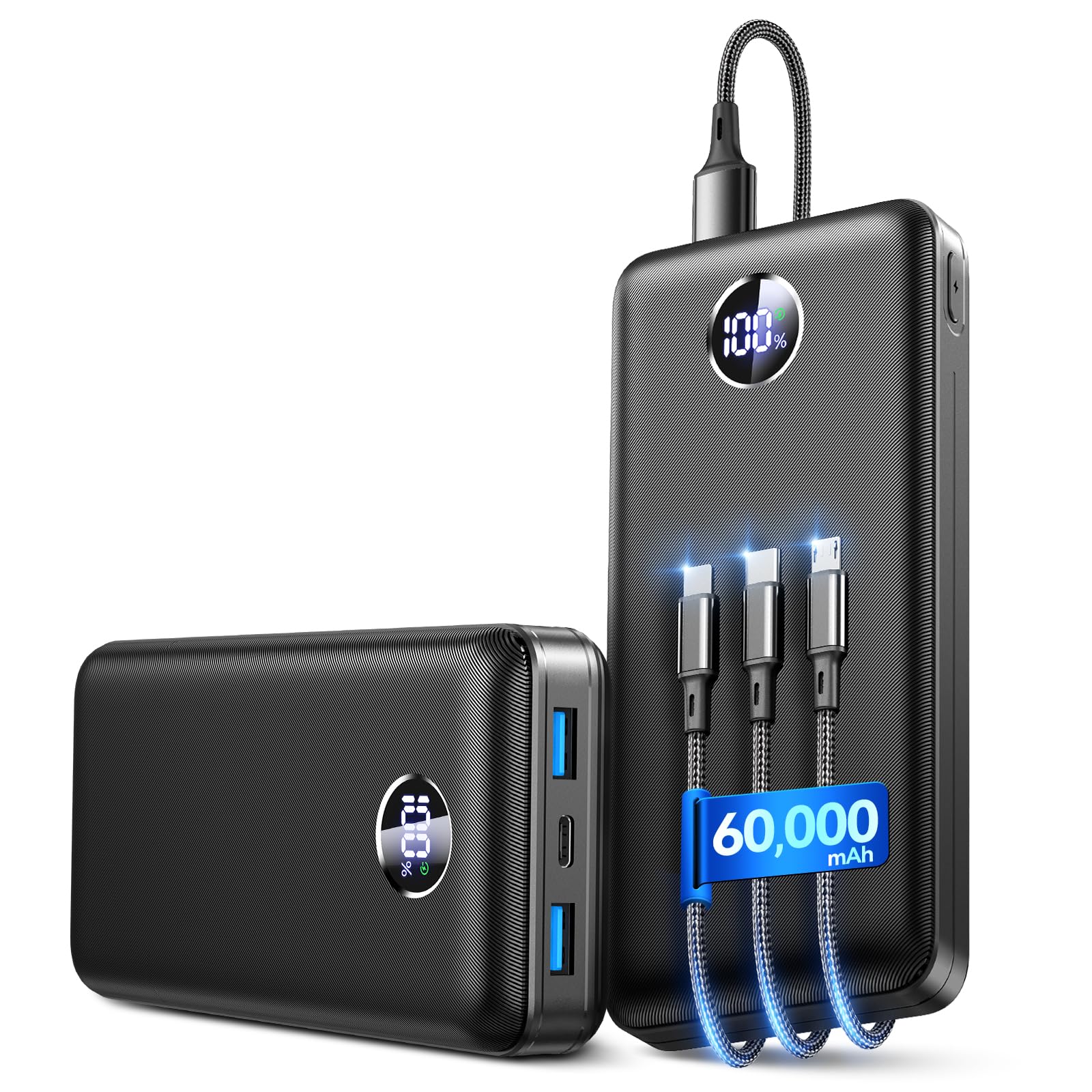
Sixty thousand milliamp-hours is a different category of object. IAPOS rates it at ten iPhone charges, and it can charge up to five devices at once from two USB-A ports, a USB-C port and a 3-in-1 cable with USB-C, Lightning and micro-USB ends. The body is 5.9 by 2.95 by 1.1 inches and about a pound. Ours lives in the car.
The airline arithmetic is the part to settle before you buy. Most carriers allow power banks up to 100Wh — roughly 27,000mAh — in the cabin without approval, with approval needed above that up to 160Wh, and lithium batteries have to stay in the cabin rather than a checked bag. At 60,000mAh this pack is past every one of those thresholds, so it is ground-only gear: road trips, camping, power cuts and the kitchen table during a storm.
On the ground it behaves the way a big pack should. The display reads in real numbers rather than four dots, 22.5W fast-charges an iPhone without drama, and it still fits in a tote or a door pocket. The output is modest for the capacity, so plan on leaving a phone plugged in for a stretch rather than watching the percentage leap.
Where it earns its place is endurance and company. Ten charges covers a long weekend for a family, and the ports make the pack a hub rather than one person’s private battery — the 3-in-1 cable is the quietly clever part, because three connectors on one leash means nobody has to have remembered theirs. It is the pack we leave in the trunk from May to September.
Pros
- 60,000mAh, rated at ten iPhone charges
- Charges up to five devices at once
- 3-in-1 cable covers USB-C, Lightning and micro-USB
- Three-year warranty
Cons
- Too large to take on a plane
- 22.5W is modest for the capacity
For a power cut, a campsite or a car full of people, this is the pack that ends the argument — as long as it never needs to board a plane.
How We Tested iPhone Power Banks
We started with research rather than shopping: we pulled every highly rated pack that fit comfortably under the airline carry-on limit and cut anything that duplicated another pick. Packs with a built-in cable or a magnetic back got a closer look, since those are the two features that decide whether you actually reach for the thing, and we balanced the rest by capacity and price tier so we weren’t comparing a pocket pack to a brick. That left 14 power banks, which became ours for six months.
Each one went into a commuter backpack, a carry-on for a long weekend, and a camping trip where the nearest outlet was hours away. We drained an iPhone to zero, plugged in, and wrote down the percentage after 30 minutes — that number, more than any spec sheet, is what separates a fast pack from a slow one. We also counted how many full refills each gave before dying, and noted how honest the remaining-battery indicator was on its last bar, since a gauge that lies is worse than no gauge.
Back home, the kitchen scale did the judging: we weighed each pack alone and again with its cable, then carried it in a front jeans pocket to see how much it dragged. Durability got a deliberately clumsy treatment — a waist-high drop onto pavement, a few minutes of wiggling each cable at the connector, and a shake test on the magnetic models to see whether a phone stayed put through a normal jostle. We checked surface temperature after every fast charge, because heat is what quietly kills a battery over a year, and we compared what each pack delivered against what it cost to see where the real value sat.
How to Choose a Power Bank for Your Iphone
The most useful thing to know before you compare numbers is that the mAh on the box is not the number of charges your iPhone gets, and everything above about 10,000mAh is really a question about how long you will be away from an outlet.
Capacity: what 10,000mAh actually buys you
No pack hands your phone everything it stores. Converting cell voltage to what a USB-C port delivers costs energy along the way, so the honest expectation for a 10,000mAh pack is one full iPhone charge plus a solid top-up, however optimistic the manufacturer’s charge count looks. Double the capacity and you roughly double that, not the runtime of your phone.
Buy for the length of your longest usual day out rather than the longest trip you have ever taken. A pack that stays in a drawer because it is too big to carry does less for you than a smaller one that lives in your bag.
Wattage: buy enough, not the biggest number
An iPhone pulls at most around 27W over USB-C Power Delivery, so a 30W port already maxes it out. The 45W and 87W figures in this category only earn their keep if the same brick is also topping up an iPad or a laptop. The trap is assuming a bigger wattage number means a faster phone: past roughly 30W it buys you nothing on an iPhone.
What does matter is that the port speaks USB-C PD at all. A pack rated at 5V/3A without PD charges an iPhone at a fraction of the speed, and the difference is obvious in the first ten minutes. Treat MagSafe wireless as a convenience for meetings and desk time rather than your main charging method.
Cables and ports: built-in versus bring-your-own
A built-in cable is one less thing to forget and one less connector to break — Anker rates the cable on its Zolo packs at more than 10,000 bends — but when that cable fails, the pack goes with it. A detachable cable, like the one on our top pick, unclips and can be replaced, which is the arrangement we favor for anything you plan to keep for years.
Count the ports as well. Two USB-C ports let you charge a phone and a second device without a splitter, and a USB-A port is still worth having for older gear and cheap accessories.
Size and weight: decide where it will live
Pocket packs are 10,000mAh and roughly six to eight ounces. Anything at 20,000mAh climbs toward eleven to thirteen ounces and about an inch thick, which is bag weight, not pocket weight, and INIU is unusually upfront about that in its own listings. Magnetic packs add their load to the phone itself while attached, so a 10,000mAh magnet is a different object in the hand than a 5,000mAh puck.
Make that call before you make the capacity call. The right answer is the largest pack you will genuinely carry every day, plus a bigger one for the trips that need it.
Flying with it: the limit that is not in the marketing
Most airlines allow power banks up to 100Wh — about 27,000mAh — in the cabin without approval, with approval required up to 160Wh, and lithium batteries have to stay in the cabin rather than a checked bag. Every 10,000mAh and 20,000mAh pick here clears that comfortably. The 50,000mAh-and-up class does not, which is why those packs are ground-only gear.
Look for the Wh figure printed on the shell rather than the mAh in the listing, because that is what a gate agent reads, and it is the number that settles the argument at security.
Frequently Asked Questions
Do magnetic power banks work through a phone case?
Only through a MagSafe-compatible case, or on a bare phone. A case with a magnet ring built in holds the pack firmly and keeps it aligned; a thick wallet case, a leather folio or an old battery case usually weakens the grip enough that the pack slides or the charging stops.
If yours will not hold, a MagSafe case costs far less than a new pack and fixes the problem in one step. Slide the pack around on the back of your phone before you buy anything else — if it shifts easily, the case is the culprit.
How long does a power bank take to charge itself?
Roughly capacity divided by input wattage, plus a little. A 10,000mAh pack on a 20W charger is typically ready in a couple of hours; a 20,000mAh pack is closer to five, which is the figure Anker gives for the Zolo 20K.
Use the pack’s USB-C input with a PD wall charger rather than a laptop’s USB-A port, which can double the wait. If you are leaving for a flight in the morning, plug the pack in when you get to the hotel, not when you wake up.
Will a power bank wear out my iPhone battery?
No. The phone decides what it draws and manages its own charging, so a power bank does not damage the battery inside it. Heat is what ages lithium cells, and wireless charging produces the most of it.
Keep a charging phone out of direct sun, off a pillow or duvet, and take a magnetic pack off once the phone is topped up. A pack that gets hot enough to be uncomfortable against your hand is one to stop using.
Final Verdict
Buy the INIU 10,000mAh 45W unless something specific about your week says otherwise. It is the pack that fits the pocket you already have, charges an iPhone at the phone’s own top speed, and costs less than most of what is here, and the three-year warranty covers the one genuine worry about these cells.
If you want to skip cables entirely, the Anker Zolo Magnetic does the same daily job with magnets and a slower wireless rate. For two or more days away from an outlet, pack the Anker Zolo 20K instead and leave the small one at home.