
This post contains affiliate links. We may earn a small commission when you buy through our links — at no extra cost to you.
Many strollers carry the ‘all-terrain’ label, but when you’re on a rooty trail with your child, the difference between a plastic frame that flexes like a folding chair and a coil-sprung suspension becomes painfully obvious. Worse, on steep downhills, a parking brake is no substitute for a hand brake that gives you moment-to-moment speed control.
Our guide focuses on what separates real hiking strollers from the pretenders: proven suspension systems, tires that either hold air or never flat, and that critical hand brake. We’ll help you find a stroller that handles the terrain you actually hike — whether that’s a gentle fire road or a rocky scramble — without spending more than you need.
The right tire type and suspension mean the difference between a child who naps through the rocks and one who screams after every bump.



Best for Serious Trail Hikers
BOB Alterrain Pro
Key Features
- Tire Type: Air-filled pneumatic
- Suspension: SmoothShox independent
- Hand Brake: Ergonomic hand brake
- Wheel Size: 12" front, 16" rear
- Folded Size & Weight: 39x25x17", 32.3 lb
- Price: Luxury
The BOB Alterrain Pro is built for terrain that defeats lesser strollers. Its SmoothShox independent suspension absorbs roots, rocks, and ruts, while 16-inch rear air tires and a 12-inch front air tire provide traction on loose surfaces like sand and snow. The hand brake gives controlled descents on steep grades — a feature that separates serious off-road models from pavement-only joggers.
On actual trails, this stroller lives up to its billing. It plows through deep sand without bogging down, climbs rocky ascents without losing grip, and rolls over packed snow with stability. The 75-pound weight limit means a tall four-year-old still fits comfortably, extending the useful life well past typical stroller timelines. At 32.3 pounds, it’s heavy — lifting it into a car trunk is a two-hand job that gets old fast if you’re loading it daily.
This stroller suits families who treat the outdoors as an extension of home: serious hikers, trail runners, and those who live near beaches, mountains, or snowy paths. The hand brake can be stiff when new, requiring more force than some parents expect, and a small number of units develop a wheel squeak in reverse — neither is a safety issue, but they’re worth checking before a long descent. If you need car seat compatibility out of the box or plan to fold it into a compact trunk multiple times a day, look at lighter options.
Pros
- Handles deep sand, rocks, hills, and snow with confidence
- Durable aluminum frame and fully waterproof canopy withstand years of outdoor use
- SmoothShox suspension delivers a comfortable ride even on rough trails
- 75-lb weight limit allows a growing child to ride comfortably well past age four
Cons
- Hand brake requires significant force to squeeze, and occasional wheel squeak can occur in reverse
- Heavy and bulky when lifted into a car; not ideal for frequent trunk transfers
For families who treat the trail as their backyard, the Alterrain Pro delivers unmatched off-road capability and long-term durability — just be prepared for its weight and occasional quirks.
Best for Pavement & Moderate Trails
BOB Revolution Flex 3.0
Key Features
- Tire Type: Air-filled pneumatic
- Suspension: Adjustable suspension
- Hand Brake: No
- Wheel Size: 12" front, 16" rear
- Folded Size & Weight: 38x25x16", 28.5 lb
- Price: Premium
Air-filled tires and adjustable suspension give the Flex 3.0 the ride quality that made the BOB line a go-to for active families. It pushes with one hand and swallows uneven sidewalks, grassy parks, and compacted dirt trails without jarring the passenger. That smoothness, however, comes without the hand brake and extreme-terrain prowess of the top pick — you get a foot-operated parking brake, not a control brake for steep descents. On paved routes and groomed trails, the omission is barely noticeable. For parents who occasionally venture onto gravel or hard-pack, this stroller feels planted and precise, but deep sand, rocks, or muddy inclines are outside its design brief.
This stroller suits runners and daily walkers with a child approaching 75 pounds, as the seat adjusts nicely for growth and the frame holds up to heavy use. The under‑basket is tight and accessing it requires some maneuvering, and the fabric can develop tears in high‑wear spots over many seasons of heavy use. These are boundary tradeoffs for an otherwise durable jogger, not dealbreakers for its primary job. If your routes stay on pavement, boardwalks, or smooth dirt paths, the Flex 3.0 rewards you with a comfortable, long‑mile push. Families heading into rougher backcountry will want the hand brake and all‑weather canopy of the top pick.
Pros
- Ride is exceptionally smooth across pavement, grass, and uneven terrain.
- Easy to push and maneuver with one hand, ideal for jogging.
- High-quality construction with a comfortable, adjustable seat that supports growing toddlers.
- Smooth transition from running to everyday walking, fits varied family routines.
Cons
- Storage basket access is tight and awkward to load with larger items.
- Fabric may tear in high-wear areas after extended heavy use.
For pavement runners and daily walkers who value a smooth, durable push and don’t need extreme off‑road capability, the Flex 3.0 is a wisely priced classic — just expect a cramped basket and keep an eye on the seat fabric over time.
Best for Hilly Trail Hiking
Chicco Activ3
Key Features
- Tire Type: Foam-filled never-flat
- Suspension: FlexCore rear
- Hand Brake: Hand brake
- Wheel Size: 12" front, 12" rear
- Price: Mid-Range
The Chicco Activ3 sets itself apart with a hand-operated parking brake that gives controlled descents on steep trails, plus FlexCore rear suspension that softens bumps without relying on air-filled tires. The never-flat foam wheels eliminate puncture worries on rough terrain.
This stroller is aimed at hiking parents who already use Chicco infant seats — the one-step click-in makes transitions fast. The foam tires trade some cushioning for flat-free reliability, so runners seeking a plush air-filled feel may want to look elsewhere. Two-hand fold and a sizable stored footprint (roughly 47" long) mean it won’t suit small trunks or daily folding routines.
On the trail, the rear suspension absorbs rocks and roots well enough for moderate hikes, and the front wheel lock keeps the line straight on downhills. The parking brake engages with a squeeze, so you can hold the stroller steady while adjusting cargo or checking the child.
Pros
- Smooth, gliding ride absorbs bumps via rear suspension.
- Hand-operated parking brake and locking front wheel for downhill control.
- One-step click-in for Chicco infant seats — no extra adapter needed.
Cons
- Folding and unfolding require two hands; not a one-hand system.
- Stored size is large and may overwhelm small car trunks or tight storage closets.
For Chicco car seat owners who hike moderate trails and can handle a less compact fold, the Activ3 delivers a rare hand brake and flat-free peace of mind at a mid-range price.
Best for Light Trail Walking
Baby Trend Expedition
Key Features
- Tire Type: Rubber
- Hand Brake: No
- Wheel Size: 16" rear, 12" front
- Folded Size & Weight: —, 23.6 lb
- Price: Budget
Where the puncture-proof specialist prioritizes flat-free convenience, the Expedition doubles down on ride quality. Its bicycle-style tires absorb pavement chatter and hard-packed dirt ruts with a smoothness usually reserved for pricier models, and at 23.6 pounds, it’s lighter to lift into a trunk than most all-terrain strollers. The one-step fold collapses it flat enough for tight storage.
Budget-conscious families who stick to sidewalks, paved paths, and occasional crushed gravel or smooth dirt trails will appreciate the Expedition’s value. For hikes over roots and rocks, the lack of suspension and a hand brake crosses the line into risky territory — this isn’t a trail stroller. The under-seat basket is cramped and awkwardly shaped, holding a small diaper bag at most, so it’s a poor fit for marathon all-day outings. Tire quality varies; some units roll for miles without incident, while others may develop flats early. Carrying a spare tube and a pump turns a potential frustration into a manageable nuisance for casual walkers who don’t mind roadside maintenance.
Pros
- Surprisingly smooth glide on pavement and packed dirt for a budget stroller.
- Lightweight 23.6-lb frame and quick fold make it easy to toss in the car between errands.
- The large bicycle-style tires deliver a ride that feels far more expensive than it is.
Cons
- The rear tire can develop flats or blowouts unexpectedly on longer walks — carrying a spare tube is wise.
- The under-seat storage bin is narrow and difficult to access, limiting cargo to a slim diaper bag or a few essentials.
If your routes are limited to pavement, smooth paths, and occasional hard-packed dirt, the Expedition offers unbeatable value — just factor in the possibility of a flat tire and the cost of a spare tube. For anything rougher, step up to a true hiking stroller with suspension and a hand brake.
Best for Weekend Trail Walks
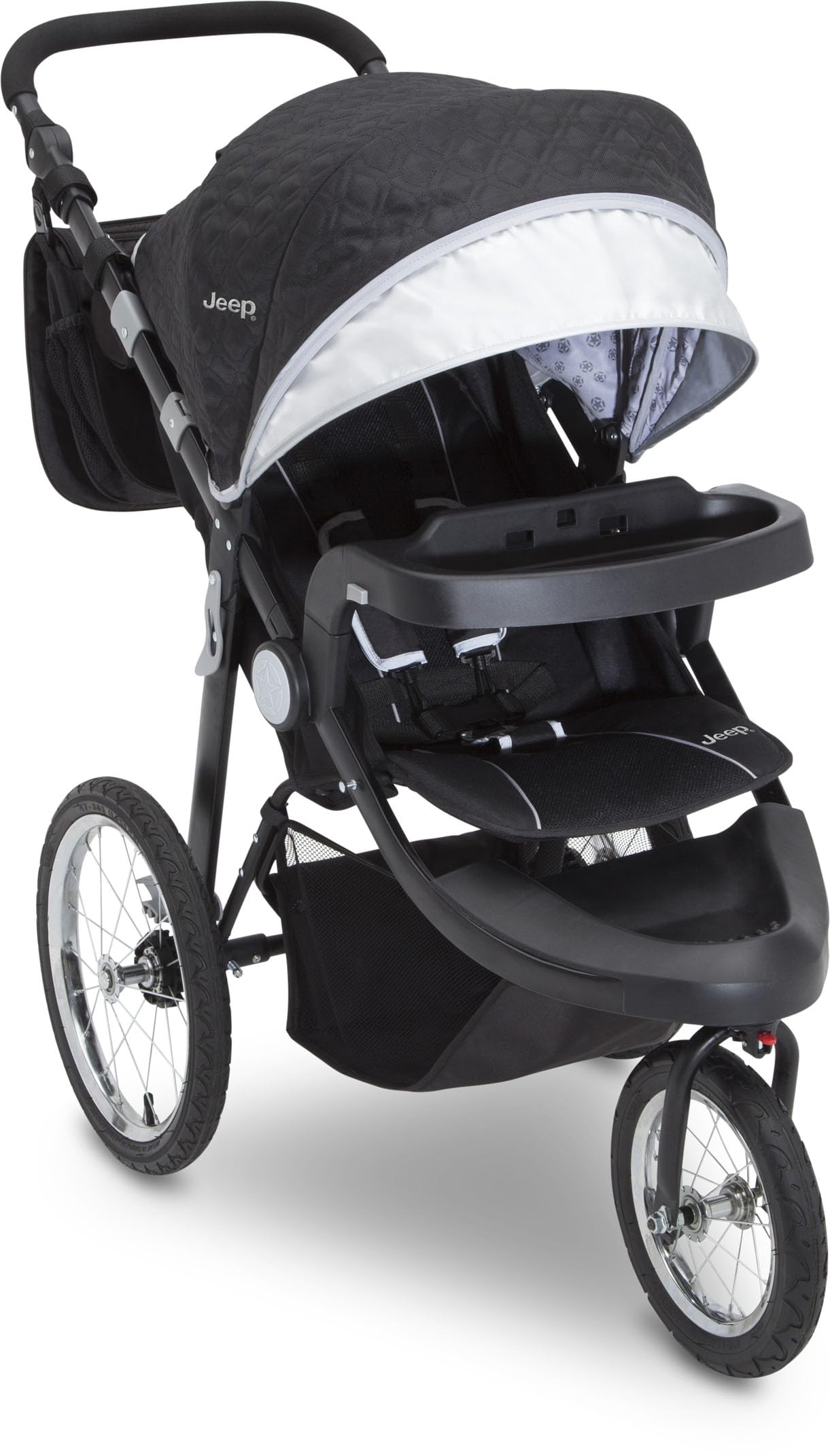
Jeep Cross-Country Sport
Key Features
- Tire Type: Air-filled with ball bearings
- Hand Brake: No
- Wheel Size: 16" rear, 12" front
- Folded Size & Weight: 19x24x36", 26 lb
- Price: Mid-Range
Sixteen-inch air-spoke rear wheels and a steel frame give the Jeep Cross-Country Sport genuine trail capability that separates it from many budget joggers. Unlike the simpler classic Jeep stroller, this model uses large air-filled tires with ball bearings, allowing it to glide over gravel, grass, and rooty paths with less effort. The mid-range price puts air-tire performance within reach for families who don’t need the premium suspension of the top all-terrain picks.
On pavement, the push feels surprisingly light for a 26-pound stroller, and the canopy offers adequate coverage for sunny days. The sporty Charcoal Galaxy design with orange accents looks rugged without being clunky. Steering stays responsive on winding trails, and the steel frame absorbs chatter from washboard surfaces well enough for casual hikes.
Weekend hikers and families who frequent dirt paths will appreciate the capable wheel setup. The trade-off is durability in peripheral parts: the parent tray and child snack tray are molded from plastic that can crack if forced, and the multi-step fold leaves a sizable footprint in tight trunks. This isn’t a stroller for daily errand chains or attaching a car seat; it’s built for trail walking, not constant chore duty.
Pros
- Smooth push across grass, gravel, and cracked sidewalks — the large air tires absorb bumps well.
- Handles trail ruts and packed dirt confidently, staying stable on uneven terrain.
- Steel frame and sporty styling give a durable feel without the premium price of high-end all-terrain strollers.
- 26-pound weight is manageable for lifting into trunks, feeling lighter than its footprint suggests.
Cons
- The parent and child trays are made of brittle plastic that may crack under moderate force or if over-torqued.
- The folding mechanism requires a deliberate multi-step motion, and the folded stroller remains bulky, which can be a challenge in smaller trunks.
If your weekends involve fire roads and park trails, and you’re willing to handle the plastic bits with care, this Jeep delivers air-tire smoothness where many mid-range strollers stick to pavement.
Best for Graco Travel System
Graco FastAction Jogger LX
Key Features
- Tire Type: Rubber
- Hand Brake: No
- Folded Size & Weight: 23.5×35.5×17.5", 28.2 lb
- Price: Mid-Range
One-handed folding and direct Graco car seat compatibility separate this stroller from bulkier two-hand-fold joggers. The FastAction Jogger LX collapses with a single pull and stands on its own, letting you lift a sleeping infant carrier straight from car to frame without adapters. That convenience sets it apart from the budget-focused value king, where a smooth ride on packed dirt comes with a less integrated car seat experience.
The stroller navigates sidewalks and packed dirt with responsive, predictable steering thanks to its rubber all-terrain wheels. But the lack of any suspension becomes obvious once you leave smooth surfaces. Rocky paths and tree roots send vibrations straight through the frame, making the ride feel jostling for a child. While stable for walking and light jogging, the front wheel may develop a shimmy at sustained running speeds, which undermines confidence for regular runners.
This stroller is for parents already using Graco Click Connect infant seats who walk mostly on pavement and occasional groomed dirt paths. The folded bulk consumes significant trunk space and will be a tight squeeze in smaller cars. Trail hikers and serious runners will find the missing suspension and potential wheel wobble deal-breaking; they’re better served by a genuine all-terrain option with air tires and a hand brake.
Pros
- Folds with one hand quickly and without a struggle, even while holding a baby.
- Maneuvers smoothly on pavement and hard-packed dirt with responsive steering.
- Accepts Graco Click Connect infant seats with a secure, audible click — no extra adapters needed.
Cons
- Folded size is bulky, consuming substantial trunk space in smaller cars.
- No suspension means every bump on gravel or roots is felt; ride turns jostling on uneven terrain.
- Front wheel can wobble at jogging speeds, reducing stability for runners.
If you prioritize a one-hand fold and seamless Graco car seat click-in over rugged trail capability, the FastAction Jogger LX delivers — just ensure your trunk can accommodate its bulky fold.
Best for Thorny Trails
Baby Trend Expedition Zero Flat

Key Features
- Tire Type: Foam-filled never-flat
- Hand Brake: No
- Wheel Size: 16" rear, 12" front
- Folded Size & Weight: 24x34x18.8", 29.9 lb
- Price: Budget
With foam-filled never-flat tires and integrated LED lights, the Baby Trend Expedition Zero Flat eliminates puncture anxiety on debris-strewn paths. It folds easily and maneuvers well at walking speeds, offering genuine value for parents who stick to pavement or hard-packed dirt. However, the front wheel can become unstable at running speeds or when striking bumps, causing a disconcerting wobble. That instability limits its role on trails where jogging is expected, making it more of a walking companion than a true all-terrain jogger.
Pros
- Puncture-proof foam-filled tires handle goatheads and thorns without the risk of flats.
- Quick folding and nimble steering, with LED lights for visibility during low-light walks.
- Includes storage and LED lights at a budget-friendly price.
Cons
- The canopy may snap back from its fully extended position, reducing sun coverage.
- Front wheel can wobble at running speeds or on uneven surfaces, which makes jogging less stable.
For walkers on thorn-lined paths or low-light sidewalks, it’s a low-maintenance, puncture-free option. But if you plan to jog or tackle uneven trails, the front wheel instability points toward a true all-terrain jogger with suspension.
Best for 4-Wheel All-Terrain
BOB Wayfinder

Key Features
- Tire Type: Air-filled rubber
- Suspension: Independent dual
- Hand Brake: Hand brake
- Wheel Size: 16" rear, 12" front
- Folded Size & Weight: 33×22.5×16.5", 31.1 lb
- Price: Premium
The Wayfinder’s 4-wheel design, independent suspension, and air tires deliver a stable, cushioned ride over gravel and grass, and its hand brake provides control on hills. The fold shrinks smaller than many BOB models and stands upright for storage. Fabric near the footrest can fray surprisingly early, and some units arrive with bent wheels. The two-handed fold and narrow storage basket add effort to daily use. For parents who will inspect the stroller upon delivery and don’t need a one-hand fold, it remains a smooth-rolling companion on mixed terrain.
Pros
- Dual suspension and air-filled tires smooth out bumps on pavement, grass, and gravel.
- Handles varied terrain confidently, including grass and gravel, thanks to the all-terrain air tires and suspension.
- Folds smaller than many BOB joggers and stands upright on its own for easier storage.
Cons
- Two-handed fold and narrow storage basket make loading and unloading a chore.
- Fabric near the footrest can fray early; some units arrive with wheels that are not true.
The Wayfinder fits hikers who prioritize a smooth, stable 4-wheel ride with a hand brake and a relatively compact fold, provided they inspect the fabric and wheel trueness upon delivery and accept the two-hand fold.
Best for Light Family Walks
Delta Apollo Jogger

Key Features
- Tire Type: Puncture-proof rubber
- Suspension: Frame shock absorption
- Hand Brake: No
- Wheel Size: 12" front, 16" rear
- Folded Size & Weight: 18.5×15.5×31.5", 30.6 lb
- Price: Budget
The Apollo glides smoothly over sidewalks, paved paths, and packed dirt, with a shock-absorbing frame that handles minor bumps well. Puncture-proof rubber tires eliminate flat worries, and the compact fold plus simple assembly add everyday convenience. Build quality feels solid for a budget stroller, and the child’s seat is comfortable. The front wheel, however, can develop a wobble or crack under the jolts of rocky, root-strewn trails—the kind of terrain that comes with genuine off-road hiking. This limitation doesn’t show up on smooth ground, so the stroller remains a strong value for families whose outings rarely leave the pavement.
Pros
- Smooth, stable ride on paved and light terrain with predictable handling.
- Solid construction and a comfort-focused seat that keeps the child happy on longer walks.
- Excellent value with many features found on pricier joggers, including compact fold and included car seat adapter.
Cons
- Front wheel can crack or wobble when taken on rocky trails—stick to smooth surfaces.
If your daily route sticks to sidewalks, paved paths, and occasional grass, this stroller delivers value and comfort. For any trail with rocks or roots, look to a model with air-filled tires and a hand brake.
How to Choose
A hiking stroller that lacks real suspension and a hand brake can turn even a gentle slope into a white-knuckle experience.
Tire Type: Air vs. Foam
Air-filled pneumatic tires act like mountain bike tires, absorbing trail chatter so your child stays comfortable. The trade-off: they require occasional pumping and can puncture on sharp rocks. Foam-filled tires eliminate flats entirely, but they’re less forgiving on rough terrain, passing more bumps to the passenger. For rocky trails, air-filled is worth the maintenance; for thorny paths, foam is the pragmatic choice.
Suspension That Actually Works
Coil-sprung or independent suspension isolates the seat from the chassis, meaning your child isn’t jostled by every root. Frame-based shock absorption is often just marketing — it’s the plastic flexing under load. For any trail beyond a manicured park path, look for actual springs or pivot-based suspension. The difference is instantly noticeable: a suspended stroller glides over bumps; an unsuspended one transmits every vibration directly to the passenger.
Hand Brake for Downhill Control
A hand brake squeezes the rear tires to modulate speed on descents, letting you hold the stroller back without risking it running away. A parking brake is only for stationary stops, not on a slope. If your hikes involve any downhill grade, a hand brake is the single biggest upgrade for safety and confidence — you can relax your grip and focus on the trail instead of wrestling the stroller.
Wheel Size & Material
Larger rear wheels — 16 inches — require less force to push over roots and rocks than 12-inch versions. The front wheel size affects steering: 12-inch is common and handles most terrain; smaller 8-inch wheels may catch on obstacles. For dedicated trail use, a 12-inch front/16-inch rear combo is the sweet spot. Metal spoke or alloy wheels add strength but a bit of weight, while plastic rims save pounds at the cost of long-term durability.
Folded Size & Weight for Travel
A 32-pound stroller with full suspension will outperform a 23-pound budget model on trails, but that weight makes loading into a car a chore. If you’ll be folding and lifting daily, sacrifice some off-road prowess for a lighter, more compact fold. Measure your trunk before you buy — a few extra inches of folded height can prevent the stroller from fitting at all.
FAQ
Why does my jogging stroller wobble when I run fast?
The front wheel likely isn’t locked in the fixed, straight-ahead position. Most jogging strollers have a switch or lever to lock the wheel for running; if it’s left in swivel mode, even small side forces cause wobble. If the problem persists when locked, the wheel bearings may be damaged or the fork may be bent — a repair shop can diagnose it.
Are foam-filled tires better for hiking strollers than air-filled?
Foam tires never go flat and require zero maintenance, which is perfect for trails littered with goatheads or broken glass. Air-filled pneumatic tires, however, absorb shock far better, delivering a smoother, quieter ride over roots and rocks. For anything beyond smooth paths, the comfort advantage of air tires outweighs the occasional flat risk for most families; foam is the best choice only when puncture protection is non-negotiable.
Can I use a hiking stroller for daily walks on pavement?
Yes, but air tires wear faster on hard, abrasive pavement, so you may need to replace them sooner than if you stayed on dirt. Many all-terrain strollers feel clunky on sidewalks because the oversized wheels add rolling resistance. If most of your miles are on pavement, a dedicated jogging stroller with smaller, harder tires will be more efficient, while the hiking stroller can be reserved for weekends.
How do I prevent stroller tires from going flat on rocky trails?
Start by keeping air-filled tires pumped to the recommended pressure — underinflation is the #1 cause of pinch flats. Adding a tire sealant like Slime to the tubes before riding can self-heal small punctures in seconds. If flats are still frequent, switch to foam-filled tires or carry a spare tube and a mini pump on every hike.