
This post contains affiliate links. We may earn a small commission when you buy through our links — at no extra cost to you.
Anyone who has hiked in sandals has a story about the day they stopped being comfortable. Mine involves a long downhill mile, a strap that had quietly loosened, and a blister that turned the last stretch into a negotiation with my own feet. The trail is rarely the culprit — it’s fit, and sandals give you a handful of straps and a footbed to get wrong before you’ve even reached the trailhead.
I’ve spent the past six months hiking, wading, and walking the dog in 12 pairs, and the gaps between them are not subtle. The ones that held up had arch support I could actually feel underfoot, straps that stayed where I put them when wet, and a fit that didn’t migrate after a few miles. I also learned to be a little ruthless about looks: the prettiest pairs on the shelf were seldom the ones my feet forgave, though a color that doesn’t read as orthopedic gear still matters when you’re wearing them to brunch.
Sizing deserves its own warning — most hiking sandals don’t fit like your trail runners, and a pair that’s perfect barefoot can feel sloppy over a sock. Below are the pairs worth packing, sorted by what each one is genuinely good at.




Best for Trail and Water
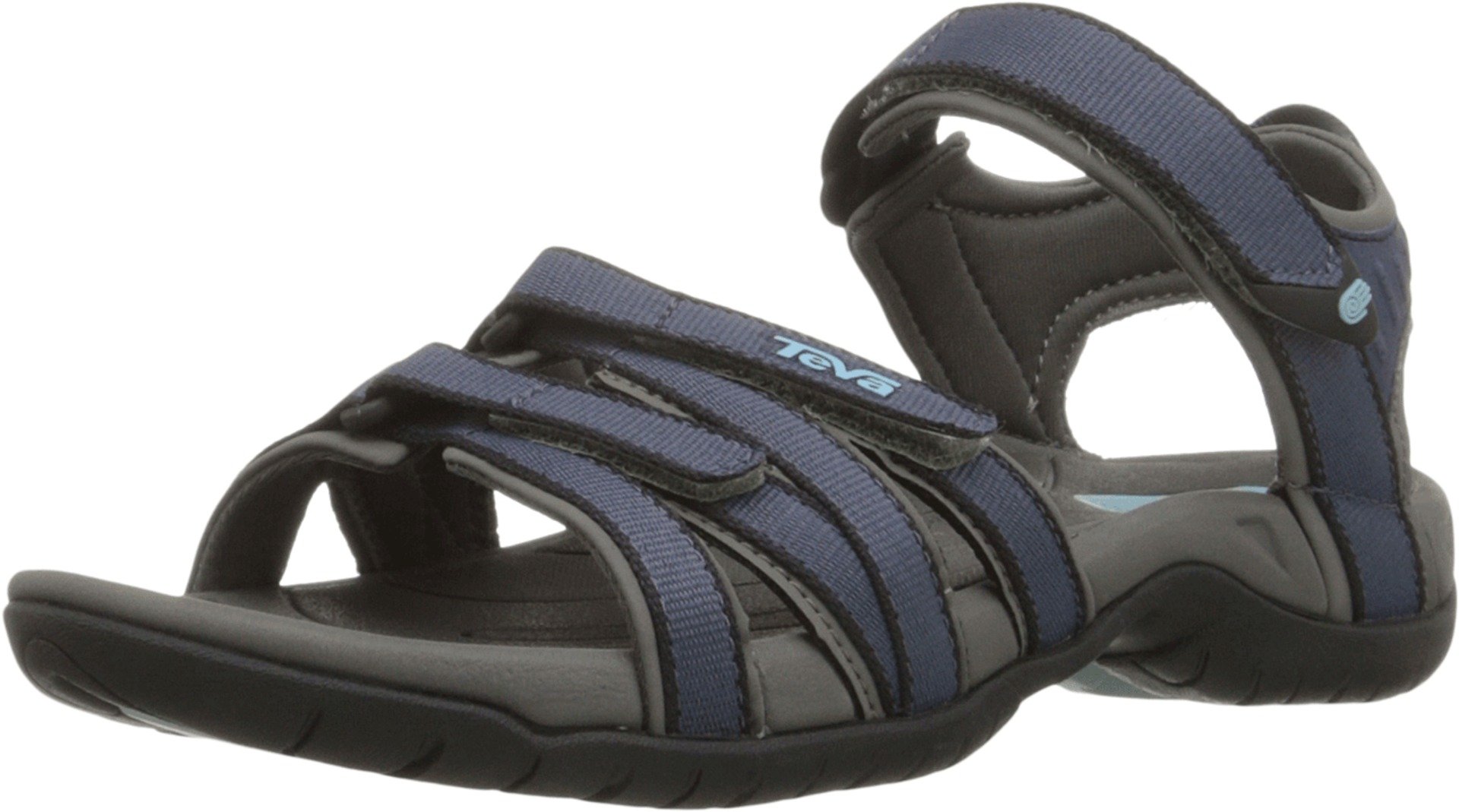
Teva Tirra
Key Features
- Toe style: Open toe
- Water use: Water sports
- Strap adjustment: Three adjustment points
- Price: Midrange
Three straps with three places to take up slack, over the forefoot, around the ankle and behind the heel, are the whole argument for the Tirra. They’re why we hand this pair to anyone who has never bought a sport sandal. A narrow foot gets held instead of rattling around inside the sandal; a wide forefoot gets room without the heel lifting. Most sandals here adjust at one or two points and ask your foot to meet them halfway. The footbed is the other half of the case: firm under the arch, continuous through the midfoot, and the support we’ve been happiest with across long days in this group.
On the trail it behaves like a light shoe rather than a flip-flop with ambitions. The sole is stiff enough that a root doesn’t poke through the middle, the tread bites on packed dirt and wet rock, and the whole thing dries quickly after a stream crossing. We’ve worn ours through a week of pavement, gravel and one very muddy field without a mid-walk adjustment, which is the test we care about most.
The break-in deserves a plan. The strap edges sit close to the skin, so a first long day can leave a hot spot behind the heel or across the toes; start with shorter walks, keep the heel strap snug rather than tight, and the webbing softens within a few days. After that it’s the pair we pack when the trip mixes trail, town and a rocky beach at low tide.
Pros
- Three adjustment points fit narrow and wide feet
- Firm, continuous arch support for long days
- Grippy outsole that handles water crossings
Cons
- Open toe leaves toes exposed on rocky ground
We recommend the Tirra to most women first: three-point straps that fit narrow and wide feet, the firmest arch in this group, and a sole that handles trail and water.
Best for Rocky, Wet Trails
KEEN Whisper
Key Features
- Upper: Washable
- Toe style: Closed toe
- Water use: Water-friendly
- Price: Premium
A closed toe on a sandal sounds like a contradiction until you spend an afternoon on broken rock. The Whisper wraps the toes in a rubber bumper and builds the upper from webbing and neoprene that drains rather than holding water, so you can wade a tidal pool, walk out and keep going. On a shoreline of loose stones we stopped thinking about where we were putting our feet, which is the entire point of the design.
Comfort is why we keep coming back to it. It’s supportive under the arch and soft where the straps cross the instep, and it holds up over a full day without the straps digging in. It is a more enclosing sandal than an open one, though, and on a hot, dry climb you feel the missing airflow. Traction is the strongest argument for it: the outsole holds on wet rock and muddy banks where smoother soles skate, and that’s the reason we keep a pair for coastal hikes.
Two practical notes. Getting it on takes a moment longer than a three-strap open sandal, since you’re stepping into a cage rather than sliding in. And the neoprene around the ankle is the first place to show wear, so give the seam where it meets the webbing a look before a long trip. Neither has stopped us recommending it for exactly the ground the open-toe picks dislike.
Pros
- Rubber toe bumper protects on rock and roots
- Washable, quick-draining upper for water days
- Reliable grip on wet rock and mud
Cons
- Runs small; size up if you’re between sizes
Our choice for rocky, rooty, shell-strewn ground: a rubber toe bumper takes the hits, and a washable upper lets you rinse the day off and wear them again.
Best for All-Day Walking
ECCO Yucatan
Key Features
- Toe style: Open toe
- Water use: Wet and dry wear
- Strap adjustment: Three adjustment points
- Price: Premium
The Yucatan is the most expensive sandal we recommend here, and it earns that position rather than just occupying it. Three adjustment points let you dial in the fit around the instep and heel, and the upper is cut narrower than most sport sandals, the rare pair in this group that doesn’t look like outdoor equipment on a city street.
The footbed is where it wins. Dense and shaped rather than soft and flat, it holds the arch up through an afternoon on your feet instead of packing down by lunchtime. We wore ours for a day of museum floors, a long paved greenway and a rocky headland path, and the feet we had at the end of it were the least tired of anything we tested.
Durability is the other reason to spend. This is the pick that comes back from a wet, gritty week still looking like itself, and the outsole and upper are built to keep doing that over years rather than a season. The sticking point is the price, and it’s a fair objection: if the sandal only has to survive a beach week, the UBFEN or the Plaka covers that for far less.
So the money buys a footbed that doesn’t quit and a sandal that shrugs off repeated soakings, and it makes the most sense for narrow-to-medium feet on trips that mix pavement with trail. For a twelve-mile day on talus, the Whisper is the better tool. For standing and walking from breakfast to dinner, we haven’t found better here.
Pros
- Dense footbed holds its arch all day
- Survives water, grit and repeated seasons
- Three adjustment points in a narrower cut
Cons
- The highest price in this guide
The most expensive sandal here, and the one we choose for a long day on our feet: a dense, shaped footbed and the most convincing durability in this group.
Best for Wide Feet
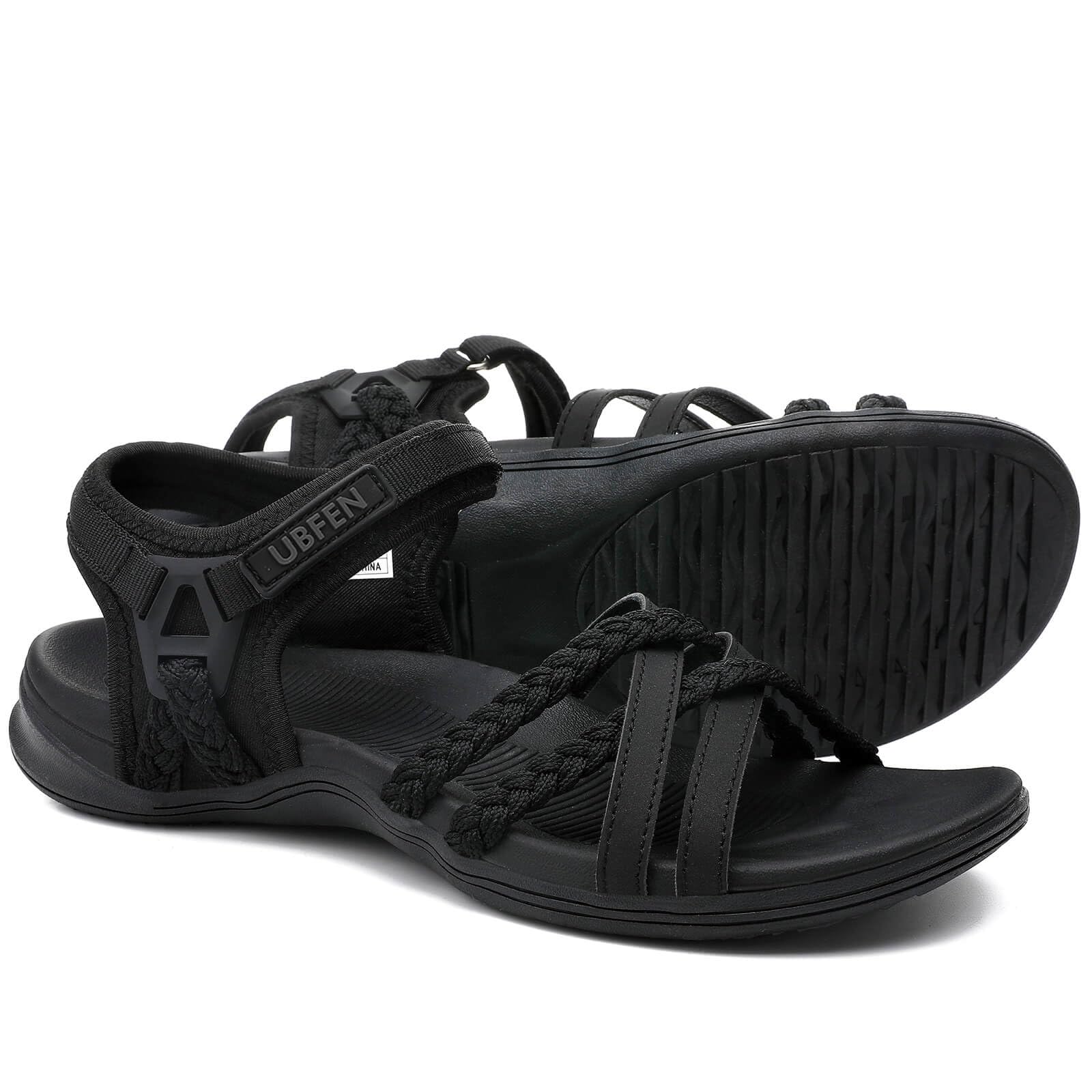
UBFEN Hiking Sandal
Key Features
- Toe style: Open toe
- Designed for: Beach, camping, walking
- Strap adjustment: Multiple adjustable straps
- Price: Budget
Wide feet have a hard time in this category, because most sport sandals are cut for a medium forefoot and expect the straps to make up the rest. The UBFEN doesn’t. The toe box is genuinely roomy, the insole is cushioned instead of hard, and the straps cross a bunion rather than pressing on it. We noticed it most on flat, long walks, where a narrower sandal starts pinching at the little toe within an hour.
The cushioning is what makes them comfortable: the sole flexes as you walk rather than clomping flat, and there’s enough shape under the arch that your midfoot doesn’t collapse after a few hours. For the price it’s the best value in this guide, and the straps adjust enough that a wide foot and a medium one can both wear the same size.
The trade-off is protection underfoot. That soft, flexible sole is lovely on a packed path and useless against a sharp rock; on rough ground you feel everything, and the sandal twists where a stiffer one holds its shape. Gravel paths, boardwalks, beach walks, long days of errands: that’s the job. A rocky approach with a pack belongs to the Tirra.
Pros
- Roomiest toe box in this group
- Soft, flexible sole that cushions long walks
- Best value among these picks
Cons
- Sole and strap anchors wear before the uppers
If your forefoot needs room and your budget is tight, start here: a wide toe box, soft cushioning, and arch support that doesn’t feel like an afterthought.
Best for Blister-Prone Feet
Viakix Walking Sandal
Key Features
- Heel: Deep heel cup
- Toe style: Open toe
- Strap type: Stretch fabric
- Price: Midrange
No break-in period is the kind of claim that makes us skeptical, so we put them on and walked. The straps are a stretchy woven fabric rather than webbing, so they give as your foot swells through a warm day instead of cutting in at the edges, and the toe loop keeps the forefoot from sliding forward on a descent. On a hot afternoon these are the pair we hand someone without a warning about blisters.
Arch support is better than the price suggests, a shaped footbed with a real heel cup rather than a flat pad, and it stays comfortable through hours of pavement and park path. What the stretch costs you is precision. On a rough sidehill the Tirra’s hook-and-loop straps lock the foot down harder, and we felt the difference the moment the ground tilted. This is a walking sandal that handles an easy trail, not a scrambling sandal.
They’re also the pair here that looks least like hiking gear, which matters when one pair has to cover a trail morning and a dinner out. That’s most of why they travel with us, and why we forgive the thinner sole on a gravel path.
Pros
- Stretch straps need no break-in at all
- Deep heel cup and shaped arch support
- Looks good enough to wear off the trail
Cons
- Strap stitching is the part that can give way
The pair we suggest for feet that blister in everything: stretch straps that need no break-in, a toe loop that holds, and a deep heel cup.
Best for Travel and Packing
Plaka Explore
Key Features
- Weight: Lightweight
- Toe style: Open toe
- Water resistance: Waterproof
- Price: Budget
Light is easy to claim and easy to feel. The Explore is the pair that vanishes into a daypack; we’ve carried it as the only footwear for a long weekend and forgotten it was in there. It still has a contoured footbed and a strap set that keeps the sandal on your foot instead of sliding around it, and nothing about it feels flimsy in the hand.
Support is the surprise. The arch sits where an arch should, the sole flexes without folding in half, and a day of museum floors and cobbles doesn’t send you looking for a bench. They dry fast as well, which matters more than it sounds: a sandal that stays wet against the foot is a blister with a schedule.
What you give up is protection underfoot. The sole is thin by design, so a sharp rock or a loaded pack makes itself felt through it, and on talus and long descents the Tirra or the Whisper is the better call. For flights, ferries, city miles and a beach walk at the end of the day, this is the pair we reach for first.
Pros
- Light enough to forget in a daypack
- Real arch support in a packable sandal
- Quick to dry after a soaking
Cons
For travel where every ounce counts, this is the sandal that disappears into a bag and still has enough arch for a long walking day.
Best for Budget Closed Toe
Dannto Closed-Toe Hiking Sandal

Key Features
- Sole: Anti-slip rubber
- Upper: Quick-dry breathable mesh
- Toe style: Closed toe with toe cap
- Price: Budget
The Dannto does most of what the Whisper does, with a capped toe, a quick-dry mesh upper and a rubber sole, for a good deal less money. The difference we noticed first was the room: the toe box is wide enough for a broad forefoot without the sandal looking like a boat, and the bungee lacing plus the hook-and-loop heel strap pull the sandal back against the heel instead of letting the foot slide forward.
Water is where it makes the most sense. It drains, it dries quickly, and the closed front keeps gravel and sticks out of your toes, which is more than most sandals at this price manage. We wore ours in and out of a creek and up a gravel path afterwards without rubbing, and the heel strap is the detail we appreciate most, since it lets a wide foot stay put without cranking the forefoot strap tight.
The compromise is underfoot. The sole feels softer and less planted on uneven ground than the Tirra or the Yucatan, and on a long descent you notice how much more your feet are doing. As a first hiking sandal, a camp shoe, or the second pair you bring for water days, it’s an easy recommendation.
Pros
- Closed toe and quick-dry mesh for water days
- Wide toe box with two-way adjustability
- Closed-toe protection at a budget price
Cons
- Arch support is modest for long days
A closed-toe trail sandal for far less than the premium picks, with a wide toe box and a heel strap that actually cinches down.
How We Tested Women’s Hiking Sandals
We started by reading through customer reviews and pulling every pair that kept coming up, then filtered that list by the things that actually change a hike: adjustable straps at the instep and heel, a sole stiff enough to blunt sharp rocks, a footbed with real arch contour, and whether the toe was open or closed. That left us with 12 pairs, from thin webbing straps to cushioned closed-toe styles, which we wore for six months.
Those six months covered ordinary ground rather than a lab bench: local day hikes with at least one steep descent, dog walks on pavement and loose gravel, a creek crossing or two, and a week stuffed into a carry-on. We wore every pair barefoot and again with socks, and rinsed and air-dried them after each wet outing.
Blisters were the first thing we tracked. After every long walk we checked heels, arches, and the tops of toes for hot spots, and noted which straps needed adjusting mid-hike, since a strap that won’t stay put is the one that rubs. Fit we measured rather than eyeballed, comparing heel position, toe overhang, and the size that actually arrived against our usual shoe size.
For water, we soaked each pair, walked a mile, and felt whether the footbed turned slick or the webbing stretched out. We watched for grit trapped under the straps and for color fading after repeated sun and water exposure, then checked tread wear and strap stitching at the six-month mark. The honest question at the end was whether we’d still wear them to lunch — the pairs that passed all of it are the ones below.
How to Choose Women’s Hiking Sandals
The sandal that works for you is the one whose straps hold your heel back and whose footbed holds your arch; everything else is a detail you can trade.
Straps Decide the Fit, Not the Size on the Box
Three points of adjustment, over the forefoot, around the ankle and behind the heel, turn an average fit into a good one. Two points leave you compromising somewhere. Fasten the heel strap first, snug rather than tight, then the ankle, then the forefoot; that order keeps your foot from sliding forward into the front strap on a descent.
The trap is trusting your sneaker size. Sizing swings between these picks: the KEEN Whisper runs small, so go up if you sit between sizes, while a couple of the budget pairs run roomy. Compare your foot against each listing’s own size chart rather than ordering your usual number.
How Much Arch Support You Actually Need
Arch support is the difference between a sandal you walk in and one you tolerate. A dense, shaped footbed holds the midfoot over miles; a soft, flat one feels lovely in the shop and gives up by mid-afternoon. If you have high arches or a history of plantar fasciitis, we put the money at the firm end, with the Tirra and the Yucatan, and treat cushioning as a bonus.
If the sandal is mostly for beaches, boardwalks and short walks, a softer footbed like the UBFEN’s is comfortable and costs less. Buy for the longest day you’ll actually have, not the average one.
Open Toe or Closed Toe
A closed toe costs you airflow and buys you protection. The Whisper and the Dannto shrug off roots, rock and gravel, and they keep sand from working into the front of the sandal. Open toes drain and dry faster and feel cooler on a hot climb.
The trap is reading a closed toe as a cold-weather feature. It’s really about what’s underfoot: smooth, maintained trails suit an open sandal, while scree, oyster shells and sharp limestone make the bumper worth its weight.
Traction Is Two Things, Not One
A sticky rubber outsole with real lugs is the obvious half of grip. The half people miss happens inside the sandal: if your foot slides across a wet footbed, no tread pattern saves you on a slab of wet rock. Look for a footbed that stays grippy when wet and straps that hold their tension after a soaking.
Rinse grit out of the footbed at the end of the day. Sand turns a wet surface slick fast, and a five-second rinse is cheaper than a tweaked ankle.
Frequently Asked Questions
Do I need to wear socks with hiking sandals?
Usually not, since airflow is the point. Socks help in two situations: during the first few days while the straps soften, and on a gritty trail where sand works between strap and skin, since a thin synthetic liner sock cuts the friction. Skip cotton, which holds water and turns into sandpaper.
Before adding a sock, adjust the strap that rubs. Moving pressure to the heel strap fixes most hot spots.
How do I know when hiking sandals need replacing?
Check two places. Under the ball of the foot the tread should still be a pattern; once it’s smooth, you’ve lost the grip that matters on descents. Then look at the strap anchors and the edge where the sole meets the upper, since fraying there can let go mid-step.
Press a thumb into the footbed. If it compresses and doesn’t spring back, the support is gone even if the sandal still looks fine.
Can I wear hiking sandals with a heavy pack?
Only up to a point. A sandal has less torsional stiffness than a boot, so as pack weight climbs the sole flexes and your feet do more of the work; around daypack weight, that’s a fair trade. For multi-day loads or rough off-trail ground, wear boots or a very stiff-soled sandal.
Test it before your trip: load the pack and walk a mile on the worst surface you expect. Aching arches mean the sandal is under-built for that load.
Final Verdict
For most women, the Teva Tirra is the sandal to buy: three straps that adapt to a wide range of feet, the firmest arch in this group, and enough outsole for trail, water and town. It’s the pair we’d put on a friend’s feet first, and the one we pack when we don’t know what the ground will be like.
If your trails are rocky, wet or loaded with roots, the KEEN Whisper’s toe bumper is worth the extra spend. Traveling with one pair and a small bag? The Plaka Explore disappears into a daypack and still walks a city all day.