
This post contains affiliate links. We may earn a small commission when you buy through our links — at no extra cost to you.
Finding a birthday present for a two-year-old should be joyful, but too many well-reviewed gadgets shrink to pocket-sized letdowns or stop working within weeks. Parents and gift-givers repeatedly discover that doll-sized tractors, flimsy electronic books, and handles-that-break-on-day-two are hidden behind shiny four-star averages.
This collection focuses on gifts that fit little hands without fooling the camera, with materials and mechanisms that stand up to bites, drops, and the occasional bath in a sandbox. Whether you need a quiet travel toy, a first building set, or a learning toy that actually teaches, you’ll find durable, age-appropriate options that put play first—no fine print necessary.
From teaching words in two languages to hosting pretend picnics, these gifts match the real energy and curiosity of a two-year-old without demanding a battery subscription or a shrink ray apology.



Best for Bilingual Learning
LeapFrog 100 Words Book
Key Features
- Age-Appropriateness: 18 months – 4 years
- Durability: Tear-resistant pages
- Educational Value: Bilingual vocabulary, songs
- Price: Budget
LeapFrog’s 100 Words Book turns vocabulary building into a button-pressing game that toddlers actually want to return to. Touch-sensitive pages, a light-up star button, and three play modes (words, fun facts, and songs) introduce animals, colors, and everyday objects in both English and Spanish. The tear-resistant pages and solid construction handle enthusiastic page-turning without falling apart.
In practice, the book keeps toddlers engaged for longer stretches than most electronic toys in this price range. But it’s not silent: the sound plays on every touch, and volume is adjustable but may not be loud enough for noisy living rooms. In homes where the book gets heavy daily use, battery changes can come sooner than expected — keeping spare AAs on hand is a good idea.
This is best for families who want a bilingual learning tool that feels like playtime, not a lesson. The audio tradeoffs are manageable for most households: the sound is clear enough in quiet spaces, and the content depth far outweighs the occasional battery swap. It’s a reliable gift for 18-month to 4-year-olds, especially for grandparents or parents introducing a second language.
Pros
- Teaches 100+ words in English and Spanish through touch-and-play interaction
- Durable tear-resistant pages hold up to toddler handling and drops
- Three play modes keep engagement high across different learning styles
Cons
- Battery life can be shorter in homes where the book sees heavy daily use — fresh AAs help
- Sound output may feel low on some units; in a busy room, the volume might not carry
For under $20, this is the most content-rich bilingual learning toy for toddlers — the occasional volume or battery quirk doesn’t outweigh the educational return.
Best for Early Building
MEGA BLOKS First Builders
Key Features
- Age-Appropriateness: 12 months – 5 years
- Durability: Large plastic blocks
- Educational Value: Fine motor, colors
- Price: Budget
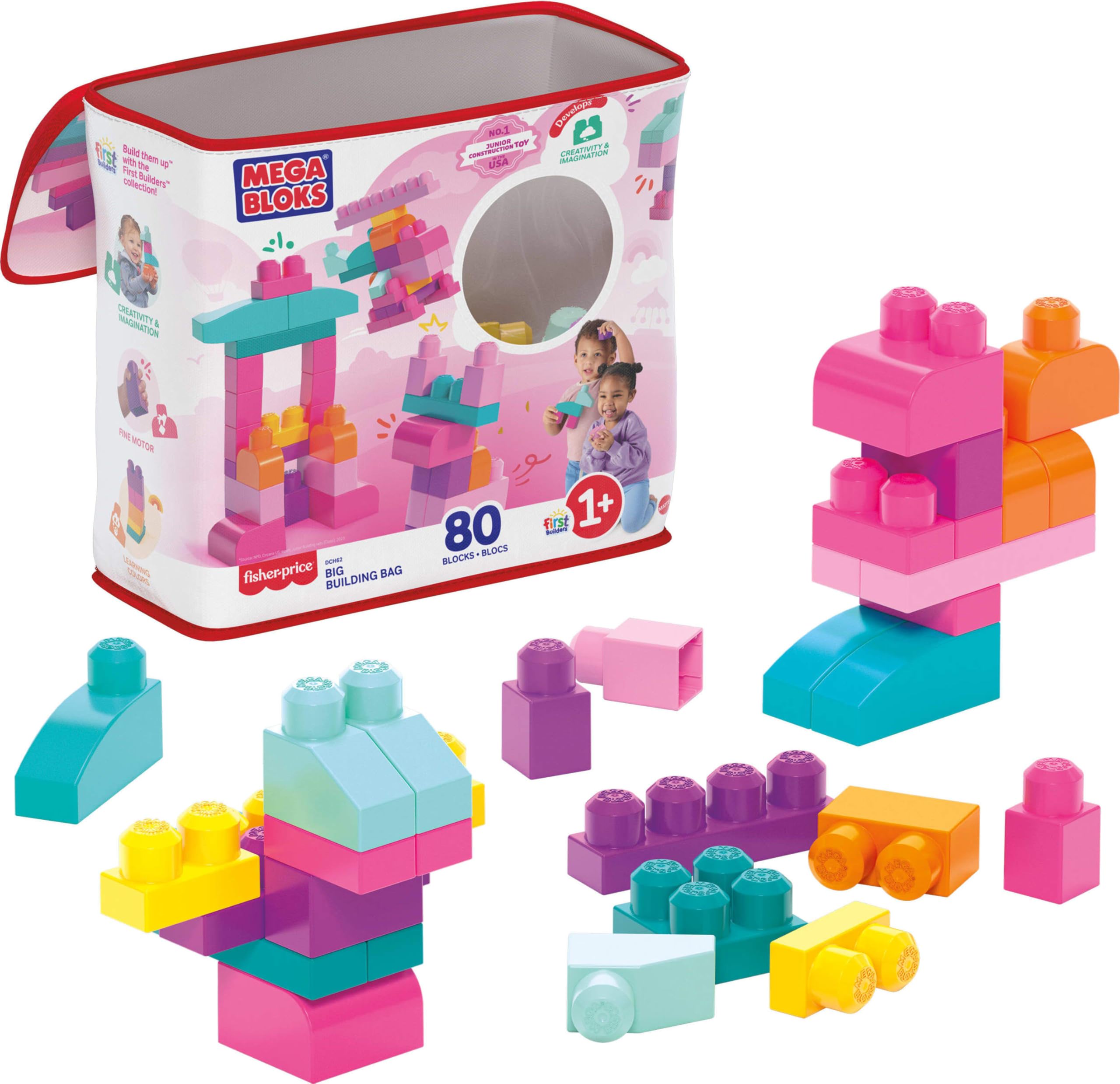
Where the top pick impresses with tight clutch and iconic figures, this Mega Bloks bag leans into easy, oversized building for the smallest hands. The 80 large blocks come in 10 shapes and 9 bright colors, inviting color naming and open-ended stacking without screens.
The intentionally loose block fit—great for pull-apart exploration—means towers may topple easily, especially for toddlers craving rigid structures. This suits 12- to 24-month-olds best; parents of older builders or DUPLO fans may want a tighter system. The included storage bag keeps clean-up portable.
Pros
- Large, chunky blocks are easy for tiny hands to grip and stack independently
- Vibrant mix of 9 colors and 10 shapes supports early color and shape learning
- Reusable storage bag makes cleanup simple and portable between rooms
Cons
- Blocks may come apart too easily during stacking play, frustrating toddlers building tall towers
A forgiving first building set that trades structural tightness for ease of use—ideal for toddlers who are more about the process of stacking than the permanence of the result.
Best for Lego Start
LEGO DUPLO Brick Box
Key Features
- Age-Appropriateness: 18 months +
- Durability: Plastic bricks, tight clutch
- Educational Value: Creative building, spatial
- Price: Mid-Range
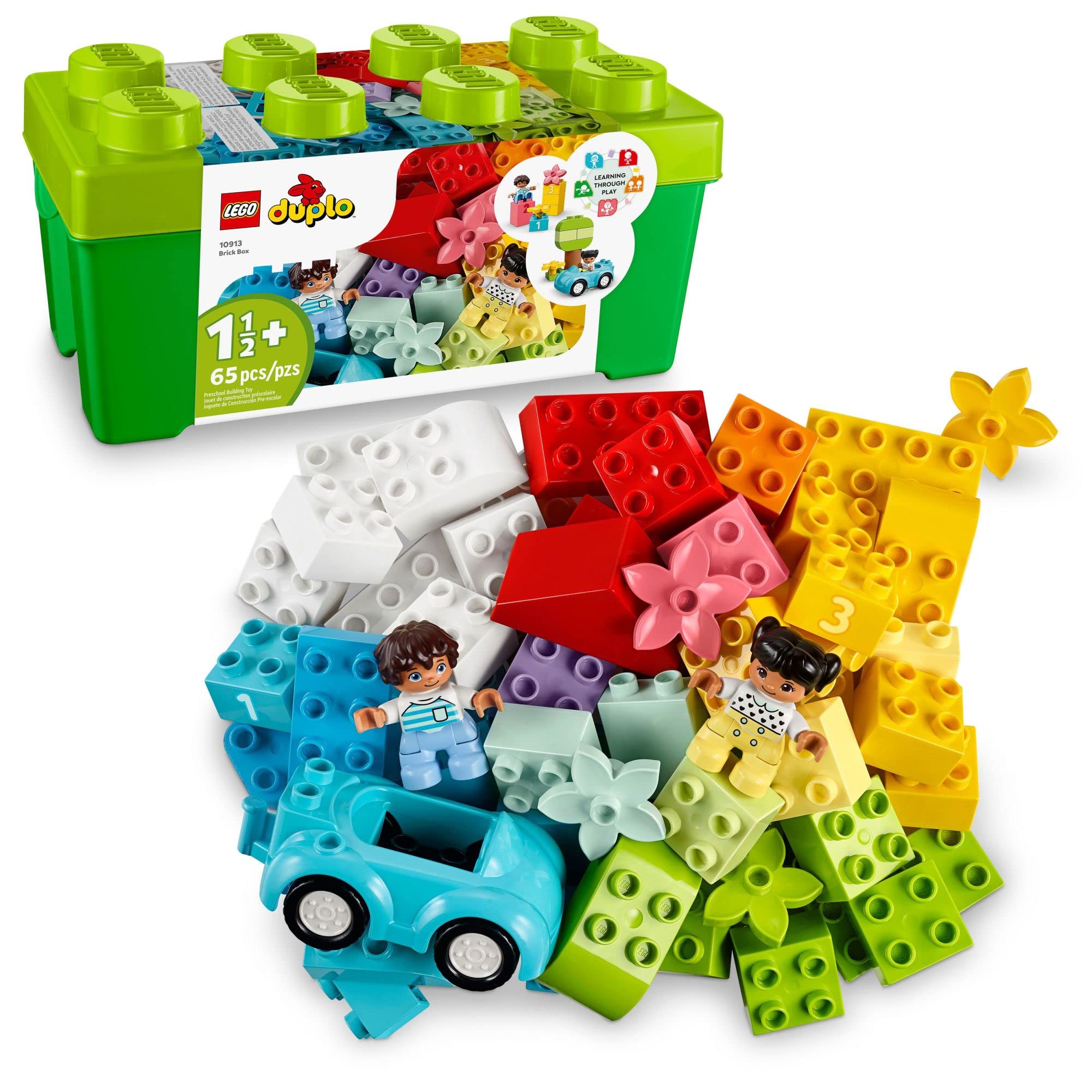
Unlike the oversized block set in this list, these DUPLO bricks click together with the familiar LEGO clutch, keeping creations intact until a toddler pulls them apart. The set includes a child figure, a car, windows, and numbered bricks—enough for guided building but not sprawling free play. The brick-shaped storage box is a tidy, shelf-friendly solution, but it arrives noticeably underfilled. This is for parents who want the genuine LEGO system and an organized first kit, not the most bricks per dollar.
Pros
- Bricks lock together with that signature LEGO clutch—sturdy enough for vertical builds without frustration.
- Comes in a sturdy, brick-shaped storage box that keeps pieces organized and looks neat on a shelf.
- Chunky bricks and vibrant colors are sized safely for small hands—no choking hazard with these pieces.
Cons
- The 65-piece count can feel sparse for the price; the storage box may arrive half-empty, especially coming from bulk brick bags.
An organized, curated start to LEGO building that prioritizes the genuine DUPLO system and a tidy storage solution over sheer brick count. Best for gift-givers who want the classic name and a complete, self-contained set.
Best for Pretend Picnic
LeapFrog Picnic Basket
Key Features
- Age-Appropriateness: 6 months – 4 years
- Durability: Plastic, light-up basket
- Educational Value: Shape sorting, manners
- Price: Mid-Range
While the top pick builds bilingual vocabulary, this picnic basket weaves learning into role-play. A light-up shape sorter doubles as a tea-party set, with food pieces, plates, and cups that trigger songs about colors, shapes, and polite sharing. The music and light-up basket respond to each correct placement, turning fine-motor sorting into interactive social practice.
It’s best for toddlers drawn to tea parties and pretend feeding, and for parents who want a gift that gently coaches manners alongside early concepts. The basket handle can resist staying upright, and some fruit shapes are snug for the youngest fingers, so a nearby grown-up may lend a hand during play.
Pros
- Pretend play with built-in shape sorting keeps toddlers engaged and learning
- Bright, cute design makes it a standout first-birthday or toddler gift
- Songs and phrases teach shapes, colors, and sharing in a natural way
Cons
- Basket handle may not stay upright, making the open basket less stable
- Some food pieces can be tight to insert or remove, occasionally needing adult help
A charming, gift-ready option for the toddler who lights up at the idea of a picnic — the social learning angle and pretend-play format are worth the minor handle quirk.
Best for Outdoor Play
TOMY John Deere Set
Key Features
- Age-Appropriateness: 18 months – 4 years
- Durability: Sturdy plastic
- Educational Value: Imaginative play
- Price: Budget
While the top pick in this set focuses on words and electronic learning, the TOMY John Deere Set delivers pure, screen-free push play that thrives in sand, dirt, and water. The dump truck tilts and the tractor’s loader scoops, both rolling smoothly across uneven ground. Simple construction means no batteries, no wires, and no downtime between play sessions—just grab and go.
Best for toddlers who’d rather dig and dump than sit still for a learning toy. The vehicles are 6 inches long—smaller than the photos suggest—so they’re easy for small hands to maneuver but won’t satisfy those expecting large, chunky trucks. The set makes a low-risk birthday stuffing stocker or outdoor toy that rinses clean after a sandy afternoon.
Pros
- Durable construction survives rough sandbox play and drops without cracking.
- Perfectly sized for little hands—easy for toddlers to push, scoop, and carry.
- Affordable price makes it an excellent small gift or stocking stuffer that gets daily use.
Cons
- Vehicles are smaller than expected from product photos—check the 6-inch length to avoid disappointment.
For sandbox-obsessed toddlers, this affordable set delivers daily outdoor play with no batteries required—just confirm the compact size fits your expectations.
Best for Counting Fun
VTech Chomp Dino
Key Features
- Age-Appropriateness: 1 – 3 years
- Durability: Plastic
- Educational Value: Counting, colors, foods
- Price: Budget
A pull-along dinosaur that teaches counting, colors, and foods through feeding play, adding gross motor movement to the interactive toy category. Where a construction set keeps hands busy fixing, this dino invites toddlers to feed it eight food pieces, each triggering songs, numbers, or color names — then pull the dino along to hear more.
The feeding slot requires a firm push to register the piece; younger toddlers may need a hand at first. That small demand on fine-motor skill makes the toy more engaging over time, and the pull cord encourages walking. For a dino-loving child building coordination, it spans the 1–3 age range without losing appeal.
Pros
- Teaches counting, colors, and 8 food names through a feeding game that keeps toddlers engaged.
- Cute, pull-along design encourages walking and gross motor practice.
- Durable and budget-friendly, holding up through multiple children across the 1–3 year span.
Cons
- Pushing food pieces all the way into the mouth can require some force; younger toddlers may need help at first.
A budget-friendly dino that grows with a toddler, teaching counting and colors while encouraging steps — the feeding push is a minor hurdle that most master quickly.
Best for Vocab Hunt
Scavenger Hunt Cards
Key Features
- Age-Appropriateness: 2+ years
- Durability: Sturdy paper cards
- Educational Value: Vocabulary building
- Price: Budget
Unlike passive toys, these scavenger hunt cards get a two-year-old walking, pointing, and listening as you call out a clue—finding something blue or locating the bathtub. The activity builds vocabulary and problem-solving without a screen, and the ring keeps cards together so nothing gets lost. The set works best with an adult leading the hunt, not as a toy to hand off for independent play. Compact enough for travel and waiting rooms, the simple prompts mean no setup.
Pros
- Transforms rainy days into active, screen-free games that build vocabulary and listening skills.
- Compact design travels easily in a bag for waiting rooms, restaurants, or family visits.
- No setup required—open the ring and start hunting immediately, even with a short attention span.
Cons
- Cardstock can bend or crease if chewed or roughly handled.
For caregivers wanting to add movement and language to indoor play, these cards deliver enormous engagement at a budget-friendly price—just store them out of reach after the hunt.
Best for Dino-Themed Bag
Dino Toddler Backpack

Key Features
- Age-Appropriateness: Toddler
- Durability: Canvas, plush
- Price: Mid-Range
The removable T-Rex plush gives this backpack gift appeal—kids delight in wearing their cuddly companion. The storage compartment is compact, holding just a snack, a small toy, or a spare diaper. Occasional stitching fragility at seams means rough play can cause unraveling. For dinosaur fans, the wow factor overshadows these tradeoffs, making it a charming but limited-use item.
Pros
- Two-in-one gift: a cute backpack and a removable plush toy that toddlers love to carry around.
- Makes a memorable birthday present for dino enthusiasts; the adorable design delights both kids and parents.
Cons
- Stitching may unravel at stress points on some units, especially with heavy toddler use.
If you need a showstopper gift for a dinosaur-obsessed toddler and don’t expect to pack more than a few tiny treasures, this backpack-plush combo fits the bill.
Best for Farm Fun
Wooden Farm Barn

Key Features
- Age-Appropriateness: 2 – 5 years
- Durability: Wood
- Educational Value: Animal names, sorting
- Price: Budget
Chunky farm animals and a pop-up roof invite free play, not shape-matching. The barn’s slots accept any animal—no right-or-wrong fits. Some units may have loose glue or rough spots, but the portable design is ideal for a two-year-old who wants to carry a farm everywhere and make animal noises.
Pros
- Screen-free wooden play that encourages storytelling and animal sounds without batteries.
- Chunky animals and a built-in handle turn the barn into a grab-and-go travel toy and storage box.
Cons
- Not a shape sorter—every animal fits through every opening, removing the matching challenge some parents expect.
For a two-year-old who loves loading, unloading, and making animal sounds, this portable wooden barn delivers quiet imaginative play. Those needing a true shape-sorting puzzle should look elsewhere.
Best for Active Bounce
Bouncy Dino Hopper

Key Features
- Age-Appropriateness: 18 months – 6 years
- Durability: Plush over inflatable
- Educational Value: Balance, gross motor
- Price: Mid-Range
This plush-covered hopper inflates quickly and feels gentle on young legs, with a dinosaur design toddlers love. It promotes active indoor play. The small size suits only up to about 30 months, and air can leak slowly, requiring occasional pump top-ups before bouncing. It’s a cute short-term option for the youngest bouncers.
Pros
- Soft plush cover prevents skin friction and feels gentle on bare legs
- Quick to inflate with included hand pump; dinosaur design excites toddlers
Cons
- Air retention can be inconsistent; topping up before play may be necessary
For the youngest bouncers (18–30 months), this soft dino delivers smiles and gentle indoor exercise, as long as you’re fine with occasional reinflation.
Best for Fix-It Play
VTech Toolbox

Key Features
- Age-Appropriateness: 2 – 5 years
- Durability: Plastic toolbox, drill
- Educational Value: Tool recognition, numbers
- Price: Mid-Range
The working drill spins and drives screws, while the fix-it tray teaches colors, numbers, and tool names through role-play. The drill may not work right away on some units, and it can’t be stowed inside the box — small snags that don’t overshadow the imaginative play when it clicks.
Pros
- Spinning drill that drives screws captivates mechanically-minded toddlers
- Teaches colors, numbers, and tool names through pretend repair play
Cons
- Drill may not function out of the box; it must be stored separately
This toolbox suits toddlers obsessed with helping, as long as you accept that the drill might be finicky and needs its own storage spot.
How to Choose
Before you click buy, verify the toy’s real dimensions; size disappointment is the #1 reason 2-year-old gifts get ignored.
Age-Appropriateness: Match Motor Skills to Mechanism
Motor demands matter more than the age label. A shape-sorting toy that requires a firm push with tiny fingers will frustrate a young two-year-old, not teach them. Choose toys where the required grip strength and dexterity match the stage of a child who is still mastering fine motor control—buttons that respond to light touches and chunky pieces that slip in easily prevent meltdowns. Look for age ranges that start at 18 months rather than 2 years if your little one is just beginning to stack and sort.
Durability: Materials That Survive Toddler Life
Plastic isn’t plastic—polypropylene blocks survive drops that shatter rigid ABS blends commonly used in electronics housings. Fabric toys with reinforced seams last longer than those with just decorative stitching; plush covers that can’t be removed for washing trap drool and odors. Opt for brands known for thick, flexible plastics that bounce back and for wooden toys with non-toxic finishes that won’t flake when chewed.
Educational Value: What They Actually Learn vs. The Label
Many toys claim to teach letters or numbers, but true learning happens when the child interacts repeatedly without prompts. A toy that passively recites the alphabet on press is less effective than one that requires matching a shape to a slot or identifying a color to progress. The best educational gifts embed the lesson inside a play mechanic, so the child practices counting while feeding a dino or learns words by touching a picture, not just hearing a recorded voice.
Engagement Span: Why Some Toys Gather Dust in 48 Hours
The quickest way to waste a gift is to pick a toy with only one play mode. Two-year-olds lose interest in static objects that do the same thing every time. Gifts with multiple layers—like a picnic basket that also sings, a book that switches languages, or blocks that become towers, trains, or castles—hold attention because they adapt to a toddler’s shifting curiosity. Electronic toys with only a single song sequence often become background noise after the first day.
Battery Life: The Hidden Cost of Interactive Toys
Interactive toys that drain AA batteries in days create a continuous expense and disappointment. Always check if the toy uses a low-voltage sleep mode or shuts off automatically; many electronic items include demo batteries that last only a few hours. Keep a stock of rechargeable AAs and choose models with a reliable power switch that prevents battery drain when off.
FAQ
Why did my VTech toy stop working after only a few weeks?
Many VTech electronic toys ship with demo batteries that deplete quickly, and some units have poor-quality solder joints that fail after light drops. Replace batteries with fresh alkaline batteries first. If the toy stays unresponsive, clean the battery contacts and contact VTech’s warranty support—early electronic failures are covered. Not all units are defective, but the failure rate is higher than average for this category.
Are Mega Bloks and LEGO DUPLO compatible with each other?
Yes, Mega Bloks First Builders and LEGO DUPLO both use the standard large stud-and-tube size, so bricks from each brand can stack together. However, the clutch fit differs: Mega Bloks connect more loosely, so towers may wobble, while DUPLO bricks grip firmly. Mixing sets works, but if your toddler wants tall, stable structures, stick with DUPLO for the top half.
How do I fix the LeapFrog 100 Words Book when the sound goes out?
First, replace the included demo batteries with fresh AA batteries—the pre-installed cells often cause low volume or no sound. If the book still fails, clean the battery contacts with a dry cloth and ensure the pages lie flat; bent page sensors can interrupt touch recognition. If the problem persists, contact LeapFrog for a replacement under warranty.
Is the iPlay bouncy dinosaur hopper big enough for a 3-year-old?
The hopper’s 25-inch inflatable body works best for children under 35 inches tall. Most 3-year-olds quickly outgrow it, as their legs reach the ground too easily, turning bouncing into a scoot. For a bouncer that lasts past age 2.5, look for models with a height range up to 44 inches instead.