
This post contains affiliate links. We may earn a small commission when you buy through our links — at no extra cost to you.
Finding a gift for a 10-year-old boy that outlasts the Christmas morning rush is trickier than it sounds. Many popular toys branded as ‘STEM’ or ‘educational’ promise deep engagement but fall apart during normal play, or worse, arrive with pieces missing right out of the box.
When you’re shopping for a family that travels — or just need something compact enough to survive a road trip to grandma’s — portability and quick setup matter almost as much as the cool factor. This guide cuts through the hype, highlighting gifts that balance genuine fun, durability, and the kind of design that doesn’t require a PhD to assemble.
The result is a set of picks that match how 10-year-old boys actually play: building, competing, showing off tricks, and tinkering — not just passively watching a screen. You’ll find options that keep him engaged well into the new year, and maybe even on the drive home.




Best for Budding Engineers
Snap Circuits Jr. SC-100
Key Features
- Educational Value: Hands-on circuitry, 100+ projects
- Ease of Assembly: Picture-based steps, no tools
- Build Quality: Durable snap modules, robust
- Replayability: 100+ projects, grows with child
- Age Fit: 8‑108, independent after intro
- Price: Mid-Range
Kids snap together color‑coded modules — a power source, a switch, a motor, a light — and immediately see circuits power a fan, sound an alarm, or launch a spinning disc. The full‑color manual guides them with clear pictures, moving from a simple lamp to a musical doorbell without a word of text needed. The 28 snap modules feel sturdy on the included grid, and the tool‑free design means they can tinker independently after the first connection.
For a 10‑year‑old who likes building and understanding how things work, this kit hits a sweet spot. It rewards patience with 100+ projects that span alarms, radios, and motion detectors — screen‑free play that lasts well beyond a single afternoon. The only real requirement is 4 AA batteries, which aren’t in the box. The first few snaps may need an adult’s press to click securely, but that learning curve is brief.
Pros
- Hands‑on electronics intro with picture‑based steps kids can follow independently.
- Keeps tinkerers engaged for hours — from a basic lamp to a working AM radio.
- Outstanding value with 100+ projects and durable parts that outlast many pricier kits.
Cons
- Requires 4 AA batteries (not included) — a small extra purchase to have on hand.
A gift that sparks genuine curiosity — the SC‑100 turns a bedroom floor into an electronics lab without a single video screen in sight.
Best for Puzzle Solvers
ThinkFun Gravity Maze
Key Features
- Educational Value: Spatial reasoning, problem-solving
- Ease of Assembly: Snap-together towers, grid
- Build Quality: Lightweight plastic, flat surface needed
- Replayability: 60 escalating challenge cards
- Age Fit: 8+, independent solo play
- Price: Mid-Range
ThinkFun Gravity Maze turns a stack of translucent towers and three marbles into a self-contained logic puzzle that gets harder as kids progress. The 60 challenge cards, from beginner to expert, require building increasingly complex paths — a mix of planning and trial-and-error that sharpens spatial reasoning without a screen. It’s ideal for a 10-year-old who loves strategy games and solo problem-solving. The hardest cards can test an adult’s patience, which is why it thrives with kids who embrace a slow burn rather than instant wins. On less-than-flat surfaces, the light plastic towers may wobble slightly, so a tabletop is best.
Pros
- Builds critical thinking and spatial reasoning through hands-on, screen-free puzzles
- Multiple difficulty levels keep it challenging from age 8 through adult
- Easy to set up and play independently, giving kids a self-directed challenge
Cons
- Towers can wobble or shift on uneven surfaces, requiring a flat tabletop for stable play
- Expert-level challenges may feel too difficult for kids who get frustrated easily
A smart logic game that offers years of challenge; the steepest cards are a feature for persistent puzzle fans, not a bug. For a 10-year-old who enjoys methodical problem-solving, it’s a solid gift.
Best for Science Magicians
Nat Geo Magic Chemistry
Key Features
- Educational Value: Chemistry + magic, STEM intro
- Ease of Assembly: Illustrated steps, everything included
- Build Quality: Standard kit supplies
- Replayability: 10 one-time experiments
- Age Fit: 8+, involves younger siblings
- Price: Budget
Where the top-pick circuitry set builds electronics intuition, this kit turns a kitchen table into a magic show while sneaking in real chemistry. Ten experiments—from color-changing liquids to hydrophobic sand—come with a wand and gloves to make the performance feel stage-ready. Illustrated instructions keep the pace moving for an 8-year-old to lead, and younger siblings (6-8) can join with a little help. Before wrapping, do a quick inventory: some boxes may be missing a vial or scooper, but the fun factor more than compensates.
Pros
- Science-magic blend delights kids and amazes family during a show-and-tell finale.
- Illustrated instructions let an 8-year-old lead the experiments with minimal help.
- A hit gift for budding scientists ages 6-10, especially those who enjoy performing.
Cons
- Some kits have been noted missing a vial or scooper—a pre-wrap inventory avoids any surprise.
A memorable afternoon of magical science at a budget-friendly price—just check the box before the big reveal to avoid a letdown.
Best for Hands-On Builders
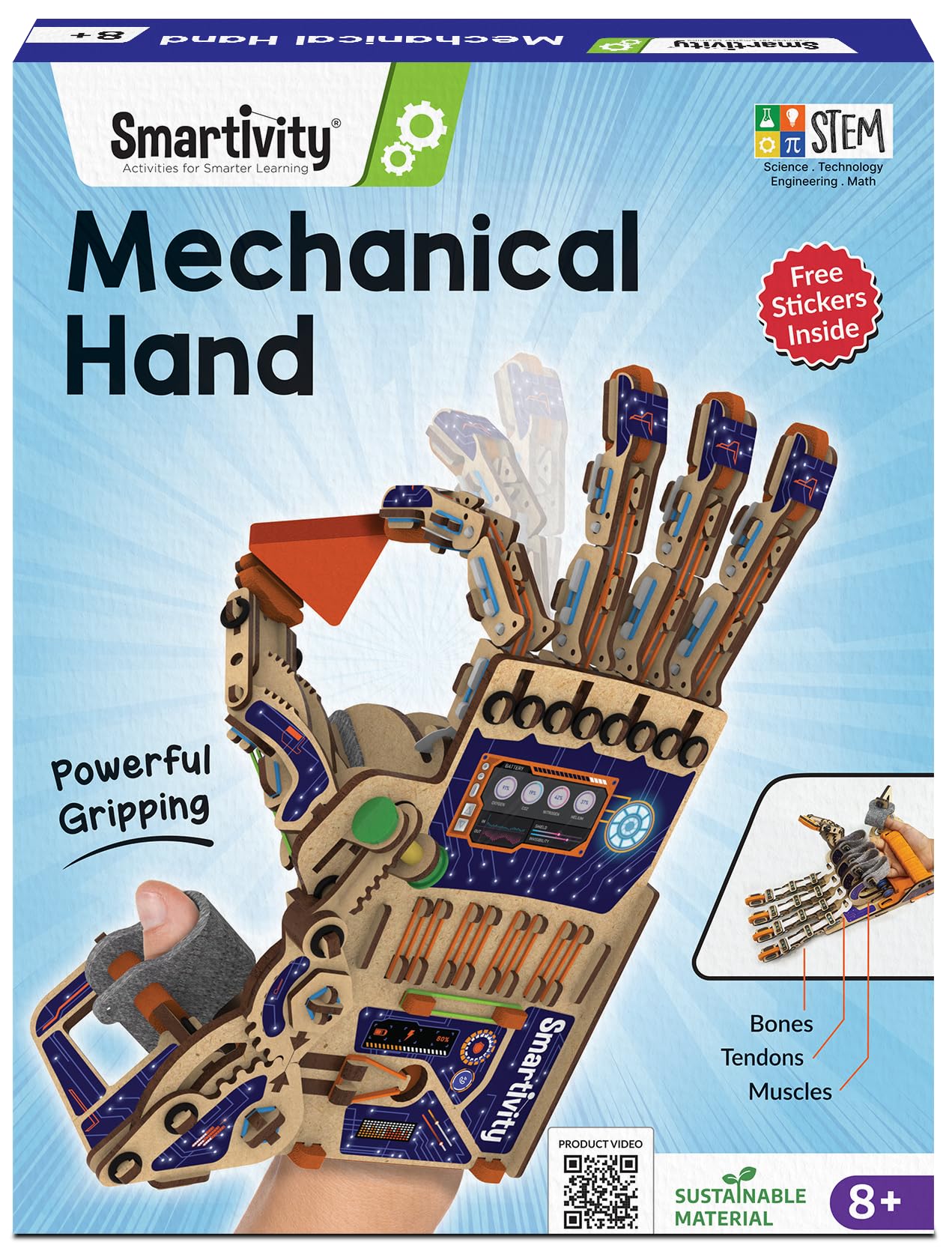
Smartivity Mechanical Hand
Key Features
- Educational Value: Mechanics, levers, construction
- Ease of Assembly: Snap-fit wood, no glue
- Build Quality: Engineered wood, stable when built
- Replayability: Functional hand, picks up objects
- Age Fit: 8‑14, careful on tabs
- Price: Mid-Range
The Smartivity Mechanical Hand transforms flat-engineered wood sheets into a fully articulated hand that actually grips objects, no tools required. Unlike simpler papercraft or static models, this build ends with functional mechanics — each joint moves independently via a finger-controlled pulley system. It’s built for the 10-year-old who enjoys the assembly as much as the result, and parents will appreciate the clear pictorial instructions that guide young engineers through the process. A few tiny tab connections need careful alignment; forcing them can lead to breakage, so impatient builders may need a bit of oversight during the trickier steps.
Pros
- Clear, pictorial instructions make assembly approachable, much like a premium building kit.
- The completed hand genuinely picks up lightweight objects, turning the build into a playable tool.
- Pieces snap together cleanly without glue, yielding a sturdy model that stands up to careful use.
Cons
- Small tabs can snap if aligned improperly during assembly; rushing may result in breakage that requires replacement parts.
For the kid who wants a building project with a functional payoff, this kit delivers a real working hand — just ensure a careful, step‑by‑step approach with the smallest connectors.
Best for Reluctant Readers
Trapped in a Video Game
Key Features
- Educational Value: Reading engagement, reluctant readers
- Build Quality: Paperback box set, 5 books
- Replayability: Fast-paced series, page-turner
- Age Fit: 8‑10, independent reading
- Price: Mid-Range
Where the top pick gets a kid building circuits, this box set gets a non-reader turning pages — with the same ‘one more level’ compulsion they’d bring to a console. Short chapters packed with humor, cliffhangers, and video-game logic keep reluctant readers devouring all five books without a fight. The complete set eliminates waiting, so momentum never stalls. Best for ages 8–10 who love gaming, but the reading level is firmly 2nd-5th grade; strong readers may finish the series in a weekend.
Pros
- Turns video game-obsessed kids into voluntary readers.
- High-octane chapters with cliffhangers that make kids ask for ‘one more.’
- Complete 5-book set keeps momentum going — no waiting between volumes.
Cons
- Reading level targets 2nd-5th grade; strong readers may finish the series quickly.
For a 10-year-old who’d rather hold a controller than a book, this series is the literary equivalent of a gateway game — just accept that it’s a starter pack, not a long-term challenge.
Best for Stunt Lovers
QUNREDA RC Stunt Car
Key Features
- Ease of Assembly: No assembly, ready to run
- Build Quality: Plastic chassis, dual USB-C batteries
- Replayability: 360° flips, stunt driving
- Age Fit: 6‑12, needs smooth surface
- Price: Mid-Range
The QUNREDA stunt car flips, spins, and scoots up walls with a 4WD drivetrain that handles low-pile carpet and asphalt driveways easily. Its two modular 500mAh batteries recharge over USB‑C and swap in seconds, offering roughly 40–50 minutes of total playtime before swapping — enough to keep a 10-year-old entertained without constant downtime.
This car is for kids who want immediate stunt action, not fine motor assembly. It rewards controlled flips on smooth ground, but aggressive bashing into curbs or walls can snap wheels or strain motors. For indoor gymkhana-style play or gentle outdoor runs, it’s a hit.
Pros
- 360° flips, spins, and wall climbs on smooth surfaces make stunt driving instantly exciting.
- Two swappable USB‑C batteries deliver nearly an hour of combined run time and recharge from any phone charger.
- Hits the sweet spot for active 8–10 year olds; delivers big smiles and outdoor play at a reasonable price.
Cons
- Battery life under constant stunt use can dip below the advertised 25-minute mark per pack.
- Hard impacts against curbs or concrete can cause wheel breakage or motor damage.
It’s a lively gift for pavement and playroom floors, with the dual battery system keeping frustration low; just steer clear of concrete obstacles to avoid breakage.
Best for Curious Kids
Nat Geo Why? Book

Key Features
- Educational Value: General knowledge, curiosity
- Build Quality: Hardcover, 224 pages
- Replayability: Re-read, bite-sized facts
- Age Fit: 7‑10, independent reader
- Price: Budget
The 1,111 Q&A format fuels independent browsing and sparks dinner-table conversations, while the photography draws in reluctant readers. It’s a purely visual-reading experience — ideal for curious kids who’d rather flip through facts than play a video game, but a passive gift best paired with a hands-on STEM kit or outdoor gear.
Pros
- Stunning National Geographic photography captivates even reluctant readers
- Over 1,111 fascinating Q&A entries spark independent browsing and family conversations
Cons
- A passive gift — engaging, but not a hands-on activity for active play
For the curious 10-year-old who would rather read a fact than play a video game, this book is a compelling gift — especially paired with a hands-on STEM kit or outdoor gear.
Best for Crafty Flyers
Klutz Paper Airplanes

Key Features
- Educational Value: Aerodynamics, paper crafting
- Ease of Assembly: Illustrated folding steps
- Build Quality: Pre-printed paper, flight-tested
- Replayability: 10 airplane designs, repeatable
- Age Fit: 7‑10, adult help on complex
- Price: Budget
The kit combines clear instructions and flight-tested paper to produce planes that actually fly, getting kids outdoors and away from screens. It lacks the novelty of robotics or chemistry experiments, making it a better add-on gift or stocking stuffer than a main event. Complex folds may need an adult’s participation, transforming a limitation into a shared project.
Pros
- Clear, illustrated instructions keep even novice folders on track.
- Planes fly well, with multiple designs delivering satisfying outdoor flights.
Cons
- Complex planes like the helicopter design may stall solo efforts; adult help is sometimes needed.
A low-cost, high-engagement stocking stuffer for kids who enjoy hands-on crafting, best paired with a more novel main present.
Best for Lego Tinkerers
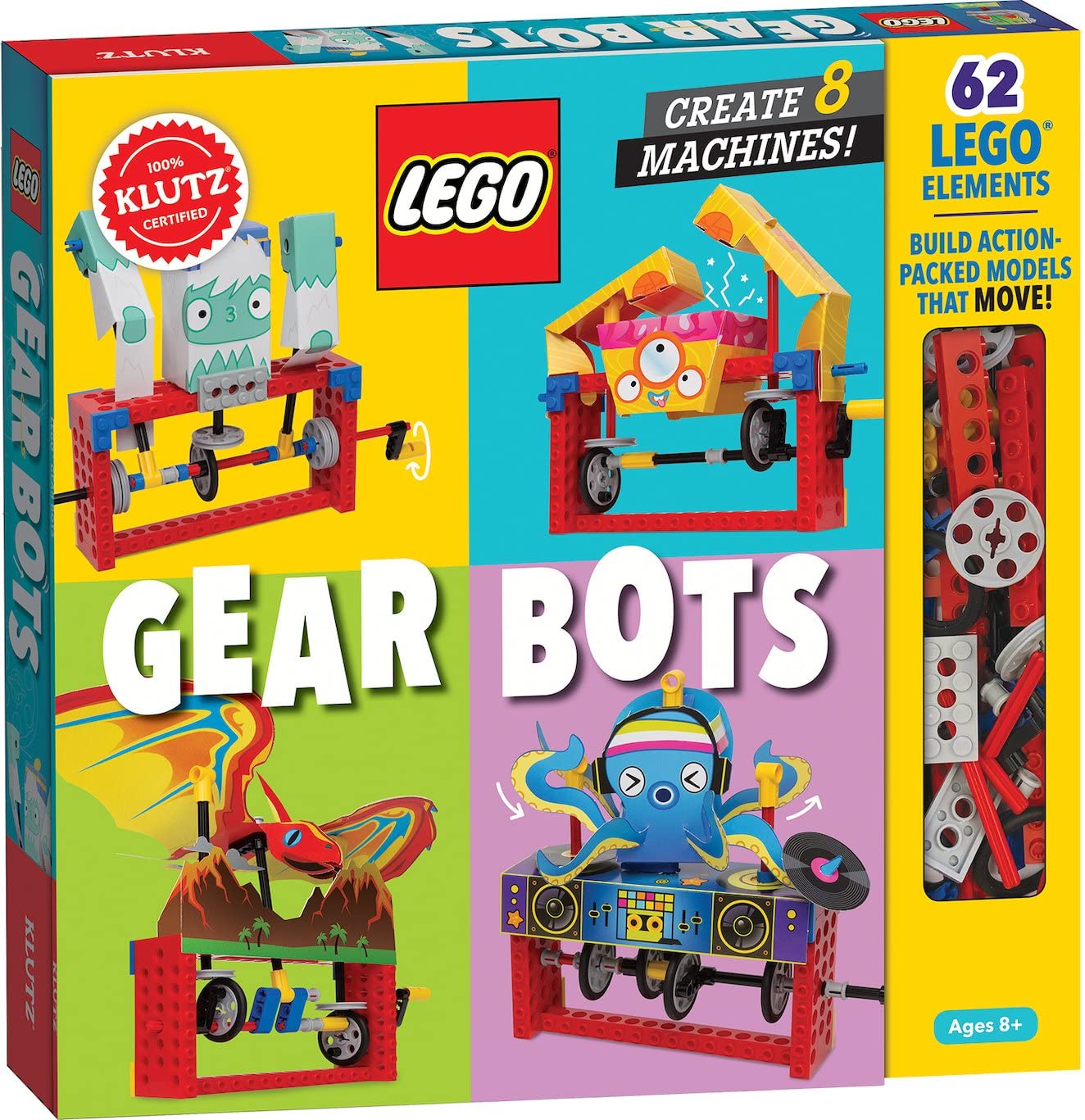
Klutz LEGO Gear Bots
Key Features
- Educational Value: Gears, cams, engineering
- Ease of Assembly: Illustrated book, needs patience
- Build Quality: LEGO Technic + papercraft
- Replayability: 8 kinetic creatures to build
- Age Fit: 8‑12, adult help recommended
- Price: Mid-Range
The concept is brilliant, blending LEGO Technic with papercraft to create kinetic models that teach real mechanics. Assembly can be finicky: some paper-to-LEGO connections may separate during play, and picture-heavy instructions can confuse younger builders. This kit rewards tinkerers and parent-child projects, but it’s not a quick-win gift.
Pros
- Unique fusion of LEGO Technic and papercraft creates moving models that nothing else in this category offers.
- Hands-on introduction to axles, cams, and cranks that makes engineering principles tangible.
Cons
- Paper-to-LEGO connections can loosen during play, requiring occasional regluing or reinforcement.
A creative engineering kit that shines when a parent and child build together — just be ready to help with delicate steps and occasional regluing.
Best for On-The-Go Players
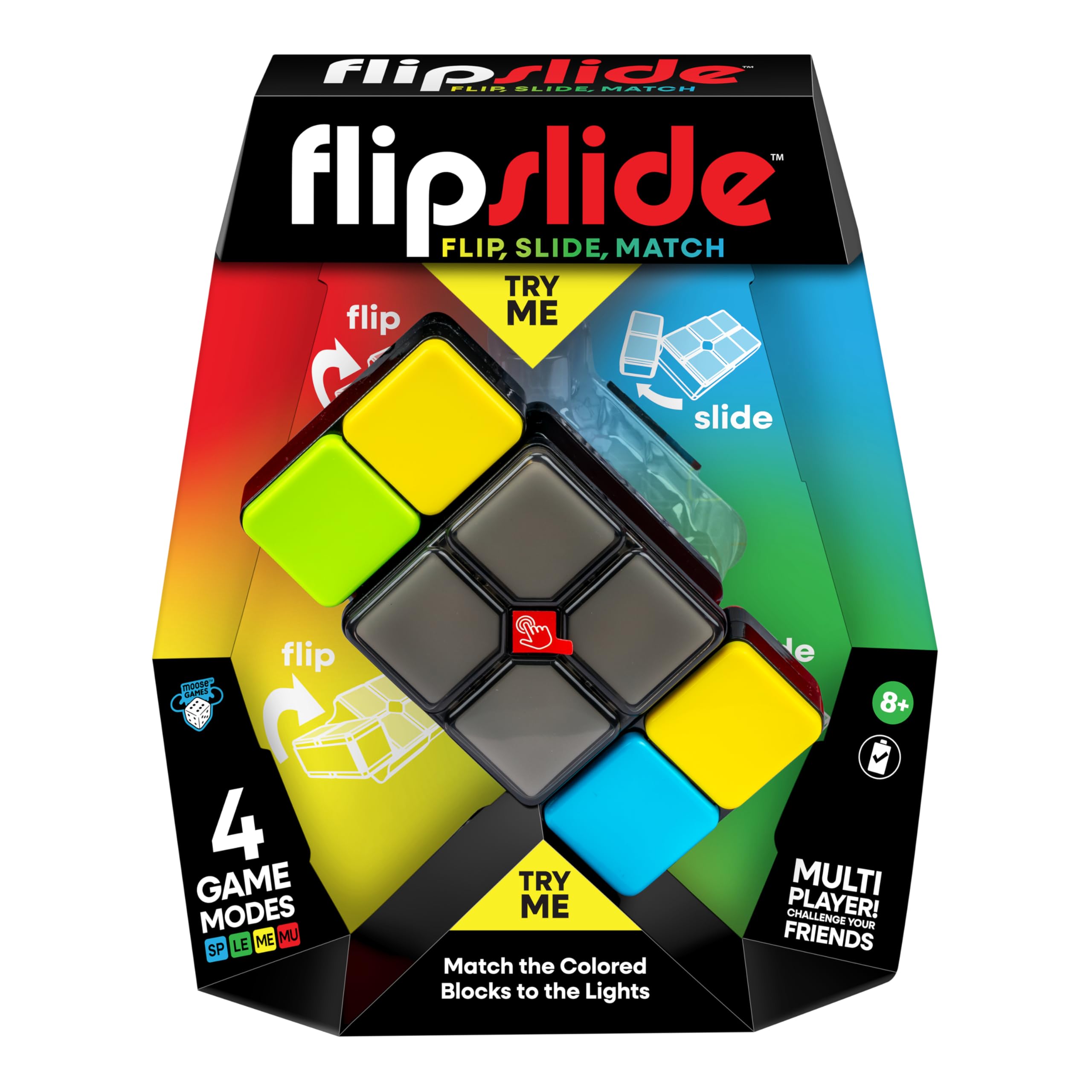
Moose Flipslide
Key Features
- Educational Value: Hand-eye coordination, reflexes
- Ease of Assembly: No assembly, ready out of box
- Build Quality: Plastic handheld, batteries included
- Replayability: 4 game modes, multiplayer
- Age Fit: 8+, fidgety, ADHD friendly
- Price: Budget
Flipslide’s speed, memory, multiplayer, and level modes deliver addictive reaction challenges suited for travel and fidgety hands. The volume control does not offer a silent mode — the lowest setting can be heard in quiet rooms. That limits its use in libraries or while a sibling naps, but in a car or bustling terminal it keeps kids occupied. Short-burst gameplay means less deep engagement than a buildable STEM kit, yet for a pocket-sized road-trip toy, it hits the mark.
Pros
- Addictive, fast-paced play that sharpens hand-eye coordination and reaction time.
- Compact and travels well; the tactile, fidget-friendly format suits kids with restless hands or ADHD.
Cons
- No silent setting; the lowest volume can be heard in quiet rooms, and occasional units lose sound.
A fit for families who need a compact travel game for noisy environments like cars and airports, but not for quiet home use or long-term building play.
Best for Gross-Out Fans
Nat Geo Gross Science

Key Features
- Educational Value: Biology, chemistry (gross theme)
- Ease of Assembly: Instructions, some messy steps
- Build Quality: Typical kit materials
- Replayability: 15 core + 30 bonus experiments
- Age Fit: 8+, adult for some parts
- Price: Mid-Range
Packed with oozy, gooey projects like fake vomit and brain dissections, this kit turns squeamish curiosity into messy STEM engagement. The gross-out hook is laser-focused on kids who revel in ick, but it cedes ground to the Magic Chemistry kit for those who prefer a less slimy experience. A box may arrive missing a vial or scooper, so a quick inventory check before gifting turns a potential letdown into a non-issue.
Pros
- Gross, hands-on projects (slime, boogers, dissections) keep kids actively experimenting, not just watching.
- Real science facts woven into each disgusting experiment make the mess genuinely educational.
Cons
- A kit can arrive missing vials or scoopers, blocking a few experiments until replacements arrive.
If the 10-year-old you’re shopping for lives for slime and fake boogers, this kit lands squarely in his humor—just do a quick parts check before wrapping it.
Best for Aspiring Magicians
Nat Geo Magic Kit

Key Features
- Educational Value: Performance, slight-of-hand skills
- Ease of Assembly: Video tutorials, easy learning
- Build Quality: Plastic props, wand, cards
- Replayability: 45 tricks, show-ready
- Age Fit: 8+, confidence-building
- Price: Mid-Range
The 45 tricks and professional video training make this a complete stage kit for a kid eager to perform. It leans entirely on showmanship, so families wanting a STEM angle will find more substance in the Magic Chemistry set. The printed instruction booklet can be murky compared to the videos, though the videos carry the learning.
Pros
- 45 tricks provide enough variety to put on a full magic show for friends and family.
- Step-by-step video tutorials from a professional magician reduce the learning curve and build confidence quickly.
Cons
- The printed booklet’s clarity is inconsistent, which means the video becomes almost required for some tricks.
For the performer who thrives on applause rather than science, this kit offers a stage-ready intro to magic that outshines unstructured toy sets.
Best for Future Coders
ELEGOO Robot Car Kit

Key Features
- Educational Value: Arduino coding, robotics
- Ease of Assembly: Complex, requires adult tech
- Build Quality: Electronic parts, sturdy wired
- Replayability: Obstacle avoidance, programmable
- Age Fit: 12+, adult guidance necessary
- Price: Premium
This kit delivers genuine Arduino programming and real robotics with obstacle avoidance and Bluetooth control, rewarding patient assembly with clearly labeled bags. However, it requires a tech-savvy adult to handle setup and coding — making it a parent-child project, not a solo gift for most 10-year-olds.
Pros
- Provides a genuine introduction to Arduino robotics and programming, building real skills.
- Well-organized kit with labeled bags makes assembly clear and rewarding for tinkerers.
Cons
- For a 10-year-old working independently, setup and programming may be too complex without a tech-savvy adult to troubleshoot.
Fits families where a parent or coach can actively guide a motivated tinkerer through real Arduino coding.
Best for Nighttime Fun
TOSY LED Flying Disc

Key Features
- Ease of Assembly: No assembly, ready to throw
- Build Quality: 175g disc, USB-C rechargeable
- Replayability: Night flying, LED light modes
- Age Fit: 8+, gentle play recommended
- Price: Mid-Range
The 108 RGB LEDs create a mesmerizing light show that turns an after-dark game of catch into a spectacle. Families will appreciate the screen-free activity, but battery life may not last a full evening and a hard landing on pavement can crack the disc. Durability and electronic longevity concerns keep it from being a sure-fire pick, yet for gentle backyard toss or camping trips, the light-up experience is a hit.
Pros
- Dazzling 108-LED show makes night games easy to see and adds magic to every throw.
- Gets the whole family outside after dark for active, screen-free fun.
Cons
- LEDs can stop illuminating even though the disc still flies, cutting the light show short.
If the 10-year-old tends to throw frisbees gently on grass and loves anything that lights up, the TOSY disc can be the highlight of a camping trip or backyard evening — just keep expectations for longevity in check.
How to Choose
A gift that aligns with how a 10-year-old actually plays—building, competing, or showing off—is far more likely to survive the holiday season than a generic toy that looks impressive but bores quickly.
Prioritizing STEM Without Sacrificing Fun
Many kits pack in educational buzzwords but rely on dry instruction manuals that lose kids within 20 minutes. The real measure is whether the learning feels invisible—a byproduct of building a working hand, making a light turn on, or staging a magic trick.
Look for projects that let him surprise himself and an audience. A circuit that makes a flying saucer sound or a chemistry trick that wows the family table will be revisited, while a kit that feels like homework ends up in the closet.
Assembly Complexity and Instruction Quality
Picture-only instructions can fail if a single step is ambiguous; a well-designed kit uses clear, step-by-step visuals that a 10-year-old can follow without an adult translating. When instructions falter, the line between a satisfying build and a meltdown gets very thin.
For gifts that involve folding, snapping, or coding, check whether the manufacturer also offers video support or downloadable troubleshooting. Hands-on help from dad or mom can become a bonding activity, but the gift should be able to stand on its own for at least the first few projects.
Build Quality and Long-Term Durability
Lightweight plastic towers may wobble. Wooden tabs can snap if forced the wrong way. These aren’t fatal flaws, but they change who the gift suits: a gentle, methodical builder versus a rough-and-tumble kid who will put an RC car through repeated crashes.
Durability often correlates with material choices. Snap-together electronics with thick insulation outlast papercraft hybrids, while a hardcover book might physically survive years but only if the content hooks the reader early. Match the build to the boy’s play style, not the price tag.
Replayability: Will He Play With It Again?
One-time science experiments have a high ‘wow’ factor but may sit unused after a single event. In contrast, a building set with 100+ variations or a puzzle game with escalating difficulty levels remains relevant as his skills grow. The best replayable gifts give him a reason to return tomorrow—either to perfect a trick, beat a harder challenge, or customize a machine.
Age Fit: Can He Do It Alone?
Some boxes say ‘8+’ but require an adult to parse the setup or handle sharp parts. The smarter move is to gauge whether the task sits in his independence sweet spot. When a kit demands constant adult intervention, enthusiasm fades fast—unless the adult is genuinely interested in co-building, in which case it transforms into a shared project that teaches patience and problem-solving side by side.
FAQ
Does the Snap Circuits Jr. kit need a lot of batteries or special tools?
It requires 4 AA batteries (not included), and no tools at all—the pieces snap together by hand. Keep a fresh set of rechargeables nearby, and he’ll be building within minutes of opening the box.
Why is my Gravity Maze marble run falling apart or the towers not staying in place?
The towers are lightweight and need a completely flat surface to stay stable; pressing them fully into the grid helps. If the hardest challenge cards lead to frustration, step back to an easier level—many 10-year-olds work up to expert mode gradually.
Are magic trick kits too hard for a 10-year-old to learn alone?
The National Geographic Magic Kit includes video tutorials from a professional magician that walk him through each trick step by step, so most 10-year-olds can master the basics alone. Expect some fumbling on the first attempts, but the learning curve is fast enough to keep motivation high.
How long does the TOSY flying disc battery really last during a family camping trip?
Real-world use typically delivers 30–45 minutes of light-up time per charge, not the full 90 minutes in ideal conditions. For a camping trip, bring a USB-C power bank to recharge it between games, and avoid aggressive throws onto hard surfaces to protect the LEDs.
Which of these gifts are best for keeping a 10-year-old entertained on a road trip?
Moose Flipslide is pocket-sized and runs on AA batteries, making it the top travel pick. The Nat Geo Why? book and Trapped in a Video Game box set work well for car reading, and the Klutz Paper Airplanes book plus a few sheets can turn a rest-stop picnic table into a flight contest.