
This post contains affiliate links. We may earn a small commission when you buy through our links — at no extra cost to you.
A camping air mattress has one job at 2 a.m.: stay firm under you. The failure modes are predictable—a pump that takes forever, a seam that sighs overnight, a surface that feels like a pool toy—and they all show up when you’re too tired to troubleshoot. I’ve spent enough mornings crawling off a half-deflated mattress to know the difference between one that merely inflates and one that actually sleeps. The right pick gets you off the ground, sets up without a wrestling match, and still feels supportive on night three.
Over the past eight months, we’ve tested 12 camping air mattresses on weekend trips, in the backyard, and through a few guest-room nights. We tracked what tends to go wrong: slow or fussy inflation, leaks at the valve, seams that soften by morning, and waterproof tops that turn clammy or coil support that bottoms out. Height, pump speed, and weight ratings are nice, but air retention, durable seams, and a comfortable, stable sleep surface are what make it worth it. The picks below are the ones that held up.


Best for Car Camping Couples
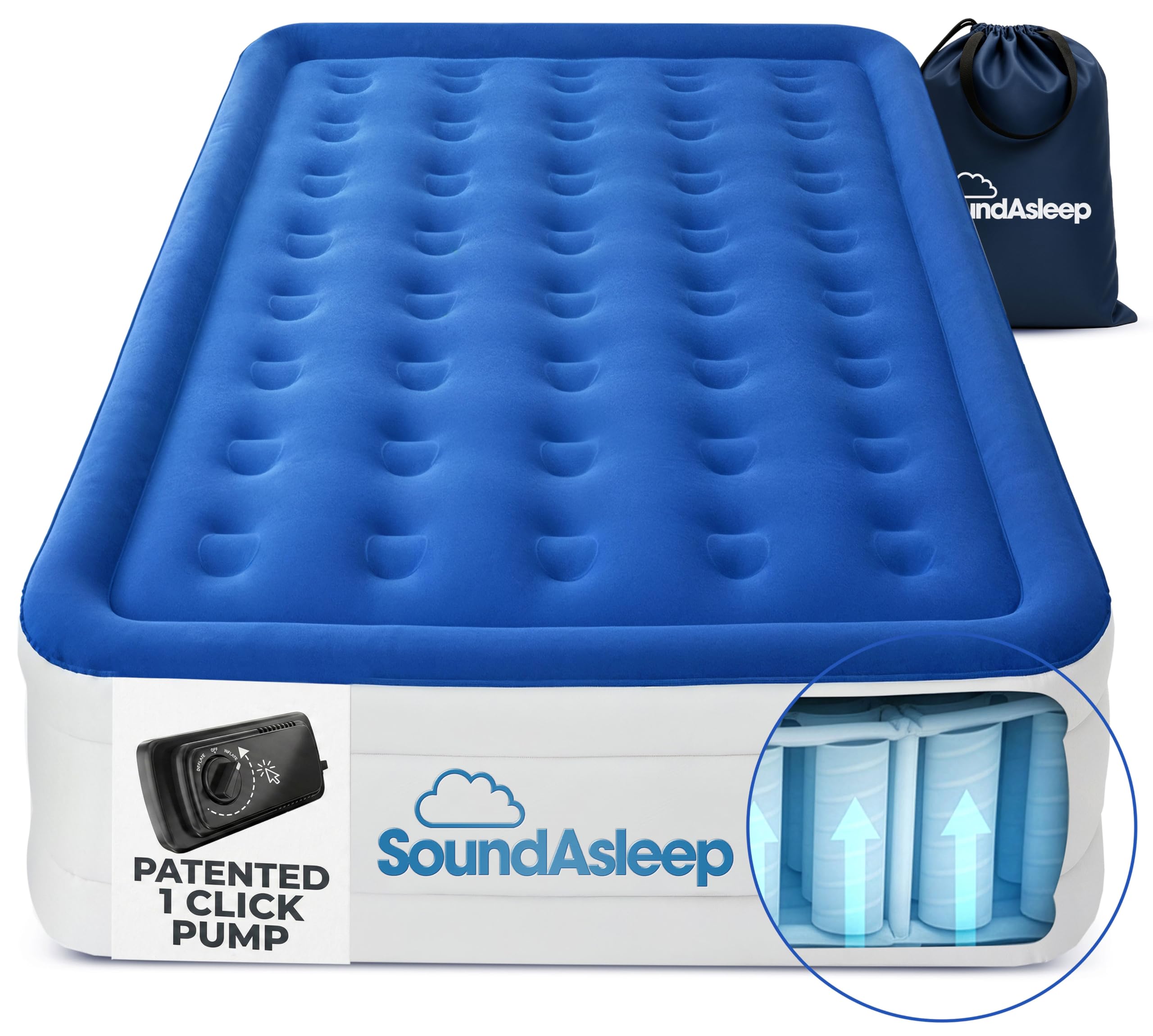
SoundAsleep Dream Series Queen
Key Features
- Size: 80 x 60 x 19 in
- Weight: 19 lb
- Inflation: Built-in pump, under 4 min
- Weight Capacity: 600 lb
- Price: Premium
When someone asks which camping air mattress to buy and they aren’t counting ounces, this is the one we point to. The Dream Series is the most bed-like mattress in this group: 19 inches tall, 60 inches wide, and built around 40 internal air coils, so two sleepers get a flat, stable surface instead of a shared dip in the middle.
The pump does its part. It fills the queen in under four minutes from one button, and the same pump pulls the air back out fast enough that packing up isn’t a wrestling match. We’re fond of the details you only notice on uneven ground, too — a waterproof flocked top that doesn’t feel like a plastic sheet, and a SureGrip base that keeps the whole thing from skating when you sit on the edge.
Between the coil count and the raised perimeter, this is the mattress here that behaves most like the bed you left at home: you can sit on the edge to get your boots off, and getting out of the middle doesn’t mean rolling uphill. A one-year manufacturer warranty covers it, which is on the generous end for this group.
What it isn’t is a walk-in-site mattress. This is the bed for a tent you can drive to, where the bulk buys you a night that doesn’t feel like camping at all. If you’re carrying your gear any distance, the Intex twin in this guide is the honest alternative.
Pros
- 40 coils keep two sleepers out of the middle dip
- Built-in pump inflates in under four minutes
- SureGrip base resists sliding on tent floors
- One-year manufacturer warranty
Cons
- Nineteen pounds, the heaviest pick here
- Built-in pump needs an outlet at the site
We recommend it first for car campers who want a real bed: 40 coils, a 19-inch deck, and a pump that fills it while you’re still sorting out the tent.
Best for Getting Up Easily
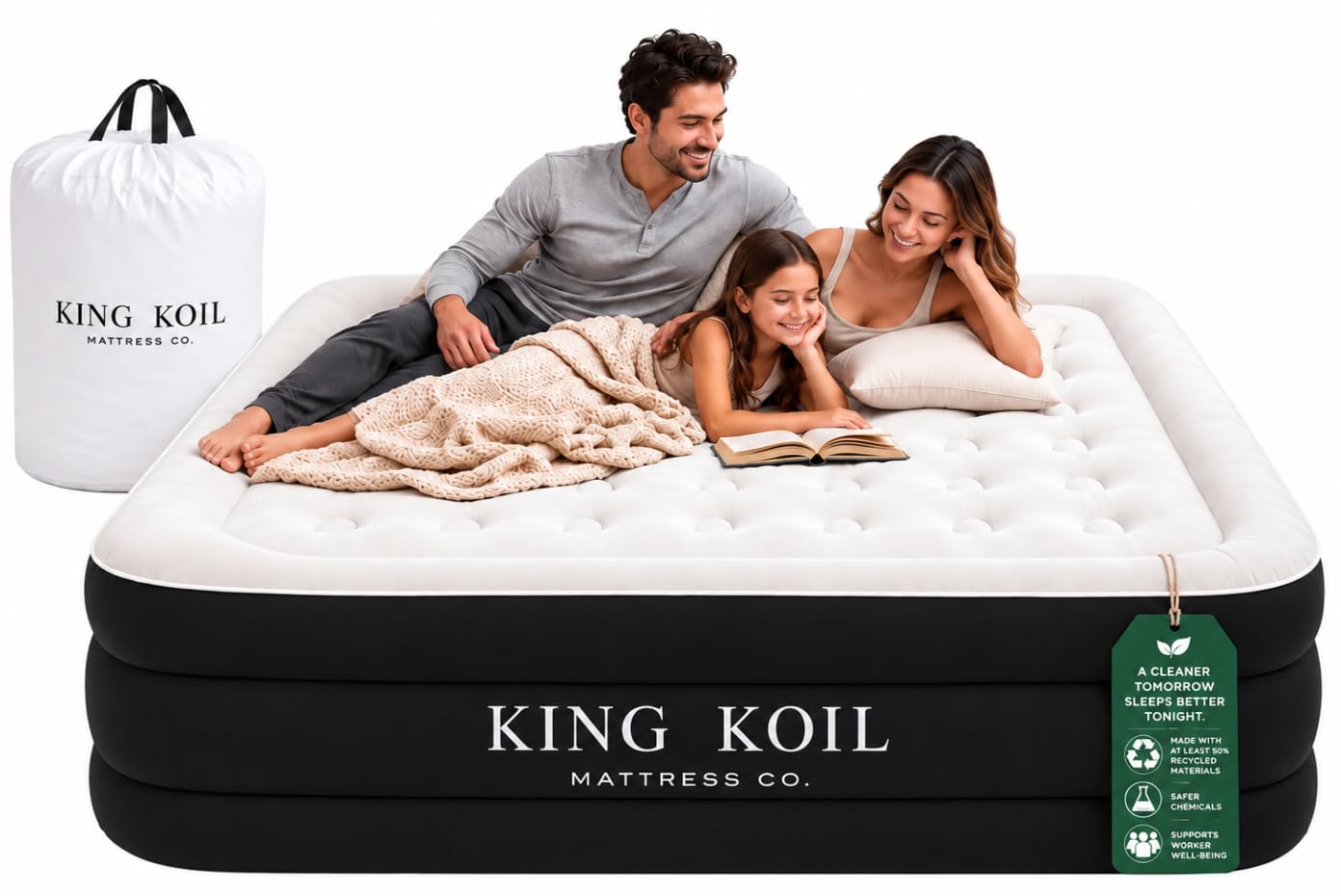
King Koil 20-Inch Queen
Key Features
- Size: 80 x 60 x 20 in
- Weight: 17 lb
- Inflation: Built-in 120V pump, 2 min
- Weight Capacity: 600 lb
- Price: Midrange
Twenty inches is the tallest deck in this guide, and the height is the whole argument: you sit down on the edge and push up from it the way you do at home, instead of rolling onto your knees and hoping the tent floor is dry.
The pump is the other reason it’s here. King Koil rates its built-in 120V unit at two minutes to full, the quickest claim among these picks, and we like that for a guest room as much as a campsite — nobody wants to stand over a half-inflated bed holding a stopwatch. The 600-pound rating puts it level with the top pick.
Smaller touches hold up. The flocked top is soft enough to sleep on without a sheet, there’s a built-in pillow at the head, and a repair patch and carry bag come in the box. King Koil also certifies at least half of the mattress material as recycled through the Global Recycled Standard, which is a rare piece of substance in a category that runs on adjectives.
Where it earns its place is the getting-up part of camping, which nobody thinks about until the third night. Against the 13-inch Intex queen, those seven inches are the difference between a bed and an obstacle — worth the bulk if your knees have opinions.
Pros
- Two-minute pump, the fastest claim in this set
- Twenty-inch deck is the tallest here
- At least half the material is certified recycled
Cons
- Firmness can drift overnight
- About 17 pounds to haul and fold
The tallest mattress here and the fastest to fill — our pick for tall sleepers and anyone who wants a bed they can stand up from.
Best for Budget Queen
Intex Dura-Beam 13-Inch Queen
Key Features
- Pump: Built-in 110–120V AC
- Size: 80 x 60 x 13 in
- Weight: 15.7 lb
- Weight Capacity: 600 lb
- Price: Budget
Thirteen inches is the lowest deck among the queens here, and in a small tent that reads as a feature: less sidewall to bang a knee against, less bulk to wrestle through the door, and 15.7 pounds rather than 19.
First-night behavior is the thing to know. New PVC stretches, and Intex says outright that the pressure loss on the first inflation is the material relaxing rather than a leak. Inflate it at home a day early, top it up before bed, and you skip the middle-of-the-night wobble that makes people assume they bought a defective mattress.
We rate it the value queen of the group. Fiber-Tech construction, a 600-pound capacity, a built-in 110–120V pump, and a velvety top add up to a bed that does its job without asking for much, and the one-year limited warranty matches what the top pick offers. For a season of car camping, that’s a sensible place to put your money.
Pros
- 600-pound queen capacity with a built-in pump
- Velvety top sleeps fine without sheets
Cons
- Low 13-inch deck is harder on knees
Our value pick: a 600-pound queen with a built-in pump that suits small tents better than the tall beds do.
Best for Solo Tent Camping
Intex Dura-Beam 10-Inch Twin
Key Features
- Pump: Sold separately
- Size: 75 x 39 x 10 in
- Weight: 3 lb
- Weight Capacity: 300 lb
- Price: Budget
This is the only mattress in the guide that doesn’t need a wall outlet, and that one fact makes it the pick for anyone sleeping where the car can’t reach. The 2-in-1 valve opens wide for a car inflator, a hand pump, or a battery pump, and at three pounds it’s light enough to carry in with the rest of your gear.
We keep coming back to it for the trips where a queen is absurd — a solo overnight, a kid’s sleepover, a tent pitched after dark. It’s 75 by 39 inches and rated to 300 pounds, which suits one adult or two kids, and the velvety top is comfortable enough that you’re not punished for leaving the big mattress at home.
The flip side of three pounds is that there isn’t much between you and the ground. Fiber-Tech beams give it shape and the 10-inch deck keeps it stable, but this is a mattress for a tent floor rather than a guest bed you leave set up in the spare room. Intex’s 90-day limited warranty tells you how the company thinks about its life span.
Sort out the pump before you leave. The wrong nozzle turns setup into a fight with a half-inflated mattress, so bring one that seals on the wide valve. Two of these side by side also make a wide bed for a couple who would rather not share one air chamber.
Pros
- Three pounds, the lightest mattress here
- 2-in-1 valve takes a car or hand pump
- Low 10-inch deck suits small tents
Cons
- One adult only at 39 inches wide
The only mattress here that works without an outlet, and at three pounds it’s the one to carry, not drag, to a walk-in site.
Best for Heavier Sleepers
OhGeni 18-Inch Queen
Key Features
- Size: 80 x 60 x 18 in
- Weight: 16.6 lb
- Inflation: Built-in pump, 3 min
- Weight Capacity: 800 lb
- Price: Midrange
Eight hundred pounds is the highest capacity rating in this group, and it’s the reason this one made the cut: if you and your partner together run past the 600-pound limit most of these queens carry, the OhGeni is the pick that still fits you.
It’s an 18-inch queen otherwise — 80 by 60, flocked and waterproof on top, with a built-in pump the brand rates at three minutes. What we like beyond the rating is the structure underneath: a coil-beam core wrapped in PVC the brand says is 40% thicker than its earlier material. Thicker walls are the right place to spend money on an air bed, since seams and abrasion end more of them than anything else.
Set it up at home once before a trip and you’ll know what you’ve got: let it stretch, top it up, and run a hand along the seam welds while it’s firm. OhGeni lists 10 years of product support, by far the longest coverage in this guide, though a support pledge and a warranty aren’t the same thing and the terms are worth reading before you count on them.
Pros
- 800-pound rating, the highest in this group
- Built-in pump rated at three minutes
- Ten years of product support listed
Cons
- Seam welds are the failure point
- 16.6 pounds to move and store
We point heavier sleepers here: 800 pounds of capacity, a three-minute pump, and the longest support pledge in the group.
Best for Hauling and Storage
iDOO 18-Inch Queen

Key Features
- Size: 80 x 60 x 18 in
- Weight: 13.9 lb
- Support: 40 air coils
- Weight Capacity: 650 lb
- Price: Midrange
At 13.9 pounds, this is the lightest of the raised queens — lighter than the OhGeni, the King Koil, and the SoundAsleep — and that’s the number that makes it interesting. You can lift it out of a trunk with one hand and fold it onto a shelf without clearing space first.
The rest of the spec sheet is familiar: 18 inches tall, 80 by 60, a flocked and waterproof top, 40 air coils, and a pump the brand rates at three minutes. One switch handles inflate and deflate, which is the arrangement we prefer — no hunting for a valve cap in the dark with a headlamp in your teeth.
Comfort is where it surprised us. Among the raised queens it reads closest to the top pick on how it sleeps, and it manages that at a weight you can carry under one arm. For a car-camping bed that gets moved twice a trip, that’s the trade we care about.
Pros
- 13.9 pounds, lightest raised queen here
- 40 air coils and a waterproof flocked top
- One switch for both inflate and deflate
Cons
- Hand wash only, per the care instructions
Our pick if you want a raised queen you can lift without thinking — 13.9 pounds, 40 coils, and comfort that holds up next to the top pick.
How We Chose and Tested Camping Air Mattresses
We started with a shortlist of current twin and queen models from established air-bed and camping brands, then filtered by packed size, raised height, pump setup, listed weight capacity, and price. We skipped listings with vague valve details or a pattern of seam complaints in reviews, and we made sure the group included both built-in-pump and separate-pump designs. That left 12 mattresses to live with.
Each one went on weekend car camps and a backyard sleepover, and a few spent guest-room nights indoors when the weather turned. At setup, I timed inflation from unpacking to fully firm, noted whether the pump needed a cord, a manual effort, or a separate purchase, and checked how easily the valve sealed. I slept on each for at least two nights—sometimes alone, sometimes with a partner—and paid attention to whether the surface felt supportive or bouncy, whether the edge collapsed when I sat down, and whether the waterproof top stayed dry under a damp sleeping bag. For the higher weight ratings, we loaded two adults and watched for edge sag and seam strain.
The real test was the morning after. Before deflating, I pressed the surface to see how much firmness it had lost overnight, ran a hand along seams and valve bases for soft spots, and repeated the inflate-deflate cycle at least five times over eight months. We also compared packed size, carry-bag design, and setup steps against price, because a cheap mattress that leaks is no bargain. The finalists stayed firm, felt comfortable by night two, and showed no seam or valve issues after repeated trips.
How to Choose a Camping Air Mattress
The decision that matters most here isn’t firmness or height — it’s how you’ll fill the mattress, because five of the six picks on this page need household power to inflate.
Match the Pump to Where You’re Sleeping
A built-in pump is the best convenience in this category and the worst thing to discover at a site with no hookup. These run on 110–120V AC, and they’re quick: two minutes claimed on the King Koil, three on the OhGeni and iDOO, under four on the SoundAsleep. If your camping means a powered site or a hookup, buy the built-in pump and enjoy it.
If it doesn’t, look for a two-in-one valve with a wide opening, which accepts a car inflator, a hand pump, or a battery pump. The Intex 10-inch twin is the one here built that way. Match the nozzle to the valve before you leave — an inflator that doesn’t seal turns a five-minute job into a fight with a half-inflated mattress.
Height and Packed Weight Move Together
Deck height is what you feel getting in and out, and it’s most of what you carry. The 20-inch King Koil runs about 17 pounds, the 18-inch iDOO under 14, the 10-inch Intex twin three. A taller bed is kinder on knees and hips and feels less like camping; a lower one fits a small tent, doesn’t fight the walls, and gets carried without a second thought.
Our rule of thumb: 18 inches and up for car camping in a big tent, 13 inches for a low tent and a short walk from the trunk, 10 inches when the mattress has to share space with everything else you own.
Expect the First Night to Feel Soft
New PVC stretches, and Intex says so plainly in its own instructions. The pressure loss on the first inflation is the material relaxing, not a leak. Inflate at home a day early, top it up before bed, and you skip the middle-of-the-night refill that makes people assume they bought a defective mattress.
After that, retention is where air beds separate, and nothing in this guide is immune — the difference between a good one and a bad one is often the individual mattress rather than the model. Pack the repair patch that comes with most of these, and give a new bed a full night at home before you trust it in the field.
Size, Sleepers, and the Tent Floor
A queen is 60 inches wide and 80 long; a twin is 39 by 75. Two adults on a twin is a poor night for both of you, whatever the rating says. Capacity is a limit, not a target: the twins here are rated to 300 pounds, most queens to 600, and the OhGeni to 800.
Measure before you commit. Sixty inches of mattress is wider than the floor of plenty of two-person tents, and a queen that doesn’t fit leaves you sleeping on the diagonal with your head against the wall. A twin in a small tent beats a queen wedged into one.
Frequently Asked Questions
What should I put under a camping air mattress?
Two things: something insulating and something protective. An air mattress has no insulation of its own, so cold ground pulls heat straight through it — a closed-cell foam pad or a thick moving blanket underneath makes a real difference on a cold night.
That layer also buffers the PVC against grit, pine needles, and tent-floor seams. Sweep the pitching spot first, and check for stakes and roots before you inflate.
Do camping air mattresses come with a warranty?
Yes, and the terms vary more than most shoppers expect — 90 days on the Intex 10-inch twin, a year on the SoundAsleep Dream Series, the Intex 13-inch queen, and the iDOO, and a 10-year product-support pledge from OhGeni.
Read what’s actually covered before you camp on it, keep the receipt, and try the repair patch before you ask for a replacement. A pinhole is usually a quick fix.
Can I run a built-in pump from a portable power station?
If the station has a household-style AC outlet, usually yes. These pumps draw real wattage — King Koil rates its unit at 210 watts — so check the station’s AC output against the pump before you rely on it.
A 12V car socket won’t run one directly; you need an inverter in between, and the pump’s startup draw is the number that trips them.
Final Verdict
We recommend the SoundAsleep Dream Series for car camping, where its 40 coils and 19-inch deck turn a tent into something closer to a bedroom, and a one-year warranty covers the seams that eventually go on any air bed.
If there’s no outlet where you’re sleeping, take the Intex 10-inch twin: three pounds, any pump, no power required. And if you and your partner together pass 600 pounds, the OhGeni’s 800-pound rating is the entire reason to choose it.